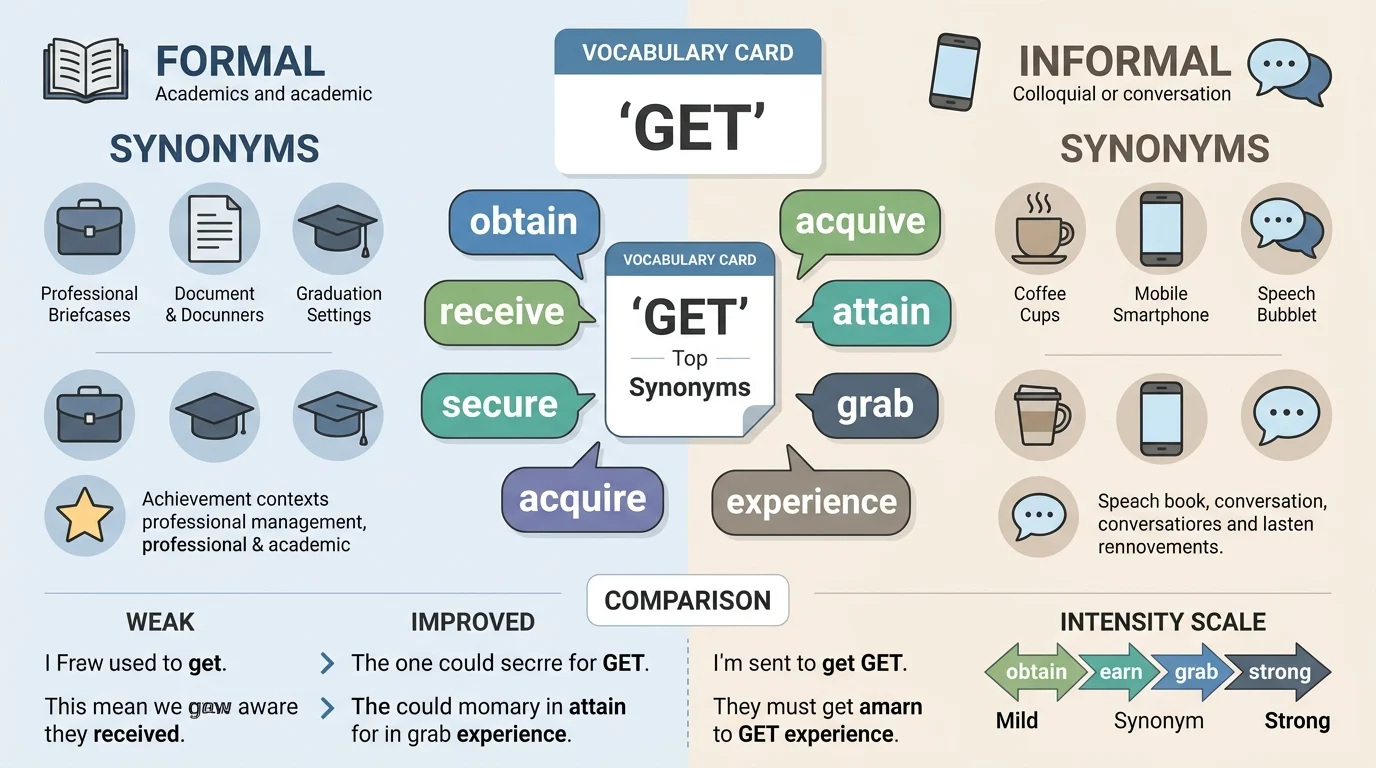
Does “get” feel too basic for your sentence? You are not alone. “Get” is one of the most useful words in English, but it can also be one of the hardest to replace. Its meaning changes with context. You can get an answer, get a job, get tired, get permission, or get someone to help. Using the same word again and again can make your writing feel flat.
That is where the right get synonyms can help. A stronger alternative can make your sentence clearer and more precise. For academic, business, or professional writing, you may also need a get synonym formal enough for the situation. Words such as obtain, receive, acquire, achieve, understand, become, and retrieve can work better, depending on the meaning.
In this guide, you will find 50+ synonyms of get, with simple meanings, examples, and usage tips. You will also learn how to choose the right formal word for get without changing the original meaning of your sentence.
What Does “Get” Mean?
“Get” means to obtain, receive, or acquire something. It can also mean to understand, become, or arrive. The best synonyms depend on your context. Use “obtain” for formal situations, “receive” for passive acquisition, “understand” for comprehension, “become” for transformation, and “grab” for casual settings.
Meaning, Tone and Context
Simple definition: “Get” is one of the most versatile verbs in English. It describes receiving, obtaining, understanding, arriving, or becoming.
Part of speech: Verb (transitive and intransitive)
Tone: Neutral to slightly informal. The tone changes based on the synonym you choose.
Formality level: Generally informal. More formal writing usually replaces “get” with stronger, more specific verbs.
Common use cases:
- Physical acquisition of objects
- Receiving information or items
- Understanding ideas or concepts
- Arriving at a destination
- Becoming a certain state or condition
- Causing something to happen
- Persuading someone to do something
Important word forms: Get (base), gets (third person), got (past), gotten (past participle in American English), getting (present participle). Related noun forms include “acquisition,” “receipt,” and “understanding.”
When and How to Use “Get”
Use “get” in casual conversation, informal writing, and everyday situations. It works perfectly when precision is not required. However, in professional, academic, or formal contexts, you should choose a more specific synonym.
Example 1 (Professional):
“I need to get the quarterly report from the finance department.”
Better: “I need to obtain the quarterly report from the finance department.”
Example 2 (Academic):
“The students need to get a better understanding of the theory.”
Better: “The students need to develop a better understanding of the theory.”
Example 3 (Casual):
“Can you get me a coffee on your way back?”
Best as is: This is perfectly acceptable in casual conversation.
Example 4 (Emotional):
“She finally got the courage to speak up.”
Better: “She finally summoned the courage to speak up.”
Example 5 (Creative):
“He got a strange feeling about the old house.”
Better: “He experienced a strange feeling about the old house.”
Example 6 (Social Media):
“Getting ready for the weekend.”
Best as is: This works well for casual social media posts.
Example 7 (Resume):
“Got new clients for the company.”
Better: “Acquired new clients for the company.”
Another Word for “Get”
The best single replacement for “get” depends entirely on your context. Here are the top recommendations for different situations.
Professional writing: Obtain, secure, acquire, receive
Academic writing: Attain, achieve, procure, derive
Casual conversation: Grab, snag, pick up, land
Emotional writing: Experience, feel, sense, endure
Creative writing: Seize, capture, harvest, claim
Resume or workplace: Secure, achieve, earn, win
Social media captions: Grab, snag, score, land
Stronger meaning: Conquer, seize, capture, commandeer
Softer meaning: Receive, accept, gain, collect
When Not to Use “Get”
“Get” sounds too vague in formal writing. It lacks the precision that professional and academic contexts demand. Your reader may struggle to understand exactly what you mean.
Consider this vague sentence: “I got a promotion.”
This tells us the outcome but nothing about how it happened. Did you earn it? Win it? Receive it unexpectedly? Secure it through negotiation?
A more precise version: “I earned a promotion through consistent performance.”
This specific verb gives your reader a clearer picture of the situation.
Avoid “get” when describing professional achievements on your resume. Hiring managers prefer strong action verbs. “Get” sounds passive and weak compared to “achieve,” “obtain,” or “secure.”
Do not use “get” when you need to sound authoritative or knowledgeable. Academic papers, business reports, and official documents benefit from more sophisticated vocabulary.
Words Commonly Confused With “Get”
Get vs. Receive
“Receive” implies a passive action. You are the recipient of something given by someone else. “Get” can be active or passive. You can get something through your own effort or receive it from others.
Get vs. Obtain
“Obtain” is more formal and implies a deliberate effort to acquire something. “Get” is casual and can describe any form of acquisition.
Get vs. Understand
“Understand” is the clearer choice when discussing comprehension. “Get” in this context is informal and may sound too casual for professional settings.
Get vs. Become
“Become” describes a transformation or change of state. “Get” can also describe becoming something, but “become” is more precise and formal.
Get vs. Fetch
“Fetch” specifically means to go and bring something back. “Get” is broader and includes receiving without moving.
Get vs. Earn
“Earn” implies you worked for something or deserved it through effort. “Get” does not carry this connotation of merit.
Best Synonym by Context for “Get”
| Context | Best Synonym | Why It Works | Example |
|---|---|---|---|
| Formal Writing | Obtain | Sounds professional and deliberate | The committee obtained the necessary approvals. |
| Academic Writing | Attain | Suggests achievement through effort | The study attained significant results. |
| Professional Business | Secure | Implies successful negotiation | We secured the contract with favorable terms. |
| Resume | Achieve | Demonstrates accomplishment | Achieved record sales in the first quarter. |
| Casual Conversation | Grab | Friendly and informal | Let’s grab lunch together. |
| Creative Writing | Seize | Adds drama and urgency | She seized the opportunity without hesitation. |
| Emotional Tone | Experience | Captures feelings or sensations | He experienced a wave of relief. |
| Strong Intensity | Conquer | Implies overcoming difficulty | They conquered every obstacle in their path. |
| Soft Moderate Tone | Receive | Neutral and passive | She received positive feedback from her manager. |
| Social Media Captions | Score | Modern and exciting | Scored tickets to the concert. |
Which Synonym Should You Choose?
Choose your synonym based on three key factors: your audience, your purpose, and your message.
Consider your audience first. Are you writing to a professor, a boss, a friend, or a general social media audience? Each group expects a different level of formality.
Think about your purpose. Are you trying to impress, inform, persuade, or entertain? Stronger verbs create more impact in persuasive writing. Neutral verbs work better in informative content.
Evaluate your emotional intensity. Do you want to sound passionate, neutral, excited, or restrained? Your word choice directly affects how readers perceive your tone.
For professional documents, choose “obtain,” “secure,” or “acquire.” These words sound competent and deliberate.
For casual conversations, “grab,” “pick up,” or “snag” feel natural and friendly.
academic writing, “attain,” “derive,” or “procure” demonstrate precision and sophistication.
For emotional content, “experience,” “sense,” or “feel” capture internal states accurately.
Real Life Examples of “Get” in Sentences
School setting:
The students worked hard to achieve high scores on the final exam.
Workplace context:
After months of negotiation, the team secured the partnership agreement.
Writing practice:
Every writer must develop a unique voice to stand out in the industry.
Conversation:
“I really need to understand this concept before the meeting tomorrow.”
Social media post:
Just snagged the last pair of limited edition sneakers.
Resume achievement:
Earned the Employee of the Month award three times.
Professional email:
Please confirm that you have received the attached documents.
Storytelling scene:
She could sense the tension in the room as she entered.
15 Synonyms for “Get”
| Synonym | Simple Meaning | Best Used For | Example Sentence |
|---|---|---|---|
| Obtain | Acquire through effort | Formal and professional writing | We obtained permission to proceed with the project. |
| Receive | Be given or presented with something | Passive acquisition | She received a standing ovation for her performance. |
| Secure | Obtain with certainty and effort | Business and professional contexts | The team secured funding for their research. |
| Acquire | Come into possession of something | Business, legal, and formal writing | The company acquired a smaller competitor. |
| Attain | Achieve through effort | Academic and personal achievement | He attained his goal of becoming a doctor. |
| Earn | Gain through work or merit | Professional and personal achievement | She earned respect through her dedication. |
| Fetch | Go and bring back | Casual and action oriented commands | Can you fetch my jacket from the car? |
| Grab | Take quickly and informally | Casual conversation and social media | Grab a seat before the presentation begins. |
| Score | Obtain something desirable | Informal and excited contexts | I scored front row tickets to the show. |
| Procure | Obtain with care and effort | Formal and official contexts | The agent procured the necessary documents. |
| Capture | Take possession or control | Creative and dramatic contexts | The artist captured the beauty of the landscape. |
| Seize | Take hold of suddenly and forcibly | Strong and urgent contexts | She seized the chance to study abroad. |
| Experience | Go through an event or feeling | Emotional and personal contexts | He experienced a profound change in perspective. |
| Collect | Gather together | Organized and systematic contexts | Please collect your registration materials. |
| Land | Obtain something desirable | Informal and achievement contexts | She landed her dream job at the agency. |
Synonym Groups and Usage Differences
Professional vs. Personal Synonyms
Professional synonyms like “obtain,” “secure,” and “acquire” sound competent and deliberate. They work well in business emails, reports, and resumes. Personal synonyms like “grab,” “snag,” and “score” feel casual and conversational. They belong in texts, social media, and friendly exchanges.
Formal vs. Conversational Synonyms
Formal synonyms include “procure,” “attain,” and “derive.” These words appear in legal documents, academic papers, and official correspondence. Conversational synonyms include “get,” “grab,” and “pick up.” These words keep everyday communication natural and friendly.
Academic Synonyms
Academic writing prefers precise verbs like “attain,” “derive,” “obtain,” and “establish.” These words demonstrate scholarly rigor and clarity. They appear in research papers, dissertations, and academic journals where precision matters most.
Professional and Business Synonyms
Business contexts value verbs like “secure,” “acquire,” “earn,” and “achieve.” These words convey competence, reliability, and results. They appear in resumes, cover letters, presentations, and performance reviews.
Creative or Literary Synonyms
Creative writing benefits from vivid synonyms like “seize,” “capture,” “harvest,” and “claim.” These words add imagery and emotional depth. They help writers create memorable scenes and characters.
Slang or Modern Synonyms
Modern slang includes “cop,” “snag,” “score,” and “land.” These words work well in casual conversation and social media. They sound current and relatable. Avoid them in professional or academic writing.
Strongest vs. Weaker Synonyms
Here is an intensity scale from mild to strongest:
- Receive (mild, passive)
- Accept (mild, cooperative)
- Obtain (moderate, effort based)
- Acquire (moderate, possession focused)
- Secure (strong, determined)
- Earn (strong, merit based)
- Seize (very strong, urgent)
- Conquer (strongest, overcome difficulty)
Emotional vs. Neutral Synonyms
Emotional synonyms include “experience,” “sense,” “feel,” and “endure.” These words connect to internal states and personal experiences. Neutral synonyms include “obtain,” “receive,” “acquire,” and “secure.” These words focus on facts and actions without emotional coloring.
Antonyms of “Get”
| Antonym | Meaning | Example Sentence |
|---|---|---|
| Lose | Fail to keep or maintain | I hope we do not lose this opportunity. |
| Give | Transfer possession to another | Please give me a moment to think. |
| Surrender | Yield to another’s control | The team refused to surrender their lead. |
| Release | Set free from restraint | The company decided to release the employee. |
| Forfeit | Lose as a penalty | He had to forfeit his claim to the prize. |
| Decline | Refuse to accept | She decided to decline the invitation. |
| Reject | Refuse to consider or accept | The committee rejected the proposal. |
| Abandon | Give up completely | Do not abandon your goals too soon. |
| Misplace | Put in wrong location | I seem to have misplaced my keys. |
| Fail | Not achieve a goal | Despite effort, he failed to secure the deal. |
| Miss | Fail to hit, reach, or catch | We cannot afford to miss this deadline. |
| Overlook | Fail to notice or consider | Do not overlook the small details. |
| Disregard | Pay no attention to | He chose to disregard the warnings. |
| Relinquish | Voluntarily give up | She had to relinquish her position. |
| Deprive | Prevent from having | The new rules may deprive us of resources. |
Comparison: Get vs. Similar Words
Get vs. Obtain
Main difference: “Obtain” is more formal and implies deliberate effort. “Get” is casual and broad. “Obtain” suggests you actively worked to acquire something. “Get” can describe any type of acquisition, including passive receipt.
Which one is stronger: “Obtain” is stronger because it implies purpose and effort.
Which one is more formal: “Obtain” is significantly more formal.
Example with “Get”: I need to get a copy of that report.
Example with “Obtain”: I need to obtain a copy of that report from the archives.
Get vs. Receive
Main difference: “Receive” is passive. Someone gives you something. “Get” can be active or passive. “Receive” does not imply any effort on your part. “Get” can mean you went and got something yourself.
Which one is stronger: “Get” is more active and dynamic.
Which one is more formal: “Receive” is more formal and official sounding.
Example with “Get”: I got your email this morning.
Example with “Receive”: I received your email this morning.
Get vs. Understand
Main difference: “Understand” is the clear and formal choice for comprehension. “Get” in this context is informal and conversational. “Understand” should always be used in professional and academic writing when discussing comprehension.
Which one is stronger: “Understand” is more precise and authoritative.
Which one is more formal: “Understand” is much more formal.
Example with “Get”: Do you get what I mean?
Example with “Understand”: Do you understand the instructions?
Get vs. Become
Main difference: “Become” is more formal and specific when describing transformation. “Get” can also describe becoming something, but it is informal. “Become” suggests a gradual or significant change. “Get” can describe quick or temporary changes.
Which one is stronger: “Become” is more precise and formal.
Which one is more formal: “Become” is more formal.
Example with “Get”: He got tired after the long walk.
Example with “Become”: He became exhausted after the long journey.
Get vs. Earn
Main difference: “Earn” specifically implies you worked for something or deserved it. “Get” has no connotation of merit. “Earn” suggests respect, money, or achievement gained through effort. “Get” could mean you simply asked for something and received it.
Which one is stronger: “Earn” is much stronger and more meaningful.
Which one is more formal: “Earn” is more formal and carries greater weight.
Example with “Get”: She got a promotion last week.
Example with “Earn”: She earned a promotion through her hard work.
Get vs. Secure
Main difference: “Secure” implies a successful effort to obtain something valuable or important. “Get” is neutral and general. “Secure” suggests you overcame obstacles or negotiated successfully. “Get” could describe any simple acquisition.
Which one is stronger: “Secure” is significantly stronger and more determined.
Which one is more formal: “Secure” is much more formal and business appropriate.
Example with “Get”: We got the contract.
Example with “Secure”: We secured the contract after extensive negotiations.
Common Phrases and Expressions with “Get”
1. Get along
Meaning: To have a good relationship with someone.
Example sentence: My coworkers and I get along very well.
2. Get over
Meaning: To recover from something difficult or upsetting.
Example sentence: It took her months to get over the loss.
3. Get through
Meaning: To successfully complete or survive something difficult.
Example sentence: We managed to get through the challenging project.
4. Get by
Meaning: To manage with limited resources or difficulty.
Example sentence: Many families struggle to get by in this economy.
5. Get ahead
Meaning: To achieve success or progress.
Example sentence: Hard work is the best way to get ahead in your career.
6. Get across
Meaning: To communicate an idea successfully.
Example sentence: She managed to get her point across during the meeting.
7. Get back
Meaning: To return or recover something.
Example sentence: I need to get back to work after lunch.
8. Get together
Meaning: To meet or assemble with others.
Example sentence: We should get together for coffee sometime.
Common Mistakes to Avoid
Mistake 1: Using “get” in formal writing
Avoid “get” in academic papers, business reports, and official documents. Choose “obtain,” “secure,” or “acquire” instead. These words maintain the professional tone your writing requires.
Mistake 2: Confusing “get” with “receive”
“Receive” is passive and formal. “Get” is active and casual. Use “receive” when you want to emphasize that something was given to you. Use “get” when you want to emphasize your role in acquiring something.
Mistake 3: Using casual synonyms in formal writing
Words like “grab,” “snag,” and “score” sound unprofessional in workplace communication. Save these for social media and casual conversations. Choose formal alternatives for professional contexts.
Mistake 4: Using overly dramatic synonyms for simple situations
Do not say “I conquered a coffee” when you mean “I got a coffee.” Strong synonyms like “conquer” and “seize” should be reserved for meaningful achievements. Using them for trivial matters sounds ridiculous.
Mistake 5: Repeating the same word too often
Even the best synonyms lose impact when overused. Vary your word choice throughout your writing. Keep a list of synonyms nearby to maintain variety in your vocabulary.
Mistake 6: Choosing a synonym with the wrong emotional tone
Consider the emotional weight of your word choice. “Experience” feels personal and reflective. “Secure” feels determined and professional. “Grab” feels casual and impulsive. Choose the tone that matches your message.
Mistake 7: Using slang in academic or professional writing
Slang synonyms like “cop” or “snag” have no place in formal documents. They undermine your credibility and make you sound unprofessional. Stick to formal alternatives in serious contexts.
FAQs
What is the best synonym for “get”?
The best synonym depends on your context. For formal writing, use “obtain.” professional settings, use “secure.” For casual conversation, use “grab” or “score.”
What is a formal synonym for “get”?
Formal synonyms include “obtain,” “acquire,” “procure,” and “attain.” These words are appropriate for academic papers, business reports, and official correspondence.
What is an informal synonym for “get”?
Informal synonyms include “grab,” “snag,” “score,” and “land.” These words work well in casual conversation, social media, and personal emails.
What is another word for “get” in professional writing?
In professional writing, use “secure,” “obtain,” “acquire,” or “earn.” These verbs demonstrate competence and professionalism.
What is the difference between “get” and “receive”?
“Receive” is passive and formal. Someone gives you something. “Get” can be active or passive. You can get something through effort or be given it.
What is the opposite of “get”?
The opposite of “get” depends on the context. Common antonyms include “lose,” “give,” “surrender,” “forfeit,” and “decline.” Choose the antonym that fits your specific meaning.
Conclusion
“Get” is a useful and versatile verb, but it lacks the precision that good writing demands. The best synonyms transform vague language into clear, powerful communication. Choose “obtain” for formal contexts, “secure” for professional achievement, “grab” for casual situations, and “experience” for emotional depth.
Remember that tone and context matter more than vocabulary size. A simple, appropriate word often works better than a complex but incorrect one. Build your synonym knowledge gradually. Practice replacing “get” with more precise alternatives in your daily writing.
Your communication will become clearer, more professional, and more engaging. Readers will notice the difference. Your writing will stand out for its clarity and sophistication.