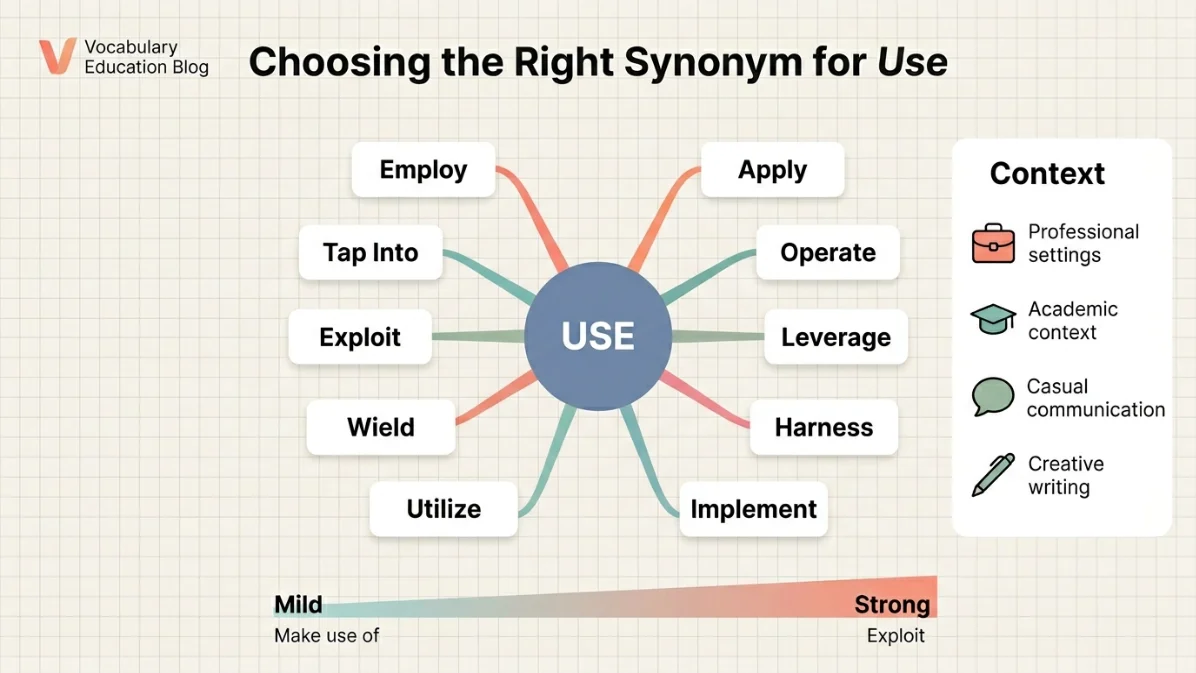
You are writing an email, updating your resume, or drafting an essay, and the word “use” keeps appearing in every other sentence. It’s a practical, essential word, but overusing it can make your writing sound repetitive and flat.
Finding the right synonym for use can instantly sharpen your message, whether you need a formal term for a report or a casual word for a caption. This guide breaks down the best alternatives by tone, context, and intensity, helping you communicate with precision and confidence.
What Does “Use” Mean?
“Use” is a verb meaning to employ something for a purpose or to take advantage of a resource. The best synonym for use depends entirely on context. Formal options include “utilize” or “employ,” casual alternatives are “work with” or “tap into,” and creative choices include “harness” or “leverage.”
Meaning, Tone and Context
The word “use” is fundamentally about application and function. Understanding its core definition helps you identify exactly when a replacement adds value.
- Simple definition: To put something into action or service to achieve a result.
- Part of speech: Verb (primary), also a noun.
- Tone: Neutral and factual.
- Formality level: Standard, suitable for almost all situations, though sometimes too plain for academic or professional documents.
- Common use cases: Instructions, everyday conversation, problem solving, describing tool functions, and explaining methods.
- Important word forms: The noun form is “use” (the act of using) or “usage” (a customary practice or the way language is used). The adjective is “useful” or “usable.” A related opposite is “misuse.”
When and How to Use “Use”
“Use” is the default choice when you need a clear, direct verb without any stylistic flair. It’s perfect for basic descriptions, instructions, and situations where simplicity is more important than sophistication. It works best when the action itself is the focus, not the nuance of how something is applied.
Here are realistic examples showing where “use” fits naturally:
- Professional: We use project management software to track deadlines.
- Instructional: Use a damp cloth to clean the screen gently.
- Casual: I use that coffee shop as my unofficial office on Fridays.
- Academic: The study uses a mixed methods approach to gather data.
- Resume: Use advanced Excel functions to analyze sales data.
- Creative: The photographer uses natural light to create a dreamy effect.
- Email: Please use the attached form to submit your request.
Another Word for “Use”
Finding another word for “use” means picking a verb that matches the relationship between the person and the object. Are you operating a tool, consuming a supply, or taking advantage of an opportunity? Each scenario has a better word.
Here are direct suggestions for specific situations:
- Professional writing: Employ, apply.
- Academic writing: Utilize, adopt.
- Casual conversation: Work with, make use of.
- Emotional writing: Lean on, draw strength from.
- Creative writing: Wield, command.
- Resume or workplace use: Operate, execute, implement.
- Social media captions: Rocking, styling, tapping into.
- Stronger meaning: Exploit, maximize, capitalize on.
- Softer meaning: Avail oneself of, draw upon.
When Not to Use “Use”
“Use” sounds too vague when you need to describe a specific, skillful, or strategic action. It can also feel too informal for advanced academic or technical writing, where a more precise term like “implement” or “administer” is expected. If you want to emphasize expertise or efficiency, “use” simply falls flat.
A weak example: “The team used the new strategy.”
A stronger revision: “The team executed the new strategy.” This shift shows action and completion.
Words Commonly Confused With “Use”
It’s easy to reach for a big word like “utilize” thinking it always sounds smarter. However, misusing these near synonyms can make your writing feel awkward or pretentious.
- Use vs. Utilize: “Utilize” means making practical use of something, often in a new way. “Use” is the general, broader term. Use “utilize” when you convert something for a purpose not originally intended. For example, “We utilized old pallets as wall art.” Don’t write, “I utilized my phone to call you.” Just write, “I used my phone.”
- Use vs. Employ: “Employ” often implies a more deliberate, formal, or organized application. It’s better for methods, skills, and official contexts. You “use” a hammer but “employ” a new marketing technique.
- Use vs. Apply: “Apply” focuses on putting something onto a specific situation or surface. You “apply” your knowledge to a problem. You “apply” a coat of paint.
- Use vs. Leverage: “Leverage” is a business term meaning to use something strategically for maximum advantage. It’s excellent for resumes and business plans but sounds like jargon in casual conversation.
- Use vs. Consume: “Consume” specifically means to use up a resource, like time, fuel, or goods. The project “consumed” all our budget. The app “uses” a lot of battery, but it “consumes” data.
- Use vs. Operate: “Operate” is the correct word for machines, equipment, and vehicles. You “operate” a forklift, not “use” it, on a professional resume.
Best Synonym by Context for “Use”
| Context | Best Synonym | Why It Works | Example |
|---|---|---|---|
| Formal Writing | Utilize | It suggests a practical, effective application. | The lab utilizes advanced robotics for testing. |
| Academic Writing | Adopt | It implies a deliberate choice of a method or theory. | The paper adopts a comparative historical framework. |
| Professional or Business | Leverage | It highlights strategic advantage and resourcefulness. | We will leverage our network to expand into new markets. |
| Resume | Implement | It shows you can put plans into action and get results. | Implemented a new inventory system that reduced waste by 10%. |
| Casual Conversation | Work with | It’s a natural, relaxed alternative. | I’ve been working with this recipe for years. |
| Creative Writing | Harness | It evokes power, energy, and mastery. | She harnessed the storm’s wind to propel the ship. |
| Emotional Tone | Draw on | It suggests reaching into a deep, inner reserve. | He drew on years of experience to stay calm. |
| Strong Intensity | Exploit | It means to fully use for maximum benefit. | We need to exploit this sudden market demand immediately. |
| Soft or Moderate Tone | Make use of | It’s a gentle, unassuming suggestion. | Please feel free to make use of the guest lounge. |
| Social Media Captions | Styling | It frames using a product as a fashion or lifestyle choice. | Styling the new summer collection with vintage finds. |
Which Synonym Should You Choose?
Start by identifying your primary goal. Are you explaining a simple function, or are you emphasizing strategic skill? For everyday instructions, “use” is often the clearest choice. If your sentence involves a specific tool, try “operate.” If you are talking about a resource or abstract asset like time or skills, “apply,” “spend,” or “invest” might be better. For professional storytelling on a resume, always choose action verbs like “implemented,” “executed,” or “administered” to show leadership.
Real Life Examples of “Use” in Sentences
Seeing the right synonym in action is the fastest way to build your vocabulary. These examples replace “use” with more powerful alternatives across different settings.
- School: “Please adopt a consistent citation style throughout your thesis.”
- Workplace: “The team executed the launch plan flawlessly, resulting in record sign ups.”
- Writing: “The author wields humor as a tool to explore serious themes.”
- Conversation: “I just tapped into my emergency fund for a car repair.”
- Social Media: “Rocking a bold red lip for tonight’s event.”
- Resume: “Administered a department budget of $500,000.”
- Email: “Could we possibly leverage your connection to the venue for our event?”
- Storytelling: “She drew upon a hidden well of courage and stepped onto the stage.”
25 Synonyms for “Use”
| Synonym | Simple Meaning | Best Used For | Example Sentence |
|---|---|---|---|
| Employ | To make use of formally | Professional methods, skills | We will employ a new verification process. |
| Utilize | To make practical use of | Technical, resourceful applications | The designer utilized the awkward space for storage. |
| Apply | To put to a specific use | Knowledge, rules, products | Apply a thin layer of glue to both surfaces. |
| Operate | To control a machine | Equipment, vehicles, tools | He is certified to operate heavy machinery. |
| Leverage | To use for strategic gain | Business, negotiation, assets | We leveraged data insights to refine the campaign. |
| Harness | To control and use energy | Natural forces, creativity, power | The wind farm harnesses power from coastal gusts. |
| Implement | To put a plan into action | Systems, strategies, decisions | The school implemented a new reading program. |
| Execute | To carry out a plan | Plans, projects, commands | They executed the merger with impressive speed. |
| Administer | To manage or dispense | Budgets, programs, medicine | She administers all company training programs. |
| Exert | To put forth effortfully | Influence, pressure, force | He exerted tremendous effort to meet the deadline. |
| Wield | To hold and use skillfully | Influence, tools, weapons | She wields enormous influence on the board. |
| Exercise | To use a right or power | Rights, authority, caution | The tenant decided to exercise their right to renew. |
| Exploit | To fully benefit from | Opportunities, resources, demand | We must exploit this window of opportunity. |
| Capitalize on | To gain an advantage from | Trends, moments, strengths | The startup capitalized on the shift to remote work. |
| Draw on | To use a supply of something | Experience, memory, reserves | He draws on his travel stories for his novels. |
| Deploy | To bring into effective action | Resources, staff, technology | The organization deployed medical teams rapidly. |
| Expend | To use up a resource | Money, time, energy | We expended a great deal of energy on the proposal. |
| Consume | To use up completely | Fuel, food, data | The old furnace consumed oil at an alarming rate. |
| Resort to | To use as a final option | Unpleasant actions | We hope not to resort to legal action. |
| Avail oneself of | To make use of an opportunity | Facilities, services | Please avail yourself of the 24 hour concierge service. |
| Tap into | To access and use a source | Funds, energy, market segments | We need to tap into the student demographic. |
| Manage | To use or handle something | Resources, time, people | She manages her time with extraordinary discipline. |
| Manipulate | To handle or control skillfully | Tools, data, situations | The technician manipulated the tiny components with ease. |
| Run | To operate or execute | Software, programs, simulations | Let’s run a quick diagnostic test. |
| Spend | To use up time or money | Time, money, effort | I spent the afternoon organizing the files. |
Synonym Groups and Usage Differences
Professional vs. Personal Synonyms
In a professional setting, synonyms like “employ,” “implement,” and “administer” show structured action. “Leverage” and “deploy” suggest strategic thinking. For personal contexts, the language is softer and more natural. You “use” a hiking app on the weekend, but you “operate” a forklift at work. In a personal blog, you “tap into” your creativity. In a boardroom, you “harness” innovation.
Formal vs. Conversational Synonyms
Formal writing benefits from precision. Words like “utilize,” “apply,” and “exercise” fit perfectly in reports, legal documents, and academic essays. Conversational English relies on phrasal verbs and simpler nouns. Instead of “utilize the opportunity,” a friend might say “make the most of it.” Emails fall in the middle. “Use the discount code” is better than “utilize the promotional identifier.”
Academic Synonyms
Academic writing demands verbs that signal a deliberate, methodological choice. “Adopt a framework,” “apply a theory,” and “employ a qualitative method” are standard. “Exercise caution” is a polished, formal phrase common in research discussions. Avoid business jargon like “leverage” unless your paper is specifically on business or economics.
Professional and Business Synonyms
In business, the right verb demonstrates your contribution. On a resume, never say you “used Excel.” Write that you “analyzed data with Excel” or “built a financial model.” Words like “execute,” “implement,” and “administer” prove you can turn ideas into results. In presentations, “leverage” and “capitalize on” show you understand strategic value.
Creative or Literary Synonyms
Creative writing is where verbs breathe and stretch. “Wield” suggests power and skill, as in “He wielded his pen like a sword.” “Harness” connects human ambition to wild energy. “Draw on” or “tap into” imply accessing deep, sometimes subconscious, reserves. A poet might “drink in” a sunset. These words add texture and emotional depth that “use” simply cannot.
Slang or Modern Synonyms
Phrases like “rocking” a new outfit, “flexing” a skill, or “tapping into” a trend are vibrant for social media and casual conversation. They are completely inappropriate for formal, academic, or most professional communication. Reserve them for captions, texts, and verbal chats where personality is welcome.
Strongest vs. Weaker Synonyms
An intensity scale helps you choose the right power level. From mild to strong: “make use of” is a soft suggestion. “Use” is neutral. “Employ” is deliberate. “Wield” is powerful. “Exploit” is forceful and maximum, often implying a strategic or even ruthless use of all available resources.
Emotional vs. Neutral Synonyms
Most synonyms for “use” are neutral and task focused. However, a few carry emotional weight. “Lean on” a friend implies emotional reliance. “Draw strength from” a memory suggests deep feeling. “Resort to” carries a negative, last ditch desperation. For factual writing, stick to “use,” “apply,” or “operate” to keep the tone objective.
Antonyms of “Use”
| Antonym | Meaning | Example Sentence |
|---|---|---|
| Neglect | Fail to care for or use properly | The owner neglected the historic building for years. |
| Misuse | Use incorrectly or wrongly | The official misused public funds for private travel. |
| Abuse | Use to bad effect or for a bad purpose | He abused his authority to intimidate colleagues. |
| Waste | Use carelessly without gain | Don’t waste water during a drought. |
| Discard | Get rid of as no longer useful | The company discarded outdated safety protocols. |
| Disregard | Pay no attention to; ignore | She disregarded the clear instructions on the form. |
| Ignore | Refuse to take notice of or use | The architect ignored the site’s natural features. |
| Abandon | Give up completely | They abandoned the old manufacturing process. |
| Idle | Keep a machine or resource inactive | The factory idled its production line for a month. |
| Conserve | Save and protect from overuse | We conserve energy by turning off lights automatically. |
| Preserve | Maintain in its original state | The library preserves rare manuscripts with care. |
| Forgo | Go without | I decided to forgo using a template and built it from scratch. |
| Refrain from | Stop oneself from using | Please refrain from using your phone during the meeting. |
| Disuse | The state of not being used | The old well fell into disuse after the storm. |
| Spare | Refrain from using or hurting | They spared no expense in creating the launch event. |
Comparison: Use vs. Similar Words
Use vs. Utilize
“Utilize” suggests a clever or practical conversion of an object for an unintended purpose. “Use” is the general term for employing something for its designed job. Use “utilize” for resourcefulness and “use” for standard function. “I used my credit card” (standard function). “I utilized a paperclip as a reset button” (creative application).
Use vs. Employ
“Employ” is more formal and deliberate than “use.” It often refers to methods, techniques, or skills rather than physical objects. You “employ” a strategy but “use” a pen. “Use” is more versatile for everyday objects.
Use vs. Apply
“Apply” means to put something onto a specific problem or surface. It is more focused and targeted than “use.” You “use” a computer for many tasks, but you “apply” a software patch to fix a specific bug. “Apply” is the better choice for following procedures and using knowledge in a practical way.
Use vs. Leverage
“Leverage” is strategic, implying you are using a small asset to generate a large return. It belongs in finance and business strategy. “We leveraged our brand loyalty to increase prices.” “Use” is better for simple transactions. “I used a coupon for free shipping.”
Use vs. Operate
“Operate” specifically means to control the functioning of a machine, device, or system. It’s the correct and safer term in technical and professional settings. You “operate” a surgical robot. You “use” a spoon. Saying “I operate a spoon” is comically wrong.
Use vs. Exert
“Exert” means to apply a force, influence, or quality with significant effort. It’s the best word when energy is being spent. “She exerted all her influence to change the policy.” “Use” describes a much simpler, less effortful application of something.
Common Phrases and Expressions with “Use”
1. Make use of
Meaning: To utilize something available.
Example sentence: We should make use of the empty office space for the new team.
2. Be of use
Meaning: To be helpful or useful.
Example sentence: I hope this guide can be of use in your writing journey.
3. Have no use for
Meaning: To not need something or to strongly dislike it.
Example sentence: I have no use for a printer anymore since everything is digital.
4. Put to good use
Meaning: To employ something in an effective or productive way.
Example sentence: She put her negotiation skills to good use when buying the car.
5. It’s no use
Meaning: An expression of futility; it’s pointless.
Example sentence: It’s no use trying to change his mind once he’s decided.
6. In use
Meaning: Currently being used or occupied.
Example sentence: All the conference rooms are in use right now.
7. What’s the use?
Meaning: A rhetorical question expressing despair or frustration about a situation’s futility.
Example sentence: What’s the use of complaining if nothing will change?
8. Use it or lose it
Meaning: An idiom meaning if you don’t practice a skill or exercise a faculty, you will forget how to do it.
Example sentence: I do a daily crossword puzzle to keep my mind sharp; it’s a “use it or lose it” situation.
Common Mistakes to Avoid
- Using “utilize” to sound smart in every sentence. “Utilize” should be reserved for creative or non standard applications. Saying “I utilized my fork to eat my salad” sounds pretentious. “Use” is the better, cleaner word for standard functions.
- Confusing “use” with “usage.” “Use” is the general act of employing something. “Usage” often refers to a standard habit or language practice. “The usage of this word has declined” (a trend), not “The use of this word in that sentence is wrong” (a single act).
- Using a casual phrasal verb in a formal report. Writing “We tapped into our savings” in a financial statement is unprofessional. The formal version is “We withdrew funds from our savings” or “We allocated savings.”
- Picking an overly dramatic synonym for a simple situation. Saying “I exploited my coffee maker this morning” sounds like you took unfair advantage of your appliance. “I used my coffee maker” is perfectly fine.
- Repeating “use” three times in one paragraph. This makes writing sound monotonous. Vary your verbs. Instead of “We used the software to use the data and use it for a report,” try “We ran the software, analyzed the data, and generated a report.”
- Choosing a synonym with the wrong emotional tone. “Resort to” implies a last, desperate option with a negative outcome. Don’t write, “I resorted to my favorite recipe for the potluck.” Use “I turned to my favorite recipe,” which has a positive feel.
- Using modern slang in an academic essay. Words like “flexing” or “rocking” are completely out of place in scholarly work. Always match the tone of your verb to the seriousness of the document.
FAQs
1. What is the best synonym for use?
The best synonym depends on context. “Employ” is excellent for formal methods, while “utilize” works for practical applications. For simple instructions, “use” is often the clearest choice.
2. What is a formal synonym for use?
“Utilize,” “employ,” and “apply” are standard formal synonyms. Choose “utilize” for making practical use and “employ” for a deliberate, organized application of a skill or method.
3. What is an informal synonym for use?
“Tap into,” “work with,” and “make use of” are common informal alternatives. “Rocking” or “styling” work well for casual fashion or lifestyle captions on social media.
4. What is another word for use in professional writing?
In professional writing, “leverage,” “implement,” and “execute” are strong choices. “Leverage” is best for strategic advantage, while “implement” and “execute” show action and completion.
5. What is the difference between use and utilize?
“Use” is general employment for a purpose. “Utilize” implies converting something to a practical use, often not its original one. Prefer “use” for standard functions to keep writing clean.
6. What is the opposite of use?
Common antonyms include “neglect,” “misuse,” “waste,” and “discard.” “Conserve” and “preserve” are opposites in the context of preventing the use of a resource to protect it.
Conclusion
“Use” is a cornerstone of English vocabulary, but relying on it exclusively limits your expression. By selecting precise synonyms like “implement” for a resume, “harness” for creative work, or “leverage” for a business plan, you communicate competence and clarity. The key takeaway is simple: always let the situation dictate your verb. Before you type “use,” pause and ask if another word captures the skill, effort, or strategy behind the action. That single swap is a hallmark of a confident, advanced communicator.