
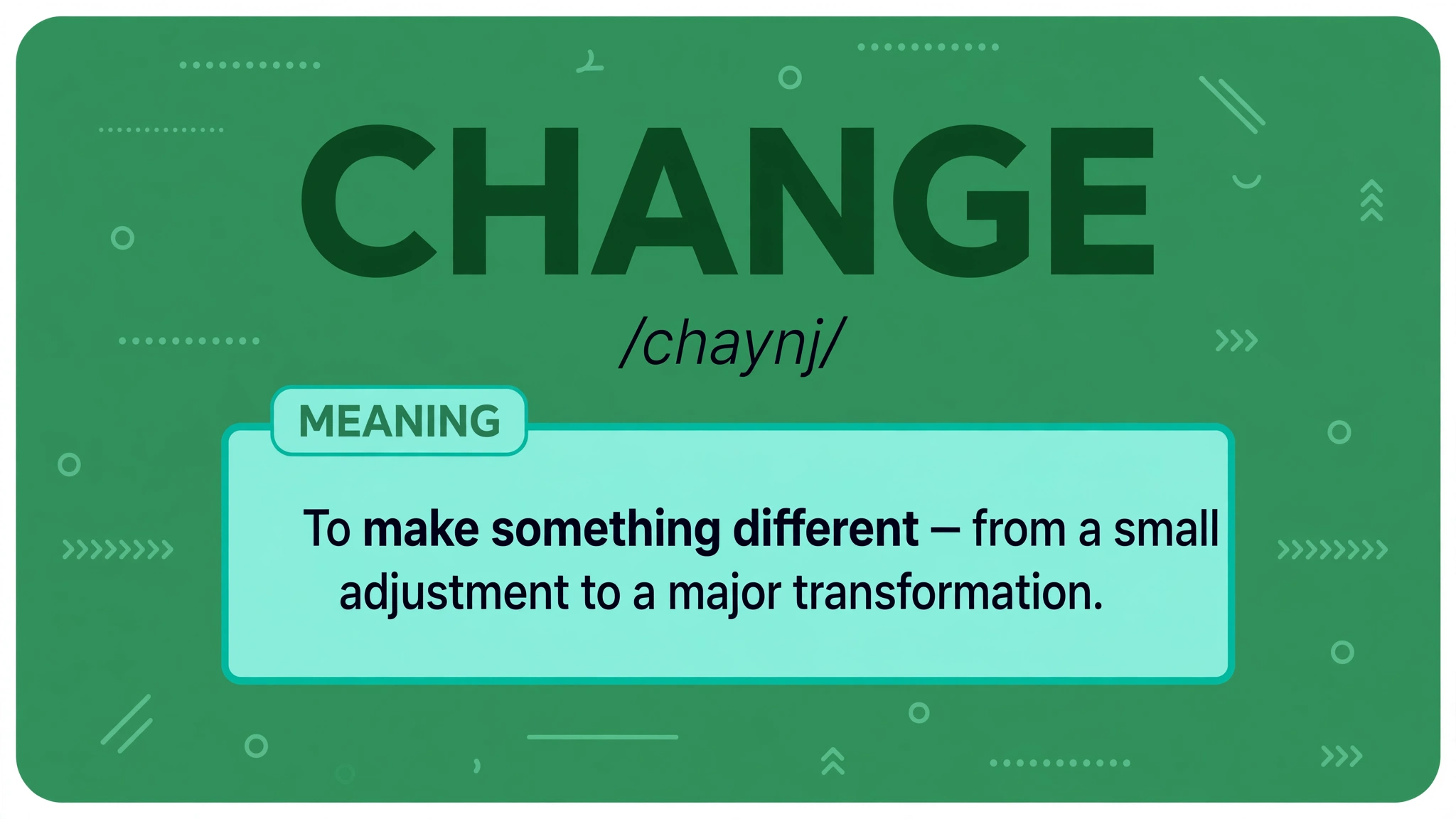
Change means making something different; strong alternatives include alter, modify, transform, revise, and adjust.
While editing an essay, email, design, or report, you may notice that synonyms of change can make your writing more precise.
The word itself can describe a small adjustment, a major transformation, or a shift in circumstances.
Choosing the right alternative depends on what becomes different and how significant the difference is.
A designer might alter a pattern, a student might revise an answer, and a company might transform its business model. Don’t miss our important synonyms
collection. To amplify your message, try boost synonyms.
This guide presents 50 useful alternatives with short meanings and natural examples. You will find vocabulary suitable for schoolwork, professional writing, technology, art, relationships, science, and everyday conversation.
What Are the Best Synonyms of “Change”?
If you need a quick answer, the strongest synonyms of change are alter, transform, modify, and adjust. Alter fits small replacements, transform suits dramatic overhauls, modify covers planned improvements, and adjust handles small corrections. Each word carries a slightly different shade of meaning, so the best pick depends on how big the difference is and what is becoming different. The sections below explain every option so you can choose with confidence.
Meaning, Tone, and Context
Change means to make something different or to become different. It works as both a verb and a noun, so you can change a plan and also describe a change in the weather. The word itself is neutral, which is why it fits almost any setting. Context decides the feeling: a change in strategy sounds hopeful in a boardroom, while a sudden change in behavior can sound worrying in a family conversation.
In business writing, change covers everything from small policy updates to full reorganizations. In personal life, it describes habits, routines, relationships, and big decisions like moving to a new city. In technology, it shows up in updates, upgrades, and redesigned tools. Because it is so broad, change often works best as a starting point. Once you know the exact kind of difference, swap it for a sharper word from this guide.
When and How to Use “Change”
Use change when the exact kind of difference does not matter or when you want to stay neutral. It is the safe default in instructions, announcements, and casual conversation. Pair it with a clear object so readers know what is different: change the password, change the schedule, change your approach. Avoid stacking it with vague nouns like things or stuff, since that combination tells the reader nothing. When precision matters more than comfort, reach for a stronger synonym instead.
Best Synonyms of “Change”
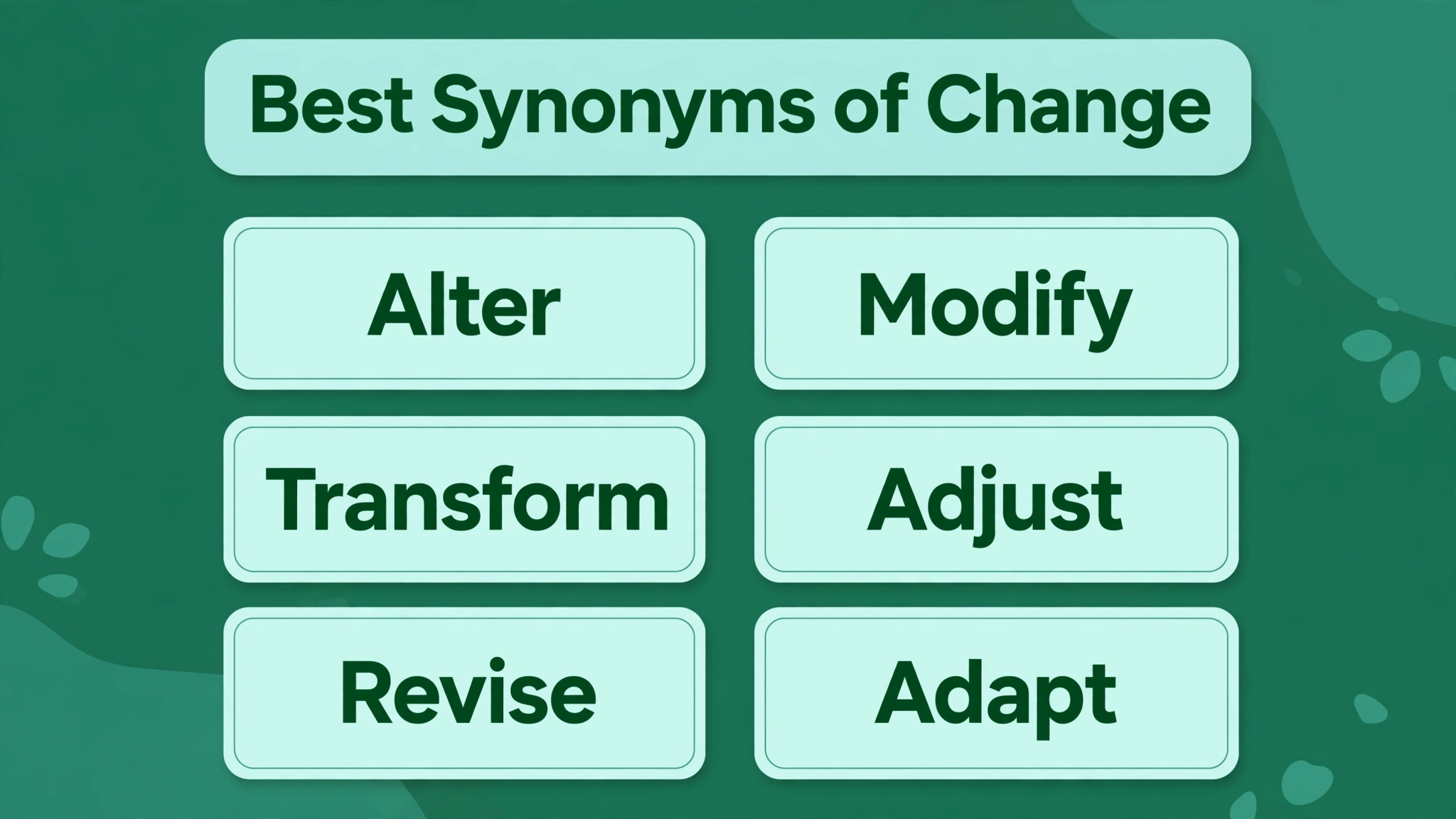
These are the most useful replacements, each with the situation where it shines. Keep them in mind as you read through the full list below.
Transform is the strongest choice for deep, dramatic change. It suggests something becomes almost unrecognizable, like a dull report that transforms into a gripping story, or a routine that transforms your mornings.
Alter fits small or partial changes, often to a single detail. You alter a plan, alter a garment, or alter your route home without touching anything else.
Modify points to a planned adjustment, usually made to improve performance or fit new rules. Engineers modify designs, teachers modify lesson plans, and writers modify drafts.
Adapt means changing to suit new conditions. It is the natural pick for people, businesses, and ideas adjusting to unfamiliar surroundings.
Revise works best for writing and plans that get reconsidered and improved. Students revise essays, teams revise proposals, and authors revise chapters.
Evolve describes slow, natural development over time. Companies evolve, languages evolve, and habits evolve without any single dramatic moment.
When Not to Use “Change”
Change is too vague when readers need exact details. In technical writing, medical instructions, or legal documents, it hides the important part: what exactly becomes different. In creative writing it can flatten a strong scene, since almost any stronger verb would paint a clearer picture. It also struggles with emotions, because people rarely change feelings the way they change a lightbulb.
In these cases, pick the precise verb. Use repair when something was broken, replace when one item takes another’s place, convert when the form shifts completely, and adjust when only a small setting moves. If you cannot explain what is different without adding three more words, change was not the right choice. Specific verbs save readers from guessing and make your writing sound more confident.
Words Commonly Confused With “Change”
Several words orbit around change but mean something narrower. Mixing them up makes sentences sound slightly off, so here is where the lines sit.
Change vs Exchange. Exchange means swapping one thing for another between two sides. She exchanged the shirt for a larger size. Change only means something becomes different, with no swap involved.
Change vs Convert. Convert means turning something into a completely different form or purpose, often in a way that is hard to undo. They converted the garage into an office. Change is the broader word and covers small tweaks too.
Change vs Transform. Transform signals a deep, radical shift where the end result looks nothing like the start. The caterpillar transformed into a butterfly. Change can describe that too, but it can also describe far smaller differences.
Change vs Alter. Alter usually means a small, partial modification. He altered the hem of the jacket. Change covers both small and large differences, so alter is the tighter word when only one detail shifts.
Change vs Switch. Switch means moving from one option to another. He switched from tea to coffee. Change can mean the same thing, but switch stresses the move between two clear choices.
Best Synonyms of “Change” by Context
The right synonym depends on where the sentence lives. This table matches the most common contexts with the word that fits best.
| Context | Best Synonym | Why It Works | Example |
|---|---|---|---|
| Business | Overhaul | Suggests a complete, system wide renewal | The firm announced an overhaul of its hiring process. |
| Personal life | Transform | Fits deep, meaningful personal growth | Travel transformed his outlook on life. |
| Technology | Upgrade | Implies an improvement to a newer version | The update upgrades the camera software on the phone. |
| Formal writing | Revise | Carries a careful, deliberate tone | The author revised the final chapter. |
Notice how each word adds information that change alone cannot carry. Picking by context keeps your writing precise without sounding forced.
How to Choose the Best Synonym of “Change”
Start with three quick questions. First, what exactly is changing: a thing, a plan, a habit, or a person? Second, how big is the difference: a tiny tweak or a total rebuild? Third, why is it happening: to fix a problem, to improve something, or to fit new conditions? Small deliberate tweaks call for adjust or modify, total rebuilds call for transform or overhaul, and adapting to new conditions calls for adapt. For written work, revise and amend are the natural picks. When you are still unsure, test the sentence out loud. The right word will sound natural, while the wrong one will feel slightly forced.
Real Life Examples of “Change”
Morning routines change when the alarm goes off earlier. Workplaces change when a new manager sets different priorities. Homes change when a family moves furniture or repaints a room. These are the small, everyday shifts that fill ordinary days.
Relationships change as people grow, sometimes slowly and sometimes all at once. Technology changes so fast that a phone bought last year already feels old. Even small habits change, like swapping an afternoon snack for fruit. The word fits all of these because every situation involves something becoming different.
50 Synonyms of Change
1. Alter
Short Meaning: To make something different without completely replacing its original form.
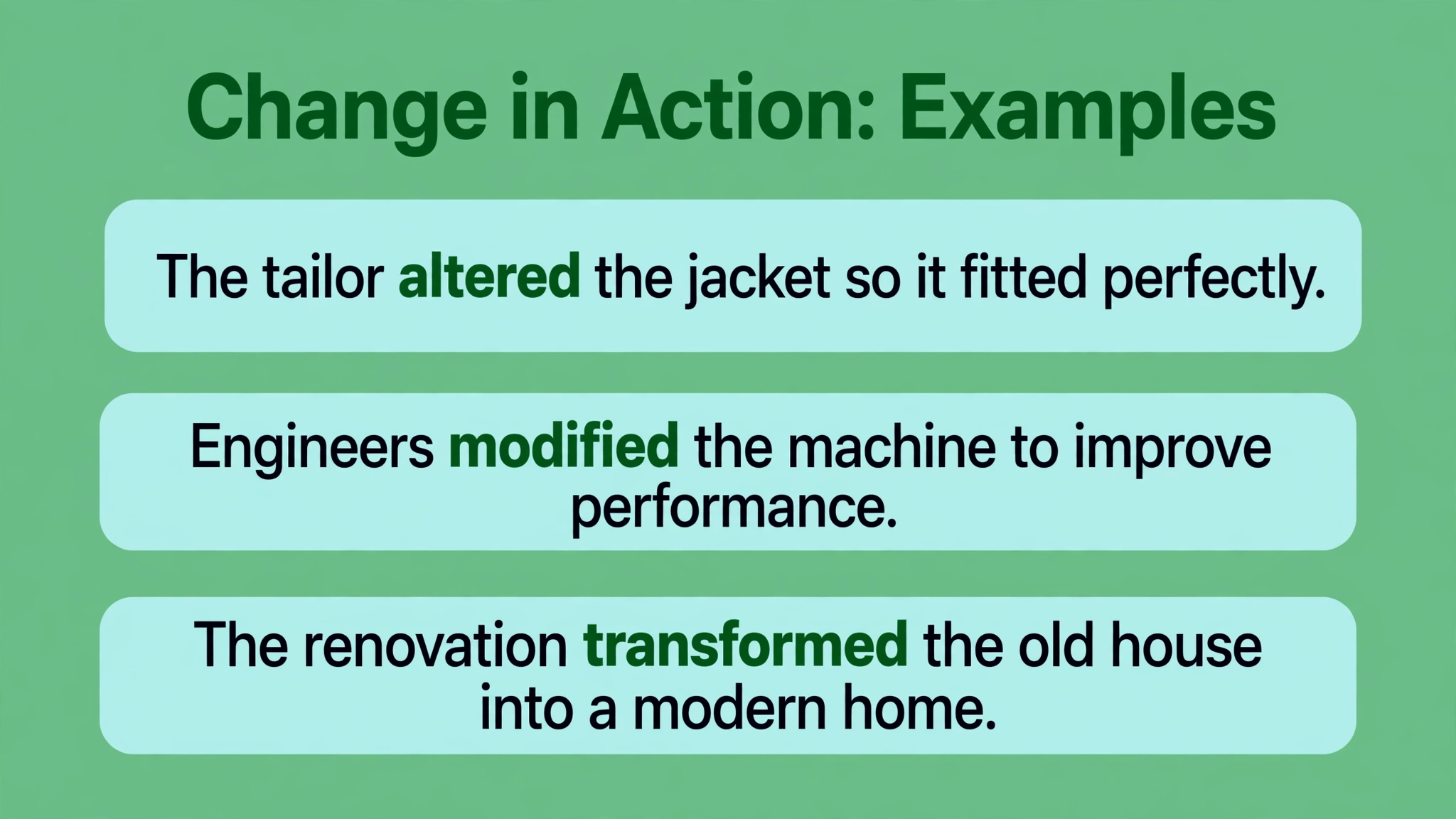
Example 1: The tailor altered the jacket so it fitted the customer perfectly.
Example 2: We altered the schedule after the meeting was postponed.
2. Modify
Short Meaning: To make small adjustments so something works better or suits a new purpose.
Example 1: Engineers modified the machine to improve its performance.
Example 2: She modified her study plan before the final examination.
3. Transform
Short Meaning: To change something greatly, giving it a noticeably different form or character.
Example 1: The renovation transformed the old house into a modern home.
Example 2: Education can transform the way people understand difficult ideas.
4. Adjust
Short Meaning: To make a minor correction so something fits, works, or feels right.
Example 1: Please adjust the chair before you begin working.
Example 2: The photographer adjusted the camera settings for better lighting.
5. Revise
Short Meaning: To improve written, planned, or prepared material by making careful corrections.
Example 1: Maria revised her essay before submitting it to her teacher.
Example 2: The committee revised its proposal after receiving useful feedback.
6. Adapt
Short Meaning: To alter something so it works effectively in different conditions or circumstances.
Example 1: The company adapted its website for mobile users.
Example 2: Good writers adapt their language to different audiences.
7. Convert
Short Meaning: To change something from one form, use, or system into another.
Example 1: The architect converted the warehouse into creative office space.
Example 2: I converted the document into a PDF for easy sharing.
8. Transform
Short Meaning: To produce a major shift in appearance, purpose, structure, or condition.
Example 1: Fresh paint transformed the dull room into an inviting space.
Example 2: New technology transformed how scientists collect information.
9. Renew
Short Meaning: To restore freshness, strength, usefulness, or effectiveness to something.
Example 1: The couple renewed their commitment after many years together.
Example 2: The company renewed its software license for another year.
10. Revamp
Short Meaning: To improve something by giving its design, structure, or operation a fresh form.
Example 1: The restaurant revamped its menu to attract younger customers.
Example 2: Our team revamped the presentation before the conference.
11. Reform
Short Meaning: To improve a system or practice by correcting weaknesses and unfair features.
Example 1: The government introduced reforms to improve public education.
Example 2: The school plans to reform its assessment process.
12. Reorganize
Short Meaning: To arrange people, information, objects, or tasks differently for better results.
Example 1: She reorganized her bookshelf according to subject.
Example 2: The manager reorganized the team to improve communication.
13. Restructure
Short Meaning: To change the basic organization of a business, system, or institution.
Example 1: The company restructured its departments after several years of growth.
Example 2: The committee restructured the project to meet new requirements.
14. Replace
Short Meaning: To remove one thing and put another in its position.
Example 1: We replaced the broken screen with a new one.
Example 2: The designer replaced the old logo with a simpler symbol.
15. Renew
Short Meaning: To continue something by restoring its validity, energy, or usefulness.
Example 1: The library renewed my membership for another year.
Example 2: A short holiday helped renew her enthusiasm for teaching.
16. Shift
Short Meaning: To move something toward a different position, direction, attitude, or condition.
Example 1: Public opinion shifted after the new evidence appeared.
Example 2: He shifted his attention from mathematics to literature.
17. Evolve
Short Meaning: To develop gradually as features, ideas, or conditions become different over time.
Example 1: Her writing style evolved during her years at university.
Example 2: Mobile phones have evolved rapidly over the past decades.
18. Develop
Short Meaning: To grow or progress into a more advanced or different state.
Example 1: The students developed stronger research skills during the course.
Example 2: The small business developed into a successful international brand.
19. Progress
Short Meaning: To move forward toward a more advanced stage or improved condition.
Example 1: The construction project progressed faster than expected.
Example 2: His reading skills progressed significantly during the school year.
20. Vary
Short Meaning: To differ from one situation, example, amount, or form to another.
Example 1: Prices vary according to the quality of the materials.
Example 2: Teachers vary their activities to keep students interested.
21. Switch
Short Meaning: To move from one option, position, method, or choice to another.
Example 1: She switched from coffee to tea during the afternoon.
Example 2: The technician switched the system to manual control.
22. Exchange
Short Meaning: To give one thing and receive another in return.
Example 1: The students exchanged ideas during the group discussion.
Example 2: We exchanged seats so everyone could see the stage.
23. Substitute
Short Meaning: To use one person or thing instead of another suitable option.
Example 1: You can substitute olive oil for butter in this recipe.
Example 2: The coach substituted a younger player during the second half.
24. Migrate
Short Meaning: To move information, systems, people, or groups from one place or environment.
Example 1: The company migrated its files to a secure cloud platform.
Example 2: Many birds migrate to warmer regions during winter.
25. Update
Short Meaning: To make information, software, equipment, or content current and more useful.
Example 1: Please update your contact details before submitting the form.
Example 2: The developer updated the application to fix several problems.
26. Upgrade
Short Meaning: To replace something with a newer or more capable version.
Example 1: The business upgraded its computers for faster performance.
Example 2: I upgraded my camera before starting the photography course.
27. Improve
Short Meaning: To make something better in quality, performance, appearance, or usefulness.
Example 1: Regular practice improved her pronunciation.
Example 2: The architect improved the building’s natural lighting.
28. Refine
Short Meaning: To make something more precise, polished, effective, or elegant through careful adjustments.
Example 1: The writer refined the final paragraph before publication.
Example 2: The jeweller refined the necklace design with smaller details.
29. Revise
Short Meaning: To reconsider and make corrections to an existing piece of writing or work.
Example 1: Students revised their answers after checking the instructions.
Example 2: The author revised several chapters before printing the novel.
30. Remake
Short Meaning: To create something again, usually with significant improvements or a different style.
Example 1: The studio decided to remake the classic film for modern audiences.
Example 2: She remade the dress using softer fabric and new decorations.
31. Recast
Short Meaning: To present an idea, role, story, or structure in a different form.
Example 1: The teacher recast the difficult theory using a simple example.
Example 2: The director recast the role after the original actor left.
32. Reconfigure
Short Meaning: To arrange the parts of a system differently for a new purpose.
Example 1: The technician reconfigured the network after installing new equipment.
Example 2: We reconfigured the classroom to support group activities.
33. Reorient
Short Meaning: To give something a new direction, purpose, focus, or approach.
Example 1: The company reoriented its strategy toward international customers.
Example 2: The course helped students reorient their career goals.
34. Rearrange
Short Meaning: To place existing parts in a different order or position.
Example 1: She rearranged the furniture to create more space.
Example 2: The editor rearranged the chapters to improve the story’s flow.
35. Redesign
Short Meaning: To create a new design that improves appearance, function, or usability.
Example 1: The architect redesigned the entrance for easier access.
Example 2: The team redesigned the website after studying customer feedback.
36. Rework
Short Meaning: To work on something again so its quality, structure, or effectiveness improves.
Example 1: The engineer reworked the circuit to prevent overheating.
Example 2: The student reworked the introduction to make the argument clearer.
37. Alteration
Short Meaning: A modification made to an existing object, plan, structure, or arrangement.
Example 1: The dress required a small alteration around the sleeves.
Example 2: The architect approved an alteration to the original floor plan.
38. Modification
Short Meaning: An adjustment made to improve suitability, performance, appearance, or function.
Example 1: The car received a modification to improve fuel efficiency.
Example 2: One modification made the experiment much easier to control.
39. Transformation
Short Meaning: A significant shift that produces a noticeably different form or condition.
Example 1: The transformation of the garden took several months.
Example 2: Digital technology caused a major transformation in publishing.
40. Adjustment
Short Meaning: A small correction made to achieve better fit, balance, accuracy, or performance.
Example 1: The technician made an adjustment to the machine’s settings.
Example 2: A slight adjustment to the painting improved its balance.
41. Transition
Short Meaning: The process of moving gradually from one state, stage, role, or condition.
Example 1: The transition from school to university can require careful planning.
Example 2: The company managed the transition to remote work smoothly.
42. Variation
Short Meaning: A difference or altered form that occurs within a group, pattern, or process.
Example 1: The artist used variation in color to create visual interest.
Example 2: Scientists observed a natural variation in the samples.
43. Evolution
Short Meaning: A gradual process through which something develops and becomes different over time.
Example 1: The evolution of architecture reflects changing social values.
Example 2: The software’s evolution has made it easier for beginners to use.
44. Conversion
Short Meaning: The process of changing something from one form, system, or purpose into another.
Example 1: The conversion of the factory created useful community space.
Example 2: File conversion allowed the team to open the document.
45. Innovation
Short Meaning: A new idea, method, product, or approach that introduces useful improvement.
Example 1: The company became known for innovation in medical equipment.
Example 2: This innovation made the laboratory process faster and safer.
46. Development
Short Meaning: The gradual growth or advancement of an idea, skill, system, or situation.
Example 1: The development of the new bridge took several years.
Example 2: Her development as a writer became clear in later essays.
47. Mutation
Short Meaning: A biological alteration in genetic material that may create a different trait.
Example 1: Scientists studied a mutation associated with resistance to disease.
Example 2: A genetic mutation can sometimes have no visible effect.
48. Displacement
Short Meaning: The movement of something from its usual position, place, or role.
Example 1: The earthquake caused displacement of several large rocks.
Example 2: Automation may lead to displacement of certain routine jobs.
49. Switcheroo
Short Meaning: An informal term for a surprising exchange or substitution between two things.
Example 1: The magician performed a quick switcheroo with the two cards.
Example 2: The comedy relied on a switcheroo between the characters’ identities.
50. Metamorphosis
Short Meaning: A striking transformation from one form or state into another, especially in biology.
Example 1: A butterfly’s metamorphosis begins when the caterpillar forms a chrysalis.
Example 2: The novel portrays her emotional metamorphosis after a difficult experience.
Synonyms of “Change” by Usage
Formal vs Informal. Formal writing favors words with weight and precision. Modify, revise, amend, and transform belong in reports, academic essays, and official documents because they signal careful thought. She revised the contract before signing. Informal conversation favors shorter, looser words. Switch, tweak, mix up, and change itself sound natural in texts and chats. He switched his order at the last minute. Formal synonyms also pair well with formal nouns like policies, procedures, and legislation: the board approved amendments to the bylaws. Informal synonyms pair with everyday nouns like plans, outfits, and routes: she changed her route to avoid traffic. Mixing registers sounds odd, so keep transform for the annual report and tweak for the group chat.
Written vs Spoken. In writing, you have time to pick the exact word, so readers expect precision. A guide can explain how the committee amended the policy. In speech, speed matters more, and listeners forgive vagueness. People say things like “let me just change this” and figure out the details later. If you are writing dialogue, lean toward the spoken style so characters sound real. Writing also lets you use stronger verbs that would sound stiff out loud. Metamorphosis and overhaul read fine on the page but rarely leave anyone’s mouth. Spoken English leans on simple words and phrasal verbs: switch over, move around, shake up. They shook things up at the office. When writing for the ear, like speeches or scripts, choose the spoken set.
Business vs Personal. Business language frames change as strategy and improvement. Teams talk about overhauls, pivots, upgrades, and restructuring. The company restructured its sales team. Personal language frames change as growth and feeling. People say they turned over a new leaf, moved on, or started fresh. After the move, she reinvented her routine. Business change often involves systems and money, so the vocabulary is cool and procedural: reallocate, streamline, downsize. They streamlined the checkout process. Personal change often involves identity and emotion, so the vocabulary is warmer: reinvent, rediscover, start over. The same event can wear either outfit, so pick the one your reader expects.
Antonyms of “Change”
The opposite of change is staying the same. These words describe keeping, holding, or continuing what already exists, and they are useful whenever you want contrast.
Keep means holding on to what you have. She kept her old phone for years. Preserve means protecting something from damage or loss. The museum preserves ancient manuscripts. Maintain means keeping something in its current state through effort. He maintains a strict sleep schedule. Continue means carrying on without stopping or shifting. They continued the tradition every holiday. Stability is the noun for a steady, unchanging condition. The business finally reached stability after a rough year.
Pair antonyms with change to sharpen a contrast. The plan was to preserve tradition, not change it. That single sentence tells the reader exactly where everyone stands.
Comparison: “Change” vs Similar Words
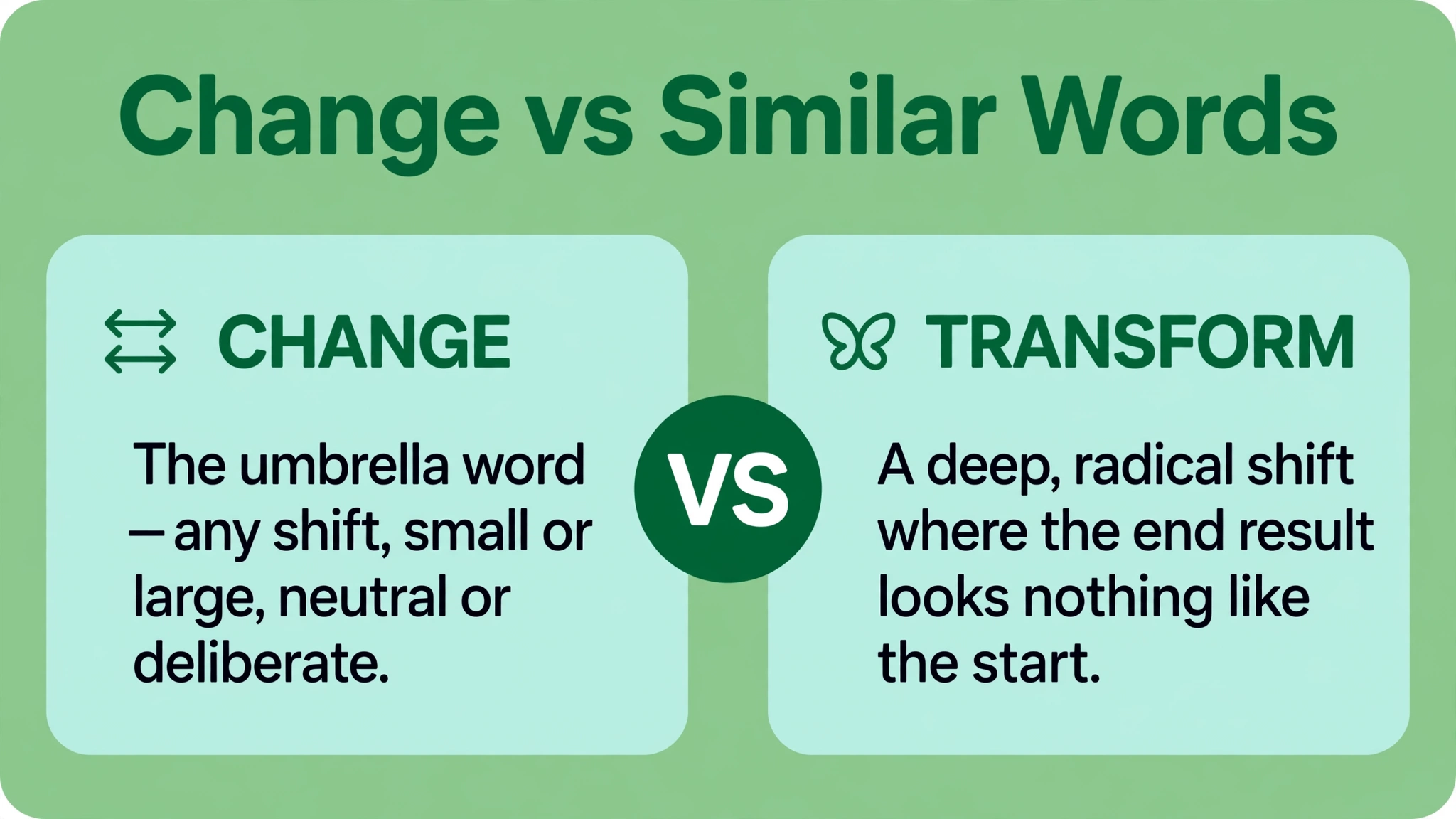
These three words overlap with change more than any others. Knowing exactly where they split helps you pick the right one every time.
Change vs Transform
Main Difference: Transform promises a deep, radical shift, while change can mean anything from a tiny tweak to a total rebuild. Use transform when the end result looks nothing like the beginning, like a dull report that becomes a gripping story. Use change when the scale is small, unclear, or deliberately neutral. “They changed the meeting time” is too small for transform, but “the renovation transformed the kitchen” earns the stronger word. When in doubt, ask whether anything would still be recognizable afterward.
Change vs Alter
Main Difference: Alter narrows the focus to a small or partial modification. Change is the umbrella word that covers everything. Say you altered the recipe and readers picture one or two ingredients swapped. Say you changed the recipe and they might picture anything, including a brand new dish. When only a detail shifts, alter is the precise pick. When the whole picture shifts, change keeps its job. Most everyday edits, like altering a date or an address, are alters rather than full changes.
Change vs Convert
Main Difference: Convert means turning something into a different form or purpose, often permanently. Change simply means something becomes different. “They converted the spare room into an office” tells you the room has a new function. “They changed the spare room” could mean new paint. Convert also shows up in technical and financial contexts: converting files, converting currencies, converting measurements. Reach for convert when the thing becomes something else entirely. A quick test: if you can name what it becomes, convert or transform fits. If you can only name what is different, alter or change is safer.
Common Phrases and Expressions with “Change”
Change appears in several everyday expressions. Each one carries a meaning you cannot guess from the words alone, so they are worth learning as whole units.
| Phrase | Meaning | Example Sentence |
|---|---|---|
| change of heart | A shift in what you feel or believe | After the visit, he had a change of heart and apologized. |
| change of pace | Doing something different from your routine | A weekend hike was a welcome change of pace. |
| change your mind | Deciding differently than before | She changed her mind about the trip after seeing the forecast. |
| sea change | A major, far reaching transformation | Remote work brought a sea change to office culture. |
Common Mistakes to Avoid
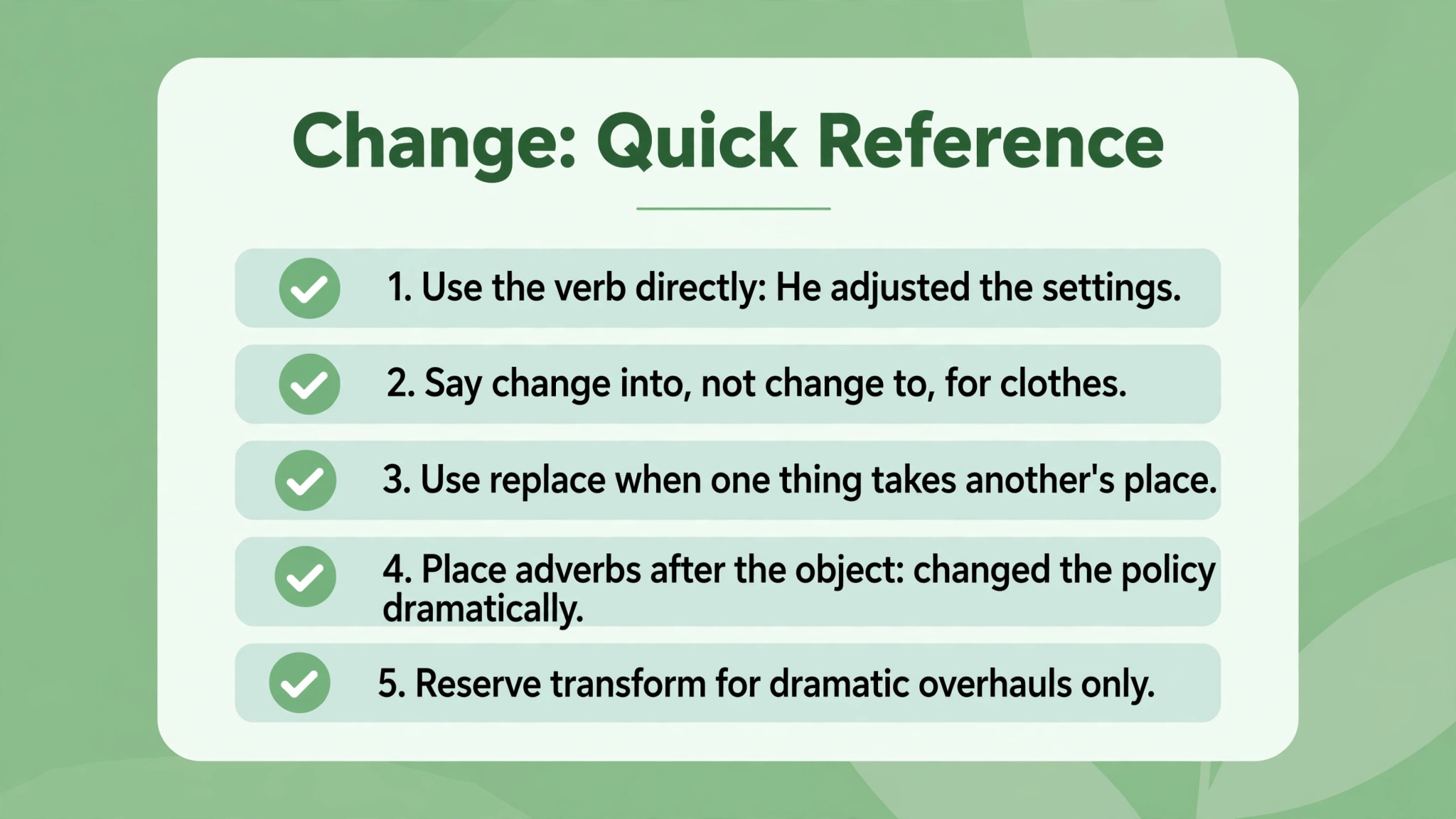
Writers stumble over change in a few predictable ways. Each pair below shows the weak version first, then the fix.
- Incorrect: He made a change to the settings.
Better: He adjusted the settings. The noun phrase “made a change” adds filler; the verb says it directly. - Incorrect: The weather did a change.
Better: The weather changed. Use the verb form instead of building a clumsy phrase around it. - Incorrect: She changed her clothes to another one.
Better: She changed into another outfit. The natural collocation is “change into,” not “change to.” - Incorrect: They want to change the old system with a new one.
Better: They want to replace the old system with a new one. When one thing takes the place of another, replace is the precise verb. - Incorrect: The company changed dramatically the policy.
Better: The company changed the policy dramatically. Adverbs go after the object, not between the verb and the object.
Short Quiz
1: What does the word change generally describe?
A. Making something different
B. Measuring something carefully
C. Removing all information
D. Describing something permanent
2: Which alternative best fits this sentence: “The editor _____ the article before publication”?
A. Migrated
B. Revised
C. Exchanged
D. Displaced
3: Which word suggests gradual development over time?
A. Replace
B. Switch
C. Evolve
D. Substitute
4: Which option is most suitable for a formal discussion about improving a government system?
A. Switcheroo
B. Revamp
C. Reform
D. Remake
5: Which word is most closely associated with genetic alteration?
A. Mutation
B. Rearrange
C. Transition
D. Adjustment
Quiz Answers
- A. Making something different describes the basic meaning of the target word.
- B. Revised is appropriate because editors make corrections and improvements to written material.
- C. Evolve describes gradual development across time.
- C. Reform is appropriate for structured improvements to laws, institutions, or public systems.
- A. Mutation specifically describes an alteration in genetic material.
Frequently Asked Questions
1: What is the best general synonym for change?
Alter is one of the best general alternatives when something is made different without being completely replaced.
2: What is the simple meaning of change?
The simple meaning is to make something different in form, condition, position, appearance, or behavior.
3: What is a formal alternative to change?
Modification is a useful formal alternative when discussing a specific adjustment to an object, process, plan, or system.
4: Can change describe both objects and situations?
Yes, it can describe physical objects, personal circumstances, ideas, systems, relationships, plans, and many other conditions.
5: What is the opposite of change?
Stability is a common opposite because it describes a condition that remains steady rather than becoming different.
Conclusion
The best vocabulary choice depends on the exact kind of difference you want to describe.
A small correction may call for an adjustment, while a major shift may be better described as a transformation or metamorphosis.
The alternatives in this guide show how synonyms of change can add precision to everyday speech, academic writing, professional communication, and creative work.
Some words focus on gradual development, while others emphasize replacement, improvement, movement, or structural reform.
Before choosing an alternative, consider the subject, tone, scale, and intended meaning.
A precise word makes your sentence easier to understand and helps readers picture the situation clearly.
Choose the word that communicates your idea naturally rather than simply replacing one term with another.
Related synonym guides: synonyms of radiation.