Have you ever written a sentence and realized you used the word “power” three times in two paragraphs? You are not alone. This happens to students, professionals, and even experienced writers. Repeating the same word makes your writing feel flat and uninspired. But finding the right synonym for power can transform your message entirely.
The English language offers dozens of alternatives, each with a distinct shade of meaning. Some synonyms carry formal weight. Others feel emotional or creative. Choosing the wrong one can confuse your reader or weaken your point.
This guide will help you master synonyms of power so you always pick the perfect word for every situation. Whether you are writing a resume, crafting an email, or telling a story, you will find the exact word you need here.
What Does “Power” Mean?
Power means the ability to control, influence, or produce an effect. It can refer to physical strength, political authority, personal influence, or energy. The best synonyms depend on your context. Use “authority” for formal situations, “might” for strength, “influence” for persuasion, “energy” for physical force, and “dominance” for competitive settings.
Meaning, Tone and Context
Simple Definition
Power is the capacity to act, direct, or affect something or someone. It can be physical, social, political, or personal.
Part of Speech
Power is primarily a noun. It can also function as a verb, meaning to supply with energy.
Tone
The tone of power is neutral. It can become positive, negative, or dramatic depending on the synonym you choose and how you use it.
Formality Level
Power is standard English. It works in almost any setting, from casual conversation to formal reports.
Common Use Cases
You will use power when discussing leadership, energy, strength, influence, authority, control, ability, and motivation.
Important Word Forms
Powerful is the adjective form. Powerfully is the adverb. Empower is a verb that means to give power. Powerlessness is the noun form for lack of power.
When and How to Use “Power”
Power works well when you need a general word for control, strength, or influence. It is safe, clear, and widely understood. However, using it too often makes your writing repetitive. You should replace it with more specific synonyms when possible.
Professional Context
The manager has the power to approve all project budgets.
Academic Context
Solar power offers a sustainable alternative to fossil fuels.
Personal Context
She found the inner power to overcome her fear of public speaking.
Creative Context
The dragon’s power shook the mountains and darkened the sky.
Social Media Context
Never underestimate the power of a kind comment.
Email Context
I do not have the power to authorize this expense without director approval.
Resume Context
Led a team of twenty engineers and used my power to streamline workflow.
Another Word for “Power”
The best single replacement depends entirely on your context and intent.
Professional Writing
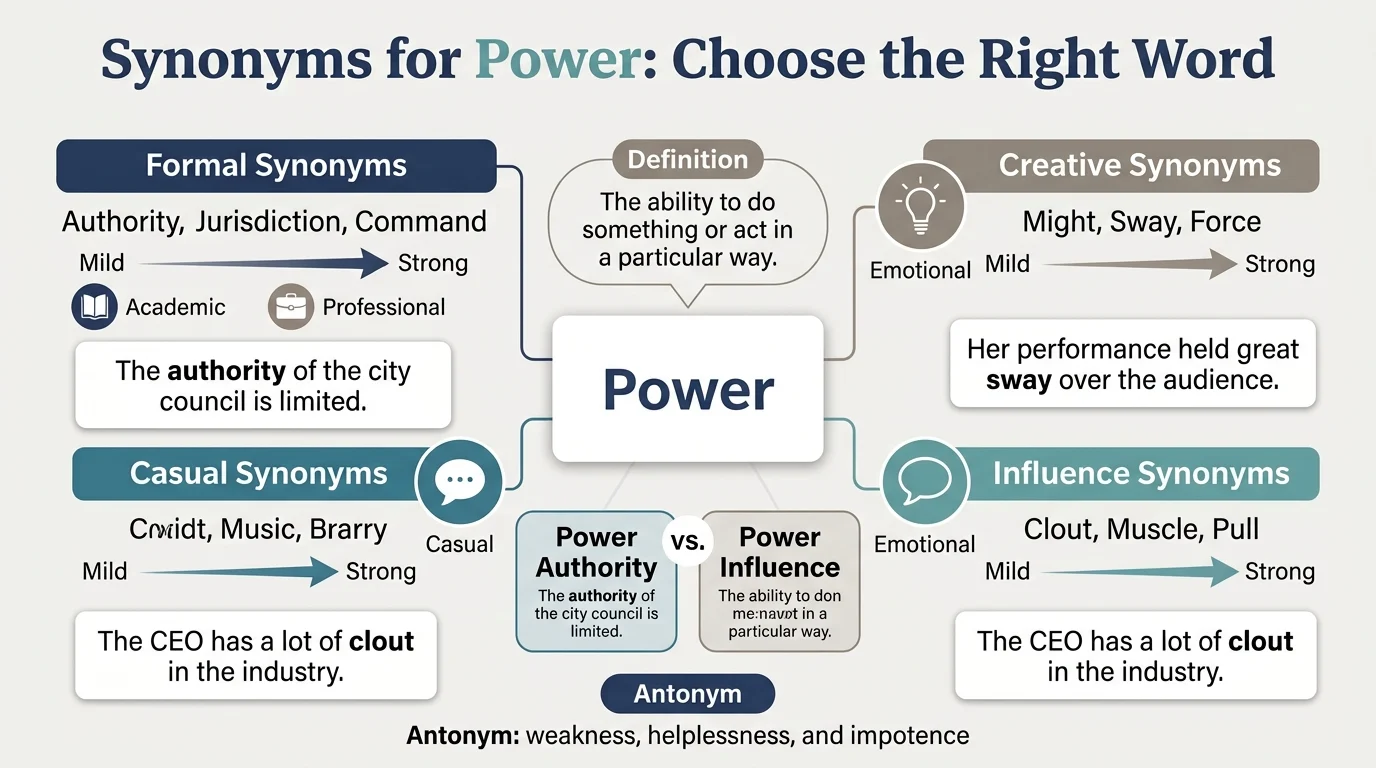
Use “authority” when referring to official decision making rights. “Jurisdiction” works for legal or territorial control.
Academic Writing
Use “capacity” for ability and “energy” for physical or scientific force.
Casual Conversation
Use “clout” for influence or “muscle” for physical strength.
Emotional Writing
Use “strength” for personal resilience or “determination” for willpower.
Creative Writing
Use “might” for epic strength or “sway” for subtle influence.
Resume Writing
Use “leadership” for managing people or “initiative” for taking charge.
Social Media Captions
Use “vibe” for personal energy or “fire” for passionate intensity.
Stronger Meaning
Use “omnipotence” for unlimited power or “supremacy” for highest authority.
Softer Meaning
Use “influence” for gentle persuasion or “capability” for basic ability.
When Not to Use “Power”
Power sounds too vague when you need precision. It sounds too casual in formal legal documents. It sounds too weak when describing extreme strength. Isounds too strong when describing minor influence.
Weak Example
He has power over the schedule.
Stronger Example
He controls the schedule.
Weak Example
The engine has power.
Stronger Example
The engine produces three hundred horsepower.
Weak Example
She used her power to convince them.
Stronger Example
She used her influence to persuade them.
Words Commonly Confused With “Power”
Strength vs. Power
Strength is physical capacity. Power is broader and includes authority and influence. Strength focuses on force. Power focuses on control.
Authority vs. Power
Authority is legitimate or official power. Power can be unofficial or even illegal. Authority is always recognized. Power can be hidden.
Energy vs. Power
Energy is the capacity to do work. Power is the rate at which work is done. In everyday language, energy feels active while power feels controlling.
Influence vs. Power
Influence is persuasive. Power is coercive. You can influence someone without having power over them.
Control vs. Power
Control is specific and direct. Power is broader. You can have power without controlling every detail.
Might vs. Power
Might emphasizes physical or military strength. Power includes political, social, and personal dimensions.
Best Synonym by Context for “Power”
| Context | Best Synonym | Why It Works | Example |
|---|---|---|---|
| Formal Writing | Authority | Sounds official and recognized | The committee has the authority to enforce regulations. |
| Academic Writing | Capacity | Emphasizes ability and potential | The system’s capacity for data processing is impressive. |
| Professional Business | Influence | Highlights persuasion and networking | Her influence helped close the deal. |
| Resume Writing | Leadership | Shows people management skills | Demonstrated strong leadership across multiple departments. |
| Casual Conversation | Clout | Informal and modern | He has serious clout in the music scene. |
| Creative Writing | Might | Adds drama and epic tone | The warrior’s might was legendary. |
| Emotional Tone | Strength | Connects to resilience and courage | She found the strength to start over. |
| Strong Intensity | Dominance | Shows clear superiority | Their dominance in the market is unmatched. |
| Soft Moderate Tone | Leverage | Suggests strategic advantage | We have leverage in the negotiation. |
| Social Media Captions | Vibe | Trendy and personal | This place has such good energy and vibe. |
| US Usage | Authority | Preferred for official contexts | The mayor used her authority to approve the plan. |
Which Synonym Should You Choose?
Ask yourself three questions before choosing a synonym for power.
First, what is your setting? Formal writing demands “authority” or “capacity.” Casual conversations welcome “clout” or “muscle.” Creative work benefits from “might” or “sway.”
Second, what is your emotional intensity? Strong emotions call for “dominance” or “supremacy.” Gentle emotions suit “influence” or “leverage.”
Third, what is your professional goal? Resume writing needs “leadership.” Business emails need “influence.” Technical writing needs “energy” or “capacity.”
Your audience matters too. Colleagues understand “leverage.” Friends understand “clout.” Academics understand “capacity.” Choose the word your reader will immediately grasp.
Real Life Examples of “Power” in Sentences
School Setting
The principal holds significant power over school policies. Students discovered the power of collaborative study groups.
Workplace Setting
Our team gained more power after the reorganization. She used her position’s power to mentor junior staff members.
Writing Setting
The author’s power lies in her ability to create vivid characters. Clear writing gives you power over your reader’s attention.
Conversation Setting
My grandfather always talked about the power of a handshake. We discussed the power of community support.
Social Media Setting
The power of this video is incredible. Social media gives ordinary people extraordinary power.
Resume Setting
Exercised budgetary power to reduce operating costs. Demonstrated the power to motivate teams during difficult quarters.
Email Setting
Please confirm you have the power to approve this request. I appreciate your power to make quick decisions.
Storytelling Setting
The ancient amulet granted its bearer unlimited power. Her words held the power to heal old wounds.
15 Synonyms for “Power”
| Synonym | Simple Meaning | Best Used For | Example Sentence |
|---|---|---|---|
| Authority | Legitimate official control | Formal and professional writing | The board has authority over all financial decisions. |
| Influence | Indirect persuasion or effect | Networking and soft power | Her influence shaped the company culture. |
| Strength | Physical or mental force | Personal resilience | His strength carried him through difficult times. |
| Might | Great physical or military force | Creative and epic writing | The army’s might was impossible to defeat. |
| Energy | Active force or vitality | Scientific and active contexts | Solar energy powers the entire building. |
| Control | Direct command or regulation | Management and process contexts | She maintains control over the production schedule. |
| Dominance | Superior position or authority | Competitive environments | Their dominance in the industry is undisputed. |
| Leverage | Strategic advantage | Business and negotiation | We have leverage in the price discussion. |
| Clout | Informal influence or pull | Casual and social contexts | He has political clout in the community. |
| Sway | Persuasive influence | Creative and gentle contexts | His sway over public opinion is remarkable. |
| Supremacy | Highest power or authority | Extreme superiority | The nation’s naval supremacy lasted for decades. |
| Capability | Ability or potential | Technical and academic use | The software’s capability exceeds our expectations. |
| Jurisdiction | Legal or official authority | Legal and governmental use | This court has jurisdiction over the case. |
| Force | Physical or violent power | Action oriented writing | The storm hit with tremendous force. |
| Command | Authority to direct or control | Military and leadership | He took command of the situation immediately. |
Synonym Groups and Usage Differences
Professional vs. Personal Synonyms
Professional synonyms include authority, jurisdiction, leverage, and command. These words sound official and appropriate for workplace communication. Personal synonyms include strength, energy, and determination. These words connect to individual experience and personal growth.
Formal vs. Conversational Synonyms
Formal synonyms suit reports, essays, and speeches. Use authority, capacity, supremacy, and jurisdiction. Conversational synonyms work in texts, emails to friends, and casual chats. Use clout, muscle, sway, and pull.
Academic Synonyms
Academic writing requires precise and objective language. Capacity describes ability or potential. Energy describes physical force in science. Authority describes legitimate power in social sciences. Jurisdiction describes legal power in law studies.
Professional and Business Synonyms
Business communication benefits from influence, leverage, and command. Influence helps describe networking and soft skills. Leverage describes strategic advantages. Command describes leadership and control.
Creative or Literary Synonyms
Creative writing comes alive with might, force, and sway. Might suggests epic battles and heroes. Force suggests unstoppable movement. Sway suggests subtle and magical persuasion. These words add imagery and emotion.
Slang or Modern Synonyms
Clout and vibe are modern informal words. Clout means social or political influence. Vibe means personal energy or atmosphere. These words are acceptable in casual writing and social media. Avoid them in formal reports or academic essays.
Strongest vs. Weaker Synonyms
Mildest
Capability, ability, capacity
Moderate
Influence, leverage, authority
Strong
Control, command, might
Strongest
Dominance, supremacy, omnipotence
Emotional vs. Neutral Synonyms
Emotional synonyms add feeling to your writing. Strength suggests courage. Might suggests awe. Force suggests urgency. Neutral synonyms stay factual and professional. Authority, capacity, and jurisdiction do not carry strong emotional weight.
Antonyms of “Power”
| Antonym | Meaning | Example Sentence |
|---|---|---|
| Weakness | Lack of strength | His weakness prevented him from lifting the box. |
| Impotence | Lack of power or effectiveness | The committee’s impotence frustrated everyone. |
| Helplessness | Inability to act or control | She felt helplessness in the face of disaster. |
| Inability | Lack of skill or capacity | His inability to focus hurt his performance. |
| Subordination | State of being lower in rank | Their subordination to the manager was clear. |
| Inferiority | Lower status or quality | The team’s inferiority showed in the results. |
| Subjection | State of being controlled | The nation lived in subjection for centuries. |
| Dependence | Reliance on others | His dependence on others limited his freedom. |
| Servitude | Condition of being a servant | They were forced into servitude. |
| Incapacity | Lack of physical or mental ability | The injury caused temporary incapacity. |
| Powerlessness | Complete lack of power | The workers felt powerlessness against the changes. |
| Vulnerability | Openness to harm | Their vulnerability made them easy targets. |
| Limitation | Restriction or boundary | The limitation of resources prevented progress. |
| Ineffectiveness | Lack of desired effect | The policy’s ineffectiveness was obvious. |
| Impairment | Damage or weakening | The impairment of his vision affected his work. |
Comparison: Power vs. Similar Words
Power vs. Authority
Main Difference
Power is broad and can be unofficial. Authority is official and recognized. Power can be taken. Authority is given.
Which is Stronger
Power is stronger because it can override authority. A powerful person can challenge authority.
Which is More Formal
Authority is more formal and legal in nature.
Example with Power
The general had power over the entire region.
Example with Authority
The judge has authority to make final rulings.
Power vs. Influence
Main Difference
Power involves control or force. Influence involves persuasion and gentle direction.
Which is Stronger
Power is stronger and more direct.
Which is More Formal
Both are formal, but influence is softer.
Example with Power
The CEO has power to fire employees.
Example with Influence
The advisor has influence over the CEO’s decisions.
Power vs. Strength
Main Difference
Power can be social, political, or personal. Strength is usually physical or mental.
Which is Stronger
Strength implies pure force. Power implies control and strategy.
Which is More Formal
Power is more formal. Strength is more personal.
Example with Power
Political power requires strategic thinking.
Example with Strength
Physical strength requires exercise and training.
Power vs. Control
Main Difference
Power is the ability to affect things. Control is the direct management of things.
Which is Stronger
Control is more specific and hands on. Power is broader.
Which is More Formal
Control is slightly more direct and operational.
Example with Power
She has power over the department budget.
Example with Control
She controls every line item in the budget.
Power vs. Might
Main Difference
Might is physical or military power. Power is broader and includes political and social forms.
Which is Stronger
Might suggests overwhelming physical force.
Which is More Formal
Might is more literary and creative.
Example with Power
The president has power to sign treaties.
Example with Might
The army’s might crushed the rebellion.
Power vs. Clout
Main Difference
Clout is informal social or political influence. Power is the general term for control or ability.
Which is Stronger
Power is stronger and more comprehensive.
Which is More Formal
Power is formal. Clout is informal and modern.
Example with Power
The senator has significant political power.
Example with Clout
The celebrity has clout with young voters.
Common Phrases and Expressions with “Power”
1. Power to the people
Meaning
A slogan supporting popular control and democracy.
Example
The protestors chanted “power to the people” as they marched.
2. Power play
Meaning
A strategic move to gain advantage.
Example
His sudden resignation was a power play to force new negotiations.
3. Power trip
Meaning
A situation where someone uses power to feel superior.
Example
The supervisor went on a power trip and micromanaged everyone.
4. The powers that be
Meaning
The people or authorities in charge.
Example
The powers that be decided to delay the project.
5. Power behind the throne
Meaning
Someone who influences decisions without having official power.
Example
The advisor was the real power behind the throne.
6. More power to you
Meaning
An expression of encouragement and support.
Example
You decided to start your own business. More power to you.
7. Power couple
Meaning
Two successful and influential people in a relationship.
Example
The celebrity power couple attended every major event.
Common Mistakes to Avoid
1. Using “power” when a more precise synonym exists
Instead of saying “She has power,” say “She has authority” for official control or “She has influence” for persuasive ability.
2. Confusing “power” with “authority” in legal contexts
Authority is legal. Power is broader. A thief has power but no authority. A judge has authority and power.
3. Using “clout” in professional reports
Clout is too informal for business reports. Use influence or leverage instead.
4. Using “might” for everyday situations
Might sounds dramatic and epic. Use strength or force for ordinary contexts.
5. Repeating “power” too often in one paragraph
Use synonyms like authority, control, or influence to create variety.
6. Using “dominance” when you mean “influence”
Dominance suggests superiority and competition. Influence suggests gentle persuasion.
7. Using “vibe” in formal academic writing
Vibe is slang. Use energy or atmosphere in formal contexts.
8. Choosing a synonym with the wrong emotional tone
The word “domination” sounds aggressive. The word “leadership” sounds positive. Match your emotion.
FAQs
What is the best synonym for power?
The best synonym depends on context. Use “authority” for official settings, “influence” for persuasion, “strength” for personal resilience, and “might” for creative writing.
What is a formal synonym for power?
“Authority” and “jurisdiction” are formal synonyms. “Capacity” works in academic settings. “Leverage” suits business contexts.
What is an informal synonym for power?
“Clout” and “muscle” are informal synonyms. Pull” and “sway” are also casual alternatives.
What is another word for power in professional writing?
Use “authority,” “influence,” “leadership,” or “command” in professional writing. “Leverage” works for strategic advantage.
What is the difference between power and influence?
Power involves control and authority. Influence involves persuasion and gentle direction. You can have influence without having power.
What is the opposite of power?
Weakness is the most direct opposite. Impotence, helplessness, and powerlessness are also antonyms.
Conclusion
Power is a versatile word with many alternatives. The best synonym depends on your context, audience, and emotional tone. Formal settings call for authority and jurisdiction. Casual conversations welcome clout and muscle. Creative writing comes alive with might and force. Professional communication benefits from influence and leverage.
Pay attention to your emotional intensity. Use dominance and supremacy for competitive situations. Use strength and energy for personal motivation. sway and leverage for strategic persuasion.
Your vocabulary grows when you understand these subtle differences. Practice using different synonyms in your daily writing. Replace “power” with a more precise word each time. Your readers will notice the improvement. Your writing will become clearer, more engaging, and more professional.