Have you ever found yourself writing an email, an essay, or a report and realized you’ve used the word “synthesize” three times in two paragraphs? It happens to the best of us. You know what you want to say, but repeating the same word makes your writing feel flat and uninspired. Whether you are a student working on a research paper, a professional drafting a business proposal, or a blogger trying to keep your content fresh, finding the right synonym for “synthesize” can transform your communication. Choosing the precise word for your situation improves clarity, sets the right tone, and keeps your reader engaged. This guide explores the best synonyms of synthesize to help you write with more confidence and variety.
What Are the Best Synonyms of “Synthesize”?
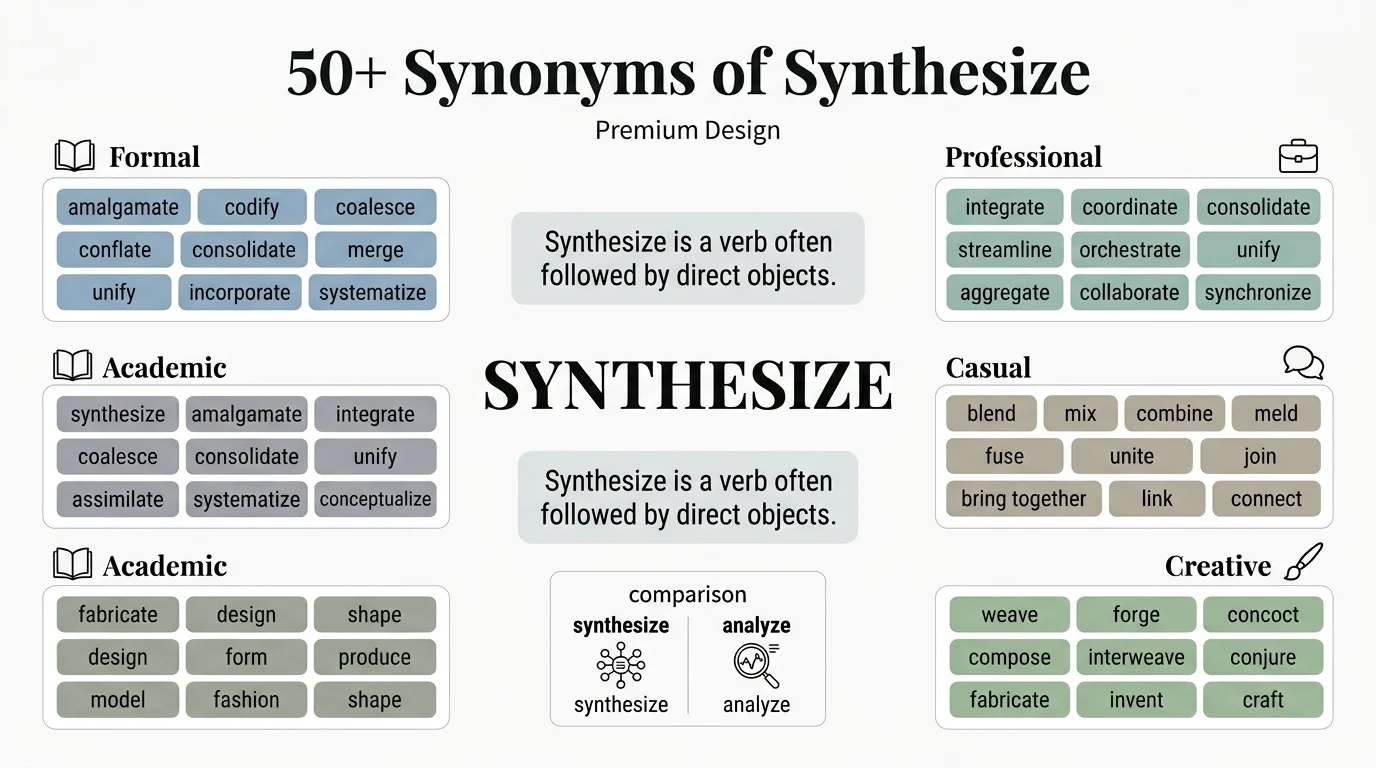
To synthesize means to combine different elements, ideas, or substances to create something new and often more complex. The best synonym depends on your context. For formal writing, choose integrate or consolidate. For casual conversation, use blend or mix. In academic work, opt for amalgamate or synthesize itself. For professional communication, unify and coordinate work well. Emotional or creative writing benefits from fuse or weave, which add vivid imagery.
Meaning, Tone, and Context
Simple Definition
To synthesize is to bring separate things together to form a new, unified whole. This can apply to physical materials, like chemicals in a lab, or abstract concepts, like ideas in a research paper.
Part of Speech
Verb (transitive). Example: “The researcher synthesized the data.”
Overall Tone
Neutral. The word itself does not carry a positive or negative emotional charge.
Formality Level
Formal to semi-formal. “Synthesize” is common in academic, scientific, and professional writing. It is less common in everyday casual conversation.
Common Uses
Native English speakers use “synthesize” in several key areas:
- Academic writing: Combining research from multiple sources to form a new argument.
- Science and technology: Creating a substance through a chemical or biological process.
- Professional settings: Merging different strategies, reports, or departments into a cohesive plan.
- Creative fields: Blending different artistic styles, sounds, or genres.
- Everyday discussion: Combining different perspectives or experiences to form a new opinion.
Word Forms
- Noun: Synthesis (the result of synthesizing), Synthesizer (a person or thing that synthesizes)
- Verb: Synthesize (present), Synthesized (past), Synthesizing (present participle)
- Adjective: Synthetic (made by synthesis, often artificial)
When and How to Use “Synthesize”
Choose “synthesize” when you want to emphasize the creation of something new and complex from simpler parts. It is a powerful word that signals a higher level of thinking or processing. Here are seven realistic examples showing how to use it in different contexts.
Professional
“The marketing team will synthesize customer feedback from various surveys to develop our new campaign strategy.”
Academic
“For your final paper, you must synthesize at least ten scholarly sources to support your thesis.”
Workplace
“Our job is to synthesize the findings from the R&D, sales, and finance departments into a single annual report.”
Personal
“After years of practicing different styles, she began to synthesize them into her own unique approach to yoga.”
Email
“I have reviewed the project proposals and will synthesize the key points into a summary for our next meeting.”
Resume
“Synthesized complex financial data to provide actionable insights for the executive team.”
Social Media
“This podcast synthesizes history, science, and storytelling in a way I have never heard before.”
Best Synonyms of “Synthesize”
No synonym is a perfect match for every situation. The best choice depends on what you are combining, why you are combining it, and who your audience is. Here are the top recommendations for specific contexts.
- Professional Writing: Consolidate. This word suggests making something stronger or more efficient by bringing parts together. It is ideal for business and management contexts.
- Academic Writing: Amalgamate. This formal term emphasizes the merging of different elements into a coherent whole, perfect for research and scholarly work.
- Business Communication: Integrate. This is a versatile and professional word that implies combining parts into a functioning system.
- Casual Conversation: Blend. This is a friendly, everyday word that suggests a smooth and harmonious mixture.
- Emotional Writing: Fuse. This word carries a sense of intensity and permanent union, suggesting that things have become one.
- Creative Writing: Weave. This verb creates a strong visual image of intertwining different threads or elements into a rich tapestry.
- Resume Writing: Distill. This suggests you have taken complex information and extracted the most essential, valuable parts.
- Workplace Communication: Coordinate. This focuses on the organizational aspect of bringing different parts together to work effectively.
- Stronger Meaning: Forge. This implies creating something through great effort and skill, often in a challenging environment.
- Softer Meaning: Merge. This is a neutral word for combining, without the strong implication of creating something entirely new.
When Not to Use “Synthesize”
Using “synthesize” in the wrong context can make your writing sound awkward, overly technical, or simply unclear.
The word sounds too general: If you are describing a simple physical action, like stirring ingredients, “synthesize” is too grand.
- Less effective: “Synthesize the eggs and flour in a bowl.”
- Better: “Mix the eggs and flour in a bowl.”
- Why: “Mix” is the correct, natural word for this simple action.
When the word sounds too formal: In a casual text message or an informal blog post, “synthesize” can feel out of place.
- Less effective: “I need to synthesize my thoughts before I text you back.”
- Better: “I need to gather my thoughts before I text you back.”
- Why: “Gather” is more conversational and natural for everyday speech.
When the word sounds too weak: If you want to emphasize a powerful, irreversible combination, “synthesize” might not be strong enough.
- Less effective: “The two companies will synthesize their operations.”
- Better: “The two companies will merge their operations.”
- Why: “Merge” implies a more complete and permanent union, which is often the case with companies.
The word is outdated or overly complex: In some modern, fast-paced business contexts, simpler words are often preferred for clarity.
- Less effective: “We will synthesize our various workflows.”
- Better: “We will unify our various workflows.”
- Why: “Unify” is clear, direct, and widely understood in a business setting.
Words Commonly Confused With “Synthesize”
Several words are often used interchangeably with “synthesize,” but they have distinct meanings. Understanding these differences will help you choose the most accurate word.
Vs. Combine
- Difference: “Combine” is a general term for putting things together. “Synthesize” is a specific type of combination that results in a new, more complex product.
- When to Use It: Use “combine” for simple, everyday mixtures. Use “synthesize” when the result is a new, integrated whole.
- Example (Combine): “Combine the sauce ingredients in a pan.”
- Example (Synthesize): “The philosopher synthesized ideas from Plato and Aristotle to create a new ethical framework.”
Synthesize vs. Integrate
- Difference: “Integrate” means to make something a part of a larger whole. “Synthesize” means to combine parts to form a new, distinct whole.
- When to Use It: Use “integrate” when adding a new element into an existing system. Use “synthesize” when creating a new system from various parts.
- Example (Integrate): “We need to integrate the new software with our existing database.”
- Example (Synthesize): “The researcher synthesized the findings of five different studies into a new theory.”
Synthesize vs. Amalgamate
- Difference: “Amalgamate” specifically refers to merging or combining things to form a single, unified structure or organization. It is often used for businesses or large-scale unions.
- When to Use It: Use “amalgamate” when the result is a single, unified entity, often an organization. Use “synthesize” for ideas, data, or chemical compounds.
- Example (Amalgamate): “The two schools decided to amalgamate to form a larger academy.”
- Example (Synthesize): “The chemist worked to synthesize the new compound.”
Vs. Blend
- Difference: “Blend” suggests a smooth, harmonious mixture where the original parts may no longer be distinct. “Synthesize” can also result in a blend, but it often implies a more intellectual or complex process.
- When to Use It: Use “blend” for smooth mixtures, especially in cooking or art. Use “synthesize” for intellectual or scientific processes.
- Example (Blend): “Blend the spices together to create a flavorful rub.”
- Example (Synthesize): “The artist’s work blends (or synthesizes) elements of pop art and surrealism.”
Synthesize vs. Fuse
- Difference: “Fuse” means to join or blend to form a single entity, often with the implication of heat or intense energy. It suggests a very strong, often permanent union.
- When to Use It: Use “fuse” when you want to emphasize the strength and permanence of the union. Use “synthesize” for a more general or intellectual combination.
- Example (Fuse): “The intense heat caused the metals to fuse together.”
- Example (Synthesize): “The composer fused (or synthesized) jazz and classical music.”
Vs. Consolidate
- Difference: “Consolidate” means to make something stronger or more solid by combining parts. It often implies a process of strengthening or streamlining.
- When to Use It: Use “consolidate” in business or management contexts to describe making a system or organization more efficient.
- Example (Consolidate): “The company consolidated its various departments to reduce costs.”
- Example (Synthesize): “The manager consolidated (or synthesized) the team’s ideas into a single action plan.”
Best Synonyms of “Synthesize” by Context
| Context | Best Synonym | Why It Works | Example |
|---|---|---|---|
| Formal Writing | Consolidate | It conveys strength and efficiency, making it suitable for official documents. | “The report consolidates findings from three years of research.” |
| Academic Writing | Amalgamate | Its formal tone and meaning of merging into a coherent whole are perfect for scholarly work. | “The theory amalgamates concepts from psychology and sociology.” |
| Professional Communication | Integrate | It is a versatile and respected term that implies creating a functional system. | “We will integrate your feedback into the final design.” |
| Business Emails | Summarize or Distill | These are clear and direct, ideal for concise email communication. | “Let me distill the key takeaways from today’s meeting.” |
| Resume Writing | Synthesized or Consolidated | These action verbs demonstrate higher-order thinking and the ability to manage complex information. | “Synthesized market data to identify new business opportunities.” |
| Workplace Communication | Coordinate | It emphasizes the organizational aspect of bringing different parts together. | “We need to coordinate our efforts across all teams.” |
| Casual Conversation | Mix or Blend | These are simple, friendly, and universally understood. | “Let’s mix our ideas and see what we come up with.” |
| Everyday Speaking | Put together | This is a very common and natural phrasal verb. | “She put together a great presentation from various sources.” |
| Creative Writing | Weave | It creates a strong visual of intertwining different threads or elements. | “The author weaves a complex narrative from multiple characters’ perspectives.” |
| Storytelling | Fuse | It implies a powerful and often dramatic combination. | “The film fuses action with dark comedy.” |
| Emotional Writing | Merge | It suggests a deep, personal, and often irreversible union. | “Their lives merged as they built a future together.” |
| Strong Emphasis | Forge | It implies creating something new through significant effort and skill. | “The team forged a new strategy from the crisis.” |
| Mild Tone | Merge | It is a neutral and softer alternative to more intense words like “fuse.” | “The two companies decided to merge their resources.” |
| Social Media Captions | Blend or Mix | These are short, catchy, and easy to understand. | “Blending my love for travel and photography in this shot.” |
| American English | Synthesize | This is the standard spelling in the US. | “The scientist synthesized a new compound.” |
| British English | Synthesise | This is the standard spelling in the UK. | “The scientist synthesised a new compound.” |
How to Choose the Best Synonym of “Synthesize”
Choosing the right word doesn’t have to be a guessing game. Follow this simple decision guide to pick the perfect synonym every time.
- Define the Nature of the Combination: Are you combining physical objects, abstract ideas, or data? For physical objects, “mix” or “blend” are often best. For abstract ideas, “synthesize,” “integrate,” or “amalgamate” are more appropriate. For data, “consolidate” or “distill” work well.
- Consider Your Audience: Who are you writing for? If you are writing for experts, a more formal term like “amalgamate” is acceptable. If you are writing for a general audience, a simpler word like “blend” or “combine” is better.
- Determine the Desired Tone: What feeling do you want to convey? If you want to sound professional and efficient, use “consolidate.” If you want to sound creative and vivid, use “weave” or “fuse.”
- Assess the Level of Formality: Is this a formal report or a casual email? Match the formality of your word to the context.
- Focus on the Result: What is the outcome of the combination? If the result is a stronger, more efficient whole, use “consolidate.” If it is a new, unified entity, use “amalgamate” or “merge.” If it is a harmonious mixture, use “blend.”
- Prioritize Clarity: Always choose the word that most clearly communicates your intended message. A fancy word that confuses your reader is never the right choice.
Real Life Examples of “Synthesize”
Seeing the word in action is the best way to understand how to use it. Here are realistic examples from various situations, including some where we replace “synthesize” with a stronger synonym for improved writing.
School: “For our history project, we had to synthesize information from the textbook, primary sources, and documentaries.”
College: “The professor praised the student’s ability to synthesize complex philosophical arguments in her term paper.”
Workplace: “My job is to synthesize the data from our global offices and present it to the board.”
Business: “The new CEO’s first task was to synthesize the company’s various missions into one clear, unifying vision.” (Stronger: consolidate)
Email: “I have read all the proposals and will synthesize the main points for our discussion on Friday.” (Stronger: distill)
Resume: “Synthesized customer feedback from multiple channels to drive product improvements.”
Conversation: “We need to synthesize our different viewpoints if we are going to agree on a plan.” (Stronger: blend)
Storytelling: “The myth synthesizes elements from several ancient cultures into a single, compelling narrative.” (Stronger: weaves)
Blogging: “This post synthesizes everything I have learned about SEO over the past five years.” (Stronger: consolidates)
Social Media: “Synthesizing my love for design and coffee in this new logo.” (Stronger: merging)
18 Best Synonyms of “Synthesize”
Synonyms of “Synthesize” by Usage
Professional vs Personal Synonyms
In the workplace, you want to sound competent and efficient. Words like consolidate, integrate, and coordinate are excellent choices. They convey a sense of control and strategic thinking. In personal conversations, simpler and more relatable words are better. Blend, mix, and put together sound natural and friendly, making you more approachable.
Formal vs Conversational Synonyms
For formal reports, essays, and presentations, choose amalgamate, consolidate, or synthesize itself. These words add a level of sophistication and authority to your writing. For casual conversations, text messages, and social media, blend, mix, or merge are far more appropriate and will not make you sound overly academic.
Academic Synonyms
In academic writing, precision is key. Amalgamate is a strong choice for merging different theories or concepts. Synthesize is the standard term for combining research from multiple sources to form a new argument. Conflate is useful when you are intentionally combining ideas or texts to make a point, though be careful as it can also mean to confuse. These words sound authoritative and demonstrate a high level of scholarly thinking.
Professional and Business Synonyms
Your resume, emails, and presentations need to make a strong impression. For resumes, use action verbs like synthesized, consolidated, or distilled to show you can handle complex information. In meetings and presentations, integrate and coordinate are excellent for showing you can bring different parts of a project together. For business emails, summarize or distill are clear, direct, and professional.
Creative and Literary Synonyms
If you are a writer, you want to paint a picture with your words. Weave is fantastic for describing how a story or narrative is created. Fuse is perfect for describing a powerful, often dramatic combination of styles or genres. Meld is a modern and slightly more casual alternative to “merge” that works well in creative writing. These words add depth, imagery, and emotion to your descriptions.
Slang or Modern Synonyms
There are no widely recognized slang synonyms for “synthesize.” The concept is too specific and formal to have generated casual slang terms. If you are in a very informal setting, the best approach is to use simpler words like “mix up” or “put together.”
Strongest to Mildest Synonyms
The intensity of a synonym can change the feeling of your entire sentence. Here is a scale from mildest to strongest.
| Intensity | Synonym | Example |
|---|---|---|
| Mildest | Mix | “Mix the paint colors.” |
| Mild | Combine | “Combine your resources.” |
| Moderate | Merge | “The two companies will merge.” |
| Moderate | Blend | “The design blends old and new.” |
| Moderate | Integrate | “Integrate the new software.” |
| Strong | Unify | “The leader will unify the party.” |
| Strong | Amalgamate | “The schools will amalgamate.” |
| Strong | Consolidate | “Consolidate your debts.” |
| Very Strong | Fuse | “The metals fused in the heat.” |
| Very Strong | Forge | “They forged a new alliance.” |
Emotional vs Neutral Synonyms
Emotional Synonyms
Words like fuse, forge, and weave carry emotional weight. “Fuse” suggests a powerful, almost passionate union. “Forge” implies effort, struggle, and creation through adversity. “Weave” creates a sense of artistry and care. Use these words when you want to evoke a feeling or create a vivid image.
Neutral Synonyms
Words like combine, merge, integrate, and amalgamate are neutral and factual. They simply describe the action of bringing things together without adding any particular feeling. Use these words in professional, academic, or scientific writing where objectivity is important.
Antonyms of “Synthesize”
| Antonym | Meaning | Example Sentence |
|---|---|---|
| Analyze | To break down into parts. | “The scientists will analyze the compound to understand its structure.” |
| Dissect | To cut apart for detailed examination. | “The students will dissect a frog in biology class.” |
| Break down | To separate into smaller parts. | “The machine will break down the plastic into its components.” |
| Separate | To move apart or divide. | “It is important to separate fact from fiction.” |
| Divide | To split into parts. | “The teacher will divide the class into groups.” |
| Disassemble | To take apart. | “The mechanic will disassemble the engine.” |
| Isolate | To separate from others. | “The researcher will isolate the bacteria for study.” |
| Fragment | To break into pieces. | “The ancient artifact began to fragment over time.” |
| Decompose | To break down or rot. | “The leaves will decompose and enrich the soil.” |
| Dismantle | To take apart systematically. | “The crew will dismantle the old scaffolding.” |
| Disintegrate | To break into small parts. | “The paper began to disintegrate in the water.” |
| Part | To separate. | “The crowd will part to let the parade pass.” |
| Disconnect | To break a connection. | “Please disconnect the cables from the device.” |
| Detach | To separate from something larger. | “Detach the coupon from the page.” |
| Scatter | To throw in various random directions. | “The wind will scatter the leaves.” |
Comparison: “Synthesize” vs Similar Words
Synthesize vs Combine
Main Difference: “Combine” is a general term for putting things together. “Synthesize” is a more specific process that results in a new, complex product.
Which Is Stronger? “Synthesize” is stronger because it implies a more sophisticated and transformative process.
Which Is More Formal? “Synthesize” is more formal.
When to Use Each: Use “combine” for simple mixtures, like ingredients. Use “synthesize” for intellectual or complex creations, like theories or chemical compounds.
Examples:
- Combine: “Combine the flour and water.”
- Synthesize: “The author synthesizes multiple perspectives in her book.”
Synthesize vs Integrate
Main Difference: “Integrate” means to make something part of a larger whole. “Synthesize” means to combine parts to form a new, distinct whole.
Which Is Stronger? “Synthesize” is stronger because it implies creating something new, not just adding to an existing structure.
Which Is More Formal? Both are formal, but “synthesize” can be more academic.
When to Use Each: Use “integrate” when adding a new element to an existing system. Use “synthesize” when creating a new system.
Examples:
- Integrate: “We need to integrate the new software.”
- Synthesize: “The researcher synthesized a new theory.”
Synthesize vs Amalgamate
Main Difference: “Amalgamate” specifically means to merge into a single, unified structure. “Synthesize” is a broader term for combining elements to create something new.
Which Is Stronger? They are similar in strength, but “amalgamate” often implies a more permanent and structural union.
Which Is More Formal? “Amalgamate” is slightly more formal.
When to Use Each: Use “amalgamate” for merging organizations or large entities. Use “synthesize” for ideas, data, or chemical compounds.
Examples:
- Amalgamate: “The two banks will amalgamate.”
- Synthesize: “The chemist will synthesize a new polymer.”
Synthesize vs Blend
Main Difference: “Blend” suggests a smooth, harmonious mixture. “Synthesize” implies a more intellectual or complex process.
Which Is Stronger? “Synthesize” is stronger because it implies a more sophisticated outcome.
Which Is More Formal? “Synthesize” is more formal.
When to Use Each: Use “blend” for smooth mixtures in cooking or art. Use “synthesize” for intellectual or scientific combinations.
Examples:
- Blend: “Blend the ingredients until smooth.”
- Synthesize: “The artist synthesizes different artistic movements.”
Synthesize vs Fuse
Main Difference: “Fuse” often implies joining through heat or intense energy. “Synthesize” is a more general term.
Which Is Stronger? “Fuse” is stronger and more dramatic.
Which Is More Formal? “Synthesize” is more formal and academic.
When to Use Each: Use “fuse” for powerful, often permanent unions. Use “synthesize” for general combinations.
Examples:
- Fuse: “The metals fused under the intense heat.”
- Synthesize: “The musician synthesizes jazz and classical styles.”
Synthesize vs Consolidate
Main Difference: “Consolidate” means to make something stronger by combining parts. “Synthesize” focuses on the creation of something new.
Which Is Stronger? They are similar in strength, but “consolidate” emphasizes the strengthening aspect.
Which Is More Formal? Both are very formal.
When to Use Each: Use “consolidate” in business or management to describe making a system more efficient. Use “synthesize” for a general combination.
Examples:
- Consolidate: “The company consolidated its departments.”
- Synthesize: “The researcher consolidated (or synthesized) the data into a report.”
Common Phrases and Expressions with “Synthesize”
Common Mistakes to Avoid
1: Choosing a vague synonym
- Incorrect: “The article tries to combine different ideas.” (Too vague)
- Better: “The article synthesizes different ideas.”
- Why: “Synthesize” implies a more sophisticated and intellectual process than the simple word “combine.”
2: Confusing “synthesize” with “analyze”
- Incorrect: “The essay will analyze the various sources into a new argument.” (Incorrect word)
- Better: “The essay will synthesize the various sources into a new argument.”
- Why: “Analyze” means to break down. “Synthesize” means to build up. They are opposites.
3: Using an informal synonym in formal writing
- Incorrect: “We need to mix up the data from the different departments.” (Too informal)
- Better: “We need to consolidate the data from the different departments.”
- Why: “Consolidate” is much more professional and appropriate for a business context.
4: Selecting an overly dramatic synonym
- Incorrect: “I need to fuse my thoughts before I write this email.” (Overly dramatic)
- Better: “I need to organize my thoughts before I write this email.”
- Why: “Fuse” is too intense for this simple, everyday situation.
5: Repeating the same word too often
- Incorrect: “The study aims to synthesize data. It will synthesize findings from various sources. The synthesis will be published.” (Repetitive)
- Better: “The study aims to synthesize data. It will amalgamate findings from various sources. The consolidation will be published.”
- Why: Using a variety of synonyms makes your writing more engaging and sophisticated.
6: Using a word with the wrong emotional tone
- Incorrect: “The two companies will fuse.” (Too dramatic for a business context)
- Better: “The two companies will merge.”
- Why: “Fuse” is more appropriate for creative or scientific contexts. “Merge” is a standard business term.
7: Using slang in academic writing
- Incorrect: “The researcher mixed up the data.” (Too casual)
- Better: “The researcher amalgamated the data.”
- Why: “Amalgamate” is a formal and precise word suitable for academic work.
Frequently Asked Questions
1. What are the best synonyms of “synthesize”?
The best synonyms depend on your context. For formal writing, use “consolidate” or “amalgamate.” For casual conversation, use “blend” or “mix.” Professional settings, “integrate” and “unify” are excellent choices.
2. What are the best formal synonyms of “synthesize”?
The best formal synonyms are “amalgamate,” “consolidate,” and “integrate.” These words are commonly used in academic papers, business reports, and professional documents to convey a sense of authority and precision.
3. What are common informal synonyms of “synthesize”?
Common informal synonyms include “blend,” “mix,” “merge,” and “put together.” These words are perfect for everyday conversations, text messages, and social media posts where a casual tone is appropriate.
4. What is another word for “synthesize” in professional writing?
In professional writing, strong alternatives are “consolidate,” “integrate,” and “coordinate.” For resumes, “synthesized,” “consolidated,” and “distilled” are powerful action verbs that demonstrate your ability to manage complex information.
5. What is the difference between “synthesize” and “integrate”?
“Synthesize” means to combine parts to form a new, distinct whole. “Integrate” means to make something part of a larger whole. “Synthesize” creates something new, while “integrate” adds to an existing system.
6. What is the opposite of “synthesize”?
The direct opposite of “synthesize” is “analyze,” which means to break something down into its component parts. Other antonyms include “dissect,” “separate,” and “break down.”
Conclusion
“Synthesize” is a powerful and versatile word that describes the act of combining different elements to create something new. Whether you are blending ideas in an academic paper, consolidating data in a business report, or weaving a narrative in a creative project, understanding the nuances of this word and its synonyms will elevate your writing. Remember, no synonym works perfectly in every situation. The key to effective communication is choosing the word that best fits your audience, tone, and purpose. Keep this guide handy, and the next time you reach for “synthesize,” you will have a wealth of precise and powerful alternatives at your fingertips.