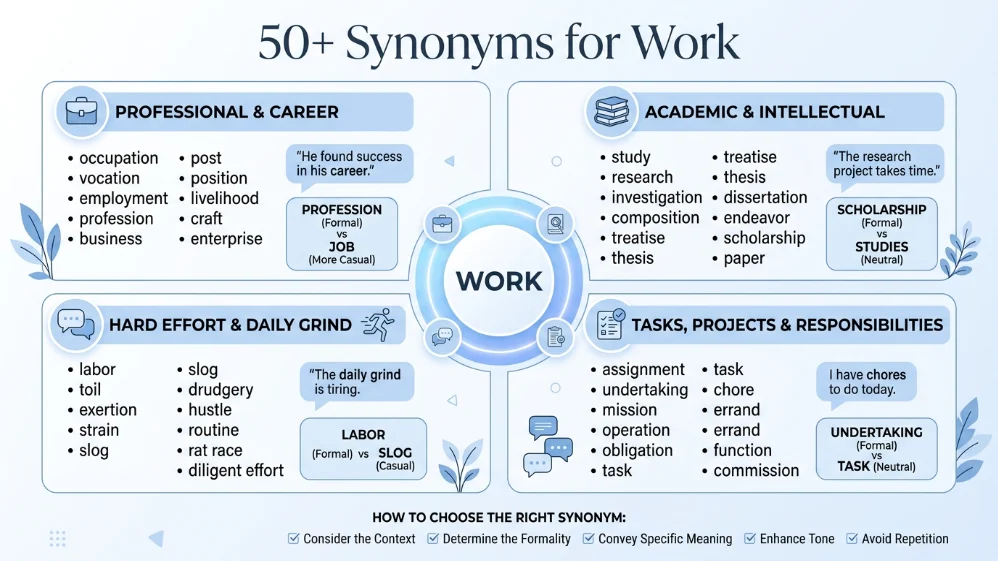
Do you ever catch yourself using the word “work” over and over again in emails, essays, or conversations? You are not alone. Many people struggle to find fresh alternatives for this common word. Whether you are writing a resume, sending a professional email, or crafting a creative story, having a variety of synonyms for work can make your language more precise and engaging. This guide will help you choose the perfect word for every situation.
What Does “Work” Mean?
Work means activity involving mental or physical effort done to achieve a purpose or result. The best synonym depends on your context.
For professional settings, try “task” or “project.” For academic writing, use “research” or “analysis.” In casual conversation, “gig” or “job” works well. For creative writing, consider “craft” or “artistry.”
Meaning, Tone and Context
The word “work” carries several layers of meaning that affect how you should use it.
- Simple definition: Work is effort directed toward producing something or accomplishing a task.
- Part of speech: Work functions as both a noun and a verb. As a noun, it refers to tasks or employment. As a verb, it describes the action of performing duties.
- Tone: The tone of “work” is generally neutral. It does not carry strong positive or negative emotions on its own.
- Formality level: Work is appropriate for all formality levels, from casual conversation to formal business writing.
- Common use cases: You will use work when discussing employment, tasks, projects, creative output, physical effort, or professional achievements.
- Important word forms: The word has several related forms. Worker refers to a person who performs work. Workable describes something that is feasible. Workmanship refers to the quality of something made or done.
When and How to Use “Work”
Use work when you need a general term for effort or tasks. It works well in everyday communication and covers many situations without being too specific. Here are some examples.
Professional context:
Our team will work on the quarterly report this week.
Personal context:
I have some work to finish before I can relax this evening.
Academic context:
The professor praised her work on the research project.
Emotional context:
The charity does meaningful work in the community.
Creative context:
His latest work explores themes of identity and belonging.
Social media context:
Behind the scenes work on our new collection starts tomorrow.
Resume context:
Managed work schedules for a team of fifteen employees.
Another Word for “Work”
Finding the best single replacement depends on your specific situation. Consider these options.
- Professional writing: “Task” works well for specific assignments. “Project” fits larger initiatives.
- Academic writing: “Research” is excellent for scholarly efforts. “Analysis” works for detailed examination.
- Casual conversation: “Gig” is perfect for informal chats. “Job” works in everyday talk.
- Emotional writing: “Calling” describes meaningful work. “Mission” suggests purpose.
- Creative writing: “Craft” implies skill and artistry. “Creation” focuses on the output.
- Resume or workplace: “Position” sounds professional. “Role” describes responsibilities well.
- Social media captions: “Hustle” works for ambitious posts. “Grind” suggests dedication.
- Stronger meaning: “Labor” emphasizes physical effort. “Toil” suggests hard struggle.
- Softer meaning: “Activity” is gentle and vague. “Effort” acknowledges attempt without pressure.
When Not to Use “Work”
Work becomes problematic when you need more specific language. It sounds vague in professional settings where precision matters. Overusing work can make your writing feel repetitive and uninspired.
Consider this example. The original sentence says “She did good work on the presentation.” A better version reads “She delivered an excellent presentation that impressed the clients.” The second sentence uses a stronger verb and provides more detail.
Work also fails when you need to describe emotional depth. Saying “His work changed lives” feels flat compared to “His advocacy transformed communities and gave hope to thousands.”
Avoid work when you want to sound authoritative or expert. Instead of “I work on financial reports,” try “I prepare comprehensive financial reports for executive review.”
Words Commonly Confused With “Work”
Several words are often mixed up with work. Understanding their differences will improve your vocabulary.
Job versus work: Job refers to a specific position or employment. Work encompasses all effort and tasks. You can say “My job is demanding” but “I have work to do” sounds more natural. Use job when discussing employment status. Use work when discussing tasks or effort.
Task versus work: Task is a specific piece of work. Work is the broader category. “Complete this task by noon” is precise. “I have work all day” is general. Tasks are countable items. Work is often uncountable.
Labor versus work: Labor emphasizes physical exertion and often implies hard, manual effort. Work is more general. Labor sounds more strenuous. Work can describe mental effort too.
Career versus work: Career refers to a long term professional journey. Work describes daily activities. “She has a successful career” describes her trajectory. “Her work involves managing teams” describes her daily duties.
Effort versus work: Effort focuses on the attempt and energy expended. Work focuses on the output or result. Effort highlights the process. Work highlights the product.
Profession versus work: Profession implies specialized training and formal qualification. Work is broader. Profession sounds more prestigious. Work is more casual and inclusive.
Best Synonym by Context for “Work”
| Context | Best Synonym | Why It Works | Example |
|---|---|---|---|
| Formal writing | Endeavor | Shows serious commitment and intention | The company supports charitable endeavors |
| Academic writing | Research | Implies systematic investigation and study | Her research on climate change is groundbreaking |
| Professional or business | Project | Suggests structured effort with clear goals | We launched the marketing project last month |
| Resume or cover letter | Role | Highlights position and responsibility | My role involved managing cross functional teams |
| Casual conversation | Gig | Feels modern and relaxed | My new gig starts next Monday |
| Creative writing | Craft | Emphasizes skill and artistic ability | He practiced his craft for twenty years |
| Emotional tone | Calling | Suggests deep purpose and passion | Teaching is more than a job; it is a calling |
| Strong intensity | Labor | Conveys physical effort and hard work | The construction labor continued through the night |
| Soft or moderate tone | Activity | Keeps language gentle and non specific | The activity kept the children engaged for hours |
| Social media captions | Hustle | Captures ambition and drive | The grind and hustle never stops in this city |
| US usage | Job | Standard American English for employment | She found a great job in New York |
| UK usage | Work | Similar usage across both dialects | He goes to work at eight every morning |
Which Synonym Should You Choose?
Your choice depends on several factors. Consider the meaning you want to convey first. Are you discussing daily tasks or long term purpose? Are you emphasizing effort or results?
Think about formality next. Professional documents need precise, standard terms. Casual conversations allow relaxed options. Academic writing requires clear, specific vocabulary.
Emotional intensity matters too. Some synonyms carry powerful feelings. Others remain neutral and factual. Match the tone to your message.
Professional value is another consideration. Resume and interview language should sound competent and confident. Avoid casual terms in these settings.
Sentence context shapes your choice. The surrounding words will determine which synonym sounds most natural. Read your sentence aloud to test the flow.
Real Life Examples of “Work” in Sentences
School setting:
The students completed their group project ahead of schedule.
Workplace setting:
Our team handles customer service inquiries throughout the day.
Writing setting:
The author’s latest novel explores themes of redemption and hope.
Conversation setting:
I have so much to do before the weekend starts.
Social media setting:
This project represents months of dedication and late nights.
Resume setting:
Directed daily operations for a growing retail chain.
Email setting:
I will follow up on the account details tomorrow morning.
Storytelling setting:
The villagers gathered together for the harvest preparation.
25 Synonyms for “Work”
| Synonym | Simple Meaning | Best Used For | Example Sentence |
|---|---|---|---|
| Task | Specific piece of work | Daily assignments | Complete each task before moving to the next |
| Project | Planned undertaking with goals | Professional planning | The construction project will finish in June |
| Job | Paid employment position | Career discussions | She accepted a job at the publishing company |
| Role | Function or position | Resume descriptions | His role focuses on client relationships |
| Gig | Temporary work or performance | Casual conversation | I have a gig at the downtown cafe tonight |
| Labor | Physical work effort | Manual work contexts | The labor on the farm starts at sunrise |
| Craft | Skill based creative work | Artistic contexts | She perfected her craft over many years |
| Calling | Strong professional purpose | Inspirational writing | Medicine became his true calling |
| Hustle | Energetic work effort | Social media content | The hustle continues until we reach our goals |
| Activity | General purposeful action | Casual descriptions | The activity helped pass the afternoon hours |
| Endeavor | Serious sustained effort | Formal situations | The scientific endeavor changed our understanding |
| Research | Systematic investigation | Academic writing | Her research focuses on renewable energy |
| Analysis | Detailed examination | Professional reports | The analysis revealed important market trends |
| Creation | Something made or produced | Artistic expression | His creation won several design awards |
| Production | Process of making things | Manufacturing contexts | Production will increase next quarter |
| Effort | Attempt or exertion | General usage | The effort resulted in a successful campaign |
| Pursuit | Active engagement in activity | Personal goals | His pursuit of excellence never wavers |
| Operation | Functioning or performance | Business settings | The operation runs smoothly every day |
| Practice | Repeated activity for improvement | Skill development | Regular practice improves your abilities |
| Drudgery | Boring monotonous work | Negative descriptions | The drudgery of data entry exhausted her |
| Output | Results produced | Performance measurement | Output increased by twenty percent |
| Employment | Paid work status | Formal documents | Employment at the firm began in 2020 |
| Occupation | Regular profession | Formal conversations | Teaching is a respected occupation |
| Performance | Execution of duties | Evaluation contexts | His performance exceeded expectations |
| Assignment | Given task or duty | Educational settings | The assignment requires careful attention |
Synonym Groups and Usage Differences
Professional vs. Personal Synonyms
Professional synonyms like assignment, project, and operation emphasize structure and accountability. These words work well in workplace settings and official communications. Personal synonyms like calling, pursuit, and craft emphasize individual meaning and satisfaction. These words fit journaling, personal statements, and reflective writing.
Formal vs. Conversational Synonyms
Formal words include endeavor, occupation, and undertaking. Use these in reports, official letters, and professional publications. Conversational words include gig, job, and hustle. These fit social media, casual emails, and friendly conversations. Choose based on your audience and medium.
Academic Synonyms
Academic writing benefits from precise synonyms. Research, analysis, and investigation sound scholarly and credible. These words show systematic thinking and careful methodology. Professors and researchers prefer these terms. Academic contexts also value study, inquiry, and examination for their formal tone.
Professional and Business Synonyms
Business communication requires clear, confident language. Project, task, and operation work well in emails and presentations. Performance, output, and production suit reviews and metrics. These words convey competence and professionalism. They help you sound capable in workplace conversations.
Creative or Literary Synonyms
Creative writing thrives on evocative language. Craft, creation, and artistry add beauty and depth. These words help writers paint pictures with language. Calling and pursuit add meaning and purpose. Creative synonyms inspire emotion and imagination in readers.
Slang or Modern Synonyms
Modern slang includes hustle, grind, and gig. These words work well in social media and casual conversation. However, they do not belong in academic papers or formal business documents. Use them sparingly in professional writing. Save them for personal expression and friendly communication.
Strongest vs. Weaker Synonyms
Strong synonyms include labor, toil, and drudgery. These words emphasize difficulty and exertion. Weaker synonyms include activity, effort, and pursuit. These words suggest attempt rather than achievement. Stronger words fit intense situations. Weaker words work for general reference.
Emotional vs. Neutral Synonyms
Emotional synonyms include calling, mission, and passion. These words carry personal feeling and purpose. Neutral synonyms include task, job, and operation. These words stay factual and objective. Choose emotional words for personal statements. Use neutral words for professional documents.
Antonyms of “Work”
| Antonym | Meaning | Example Sentence |
|---|---|---|
| Rest | State of relaxation or inactivity | After the project ended, she enjoyed some well deserved rest |
| Play | Activity done for enjoyment | The children prefer play to any serious activity |
| Leisure | Free time away from duties | He values his leisure time on weekends |
| Inactivity | State of being idle | The inactivity of the office concerned management |
| Idleness | Being without useful activity | Idleness made him feel unproductive and restless |
| Relaxation | Freedom from work stress | Relaxation helps maintain mental health |
| Ease | Lack of difficulty or effort | The new system allowed for greater ease of operation |
| Entertainment | Activities that provide amusement | She planned entertainment for the whole family |
| Recreation | Activities done for refreshment | Hiking is his favorite form of recreation |
| Vacation | Time away from regular work | The vacation revitalized her energy |
| Holiday | Day of celebration or rest | The holiday gave everyone a chance to pause |
| Laziness | Unwillingness to work | Laziness prevented him from completing his goals |
| Sleep | Natural resting state | Sleep is essential for recovery and health |
| Break | Short pause from activity | She took a break to clear her mind |
| Retirement | End of active work life | Retirement allowed him to pursue new interests |
Comparison: Work vs. Similar Words
Work vs. Job
The main difference is scope. Work covers all effort and tasks. Job refers specifically to paid employment. Work is broader and more flexible. Job is more concrete and specific.
Which one is stronger? Neither is stronger; they serve different purposes. Work emphasizes effort. Job emphasizes position.
Which one is more formal? Job is more formal when discussing employment status. Work is acceptable in all contexts.
Example for work: The construction work continued despite the rain.
Example for job: She applied for a new job at the tech company.
Work vs. Task
The main difference is size. Task refers to a specific, discrete assignment. Work includes all tasks and activities together. A task is smaller and more manageable. Work is the larger collection of responsibilities.
Which one is stronger? Task is more specific and actionable. Work is more general and comprehensive.
Which one is more formal? Task is more formal in professional contexts. Work is more casual.
Example for work: I have too much work to finish today.
Example for task: Complete this task before lunch.
Work vs. Labor
The main difference is intensity. Labor suggests physical effort and struggle. Work can be mental or physical. Labor implies harder exertion. Work is more neutral and broad.
Which one is stronger? Labor is stronger and more intense. Work is standard and moderate.
Which one is more formal? Labor is formal but specific. Work works in all contexts.
Example for work: She does important work in the community.
Example for labor: The labor involved heavy lifting and long hours.
Work vs. Career
The main difference is duration. Career describes your professional journey over time. Work describes daily activities. Career is long term. Work is immediate.
Which one is stronger? Career is more significant in scope. Work is more immediate and practical.
Which one is more formal? Career is more formal and prestigious. Work is more casual.
Example for work: My work today focuses on client accounts.
Example for career: She built a career in international relations.
Work vs. Effort
The main difference is focus. Effort emphasizes energy and attempt. Work emphasizes output and result. Effort is about trying. Work is about producing.
Which one is stronger? Effort can be strong but suggests struggle. Work is more confident and productive.
Which one is more formal? Both work well in formal contexts. Effort is slightly more descriptive.
Example for work: The work produced excellent results.
Example for effort: His effort was appreciated by the entire team.
Work vs. Craft
The main difference is skill. Craft emphasizes technique and mastery. Work is more general. Craft implies artistic or specialized ability. Work covers all activities.
Which one is stronger? Craft is more precise and valuable. Work is more common and general.
Which one is more formal? Craft works well in creative contexts. Work fits all situations.
Example for work: She does good work in the kitchen.
Example for craft: He has perfected his craft over decades.
Common Phrases and Expressions with “Work”
1. Work of art
Meaning: A piece of creative work that shows exceptional skill or beauty.
Example sentence: The painting is a true work of art that belongs in a museum.
2. Work in progress
Meaning: Something that is still being developed or completed.
Example sentence: The website is a work in progress, but we are making steady improvements.
3. Work like a charm
Meaning: To function perfectly and effectively.
Example sentence: The new software works like a charm and saved us hours of time.
4. Work your magic
Meaning: To use your special skills or abilities successfully.
Example sentence: She worked her magic and secured the deal with the difficult client.
5. Work up to something
Meaning: To gradually prepare or progress toward a goal.
Example sentence: I need to work up to running five miles every day.
6. Work around something
Meaning: To find a way to handle a problem or obstacle.
Example sentence: We will work around the schedule conflicts to meet the deadline.
7. Work your fingers to the bone
Meaning: To work extremely hard.
Example sentence: She worked her fingers to the bone to support her family.
8. Work the room
Meaning: To interact with many people at a social event.
Example sentence: The politician knows how to work the room and connect with voters.
Common Mistakes to Avoid
Using work when a more precise synonym fits better
Instead of “Her work is impressive,” try “Her research is impressive” for academic contexts. Precision makes your writing stronger.
Confusing work with job
Use job when discussing paid employment. Use work for all other types of effort. Saying “I need to find work” means you want any activity. Saying “I need to find a job” means you want paid employment.
Using casual synonyms in formal writing
Words like gig and hustle do not belong in academic papers or official documents. Save these for conversations and social media.
Using overly dramatic synonyms for simple situations
“Toil” sounds strange when describing a quick task. Match the intensity of your word to the actual situation.
Repeating work too often in writing
Variety keeps your writing fresh. Use synonyms to avoid monotony. Your readers will appreciate the diversity.
Choosing synonyms with the wrong emotional tone
Calling sounds too serious for a temporary job. Labor sounds too heavy for a computer based task. Consider emotional weight carefully.
Using slang in academic or professional writing
Words like grind and hustle are too casual for formal contexts. Professors and managers expect standard vocabulary. Save these words for appropriate settings.
FAQs
What is the best synonym for work?
The best synonym depends on context. For professional use, choose project or task. For casual conversation, choose job or gig. Academic writing, choose research or analysis.
What is a formal synonym for work?
Formal synonyms include endeavor, occupation, and undertaking. These words suit business documents, academic papers, and professional correspondence.
What is an informal synonym for work?
Informal synonyms include gig, hustle, and grind. These words work well in casual conversation, social media, and friendly emails.
What is another word for work in professional writing?
Professional writing benefits from words like project, task, operation, and assignment. These terms sound competent and specific.
What is the difference between work and job?
Work covers all effort and activities. Job refers specifically to paid employment. Work is broader. Job is narrower and more concrete.
What is the opposite of work?
The opposite of work includes rest, play, leisure, and relaxation. These words describe time without effort or duties.
Conclusion
Work is a versatile word with many synonyms that fit different situations. The best replacement depends on your context, audience, and intended meaning. Professional settings call for precise terms like project and task. Creative writing benefits from expressive words like craft and creation. Casual conversation welcomes modern options like gig and hustle.
Understanding tone, intensity, and formality will help you choose the perfect synonym every time. Always consider your reader and purpose. The right word can elevate your writing and communication significantly.
Remember to verify definitions using trusted dictionaries such as Cambridge, Oxford, Merriam Webster, Collins, or Britannica before publishing your final work. Building vocabulary takes practice and awareness, but the effort pays off in clearer, more engaging communication.