Have you ever caught yourself using the word “home” too many times in a single piece of writing? Perhaps you were drafting an email, crafting a social media caption, or writing an essay. The word felt right, but it also felt repetitive.
You knew there had to be another way to say it, but your mind went blank. This happens to everyone. Finding the right synonym for home can transform your writing from ordinary to engaging. The best writers know that word choice matters.
They understand that “home” carries deep emotional weight. It can mean a physical building, a feeling of comfort, or even a place of origin. Selecting the perfect alternative depends entirely on your context and audience. This guide will show you exactly how to choose the right word every time.
What Does “Home” Mean?
Home means the place where someone lives permanently, especially as a member of a family or household. It also represents a feeling of belonging, safety, and comfort.
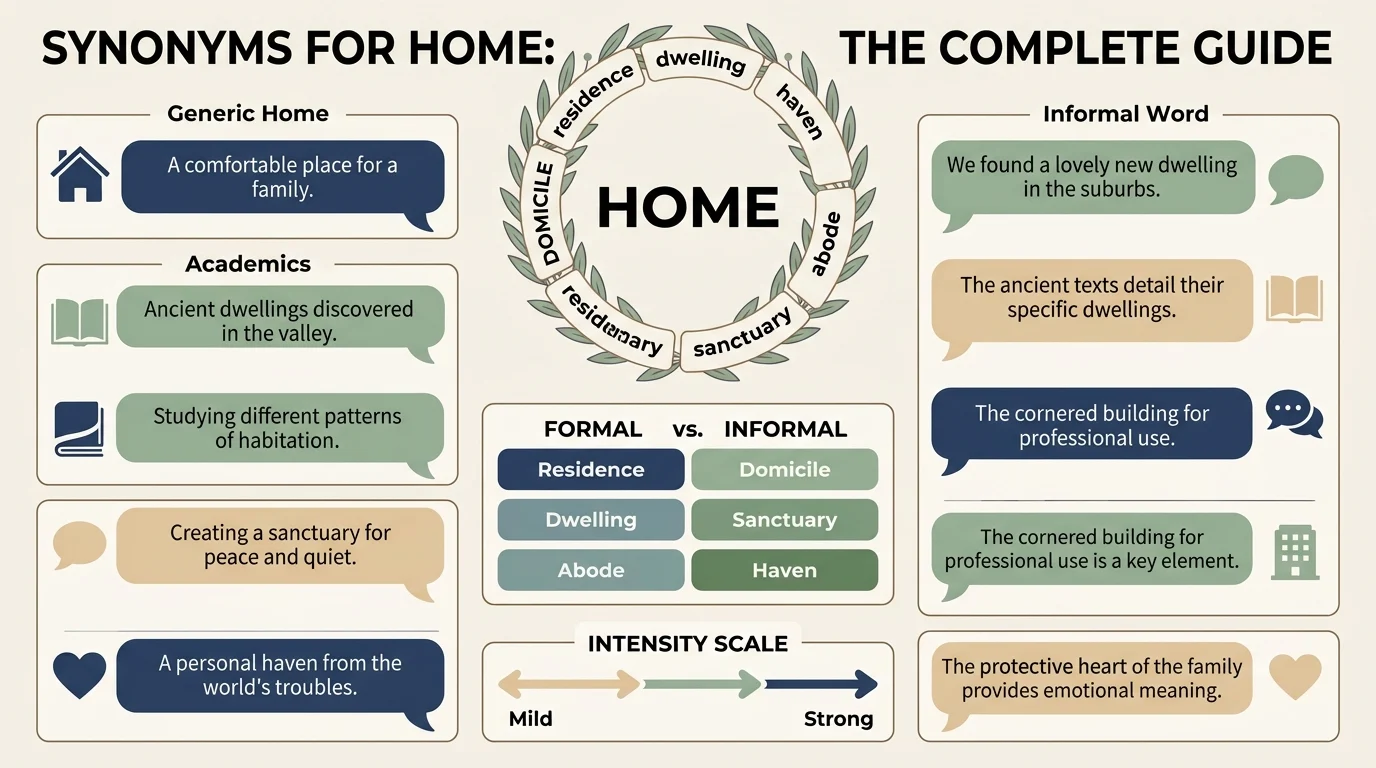
The best synonyms for home depend on context. For formal writing, use residence or dwelling. casual conversation, try place or pad. For emotional writing, choose haven or sanctuary.
Meaning, Tone and Context
- Simple definition: Home refers to the physical space where you live, but it also describes a deep emotional state of belonging and security.
- Part of speech: Home functions as a noun and an adverb. It can also be used as a verb in phrases like “to home in on.”
- Tone: The word home carries a positive and warm tone. It evokes feelings of safety, comfort, and personal connection.
- Formality level: Home is neutral and works in almost every context, from casual conversation to formal writing.
- Common use cases: You use home when talking about where you live, where you grew up, or where you feel you belong. It appears in personal writing, professional communication, real estate, and emotional expression.
- Important word forms: The adjective form is homely in British English or homey in American English. The verb form is to home, meaning to return or to direct toward a target.
When and How to Use “Home”
Home is your default choice when you want to describe the place where you live. It works beautifully when you want to express warmth, belonging, or personal attachment. This word is safe, clear, and universally understood.
Professional context:
“The company offers a generous work from home policy for all employees.”
Personal context:
“I cannot wait to get home and see my family after this long trip.”
Academic context:
“The study examined how home environment affects childhood development outcomes.”
Emotional context:
“Her grandmother’s house always felt more like home than anywhere else.”
Creative context:
“The cottage stood nestled in the valley, a home that had witnessed generations of laughter.”
Social media context:
“Finally home after an amazing adventure. There is truly no place like it.”
Resume context:
“Managed home office operations and coordinated remote team communication effectively.”
Another Word for “Home”
Finding the right single replacement for home requires understanding your specific situation. The best synonym changes based on tone, audience, and purpose.
Professional writing: Residence offers a formal and clear alternative for official documents.
Academic writing: Dwelling provides a precise, neutral term suitable for research papers.
Casual conversation: Place works perfectly in everyday speech without sounding stiff.
Emotional writing: Haven captures the safety and comfort that home represents.
Creative writing: Sanctuary adds poetic depth and a sense of sacred personal space.
Resume or workplace use: Headquarters works well for business or office related contexts.
Social media captions: Crib gives a modern, casual feel for younger audiences.
Stronger meaning: Sanctuary emphasizes protection and deep emotional safety.
Softer meaning: Spot uses informal, gentle language for light conversation.
When Not to Use “Home”
Home sounds too vague when you need to describe a specific type of building. Using home for an apartment, mansion, or cabin lacks the precision that words like condo, estate, or lodge provide.
Home feels too casual in highly formal legal documents. Contracts and official reports benefit from terms like domicile or property.
Home becomes too weak when you want to emphasize luxury or grandeur. Words like estate or manor carry more weight in real estate writing.
Consider this weak sentence:
“The celebrity purchased a new home in Beverly Hills.”
Now see how a more precise synonym improves it:
“The celebrity purchased a new estate in Beverly Hills.”
The second version sounds more impressive and specific. It paints a clearer picture for the reader.
Words Commonly Confused With “Home”
Many people confuse home with similar words. Each has a distinct meaning and usage that matters.
Home vs. House
House refers to a physical building structure. Home includes the emotional and personal meaning attached to that space.
House works better when discussing architecture, construction, or real estate transactions.
Home fits perfectly when discussing family life, comfort, and personal belonging.
Home vs. Residence
Residence is a formal, legal term. Home is personal and emotional.
Residence appears in official paperwork, tax documents, and legal addresses.
Home appears in personal writing and everyday conversation.
Home vs. Domicile
Domicile is a strictly legal term for permanent legal residence. Home carries emotional weight.
Domicile belongs in legal documents and official government forms.
Home belongs in personal, creative, and general writing.
Home vs. Abode
Abode sounds slightly old fashioned or literary. Home remains modern and widely used.
Abode adds a poetic touch to creative writing.
Home works in every context without sounding dated.
Home vs. Dwelling
Dwelling is a neutral, somewhat formal term. Home is warm and personal.
Dwelling works well in academic or technical writing about housing.
Home works better in personal narratives and emotional contexts.
Home vs. Habitat
Habitat refers to the natural environment of animals or plants. Home refers to human living spaces.
Habitat belongs in scientific or ecological writing.
Home belongs in writing about human experiences and spaces.
Best Synonym by Context for “Home”
| Context | Best Synonym | Why It Works | Example |
|---|---|---|---|
| Formal writing | Residence | Sounds professional and official | “The applicant listed her primary residence in Chicago.” |
| Academic writing | Dwelling | Neutral and precise for research | “The study analyzed energy consumption in urban dwellings.” |
| Professional business | Headquarters | Indicates central operations | “The company moved its headquarters to Austin.” |
| Resume writing | Office | Shows workplace environment | “Managed a remote office with fifteen team members.” |
| Casual conversation | Place | Natural and relaxed | “Come over to my place for dinner tonight.” |
| Creative writing | Sanctuary | Adds emotional depth | “The garden became her sanctuary from the noisy world.” |
| Emotional tone | Haven | Conveys safety and comfort | “His arms were a haven where she felt completely safe.” |
| Strong intensity | Refuge | Emphasizes protection | “The cabin was a refuge during the difficult winter months.” |
| Soft or moderate tone | Spot | Gentle and informal | “This quiet spot feels like our own little world.” |
| Social media captions | Crib | Modern and relatable | “Back to my crib after an epic road trip.” |
| Real estate writing | Property | Professional and transactional | “This property features four bedrooms and a pool.” |
| US usage | Home | Standard American term | “She lives in a beautiful home near the lake.” |
| UK usage | House | Often used more literally | “He bought a new house in the countryside.” |
Which Synonym Should You Choose?
Consider your audience first. Writing for a legal firm requires formality. Writing for a blog post allows more creativity.
Think about the emotional intensity you want to convey. Haven and sanctuary express deep comfort and safety. Residence and dwelling stay neutral and factual.
Match the formality level to your situation. Academic papers demand precision. Personal emails allow warmth and casual expression.
Evaluate the physical space you are describing. A mansion deserves an impressive word like estate. A small apartment might work better with place or flat.
Consider the purpose of your writing. Real estate listings need descriptive, appealing terms. Legal documents require exact, official language.
Trust the tone of your message. Emotional writing benefits from words like refuge and sanctuary. Professional writing benefits from residence and property.
Remember that context changes everything. A word that works perfectly in a poem might sound strange in a business report.
Real Life Examples of “Home” in Sentences
School context:
“The students wrote essays about what home means to their families.”
Workplace context:
“Her home office setup includes two monitors and a standing desk.”
Writing context:
“The novelist described the cottage as a home filled with memories.”
Conversation context:
“We are thinking about buying a new home in the suburbs next year.”
Social media context:
“Home sweet home. Nothing beats sleeping in your own bed.”
Resume context:
“Successfully transitioned the entire team to a permanent home based work model.”
Email context:
“Thank you for inviting me to your home for the holiday gathering.”
Storytelling context:
“She left her childhood home at eighteen and never looked back.”
25 Synonyms for “Home”
| Synonym | Simple Meaning | Best Used For | Example Sentence |
|---|---|---|---|
| House | Physical building structure | Real estate and architecture | “The house features original hardwood floors.” |
| Residence | Formal living place | Official documents | “His residence is located in the downtown district.” |
| Dwelling | Place where someone lives | Academic writing | “The dwelling was constructed in the early 1900s.” |
| Abode | Literary term for home | Creative writing | “The cottage served as their humble abode.” |
| Habitat | Natural living environment | Scientific writing | “The wetland provides habitat for migratory birds.” |
| Haven | Safe, peaceful place | Emotional writing | “The library was a haven for quiet study.” |
| Sanctuary | Sacred, protected space | Spiritual or emotional writing | “Her garden became a sanctuary for reflection.” |
| Refuge | Shelter from danger | Protective or dramatic writing | “The monastery offered refuge to travelers.” |
| Crib | Modern slang for home | Social media and casual speech | “He invited everyone back to his crib.” |
| Pad | Informal term for apartment | Casual conversation | “She has a nice pad in the city center.” |
| Place | General term for living space | Everyday conversation | “Let us meet at my place after work.” |
| Property | Real estate or land | Professional and legal writing | “The property includes a large backyard.” |
| Estate | Large property or land | Luxury real estate | “The estate spans over fifty acres.” |
| Manor | Large house with land | Descriptive writing | “The manor stood proudly on the hilltop.” |
| Lodge | Rustic or rural home | Vacation or retreat writing | “They rented a ski lodge for the winter.” |
| Cottage | Small, cozy house | Charming or rustic settings | “The cottage was surrounded by rose bushes.” |
| Cabin | Simple wooden house | Rural or wilderness settings | “They built a cabin near the lake.” |
| Condo | Apartment in a complex | Urban living | “She purchased a condo with ocean views.” |
| Flat | British term for apartment | UK English contexts | “His flat is located in central London.” |
| Domicile | Legal permanent home | Legal and official documents | “His domicile is registered in New York.” |
| Headquarters | Main office or base | Business contexts | “The company headquarters are in Silicon Valley.” |
| Base | Starting point or center | Military or organizational writing | “The expedition returned to base camp.” |
| Residence hall | Student housing | Academic contexts | “The new residence hall houses 500 students.” |
| Living space | General term for home | Descriptive and casual writing | “The living space was bright and airy.” |
| Nest | Cozy, personal home | Affectionate or intimate writing | “The young couple made a cozy nest together.” |
Synonym Groups and Usage Differences
Professional vs. Personal Synonyms
Professional synonyms like residence, property, and headquarters belong in business writing. They sound formal and authoritative.
Personal synonyms like home, place, and nest feel warm and intimate. They create connection and emotional resonance.
Use professional terms when drafting contracts, reports, or official correspondence. Use personal terms when writing to friends, family, or personal blog readers.
Formal vs. Conversational Synonyms
Formal synonyms include residence, dwelling, domicile, and property. These words appear in legal documents, academic papers, and professional reports.
Conversational synonyms include place, pad, crib, and spot. These words work in texts, casual emails, and everyday speech.
Choose formal words for essays, research papers, and business proposals. Choose conversational words for social media, personal messages, and informal writing.
Academic Synonyms
Academic writing favors precise, neutral terms. Dwelling, residence, and living space appear frequently in research papers.
These words avoid emotional connotations and maintain objectivity. They work well in sociology, urban planning, and architecture studies.
Professional and Business Synonyms
Business writing requires clarity and professionalism. Headquarters, office, property, and residence hall all serve specific purposes.
Real estate professionals favor property and estate. Corporate writers use headquarters and office. These terms convey authority and precision.
Creative or Literary Synonyms
Creative writers have many beautiful options. Sanctuary, haven, refuge, and abode add poetic depth to descriptions.
Nest, cottage, and manor create vivid imagery. These words help readers visualize scenes and feel emotions.
Slang or Modern Synonyms
Modern slang includes crib, pad, and spot. These words appear in social media, music lyrics, and casual conversation.
Younger audiences respond well to these terms. However, avoid them in professional or academic writing where they seem inappropriate.
Strongest vs. Weaker Synonyms
Mild intensity: place, spot, flat
Moderate intensity: residence, dwelling, cottage
Strong intensity: sanctuary, haven, refuge, refuge
Choose stronger words when emphasizing safety, comfort, or emotional protection. Choose milder words for neutral descriptions.
Emotional vs. Neutral Synonyms
synonyms: haven, sanctuary, refuge, nest, home
Neutral synonyms: residence, dwelling, property, house, flat
Emotional words create warmth and connection. Neutral words provide factual information without added feeling.
Antonyms of “Home”
| Antonym | Meaning | Example Sentence |
|---|---|---|
| Office | Workplace | “She spent more time at the office than at home.” |
| Workplace | Employment location | “The workplace requires everyone to be on site.” |
| Prison | Confinement space | “The cell felt like a prison, not a home.” |
| Institution | Formal facility | “He lived in an institution for several months.” |
| Shelter | Temporary housing | “The shelter provided a bed for the night.” |
| Hotel | Temporary accommodation | “The hotel room felt cold and impersonal.” |
| Motel | Traveler accommodation | “They stayed at a roadside motel on the road.” |
| Homelessness | Without permanent housing | “The crisis left many families facing homelessness.” |
| Desert | Barren, empty place | “The desert offered no comfort or home.” |
| Wilderness | Untamed nature | “The wilderness felt hostile and unwelcoming.” |
| Alienation | Feeling of not belonging | “The city created a sense of alienation.” |
| Displacement | Forced relocation | “The flood caused displacement for thousands.” |
| Exile | Banishment from home | “He lived in exile for twenty years.” |
| Stranger | Outsider status | “He felt like a stranger in his own town.” |
| Foreign land | Unfamiliar country | “The foreign land felt nothing like home.” |
Comparison: Home vs. Similar Words
Home vs. House
Main difference: Home includes emotional meaning. House refers to the physical structure.
Which one is stronger: Home is stronger emotionally.
Which one is more formal: House is more formal in real estate contexts.
Home example: “This house became a home filled with love.”
House example: “The house has three bedrooms and two bathrooms.”
Home vs. Residence
Main difference: Residence is legal and formal. Home is personal and warm.
Which one is stronger: Home carries stronger emotional weight.
Which one is more formal: Residence is much more formal.
Home example: “Her home is where she feels most herself.”
Residence example: “His official residence is in Washington D.C.”
Home vs. Dwelling
Main difference: Dwelling is academic and neutral. Home is emotional and personal.
Which one is stronger: Home has stronger emotional resonance.
Which one is more formal: Dwelling is more formal in academic writing.
Home example: “They made a home in the small town.”
Dwelling example: “The dwelling was constructed with sustainable materials.”
Home vs. Abode
Main difference: Abode sounds old fashioned or literary. Home is contemporary.
Which one is stronger: Both carry similar meaning, but home is more practical.
Which one is more formal: Abode has a literary formality.
Home example: “Welcome to our home.”
Abode example: “Welcome to our humble abode.”
Home vs. Habitat
Main difference: Habitat refers to animals and nature. Home refers to humans.
Which one is stronger: Both are strong in their respective contexts.
Which one is more formal: Habitat is more formal in scientific writing.
Home example: “The forest is home to many species.”
Habitat example: “The wetland provides critical habitat for birds.”
Home vs. Sanctuary
Main difference: Sanctuary emphasizes safety and protection. Home emphasizes belonging.
Which one is stronger: Sanctuary is stronger for safety and refuge.
Which one is more formal: Sanctuary is more dramatic and literary.
Home example: “She found her home in the mountains.”
Sanctuary example: “The church offered sanctuary to refugees.”
Common Phrases and Expressions with “Home”
1. Home sweet home
Meaning: An expression of happiness at returning to one’s home.
Example sentence: “After three weeks of travel, it felt wonderful to say home sweet home.”
2. Make yourself at home
Meaning: A friendly invitation to feel comfortable and relaxed in someone’s space.
Example sentence: “Please come in and make yourself at home while I prepare dinner.”
3. Home is where the heart is
Meaning: Your true home is wherever you feel love and belonging.
Example sentence: “She moved across the country, but home is where the heart is.”
4. Bring home the bacon
Meaning: To earn money to support your family.
Example sentence: “He works long hours to bring home the bacon for his family.”
5. Close to home
Meaning: Something that affects you personally or emotionally.
Example sentence: “The documentary about climate change hit close to home for coastal residents.”
6. Home away from home
Meaning: A place where you feel as comfortable as your own home.
Example sentence: “The local coffee shop became her home away from home.”
7. Charity begins at home
Meaning: You should take care of your family and community first.
Example sentence: “He believes that charity begins at home before helping others.”
8. Hit close to home
Meaning: To be personally relevant or emotionally affecting.
Example sentence: “The film about childhood memories hit close to home for many viewers.”
Common Mistakes to Avoid
1. Using home when a more precise synonym is better
Many writers default to home when a specific word would improve their writing. Describing a luxury property as a home misses the chance to use estate or manor.
2. Confusing home with house
Using house when you mean home loses emotional depth. Using home when you mean house can sound too personal for real estate discussions.
3. Using a casual synonym in formal writing
Words like crib and pad have no place in legal documents, academic papers, or professional reports. These contexts demand formality.
4. Using an overly dramatic synonym for a simple situation
Calling a small apartment a sanctuary may sound exaggerated. Reserve powerful words for appropriate situations.
5. Repeating the same word too often
Variety keeps writing engaging. Repeating home or any synonym becomes tiresome for readers. Rotate between appropriate alternatives.
6. Choosing a synonym with the wrong emotional tone
Using residence to describe a childhood home sounds cold and impersonal. Using haven to describe a basic apartment seems exaggerated. Match the word to the feeling.
7. Using slang in academic or professional writing
Crib, pad, and spot belong in casual conversation. These words undermine your credibility in formal contexts.
FAQs
1. What is the best synonym for home?
The best synonym depends on context. For emotional writing, haven works well. For formal writing, residence is excellent.
2. What is a formal synonym for home?
Residence, dwelling, and domicile are the most formal synonyms for home.
3. What is an informal synonym for home?
Place, pad, and crib are common informal synonyms for home.
4. What is another word for home in professional writing?
Residence, property, and headquarters work best in professional contexts.
5. What is the difference between home and house?
Home has emotional meaning. House refers only to the physical building.
6. What is the opposite of home?
Office, workplace, prison, and homelessness are antonyms of home.
Conclusion
Home is a powerful word that carries deep emotional meaning. It describes both a physical place and a feeling of belonging. The best synonyms for home depend entirely on your context, audience, and purpose. Formal writing benefits from residence and dwelling.
Creative writing thrives with sanctuary and haven. Casual conversation welcomes place and crib. The key to excellent writing is variety. Rotate between synonyms to keep your language fresh and engaging. Always consider your tone and the emotional weight you want to convey.
A precise word choice makes your writing clearer and more memorable. Remember that the right synonym transforms ordinary sentences into extraordinary ones. Keep this guide handy whenever you need the perfect alternative for home.