You are updating your resume after a big project. Writing an email about a new skill. You are posting on social media about a fascinating book.
And the word “learn” keeps popping up everywhere. I learned this. I am learning that.
It is a fundamental word, but relying on it constantly flattens your communication. This guide hands you the right synonyms for learn, sorted by situation, tone, and exact meaning, so your language stays sharp and accurate.
What Does “Learn” Mean?
“Learn” means to gain knowledge, understanding, or skill through study, experience, or being taught. It describes the process of acquiring new information or abilities.
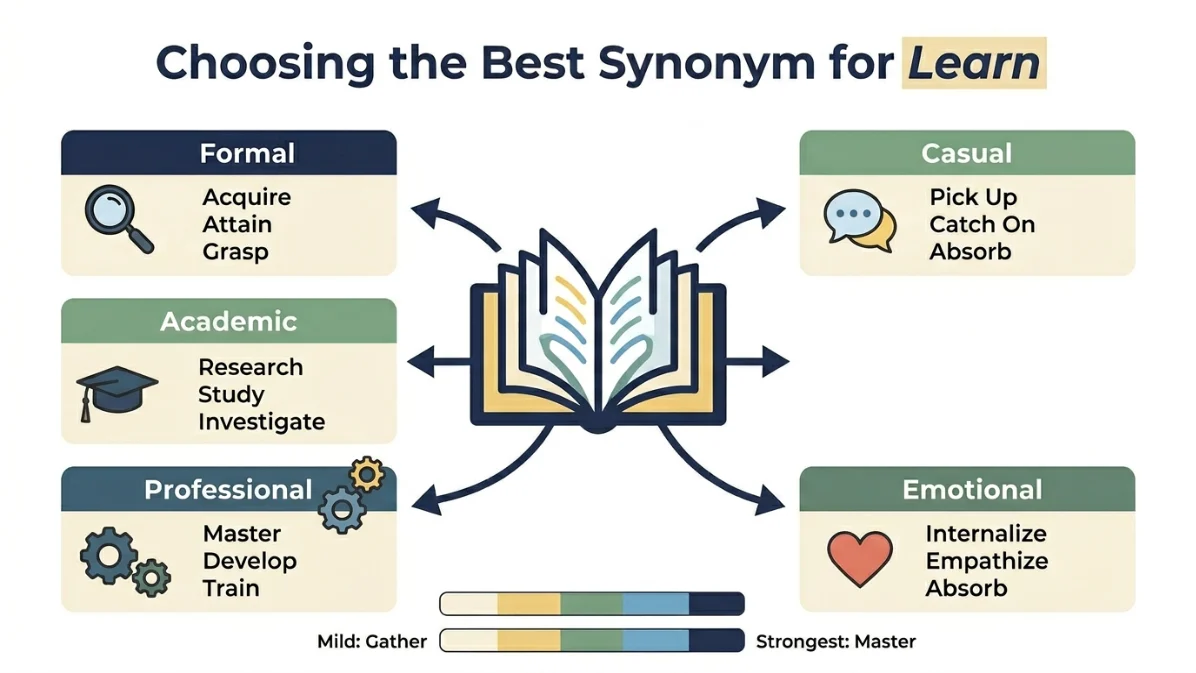
The best synonyms depend on context: ascertain for formal writing, master for professional use, grasp for casual conversation, and absorb for emotional or intuitive understanding.
Meaning, Tone and Context
The word “learn” carries a neutral and constructive tone. It implies growth and development, and it is almost universally positive because it signals progress.
Part of speech: Verb
Tone: Positive, neutral, progressive
Formality level: Neutral, fits most situations
Common use cases: Describing education, skill acquisition, discovery, and realization
Related forms: Learning (noun and adjective), learned (adjective and past tense), learner (noun)
In academic settings, “learn” is foundational. In professional life, it describes upskilling and adaptation. Personal growth, it reflects experience and wisdom.
When and How to Use “Learn”
Use “learn” when you need a clear, universally understood verb for gaining knowledge. It works well in broad statements and when the method of learning is already clear from context.
Here are realistic examples using “learn” in everyday situations.
- Our team needs to learn the new inventory software by Friday. (professional)
- Students learn critical thinking skills through this course. (academic)
- I want to learn how to make sourdough bread this winter. (casual)
- She learned the true meaning of patience after becoming a parent. (emotional)
- The protagonist must learn to trust others to survive. (creative)
- Just started to learn pottery and already obsessed. (social media)
- I would like to learn more about your department’s goals. (email)
- Eager to learn advanced project management methodologies. (resume)
Another Word for “Learn”
If you need a reliable all purpose replacement, “acquire knowledge” or simply “study” can work, but the very best synonym depends entirely on what you are learning and why.
For professional writing, choose “master” or “gain proficiency in.” For academic work, “study,” “research,” and “examine” are precise. In casual conversation, “pick up” and “get the hang of” feel natural. For emotional or deep understanding, use “absorb” or “internalize.”
In creative writing, “discover” and “uncover” add narrative depth. On resumes, “develop” and “cultivate” show deliberate growth. For social media, “pick up” and “level up” connect with audiences. For formal discoveries, “ascertain” fits perfectly.
When Not to Use “Learn”
“Learn” becomes too vague when you need to show exactly how knowledge was gained or to what depth.
The manager learned about the issue.
The manager investigated and identified the root cause of the issue.
If you simply read a fact, “came across” or “noted” might be more honest. If you achieved deep understanding, “mastered” or “grasped” shows your true level of skill. Use precise verbs when the process matters as much as the outcome.
Words Commonly Confused With “Learn”
Several words overlap with “learn” but highlight different aspects of the knowledge gaining process. Using them accurately sharpens your message.
Learn vs. Study
Study means the deliberate act of reading, memorizing, or practicing. Learn means the result of that act. You can study for hours and still not learn if the material does not sink in.
Learn vs. Understand
Understanding means comprehending meaning and connections. Learning can be surface level. You might learn a formula without understanding why it works.
Learn vs. Memorize
Memorizing is committing facts to memory without necessarily understanding them. Learning ideally includes comprehension. A student might memorize dates but never truly learn the historical narrative.
Learn vs. Discover
Discover suggests finding something previously unknown to you or to everyone. Learn often involves being taught by someone else. A scientist discovers a new species. A student learns about it from a textbook.
Learn vs. Master
Mastery implies complete command and high level skill. Learning is the ongoing journey toward that command. You learn a language for years before you might claim to master it.
Learn vs. Realize
Realize means suddenly becoming aware of something, often without formal study. You realize you left your keys inside. You learn a new software program over several training sessions.
Best Synonym by Context for “Learn”
| Context | Best Synonym | Why It Works | Example |
|---|---|---|---|
| Formal writing | Ascertain | Precise and authoritative | The committee sought to ascertain the full extent of the issue. |
| Academic writing | Study | Directly implies scholarly focus | Researchers study the long term effects of the medication. |
| Professional or business use | Master | Signals high level competence | Our team mastered the new compliance regulations swiftly. |
| Resume | Develop | Shows proactive growth | Developed expertise in stakeholder negotiation. |
| Casual conversation | Pick up | Natural and unforced | I picked up some Spanish phrases during my trip. |
| Creative writing | Uncover | Adds mystery and discovery | The detective began to uncover a tangled web of secrets. |
| Emotional tone | Absorb | Suggests deep internalization | She absorbed every piece of advice her mentor offered. |
| Strong intensity | Master | Implies full command | He mastered classical piano before turning fifteen. |
| Soft or moderate tone | Gather | Gentle and understated | I gather you have already made a decision. |
| Social media captions | Level up | Current, game like and engaging | Leveled up my cooking skills with this online course. |
| US and UK usage | Find out | Universally understood | I need to find out when the next train leaves. |
Which Synonym Should You Choose?
Let the context guide you every time. Ask yourself three questions. First, how formal is this situation? Use “ascertain” for legal or official documents, “study” for academic essays, and “pick up” for texts to friends.
Second, what depth of understanding are you describing? Choose “master” for complete command and “gather” for a casual impression.
Third, what emotional weight do you want to carry? “Absorb” feels rich and personal. “Research” feels clinical and precise. Match the word to the world you are building with your sentence.
Real Life Examples of “Learn” in Sentences
Swapping in a precise synonym changes the entire energy of your communication.
- School: Students research historical documents to form their own arguments.
- Workplace: She mastered the client onboarding process in under two weeks.
- Writing: The character slowly uncovers the truth about her family.
- Conversation: I finally figured out how to fix the Wi-Fi myself.
- Social media: Picked up watercolor painting this month. Messy but fun.
- Resume: Cultivated strong leadership skills through volunteer coordination.
- Email: Let me look into the timeline and follow up by Wednesday.
- Storytelling: Through hardship, he gained a profound understanding of resilience.
25 Synonyms for “Learn”
| Synonym | Simple Meaning | Best Used For | Example Sentence |
|---|---|---|---|
| Study | Apply the mind to a subject | Academic and focused effort | She studies marine biology at the university. |
| Master | Gain complete skill in something | Professional and high achievement | He mastered three programming languages last year. |
| Grasp | Understand something fully | Explanations and concepts | The student quickly grasped the core theory. |
| Absorb | Take in information gradually | Immersive and emotional learning | Children absorb new languages with remarkable ease. |
| Pick up | Learn casually without formal effort | Everyday conversation | I picked up knitting from watching online videos. |
| Ascertain | Find out with certainty | Formal investigations | The auditor must ascertain where the funds were directed. |
| Discover | Find something previously unknown | Science, exploration, and creativity | The team discovered an ancient settlement beneath the forest. |
| Realize | Become suddenly aware of something | Personal insights | She realized she had left the presentation at home. |
| Understand | Perceive the meaning of something | General comprehension | He finally understood the instructions after the demo. |
| Gather | Infer from available information | Subtle or polite conclusions | I gather the meeting has been postponed. |
| Internalize | Make knowledge part of oneself | Deep personal or professional growth | Good therapists internalize active listening skills. |
| Digest | Mentally process complex information | Heavy or technical material | Give me a moment to digest this report fully. |
| Research | Systematically investigate | Academic and professional projects | She is researching renewable energy solutions. |
| Apprehend | Perceive or understand, often quickly | Literary and formal contexts | He apprehended the gravity of the situation immediately. |
| Comprehend | Understand something deeply | Complex ideas and texts | The manual was difficult to comprehend at first glance. |
| Figure out | Solve or understand through effort | Problem solving and daily puzzles | I need to figure out how to budget for the conference. |
| Get the hang of | Become comfortable with a skill | Casual and skill based tasks | You will get the hang of driving this car soon. |
| Find out | Obtain information through inquiry | Everyday questions | Let me find out the answer and get back to you. |
| Familiarize | Make oneself acquainted with | Onboarding and new environments | New employees must familiarize themselves with safety protocols. |
| Cultivate | Develop through deliberate effort | Resumes and personal growth | She cultivates strong professional relationships. |
| Absorb | Soak up knowledge or experience | Immersive cultural or linguistic contexts | Living abroad helps you absorb the local customs. |
| Memorize | Commit facts to exact memory | Test preparation and performances | Actors memorize hundreds of lines for a single play. |
| Train | Learn skills through structured practice | Physical and technical disciplines | She trains in martial arts four evenings a week. |
| Educate oneself | Learn independently without a teacher | Self directed projects | He educated himself on financial planning. |
| Assimilate | Absorb and integrate information fully | Complex adaptation | New hires need time to assimilate the company culture. |
Synonym Groups and Usage Differences
Professional vs. Personal Synonyms
In professional settings, words like “master,” “develop,” “research,” and “train” convey deliberate skill building and career progression. In personal life, “pick up,” “get the hang of,” and “figure out” sound natural and unforced.
Telling a friend you “picked up” guitar feels relaxed. Telling an interviewer you “mastered a new CRM” sounds accomplished.
Formal vs. Conversational Synonyms
Formal writing expects precision. Use “ascertain,” “study,” “research,” “comprehend,” and “examine” in reports, legal documents, and academic papers.
Conversational English values approachability. Words like “pick up,” “find out,” “figure out,” and “get the hang of” keep dialogue easy and relatable. An email to a colleague might say “I will find out,” while a board report says “We will ascertain the facts.”
Academic Synonyms
Academic writing rewards verbs that describe rigorous intellectual processes. “Study,” “research,” “examine,” and “analyze” point to systematic effort. “Comprehend” and “grasp” show depth of understanding. Avoid slang entirely in scholarly work. Even “learn” can sometimes be replaced with more specific research verbs.
Professional and Business Synonyms
Business communication runs on action and results. “Master,” “implement,” “develop,” and “train” demonstrate forward motion. On resumes, “cultivated,” “developed,” and “gained proficiency in” pair powerfully with specific competencies. A performance review that says you “mastered client relations” reads far stronger than one that says you “learned about clients.”
Creative or Literary Synonyms
Creative writing thrives on sensory and emotional verbs. “Uncover” suggests mystery. “Absorb” implies deep, silent transformation. “Discover” carries a sense of wonder. “Awaken to” works beautifully for realizations. These synonyms build atmosphere in ways “learn” never can.
Slang or Modern Synonyms
Terms like “level up,” “pick up,” “get the hang of,” and “crack” inject energy into social media and casual conversation. They are perfect for captions, texts, and informal marketing copy. Keep these far away from cover letters, academic essays, and formal reports.
Strongest vs. Weaker Synonyms
Picture an intensity scale for knowledge acquisition.
Mild: Gather, find out, notice
Moderate: Study, train, familiarize
Strong: Grasp, comprehend, research
Strongest: Master, internalize, assimilate
Reserve the strongest words for accomplishments that represent genuine command or deep internal change.
Emotional vs. Neutral Synonyms
“Absorb,” “awaken to,” and “internalize” add emotional richness and suggest personal transformation. “Study,” “research,” and “ascertain” remain objective and clinical. Choose emotional synonyms for personal narratives. Choose neutral synonyms for reporting and formal documentation.
Antonyms of “Learn”
| Antonym | Meaning | Example Sentence |
|---|---|---|
| Forget | Fail to remember | I always forget where I parked my car. |
| Ignore | Deliberately pay no attention | He ignored the warning signs entirely. |
| Misunderstand | Interpret incorrectly | She misunderstood the assignment instructions. |
| Overlook | Fail to notice or consider | The editor overlooked a critical spelling error. |
| Neglect | Fail to care for or attend to | They neglected their professional development. |
| Disregard | Pay no attention to | The board disregarded the employee feedback. |
| Miss | Fail to catch or perceive | You missed the main point of the argument. |
| Abandon | Give up on learning something | She abandoned the piano lessons after two months. |
| Confuse | Make unclear or muddled | The jargon confused the new team members. |
| Misinterpret | Understand wrongly | They misinterpreted the data trends. |
| Unlearn | Discard learned knowledge or habits | We must unlearn outdated workplace biases. |
| Dismiss | Treat as unworthy of consideration | He dismissed the theory without proper review. |
| Stagnate | Stop developing or progressing | Without curiosity, the mind begins to stagnate. |
| Regress | Return to a less developed state | Skills regress without consistent practice. |
| Reject | Refuse to accept or consider | The committee rejected the new proposal outright. |
Comparison: Learn vs. Similar Words
Learn vs. Study
Main difference: Study is the process. Learn is the outcome.
Which one is stronger: Learn implies successful acquisition. Study describes effort regardless of result.
Which one is more formal: Both are neutral. Study is more common in academic settings.
Example: I studied for the certification exam for six weeks. I learned the material well enough to pass.
Learn vs. Understand
Main difference: Understand means grasping meaning. Learn means gaining new information or skill.
Which one is stronger: Understand implies deeper cognitive processing.
Which one is more formal: Understand is slightly more formal.
Example: The intern learned the procedure quickly. She understands why the procedure works that way.
Learn vs. Master
Main difference: Master means reaching an expert level. Learn is the beginning stage.
Which one is stronger: Master is vastly stronger.
Which one is more formal: Master carries professional and academic weight.
Example: She is learning graphic design basics. After years of practice, he mastered typography and layout.
Learn vs. Realize
Main difference: Realize is a sudden, often unexpected awareness. Learn is a gradual or structured process.
Which one is stronger: Realize hits with emotional or intellectual impact.
Which one is more formal: Realize is neutral and widely used.
Example: He is learning Spanish through daily practice. He realized halfway through the meeting that he was in the wrong room.
Learn vs. Memorize
Main difference: Memorize means committing to exact recall. Learn involves understanding and application.
Which one is stronger: Learn is stronger for applied knowledge. Memorize is specific to recall.
Which one is more formal: Both are neutral.
Example: She memorized the periodic table for the quiz. She learned how chemical reactions shift under pressure.
Learn vs. Discover
Main difference: Discover suggests uncovering something previously hidden or unknown. Learn often implies instruction.
Which one is stronger: Discover carries excitement and novelty.
Which one is more formal: Both are neutral. Discover adds a sense of exploration.
Example: Students learn history from textbooks. Archaeologists discovered the lost temple beneath dense jungle.
Common Phrases and Expressions with “Learn”
1. Learn the ropes
Meaning: To learn the basics of a job or activity.
Example sentence: It took me a few weeks to learn the ropes at the new office.
2. Live and learn
Meaning: A phrase of acceptance after making a mistake or experiencing something negative.
Example sentence: I left my wallet at home. Oh well, you live and learn.
3. Learn the hard way
Meaning: To learn through painful or difficult experience.
Example sentence: She learned the hard way not to skip backing up her files.
4. Learn by heart
Meaning: To memorize something perfectly.
Example sentence: The actor learned his monologue by heart weeks before opening night.
5. A learning curve
Meaning: The rate of progress in gaining experience or skill.
Example sentence: This software has a steep learning curve, but it is worth it.
6. You never stop learning
Meaning: Life continuously offers lessons regardless of age.
Example sentence: At seventy, he started painting. Truly, you never stop learning.
7. Learn a lesson
Meaning: To gain wisdom from a negative or challenging event.
Example sentence: He learned a valuable lesson about honesty after the incident.
8. Book learning
Meaning: Knowledge from reading rather than practical experience.
Example sentence: She has plenty of book learning but needs more hands on practice.
Common Mistakes to Avoid
Using “learn” when a more precise verb fits better weakens professional communication. Instead of “I learned why the client left,” write “I investigated why the client left” to show proactive effort.
Confusing “learn” with “study” misrepresents your achievement. Claiming you “learned French” after a weekend of studying misleads your audience. Match your verb to your actual depth of knowledge.
Using casual synonyms like “pick up” in a cover letter or grant application damages your credibility. Formal writing demands formal vocabulary.
Using an overly intense synonym for a small task sounds exaggerated. Telling an interviewer you “mastered email” overstates a basic skill. Reserve “master” for genuine expertise.
Repeating the same synonym across a paragraph creates the exact monotony you aimed to fix. Vary your choices for natural flow.
Choosing a synonym with the wrong emotional tone confuses readers. “Uncover” suggests mystery and hidden truth. Using it for routine training material creates an unintended dramatic effect.
Using slang like “level up” in academic or professional reports undermines your authority. Keep modern language appropriate to the medium.
FAQs
What is the best synonym for learn?
The best synonym depends on context. “Master” fits professional and skill based settings, “study” suits academic writing, and “pick up” works perfectly for casual, everyday conversation.
What is a formal synonym for learn?
“Ascertain,” “study,” “research,” and “examine” are strong formal synonyms. “Ascertain” works especially well in legal, investigative, and official business documents.
What is an informal synonym for learn?
“Pick up,” “find out,” “get the hang of,” and “figure out” are natural informal synonyms. They fit comfortably in texts, chats, and social media captions.
What is another word for learn in professional writing?
“Master,” “develop,” “gain proficiency in,” and “train” are excellent in professional writing. They demonstrate deliberate skill building and career growth.
What is the difference between learn and study?
“Study” is the intentional act of practicing or reading. “Learn” is the successful result of that act. You can study without learning if the material does not stick.
What is the opposite of learn?
“Forget” is the most common opposite. Other antonyms include “ignore,” “misunderstand,” “neglect,” “overlook,” and “stagnate,” each describing a different failure to gain knowledge.
Conclusion
“Learn” sits at the heart of how we describe growth, but it does not have to carry every sentence alone. When you reach for “ascertain,” “master,” “absorb,” or “pick up,” you paint a clearer picture of exactly how knowledge was gained and to what depth.
Match your synonym to your situation. Reserve “master” for real expertise. Use “pick up” for casual skills. Choose “ascertain” when formality and precision matter most. A deliberate verb transforms a generic statement into a specific, credible one. That is the real power of a well chosen word.