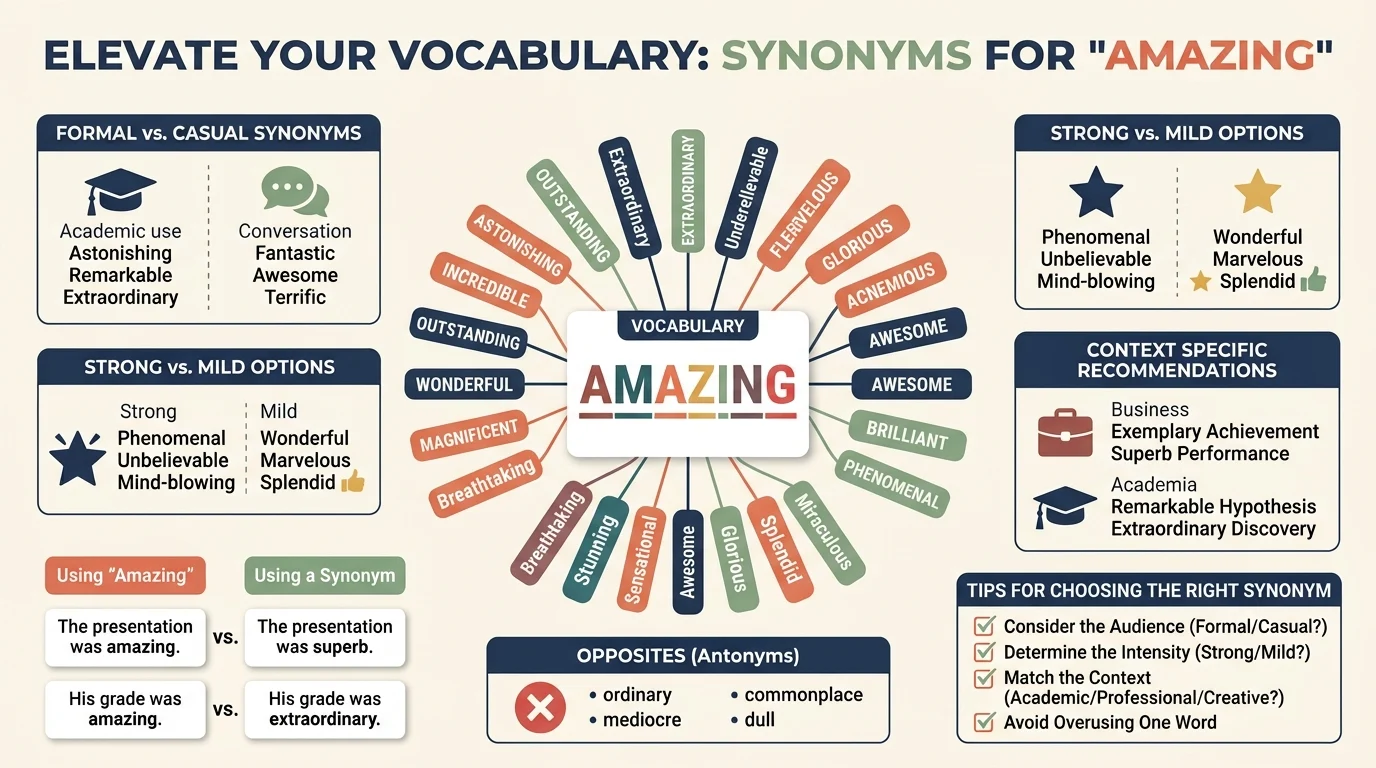
Do you find yourself using the word “amazing” over and over again in your writing, social media captions, or daily conversations? You are not alone. This common adjective appears everywhere from professional emails to casual text messages.
Using the same word repeatedly makes your language feel flat and unoriginal. Stronger vocabulary helps you express exactly what you mean with precision and impact. Your choice of words shapes how others perceive your intelligence, professionalism, and creativity.
This guide will teach you the best synonyms of amazing for every situation. You will learn when to use each alternative, which words work in formal settings, and which ones add emotional depth to your writing.
What Does “Amazing” Mean?
“Amazing” means causing great wonder, astonishment, or admiration. The best synonyms of amazing depend on your context. For formal writing, try remarkable or extraordinary. For casual conversation, use incredible or awesome. emotional impact, choose astounding or breathtaking. professional settings, impressive or outstanding work best.
Meaning, Tone and Context
Simple Definition: Something that causes surprise, wonder, or admiration due to being exceptionally good or impressive.
Part of Speech: Adjective. The word can also appear as an adverb (amazingly) or a verb (to amaze).
Tone: Positive and enthusiastic. The word carries a warm, approving emotional weight.
Formality Level: Neutral. “Amazing” works in both casual and semi-formal situations but may feel too informal for academic papers or official reports.
Common Use Cases: Describing experiences, performances, achievements, people, places, food, events, or any positive outcome.
Important Word Forms:
- Adjective: amazing
- Adverb: amazingly
- Verb: amaze, amazed, amazing
- Noun: amazement
When and How to Use “Amazing”
Use “amazing” when you want to express genuine enthusiasm about something impressive. The word works best when you need a general, all purpose positive descriptor.
Here are examples showing different contexts:
Professional Context
The team delivered amazing results on the quarterly project. Our client was thrilled with the outcome.
Personal Context
We had an amazing time at the beach yesterday. The weather was perfect and the water was warm.
Academic Context
The researcher made amazing discoveries about coral reef regeneration. Her findings could change marine biology.
Emotional Context
When I saw my sister walk down the aisle, she looked absolutely amazing. I cried happy tears.
Creative Context
The sunset painted an amazing display of orange and purple across the sky. I could not look away.
Social Media Caption
Just tried this amazing new coffee shop downtown. Their latte art is incredible.
Casual Conversation
That movie was amazing. I want to watch it again tomorrow.
Another Word for “Amazing”
The best single replacement depends on your specific meaning and context.
Professional Writing: Outstanding, exceptional, or impressive. These words sound credible and measured.
Academic Writing: Remarkable, extraordinary, or notable. These terms maintain scholarly tone without exaggeration.
Casual Conversation: Awesome, incredible, or fantastic. These feel natural and friendly in everyday speech.
Emotional Writing: Breathtaking, astounding, or awe inspiring. These add deeper feeling to personal narratives.
Creative Writing: Stupendous, prodigious, or wondrous. These words bring descriptive richness to stories.
Resume or Workplace: Accomplished, successful, or distinguished. Focus on specific achievements rather than general praise.
Social Media Captions: Stunning, epic, or unreal. These modern terms perform well in digital spaces.
Stronger Meaning: Astonishing or mind blowing. Use these when you need maximum impact.
Softer Meaning: Nice, pleasant, or enjoyable. These work when you want to sound more reserved.
When Not to Use “Amazing”
“Amazing” sounds too vague when you need specific, precise language. Describing a scientific breakthrough as “amazing” ignores the actual importance of the discovery.
The word feels too casual for formal reports, legal documents, or academic research papers. A dissertation should never describe findings as “amazing.”
“Amazing” becomes weak when you overuse it. Repeating the same adjective reduces its impact and makes your writing sound lazy.
Here is an example of improvement:
Too Vague: The presentation was amazing.
More Precise: The presentation was insightful, well structured, and highly persuasive.
Too Casual: Her research on climate change is amazing.
Better: Her research on climate change is groundbreaking and scientifically significant.
Too General: This restaurant has amazing food.
Better: This restaurant serves creative, flavorful dishes that highlight seasonal ingredients.
Words Commonly Confused With “Amazing”
Amazing vs. Awesome
“Awesome” traditionally means inspiring awe or fear. In modern usage, it is a casual synonym for good. “Amazing” feels slightly more formal and genuine. Use “awesome” with friends. Use “amazing” in most other contexts.
Amazing vs. Incredible
“Incredible” means difficult to believe. It suggests something surpasses ordinary expectations. “Amazing” focuses more on admiration than believability. Both are strong positive words, but “incredible” carries a hint of skepticism.
Amazing vs. Wonderful
“Wonderful” means full of wonder or delight. It feels softer and more emotional than “amazing.” “Wonderful” works well for personal experiences. “Amazing” covers a broader range of situations.
Amazing vs. Astonishing
“Astonishing” describes something that shocks or surprises greatly. It is stronger than “amazing” and implies a higher level of unexpectedness. Use “astonishing” when you want to emphasize surprise more than admiration.
Amazing vs. Stunning
“Stunning” means so impressive that it temporarily shocks or overwhelms. It often describes visual beauty. “Amazing” applies to more abstract qualities like performance or achievement. “Stunning” is more specific to appearance or visual impact.
Amazing vs. Fantastic
“Fantastic” suggests something imaginative, strange, or extraordinarily good. It is slightly more casual than “amazing.” Both work as positive descriptors, but “fantastic” can imply a sense of fantasy or exaggeration.
Best Synonym by Context for “Amazing”
| Context | Best Synonym | Why It Works | Example |
|---|---|---|---|
| Formal Writing | Remarkable | Carries professional credibility | The study produced remarkable findings about cognitive development. |
| Academic Writing | Extraordinary | Suggests statistical or theoretical significance | This extraordinary data set challenges previous assumptions. |
| Professional Business | Outstanding | Implies measurable excellence | Her outstanding performance earned a promotion. |
| Resume Writing | Accomplished | Focuses on achieved results | Accomplished project manager with ten years of experience. |
| Casual Conversation | Incredible | Sounds natural and friendly | We had an incredible time at the concert. |
| Creative Writing | Stupendous | Adds literary flair and drama | The stupendous waterfall roared beneath the ancient bridge. |
| Emotional Tone | Breathtaking | Connects to physical or emotional response | The view from the mountaintop was absolutely breathtaking. |
| Strong Intensity | Astonishing | Emphasizes shock and wonder | The magician’s astonishing trick left everyone speechless. |
| Soft Moderate Tone | Impressive | Measured and professional | Your presentation was very impressive. |
| Social Media Captions | Stunning | Appeals to visual platforms | Stunning sunset over the Pacific Ocean tonight. |
| US English | Awesome | Widely used and understood | That burger was awesome. |
| UK English | Brilliant | Common British expression | The show was absolutely brilliant. |
Which Synonym Should You Choose?
Consider your audience first. Professional colleagues expect measured language like “impressive” or “outstanding.” Friends and family appreciate casual words like “awesome” or “fantastic.”
Think about the intensity level you need. Mild praise calls for “impressive” or “notable.” Strong enthusiasm demands “astonishing” or “breathtaking.”
Match your synonym to the specific quality you want to emphasize. Use “stunning” for visual beauty, “remarkable” for achievements, and “extraordinary” for rare or unusual situations.
Consider your medium. Social media captions perform well with modern words like “epic.” Academic writing requires precise terms like “notable” or “exceptional.”
Avoid exaggeration. Using an overly powerful synonym for a small achievement sounds insincere. Save “astonishing” for genuinely shocking events.
Real Life Examples of “Amazing” in Sentences
School Context
My history teacher told us an amazing story about ancient Egyptian civilization. The entire class listened with complete attention.
Workplace Context
The marketing team produced amazing results this quarter. Our revenue increased by forty percent.
Writing Context
Her novel contains an amazing plot twist that readers never see coming. The reveal changes everything.
Conversational Context
You should try this amazing Thai restaurant downtown. Their pad thai is the best I have ever eaten.
Social Media Context
Amazing weekend getaway with my favorite people. Already planning the next trip.
Resume Context
Amazing customer service skills helped me maintain a ninety five percent satisfaction rating.
Email Context
Thank you for the amazing opportunity to present at the conference. I truly appreciate your support.
Storytelling Context
The explorer discovered an amazing underground cave system filled with crystal formations. No human had ever seen them before.
15 Synonyms for “Amazing”
| Synonym | Simple Meaning | Best Used For | Example Sentence |
|---|---|---|---|
| Remarkable | Worthy of attention or notice | Professional and academic writing | The scientist made a remarkable breakthrough in cancer research. |
| Extraordinary | Very unusual and impressive | Formal situations and achievements | Her extraordinary talent was recognized by the national gallery. |
| Outstanding | Exceptionally good | Business and professional contexts | His outstanding leadership guided the company through difficult times. |
| Incredible | Difficult to believe or amazing | Casual conversations and personal stories | We had an incredible view from our hotel room. |
| Stunning | Extremely impressive or beautiful | Visual descriptions and social media | She wore a stunning gown to the award ceremony. |
| Astonishing | Causing great surprise or wonder | Strong emotional impact | The magician’s astonishing final trick amazed the audience. |
| Breathtaking | So beautiful it takes your breath away | Emotional and creative writing | The Grand Canyon offers breathtaking views at sunrise. |
| Awesome | Inspiring awe or very good | Casual US English conversation | That concert was awesome from start to finish. |
| Fantastic | Extraordinarily good or imaginative | Everyday positive reactions | We had a fantastic meal at the new restaurant. |
| Impressive | Evoking admiration through size or quality | Professional feedback | Your portfolio is very impressive and well organized. |
| Stupendous | Extremely impressive or large | Creative and dramatic descriptions | The stupendous waterfall crashed down with incredible force. |
| Wondrous | Filled with wonder or marvel | Literary and poetic writing | The wondrous forest seemed to glow with magical light. |
| Prodigious | Remarkably or impressively great | Academic and formal writing | The researcher achieved prodigious success in her field. |
| Marvelous | Causing great wonder or astonishment | Positive expressions of delight | We had a marvelous time exploring the ancient ruins. |
| Exceptional | Unusually good or outstanding | Professional evaluations | The employee demonstrated exceptional problem solving skills. |
Synonym Groups and Usage Differences
Professional vs. Personal Synonyms
Professional situations call for measured, credible words. “Outstanding” and “exceptional” sound confident without exaggeration. “Remarkable” works well in formal reports and evaluations.
Personal situations allow more emotional language. “Wonderful” and “incredible” express genuine feeling. “Fantastic” and “awesome” feel warm and friendly in casual relationships.
Formal vs. Conversational Synonyms
Formal writing requires precise, established vocabulary. “Extraordinary,” “prodigious,” and “exceptional” maintain academic dignity. These words appear in research papers, official documents, and professional publications.
Conversational settings welcome shorter, simpler words. “Awesome,” “great,” and “fantastic” flow naturally in speech. They sound authentic and unpretentious among friends and colleagues.
Academic Synonyms
Academic writing values precision and restraint. “Notable” and “significant” suggest importance without emotional exaggeration. “Remarkable” points to findings worth further investigation. “Extraordinary” describes results that challenge existing theories.
These words appear in peer reviewed journals, dissertations, and scholarly presentations. They establish credibility through measured language.
Professional and Business Synonyms
Business communication needs confidence and clarity. “Outstanding” suggests measurable success. “Impressive” conveys respect for achievements. “Exceptional” describes performance above standard expectations.
Resumes benefit from action oriented synonyms. “Accomplished” and “distinguished” focus on results rather than subjective praise. Use “successful” and “proven” to demonstrate concrete value.
Creative or Literary Synonyms
Creative writing deserves vivid, imaginative vocabulary. “Stupendous” adds drama and scale to descriptions. “Wondrous” brings a magical quality to fantasy settings. “Prodigious” suggests remarkable size or scope.
These words create imagery and emotional depth. They help readers visualize scenes and feel the writer’s enthusiasm. Literary fiction and poetry benefit from such expressive language.
Slang or Modern Synonyms
Slang terms include “epic,” “lit,” “fire,” and “dope.” These words work in social media, text messages, and casual conversations. They show cultural awareness and contemporary style.
Avoid slang in professional or academic writing. These terms lack credibility and may confuse older readers. Use modern synonyms only when your audience understands and appreciates them.
Strongest vs. Weaker Synonyms
Strongest Words: Astonishing, breathtaking, stupendous, prodigious. These suggest extreme impact or scale. Use them for genuinely shocking or overwhelming experiences.
Strong Words: Remarkable, extraordinary, outstanding, incredible. These convey high praise while remaining believable. They work in most formal and informal situations.
Moderate Words: Impressive, notable, wonderful, fantastic. These express positive appreciation without exaggeration. They suit everyday conversations and general feedback.
Weaker Words: Nice, pleasant, enjoyable, agreeable. These express mild approval only. Use them when you want to avoid strong enthusiasm.
Emotional vs. Neutral Synonyms
Emotional Synonyms: Breathtaking, wonderful, marvelous, wondrous. These words connect to feelings and personal responses. They work well in narratives, personal stories, and emotional writing.
Neutral Synonyms: Impressive, notable, exceptional, outstanding. These words focus on objective qualities. They avoid emotional language and sound factual. Use them in reports, evaluations, and professional feedback.
Antonyms of “Amazing”
| Antonym | Meaning | Example Sentence |
|---|---|---|
| Ordinary | Common and unremarkable | The meal was ordinary and forgettable. |
| Average | Neither good nor bad | His performance was average at best. |
| Mediocre | Of moderate or low quality | The service was mediocre and slow. |
| Unimpressive | Not worthy of admiration | Her presentation was unimpressive and disorganized. |
| Poor | Below standard quality | The movie received poor reviews from critics. |
| Terrible | Extremely bad | We had a terrible experience at that restaurant. |
| Awful | Very unpleasant or bad | The weather was awful all weekend. |
| Dreadful | Extremely bad or unpleasant | The hotel had dreadful reviews online. |
| Horrible | Very unpleasant and shocking | The accident was horrible to witness. |
| Disappointing | Failing to meet expectations | The sequel was disappointing compared to the original. |
| Mundane | Lacking interest or excitement | My daily routine is mundane and repetitive. |
| Unremarkable | Not particularly interesting | The building was unremarkable in every way. |
| Forgettable | Easily forgotten | The song was forgettable and bland. |
| Substandard | Below expected quality | The contractor delivered substandard work. |
| Inferior | Lower in quality or value | This product is inferior to the competition. |
Comparison: “Amazing” vs. Similar Words
Amazing vs. Astonishing
Main Difference: “Amazing” focuses on admiration. “Astonishing” focuses on shock and surprise.
Which One Is Stronger: Astonishing is stronger and implies greater unexpectedness.
Which One Is More Formal: Both are acceptable, but astonishing appears more frequently in formal writing.
Example for Amazing: The team did an amazing job on the project.
Example for Astonishing: The defendant’s astonishing confession changed everything.
Amazing vs. Stunning
Main Difference: “Stunning” usually describes visual impact. “Amazing” covers a broader range of experiences.
Which One Is Stronger: Stunning is slightly stronger for visual impressions.
Which One Is More Formal: Stunning is slightly more formal.
Example for Amazing: Her singing was amazing at the concert.
Example for Stunning: Her stunning dress caught everyone’s attention.
Amazing vs. Awesome
Main Difference: “Awesome” is more casual and colloquial. “Amazing” maintains broader acceptability.
Which One Is Stronger: Awesome can feel stronger in casual contexts.
Which One Is More Formal: Amazing is definitely more formal.
Example for Amazing: The museum has an amazing collection of modern art.
Example for Awesome: That skateboard trick was awesome.
Amazing vs. Fantastic
Main Difference: “Fantastic” can imply something imaginary or unrealistic. “Amazing” feels more grounded.
Which One Is Stronger: Fantastic is slightly stronger in everyday usage.
Which One Is More Formal: Amazing is more formal and neutral.
Example for Amazing: The garden looks amazing after all your hard work.
Example for Fantastic: We had a fantastic vacation in the mountains.
Amazing vs. Incredible
Main Difference: “Incredible” means difficult to believe. “Amazing” means inspiring admiration.
Which One Is Stronger: Incredible is stronger due to the element of disbelief.
Which One Is More Formal: Both are neutral, but incredible appears more in journalism.
Example for Amazing: The children performed an amazing dance routine.
Example for Incredible: She told an incredible story about her travels.
Amazing vs. Impressive
Main Difference: “Impressive” focuses on technical or measurable qualities. “Amazing” includes emotional response.
Which One Is Stronger: Amazing is generally stronger.
Which One Is More Formal: Impressive is more formal and objective.
Example for Amazing: The sunset was absolutely amazing.
Example for Impressive: His presentation was impressive and well researched.
Common Phrases and Expressions with “Amazing”
1. Absolutely Amazing
Meaning: Extremely impressive or wonderful. This phrase adds emphasis to the basic meaning.
Example Sentence: The acrobatic performance was absolutely amazing from beginning to end.
2. Truly Amazing
Meaning: Genuinely wonderful or surprising. This phrase suggests authenticity.
Example Sentence: Her dedication to helping others is truly amazing.
3. Pretty Amazing
Meaning: Moderately or surprisingly impressive. This casual phrase softens the intensity.
Example Sentence: The new phone has some pretty amazing features.
4. Just Amazing
Meaning: Simply wonderful. This phrase emphasizes simplicity and directness.
Example Sentence: The way the community came together was just amazing.
5. Nothing Short of Amazing
Meaning: Completely and totally impressive. This phrase leaves no room for doubt.
Example Sentence: His recovery was nothing short of amazing.
6. More Than Amazing
Meaning: Exceeding expectations. This phrase suggests amazement plus something extra.
Example Sentence: Our experience at the resort was more than amazing.
7. Beyond Amazing
Meaning: Surpassing the concept of amazing. This phrase reaches for the superlative.
Example Sentence: The view from the top of the mountain was beyond amazing.
8. Amazing Grace
Meaning: A Christian hymn about divine forgiveness. Outside religious contexts, it means unexpected kindness.
Example Sentence: The volunteers showed amazing grace during the emergency.
Common Mistakes to Avoid
Mistake 1: Using “Amazing” Too Frequently
Repeating “amazing” multiple times in one paragraph weakens your writing. Each repetition reduces the word’s impact. Vary your vocabulary with specific synonyms.
Better Approach: Use “remarkable,” “impressive,” or “outstanding” to maintain reader interest. Reserve “amazing” for genuinely surprising moments.
Mistake 2: Choosing an Overly Strong Synonym
Calling a decent meal “astonishing” sounds insincere. Using words that exceed the actual level of praise damages your credibility.
Better Approach: Match your synonym to the actual quality. Use “good” or “nice” for simple pleasures. Save “breathtaking” for truly spectacular experiences.
Mistake 3: Using Casual Synonyms in Formal Writing
“Awesome” and “fantastic” do not belong in academic papers or legal documents. These words sound unprofessional and diminish your authority.
Better Approach: Choose “remarkable,” “exceptional,” or “notable” for formal contexts. These words maintain professional credibility.
Mistake 4: Confusing “Amazing” with Related Words
Using “stunning” to describe a spreadsheet achievement sounds odd. “Stunning” applies to visual beauty, not data analysis.
Better Approach: Understand each synonym’s specific meaning. Apply “stunning” to appearances, “impressive” to skills, and “astonishing” to surprises.
Mistake 5: Ignoring Cultural or Regional Differences
“Brilliant” works well in British English but may confuse American audiences. “Awesome” is common in US casual speech but may sound strange in formal British contexts.
Better Approach: Know your audience’s linguistic preferences. Adapt your vocabulary to match regional usage.
Mistake 6: Using Slang in Professional Writing
“Dope,” “lit,” and “fire” have no place in resumes, business emails, or academic work. These words lack professional credibility.
Better Approach: Save slang for social media and personal conversations. Use standard vocabulary for serious communication.
Mistake 7: Applying “Amazing” to Negative Situations
“Amazing” is a positive word. Using it ironically or sarcastically can confuse readers. Clear communication avoids ambiguous praise.
Better Approach: Use specific words for negative descriptions. “Terrible,” “awful,” and “dreadful” express dissatisfaction clearly.
FAQs
What is the best synonym for amazing?
The best synonym depends on your context. For formal writing, use remarkable. casual speech, use incredible. For creative writing, use astonishing.
What is a formal synonym for amazing?
Remarkable, extraordinary, and exceptional are excellent formal synonyms. They sound professional and measured. These words work well in academic and business writing.
What is an informal synonym for amazing?
Awesome, fantastic, and great are common informal synonyms. They feel natural in everyday conversation. These words work well with friends and family.
What is another word for amazing in professional writing?
Outstanding, impressive, and notable work best professionally. They convey excellence without exaggeration. These words maintain credibility in workplace communication.
What is the difference between amazing and astonishing?
Amazing focuses on admiration. Astonishing focuses on shock and surprise. Astonishing is stronger and suggests greater unexpectedness than amazing.
What is the opposite of amazing?
Ordinary and average are direct opposites. Mediocre and unimpressive also express the opposite meaning. These words describe things that fail to inspire wonder.
Conclusion
“Amazing” serves as a useful, positive adjective that expresses enthusiasm and admiration. The best synonyms of amazing depend entirely on your context, audience, and desired tone.
Professional situations call for measured words like “remarkable,” “outstanding,” and “exceptional.” Casual conversations welcome “awesome,” “incredible,” and “fantastic.” Creative writing benefits from vivid choices like “astonishing,” “breathtaking,” and “stupendous.”
Choosing the right synonym transforms your language from repetitive to refined. Each word carries specific emotional weight, formality level, and contextual appropriateness. Understanding these differences helps you communicate with precision and impact.
Here is one practical vocabulary tip: keep a list of your favorite synonyms nearby. When you want to say “amazing,” pause and ask yourself which alternative fits best. Over time, choosing the right word will become natural and effortless.
Strong vocabulary builds confidence in every area of life. Your writing improves, your speaking becomes more persuasive, and your professional reputation grows. Start using these synonyms today and notice the difference.