Do you keep using the word “friend” over and over again in your writing, captions, emails, or conversations? This happens to almost everyone. You might be drafting a social media post, writing a professional email, or working on an important essay.
Suddenly you realize you have used “friend” five times in two paragraphs. This guide will help you break that habit.
You will discover better, more precise words to describe the people in your life. Whether you need formal vocabulary for work, casual options for texts, or emotional language for creative writing, you will find the perfect replacement here.
What Does “Friend” Mean?
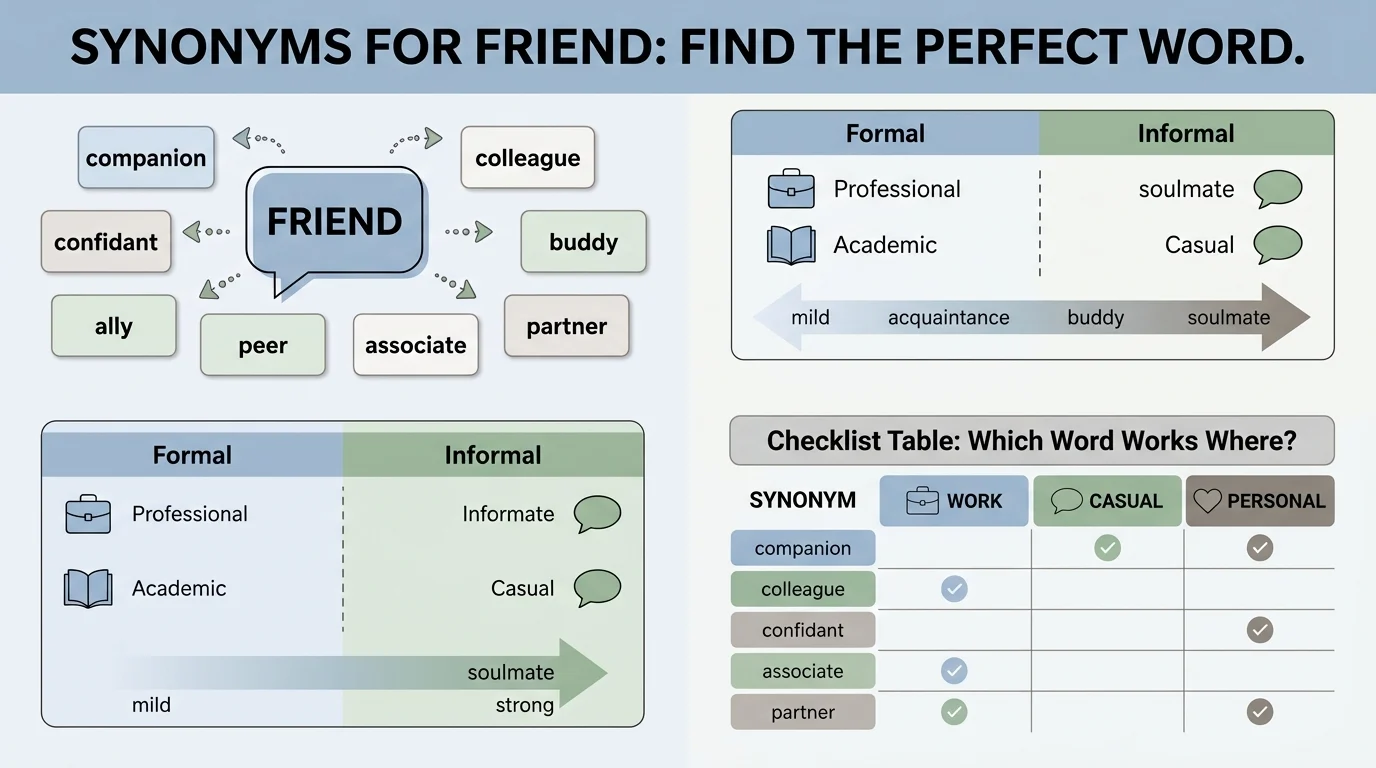
A friend is someone you know, like, and trust outside of your family relationships. The best synonyms depend on your situation. Use “colleague” for professional settings, “companion” for casual contexts, “ally” for emotional support, and “associate” for formal writing. “Buddy” and “pal” work well for social media and casual conversation.
Meaning, Tone and Context
Simple definition: A friend is a person you know well and regard with affection and trust. This relationship goes beyond simple acquaintance and involves mutual care, shared experiences, and emotional connection.
Part of speech: Noun. The word can also appear as an adjective in phrases like “friend group” or “friend zone.”
Tone: Positive and warm. The word carries strong emotional weight and implies genuine connection.
Formality level: Neutral. “Friend” works in nearly every context, from casual chats to formal writing. However, professional situations often call for more specific alternatives.
Common use cases: Personal conversations, social media posts, emails to people you know, essays about relationships, storytelling, and everyday speech.
Important word forms: Friendship (noun), friendly (adjective), friendless (adjective), befriend (verb). These related forms help you express different aspects of connection.
When and How to Use “Friend”
“Friend” works best when you want to express genuine connection and warmth without overcomplicating your message. It is your default choice for most personal situations. However, you should consider alternatives when you need more precision or formality. The word fits naturally in everyday conversation, personal writing, and casual correspondence. It creates an immediate sense of familiarity and trust between the speaker and the listener.
Professional context example:
My friend from the marketing department helped me finalize the presentation.
Personal context example:
Sarah has been my closest friend since we were in elementary school.
Academic context example:
The study examined how friend relationships influence adolescent development.
Emotional context example:
In that difficult moment, I realized what a true friend really means.
Creative writing example:
The old friend appeared at the doorstep after twenty years of silence.
Social media caption example:
Grateful for this friend who makes every adventure better.
Casual conversation example:
My friend just texted me about the concert tickets.
Another Word for “Friend”
The best single replacement for “friend” depends entirely on your context and audience. You need to match the word to the situation for maximum impact and clarity.
Professional writing: Use “colleague” or “associate” to emphasize workplace relationships and professional connections.
Academic writing: Choose “peer” or “contemporary” to highlight equality in age, status, or academic standing.
Casual conversation: “Buddy,” “pal,” or “mate” create a relaxed, friendly tone in everyday speech.
Emotional writing: “Ally,” “confidant,” or “companion” convey deeper emotional bonds and trust.
Creative writing: “Comrade,” “familiar,” or “intimate” add literary depth and descriptive richness.
Resume or workplace use: “Colleague,” “professional contact,” or “network connection” maintain appropriate professionalism.
Social media captions: “Bestie,” “ride or die,” or “soul sister” fit the casual, expressive nature of these platforms.
Stronger meaning: “Ally,” “confidant,” or “brother” suggest unbreakable bonds and deep loyalty.
Softer meaning: “Acquaintance,” “familiar face,” or “casual contact” indicate less intense relationships.
When Not to Use “Friend”
You should avoid “friend” when you need more specific information about a relationship. The word becomes too vague in professional situations where you must describe exact working relationships. It can also sound too casual for formal writing such as business reports or academic papers. Sometimes “friend” creates confusion because it cannot show the depth or nature of the connection.
Example of weak usage:
I met with my friend to discuss the contract.
Improved with precise synonym:
I met with my legal associate to discuss the contract.
Example of vague usage:
She is a friend from my networking group.
Improved with precise synonym:
She is a professional contact from my networking group.
Example of overly casual usage:
My friend in the accounting department approved the expense report.
Improved with precise synonym:
My colleague in the accounting department approved the expense report.
Words Commonly Confused With “Friend”
Many people mix up “friend” with similar words that describe different types of relationships. Understanding these differences helps you choose the most accurate word.
Friend vs. Acquaintance: A friend involves emotional connection and trust. An acquaintance is someone you know casually without deeper bonds. Use “acquaintance” when you need to show distance or limited interaction.
Friend vs. Colleague: A colleague works with you professionally. A friend may or may not share your workplace. Use “colleague” when the professional context matters more than personal connection.
Friend vs. Companion: A companion shares activities or experiences with you. A friend involves emotional depth beyond shared activities. Use “companion” when emphasizing shared experiences or travel.
Friend vs. Ally: An ally supports you actively in a cause or conflict. A friend offers general emotional support. Use “ally” when you need to show active partnership or advocacy.
Friend vs. Peer: A peer shares similar age, status, or ability. A friend may be any age or status. Use “peer” in academic or professional contexts where equality matters.
Friend vs. Confidant: A confidant receives your deepest secrets and private thoughts. A friend may not know your most personal information. Use “confidant” when emphasizing trust and privacy.
Best Synonym by Context for “Friend”
| Context | Best Synonym | Why It Works | Example |
|---|---|---|---|
| Formal writing | Associate | Shows professional connection with appropriate formality | The associate provided valuable feedback on the project. |
| Academic writing | Peer | Emphasizes equality in academic or research settings | The study compared peer influences on student performance. |
| Professional or business use | Colleague | Clearly indicates workplace or industry relationship | My colleague presented the quarterly results to the board. |
| Resume | Professional contact | Maintains appropriate workplace formality | Developed strong relationships with professional contacts across departments. |
| Casual conversation | Buddy | Creates warmth and familiarity without intensity | My buddy and I are planning a road trip for next month. |
| Creative writing | Comrade | Adds literary depth and emotional weight | The comrade stood beside him through every battle. |
| Emotional tone | Confidant | Emphasizes trust, secrets, and deep connection | She became my confidant during that difficult year. |
| Strong intensity | Ally | Shows active support and unwavering loyalty | He proved to be a true ally when I needed support most. |
| Soft or moderate tone | Companion | Focuses on shared activities without emotional intensity | My travel companion made the journey more enjoyable. |
| Social media captions | Bestie | Matches casual, expressive social media culture | Celebrating another year with my bestie by my side. |
Which Synonym Should You Choose?
Your choice depends on several factors. First, consider your audience. Professional settings require formal words like “colleague” or “associate.” Personal writing gives you more freedom to choose emotional or casual options. Second, think about the emotional intensity you want to convey. “Confidant” suggests deep trust, while “buddy” suggests casual warmth. Third, examine your sentence context. Academic papers need precise, neutral words like “peer.” Creative writing allows more descriptive choices like “comrade.” Finally, consider the specific nature of the relationship. Are you describing a work connection, a childhood bond, or a casual social contact? Each situation calls for a different word.
Real Life Examples of “Friend” in Sentences
School context:
My study partner helped me understand the calculus concepts I kept missing.
Workplace context:
The senior associate mentored me through my first major client presentation.
Writing context:
The novelist described her protagonist’s companion as the voice of reason.
Conversation context:
My gym buddy and I have been working out together for three years now.
Social media context:
Celebrating Galentine’s Day with my favorite ladies and my ride or die.
Email context:
Dear valued colleague, I appreciate your thoughtful contribution to this initiative.
Storytelling context:
The old comrade appeared in the village after decades of separation.
25 Synonyms for “Friend”
| Synonym | Simple Meaning | Best Used For | Example Sentence |
|---|---|---|---|
| Companion | Someone who shares experiences with you | Travel, activities, everyday company | My hiking companion kept me motivated on the trail. |
| Colleague | Someone who works with you professionally | Workplace, business, professional settings | My colleague recommended me for the promotion. |
| Associate | A person connected with you professionally | Formal business, legal, or professional contexts | The associate helped negotiate the contract terms. |
| Peer | Someone equal in age, status, or ability | Academic writing, research, professional equality | The study examined how peer relationships affect learning. |
| Ally | Someone who actively supports you | Advocacy, political contexts, strong emotional bonds | She remained my ally throughout the difficult campaign. |
| Confidant | Someone you trust with secrets | Emotional writing, personal revelations, deep trust | He was my confidant during the family crisis. |
| Buddy | A casual friend | Informal speech, social media, casual settings | My buddy and I are grabbing dinner tonight. |
| Pal | A friendly acquaintance | Casual conversation, lighthearted writing | We have been pals since college orientation. |
| Comrade | A companion in shared struggle or cause | Creative writing, historical contexts, activism | The comrades fought together for their shared vision. |
| Mate | A friend in casual British or Australian English | Casual speech, UK or Australian contexts | He is my best mate from university. |
| Acquaintance | Someone you know casually | Situations requiring distance or limited connection | She is an acquaintance from the local book club. |
| Crony | A close friend with possible negative undertones | Neutral or slightly critical contexts | He gave the contract to his crony from business school. |
| Bosom friend | An extremely close friend | Emotional, literary, or personal writing | She has been my bosom friend since childhood. |
| Sidekick | A constant companion who assists you | Creative writing, casual contexts, storytelling | The detective solved the case with his trusted sidekick. |
| Compadre | A close friend in Spanish influenced contexts | Cultural contexts, informal writing | We have been compadres since we were teenagers. |
| Familiar | A close friend or frequent companion | Literary writing, slightly formal contexts | The familiar arrived at the house each evening. |
| Intimate | A very close personal friend | Emotional writing, personal relationships | She shared the news only with her intimates. |
| Soul sister | A female friend with deep connection | Social media, casual speech, personal writing | My soul sister knows me better than anyone. |
| Ride or die | A friend who stays loyal forever | Modern slang, social media, casual speech | My ride or die has supported me through everything. |
| Bestie | A best friend in modern casual English | Social media, texts, casual conversation | Having lunch with my bestie this afternoon. |
| Brother | A male friend considered like family | Close emotional bonds, informal speech | He has been my brother since we were roommates. |
| Sister | A female friend considered like family | Close emotional bonds, informal speech | My sister from another mother just called. |
| Lover | A romantic partner or close friend | Romantic contexts, creative writing | They were friends before becoming lovers. |
| Protector | A friend who keeps you safe | Emotional writing, descriptive contexts | He was my protector during those uncertain years. |
| Champion | A friend who advocates for you | Professional, personal, or emotional contexts | She has been my champion in every career move. |
Synonym Groups and Usage Differences
Professional vs. Personal Synonyms
Professional contexts require words that emphasize work relationships and appropriate boundaries. “Colleague” and “associate” show respect and professionalism in workplace communication. These words also help you maintain distance when necessary. Personal contexts allow warmer, more emotional language such as “friend,” “companion,” or “confidant.” You should always match your word choice to the relationship you want to describe.
Formal vs. Conversational Synonyms
Formal writing, including reports, essays, and speeches, demands precise, neutral words. “Associate” and “peer” work well in these situations. They carry no emotional weight and focus purely on relationship type. Conversational contexts allow casual, warm words such as “buddy,” “pal,” and “mate.” These words create familiarity and comfort in everyday speech. Emails can fall anywhere on this spectrum depending on your relationship with the recipient.
Academic Synonyms
Academic writing requires precise, neutral language that avoids emotional overtones. “Peer” is the strongest choice for academic contexts. It emphasizes equality and shared status in research or educational settings. “Contemporary” works well in historical or literary analysis. “Associate” fits research contexts where you describe working relationships. These words help maintain objective, professional tone in scholarly work.
Professional and Business Synonyms
Workplace communication needs words that show respect, maintain boundaries, and accurately describe relationships. “Colleague” works for most professional situations. It shows you work together without implying personal friendship. “Associate” fits formal business writing and legal contexts. “Professional contact” describes networking relationships. These words help you communicate effectively in resumes, emails, presentations, and meetings.
Creative or Literary Synonyms
Creative writing benefits from descriptive, emotionally rich words. “Comrade” adds historical or political depth to your writing. “Intimate” suggests deep emotional connection. “Familiar” creates a sense of frequent presence and comfort. “Protector” adds tension and emotional weight. These words help you build vivid characters and relationships that resonate with readers.
Strongest vs. Weaker Synonyms
The intensity of your word choice affects how readers perceive the relationship. Weaker options like “acquaintance” and “familiar face” suggest limited connection. Moderate options like “companion” and “associate” show regular interaction. Strong options like “confidant” and “ally” indicate deep trust. The strongest words include “ride or die,” “soul sister,” “brother,” and “sister,” which suggest family level bonds.
Emotional vs. Neutral Synonyms
Emotional synonyms add feeling and personal connection to your writing. “Confidant,” “ally,” and “comrade” carry clear emotional weight. These words help you express deep bonds and loyalty. Neutral synonyms stay factual and objective. “Peer,” “associate,” and “colleague” describe relationships without emotional language. Choose based on whether you want to emphasize connection or simply state a fact.
Antonyms of “Friend”
| Antonym | Meaning | Example Sentence |
|---|---|---|
| Enemy | Someone who actively opposes you | The enemy worked against our team at every opportunity. |
| Foe | A hostile opponent | The political foe criticized her policies publicly. |
| Rival | Someone who competes with you | My rival at work applied for the same promotion. |
| Opponent | Someone who disagrees or competes | The opponent challenged every argument I presented. |
| Adversary | Someone who fights against you | The adversary refused to negotiate any settlement. |
| Competitor | Someone who competes in business or sports | Our competitor released a similar product last week. |
| Antagonist | Someone who opposes the main character | The antagonist created conflict throughout the story. |
| Stranger | Someone you do not know | The stranger approached me with an urgent question. |
| Outsider | Someone not part of a group | The outsider struggled to understand our team culture. |
| Foe | A personal or political enemy | The former friend became a bitter foe after the argument. |
| Nemesis | A powerful long term opponent | The superhero finally defeated his nemesis in battle. |
| Detractor | Someone who criticizes you | The detractor wrote negative comments about my work. |
| Critic | Someone who judges unfavorably | The critic dismissed the entire project as worthless. |
| Opposer | Someone who opposes an idea or action | The opposer stood against every policy change. |
| Betrayer | Someone who breaks trust | The betrayer revealed our secrets to the competitor. |
Comparison: Friend vs. Similar Words
Friend vs. Acquaintance
The main difference is emotional connection and trust. A friend knows you well and cares about you. An acquaintance is someone you know casually without deeper bonds. The friend relationship is stronger and more personal. Use “friend” when you want to show genuine connection. Use “acquaintance” when you need to show distance or limited interaction.
Example for friend: My friend knows about my personal struggles and supports me.
Example for acquaintance: I have a casual acquaintance in the accounting department.
Friend vs. Colleague
The main difference is context and relationship focus. A colleague shares your professional environment. A friend may or may not work with you. The colleague relationship centers on work activities. The friend relationship centers on personal connection. Use “colleague” for workplace situations. Use “friend” for personal situations.
Example for friend: My friend and I go to concerts together on weekends.
Example for colleague: My colleague and I collaborate on quarterly reports.
Friend vs. Ally
The main difference is active support versus general connection. An ally actively supports you in specific causes or conflicts. A friend offers general emotional support. The ally relationship focuses on shared goals or battles. The friend relationship focuses on personal connection. Use “ally” when emphasizing active partnership. Use “friend” for general personal relationships.
Example for friend: My friend listens when I need emotional support.
Example for ally: My ally defended my proposal at the board meeting.
Friend vs. Confidant
The main difference is trust level and privacy. A confidant knows your deepest secrets and private thoughts. A friend may not know your most personal information. The confidant relationship involves high trust and vulnerability. The friend relationship may involve less personal sharing. Use “confidant” when emphasizing trust and privacy. Use “friend” for broader personal connections.
Example for friend: My friend and I enjoy hiking on weekends.
Example for confidant: My confidant knows about my hidden career anxieties.
Friend vs. Companion
The main difference is shared experiences versus emotional connection. A companion shares activities or experiences with you. A friend involves emotional depth beyond activities. The companion relationship focuses on doing things together. The friend relationship involves caring and trust. Use “companion” when emphasizing shared activities. Use “friend” when emotional connection matters.
Example for friend: My friend supports me during difficult times.
Example for companion: My travel companion made the trip more fun.
Friend vs. Peer
The main difference is equality versus emotional connection. A peer shares similar age, status, or ability. A friend may be any age or status. The peer relationship focuses on equality. The friend relationship focuses on connection. Use “peer” in academic or professional contexts. Use “friend” for personal relationships.
Example for friend: My friend from the gym encourages me to work harder.
Example for peer: My peer reviewed my research paper before submission.
Common Phrases and Expressions with “Friend”
1. A friend in need is a friend indeed
Meaning: True friends show their loyalty when you need help.
Example sentence: When I lost my job, she helped me revise my resume. A friend in need is a friend indeed.
2. Close friend
Meaning: Someone with whom you share a deep emotional bond.
Example sentence: Only my close friend knows about my hidden artistic ambitions.
3. Best friend
Meaning: Your most trusted and closest friend.
Example sentence: My best friend has known me since we were five years old.
4. Mutual friend
Meaning: A person who is friends with two people who may not know each other.
Example sentence: Our mutual friend introduced us at the dinner party.
5. Fair weather friend
Meaning: Someone who supports you only when things are going well.
Example sentence: He proved to be a fair weather friend when I experienced financial difficulties.
6. Childhood friend
Meaning: Someone you have known since childhood.
Example sentence: My childhood friend and I still celebrate our birthdays together.
7. Family friend
Meaning: A friend who is close to your entire family.
Example sentence: Our family friend has attended every Thanksgiving dinner for thirty years.
8. Friendship
Meaning: The relationship between friends.
Example sentence: Our friendship has lasted through many difficult seasons.
Common Mistakes to Avoid
Using “friend” when a more precise synonym is better: Many writers default to “friend” in professional contexts where “colleague” or “associate” would be more accurate. This mistake makes your writing sound vague and unprofessional.
Confusing “friend” with “acquaintance”: Some people overuse “friend” to describe casual connections. This can confuse readers about the true nature of your relationship. Reserve “friend” for genuine emotional connections.
Using a casual synonym in formal writing: Words like “buddy,” “pal,” or “bestie” have no place in professional emails, academic essays, or business reports. They sound immature and inappropriate in serious contexts.
Using an overly dramatic synonym for a simple situation: Calling a casual work contact your “ally” or “confidant” sounds forced and insincere. Match your word choice to the actual relationship intensity.
Repeating the same word too often: Using “friend” multiple times in one paragraph creates boring, repetitive writing. Vary your vocabulary with appropriate synonyms for better flow.
Choosing a synonym with the wrong emotional tone: Saying someone is your “companion” when you mean “confidant” minimizes the emotional depth of your relationship. Be accurate about your feelings.
Using slang in academic or professional writing: Avoid modern casual words such as “ride or die,” “bestie,” or “soul sister” in formal contexts. These words do not belong in serious writing.
FAQs
What is the best synonym for friend?
The best synonym depends on context. Use “colleague” for professional settings, “companion” for casual situations, and “confidant” for deep emotional bonds.
What is a formal synonym for friend?
“Associate” and “colleague” are formal synonyms that work well in business, legal, and professional writing contexts.
What is an informal synonym for friend?
“Buddy,” “pal,” and “mate” are casual synonyms that work well in texts, social media, and everyday conversation.
What is another word for friend in professional writing?
“Colleague” works best for workplace relationships, while “associate” fits formal business or legal contexts.
What is the difference between friend and acquaintance?
A friend involves emotional connection and trust. An acquaintance is someone you know casually without deeper bonds.
What is the opposite of friend?
Common antonyms include enemy, foe, rival, opponent, adversary, and stranger, depending on the context.
Conclusion
“Friend” is a warm, positive word that expresses genuine connection. However, this guide has shown you many more precise alternatives. The best synonym depends on your audience, context, and emotional intensity. Professional situations need formal words like “colleague” or “associate.” Personal writing allows warmer, more emotional choices.
Creative contexts benefit from descriptive words like “comrade” or “confidant.” Remember to match your word choice to the relationship you describe. Avoid using “friend” in every situation when more accurate options exist. Building your vocabulary with these synonyms will make your writing stronger, your speech more precise, and your communication more effective. Start using these new words today and notice how your language improves.