Have you ever read back a piece of writing and realized you used the word “develop” in every other sentence? You are not alone. This happens to students finishing essays, professionals drafting reports, and job seekers polishing resumes. The word “develop” feels safe and familiar.
That is exactly why it gets overused. Relying on the same word makes your writing sound repetitive and dull. Your ideas deserve more precise language. Choosing the right synonym can transform a boring sentence into something clear and powerful. The right word shows confidence and command of the language.
This guide will help you break the habit of overusing “develop.” You will discover dozens of alternatives that fit different situations. Your writing and speaking will become more engaging and effective.
What Does “Develop” Mean?
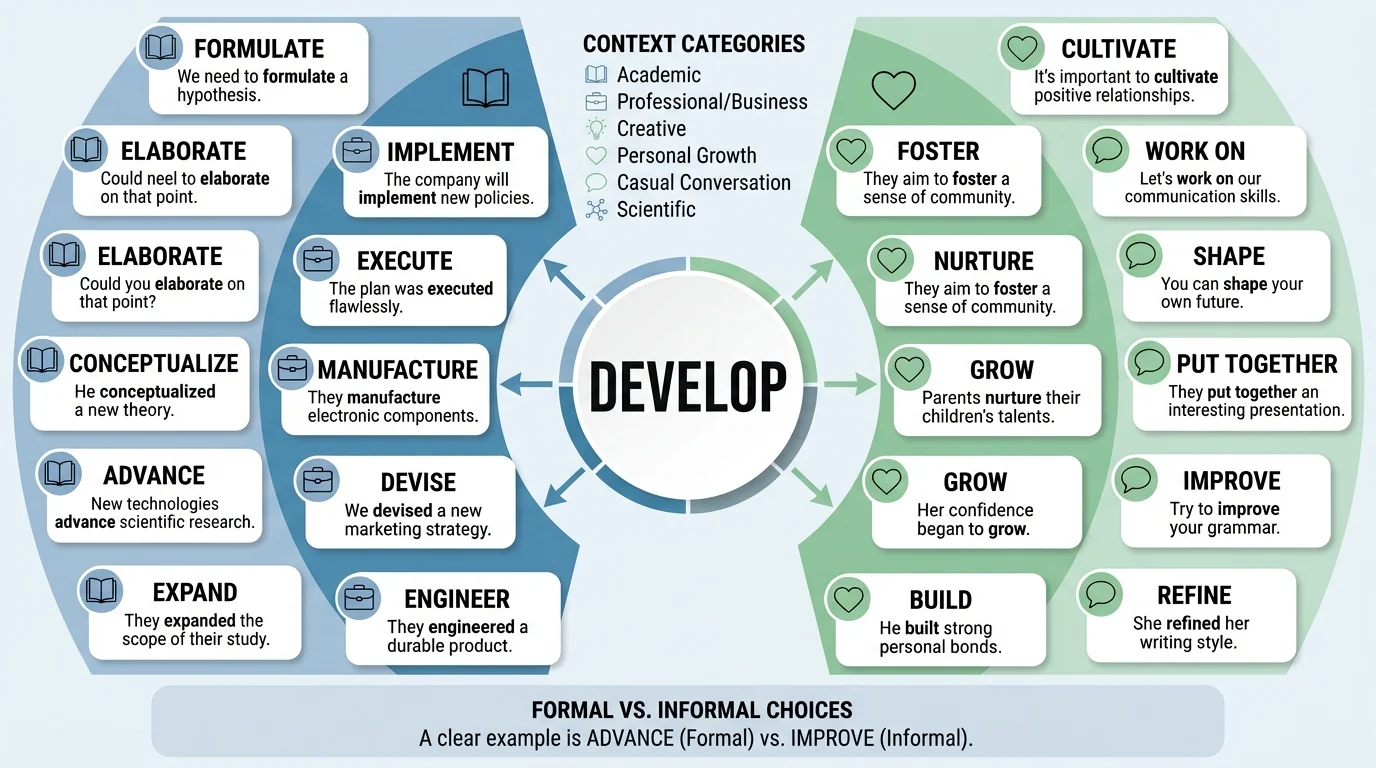
Develop means to grow, advance, or create something over time through a process. The best synonyms depend on your context. Use “cultivate” for personal growth, “generate” for creative ideas, “advance” for career progress, “establish” for professional settings, and “foster” for emotional relationships. For academic work, choose “formulate” or “devise.” For casual conversations, “work on” or “build” work perfectly.
Meaning, Tone and Context
Develop is a versatile English verb with a positive to neutral tone.
Simple definition: To grow, progress, or create something gradually through effort and time.
Part of speech: Verb. The noun form is “development.” The adjective form is “developmental.”
Tone: Generally positive or neutral. It implies advancement and improvement. The tone can shift based on context. In business, it sounds professional. Personal growth, it sounds encouraging. In scientific writing, it remains objective.
Formality level: Medium formal. It works across all formality levels. You can use it in academic papers, business emails, casual conversations, and creative writing.
Common use cases: Career progress, skill improvement, product creation, idea formation, relationship building, project management, personal growth, and scientific processes.
Important word forms: Develop is a verb. The past tense is “developed.” The present participle is “developing.” The noun form is “development.” The adjective form is “developmental.” The opposite words include “stagnate,” “decline,” and “regress.”
When and How to Use “Develop”
Use “develop” when you want to describe a process of growth, creation, or advancement over time. The word works best when you want to keep things general. It serves as a safe default when you are unsure which specific verb fits. However, you should consider whether a more precise synonym would strengthen your message.
Here are realistic examples of using “develop” in different contexts.
Professional context: The team worked hard to develop a new software solution for our clients. This sentence works but you could use “create” or “build” for more directness.
Personal context: I want to develop better time management skills this year. This sounds natural and shows a personal growth goal.
Academic context: The researcher spent years developing a theoretical framework for the study. This maintains the formal, precise tone required for academic writing.
Creative context: The artist began to develop a unique painting style after traveling abroad. This describes an organic creative evolution.
Social media caption: We are developing something exciting behind the scenes. Stay tuned. This builds anticipation without revealing too much.
Email context: I will develop a detailed proposal for the meeting next week. This is clear professional communication.
Resume context: Helped develop marketing campaigns that increased engagement by 40 percent. This highlights achievement and impact.
Casual conversation: She has developed a great sense of humor over the years. This describes a natural change in a friendly way.
Another Word for “Develop”
The best single replacement for “develop” depends entirely on your context. Here are the strongest options for specific situations.
Professional writing: Use “establish” when you mean to set something up. Use “implement” when you mean to put a plan into action. Use “generate” when you mean to produce something new.
Academic writing: Use “formulate” for creating theories or plans. Use “synthesize” for combining ideas. Use “postulate” for suggesting theoretical concepts.
Casual conversation: Use “work on” as a relaxed alternative. Use “build” for a straightforward option. Use “grow” for natural personal changes.
Emotional writing: Use “cultivate” for nurturing feelings or relationships. Use “foster” for encouraging growth in others. Use “nurture” for careful, loving development.
Creative writing: Use “evolve” for natural transformation. Use “craft” for deliberate creation. Use “forge” for building through effort.
Resume use: Use “spearheaded” for leadership. Use “pioneered” for innovation. Use “orchestrated” for coordination and management.
Social media captions: Use “cooking up” for playful anticipation. Use “building” for active effort. Use “creating” for directness.
Stronger meaning: Use “accelerate” when you mean faster progress. Use “transform” for dramatic change. Use “revolutionize” for complete rethinking.
Softer meaning: Use “adjust” for small changes. Use “refine” for gradual improvement. Use “adapt” for responding to circumstances.
When Not to Use “Develop”
“Develop” sounds too vague in many situations. You should avoid it when a more specific word would communicate your meaning with greater precision.
Avoid vague language in professional settings. Weak sentence: We will develop our customer service. Improved sentence: We will improve our customer service response time.
Avoid “develop” for sudden events. Wrong: The storm developed suddenly. Better: The storm struck suddenly. “Develop” suggests a process, not a sudden event.
Avoid “develop” when you mean “discover.” Wrong: Scientists developed a cure. Better: Scientists discovered a cure. A cure is found, not created.
Avoid “develop” in creative contexts. Weak sentence: I developed a story. Better sentence: I wrote a story. Writing is the specific action.
Avoid “develop” for physical actions. Wrong: She developed the table. Better: She built the table. Building is the precise physical action.
Avoid “develop” when describing feelings. Weak sentence: I developed feelings. Better sentence: I fell in love. The direct emotional verb is more powerful.
Use a stronger synonym when you want impact. Weak sentence: The company developed a new product. Better sentence: The company launched a new product. Launching is more dynamic and exciting.
Words Commonly Confused With “Develop”
Several verbs are often confused with “develop.” Each has a distinct meaning and use case. Understanding the differences helps you choose the right word.
Develop vs. Grow: “Develop” focuses on process and creation. “Grow” focuses on natural increase in size or quantity. Use “grow” for plants, populations, and natural expansion. Use “develop” for skills, ideas, and artificial processes. Children grow physically but develop mental abilities.
Develop vs. Create: “Develop” suggests a gradual process. “Create” suggests bringing something new into existence. You create a painting but develop a skill. Creation is often instantaneous. Development takes time.
Develop vs. Improve: “Develop” means to make or become better over time. “Improve” specifically means to make something better than before. You can develop a new feature that improves an existing product.
Develop vs. Evolve: “Develop” often involves conscious effort or planning. “Evolve” suggests natural, unplanned change over time. Businesses evolve in response to markets. Teams develop strategies to succeed.
Develop vs. Build: “Build” specifically refers to constructing physical or abstract structures. “Develop” has a broader application. You build a house or an argument. You develop a skill or a relationship.
Develop vs. Establish: “Establish” means to set up something lasting. “Develop” emphasizes the growth process. You establish a company. You develop its operations over time.
Best Synonym by Context for “Develop”
| Context | Best Synonym | Why It Works | Example |
|---|---|---|---|
| Formal writing | Establish | Conveys authority and permanence | The committee established new guidelines for research ethics. |
| Academic writing | Formulate | Suggests careful, precise thinking | The professor formulated a hypothesis based on previous studies. |
| Professional business | Implement | Shows execution and action | The manager implemented the strategy across all departments. |
| Resume use | Spearheaded | Demonstrates leadership and initiative | Spearheaded a project that reduced costs by 20 percent. |
| Casual conversation | Work on | Sounds relaxed and approachable | I am working on a new recipe for dinner tonight. |
| Creative writing | Craft | Emphasizes skill and artistry | The author crafted a narrative that captivated readers. |
| Emotional tone | Cultivate | Suggests nurturing and care | She cultivated a deep connection with her community. |
| Strong intensity | Transform | Indicates dramatic, meaningful change | The new policy transformed the company culture. |
| Soft moderate tone | Refine | Suggests gradual, careful improvement | We need to refine our approach for better results. |
| Social media captions | Build | Short, active, and visually strong | Building something amazing for you all. |
| US usage | Cultivate | Common in American self improvement contexts | He cultivated a strong work ethic from a young age. |
| UK usage | Foster | More common in British professional contexts | The organization fostered innovation among its staff. |
| Scientific context | Generate | Emphasizes creation of data or results | The experiment generated significant data for analysis. |
| Personal growth | Advance | Suggests forward movement in life goals | She advanced her career through continuous learning. |
| Relationship context | Strengthen | Shows building of bonds or connections | We strengthened our partnership through open communication. |
Which Synonym Should You Choose?
Choosing the perfect synonym requires thinking about your specific situation. Consider these factors before making your decision.
Consider the meaning. What exactly are you trying to say? Are you creating something new, improving something existing, or making something grow? If you are creating a product, use “create” or “generate.” If you are improving a skill, use “refine” or “enhance.” You are making something grow, use “cultivate” or “foster.”
Consider the formality. Are you writing a text message or a business report? Text messages allow casual words like “work on” or “build.” Business reports need professional words like “implement” or “establish.” Academic papers demand precise words like “formulate” or “postulate.”
Consider the emotional intensity. Are you describing a routine project or a life changing event? Routine projects need neutral words like “develop” or “construct.” Exciting events need strong words like “transform” or “revolutionize.” Sensitive situations need gentle words like “nurture” or “cultivate.”
Consider the professional value. Does this word make you sound competent and credible? “Spearhead” and “orchestrate” demonstrate leadership. “Implement” and “generate” show action. “Formulate” and “devise” show intelligence. Choose words that reflect your abilities.
Consider the sentence context. Read the whole sentence with your chosen word. Does it flow naturally? Does it sound like something you would actually say? Your synonym should fit seamlessly into your sentence structure.
Real Life Examples of “Develop” in Sentences
These examples show how “develop” and its synonyms work across different real life situations. Pay attention to how each word changes the tone and meaning.
School context: The students worked together to develop a science fair project. They refined their hypothesis after reviewing the initial results.
Workplace context: The marketing team developed a comprehensive campaign for the product launch. They implemented a social media strategy that increased engagement significantly.
Writing context: The novelist developed each character with careful attention to their backstory. She crafted dialogue that revealed their deepest motivations.
Conversation context: We should develop a plan before we start the project. Let us work on the details together during the next meeting.
Social media context: Developing a new collection for spring. The designer is crafting pieces that blend modern style with classic elegance.
Resume context: Developed training programs that improved employee retention. Spearheaded the creation of a mentorship initiative that fostered professional growth.
Email context: I will develop the proposal by Friday. I will formulate a comprehensive strategy and circulate it for feedback.
Storytelling context: The hero developed courage through his many trials. He forged a path through adversity and transformed into a leader.
25 Synonyms for “Develop”
| Synonym | Simple Meaning | Best Used For | Example Sentence |
|---|---|---|---|
| Advance | Move forward in progress | Career and professional goals | She advanced her career through networking and skill building. |
| Build | Construct or create | Projects and physical objects | The team built a prototype for the new device. |
| Cultivate | Nurture growth through care | Personal skills and relationships | He cultivated a strong network of mentors and peers. |
| Establish | Set up something lasting | Organizations and systems | The nonprofit established a scholarship fund for students. |
| Evolve | Change gradually over time | Natural processes and ideas | The design evolved to meet changing customer needs. |
| Expand | Increase in size or scope | Business and operations | The company expanded its reach to international markets. |
| Flourish | Grow in a healthy way | Personal growth and success | Her talent flourished under the guidance of skilled mentors. |
| Forge | Create through effort | Strong relationships and paths | They forged a partnership that lasted for decades. |
| Formulate | Create through careful thinking | Plans and theories | The scientist formulated a new approach to the problem. |
| Foster | Encourage growth in others | Relationships and environments | The program fostered creativity among young artists. |
| Generate | Produce something new | Ideas and creative work | The brainstorming session generated dozens of new concepts. |
| Improve | Make better | Quality and performance | She improved her writing skills through consistent practice. |
| Invent | Create something original | Products and solutions | The engineer invented a device that revolutionized the industry. |
| Launch | Introduce something new | Products and initiatives | The publisher launched a new series of educational books. |
| Mature | Reach full development | People and ideas | His perspective matured after years of international experience. |
Synonym Groups and Usage Differences
Understanding synonym groups helps you choose the right word for your specific situation.
Professional vs. Personal Synonyms
Professional synonyms sound formal and action oriented. “Implement” and “execute” suggest getting things done. “Establish” and “institute” suggest creating lasting structures. “Orchestrate” and “coordinate” suggest managing complex projects. These words work well in business writing and professional communication.
Personal synonyms sound warmer and more human. “Cultivate” and “nurture” suggest careful attention. “Grow” and “mature” suggest natural progression. “Refine” and “polish” suggest gradual improvement. These words fit personal development and relationship contexts.
Formal vs. Conversational Synonyms
Formal synonyms belong in academic papers, business reports, and professional documents. “Formulate” shows precise thinking. “Postulate” shows theoretical reasoning. “Devise” shows intellectual creation. “Synthesize” shows combination of ideas. These words elevate your writing and demonstrate sophistication.
Conversational synonyms work well in casual writing, texts, and friendly emails. “Work on” is relaxed and easy. “Build” is straightforward and clear. “Grow” is natural and simple. “Make” is basic and direct. These words make your communication sound approachable.
Academic Synonyms
Academic writing demands precision and objectivity. “Formulate” works for creating theories. “Postulate” works for proposing ideas. “Synthesize” works for combining research. “Analyze” works for examining data. “Conceptualize” works for forming abstract ideas. These words demonstrate academic rigor and careful thinking.
Professional and Business Synonyms
Business communication needs action oriented language. “Implement” shows you execute plans. “Generate” shows you produce results. “Optimize” shows you improve efficiency. “Streamline” shows you simplify processes. “Integrate” shows you combine elements effectively. These words make your professional writing more dynamic.
Creative or Literary Synonyms
Creative writing benefits from vivid and imaginative language. “Craft” suggests artistic skill. “Forge” suggests strength and effort. “Weave” suggests complexity and beauty. “Sculpt” suggests careful shaping. “Orchestrate” suggests coordination of elements. These words add depth and artistry to your writing.
Strongest vs. Weaker Synonyms
Intensity scale from mild to strongest:
Mild: Work on, adjust, refine. These suggest small, gradual changes.
Moderate: Build, grow, improve. These suggest steady progress.
Strong: Establish, generate, formulate. These suggest significant creation.
Stronger: Transform, revolutionize, pioneer. These suggest dramatic change.
Strongest: Spearhead, orchestrate, forge. These suggest leadership and powerful action.
Emotional vs. Neutral Synonyms
Emotional synonyms add feeling to your writing. “Cultivate” suggests care and patience. “Nurture” suggests love and attention. “Foster” suggests encouragement and support. “Transform” suggests powerful change. These words connect with readers on an emotional level.
Neutral synonyms stay factual and objective. “Generate” focuses on output. “Implement” focuses on execution. “Produce” focuses on results. “Create” focuses on existence. These words work well in technical and professional writing where emotions are not needed.
Antonyms of “Develop”
| Antonym | Meaning | Example Sentence |
|---|---|---|
| Decline | Decrease in quality or quantity | The company’s performance began to decline after the merger. |
| Decrease | Become smaller or less | The demand for the product decreased over time. |
| Deteriorate | Become worse over time | The condition of the building deteriorated without maintenance. |
| Diminish | Make or become less | His influence in the organization diminished after the scandal. |
| Fade | Gradually disappear | Her enthusiasm for the project faded after repeated setbacks. |
| Halt | Stop completely | The construction of the facility halted due to budget issues. |
| Impair | Damage or weaken | The injury impaired his ability to perform at work. |
| Neglect | Fail to care for properly | She neglected her personal relationships while focusing on work. |
| Regress | Return to a former state | The patient regressed after stopping the treatment. |
| Decline | Refuse or fall back | The quality of service declined after the policy change. |
| Shrink | Become smaller in size | The market for the product shrank as competitors emerged. |
| Stagnate | Cease developing or moving | The project stagnated without clear leadership. |
| Weaken | Make or become weaker | The continuous stress weakened his health. |
| Worsen | Become more severe | The situation worsened as conflicts increased. |
| Dwindle | Become gradually less | Resources dwindled as the project continued. |
Comparison: Develop vs. Similar Words
Develop vs. Grow
The main difference is control. “Develop” suggests conscious effort and planning. You develop a skill through practice. “Grow” suggests natural or organic change. Plants grow with water and sunlight. “Grow” is more informal and biological. “Develop” is more formal and intentional. Example: She developed a new habit. The business grew rapidly last year.
Develop vs. Create
The main difference is process. “Develop” emphasizes the gradual process. You develop a product over months. “Create” emphasizes the end result. You create a work of art. “Create” is more final and complete. “Develop” suggests ongoing refinement. Example: He created a masterpiece. She developed a prototype for testing.
Develop vs. Improve
The main difference is direction. “Develop” focuses on creating or building. You develop a new system. “Improve” focuses on making better. You improve an existing system. “Develop” suggests starting from something. “Improve” suggests working with what exists. Example: We developed a new approach. We improved the current approach.
Develop vs. Evolve
The main difference is agency. “Develop” often involves active effort. You develop yourself through learning. “Evolve” suggests natural change over time. Languages evolve without conscious direction. “Develop” can be controlled. “Evolve” is often uncontrolled. Example: She developed her skills. The technology evolved naturally.
Develop vs. Build
The main difference is scope. “Build” specifically means constructing something. You build a house or an argument. “Develop” has broader applications. You develop skills, relationships, and ideas. “Build” is more concrete. “Develop” is more abstract. Example: They built a new office. They developed a new strategy.
Develop vs. Establish
The main difference is timing. “Establish” means to set up something lasting. You establish a tradition or company. “Develop” emphasizes the process. You develop operations after establishment. “Establish” is more permanent. “Develop” suggests ongoing growth. Example: They established a foundation. They developed its programs over time.
Common Phrases and Expressions with “Develop”
1. Develop a habit
Meaning: Create a regular pattern of behavior through repetition.
Example sentence: It takes about two months to develop a new habit.
2. Develop a taste for
Meaning: Learn to like something over time.
Example sentence: She developed a taste for classical music in college.
3. Develop a relationship
Meaning: Build a connection with someone over time.
Example sentence: They developed a strong relationship through shared experiences.
4. Develop a strategy
Meaning: Create a plan of action.
Example sentence: The team spent weeks developing a strategy for the campaign.
5. Develop an interest in
Meaning: Become curious or engaged with a subject.
Example sentence: He developed an interest in photography during his travels.
6. Develop skills
Meaning: Build and improve abilities through practice.
Example sentence: The internship helped her develop valuable professional skills.
7. Develop a reputation
Meaning: Gain a certain public perception over time.
Example sentence: The restaurant developed a reputation for excellent service.
8. Develop a plan
Meaning: Create a detailed proposal or approach.
Example sentence: We need to develop a plan before starting the project.
Common Mistakes to Avoid
Mistake 1: Using “develop” when a more precise synonym is better. Avoid vague language. Instead of “develop a solution,” say “devise a solution” or “design a solution.” The specific verb makes your writing stronger.
Mistake 2: Confusing “develop” with “evolve.” “Develop” implies conscious effort. “Evolve” implies natural change. The company developed a new strategy. The industry evolved on its own.
Mistake 3: Using a casual synonym in formal writing. Avoid “work on” in academic papers. Use “formulate” or “devise” instead. Your tone should match your context.
Mistake 4: Using an overly dramatic synonym for simple situations. Do not say “revolutionize” when you mean “improve.” Choose a word that matches the scale of your action.
Mistake 5: Repeating the same word too often. Vary your vocabulary. Use different synonyms to keep your writing interesting and engaging.
Mistake 6: Choosing a synonym with the wrong emotional tone. “Cultivate” sounds warm and patient. “Generate” sounds cold and mechanical. Pick a word that matches your emotional intent.
Mistake 7: Using slang in academic or professional writing. Avoid words like “cook up” or “whip up” in formal documents. These phrases are too casual for serious writing.
FAQs
1. What is the best synonym for develop?
The best synonym for develop depends on context. For professional writing, use “establish” or “implement.” For casual situations, use “work on” or “build.”
2. What is a formal synonym for develop?
Formal synonyms include “formulate,” “postulate,” “devise,” and “synthesize.” These words work well in academic and professional documents.
3. What is an informal synonym for develop?
Informal synonyms include “work on,” “cook up,” “whip up,” and “put together.” Use these in casual conversations and social media.
4. What is another word for develop in professional writing?
Professional alternatives include “implement,” “generate,” “orchestrate,” and “spearhead.” These words show action and leadership.
5. What is the difference between develop and create?
Develop emphasizes a gradual process. Create emphasizes bringing something new into existence. You develop skills but create art.
6. What is the opposite of develop?
The opposite of develop is “decline,” “deteriorate,” “stagnate,” or “regress.” These words describe a lack of progress or backward movement.
Conclusion
Develop is a useful verb that describes growth, progress, and creation. Its versatility makes it a go to word for many writers. That same versatility leads to overuse. The best writers know when to choose a more precise synonym. Each context demands a different approach. Professional writing needs words like “implement” and “establish.” Academic writing benefits from “formulate” and “postulate.” Creative writing thrives on “craft” and “forge.” Casual conversations work well with “build” and “work on.”
The key is awareness. Think about your meaning, your audience, and your tone before you write. Choose the word that delivers your message with clarity and impact. Practice using different synonyms in your daily writing. Your vocabulary will expand naturally. Your writing will become more engaging and effective. Stop settling for “develop” every time. You have dozens of better options at your disposal.