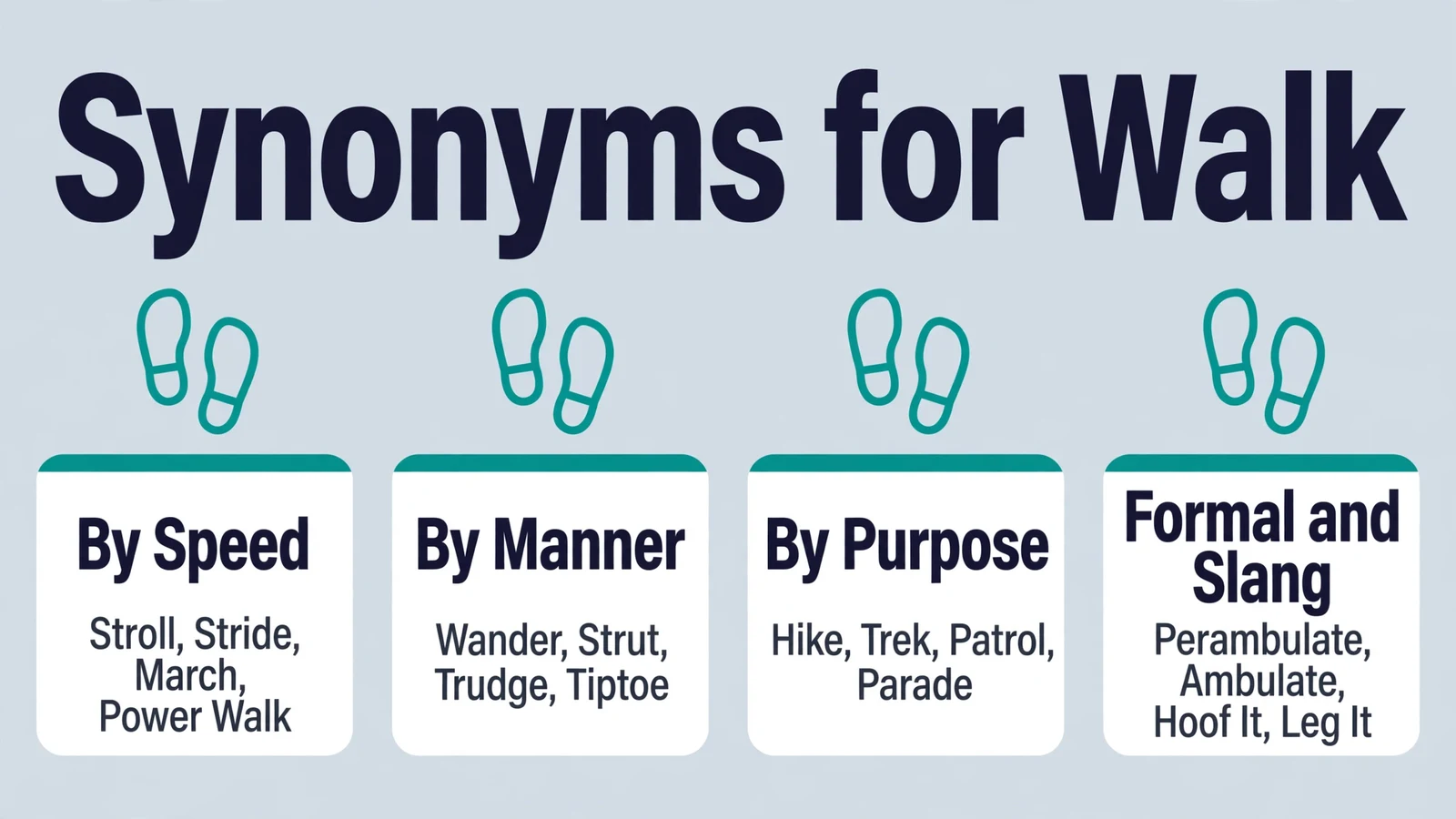
Few verbs get used as often as walk, and few sound as plain. The good news is that English offers a word for almost every way a person can move on foot. The most useful synonyms for walk include stroll, amble, saunter, stride, march, wander, hike, trek, trudge, tiptoe, and stride ahead of the pack in everyday writing. Each one paints a slightly different picture, though, which is why choosing well matters.
This guide groups more than 100 synonyms for walk by speed, manner, and purpose. Every word comes with a short meaning, and the key words include example sentences. As a result, you can pick the exact term your sentence needs instead of settling for the generic one.
Top Synonyms for Walk: Quick Reference
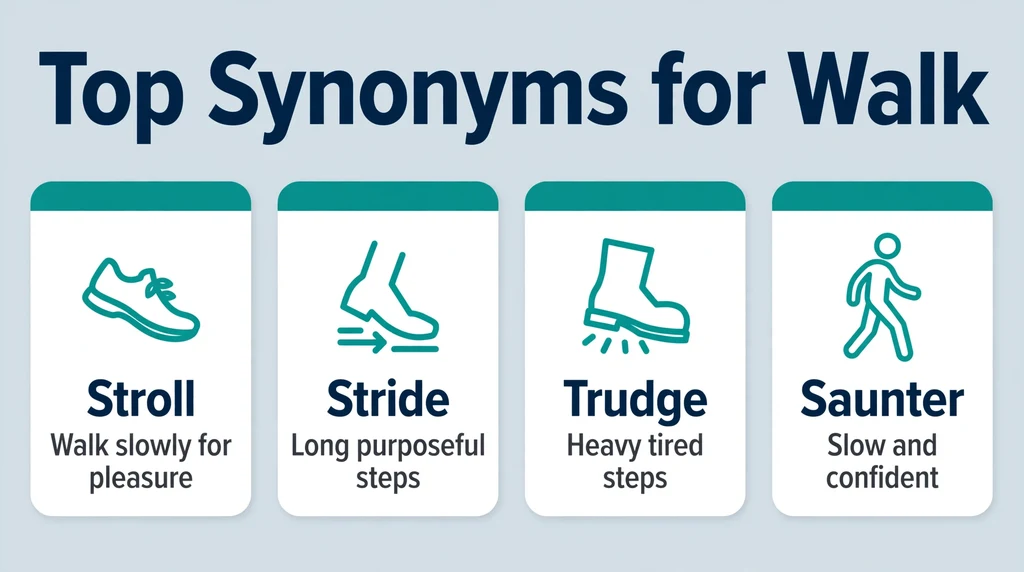
The table below covers the 28 synonyms readers reach for most often. Start here for one quick replacement. Later sections sort the full list into finer groups.
| Word | Meaning in one line | Best for |
|---|---|---|
| Stroll | Walk slowly for pleasure | Relaxed, pleasant moments |
| Amble | Walk at a slow, easy pace | Calm, unhurried scenes |
| Saunter | Walk slowly with confidence | Relaxed but self-assured tone |
| Stride | Take long, purposeful steps | Determination, urgency |
| March | Walk steadily with purpose | Protests, soldiers, resolve |
| Wander | Walk without a fixed route | Aimless, dreamy movement |
| Ramble | Walk for pleasure, often in nature | Countryside, long outings |
| Hike | Walk a long way over rough ground | Trails, hills, outdoors |
| Trek | Long journey on foot | Journeys, effort, adventure |
| Trudge | Walk with heavy, tired steps | Effort, bad weather, fatigue |
| Plod | Walk slowly and heavily | Dull, steady effort |
| Tiptoe | Walk quietly on the toes | Silence, not waking someone |
| Creep | Move slowly and quietly | Stealth, caution |
| Stagger | Walk unsteadily | Injury, shock, heavy loads |
| Strut | Walk proudly | Pride, showing off |
| Swagger | Walk with bold confidence | Arrogance, cool confidence |
| Traipse | Walk about without purpose | Informal, weary tone |
| Mosey | Move slowly and casually | Informal, relaxed speech |
| Roam | Wander over a wide area | Freedom, large spaces |
| Meander | Follow a winding, slow path | Rivers, gentle wandering |
| Tramp | Walk with firm, heavy steps | Long distances, determination |
| Perambulate | Walk about, very formal | Formal or humorous writing |
| Ambulate | Move about on foot, clinical | Medical and formal reports |
| Hoof it | Walk somewhere, slang | Humorous, informal speech |
| Pace | Walk back and forth steadily | Waiting, worry, thinking |
| Promenade | Walk publicly to be seen | Seaside towns, display |
| Patrol | Walk an area to guard it | Guards, police, duty |
| Power walk | Walk fast for exercise | Fitness, health writing |
What Does Walk Mean?
At its core, walk means to move on foot at a moderate pace, with at least one foot always touching the ground. Collins phrases the definition almost exactly that way, and Cambridge puts it more simply: you move forward by putting one foot in front of the other. That single detail explains why English needs so many near-synonyms.
Because the basic action is so simple, the extra meaning has to come from somewhere else. Sometimes it comes from speed, as with stroll and stride. At other times it comes from attitude, as with swagger and slouch. Purpose matters too, since hiking and patrolling describe very different outings. Consequently, most synonyms for walk are really the word walk plus one clear extra detail.
A handful of general words sit close to the core meaning. Step and tread focus on the feet themselves. Pace and advance stress steady forward movement. Proceed adds a formal tone, while the phrases go on foot and travel on foot state the method plainly. These neutral options help in reports and instructions, where colour would only distract.
Walk also leads a double life as a noun, and the noun section later in this guide lists its synonyms separately. A few phrases stretch the verb further. Walk the dog, walk someone home, and walk the plank all pair walk with a helper word or a set idiom, so they are not pure synonyms. This guide sticks to words that can stand in for walk on their own.
Synonyms for Walk by Speed
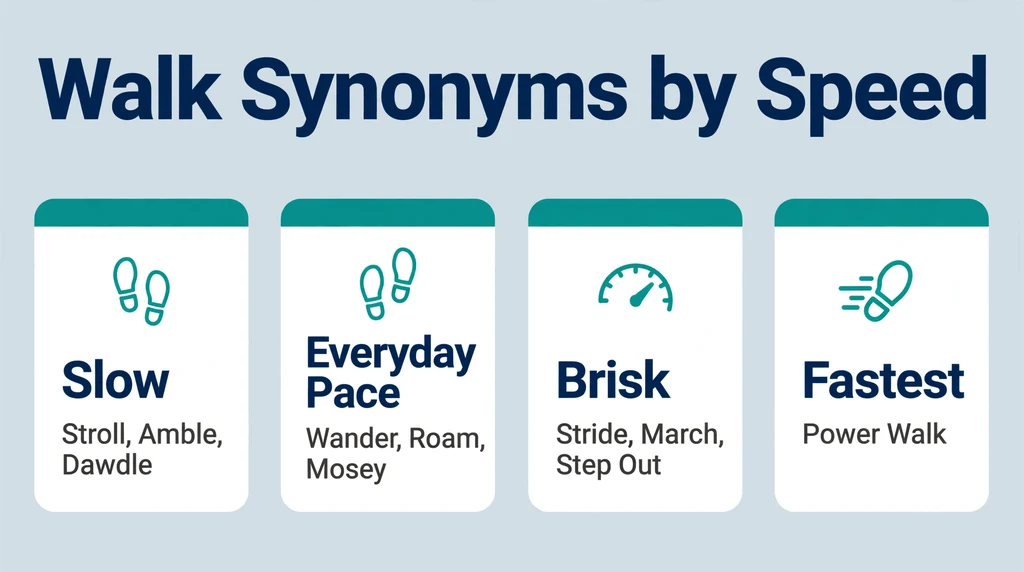
Speed is the first thing readers picture, so it is the natural place to start sorting. The scale below runs from the slowest, most relaxed words to the fastest pace a person can manage while still walking.
Slowest: The Relaxed End of the Scale
These words describe movement with no hurry at all. Use them when the scene feels calm and time does not matter.
- Stroll: walk slowly and enjoy the moment. Example: They strolled through the market after lunch.
- Amble: move at a slow, gentle pace. Example: She ambled down the lane, in no rush at all.
- Saunter: stroll in a relaxed, confident way. Example: He sauntered into the room like he owned it.
- Dawdle: walk slower than needed, wasting time. Example: The children dawdled on the way to school.
- Take a turn: take a short, gentle walk, slightly old-fashioned. Example: After dinner, we took a turn around the garden.
- Take the air: go out for a short walk, formal and dated. Example: She took the air along the cliff path.
- Stretch your legs: walk after sitting for a long time. Example: We stopped the car to stretch our legs.
An Easy, Everyday Pace
Some words keep the pace ordinary but add a hint of mood or direction. They suit daily scenes that need a little more life than plain walk.
- Wander: walk with no fixed route or goal. Example: We wandered from shop to shop all afternoon.
- Roam: wander freely across a wide area. Example: Deer roam the forest at dawn.
- Meander: move slowly along a winding path. Example: The trail meanders through the valley.
- Traipse: walk about, often longer than you wanted. Example: We traipsed around town looking for a pharmacy.
- Mosey: drift along slowly and casually, informal. Example: He moseyed over to the fence for a chat.
- Promenade: walk in a public place, often to see and be seen. Example: Couples promenaded along the pier at sunset.
Brisk and Purposeful
Faster walking words usually carry intent. The walker has somewhere to be, and the steps show it. Writers who need this energy also browse synonyms for fast for the adjectives that pair with these verbs.
- Stride: take long, confident steps. Example: She strode across the yard to meet them.
- March: walk steadily and with purpose. Example: He marched up to the desk and complained.
- Pace: walk back and forth, or move at a steady rate. Example: She paced the platform while the train was late.
- Step out: walk briskly, or head out on foot. Example: We stepped out early to beat the heat.
- Pad: move with soft, quiet but steady steps. Example: The cat padded across the kitchen floor.
- Advance: move forward in a formal or military tone. Example: The unit advanced toward the ridge at dawn.
Walking as Fast as Walking Gets
At the top of the scale, walking nearly becomes running, yet one foot still stays grounded. These two terms cover that limit.
- Power walk: walk very fast as exercise, with swinging arms. Example: She power walks around the park every morning.
- Race walking: the competitive sport is the formal name, but in daily speech people simply say they power walked. If your sentence is about sport, name the sport directly instead of hunting for a stronger verb.
Synonyms for Walk by Manner and Style
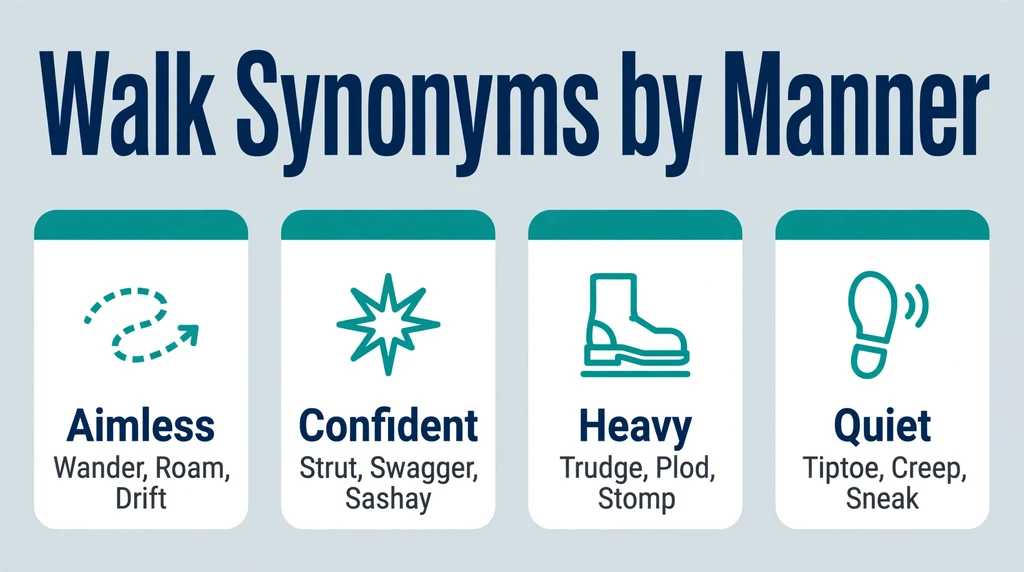
Speed tells only half the story. Manner tells the rest, because two people can cross the same street at the same pace and still look completely different. The groups below sort walking words by the picture they create.
Aimless and Wandering
These verbs suggest movement without a plan. The walker follows curiosity rather than a route, which gives scenes a dreamy or restless feel.
- Wander: move from place to place without a set aim. Example: He wandered around the old town for hours.
- Ramble: walk for pleasure, often across open country. Example: They rambled over the hills all Sunday.
- Roam: range widely and freely. Example: Wild horses roam the plain.
- Rove: roam or wander over a large area, slightly literary. Example: Her eyes roved across the crowd, though the verb also fits travellers.
- Stray: drift away from the right path or group. Example: The sheep strayed beyond the fence.
- Drift: move slowly and without clear control. Example: The crowd drifted toward the exits.
- Range: travel widely across an area. Example: Buffalo once ranged across the whole prairie.
- Loiter: hang around with no clear purpose. Example: Teenagers loitered outside the cinema.
- Straggle: lag behind or spread out untidily while moving. Example: The last hikers straggled into camp at dusk.
- Knock about: wander around informally, mostly British. Example: We knocked about the port for a day.
- Gallivant: roam about looking for fun, playful and informal. Example: He spent the summer gallivanting around Europe.
- Mooch: wander slowly with little energy, slang. Example: He mooched around the house all day.
Confident and Showy
Some walking words exist mainly to describe attitude. Pick these when posture and pride matter more than pace.
- Strut: walk proudly with the chest pushed out. Example: The peacock strutted across the lawn, and the manager did the same.
- Swagger: walk with bold, rolling confidence. Example: He swaggered in, certain everyone was watching.
- Sashay: move in a noticeable, graceful way, informal. Example: She sashayed across the dance floor.
- Prance: move with high, springy steps. Example: The pony pranced around the ring.
- Stalk: walk stiffly and angrily, or hunt quietly. Example: After the argument, he stalked out of the room.
- Parade: walk proudly in view of others. Example: The winners paraded around the stadium.
- Goose-step: march with stiff, high straight legs, mainly military. It carries strong historical associations, so writers use it with care.
- Flounce: move in a way that shows annoyance or impatience. Example: She flounced out after the remark.
- Mince: take short, delicate steps. Example: He minced across the icy pavement.
- Trip: move with light, quick steps, literary. Example: The children tripped down the steps, laughing.
Heavy and Tired
When the feet feel like lead, these are your words. They suit bad weather, long days, and heavy loads.
- Trudge: walk with slow, heavy, tired steps. Example: We trudged through the snow for an hour.
- Plod: walk heavily and slowly, with steady effort. Example: The oxen plodded along the muddy track.
- Slog: work through something difficult on foot, informal. Example: They slogged up the hill in the rain.
- Footslog: walk a long, tiring distance, British informal. Example: We footslogged it back to the station.
- Tramp: walk with firm, heavy steps over distance. Example: He tramped the moors for weeks.
- Tromp: tramp heavily, a US variant of the same idea. Example: The kids tromped through the puddles.
- Stomp: step down hard and noisily. Example: She stomped up the stairs in anger.
- Stamp: bring the foot down forcefully, often once. Example: He stamped his foot and refused.
- Clump: walk with heavy, noisy steps. Example: Boots clumped along the corridor.
- Lumber: move heavily and clumsily. Example: The bear lumbered toward the river.
- Pound: move with heavy, repeated impact. Example: Feet pounded the pavement behind her.
Unsteady and Struggling
Illness, injury, age, and exhaustion all change how a person moves. These words show the struggle clearly.
- Stagger: walk unsteadily, almost falling. Example: He staggered under the weight of the bags.
- Totter: move in an unstable, wobbly way. Example: The toddler tottered toward her mother.
- Hobble: walk with difficulty because of injury. Example: He hobbled off the field with a twisted ankle.
- Limp: walk unevenly because one leg hurts. Example: She limped home after the fall.
- Shuffle: drag the feet along the ground. Example: He shuffled to the door in his slippers.
- Shamble: shuffle in a clumsy, awkward way. Example: The sleepy guard shambled across the yard.
- Toddle: take short, unsteady steps like a young child. Example: Their son toddles everywhere now.
- Waddle: walk with short steps, swaying side to side. Example: The ducks waddled down to the pond.
- Slouch: walk with shoulders bent and head down. Example: He slouched into class, hands in pockets.
- Lurch: make sudden, unsteady movements forward. Example: The drunk lurched against the wall.
Quiet and Careful
Finally, some walkers want to avoid being noticed at all. These words keep the volume down.
- Tiptoe: walk on the toes to stay silent. Example: She tiptoed past the sleeping baby.
- Creep: move slowly and silently to avoid attention. Example: Someone was creeping around outside the tent.
- Sneak: move secretly or guiltily. Example: They sneaked out before curfew.
- Slink: move quietly in a way that suggests shame or stealth. Example: The cat slunk under the fence.
- Prowl: move quietly while hunting or searching. Example: A fox prowled around the hen house.
- Steal: slip away or move quietly, as in steal away. Example: He stole out of the meeting early.
Synonyms for Walk by Purpose
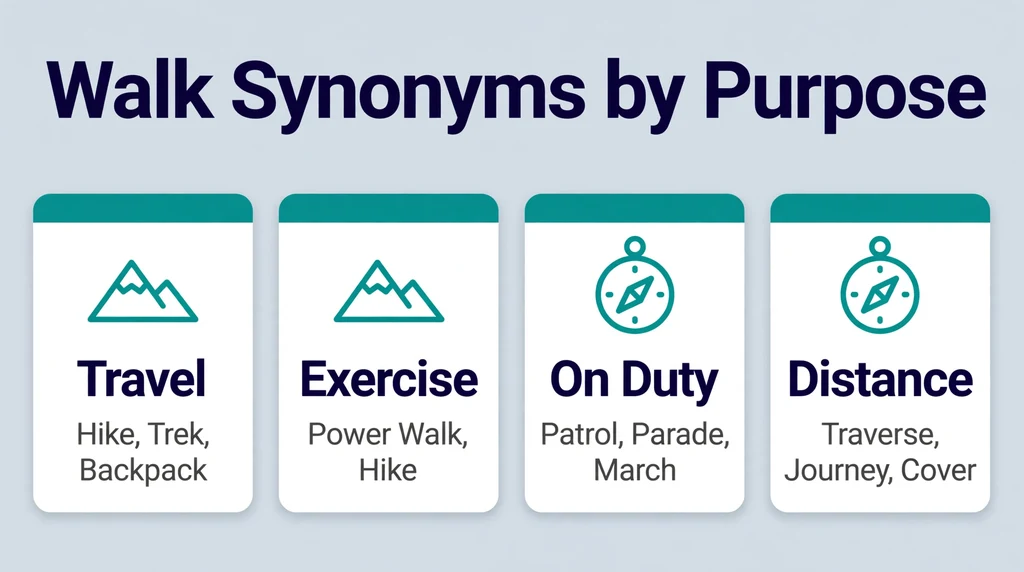
Purpose changes the word as surely as pace does. A Sunday ramble, a border patrol, and a mountain crossing may all happen on foot, yet each needs its own verb. Readers planning trips often pair these verbs with synonyms for journey for the nouns that complete the picture.
Notice, too, how purpose words bundle speed and attitude inside them. A trek is never quick, and a patrol is never careless. That built-in detail is exactly why purpose verbs save writers so many extra explaining words.
Walking for Travel and Distance
- Hike: walk a long way in the countryside or mountains. Example: They hiked through the national park.
- Trek: travel a long, difficult distance on foot. Example: We trekked for three days to reach the village.
- Backpack: travel on foot with a pack, staying cheaply. Example: She backpacked across Asia for a year.
- Traverse: cross an area on foot, formal. Example: The team traversed the glacier by noon.
- Cross: go from one side of a place to the other. Example: They crossed the desert on foot.
- Navigate: find your way through a place. Example: We navigated the old town without a map.
- Tour: travel around a place on foot, seeing the sights. Example: We toured the ruins on foot.
- Journey: travel from one place to another, formal as a verb. Example: They journeyed north on foot.
- Cover: travel a distance, as in cover ten miles. Example: By dusk we had covered fifteen miles.
Walking for Exercise and Health
- Power walk: walk fast with strong arm swings, for fitness. Example: He power walks five kilometres daily.
- Hike: doubles as the most popular exercise verb outdoors. Many fitness plans use hiking for weekend sessions.
- March: in fitness classes, marching in place raises the heart rate gently. The word fits drills and warm-ups well.
- Take a constitutional: the noun form appears in the noun section below, but the habit itself is classic exercise walking. Older relatives still swear by a daily constitutional after meals.
Walking on Duty
- Patrol: walk an area regularly to guard it. Example: Officers patrol the park at night.
- Parade: march in formation for ceremony or inspection. Example: The regiment paraded before the general.
- March: the standard verb for soldiers moving on foot. Example: The troops marched twenty miles a day.
- File: move in a single line. Example: The class filed into the hall.
- Troop: move together in a group, often cheerfully. Example: The kids trooped into the kitchen.
Formal Synonyms for Walk
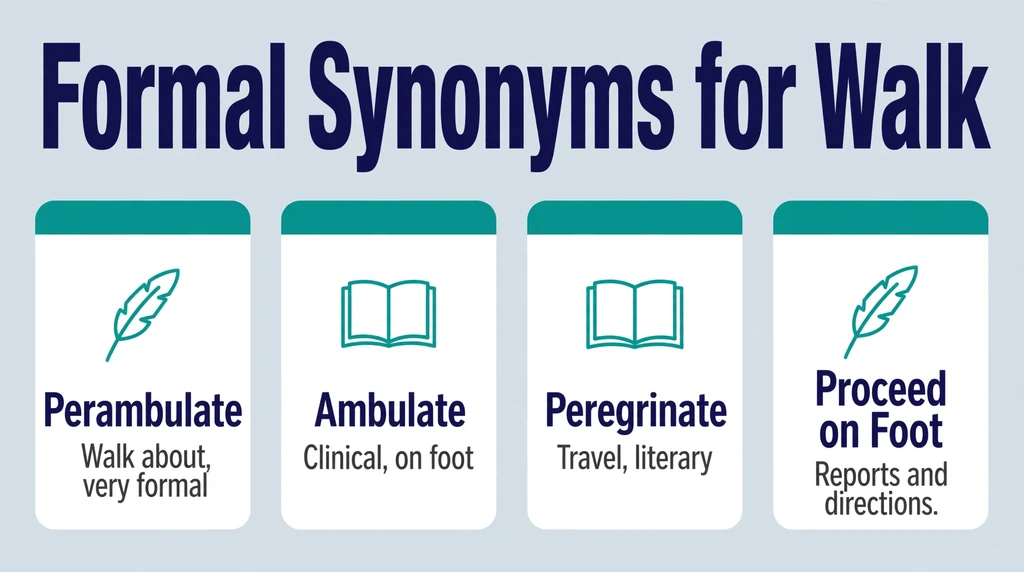
Formal writing prefers distance and precision over colour. These words raise the register, although a few can sound playful if the setting is too casual.
- Perambulate: walk about, especially for pleasure, very formal or humorous. Example: Guests perambulated around the grounds after tea.
- Ambulate: move about on foot, used in medical and clinical reports. Example: The patient was able to ambulate without assistance.
- Peregrinate: travel or wander about, literary and rare. Example: He peregrinated through Italy for a decade.
- Circumambulate: walk around something, often in ritual. Example: Pilgrims circumambulate the shrine at dawn.
- Proceed on foot: the plain formal phrase used in reports and directions. Example: From the gate, proceed on foot to the main hall.
- Go on foot: simple and neutral, slightly more formal than walk itself. Official notices use it often.
- Travel on foot: the clearest formal phrase for distance. Example: The village can only be reached by travelling on foot.
- Wend one’s way: move or proceed slowly, literary. Example: She wended her way through the crowded market.
- Make your way: proceed somewhere, neutral to formal. Example: Please make your way to the exit.
Formal words work best in legal, medical, and academic contexts. In a friendly blog post, however, perambulate will raise a smile instead of sounding smart. Match the word to the audience, and you will rarely go wrong.
Informal and Slang Synonyms for Walk
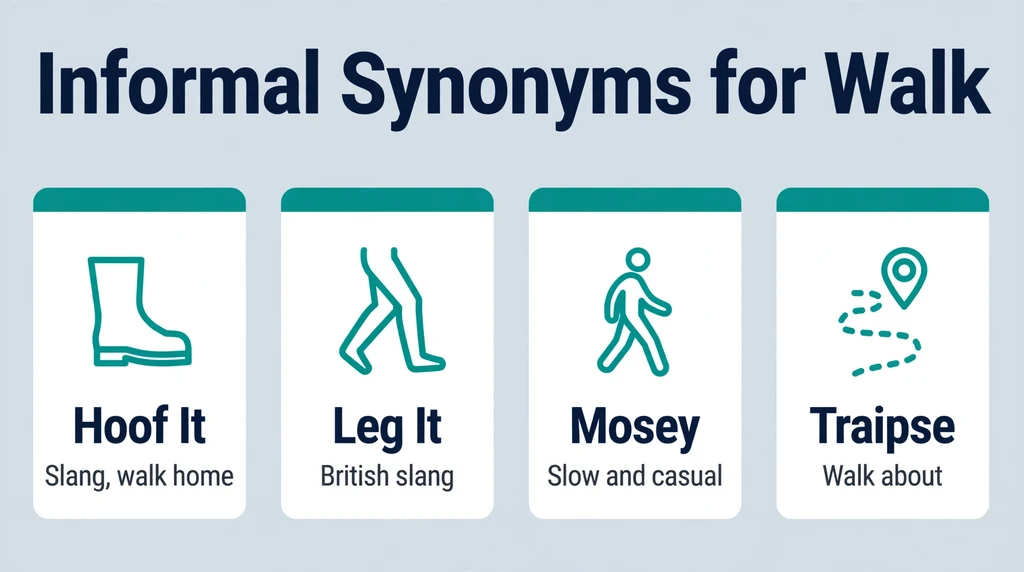
At the other end of the scale, informal words add warmth and humour. They suit dialogue, stories, and everyday speech far better than reports.
- Hoof it: walk somewhere instead of driving, slang. Example: The bus left, so we hoofed it home.
- Leg it: run or walk quickly, British slang. Example: We legged it to the station.
- Foot it: walk rather than ride, informal. Example: It is only a mile, so let us foot it.
- Mosey: wander along slowly, originally US informal. Example: Mosey over here and take a look.
- Traipse: walk about without much purpose, informal. Example: I traipsed all over town for that book.
- Mooch: wander slowly and aimlessly, British slang. Example: He mooched around the shops.
- Go for a walk: the everyday phrase that needs no explanation. Example: Let us go for a walk before dinner.
- Take a walk: the same idea, also an idiom telling someone to leave. Context decides which meaning readers hear, so check your sentence twice.
Dialogue loves these words because people actually say them. Narration can use them too, as long as the voice of the piece stays casual.
Walk as a Noun: Synonyms for a Journey on Foot
Walk also works as a noun, naming the outing itself. These fifteen words name walks of different lengths and moods.
- Stroll: a short, slow walk for pleasure.
- Amble: a gentle, unhurried walk.
- Saunter: a slow, confident walk.
- Ramble: a long walk in the countryside.
- Hike: a long walk over rough ground.
- Trek: a long, hard journey on foot.
- Tramp: a long, steady walk.
- March: a long or organised walk, as in a protest march.
- Constitutional: a daily walk taken for health, slightly old-fashioned.
- Perambulation: an extremely formal word for a walk.
- Promenade: a leisurely public walk, or the seaside path itself.
- Turn: a short walk, as in take a turn.
- Jaunt: a short, cheerful trip, often on foot.
- Airing: a short walk in fresh air, dated.
- Walkabout: a journey on foot, a term from Australian English.
- Outing: a short trip away from home, often including a walk.
The noun you choose sets the scale instantly. A jaunt sounds pleasant and brief, while a trek promises effort and distance. Writers often pair these nouns with the verbs above, as in set off on a ramble or led them on a trek.
How to Choose the Right Synonym for Walk
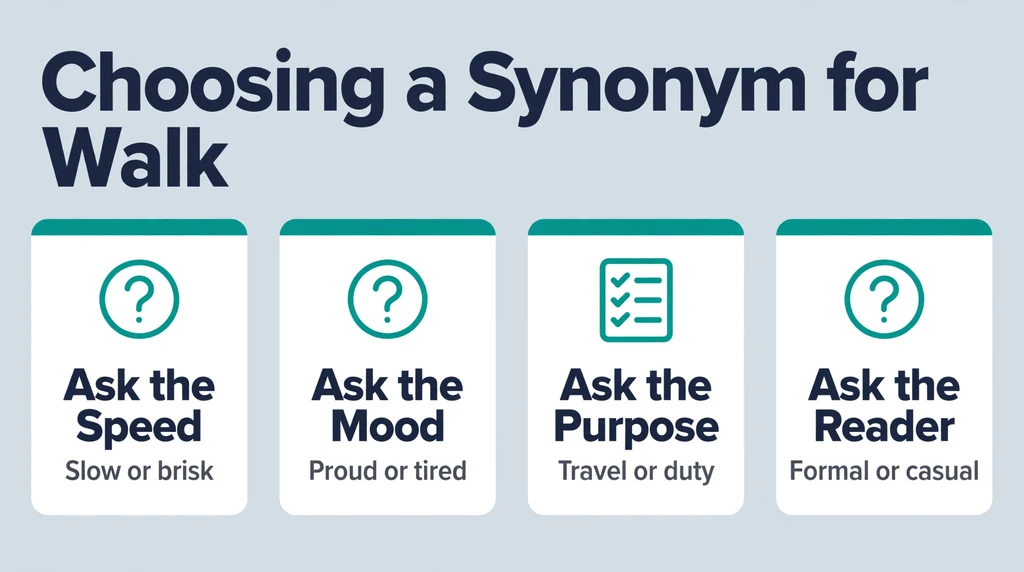
With more than 100 options, the real skill is choosing, not collecting. Four quick questions narrow the field fast. How fast is the person moving? What mood are they in? Why are they walking at all? And finally, who will read the sentence?
Paired examples show how much one verb can change a scene. Consider a character crossing a room:
- She strode to the door. She is confident and probably annoyed.
- She sauntered to the door. She is relaxed and in no hurry at all.
- She tiptoed to the door. She is trying hard not to be heard.
- She shuffled to the door. She is tired, ill, or reluctant.
- She stomped to the door. She is angry, and everyone nearby knows it.
The distance and setting never changed, yet each version tells a different story. That is the power of a precise walking verb.
The same test works in an office scene. A manager who strides into a briefing looks decisive before saying a word. One who shuffles in looks beaten already. Novelists exploit that contrast constantly, while careful report writers avoid it completely and stick to neutral verbs.
The quick picker below matches common situations to strong first choices.
| Situation | Strong first choice |
|---|---|
| Relaxed evening outing | Stroll |
| Confident entrance | Stride |
| Tired trip home | Trudge |
| Silent movement | Tiptoe |
| Long mountain route | Trek |
| Guarding an area | Patrol |
| Proud, showy display | Strut |
Context clues help as well. Soldiers march, patients ambulate, and toddlers toddle. Meanwhile, hikers trek and guards patrol. When a word sounds wrong, it usually clashes with the subject or the setting. Reading the sentence aloud exposes most clashes at once. If you still hesitate between two adverbs of speed, the guide to synonyms for quickly pairs well with the faster verbs above.
Synonyms for Walk in Essays, Stories and Professional Writing
Different kinds of writing reward different choices. Essays value clarity and a measured tone. As a result, proceed, advance, and travel on foot serve students better than slang. A history essay can say the army advanced across the plain, which sounds precise and calm. Turf slang like hoof it would weaken the same sentence instantly.
Stories reward the opposite approach. Fiction lives on exact verbs, because manner reveals character. A villain who prowls feels dangerous, while a hero who strides feels sure of himself. Dialogue, meanwhile, should sound like speech. Real people say go for a walk or leg it, not perambulate, unless the joke is intended.
Professional and workplace writing sits between the two. Instruction manuals prefer proceed on foot, step, and follow the path, since plain words prevent accidents and confusion. Medical reports use ambulate because it is precise and neutral. Travel guides mix both registers, pairing hike and trek for routes with gentle words like stroll for evening suggestions. In short, let the document decide the register, then pick the verb that fits it.
Older literature adds one more layer. Poets and classic novelists reach for wend, peregrinate, and perambulate because those words slow the reader down. Modern writers borrow the trick when a scene needs ceremony or age. Used once, the effect feels rich. Used on every page, it turns into costume.
Antonyms for Walk
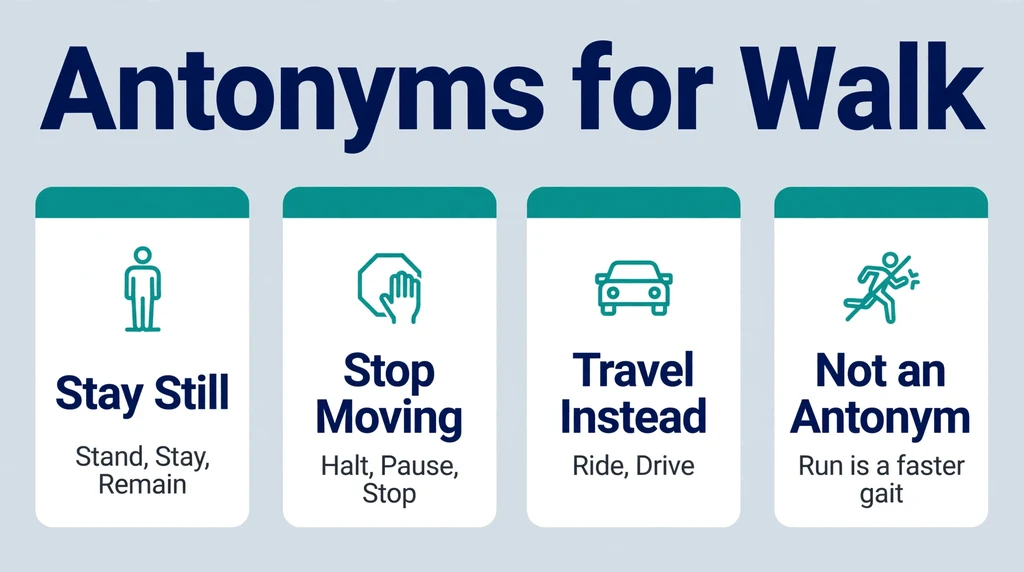
The clearest opposites of walk describe staying still rather than moving. Common antonyms include stand, stop, halt, pause, stay, and remain. Each one cancels the movement in a slightly different way. Halt suggests a sudden, ordered stop. Pause implies the walk will resume shortly. Remain and stay stress staying in one place over time.
Another set of opposites swaps the method of travel. Ride and drive answer walk when the choice is between feet and wheels. Sentences like we drove instead of walking rely on that contrast daily.
Run is not a true antonym, though it often appears in antonym lists. Running is simply a faster gait, and both gaits move a person forward on foot. The genuine opposite of walking is not moving at all.
A quick test helps in practice. If a word can finish the sentence “instead of walking, they” in a natural way, it is probably an antonym or a travel alternative. Stood still and drove both pass that test. Ran fails it, because running is still travelling on foot.
Common Mistakes: Words That Are Not True Synonyms for Walk
Accuracy matters in a synonym guide, so this section clears up the words that often sneak into walk lists wrongly.
Run, jog, and sprint are not synonyms for walk. In running and jogging, both feet leave the ground at once. Walking, by definition, keeps at least one foot down. Swap them only when the gait itself changes.
Drive and ride fail the same test from the other side. They move a person, but not on foot, so they belong in travel vocabulary instead. Climb, swim, and crawl also describe different actions with different body mechanics. Crawl, in particular, uses hands and knees.
Dance words cause subtler errors. Waltz and prance can describe walking in a figurative way, yet their home is the dance floor or the stable. Use them only when that playful image is the point. Otherwise readers picture choreography, not travel.
Two usage mistakes appear often as well. First, writers use stomp as a general word for walking, although it always signals anger or heavy noise. Second, they drop perambulate into casual writing to sound clever. The word is so formal that it reads as a joke, which is fine only when the joke is deliberate.
Frequently Asked Questions
What is the best synonym for walk?
There is no single best word, because the right choice depends on speed, mood, and purpose. For everyday writing, stroll and stride cover the most ground. Stroll suits relaxed scenes, while stride suits confident, purposeful movement.
What is a fancy or formal word for walk?
Perambulate is the classic fancy choice, and ambulate is the formal, clinical one. Reports and directions more often use the phrase proceed on foot. In very formal writing, travel on foot is the clearest option of all.
What is a synonym for walk slowly?
Stroll, amble, and saunter are the three most useful slow walking words. Stroll focuses on pleasure, amble on an easy pace, and saunter on relaxed confidence. Dawdle adds the idea of wasting time, so use it when delay matters.
What is a synonym for walk fast?
Stride and march are the standard fast, purposeful choices. For exercise, power walk is exact. Step out also suggests brisk movement, though it can simply mean leaving a place on foot.
What is the slang word for walk?
Hoof it is the best known slang choice in American English, and leg it is common in British slang. Foot it is a milder informal option. All three imply walking because transport failed or time is short.
What is the opposite of walk?
Stand, stop, halt, and stay are the main opposites, since they cancel movement completely. In travel contexts, ride and drive also work as opposites. Run is only a faster gait, not an opposite.
Is run a synonym for walk?
No. Walking keeps at least one foot on the ground at all times, while running includes moments when both feet are airborne. Dictionaries define the two gaits differently for exactly this reason, so careful writers keep them apart.
What is a word for walking for pleasure?
Stroll is the most common choice, with amble and saunter close behind. For longer countryside outings, ramble is the classic word. The noun constitutional names a regular walk taken for health and pleasure.
Final Thoughts
Walk is a small word carrying a surprising amount of traffic. Once you sort its synonyms by speed, manner, purpose, and register, the right choice usually becomes obvious. Stroll through the park, stride into the meeting, trudge home through the rain, and let each verb do its own quiet work.
For an even deeper list with related words and near-synonyms, the Merriam-Webster Thesaurus entry for walk is a reliable next step. Keep this guide bookmarked too, and your walking sentences will never sound flat again.