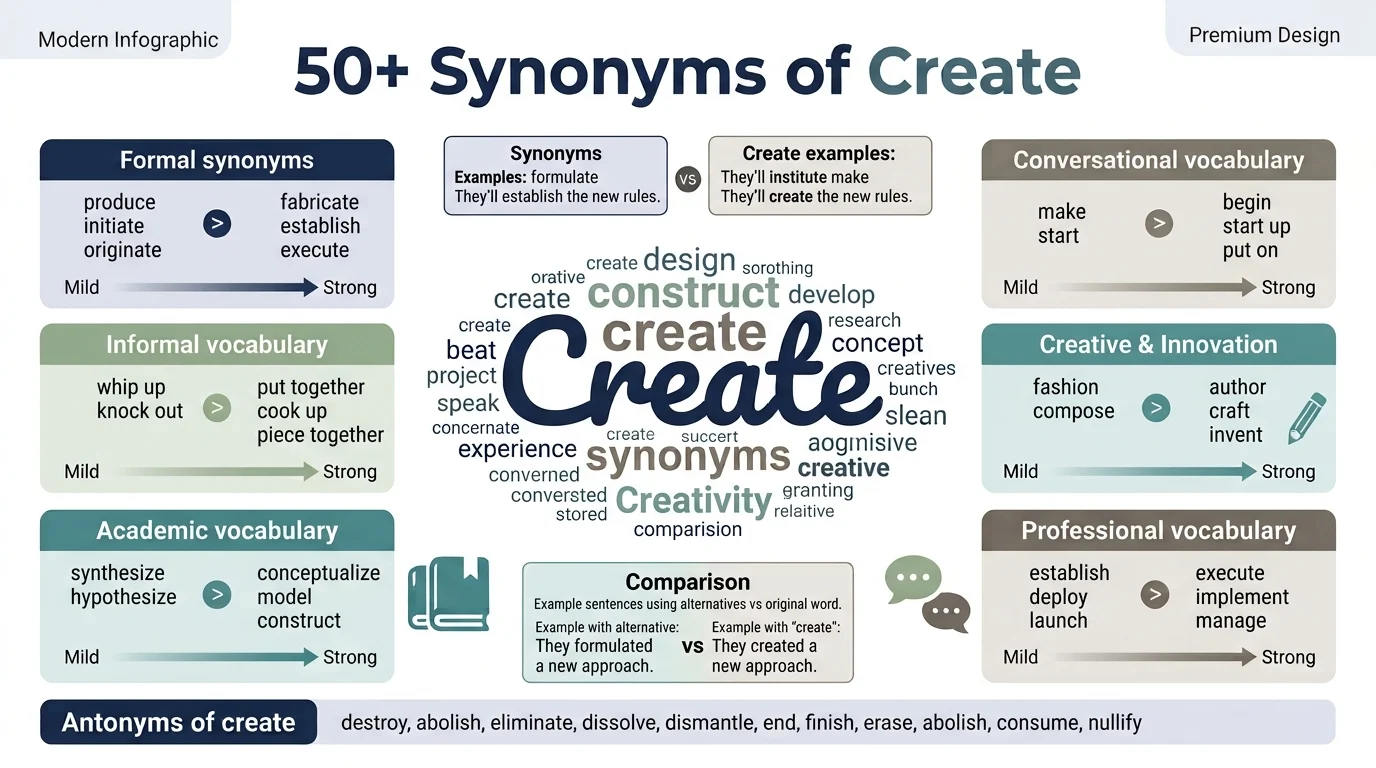
Have you ever written an email, essay, or social media caption and realized you used the word “create” five times in three sentences? It happens to everyone. Repeating the same word makes your writing feel dull and uninspired. Choosing the right synonym of create can transform your message from boring to brilliant.
When you understand the subtle differences between similar words, you can communicate more precisely. The word “create” might work well in some situations, but other options can add clarity, emotion, or professionalism where needed. This guide will help you master the synonyms of create so you can write with confidence and variety.
What Are the Best Synonyms of “Create”?
Create means to bring something into existence or cause something to happen. The best synonym depends on your context. Professional writing, try “generate” or “develop.” For creative work, use “craft” or “compose.” For academic writing, choose “establish” or “formulate.” Casual conversation, “make” or “build” work perfectly.
Meaning, Tone, and Context
Simple Definition
To create means to bring something new into existence through imagination, effort, or a combination of materials and ideas. It involves transforming thoughts, resources, or raw materials into a finished product or result.
Part of Speech
Create is a verb. It describes an action. The noun form is “creation.” The adjective forms include “creative” and “created.” The adverb form is “creatively.”
Overall Tone
Create is a neutral word. It does not carry strong positive or negative emotional weight. Its tone depends entirely on the context and how you use it. In most situations, create feels straightforward and practical.
Formality Level
Create is neutral in formality. You can use it in formal reports, academic papers, business emails, and casual conversations. It is one of the safest verbs in English because it fits almost anywhere without sounding out of place.
Common Uses
Native speakers use create in countless situations. They describe creating art, documents, businesses, strategies, recipes, relationships, and opportunities. People create content online, create solutions to problems, and create memories with loved ones. The word appears in creative fields, technical industries, and everyday life.
Word Forms
| Form | Example |
|---|---|
| Verb | She will create a new website. |
| Noun | The creation of the building took two years. |
| Adjective | He is a creative designer. |
| Adverb | She approached the problem creatively. |
When and How to Use “Create”
Choose “create” when you want a clear, simple, and neutral verb that works in almost any context. It communicates action without adding extra emotional weight or specialized meaning. Use it when you need a reliable word that everyone understands.
Here are seven examples showing how to use create naturally in different situations.
Professional Context
Our team will create a comprehensive marketing plan for the upcoming product launch.
Academic Context
The researchers aimed to create a more accurate model for predicting climate patterns.
Workplace Context
We need to create a system that tracks inventory more efficiently.
Personal Context
I want to create a morning routine that helps me feel more focused and productive.
Email Context
Please create a draft of the proposal by Friday so we can review it together.
Resume Context
Developed and created training materials that improved employee performance by 20 percent.
Social Media Context
These simple ingredients can create a delicious meal in under thirty minutes.
Best Synonyms of “Create”
No synonym of create is identical in every situation. Each alternative carries its own nuance, tone, and emotional weight. Choosing the right one depends on your audience, purpose, and the specific meaning you want to convey.
Best Professional Synonym
Generate works best in professional settings. It suggests producing something through a systematic process. This choice sounds modern and businesslike.
Best Academic Synonym
Establish suits academic writing well. It implies creating something that has lasting significance or formal recognition.
Best Business Communication Synonym
Develop is the strongest choice for business contexts. It suggests growth, improvement, and careful planning over time.
Best Casual Conversation Synonym
Make is the simplest and most natural choice for everyday speech. Everyone understands it, and it never sounds forced.
Best Emotional Writing Synonym
Inspire works well when creation involves motivation or emotional influence. It suggests that something new came from feeling or passion.
Best Creative Writing Synonym
Craft is excellent for artistic and literary contexts. It implies careful skill, attention to detail, and deliberate effort.
Best Resume Writing Synonym
Spearhead conveys leadership and initiative. It suggests you took charge and drove the creation process forward.
Best Workplace Communication Synonym
Implement works well when creation involves putting plans into action. It suggests practical execution.
Stronger Meaning
Forge implies creation through effort, determination, and sometimes difficulty. It suggests strength and persistence.
Softer Meaning
Form suggests a gentle or gradual creation process. It implies things coming together naturally without force.
When Not to Use “Create”
Sometimes “create” sounds too vague or general. In these situations, a more specific synonym of create will communicate your meaning more effectively.
When the Word Sounds Too General
Create does not specify how something came into existence. If your reader needs to understand the process, choose a more descriptive verb.
Instead of: The team created a new strategy.
Try: The team developed a new strategy through extensive market research.
Why: “Developed” suggests a thoughtful, gradual process rather than a sudden action.
When the Word Sounds Too Vague
Create lacks specificity in technical or scientific contexts. Researchers and engineers need precise language that describes exact actions.
Instead of: The experiment created new data.
Try: The experiment generated new data using advanced sensors.
Why: “Generated” implies a specific production process appropriate for scientific work.
When the Word Sounds Too Formal
In very casual situations, “create” can sound unnecessarily formal. Simple conversations feel more natural with common alternatives.
Instead of: I created dinner for my family.
Try: I made dinner for my family.
Why: “Made” sounds warmer and more conversational.
When the Word Sounds Too Weak
Some accomplishments deserve stronger language. Using a powerful synonym of create can emphasize the significance of your achievement.
Instead of: She created a new department at work.
Try: She established a new department at work.
Why: “Established” suggests something lasting and important.
When the Word Sounds Outdated
Create works well in most situations, but some contexts call for modern vocabulary. In tech and startup environments, alternatives may sound more current.
Instead of: The company created a new app.
Try: The company launched a new app.
Why: “Launched” reflects modern product development language.
Words Commonly Confused With “Create”
Create vs Make
Difference: Make is broader and more general. Create suggests originality and bringing something into existence that did not exist before. Make can also mean assembling or producing from existing materials.
When to Use It: Choose make for everyday situations and simple actions. Choose create when emphasizing originality or artistic expression.
Example: She made a cake from a recipe. She created a new recipe no one had tried before.
Create vs Generate
Difference: Generate implies producing something through a process, often mechanical, scientific, or data-driven. Create carries more emotional and artistic weight.
When to Use It: Use generate in technical, scientific, or business contexts involving systems or data. Use create for artistic, personal, or imaginative work.
Example: The solar panels generate enough electricity for the entire building. The artist created a stunning mural for the community center.
Create vs Develop
Difference: Develop suggests growth and progression over time. Create implies bringing something into existence more suddenly or completely.
When to Use It: Choose develop when something evolves or improves gradually. Choose create when something appears fully formed or brand new.
Example: The company developed their product over five years of testing. The founder created the company from a single idea.
Create vs Form
Difference: Form suggests things coming together naturally or gradually. Create implies more conscious effort and intention.
When to Use It: Use form for natural processes, shapes, or gradual development. Use create for deliberate action.
Example: Crystals form naturally under specific conditions. Scientists created synthetic crystals in the laboratory.
Create vs Build
Difference: Build implies constructing something from parts or materials. Create suggests bringing something into existence from nothing or from imagination.
When to Use It: Choose build for physical construction or systematic assembly. Choose create for abstract, artistic, or original work.
Example: The workers built the house in six months. The architect created the design on paper first.
Create vs Produce
Difference: Produce often implies manufacturing, creating on a large scale, or yielding results. Create focuses more on originality and the act of bringing something new into existence.
When to Use It: Use produce for manufacturing, output, or results. Use create for original artistic or innovative work.
Example: The factory produces thousands of units daily. The designer creates unique pieces for each client.
Best Synonyms of “Create” by Context
| Context | Best Synonym | Why It Works | Example |
|---|---|---|---|
| Formal writing | Establish | Suggests permanence and significance | The committee established new guidelines for research ethics. |
| Academic writing | Formulate | Implies careful development of ideas | The scientist formulated a hypothesis based on previous research. |
| Professional communication | Generate | Sounds modern and process-oriented | The team generated innovative solutions for client challenges. |
| Business emails | Develop | Suggests thoughtful progression | We will develop a comprehensive proposal for your review. |
| Resume writing | Spearhead | Shows leadership and initiative | Spearheaded the creation of a new training program. |
| Workplace communication | Implement | Emphasizes practical execution | We will implement the new system by next quarter. |
| Casual conversation | Make | Simple, natural, and universally understood | Can you make a copy of that document for me? |
| Everyday speaking | Build | Concrete and easy to visualize | We are building a new deck in the backyard. |
| Creative writing | Craft | Emphasizes skill and artistry | The author crafted a compelling narrative that readers loved. |
| Storytelling | Weave | Suggests combining elements beautifully | The storyteller wove together multiple plotlines seamlessly. |
| Emotional writing | Inspire | Implies emotional influence | Her words inspired a movement for change. |
| Strong emphasis | Forge | Conveys effort and determination | They forged a partnership that transformed the industry. |
| Mild tone | Form | Suggests gentle, natural development | The idea formed slowly over several conversations. |
| Social media captions | Produce | Direct and action-oriented | We produced this video to share our journey. |
| American English | Make | The most common choice across all contexts | Let’s make something amazing today. |
How to Choose the Best Synonym of “Create”
Choosing the right synonym of create is easier when you consider a few key factors. Follow this practical decision guide to select the most effective word every time.
Consider Your Meaning
Ask yourself what you really mean. Are you bringing something into existence from nothing? Choose create or invent. Are you building from existing materials? Choose build or construct. Are you developing something over time? Choose develop or formulate. Your exact meaning should guide your word choice.
Consider Your Tone
Think about how you want your message to sound. Do you need a neutral, straightforward tone? Choose make or produce. Do you want to sound professional and modern? Choose generate or develop. Do you need emotional weight? Choose inspire or forge. Match your tone to your audience.
Consider Your Audience
Who is reading your writing? Professionals appreciate precise, business-appropriate language. Academics expect formal, authoritative vocabulary. Friends and family respond better to simple, conversational words. Always choose synonyms your audience will understand and appreciate.
Consider Emotional Strength
How strong should your word feel? Some synonyms feel mild and gentle, like form or shape. Others feel powerful and determined, like forge or establish. Choose the emotional intensity that matches your message. Do not use an overly strong word for a simple action.
Consider Your Writing Purpose
What are you trying to accomplish? Are you informing, persuading, inspiring, or describing? Informative writing benefits from clear, neutral synonyms. Persuasive writing often needs stronger, more confident language. Inspirational writing requires emotional and uplifting words. Match your purpose with your vocabulary.
Consider Formality Level
Assess the formality of your situation. Business reports, academic papers, and professional emails need formal synonyms. Text messages, social media posts, and casual conversations call for informal alternatives. Choosing the right formality level makes your writing feel appropriate and natural.
Real Life Examples of “Create”
These examples show how synonyms of create can strengthen your writing in various situations.
School Assignment
Weak: The students created projects about American history.
Strong: The students developed projects about American history.
Why: “Developed” suggests research, effort, and learning over time.
College Essay
Weak: My internship helped me create new skills.
Strong: My internship helped me develop new skills.
Why: “Develop” accurately describes skill acquisition as a gradual process.
Workplace Update
Weak: Our department created a new filing system.
Strong: Our department implemented a new filing system.
Why: “Implemented” emphasizes the practical execution and completion.
Business Proposal
Weak: We will create a better customer experience.
Strong: We will design a better customer experience.
Why: “Design” suggests intentional planning and thoughtful creation.
Professional Email
Weak: I created a report summarizing our findings.
Strong: I prepared a report summarizing our findings.
Why: “Prepared” sounds more thorough and professional.
Resume Achievement
Weak: Created a marketing strategy that increased sales.
Strong: Developed a marketing strategy that increased sales.
Why: “Developed” implies research, analysis, and strategic thinking.
Casual Conversation
Weak: I want to create a garden in my backyard.
Strong: I want to plant a garden in my backyard.
Why: “Plant” is more specific and natural for gardening.
Storytelling
Weak: The author created an interesting character.
Strong: The author crafted a fascinating character.
Why: “Crafted” emphasizes skill and artistry in character development.
Blogging
Weak: This guide will create better results for readers.
Strong: This guide will generate better results for readers.
Why: “Generate” sounds more compelling and action-oriented.
Social Media
Weak: We created this content to help you learn.
Strong: We made this content to help you learn.
Why: “Made” feels more personal and approachable on social media.
18 Best Synonyms of “Create”
| Synonym | Simple Meaning | Best Used For | Example Sentence |
|---|---|---|---|
| Make | To produce something using materials or effort | Everyday situations and casual communication | Can you make a copy of this document for the meeting? |
| Build | To construct by assembling parts | Physical construction and systematic development | We plan to build a new website from the ground up. |
| Develop | To grow or improve something over time | Projects, skills, products, and gradual progress | The team developed a comprehensive training program. |
| Generate | To produce through a process | Business, scientific, and technical contexts | The new software generates detailed reports automatically. |
| Establish | To create something lasting or formal | Organizations, systems, and permanent institutions | They established a new department for research and development. |
| Formulate | To create through careful planning | Academic work, strategies, and complex ideas | The committee formulated a plan to address the issue. |
| Produce | To manufacture or bring forth | Manufacturing, creative output, and results | The studio produces award-winning documentaries every year. |
| Craft | To create with skill and care | Art, writing, and detailed creative work | She crafted a beautiful speech that moved the audience. |
| Compose | To create by combining elements | Writing, music, and artistic arrangements | The musician composed a symphony for the orchestra. |
| Design | To create with a specific purpose | Products, experiences, and planned outcomes | They designed a new interface for the mobile app. |
| Invent | To create something entirely new | Original ideas, inventions, and innovations | The scientist invented a device that revolutionized the industry. |
| Originate | To be the source or starting point | Ideas, movements, and pioneering efforts | She originated the concept that shaped modern marketing. |
| Launch | To introduce something new | Products, services, and public initiatives | The company launched their new product line last week. |
| Initiate | To begin or start something | Projects, processes, and official actions | The department initiated a program to improve efficiency. |
| Forge | To create through effort and determination | Strong relationships, partnerships, and difficult tasks | They forged a partnership that lasted for decades. |
| Shape | To give form or direction to something | Ideas, processes, and gradual development | Her experiences shaped her unique approach to business. |
| Weave | To combine elements into a unified whole | Storytelling, narratives, and complex creations | The author wove multiple plotlines into a compelling story. |
| Inspire | To influence creation through motivation | Emotional writing, leadership, and creative influence | Her leadership inspired innovative ideas throughout the organization. |
Synonyms of “Create” by Usage
Professional vs Personal Synonyms
Professional workplaces value precise, confident language. Words like “generate,” “develop,” and “implement” sound businesslike and competent. These synonyms suggest strategic thinking and professional capability.
Personal conversations call for warmer, more natural vocabulary. Words like “make,” “build,” and “put together” feel friendly and approachable. These synonyms help you connect with others in everyday situations.
Professional: The marketing team generated significant leads this quarter.
Personal: I am going to make dinner for my friends tonight.
Formal vs Conversational Synonyms
Formal writing requires sophisticated vocabulary. Reports, proposals, and academic papers benefit from words like “formulate,” “establish,” and “originate.” These choices convey authority and serious intent.
Conversational language values simplicity and clarity. Texting, casual emails, and everyday speech work best with words like “make,” “get,” and “put.” These synonyms feel natural and effortless.
Formal: The researchers formulated a new theory about cognitive development.
Conversational: I made a new recipe I found online.
Academic Synonyms
Academic writing demands precision and authority. Words like “formulate,” “establish,” and “postulate” sound appropriately scholarly. These synonyms show that you understand formal academic conventions.
Research: The study formulated a framework for analyzing historical patterns.
Essay: The author establishes her argument through careful evidence.
Report: The findings establish a clear connection between the variables.
Professional and Business Synonyms
Business professionals need vocabulary that projects confidence and competence. Words like “spearhead,” “implement,” and “generate” convey leadership and results-oriented thinking. These synonyms help you stand out in resumes, interviews, and meetings.
Resume: Spearheaded the development of a customer retention program.
Interview: I have implemented similar systems in my previous roles.
Meeting: We need to generate more leads through our digital marketing efforts.
Creative and Literary Synonyms
Creative writing thrives on expressive, evocative language. Words like “craft,” “weave,” “compose,” and “forge” add artistry and emotional depth to your work. These synonyms help you paint vivid pictures with words.
Storytelling: The author crafted a world that felt entirely real.
Poetry: She composed verses that captured the beauty of the moment.
Descriptive: The artist forged a style that was uniquely her own.
Slang or Modern Synonyms
The modern English vocabulary includes a few informal alternatives for “create.” “Whip up” works well for food or quick creations. “Cook up” suggests coming up with an idea or scheme. “Put together” describes assembling or organizing something.
These slang synonyms work in casual conversation but should never appear in academic papers, business reports, or professional emails. Save them for friendly communication where informal language is welcome.
Acceptable: Let me whip up a quick presentation for the team.
Avoid: We need to cook up a new business strategy by Friday.
Strongest to Mildest Synonyms
This intensity scale shows how synonyms of “create” range from mild to very strong.
Mild
- Form: Suggests gentle, natural development
- Shape: Implies gradual influence over time
- Make: Simple and neutral
Moderate
- Develop: Suggests growth and progression
- Generate: Implies production through process
- Build: Suggests construction and assembly
Strong
- Establish: Implies permanence and significance
- Launch: Suggests public introduction and impact
- Spearhead: Conveys leadership and initiative
Very Strong
- Forge: Implies effort, determination, and strength
- Originate: Suggests being the absolute source
- Invent: Implies creating something entirely new
The emotional intensity changes significantly across this scale. Mild synonyms feel gentle and unobtrusive. Strong synonyms command attention and convey determination. Choose the intensity that matches your purpose and audience.
Emotional vs Neutral Synonyms
Emotional Synonyms
Some synonyms of create carry emotional weight. These words express feelings like passion, determination, or inspiration.
Inspire: Suggests creation motivated by emotional influence. “Her story inspired a wave of donations.”
Forge: Implies determination and effort through difficulty. “They forged a friendship that lasted a lifetime.”
Craft: Suggests love and care in the creative process. “She crafted each piece with extraordinary attention to detail.”
Weave: Creates imagery of connecting things beautifully. “The author wove a story that moved readers deeply.”
These words work best in creative writing, storytelling, inspirational content, and emotional communication.
Neutral Synonyms
Other synonyms simply communicate information without adding emotional coloring. These words focus on the action itself.
Make: Simply describes producing something. “I make coffee every morning.”
Generate: Focuses on production without emotion. “The system generates reports automatically.”
Formulate: Describes careful planning without feeling. “We formulated a response to their inquiry.”
Develop: Suggests growth without emotional emphasis. “They developed new software for the company.”
These words work best in professional, academic, and technical writing where clarity matters most.
Antonyms of “Create”
| Antonym | Meaning | Example Sentence |
|---|---|---|
| Destroy | To damage or eliminate completely | The storm destroyed most of the crops in the region. |
| Demolish | To tear down or destroy completely | They will demolish the old building next week. |
| Ruin | To damage irreparably | The mistake ruined years of careful preparation. |
| Eliminate | To remove completely | The software update eliminated several persistent bugs. |
| Erase | To remove all traces of something | Time could not erase the memories of that day. |
| Annihilate | To destroy utterly | The virus annihilated the entire population of trees. |
| Terminate | To bring to an end | The company terminated the project due to budget cuts. |
| Abolish | To formally put an end to something | The government abolished the outdated law. |
| Dismantle | To take apart or break down | They dismantled the machinery and sold it for parts. |
| Extinguish | To put out or bring to an end | The firefighters worked to extinguish the blaze. |
| Obliterate | To destroy beyond recognition | The explosion obliterated everything in its path. |
| Dissolve | To break down or disappear | The committee dissolved after completing its mission. |
| Eradicate | To remove or destroy completely | Scientists hope to eradicate the disease entirely. |
| Nullify | To make legally void or ineffective | The court moved to nullify the contract. |
| Vanish | To disappear completely | All evidence of the civilization vanished over time. |
Comparison: “Create” vs Similar Words
Create vs Make
Main Difference: Create emphasizes originality and bringing something into existence from nothing. Make emphasizes production, assembly, or preparation using existing materials.
Which Is Stronger? Create is stronger because it implies novelty and imagination. Make is neutral and straightforward.
Which Is More Formal? Create is more formal than make. Make is acceptable in all situations but sounds casual.
When to Use Each: Use make for everyday tasks and simple production. Use create when emphasizing originality or artistic effort.
Examples:
Create: The artist created a masterpiece that inspired generations.
Make: Let me make a quick phone call before we leave.
Create vs Generate
Main Difference: Create suggests imaginative or artistic work. Generate suggests production through a systematic, mechanical, or data-driven process.
Which Is Stronger? Create is emotionally stronger. Generate feels more technical and process-oriented.
Which Is More Formal? Both are formal, but generate sounds more technical and businesslike.
When to Use Each: Use create for artistic, personal, or innovative work. Use generate for systems, data, and business processes.
Examples:
Create: She created a beautiful painting for the gallery.
Generate: The algorithm generates personalized recommendations for users.
Create vs Develop
Main Difference: Create implies bringing something into existence. Develop implies growth, improvement, and progression over time.
Which Is Stronger? Both are similarly strong, but develop suggests more effort and time investment.
Which Is More Formal? Both are formal. Develop may sound slightly more sophisticated.
When to Use Each: Use create for sudden or complete creation. Use develop for gradual growth or improvement.
Examples:
Create: The company created a new division to handle international sales.
Develop: The company developed their marketing strategy over several months.
Create vs Form
Main Difference: Create implies conscious, deliberate action. Form suggests natural, gradual, or organic development.
Which Is Stronger? Create is stronger because it implies intentional effort. Form is milder and gentler.
Which Is More Formal? Both are formal, but form can sound more poetic or natural.
When to Use Each: Use create for deliberate human action. Use form for natural processes or gradual development.
Examples:
Create: The committee created a plan for disaster response.
Form: Ice crystals form when temperatures drop below freezing.
Create vs Build
Main Difference: Create emphasizes originality and imagination. Build emphasizes construction, assembly, and systematic creation.
Which Is Stronger? Build sounds more substantial and concrete. Create sounds more innovative and original.
Which Is More Formal? Both are neutral in formality. Build may sound more practical.
When to Use Each: Use create for abstract or artistic work. Use build for physical construction or systematic development.
Examples:
Create: The designer created an innovative new concept.
Build: The contractors built the house according to specifications.
Create vs Produce
Main Difference: Create focuses on the act of bringing something new into existence. Produce focuses on the output or result, often on a larger scale.
Which Is Stronger? Create is slightly stronger because of its focus on originality.
Which Is More Formal? Both are formal, but produce is common in business and manufacturing.
When to Use Each: Use create for original, artistic, or innovative work. Use produce for manufacturing, large-scale output, or results.
Examples:
Create: The artist creates one-of-a-kind pieces for collectors.
Produce: The factory produces 500 units per day.
Common Phrases and Expressions with “Create”
Create a Buzz
Meaning: To generate excitement, interest, or discussion about something.
Example Sentence: The new product launch created a buzz across social media platforms.
Create Opportunities
Meaning: To make chances for advancement or success possible.
Example Sentence: Her willingness to take risks created opportunities for everyone on the team.
Create Value
Meaning: To add worth or benefit to something.
Example Sentence: Our goal is to create value for our clients through innovative solutions.
Create a Stir
Meaning: To cause excitement, controversy, or strong reactions.
Example Sentence: The CEO’s announcement created a stir among employees.
Create a Scene
Meaning: To behave in a noticeable, often embarrassing way in public.
Example Sentence: Please do not create a scene at the restaurant.
Create an Impression
Meaning: To produce a specific feeling or perception about someone.
Example Sentence: Her professionalism created a positive impression during the interview.
Create Room
Meaning: To make space or opportunity for something new.
Example Sentence: We need to create room in the budget for additional resources.
Common Mistakes to Avoid
Choosing a Vague Synonym Instead of a Precise One
Incorrect: The team created a better system.
Better: The team designed a more efficient system.
Why: “Designed” clarifies that the team planned the system intentionally, not just brought it into existence vaguely.
Confusing Create with a Similar Word
Incorrect: The musician created a song that everyone loved.
Better: The musician composed a song that everyone loved.
Why: “Composed” is the precise musical term. “Created” works but lacks the same artistic specificity.
Using an Informal Synonym in Formal Writing
Incorrect: The researchers cooked up a theory about climate change.
Better: The researchers formulated a theory about climate change.
Why: “Cooked up” is too casual for academic writing. “Formulated” sounds appropriately scholarly.
Selecting an Overly Dramatic Synonym
Incorrect: I forged a sandwich for lunch.
Better: I made a sandwich for lunch.
Why: “Forged” implies effort and determination appropriate for partnerships or significant achievements, not everyday food preparation.
Repeating the Same Word Too Often
Incorrect: We need to create a plan, create a budget, and create a timeline.
Better: We need to develop a plan, establish a budget, and create a timeline.
Why: Varying your vocabulary improves readability and keeps your writing interesting.
Choosing a Synonym with the Wrong Emotional Tone
Incorrect: The children inspired a sandcastle on the beach.
Better: The children built a sandcastle on the beach.
Why: “Inspired” suggests emotional influence, which does not fit a casual beach activity.
Using Slang in Professional Writing
Incorrect: We will whip up a strategy for client acquisition.
Better: We will develop a strategy for client acquisition.
Why: “Whip up” sounds careless and rushed. “Develop” conveys professionalism and thoughtful planning.
Frequently Asked Questions
What are the best synonyms of create?
The best synonyms depend on your context. Professional settings, use generate or develop. For creative work, choose craft or compose. For casual conversation, make or build work well. Academic writing, formulate or establish sound authoritative.
What are the best formal synonyms of create?
The best formal synonyms include establish, formulate, generate, originate, and implement. These words sound authoritative and work well in academic papers, business reports, and professional correspondence. They convey precision and seriousness appropriate for formal contexts.
What are common informal synonyms of create?
Common informal synonyms include make, build, put together, and whip up. These words feel natural and friendly in casual conversations, text messages, and social media posts. They prioritize simplicity and approachability over formality.
What is another word for create in professional writing?
Generate and develop are excellent choices in professional writing. Generate suggests systematic production. Develop implies thoughtful progression over time. Spearhead works well when describing leadership in creating new initiatives or projects.
What is the difference between create and make?
Create emphasizes originality and bringing something into existence from nothing. Make is broader and can mean producing, assembling, or preparing using existing materials. Create carries more artistic weight, while make is more practical and everyday.
What is the opposite of create?
The opposite of create includes destroy, demolish, ruin, eliminate, and erase. These words describe removing or ending existence rather than bringing it into being. The most direct antonym is destroy, which means to damage or eliminate completely.
Conclusion
Create is a versatile verb that means bringing something into existence. It works well in many situations, but you have numerous alternatives available. Choosing the right synonym of create depends on your audience, context, and purpose. Professional writing benefits from words like generate and develop. Creative work calls for craft and compose. Casual situations are best served by simple choices like make and build.
No single synonym works perfectly in every situation. The best writers know how to match their vocabulary to their message and their readers. Keep this guide handy when you need to find the perfect word. Your writing will become clearer, stronger, and more engaging.
Vocabulary improvement tip: Start with one or two new synonyms each week. Practice using them in emails, journaling, or conversation. Over time, they will become natural choices, and your vocabulary will expand effortlessly.