Do you find yourself repeating the word “benefit” too often in your writing?
Maybe you are drafting a professional email, updating your resume, or writing a school essay.
You want to sound clear and confident, but using the same word over and over makes your writing feel flat.
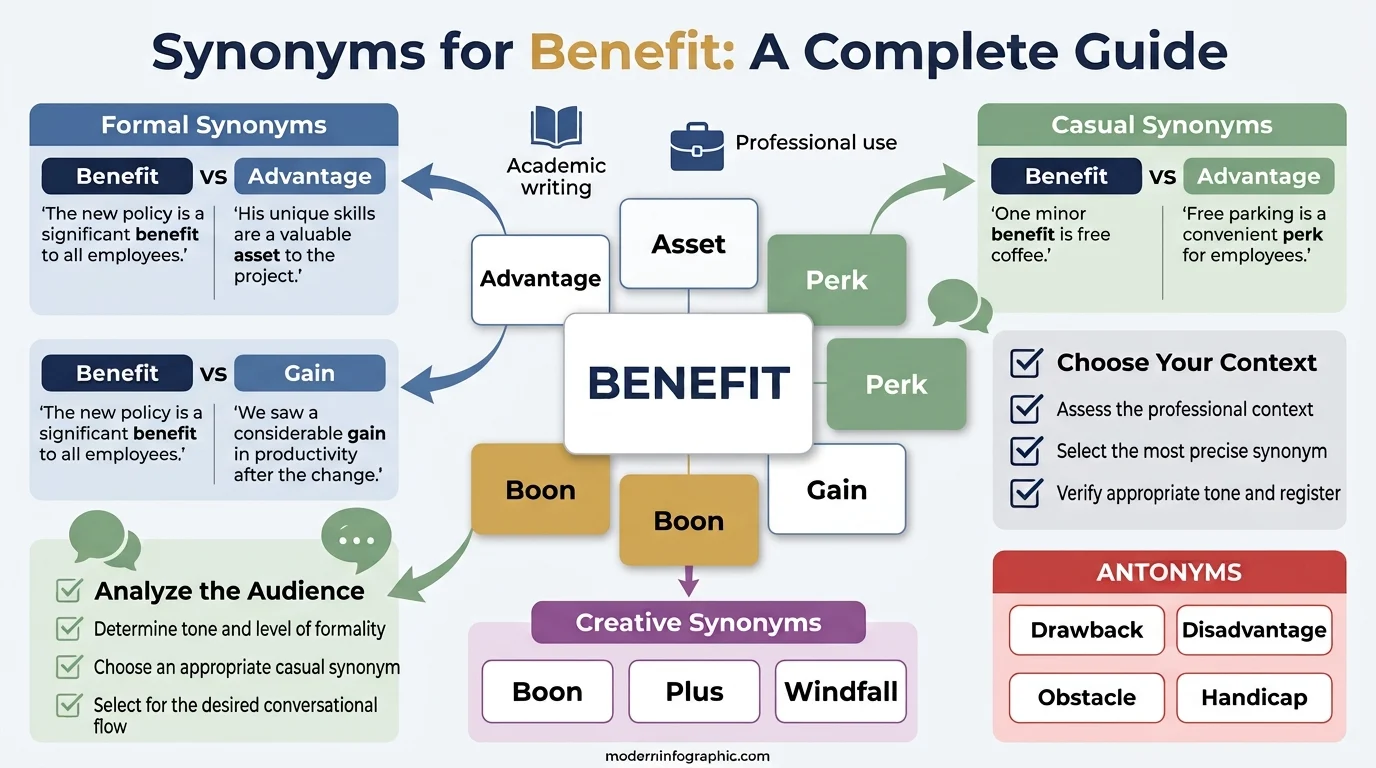
This guide helps you choose the right synonym for every situation.
You will learn formal, casual, academic, and professional alternatives that make your language more precise.
Let us explore the best synonyms for benefit and how to use them effectively.
What Does “Benefit” Mean?
Benefit means an advantage, gain, or positive result that comes from an action, decision, or situation. The best synonyms depend on your context. Use “advantage” for professional writing, “perk” for casual conversation, “asset” for resumes, and “boon” for creative expression. Choose your synonym based on tone and audience.
Meaning, Tone and Context
Simple Definition
Benefit refers to something that produces a favorable outcome or improves a person’s situation.
Part of Speech
Benefit works as both a noun and a verb. As a noun, it means an advantage. As a verb, it means to gain or receive advantage.
Tone
The word benefit carries a positive, constructive tone. It suggests improvement, progress, or helpfulness.
Formality Level
Benefit sits comfortably in the middle of formal and informal language. You can use it in professional reports and everyday conversations.
Common Use Cases
People use benefit in business writing, academic papers, healthcare discussions, employee reviews, and personal goal setting.
Important Word Forms
The adjective form is “beneficial.” The noun form for a person is “beneficiary.” The opposite is “drawback” or “disadvantage.”
When and How to Use “Benefit”
Use benefit when you want to describe a positive outcome that is clear and widely understood.
This word works well when you want to be direct without sounding overly emotional or dramatic.
Consider these examples across different contexts.
Professional Context
The new software system will benefit our team by reducing manual data entry tasks.
Academic Context
Studies show that regular reading benefits cognitive development in young children.
Personal Context
Exercising for thirty minutes each day benefits my overall energy levels and mood.
Emotional Context
Her kindness benefited the entire community during a difficult season.
Creative Context
The morning sunlight benefited the garden, coaxing every flower to open.
Social Media Caption
Taking a break from screens benefits your eyes and your peace of mind.
Resume Context
My leadership training benefited my ability to manage cross functional teams effectively.
Another Word for “Benefit”
The best single replacement depends on your specific context and purpose.
Professional Writing
Use “advantage” when you want to sound strategic and business focused.
Academic Writing
Use “gain” when discussing measurable or evidence based outcomes.
Casual Conversation
Use “perk” when talking about small, enjoyable advantages in daily life.
Emotional Writing
Use “blessing” when you want to express gratitude or appreciation.
Creative Writing
Use “boon” to add literary depth and descriptive richness.
Resume or Workplace Use
Use “asset” to describe personal qualities that make you valuable to an employer.
Social Media Captions
Use “plus” for a quick, modern way to highlight a positive point.
Stronger Meaning
Use “windfall” to describe an unexpected and significant advantage.
Softer Meaning
Use “help” for a gentle, unpretentious way to describe a positive effect.
When Not to Use “Benefit”
Benefit sounds too vague when you need to describe a specific, measurable outcome.
It feels too casual for highly formal legal or technical documents.
It lacks emotional depth when you want to express profound gratitude or relief.
Consider this weak sentence.
The new policy benefited the staff.
Now see the improved version.
The new policy increased staff productivity by twenty percent and reduced overtime complaints.
The second sentence provides concrete details that make the advantage clear and credible.
Words Commonly Confused With “Benefit”
Several words share similar meanings with benefit but carry distinct nuances.
Benefit vs. Advantage
Advantage suggests a competitive edge or superior position. Benefit focuses on general improvement or gain.
Use advantage when comparing options. Use benefit when describing positive effects.
Benefit vs. Perk
Perk refers to a small, extra advantage often related to employment or membership. Benefit is broader and more formal.
Use perk for informal situations. Use benefit for professional or serious topics.
Benefit vs. Gain
Gain emphasizes acquisition or increase. Benefit emphasizes overall positive outcome.
Use gain when measuring growth. Use benefit when describing holistic improvement.
Benefit vs. Profit
Profit focuses on financial or material return. Benefit includes nonmaterial advantages.
Use profit for business earnings. Use benefit for personal, social, or health related outcomes.
Benefit vs. Boon
Boon suggests a timely, welcome advantage that makes life easier. Benefit is more neutral.
Use boon for creative or descriptive writing. Use benefit for straightforward communication.
Benefit vs. Asset
Asset describes a valuable resource or quality. Benefit describes the positive result itself.
Use asset to identify something valuable. Use benefit to describe what that value produces.
Best Synonym by Context for “Benefit”
| Context | Best Synonym | Why It Works | Example |
|---|---|---|---|
| Formal writing | Advantage | Sounds strategic and precise | The proposal offers a clear competitive advantage. |
| Academic writing | Gain | Emphasizes measurable outcomes | The intervention resulted in significant cognitive gains. |
| Professional business use | Value | Highlights worth and importance | Our service delivers exceptional value to clients. |
| Resume writing | Asset | Positions you as a valuable resource | My problem solving skills are a key asset to any team. |
| Casual conversation | Perk | Feels friendly and approachable | Free coffee is a nice perk of this job. |
| Creative writing | Boon | Adds literary elegance | The quiet library was a boon to the young writer. |
| Emotional tone | Blessing | Expresses deep appreciation | Her friendship has been a true blessing in my life. |
| Strong intensity | Windfall | Describes unexpected major advantage | The grant was an unexpected windfall for our project. |
| Soft or moderate tone | Help | Keeps language simple and humble | The extra time will help us finish the report. |
| Social media captions | Plus | Sounds modern and casual | Regular reading plus better focus, a win for everyone. |
Which Synonym Should You Choose?
Start by identifying your audience and your purpose.
Ask yourself these questions.
Is this for a formal report, a casual conversation, or a creative project?
Do you need to sound professional, friendly, or poetic?
Are you describing a measurable result or an emotional experience?
Choose advantage or value for professional settings where precision matters.
perk or help for casual situations where warmth and approachability are key.
boon or blessing for expressive writing that needs emotional depth.
gain when you want to emphasize measurable improvement.
Choose asset when you are describing personal or organizational resources.
The right synonym makes your writing clearer and more engaging.
Real Life Examples of “Benefit” in Sentences
School Context
The tutoring program benefits students who struggle with math concepts.
A stronger alternative could be: The tutoring program provides academic gains for students who struggle with math.
Workplace Context
Flexible hours benefit employees with young children.
A stronger alternative could be: Flexible hours offer a significant advantage to employees with young children.
Writing Context
Using varied vocabulary benefits your overall writing style.
A stronger alternative could be: Using varied vocabulary enhances your overall writing style.
Conversation Context
Learning a second language benefits your brain health.
A stronger alternative could be: Learning a second language yields cognitive gains for your brain health.
Social Media Context
Meditation benefits your mental health in many ways.
A stronger alternative could be: Meditation offers a daily plus for your mental health.
Resume Context
My volunteer work benefited my leadership development.
A stronger alternative could be: My volunteer work was an asset to my leadership development.
Email Context
This change will benefit the entire department.
A stronger alternative could be: This change will deliver measurable value to the entire department.
Storytelling Context
Her presence benefited everyone at the gathering.
A stronger alternative could be: Her presence was a boon to everyone at the gathering.
25 Synonyms for “Benefit”
| Synonym | Simple Meaning | Best Used For | Example Sentence |
|---|---|---|---|
| Advantage | A favorable position | Professional writing | The new system gives us a clear advantage over competitors. |
| Asset | A valuable quality or thing | Resumes and personal qualities | Her adaptability is a major asset to the organization. |
| Boon | A timely and welcome benefit | Creative writing | The sunny weather was a boon for outdoor events. |
| Blessing | A source of good fortune | Emotional or grateful tone | Having supportive parents is a true blessing. |
| Gain | Something obtained or achieved | Academic and measurable outcomes | The study showed significant gains in student performance. |
| Perk | A small extra advantage | Casual conversation | Free lunch is a great perk at this company. |
| Value | Worth or importance | Business and professional use | This tool adds real value to our workflow. |
| Help | Assistance or support | Soft and humble tone | Your advice was a great help to me. |
| Profit | Financial or material gain | Business and financial topics | The partnership will profit both companies. |
| Plus | An additional advantage | Social media and casual writing | The extra storage space is a nice plus. |
| Good | Something beneficial | Simple everyday language | Eating vegetables does your body good. |
| Favor | An act of kindness | Personal situations | The warm weather worked in our favor. |
| Reward | Something given in return | Motivational contexts | Patience brings its own reward. |
| Bonus | An extra positive feature | Job descriptions and products | The free shipping is a welcome bonus. |
| Merit | Worth or excellence | Formal evaluations | The plan has considerable merit. |
| Service | Helpful action or effect | Practical contexts | The new app performs a real service for busy parents. |
| Convenience | Ease or comfort | Lifestyle and product writing | Online shopping offers great convenience. |
| Improvement | A better condition | Progress and development | We saw steady improvement in team morale. |
| Wellness | Health and well being | Health and lifestyle content | Daily walks contribute to overall wellness. |
| Enrichment | Enhancement of quality | Educational contexts | Art programs add enrichment to the school curriculum. |
| Utility | Practical usefulness | Technical and design writing | The tool’s utility is clear to experienced users. |
| Opportunity | A chance for advancement | Career and personal growth | This grant creates new opportunity for researchers. |
| Strength | A positive quality | Character and team descriptions | Her patience is a strength in difficult negotiations. |
| Support | Help or encouragement | Community and teamwork | The grant provided crucial support for the project. |
| Break | A lucky or helpful chance | Informal conversation | Getting that internship was a lucky break. |
Synonym Groups and Usage Differences
Professional vs. Personal Synonyms
Professional synonyms like “advantage” and “value” emphasize strategic outcomes and measurable results. Personal synonyms like “blessing” and “help” focus on emotional and relational impacts. Choose based on whether you are writing for business or personal communication.
Formal vs. Conversational Synonyms
Formal synonyms include “advantage,” “gain,” and “merit.” These words work well in reports, academic papers, and official documents. Conversational synonyms include “perk,” “plus,” and “good.” These words feel natural in emails, texts, and casual discussions.
Academic Synonyms
“Gain,” “improvement,” and “enrichment” sound precise and suitable for essays or research based writing. These words suggest evidence, measurement, and scholarly rigor. They help you maintain an authoritative tone in educational contexts.
Professional and Business Synonyms
“Value,” “asset,” and “profit” work best in emails, reviews, resumes, presentations, and workplace communication. These words sound confident and results oriented. They help you appear competent and strategic in professional settings.
Creative or Literary Synonyms
“Boon,” “blessing,” and “enrichment” add imagery, emotion, and descriptive depth. These words help you paint vivid pictures and evoke feelings. Use them in storytelling, poetry, and expressive writing.
Strongest vs. Weaker Synonyms
Mild synonyms include “help,” “good,” and “convenience.” These words are gentle and unassuming.
Moderate synonyms include “advantage,” “gain,” and “value.” These words are balanced and versatile.
Strongest synonyms include “windfall,” “asset,” and “boon.” These words carry weight and intensity.
Emotional vs. Neutral Synonyms
Emotional synonyms like “blessing,” “boon,” and “reward” add feeling and warmth to your writing. Neutral synonyms like “advantage,” “gain,” and “utility” stay factual and objective. Choose emotional words for personal stories and neutral words for professional reports.
Antonyms of “Benefit”
| Antonym | Meaning | Example Sentence |
|---|---|---|
| Disadvantage | A negative condition | The location is a disadvantage for the business. |
| Drawback | A negative feature | The main drawback is the high cost. |
| Harm | Physical or emotional damage | The chemical exposure caused harm to workers. |
| Loss | Deprivation of something valuable | The company reported a loss this quarter. |
| Obstacle | Something that blocks progress | Lack of funding is a major obstacle. |
| Hindrance | A thing that causes delay | Outdated equipment is a hindrance to productivity. |
| Liability | A person or thing that is burdensome | Her lack of experience is a liability. |
| Weakness | A negative quality | Poor communication is his main weakness. |
| Damage | Physical or reputational injury | The scandal caused serious damage to his career. |
| Injury | Physical or emotional hurt | The accident resulted in serious injury. |
| Defect | An imperfection or flaw | The product has a design defect. |
| Fault | A mistake or imperfection | It is not your fault that the project failed. |
| Deficiency | A lack or shortage | The diet causes a vitamin deficiency. |
| Impairment | A state of being weakened | The injury resulted in permanent impairment. |
| Setback | A temporary reversal of progress | The delay was a setback for the timeline. |
Comparison: Benefit vs. Similar Words
Benefit vs. Advantage
Main difference: Advantage emphasizes a competitive edge over others. Benefit focuses on general positive outcomes.
Which one is stronger: Advantage sounds more strategic and competitive.
Which one is more formal: Both are formal, but advantage is more commonly used in business strategy.
Example for benefit: Exercise benefits your cardiovascular health.
Example for advantage: Our speed gives us an advantage in the market.
Benefit vs. Perk
Main difference: Perk implies a small, extra benefit often tied to employment or membership.
Which one is stronger: Benefit has more weight and importance.
Which one is more formal: Benefit is more formal and appropriate for serious writing.
Example for benefit: Health insurance is a standard employee benefit.
Example for perk: Free snacks in the break room are a nice perk.
Benefit vs. Gain
Main difference: Gain emphasizes acquisition or increase. Benefit emphasizes overall positive effect.
Which one is stronger: Gain sounds more tangible and measurable.
Which one is more formal: Both are formal, but gain appears more often in academic writing.
Example for benefit: The workshop benefited the entire team.
Example for gain: We saw significant productivity gains after the training.
Benefit vs. Asset
Main difference: Asset describes a valuable resource or quality. Benefit describes what that resource produces.
Which one is stronger: Asset implies lasting value and importance.
Which one is more formal: Both are formal, but asset is common in business and finance.
Example for benefit: Good communication benefits workplace relationships.
Example for asset: Good communication is a valuable asset in any career.
Benefit vs. Boon
Main difference: Boon suggests a timely, welcome advantage that makes life significantly easier.
Which one is stronger: Boon is more emphatic and expressive.
Which one is more formal: Boon is less common in formal writing and more suited to creative work.
Example for benefit: The grant benefits local schools.
Example for boon: The new library was a boon to the entire community.
Benefit vs. Blessing
Main difference: Blessing implies divine favor or profound gratitude.
Which one is stronger: Blessing carries deep emotional weight.
Which one is more formal: Blessing is less formal and more personal.
Example for benefit: Exercise benefits your mental health.
Example for blessing: Your friendship has been a true blessing.
Common Phrases and Expressions with “Benefit”
1. Benefit of the doubt
Meaning: A favorable judgment in the absence of full evidence.
Example sentence: I gave him the benefit of the doubt despite his lateness.
2. For the benefit of
Meaning: To help or aid someone or something.
Example sentence: The meeting was held for the benefit of new employees.
3. Benefit from
Meaning: To receive advantage or gain from something.
Example sentence: Students benefit from hands on learning experiences.
4. Mutual benefit
Meaning: Advantage shared by two or more parties.
Example sentence: The partnership was built on mutual benefit.
5. Benefit package
Meaning: The total compensation and perks offered to employees.
Example sentence: The company offers a generous benefit package.
6. To someone’s benefit
Meaning: In a way that helps or advantages someone.
Example sentence: The changes worked to everyone’s benefit.
7. Benefit concert
Meaning: A performance held to raise money for a cause.
Example sentence: The band organized a benefit concert for disaster relief.
8. Cost benefit analysis
Meaning: A comparison of costs and advantages of a decision.
Example sentence: We conducted a cost benefit analysis before investing.
Common Mistakes to Avoid
1. Using benefit when a more precise synonym is better
Do not say: The new policy benefits the company.
Better to say: The new policy increases our competitive advantage.
2. Confusing benefit with advantage in emotional writing
Do not say: Her kindness was an advantage to my life.
Better to say: Her kindness was a blessing to my life.
3. Using a casual synonym in formal writing
Do not say: The initiative is a nice perk for the community.
Better to say: The initiative offers significant benefit to the community.
4. Using an overly dramatic synonym for a simple situation
Do not say: Finding a parking spot was a boon for me.
Better to say: Finding a parking spot was a convenience for me.
5. Repeating the same word too often
Do not say: This benefits us. It also benefits our clients. The benefits are clear.
Better to say: This gives us an edge. It also creates value for our clients. The advantages are clear.
6. Choosing a synonym with the wrong emotional tone
Do not say: The daily meetings are a blessing.
Better to say: The daily meetings are helpful for staying organized.
7. Using slang in academic or professional writing
Do not say: The extra funding was a huge plus.
Better to say: The extra funding provided a significant advantage.
FAQs
What is the best synonym for benefit?
The best synonym depends on context. Use “advantage” for professional writing, “perk” for casual conversation, and “boon” for creative expression.
What is a formal synonym for benefit?
“Advantage,” “gain,” and “merit” are formal synonyms for benefit that work well in academic and professional documents.
What is an informal synonym for benefit?
“Perk,” “plus,” and “good” are informal synonyms that sound natural in casual conversation and everyday writing.
What is another word for benefit in professional writing?
“Value” and “asset” are strong professional synonyms that convey worth and importance in business contexts.
What is the difference between benefit and advantage?
Benefit focuses on general positive outcomes. Advantage emphasizes a competitive edge or superior position over others.
What is the opposite of benefit?
“Drawback,” “disadvantage,” and “hindrance” are common antonyms that describe negative effects or obstacles.
Conclusion
Benefit is a useful and flexible word for describing positive outcomes.
But your writing becomes stronger when you choose more precise alternatives.
Formal settings call for words like “advantage” and “gain.”
Casual conversations welcome words like “perk” and “plus.”
Creative writing flourishes with expressive choices like “boon” and “blessing.”
Always consider your audience, your purpose, and the emotional tone you want to create.
The right synonym makes your message clearer, your writing more engaging, and your communication more effective.
Remember to verify definitions using trusted dictionaries such as Cambridge, Oxford, Merriam Webster, Collins, or Britannica for complete accuracy.
Now you have a comprehensive toolkit for replacing “benefit” with confidence and precision.