Have you ever found yourself repeating the word “hysteria” in a piece of writing or a conversation? Perhaps you were describing a chaotic scene at work, an emotional reaction to news, or a crowd’s response to an event. The word carries weight, but using it too often can make your language feel repetitive and imprecise.
As a professional writer or communicator, you need a rich vocabulary to express the full range of human emotion and behavior. This guide will help you understand the nuances of “hysteria” and provide you with dozens of alternative words that fit different situations, tones, and contexts.
Whether you are writing an academic essay, a professional email, a creative story, or a social media caption, the right word choice can transform your message. Let us explore the world of synonyms for hysteria and help you communicate with greater precision and impact.
What Does “Hysteria” Mean?
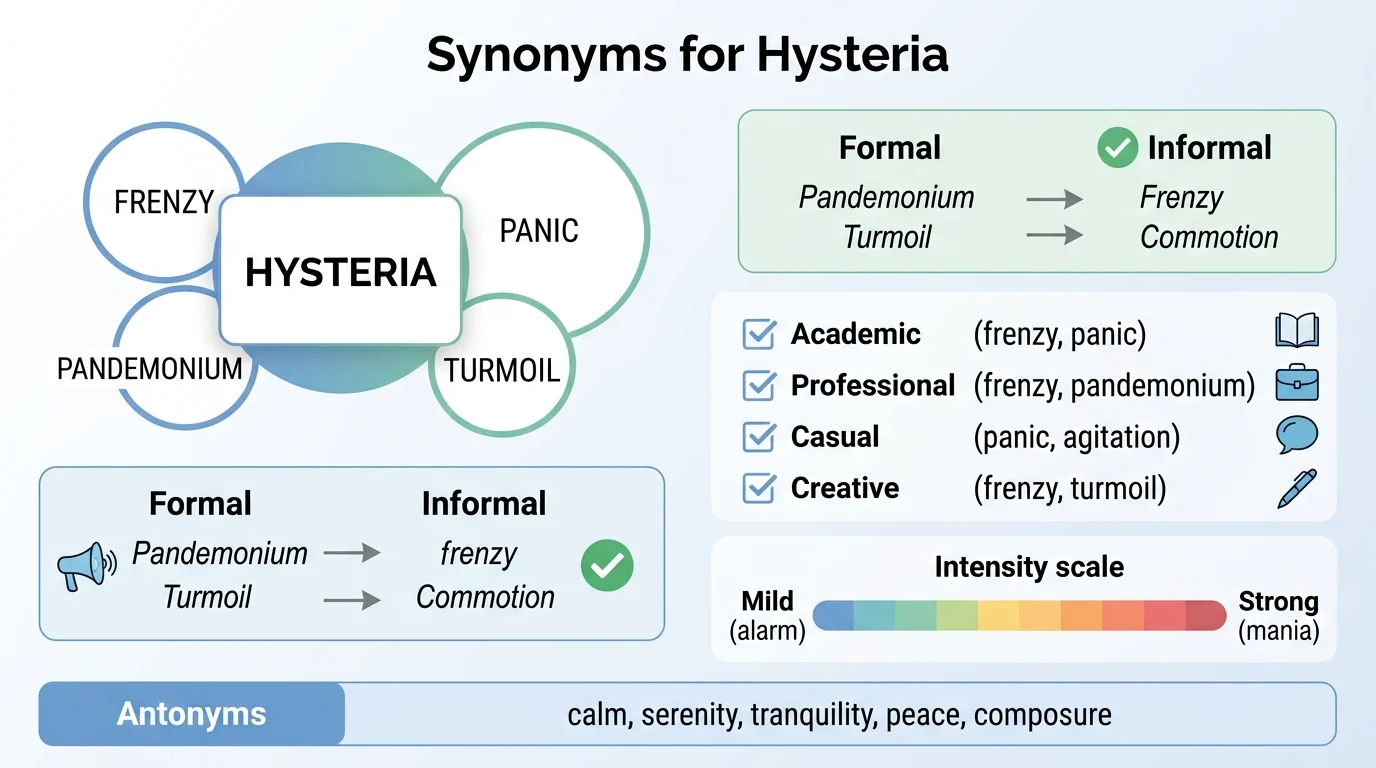
Hysteria refers to an overwhelming and uncontrollable emotional reaction, often involving extreme fear, panic, or excitement. The best synonyms depend on your context. For formal writing, use “frenzy” or “turmoil.” For casual conversation, “panic” or “freak out” work well. Academic contexts favor ” reaction” or “emotional upheaval,” while creative writing might use “delirium” or “pandemonium.”
Meaning, Tone and Context
Simple Definition
Hysteria is a state of intense emotional disturbance characterized by irrational behavior, excessive excitement, or uncontrollable fear. It often describes situations where emotions completely override rational thought.
Part of Speech
Hysteria is a noun. The adjective form is the adverb is “hysterically.”
Tone
Hysteria carries a negative tone. It suggests something excessive, irrational, and potentially dangerous or overwhelming.
Formality Level
The word is moderately formal. It appears in medical contexts, news reports, and serious discussions. However, it can also be used casually to describe dramatic reactions.
Common Use Cases
You will encounter “hysteria” in discussions of crowd behavior, media reactions, historical events, medical conditions, and intense emotional responses to personal situations.
Word Forms
Noun: hysteria
Adverb: hysterically
Verb form: hystericize (rarely used)
When and How to Use “Hysteria”
Use “hysteria” when describing situations where emotions have completely taken over rational thinking. The word works best for large scale reactions or moments of intense personal breakdown.
Professional Context
The CEO’s sudden resignation caused a wave of hysteria among the employees who feared for their jobs.
Academic Context
Historians debate whether the Salem witch trials were driven by religious fervor or mass hysteria.
Emotional Context
When she received the devastating news, a moment of hysteria overtook her before she could compose herself.
Creative Writing
The carnival erupted into hysteria as the fireworks display accidentally ignited the main tent.
Social Media Context
The announcement of the limited edition product caused absolute hysteria across all our social channels.
Casual Conversation
Stop with the hysteria; it is just a minor mistake that we can fix easily.
News Reporting
The stock market experienced a brief period of hysteria following the unexpected economic data release.
Another Word for “Hysteria”
The best replacement for “hysteria” depends entirely on your context, audience, and desired tone.
Professional Writing
Choose “turmoil” or “upheaval” for workplace situations. These words sound measured and professional while conveying significant disruption.
Academic Writing
Use “mass reaction” or “emotional contagion” when writing research papers. These terms sound scholarly and precise.
Casual Conversation
“Panic,” “freak out,” or “commotion” work well in everyday speech. They feel natural and accessible.
Emotional Writing
“Frenzy” or “fury” capture the emotional intensity of the moment. These words add dramatic weight to your writing.
Creative Writing
“Pandemonium” or “delirium” offer vivid imagery for storytelling. They paint a clear picture for your readers.
Resume or Workplace Use
“Overwhelmed” or “stressed” are better choices. “Hysteria” sounds unprofessional in a work context.
Social Media Captions
“Chaos” or “craze” work perfectly. They are short, punchy, and relatable.
Stronger Meaning
“Mania” suggests a more extreme state. It implies a complete loss of control or even a clinical condition.
Softer Meaning
“Distress” or “upset” offer gentler alternatives. They convey emotion without the dramatic intensity.
When Not to Use “Hysteria”
Avoid “hysteria” when describing routine emotional responses. The word implies something excessive and irrational.
Vague Usage
Using “hysteria” for ordinary anxiety makes your writing sound overblown. The team’s nervousness before a presentation is not hysteria.
Casual Tone Problems
In lighthearted conversations, “hysteria” sounds too serious. You might sound dramatic or insincere.
Formal Writing Issues
Some academic disciplines avoid “hysteria” due to its historical association with sexist medical diagnoses. Choose more precise terminology.
Professional Contexts
Using “hysteria” in business reports can undermine your credibility. It sounds emotional rather than analytical.
Weak Precision
Hysteria often describes shared emotional responses. For individual feelings, more precise words like “anxiety” or “panic” work better.
Words Commonly Confused With “Hysteria”
Hysteria vs. Panic
Panic is a sudden, intense fear response. Hysteria involves a broader emotional breakdown that may include laughter, crying, or irrational behavior.
Hysteria vs. Frenzy
Frenzy describes wild, uncontrolled activity. Hysteria focuses more on emotional disturbance rather than physical action.
Hysteria vs. Mania
Mania suggests a clinical state of elevated mood and energy. Hysteria can appear in various emotional states, not just excitement.
Hysteria vs. Chaos
Chaos describes disorder and confusion. Hysteria specifically involves emotional upheaval that may or may not create chaos.
Hysteria vs. Alarm
Alarm is a mild warning or concern. Hysteria represents an extreme reaction far beyond simple alarm.
Hysteria vs. Distress
Distress covers a wide range of suffering or discomfort. Hysteria is a specific and extreme form of distress.
Best Synonym by Context for “Hysteria”
| Context | Best Synonym | Why It Works | Example |
|---|---|---|---|
| Formal Writing | Turmoil | Professional and precise without emotional exaggeration | The company faced significant turmoil during the merger process. |
| Academic Writing | Collective Reaction | Objective and scholarly terminology | The study examined collective reactions to natural disasters. |
| Professional Context | Upheaval | Serious but appropriate for workplace communication | The restructuring created upheaval across all departments. |
| Resume Writing | Stress | Professional and accurate without negativity | Successfully managed team stress during major transitions. |
| Casual Conversation | Freak Out | Relatable and natural in everyday speech | Everyone freaked out when they heard the news. |
| Creative Writing | Pandemonium | Vivid and atmospheric for storytelling | Pandemonium broke loose as the storm hit the town. |
| Emotional Tone | Frenzy | Captures intense emotional energy | The stadium erupted in frenzy as the winning goal was scored. |
| Strong Intensity | Mania | Suggests extreme, uncontrollable emotion | The sale drove shoppers into a mania of consumption. |
| Moderate Tone | Commotion | Balanced and less dramatic | There was quite a commotion when the celebrity arrived. |
| Social Media | Craze | Modern and engaging for digital content | The new product launched to social media craze. |
Which Synonym Should You Choose?
Consider Your Meaning
Think carefully about what you actually want to describe. Are you talking about emotional breakdown, chaotic activity, or irrational group behavior?
Evaluate Formality
Match your word to your audience. Academic readers expect scholarly vocabulary. Social media followers respond to modern, casual language.
Assess Emotional Intensity
How strong is the reaction you are describing? “Disturbance” works for mild situations. “Mania” fits extreme cases.
Think About Professional Impact
Choose words that enhance your professional credibility. “Turmoil” and “upheaval” sound measured and responsible.
Analyze Sentence Context
Consider the surrounding words and tone. A word that works in one sentence might sound wrong in another.
Real Life Examples of “Hysteria” in Sentences
School Context
The fire drill caused momentary hysteria among the younger students who had never experienced one before.
Workplace Context
When the email announcement went out, office hysteria spread rapidly as employees rushed to interpret the news.
Writing Context
The author captured the crowd’s hysteria with vivid descriptions of shouting, running, and crying.
Conversation Context
We all laughed at his hysteria over a simple typo in the company newsletter.
Social Media Context
The influencer’s giveaway created absolute hysteria with thousands of entries flooding in within minutes.
Email Context
I apologize for the hysteria in my previous message; I have had time to think clearly now.
Storytelling Context
The entire village descended into hysteria when the strange lights appeared in the night sky.
News Context
Journalists reported mass hysteria at the airport after the announcement of travel restrictions.
15 Synonyms for “Hysteria”
| Synonym | Simple Meaning | Best Used For | Example Sentence |
|---|---|---|---|
| Frenzy | Wild excitement or agitation | Intense emotional scenes | The shoppers were in a frenzy during the midnight sale. |
| Panic | Sudden uncontrollable fear | Emergency situations | Panic spread through the crowd when the fire alarm sounded. |
| Pandemonium | Wild noisy disorder | Chaotic public events | Pandemonium reigned in the parliament after the vote. |
| Mania | Excessive enthusiasm or desire | Extreme emotional states | The concert sent fans into a mania of screaming and dancing. |
| Turmoil | State of great disturbance | Professional and formal contexts | The country experienced political turmoil after the election. |
| Commotion | Sudden noisy confusion | Everyday disturbances | A commotion erupted outside the courthouse. |
| Fever | Intense nervous excitement | Building anticipation | The team worked in a fever of preparation before the launch. |
| Delirium | State of confusion and excitement | Creative or literary writing | The city fell into delirium during the festival week. |
| Craze | Widespread enthusiasm | Social media and trends | The fashion craze swept through every high school in town. |
| Madness | Extreme foolishness or irrationality | Strong emotional reactions | The proposal was sheer madness that could never work. |
| Hysterics | Uncontrollable emotional outbursts | Casual conversation | She went into hysterics when she saw the surprise party. |
| Uproar | Loud public disturbance | Political or social events | The announcement caused an uproar in the community. |
| Alarm | Sudden fear or worry | Mild to moderate reactions | His comments raised alarm among the investors. |
| Fluster | Confusion and agitation | Personal interactions | The unexpected question put him in a fluster. |
| Disturbance | Disruption of normal function | General use | The protest caused a disturbance in the city center. |
Synonym Groups and Usage Differences
Professional vs. Personal Synonyms
Professional contexts demand words like “turmoil” and “upheaval” that sound mature and objective. Personal situations allow for emotional vocabulary such as “panic” or “hysterics” that feel authentic and relatable.
Formal vs. Conversational Synonyms
Formal writing favors “collective reaction,” “emotional disturbance,” and “turmoil.” Casual conversations thrive with “freak out,” or “lose it.” Always match your formality level to your audience.
Academic Synonyms
Academic writing benefits from precise terms like “emotional contagion,” “mass reaction,” and “collective behavior.” These phrases sound scholarly and avoid the loaded history of “hysteria” in medical and psychological contexts.
Professional and Business Synonyms
Business communication works best with “upheaval,” “disruption,” “turmoil,” or “transition challenges.” These words convey seriousness without emotional exaggeration.
Creative or Literary Synonyms
Creative writers can use vivid words like “pandemonium,” “delirium,” “fury,” and “bedlam.” These terms paint powerful mental images for readers.
Slang or Modern Synonyms
Modern usage includes “freak out,” “go viral,” “meltdown,” and “craze.” These words feel current and engaging. Use them in social media, casual writing, and contemporary dialogue. Avoid them in formal or academic contexts.
Strongest vs. Weaker Synonyms
Strongest: mania, delirium, pandemonium
Strong: frenzy, hysterics, bedlam
Moderate: commotion, upheaval, turmoil
Weaker: alarm, fluster, concern
Emotional vs. Neutral Synonyms
Emotional synonyms: frenzy, hysterics, delirium, mania
Neutral synonyms: disturbance, turmoil, commotion, upheaval
Antonyms of “Hysteria”
| Antonym | Meaning | Example Sentence |
|---|---|---|
| Calm | Peaceful state of mind | The room remained calm despite the shocking news. |
| Composure | Emotional self control | She maintained her composure during the difficult meeting. |
| Serenity | State of being calm and peaceful | The beach brought him a sense of serenity he rarely felt. |
| Equanimity | Mental calmness under stress | His equanimity impressed everyone during the crisis. |
| Tranquility | State of quiet and peace | The library offered tranquility away from the city noise. |
| Peace | Absence of disturbance | Peace returned after the protesters dispersed. |
| Order | Arranged and controlled state | The manager restored order quickly. |
| Rationality | Logical and reasonable thinking | Rationality replaced panic as they found a solution. |
| Stability | Steady and unchanging condition | The market showed stability after the brief disruption. |
| Restraint | Self control and moderation | He showed remarkable restraint in his response. |
| Poise | Elegant composure | She handled the interview with grace and poise. |
| Stillness | Absence of movement or sound | The forest was filled with profound stillness. |
| Harmony | Agreement and peaceful relations | Harmony prevailed at the family gathering. |
| Sanity | Healthy mental state | He questioned his sanity during the stressful period. |
| Control | Power over one’s emotions | She regained control of her feelings quickly. |
Comparison: Hysteria vs. Similar Words
Hysteria vs. Panic
Main difference: Panic is sudden fear focused on danger. Hysteria involves a broader emotional collapse.
Which is stronger: Hysteria suggests a more intense and prolonged reaction.
Which is more formal: Both are moderately formal, but hysteria has more weight.
Panic example: Panic set in when they realized the plane was losing altitude.
Hysteria example: The announcement triggered hysteria among the waiting crowd.
Hysteria vs. Frenzy
Main difference: Frenzy describes wild activity. Hysteria focuses on emotional disturbance.
Which is stronger: Frenzy implies more physical action. Hysteria suggests deeper emotional breakdown.
Which is more formal: Hysteria is slightly more formal.
Frenzy example: The fans worked themselves into a frenzy before the concert.
Hysteria example: The media coverage created hysteria about the health scare.
Hysteria vs. Mania
Main difference: Mania suggests a clinical or psychological state. Hysteria is more general.
Which is stronger: Mania is stronger and more specific.
Which is more formal: Mania is more formal and technical.
Mania example: Her cleaning mania made her scrub floors three times daily.
Hysteria example: The product launch caused hysteria among loyal customers.
Hysteria vs. Pandemonium
Main difference: Pandemonium means wild disorder and noise. Hysteria includes the emotional component.
Which is stronger: Pandemonium suggests more chaos. Hysteria suggests more emotional upset.
Which is more formal: Both are used in creative and formal contexts.
Pandemonium example: Pandemonium broke loose when the doors opened.
Hysteria example: The courtroom fell into hysteria after the verdict.
Hysteria vs. Turmoil
Main difference: Turmoil implies confusion and disorder. Hysteria adds intense emotional reaction.
Which is stronger: Hysteria suggests more emotional intensity.
Which is more formal: Turmoil is more formal and professional.
Turmoil example: The company experienced financial turmoil last quarter.
Hysteria example: The news caused public hysteria across the nation.
Hysteria vs. Alarm
Main difference: Alarm is a mild warning or concern. Hysteria is an extreme reaction.
Which is stronger: Hysteria is significantly stronger.
Which is more formal: Alarm is moderately formal.
Alarm example: The report raised alarm among environmental groups.
Hysteria example: The announcement sparked hysteria in the investment community.
Common Phrases and Expressions with “Hysteria”
1. Mass Hysteria
Meaning: A phenomenon where large groups of people experience similar emotional or physical symptoms.
Example sentence: Mass hysteria spread through the school after students reported mysterious symptoms.
2. Hysteria Over Nothing
Meaning: An extreme reaction to something trivial.
Example sentence: The media created hysteria over nothing when the celebrity made a minor mistake.
3. Fit of Hysteria
Meaning: A sudden uncontrollable emotional outburst.
Example sentence: She went into a fit of hysteria when she lost her wallet.
4. Hysteria Ensued
Meaning: Hysteria followed a particular event.
Example sentence: Hysteria ensued when the store announced the limited release.
5. Moral Hysteria
Meaning: Extreme public concern about moral or social issues.
Example sentence: Moral hysteria swept the town after the controversial art exhibit opened.
6. Hysteria Laced
Meaning: Containing elements of hysteria.
Example sentence: Her speech was hysteria laced with genuine fear.
7. Whipped Into Hysteria
Meaning: Made to become.
Example sentence: The political speech whipped the crowd into hysteria.
Common Mistakes to Avoid
1. Using Hysteria for Normal Emotions
Describing routine disappointment as hysteria makes your writing sound dramatic and inaccurate. Use “frustration” or “disappointment” instead.
2. Confusing Hysteria with Panic
Remember that panic is a specific fear response. Hysteria encompasses a wider range of irrational emotions and behaviors.
3. Using Casual Synonyms in Formal Writing
Avoid “freak out” in academic papers or professional reports. These phrases undermine your credibility.
4. Using Overly Dramatic Synonyms for Simple Situations
Reserve “mania” and “pandemonium” for truly extreme events. Minor disturbances only need “commotion” or “disturbance.”
5. Repeating the Same Word
Use variety in your writing. If you have already used “hysteria” once, choose a synonym for the next reference.
6. Choosing Synonyms with Wrong Emotional Tone
Match your word to the feeling you want to convey. “Frenzy” works for excitement. “Panic” works for fear. Using the wrong tone confuses readers.
7. Using Slang in Professional Contexts
Save “meltdown” and “freak out” for casual writing. Professional documents need more formal alternatives.
FAQs
What is the best synonym for hysteria?
The best synonym depends on context. “Frenzy” works well for excitement. “Panic” fits fear based reactions. “Turmoil” suits professional situations.
What is a formal synonym for hysteria?
“Turmoil,” “upheaval,” and “emotional disturbance” are formal alternatives that work well in professional and academic writing.
What is an informal synonym for hysteria?
“Freak out,” and “meltdown” are casual alternatives for everyday conversation and social media.
What is another word for hysteria in professional writing?
“Upheaval,” “disruption,” and “turmoil” are appropriate for workplace communication and business reports.
What is the difference between hysteria and panic?
Panic is sudden fear of danger. Hysteria involves a broader emotional breakdown that may include various reactions beyond fear.
What is the opposite of hysteria?
“Calm,” “composure,” “serenity,” and “equanimity” are direct opposites that describe emotional control and peace.
Conclusion
Hysteria describes overwhelming emotional disturbance, often involving irrational behavior or intense reactions. The best synonyms range from formal choices like “turmoil” and “upheaval” to casual alternatives like “freak out” and “craze.” Always consider your audience, context, and desired tone before selecting a replacement.
Your choice of words shapes how readers perceive your message. Using precise vocabulary demonstrates your communication skills and builds trust with your audience. Start practicing with these synonyms today, and your writing will become more engaging, professional, and effective.
Remember to verify definitions using trusted dictionaries such as Cambridge, Oxford, Merriam Webster, Collins, or Britannica before publishing any content that relies on specific word meanings. A quick dictionary check can prevent embarrassing mistakes and strengthen your credibility as a writer.