Do you catch yourself using the word “have” too often in your writing? You are not alone. Most English speakers rely on this common verb more than they realize. Whether you are drafting a professional email, crafting a college essay, or updating your resume, repeating the word “have” can make your writing feel dull.
A richer vocabulary helps you communicate with clarity and precision. This guide will transform how you express possession, obligation, experience, and relationships.
What Does “Have” Mean?
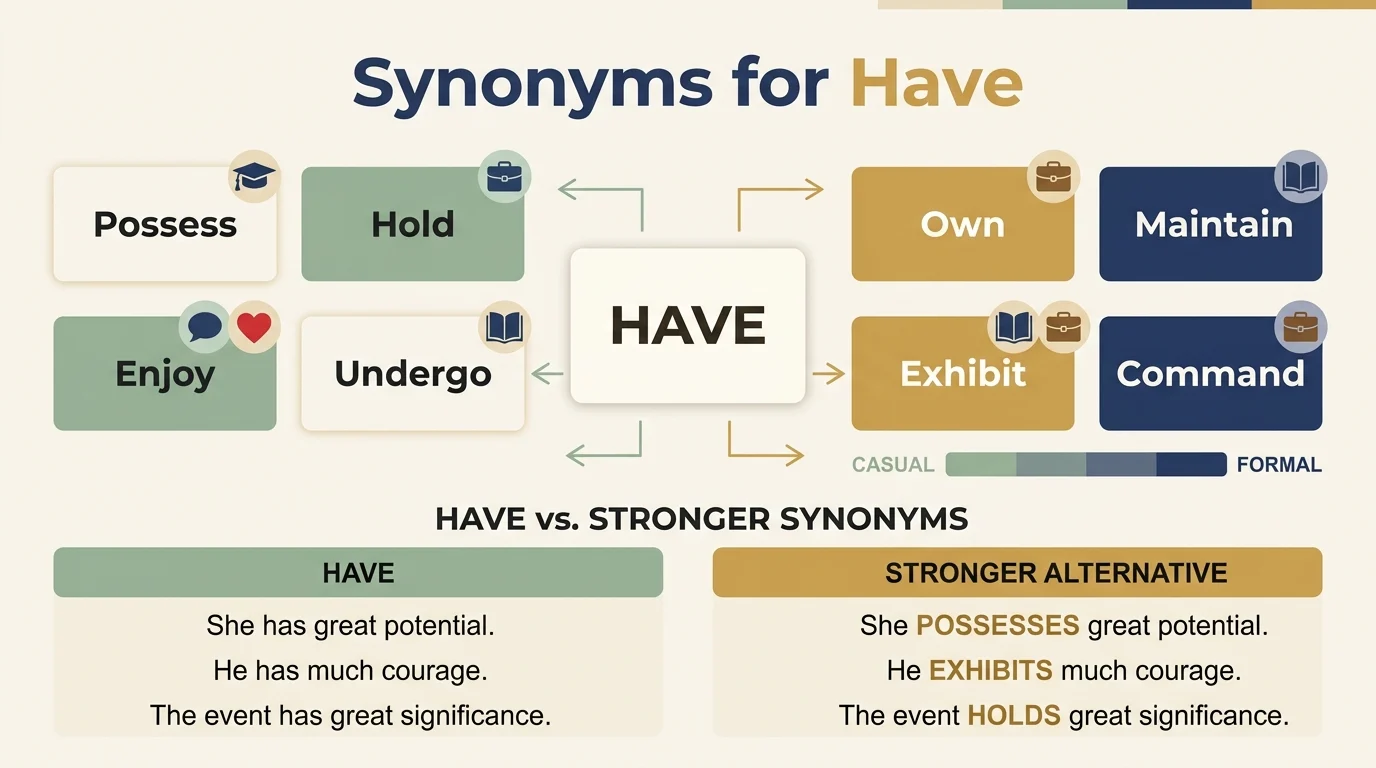
Have” is a common verb that means to possess, own, or hold something. It also expresses experiences, obligations, relationships, and actions. The best synonyms for have depend on your situation. Use “possess” for formal writing, “hold” for professional contexts, “enjoy” for experiences, “maintain” for business, “own” for legal matters, and “undergo” for medical or emotional situations.
Meaning, Tone and Context
1. Simple definition
“Have” means to possess or hold something in your control. It also describes experiences, relationships, obligations, and actions.
2. Part of speech
“Have” functions as a verb. It is an irregular verb with forms including has, having, and had.
3. Positive, negative, or neutral tone
The word “have” is neutral. It carries no strong emotional weight on its own.
4. Formality level
“Have” is universal. It works in formal, casual, professional, and personal settings.
5. Common use cases
People use “have” to talk about possession, personal experiences, medical conditions, family relationships, daily activities, and professional duties.
6. Important word forms
Related forms include “having” as a gerund, “has” for third person singular, and “had” for past tense. The noun form “having” refers to possessions or assets in some contexts.
When and How to Use “Have”
Use “have” when you need a simple, clear, and widely understood verb. It fits almost every situation. However, you should choose more precise synonyms when you want to sound professional, emotional, or descriptive. Here are practical examples.
Professional context
Our team has completed the quarterly financial review.
Personal context
I have two brothers and a sister.
Academic context
Researchers have observed this pattern in multiple studies.
Emotional context
She has a deep love for classical music.
Creative context
The old house has a mysterious charm that draws visitors.
Social media context
We have the best brunch spots in the city.
Email context
I have attached the proposal for your review.
Resume context
I have managed teams of up to fifteen people.
Another Word for “Have”
The best single replacement for “have” depends on your meaning and situation.
Professional writing
Use “possess” when discussing skills, qualifications, or assets. Use “maintain” for ongoing responsibilities.
Academic writing
Use “exhibit” for showing characteristics or “demonstrate” for presenting evidence.
Casual conversation
Use “got” for informal settings or “own” for clear possession.
Emotional writing
Use “experience” for feelings or “cherish” for valuable relationships.
Creative writing
Use “hold” for physical or emotional grasp, “bear” for burdens, or “carry” for qualities.
Resume or workplace use
Use “managed” for responsibilities, “developed” for skills, or “led” for team experience.
Social media captions
Use “got” for casual posts or “scored” for exciting finds.
Stronger meaning
Use “command” for authority, “dominate” for control, or “monopolize” for exclusive possession.
Softer meaning
Use “enjoy” for pleasant experiences or “benefit from” for advantages.
When Not to Use “Have”
The word “have” becomes weak when you need precision or emotional impact. Overusing this verb makes your writing sound vague and repetitive.
Example of a vague sentence
She has a good job.
Improved with a precise synonym
She holds a senior position at a technology firm.
Example of a weak sentence
He has a lot of experience.
Improved with a stronger synonym
He possesses extensive industry expertise.
Example of an emotional sentence
I have a great relationship with my mentor.
Improved with an emotional synonym
I cherish the strong connection with my mentor.
Avoid “have” when you need to show ownership clearly. Use “own” instead. Avoid “have” when you describe physical holding. Use “hold” or “grasp” instead. Avoid “have” when you discuss obligations. Use “must” or “need” instead. Avoid “have” when you talk about experiences. Use “undergo” or “enjoy” instead.
Words Commonly Confused With “Have”
Many words seem similar to “have” but carry distinct meanings. Understanding these differences will improve your writing accuracy.
1. Have vs. Own
“Have” is general and broad. “Own” specifically means legal or rightful possession. Use “own” when you want to emphasize legal ownership.
2. Have vs. Hold
“Have” describes possession or experience. “Hold” suggests physical grasp or maintaining a position. Use “hold” when you refer to keeping something in your hands or maintaining a belief.
3. Have vs. Possess
“Possess” sounds more formal and deliberate. “Have” is neutral and common. Use “possess” in legal, academic, or professional documents.
4. Have vs. Get
“Have” describes existing possession. “Get” describes the action of obtaining. Use “get” when you focus on acquiring something new.
5. Have vs. Take
“Have” implies passive possession. “Take” implies active choice or effort. Use “take” when you actively choose or grab something.
6. Have vs. Experience
“Have” is general for life events. “Experience” emphasizes personal involvement and feeling. Use “experience” when you want to highlight emotional or sensory engagement.
Best Synonym by Context for “Have”
| Context | Best Synonym | Why It Works | Example |
|---|---|---|---|
| Formal writing | Possess | Adds professionalism and legal clarity | The applicant must possess a master’s degree. |
| Academic writing | Exhibit | Describes observable traits or behaviors | The data exhibit a clear upward trend. |
| Professional business | Maintain | Shows ongoing responsibility | We maintain strict quality control standards. |
| Resume skills | Developed | Emphasizes achievement and growth | I developed a new training program. |
| Casual conversation | Got | Sounds natural and friendly | I got tickets to the concert. |
| Creative writing | Bear | Adds literary weight and imagery | She bears the weight of her family legacy. |
| Emotional tone | Cherish | Conveys deep appreciation | I cherish every moment with my children. |
| Strong intensity | Command | Shows authority and control | He commands respect from his peers. |
| Soft or moderate tone | Enjoy | Focuses on pleasant experiences | We enjoy a comfortable lifestyle. |
| Social media captions | Scored | Creates excitement and engagement | We scored the best seats in the house. |
Which Synonym Should You Choose?
Choosing the right synonym for “have” depends on several factors.
Consider your audience
Choose formal synonyms like “possess” or “maintain” for professional audiences. Use casual options like “got” for friends and social media.
Consider your purpose
Use “own” for legal or financial statements. Use “experience” for personal stories. Use “hold” for physical objects or steadfast beliefs.
Consider your tone
Choose “cherish” for emotional writing. Choose “command” for assertive statements. Choose “enjoy” for positive experiences.
Consider emotional intensity
Use “bear” for heavy burdens. Use “possess” for neutral facts. Use “monopolize” for strong control.
Consider sentence context
Think about the noun following the verb. Match your synonym to the object. You possess skills, maintain relationships, and cherish memories.
Real Life Examples of “Have” in Sentences
School setting
Students must possess strong critical thinking skills for advanced coursework.
Workplace setting
Our department maintains rigorous safety standards throughout the year.
Writing context
Skilled writers exhibit a natural command of language and structure.
Conversation setting
I got a new phone yesterday and I love the camera quality.
Social media context
We scored amazing photos from our weekend adventure.
Resume context
I developed comprehensive marketing strategies that increased sales.
Email context
Please find the attached documents for your reference.
Storytelling context
She bears the memories of her travels like precious treasures.
25 Synonyms for “Have”
| Synonym | Simple Meaning | Best Used For | Example Sentence |
|---|---|---|---|
| Possess | Own or hold something | Formal and legal writing | The company possesses valuable intellectual property. |
| Hold | Keep in your grasp | Physical or metaphorical holding | She holds a degree from a prestigious university. |
| Own | Have legal right to something | Property and legal contexts | He owns three properties in the city. |
| Maintain | Keep in a particular state | Professional and business use | We maintain high standards of customer service. |
| Enjoy | Experience something pleasant | Positive experiences and lifestyle | They enjoy a comfortable retirement. |
| Undergo | Experience something difficult | Medical and challenging situations | Patients undergo careful evaluation. |
| Exhibit | Show or display characteristics | Academic and scientific writing | The results exhibit significant improvement. |
| Command | Have authority over | Leadership and military contexts | He commands respect from his colleagues. |
| Bear | Carry a burden or responsibility | Emotional and literary contexts | She bears the responsibility for her team. |
| Acquire | Gain or obtain something | Growth and achievement contexts | I acquired new skills during the internship. |
| Retain | Keep possession of something | Legal and professional contexts | The lawyer retained all original documents. |
| Boast | Have something to be proud of | Positive and promotional contexts | This restaurant boasts an award winning chef. |
| Contain | Include within something | Descriptive and scientific contexts | The report contains all necessary data. |
| Comprise | Include or consist of | Formal and academic contexts | The committee comprises seven members. |
| Experience | Undergo an event | Personal and emotional contexts | We experienced a remarkable transformation. |
| Sustain | Maintain over time | Long term professional contexts | Our team sustained excellent performance. |
| Embrace | Accept enthusiastically | Emotional and philosophical contexts | She embraces a minimalist lifestyle. |
| Cherish | Value deeply | Personal and romantic contexts | I cherish my friendship with her. |
| Harbor | Keep hidden or hold secret | Emotional and secretive contexts | He harbors doubts about the plan. |
| Carry | Transport or support | Physical and metaphorical contexts | She carries a heavy workload. |
| Grasp | Hold tightly or understand | Physical and intellectual contexts | He grasps complex concepts quickly. |
| Secure | Obtain successfully | Professional and achievement contexts | I secured funding for the project. |
| Earn | Gain through effort | Professional and personal development | She earned a promotion through dedication. |
| Attain | Achieve a goal | Formal and academic contexts | He attained the highest level of certification. |
| Derive | Obtain from a source | Academic and analytical contexts | We derive benefits from this partnership. |
Synonym Groups and Usage Differences
Professional vs. Personal Synonyms
Professional contexts demand precise and formal language. Use “possess” for qualifications, “maintain” for ongoing responsibilities, and “command” for authority.
Personal contexts allow casual language. Use “got” for everyday conversations and “enjoy” for pleasant experiences. Choose “cherish” for loved ones and important relationships.
Formal vs. Conversational Synonyms
Formal writing includes reports, academic papers, business documents, and professional correspondence. Choose “possess,” “maintain,” “exhibit,” and “comprise” for these situations.
Conversational writing includes texts, social media posts, friendly emails, and personal messages. Choose “got,” “enjoy,” “scored,” and “have” for natural, approachable communication.
Academic Synonyms
Academic writing values precision and clarity. Use “exhibit” for displaying traits, “demonstrate” for showing evidence, “comprise” for including elements, and “derive” for obtaining from sources. These words signal careful thinking and scholarly rigor.
Professional and Business Synonyms
Workplace communication demands confidence and clarity. Use “possess” for skills and qualifications. “maintain” for quality and standards. Use “command” for authority and respect. “secure” for achievements and funding. These synonyms project competence and reliability.
Creative or Literary Synonyms
Creative writing values imagery and emotional weight. Use “bear” for burdens and responsibilities. “harbor” for hidden feelings or secrets. Use “cherish” for deeply valued people and things. “embrace” for accepting ideas and lifestyles. These synonyms add depth and atmosphere to your writing.
Slang or Modern Synonyms
Modern English includes slang terms that substitute for “have” in casual settings. “Got” is the most common casual replacement. “Scored” works for exciting acquisitions. “Grabbed” suggests quick and casual possession. Use these words in texts, social media, and friendly conversations. Avoid them in professional or academic writing.
Strongest vs. Weaker Synonyms
Here is an intensity scale from mild to strongest for synonyms of “have.”
Mild intensity: “Enjoy,” “possess,” “maintain.”
Moderate intensity: “Hold,” “own,” “experience.”
Strong intensity: “Command,” “dominate,” “monopolize.”
Strongest intensity: “Wield,” “assert,” “exert.”
Choose the intensity that matches your message. A mild synonym fits neutral statements. A strong synonym works for powerful assertions.
Emotional vs. Neutral Synonyms
Neutral synonyms state facts without emotional weight. These include “possess,” “maintain,” “hold,” and “comprise.”
Emotional synonyms add feeling and personal connection. These include “cherish” for love and appreciation, “bear” for burdens and struggles, “harbor” for hidden feelings, “embrace” for acceptance and enthusiasm, and “relish” for intense enjoyment. Use emotional synonyms when you want your audience to feel something.
Antonyms of “Have”
| Antonym | Meaning | Example Sentence |
|---|---|---|
| Lack | Not have something | They lack sufficient funding for the project. |
| Need | Require something absent | I need a reliable internet connection. |
| Want | Desire something not possessed | She wants a new laptop for her studies. |
| Miss | Be without something | He misses the support of his former team. |
| Lose | No longer have something | We may lose our competitive advantage. |
| Forfeit | Give up something | The company will forfeit its license. |
| Surrender | Give up possession | The defendant surrendered his passport. |
| Relinquish | Let go of something | She relinquished her leadership role. |
| Cede | Give away territory or rights | The country ceded control of the region. |
| Yield | Surrender to pressure | He yielded his position to a younger candidate. |
| Abandon | Leave behind completely | They abandoned their original plan. |
| Dispossess | Deprive of something | The court dispossessed the former owners. |
| Deprive | Take something away | Hunger deprived them of energy. |
| Deny | Refuse to give something | The committee denied their request. |
| Withhold | Refuse to give something | The bank withheld the loan approval. |
Comparison: Have vs. Similar Words
Have vs. Possess
“Have” is universal and neutral. “Possess” is formal and deliberate. “Possess” sounds more definitive and legalistic. Use “possess” for formal documents and professional descriptions. Use “have” for everyday conversation.
Example with “have”: I have a valid passport.
Example with “possess”: The applicant must possess a valid passport.
Have vs. Own
“Own” emphasizes legal or financial possession. “Have” is broader and includes experiences and relationships. Use “own” when you discuss property, assets, or legal rights.
Example with “have”: We have three cars.
Example with “own”: We own three cars outright.
Have vs. Hold
“Hold” suggests physical grasping or maintaining a position. “Have” is more passive. Use “hold” for physical objects, firm beliefs, or official positions.
Example with “have”: She has a degree in biology.
Example with “hold”: She holds a degree in biology from Harvard.
Have vs. Experience
“Have” is general for life events. “Experience” emphasizes personal involvement and sensation. Use “experience” when you want to highlight feelings, challenges, or memorable events.
Example with “have”: We have a difficult year.
Example with “experience”: We experienced a difficult year together.
Have vs. Get
“Have” describes existing possession. “Get” describes the action of obtaining. Use “get” when you focus on acquisition rather than current possession.
Example with “have”: I have a new phone.
Example with “get”: I got a new phone yesterday.
Have vs. Maintain
“Maintain” implies ongoing effort and care. “Have” is neutral. Use “maintain” when you discuss standards, relationships, or conditions that require active attention.
Example with “have”: They have good relationships with clients.
Example with “maintain”: They maintain good relationships with clients.
Common Phrases and Expressions with “Have”
1. Have a good day
Meaning: A polite wish for someone to enjoy their day.
Example: Thank you for your help. Have a good day.
2. Have a meeting
Meaning: To attend or participate in a scheduled discussion.
Example: We have a meeting at three o’clock this afternoon.
3. Have a look
Meaning: To examine or observe something.
Example: Please have a look at these new designs.
4. Have a feeling
Meaning: To sense or suspect something.
Example: I have a feeling that we will succeed.
5. Have an impact
Meaning: To affect or influence something.
Example: This policy will have an impact on small businesses.
6. Have a chance
Meaning: To possess an opportunity or possibility.
Example: We have a chance to win the contract.
7. Have a conversation
Meaning: To talk or discuss with someone.
Example: We need to have a conversation about our goals.
8. Have a problem
Meaning: To encounter or possess an issue or difficulty.
Example: I have a problem with this software update.
Common Mistakes to Avoid
1. Overusing “have” in professional writing
Many professionals repeat “have” in resumes, emails, and reports. This makes your writing sound basic and unimpressive. Replace “have” with specific action verbs that showcase your achievements.
2. Confusing “have” with “of”
Some writers incorrectly write “could of” instead of “could have.” This is a grammar error. Always write “should have,” “could have,” and “would have.”
3. Using casual synonyms in formal writing
Words like “got” and “scored” do not belong in academic papers or professional reports. Choose formal alternatives like “possess” or “acquire.”
4. Using overly dramatic synonyms for simple situations
Do not use “cherish” for casual likes or “bear” for minor responsibilities. Save powerful synonyms for situations that deserve emotional weight.
5. Choosing a synonym with the wrong emotional tone
Selecting “bear” for a positive situation sounds negative. Choosing “relish” for a serious problem sounds inappropriate. Match your synonym to the emotional tone of your message.
6. Using slang in academic or professional writing
Slang replacements like “got” and “scored” undermine your credibility in formal contexts. Use standard English in professional communications.
7. Forgetting subject verb agreement with “have”
Use “has” for singular third person subjects. Use “have” for plural subjects and first or second person. This mistake makes your writing look unprofessional.
FAQs
1. What is the best synonym for have?
The best synonym depends on your context. “Possess” works for formal writing, “hold” for professional settings, and “got” for casual conversation.
2. What is a formal synonym for have?
“Possess” is an excellent formal synonym. “Maintain” and “command” also work well in professional and business contexts.
3. What is an informal synonym for have?
“Got” is the most common informal replacement. “Scored” and “grabbed” also work in casual conversations and social media.
4. What is another word for have in professional writing?
Use “possess” for qualifications, “maintain” for standards, and “command” for authority. These words project professionalism and competence.
5. What is the difference between have and possess?
“Have” is universal and neutral. “Possess” is more formal, deliberate, and legalistic. Use “possess” in official and professional documents.
6. What is the opposite of have?
“Lack” is the direct opposite. “Need,” “want,” “miss,” and “lose” also serve as antonyms depending on your meaning.
Conclusion
The verb “have” serves as a reliable workhorse in English, but relying on it too heavily makes your writing feel flat and repetitive. A thoughtful vocabulary choice transforms your communication. Use “possess” to sound professional and precise. “hold” to suggest physical or metaphorical grasp. “experience” to emphasize personal involvement. Use “cherish” to convey deep emotional value. Remember that context, tone, and audience should guide your word selection. The right synonym elevates your message and captures your reader’s attention. Start replacing “have” with more precise alternatives today and watch your writing improve.