Have you ever typed the word “created” for the fifth time in a single email or essay? You pause. stare at the screen. You know there must be a better way to express the same idea.
This happens to English learners, writers, and professionals every day. Repeating the same word drains energy from your message. It makes your writing feel flat and uninspired.
The good news is simple. English offers dozens of powerful alternatives to “created.” Each synonym carries a unique shade of meaning. Each one fits specific situations better than others.
By the end of this guide, you will understand exactly which synonym to choose for any context. Your writing will become more precise. Your vocabulary will grow naturally. You will stop repeating “created” forever.
What Does “Created” Mean?
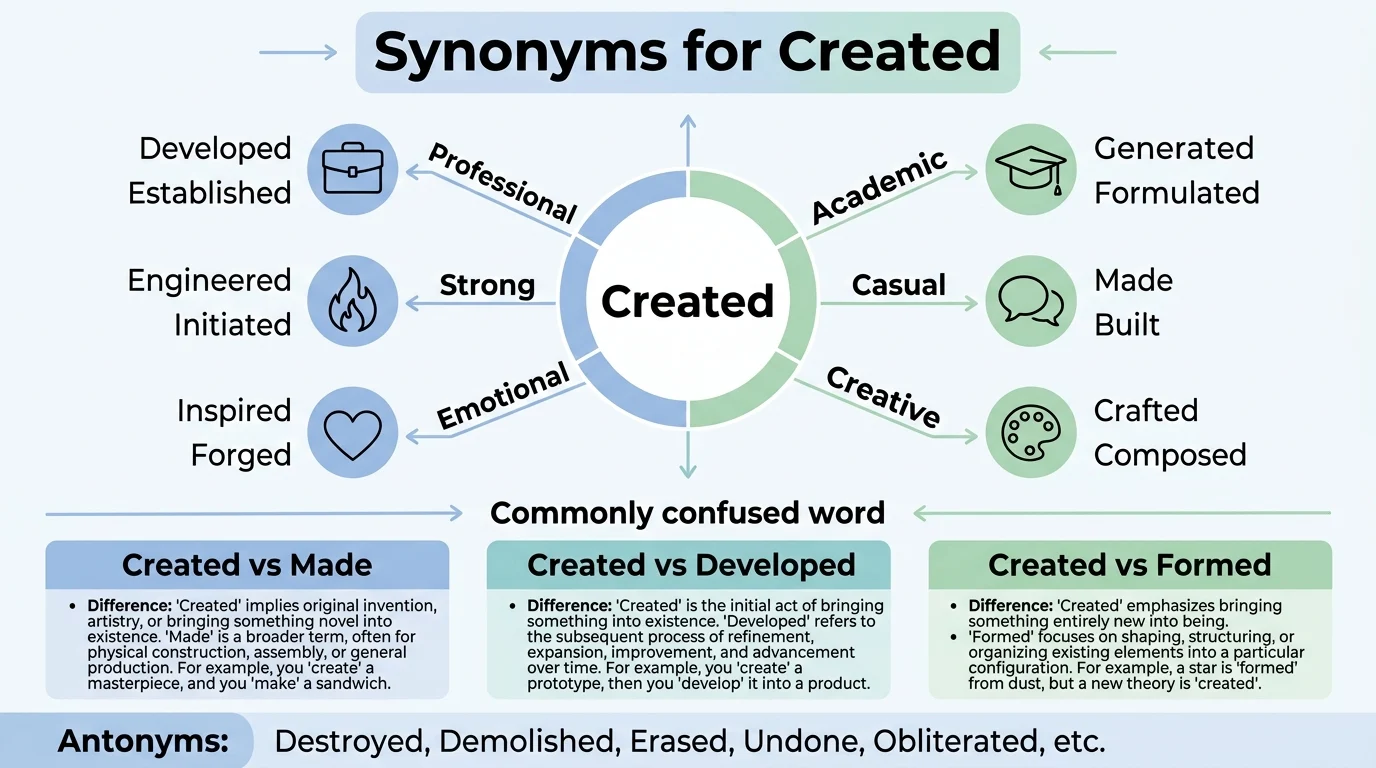
Created means bringing something into existence that did not exist before. The best synonyms depend on context. For formal writing, use “established” or “generated.” casual conversation, use “made” or “built.” creative contexts, try “crafted” or “composed.” For emotional impact, use “inspired” or “forged.” Each synonym carries distinct tone and intensity.
Meaning, Tone and Context
Simple Definition
Created means to cause something to exist or to bring something into being through action, imagination, or effort.
Part of Speech
Created is the past tense and past participle form of the verb “create.”
Tone
Created is neutral in tone. It carries no strong positive or negative emotional weight on its own.
Formality Level
Created is standard English. It works in formal and informal situations equally well.
Common Use Cases
People use created in everyday conversation, professional documents, academic papers, creative writing, resumes, and social media content.
Important Word Forms
Create (verb), creator (noun), creation (noun), creative (adjective), creatively (adverb), creativity (noun).
When and How to Use “Created”
Use created when you want to state a fact about bringing something into existence. The word works best when you do not need to emphasize the process or the effort involved.
Professional Context
“The team created a new marketing strategy for the product launch.”
Personal Context
“My grandmother created this recipe over fifty years ago.”
Academic Context
“The researcher created a model to predict climate change patterns.”
Emotional Context
“She created a safe space for her students to share their feelings.”
Creative Context
“The artist created a stunning mural on the downtown building.”
Social Media Context
“I created this playlist for my morning workout routine.”
Resume Context
“Created a customer feedback system that improved satisfaction by 40 percent.”
Another Word for “Created”
Professional Writing
Use “established” when describing companies, systems, or lasting structures. It conveys permanence and credibility.
Academic Writing
Use “generated” for data, results, or theoretical frameworks. It sounds precise and methodical.
Casual Conversation
Use “made” for everyday situations. It is simple, clear, and universally understood.
Emotional Writing
Use “inspired” when human connection or motivation is involved. It carries warmth and personal meaning.
Creative Writing
Use “crafted” to emphasize skill, care, and artistic attention to detail.
Resume or Workplace Use
Use “developed” to show initiative and growth. It suggests planning and follow through.
Social Media Captions
Use “made” or “built” for short, engaging content that feels personal and approachable.
Stronger Meaning
Use “forged” to suggest overcoming difficulty or creating through intense effort.
Softer Meaning
Use “formed” when the creation happened gradually or naturally without forceful action.
When Not to Use “Created”
When the Word Sounds Too Vague
Created often fails to communicate the method, effort, or significance behind the action.
Weak example: “I created a report.”
Improved example: “I compiled a report from multiple data sources.”
When the Word Is Too Casual for Formal Writing
In academic or legal documents, created may feel insufficiently precise.
Weak example: “The law created new regulations.”
Improved example: “The law established new regulatory frameworks.”
When the Word Is Too Formal for Casual Conversation
Created can sound stiff in everyday speech.
Weak example: “I created dinner.”
Improved example: “I made dinner.”
When a More Powerful Word Better Captures the Action
Created does not convey struggle, artistry, or innovation on its own.
Weak example: “She created a beautiful dress.”
Improved example: “She designed a beautiful dress.”
When the Word Is Too General
Created does not distinguish between physical objects, abstract ideas, or digital content.
Weak example: “He created a website.”
Improved example: “He built a website.”
Words Commonly Confused With “Created”
Created vs. Made
Made is more general and casual. It can refer to physical objects, food, or simple actions. Created suggests originality and novelty.
Made example: “I made coffee this morning.”
Created example: “I created a new coffee blend.”
Created vs. Developed
Developed implies a process of growth or improvement over time. Created suggests a single moment of coming into existence.
Developed example: “She developed her skills over many years.”
Created example: “She created a new method for teaching.”
Created vs. Formed
Formed suggests natural or gradual shaping. Created implies intentional effort or design.
Formed example: “Crystals formed in the solution.”
Created example: “The artist created a crystal sculpture.”
Created vs. Generated
Generated often relates to data, results, or outcomes from a system. Created is broader and more general.
Generated example: “The software generated a report.”
Created example: “The team created the software.”
Created vs. Constructed
Constructed implies building physical things or assembling parts. Created can refer to abstract and physical things equally.
Constructed example: “Workers constructed a new bridge.”
Created example: “She created a new theory.”
Created vs. Founded
Founded refers specifically to starting organizations, institutions, or cities. Created is much broader.
Founded example: “He founded a nonprofit organization.”
Created example: “He created a nonprofit program.”
Best Synonym by Context for “Created”
| Context | Best Synonym | Why It Works | Example |
|---|---|---|---|
| Formal Writing | Established | Conveys authority and permanence | “The committee established new guidelines.” |
| Academic Writing | Generated | Sounds precise and scientific | “The study generated significant findings.” |
| Professional Business | Developed | Shows planning and execution | “We developed a comprehensive solution.” |
| Resume Use | Engineered | Suggests innovation and technical skill | “Engineered a system that cut costs by half.” |
| Casual Conversation | Made | Natural, simple, and universally understood | “I made a cake for the party.” |
| Creative Writing | Crafted | Emphasizes artistry and skill | “She crafted each chapter with care.” |
| Emotional Tone | Inspired | Reflects passion and human connection | “His speech inspired a movement.” |
| Strong Intensity | Forged | Implies overcoming challenges | “They forged a partnership against all odds.” |
| Soft Moderate Tone | Formed | Suggests gentle natural development | “A friendship formed between them.” |
| Social Media Captions | Built | Feels personal and community focused | “Built this community from the ground up.” |
| US Usage | Produced | Common in American business language | “The company produced innovative products.” |
| UK Usage | Devised | More common in British professional contexts | “The team devised a clever strategy.” |
Which Synonym Should You Choose?
Consider your audience first. Formal reports require formal synonyms like “established” or “generated.” Casual emails and conversations work best with “made” or “built.
Think about intensity. Do you want to highlight effort and struggle? Choose “forged” or “engineered.” Do you want to sound gentle and natural? Choose “formed” or “produced.”
Examine what you created. Physical objects often pair well with “constructed,” “built,” or “crafted.” Abstract ideas work better with “developed,” “devised,” or “formulated.”
Pay attention to emotional tone. Neutral situations call for neutral words. Inspiring stories benefit from words like “inspired” or “originated.”
Consider the time frame. Quick actions suit “made” or “produced.” Long term projects deserve “established” or “developed.”
Test different options aloud. The right synonym should feel natural in your mouth and sound appropriate to your listener.
Real Life Examples of “Created” in Sentences
School Example
“The students created a science fair project about renewable energy.”
Workplace Example
“The design team created a prototype that impressed the investors.”
Writing Example
“She created characters that felt like real people with complex emotions.”
Conversation Example
“I created this garden from nothing but seeds and patience.”
Social Media Example
“Created a fun quiz for my followers to learn about their personality types.”
Resume Example
“Created training materials that reduced onboarding time by three weeks.”
Email Example
“I created a shared folder with all the project documents you need.”
Storytelling Example
“The storm created chaos in the small coastal town.”
25 Synonyms
| Synonym | Simple Meaning | Best Used For | Example Sentence |
|---|---|---|---|
| Made | Produced through simple action | Everyday situations | “She made a beautiful quilt for her granddaughter.” |
| Developed | Grew or improved over time | Professional projects | “The team developed a new software application.” |
| Established | Set up something lasting | Organizations or systems | “They established a nonprofit to help local families.” |
| Generated | Produced from a process | Data or results | “The algorithm generated accurate predictions.” |
| Formed | Took shape naturally or gradually | Relationships or structures | “A strong bond formed between the two coworkers.” |
| Crafted | Made with care and skill | Art or careful work | “He crafted an intricate wooden sculpture.” |
| Designed | Planned with specific purpose | Products or systems | “She designed an energy efficient building.” |
| Built | Constructed from parts | Physical or digital structures | “They built a new school in the neighborhood.” |
| Produced | Made through manufacturing or effort | Goods or results | “The factory produced thousands of units.” |
| Composed | Created by arranging elements | Music or writing | “He composed a symphony for the orchestra.” |
| Devised | Invented through thought | Strategies or plans | “She devised a clever solution to the problem.” |
| Originated | Came from a particular source | Ideas or movements | “The tradition originated in ancient times.” |
| Initiated | Started something new | Projects or processes | “He initiated a recycling program at work.” |
| Invented | Created something completely new | Inventions or concepts | “She invented a device to purify water.” |
| Engineered | Designed with technical expertise | Technical or complex systems | “The team engineered a more efficient engine.” |
| Manufactured | Produced on a large scale | Products or goods | “The company manufactured furniture for export.” |
| Constructed | Built from separate parts | Buildings or complex structures | “Workers constructed a new stadium.” |
| Fabricated | Made or manufactured | Industrial production | “They fabricated metal parts for the aircraft.” |
| Formulated | Developed with careful planning | Plans or chemical products | “He formulated a new skincare product.” |
| Conceived | Formed an idea or plan | Abstract concepts | “She conceived a new approach to teaching.” |
| Instigated | Caused an action to begin | Change or events | “The report instigated policy changes.” |
| Founded | Set up an institution or organization | Companies or organizations | “He founded a successful tech startup.” |
| Coined | Created a new word or phrase | Language or expressions | “She coined the term to describe the phenomenon.” |
| Forged | Made through great effort | Relationships or agreements | “They forged a strong partnership over the years.” |
| Inspired | Created by motivating others | Ideas or movements | “Her story inspired a new generation of activists.” |
Synonym Groups and Usage Differences
Professional vs. Personal Synonyms
Professional contexts demand words like “established,” “generated,” and “developed.” These terms sound competent and polished in business settings. Personal situations invite warmer words like “made,” “built,” and “crafted.” These feel more human and relatable.
Formal vs. Conversational Synonyms
Formal writing benefits from “formulated,” “devised,” and “originated.” These words appear frequently in reports, essays, and official documents. Conversational language prefers “made,” “built,” and “formed.” These words feel natural in casual speech and everyday texts.
Academic Synonyms
Academic writing requires precision and authority. “Generated” works well for research data and findings. “Formulated” suits theoretical models and hypotheses. “Established” fits accepted facts and proven frameworks. “Conceived” works for original ideas and new approaches.
Professional and Business Synonyms
Business communication favors action oriented words. “Developed” suggests growth and improvement. “Engineered” implies technical skill and innovation. “Produced” relates to tangible results. “Initiated” shows leadership and proactive behavior.
Creative or Literary Synonyms
Creative writing demands vivid, sensory language. “Crafted” suggests artistic skill and attention. “Composed” fits music, poetry, and structured art forms. “Forged” implies drama and intensity. “Conceived” works for original ideas and imaginative works.
Slang or Modern Synonyms
Modern synonyms like “cooked up” or “whipped up” appear in casual speech. These work in friendly conversations and informal social media posts. They do not belong in professional or academic contexts.
Strongest vs. Weaker Synonyms
Mild intensity words include “made,” “formed,” and “produced.” These state facts without emphasis. Medium intensity words include “developed,” “established,” and “generated.” These suggest deliberate effort. Strongest words include “forged,” “engineered,” and “instigated.” These convey struggle, expertise, or forceful action.
Emotional vs. Neutral Synonyms
Neutral words like “made,” “produced,” and “generated” state facts without emotional weight. Emotional words like “inspired,” “forged,” and “originated” carry human feeling and passion. Choose based on whether you want to connect with hearts or simply deliver information.
Antonyms of “Created”
| Antonym | Meaning | Example Sentence |
|---|---|---|
| Destroyed | Broke apart or ruined | “The storm destroyed the historic building.” |
| Demolished | Tore down completely | “Workers demolished the old factory.” |
| Dismantled | Took apart piece by piece | “They dismantled the machinery for repairs.” |
| Erased | Removed all traces | “The fire erased centuries of history.” |
| Obliterated | Destroyed completely | “The explosion obliterated the structure.” |
| Annihilated | Wiped out entirely | “The disease annihilated the population.” |
| Ruined | Damaged beyond repair | The flood ruined their home.” |
| Wrecked | Caused severe damage | “The accident wrecked the car.” |
| Dissolved | Broke down into parts | “Water dissolved the sugar completely.” |
| Disbanded | Broke up a group | “The organization disbanded after the scandal.” |
| Terminated | Brought to an end | “The company terminated the program.” |
| Abolished | Formally ended something | “The law abolished the outdated policy.” |
| Nullified | Made legally void | “The court nullified the contract.” |
| Neutralized | Made ineffective | “The treatment neutralized the poison.” |
| Vaporized | Turned into gas | “The heat vaporized the liquid instantly.” |
Comparison: Created vs. Similar Words
Created vs. Made
Made focuses on the basic act of producing something. Created adds a sense of originality and novelty. Made works for simple everyday actions. Created suits situations where something new enters existence. Made is more casual and common. Created sounds slightly more deliberate and formal.
Made example: “I made lunch for the family.”
Created example: “I created a new family recipe.”
Created vs. Developed
Developed implies a gradual process of growth and improvement. Created suggests a single moment of bringing into existence. Developed works for skills, relationships, and long term projects. Created fits moments of invention or first existence. Developed carries a sense of patience and nurturing. Created feels more immediate and decisive.
Developed example: “She developed her skills over five years.”
Created example: “She created a new teaching method.”
Created vs. Produced
Produced often relates to manufacturing, results, or outcomes. Created is broader and includes artistic and abstract things. Produced sounds efficient and practical. Created sounds imaginative and original. Produced often implies quantity or scale. Created emphasizes individuality and novelty.
Produced example: “The factory produced 10,000 units.”
Created example: “The factory created 500 new jobs.”
Created vs. Formed
Formed suggests natural or gradual shaping without forceful action. Created implies intentional design and purpose. Formed works for organic processes and relationships. Created works for deliberate construction and invention. Formed feels softer and more passive. Created feels active and purposeful.
Formed example: “Rocks formed over millions of years.”
Created example: “The sculptor created a masterpiece.”
Created vs. Designed
Designed emphasizes planning and purpose. Created is more general and can include accidental or natural processes. Designed implies forethought and intention. Created may or may not include planning. Designed sounds professional and strategic. Created feels broader and more inclusive.
Designed example: “She designed an efficient kitchen layout.”
Created example: “She created a comfortable home.”
Created vs. Constructed
Constructed focuses on assembling physical parts into a whole. Created works for both physical and abstract things. Constructed implies building with materials and plans. Created can refer to ideas, art, and systems. Constructed sounds technical and hands on. Created sounds conceptual and imaginative.
Constructed example: “Workers constructed a bridge.”
Created example: “Workers created a safety protocol.”
Common Phrases and Expressions with “Created”
1. Created equal
Meaning: Born with the same rights or abilities.
Example sentence: “The founders declared that all people are created equal.”
2. Newly created
Meaning: Just brought into existence recently.
Example sentence: “The newly created position will focus on sustainability.”
3. Created from scratch
Meaning: Made entirely from basic materials without using existing components.
Example sentence: “She created the website from scratch using only her coding skills.”
4. Created a buzz
Meaning: Generated excitement or widespread conversation.
Example sentence: “The product created a buzz on social media before its release.”
5. Created an impression
Meaning: Made a particular impact on someone’s perception.
Example sentence: “Her presentation created a lasting impression on the board members.”
6. Created a stir
Meaning: Caused excitement, controversy, or strong reactions.
Example sentence: “The article created a stir in the academic community.”
7. Created opportunities
Meaning: Made new possibilities available.
Example sentence: “The program created opportunities for underprivileged students.”
8. Created a precedent
Meaning: Established an example or standard for future situations.
Example sentence: “The court ruling created a precedent for similar cases.”
Common Mistakes to Avoid
1. Using Created When a More Precise Synonym Is Better
Created is often too general. “The artist created a painting” lacks the specificity of “The artist painted a portrait.”
2. Confusing Created with Made
Made is not always a proper substitute. “She created a new theory” cannot become “She made a new theory” without losing meaning.
3. Using a Casual Synonym in Formal Writing
Casual words like “made” and “built” sound weak in academic papers. Choose “generated” or “established” instead for formal contexts.
4. Using an Overly Dramatic Synonym for a Simple Situation
“Forged” and “engineered” sound exaggerated for everyday tasks. “I forged dinner” does not work for preparing a simple meal.
5. Repeating the Same Word Too Often
Variety matters. Repeating “created” in every sentence makes writing dull. Rotate between synonyms to maintain reader interest.
6. Choosing a Synonym with the Wrong Emotional Tone
Using “inspired” for a cold, factual report feels out of place. Match emotional intensity to the situation.
7. Using Slang in Academic or Professional Writing
Words like “cooked up” have no place in formal documents. Save casual language for conversations with friends.
FAQs
What is the best synonym for created?
The best synonym depends on your context. “Developed” works for professional projects. “Crafted” suits artistic work. “Made” fits casual situations. “Established” works for lasting structures.
What is a formal synonym for created?
“Established,” “generated,” “formulated,” and “devised” are excellent formal synonyms. These words appear frequently in academic and professional writing.
What is an informal synonym for created?
“Made,” “built,” and “put together” work well in casual conversation. “Cooked up” and “whipped up” work in very informal contexts.
What is another word for created in professional writing?
“Developed,” “initiated,” “engineered,” and “established” are strong professional alternatives. These words convey competence and initiative.
What is the difference between created and made?
Created emphasizes originality and novelty. Made focuses on the simple act of production. Created suits new or innovative things. Made works for everyday items.
What is the opposite of created?
Destroyed, demolished, dismantled, and erased are direct opposites. These words describe removing something from existence.
Conclusion
Created is a versatile word that works in almost any situation. Yet relying on it too often makes your writing feel dull and repetitive. The English language offers dozens of powerful alternatives to express the same idea with precision and style.
Understanding context is your most important tool. Professional settings demand polished words like “established” and “developed.” Creative work calls for vivid words like “crafted” and “composed.” Casual conversation welcomes simple words like “made” and “built.”
The best way to improve your vocabulary is to practice. Each time you want to write “created,” pause and think about your context. Consider your audience. your message. Consider your tone. Then choose the synonym that fits perfectly.
Great writing does not happen by accident. It happens through thoughtful word choices. happens through variety and precision. It happens when you know exactly which word to use in every situation.
You now have the tools to stop repeating “created.” Your writing will become more engaging. Your communication will become clearer. vocabulary will continue to grow with each new choice you make.
Start small. Replace one “created” today with a more precise synonym. Notice how the sentence improves. Then do it again tomorrow. Before long, you will choose the perfect word without even thinking about it.