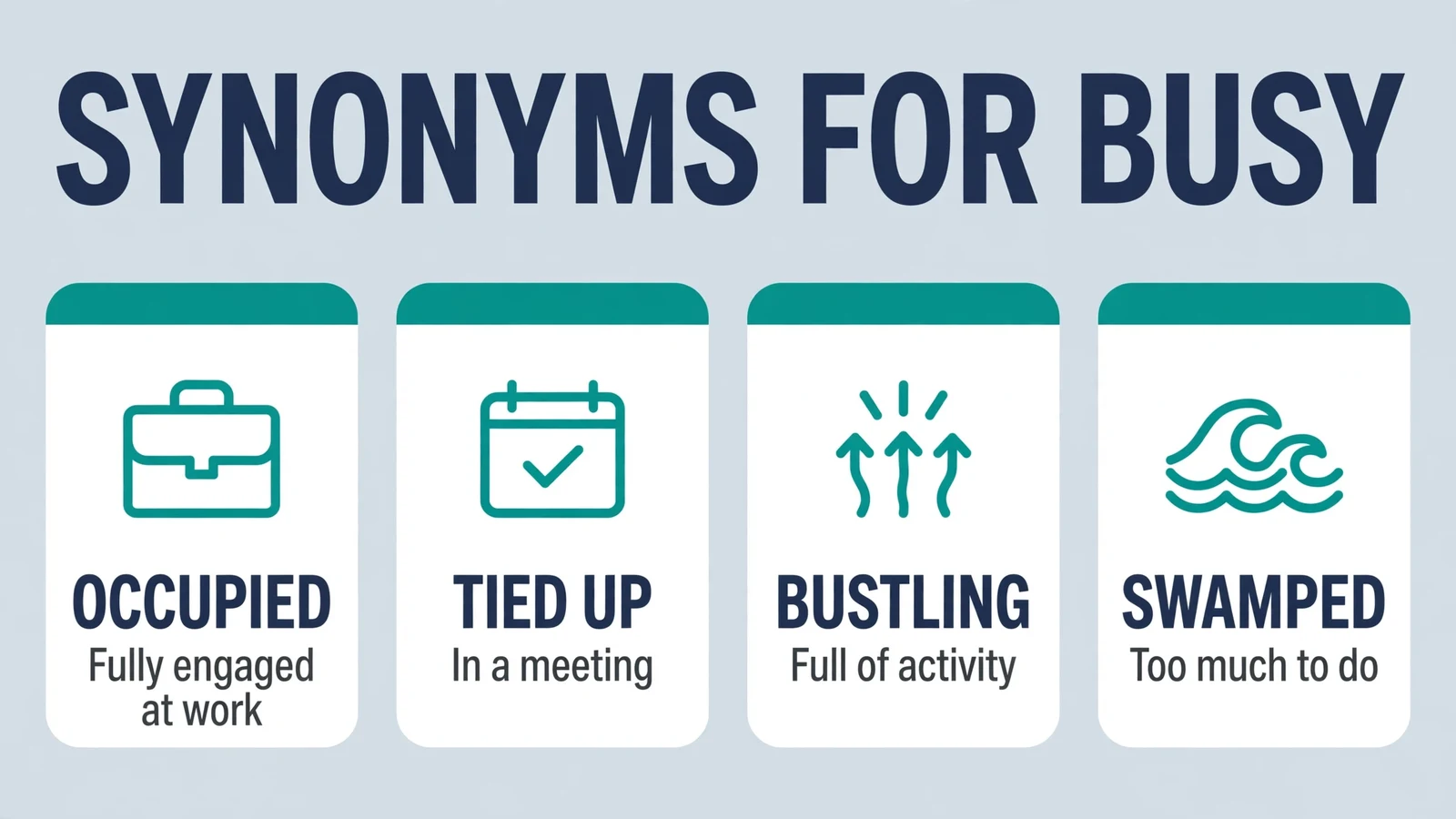
Busy is the word we reach for a dozen times a day, and it flattens everything it touches. A nurse ending a double shift, a market street at noon and a diary with no white space are all just “busy”, yet they feel completely different. The strongest synonyms for busy include occupied and engaged for a person, bustling and hectic for a place, packed for a schedule, tied up when you cannot meet, and swamped or snowed under when the work has buried you.
This guide keeps those senses apart, because the wrong swap sounds odd within seconds. A street can be bustling, but a diary cannot. Each group below gives you the words, a plain gloss for every one, and short examples, so you can pick the exact shade you mean.
What Does Busy Mean?
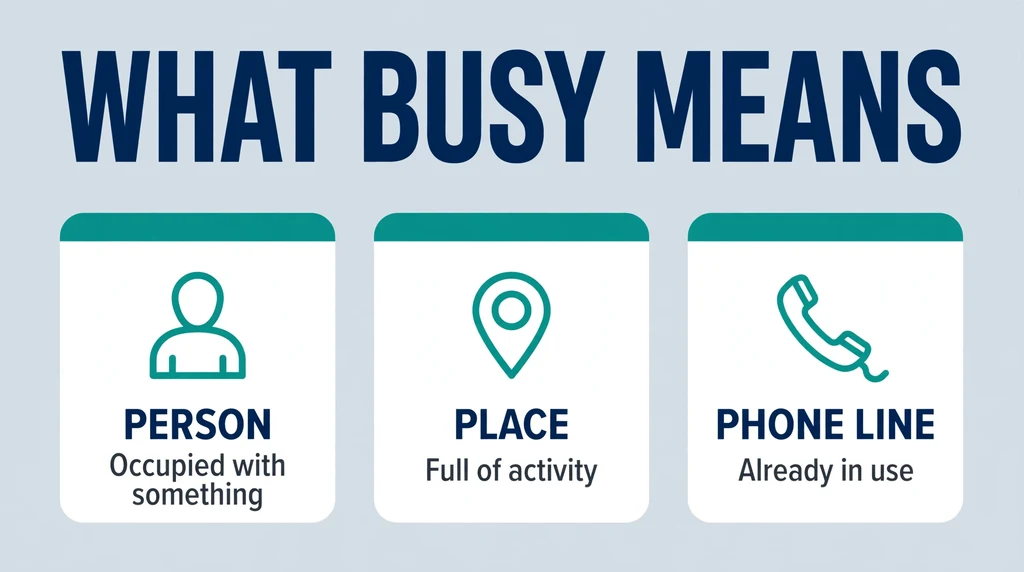
At its core, busy means fully occupied. A busy person is giving time and attention to something, with none left over. A busy place is full of people, movement and noise. A busy period is a stretch of time with far more in it than usual.
Dictionaries separate these senses carefully, and it pays to follow them. Cambridge lists the phone line as its own sense: if a line is busy, someone is already using it. Cambridge also lists a design sense, marked disapproving, for patterns with too much detail packed in.
The word has shifted a long way over the centuries. Old English *bisig* meant “careful” or “anxious”, and the meaning later settled into “continually employed or occupied”. That older worry still peeks through today. When we call a day busy, we rarely mean it as praise.
Busy also works as a verb, which surprises many learners. To busy yourself is to fill time on purpose: “She busied herself with the mending until the train came.” Merriam-Webster ties the verb to holding attention, and its lists give occupy for the same job. The pattern is always busy yourself with something, never busy yourself to do it.
One practical point follows from all this. Before you swap busy for another word, decide what is busy: a person, a place, a period, a road, a schedule or a phone line. The sections below follow that order.
Synonyms for Busy at a Glance
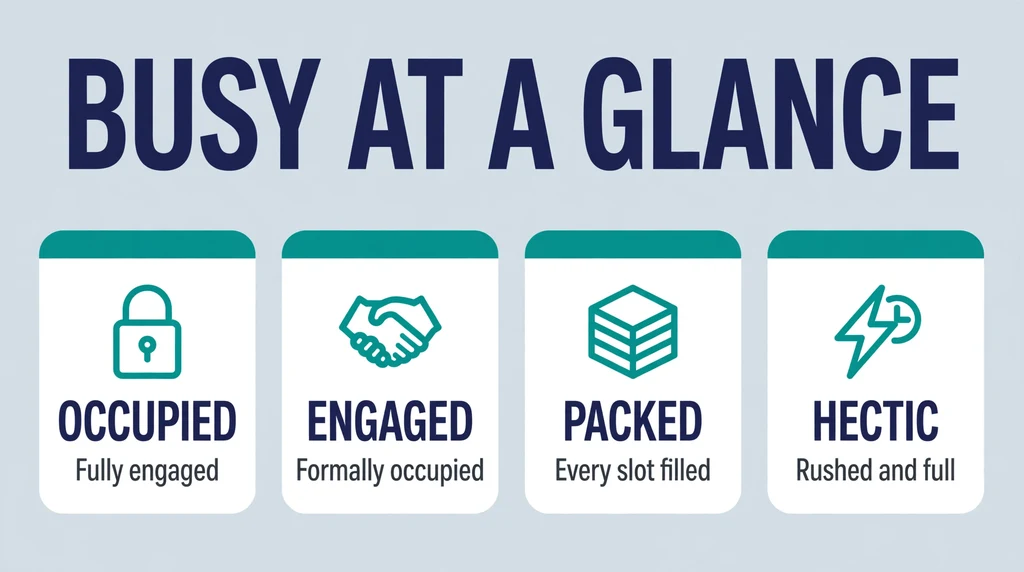
The table below collects the most useful words from every section. Use it when you need a fast answer, then read the group notes for tone.
| Word | Meaning in one line | Best for / tone |
|---|---|---|
| occupied | Attention fully taken by one thing | People, neutral |
| engaged | Formally occupied, or on the phone in the UK | People and phone lines, formal |
| tied up | Busy in something and unable to break away | People, everyday |
| unavailable | Cannot be reached or booked | People, professional |
| active | Always doing things, full of energy | People and days, positive |
| on the go | Constantly moving from task to task | People, informal |
| diligent | Working carefully and steadily at one goal | People, approving |
| industrious | Hardworking by habit, not just today | People, formal |
| tireless | Keeps working without flagging | People, approving |
| swamped | Buried under more work than fits | People, informal |
| snowed under | Completely buried in tasks or requests | People, informal |
| overloaded | Carrying more than a fair share | People and systems, informal |
| rushed off your feet | So busy there is no pause at all | People, informal British |
| have your hands full | Fully stretched by what you already hold | People, informal |
| bustling | Full of eager activity and movement | Places, positive |
| buzzing | Alive with noise and energy | Places, informal |
| hectic | Rushed, crowded and slightly chaotic | Places and periods |
| lively | Full of life and interest | Places and events, positive |
| frenetic | Wildly fast and uncontrolled | Places and periods, strong |
| humming | Thriving and full of activity | Places, informal |
| packed | Filled to the limit with people or bookings | Places and schedules |
| full | With a lot fitted in, nothing spare | Schedules and days |
| jam-packed | Crammed completely full | Schedules and places, informal |
| teeming | Swarming with people or life | Places, vivid |
| congested | Blocked by too much traffic | Roads |
| engaged (phone) | The line is already in use | Phone lines, British |
Notice how few of these words fit everywhere. That is the whole lesson of this page, and the groups below show exactly where each one belongs.
Synonyms for a Busy Person
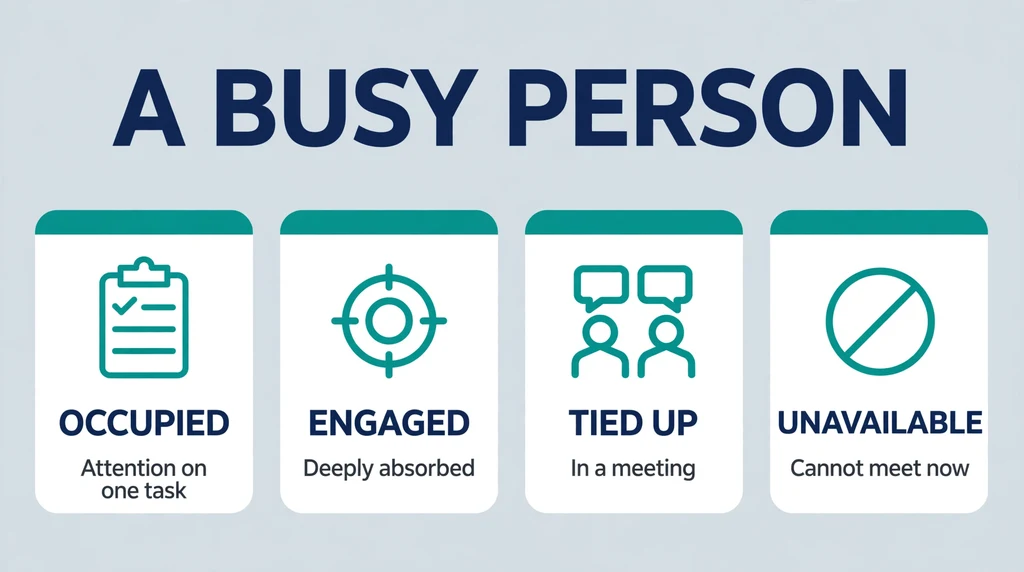
Most searches for this word are really about people. Someone is mid-task, mid-shift or mid-conversation, and busy is doing all the describing. The words below split into three jobs: fully occupied, unavailable to others, and always moving.
Fully occupied with one thing
Occupied is the closest all-purpose swap. It says the person’s attention is taken, without saying by what. “She was occupied with the accounts all morning” sounds calm and complete.
Engaged does the same job with a formal polish. Collins pairs it with phrases like engaged in, absorbed in and immersed in. Those three are useful when the work pulls someone in deeply, not just fills their time.
Engrossed means the task has swallowed the person’s attention whole. A reader engrossed in a letter may not hear the door. Use it when absorption, not workload, is the point.
Preoccupied adds a mental twist. The person may be sitting still, yet their thoughts are elsewhere, usually circling a worry or a problem. It is the right word when the busyness is inside the head rather than in the diary.
Hard at work is a plain spoken phrase from the same family. It suits reports and stories better than essays, and it always sounds slightly admiring.
Too busy to meet you
Sometimes busy is really a polite refusal. Tied up is the everyday champion here: “I will be tied up in meetings until three.” It promises an end time, which makes the refusal softer.
Unavailable is the professional version. Receptionists and assistants use it because it gives nothing away. “The manager is unavailable this afternoon” closes the door without a reason.
Already taken appears in thesaurus lists for this exact job. It works for time slots and appointments: the slot is gone, so the person is gone too.
With a customer is the service-desk variant. Hairdressers, mechanics and shop staff are not vaguely busy; they are with a customer, and the phrase tells you exactly why you must wait.
On duty and on assignment narrow the picture further. Both say the busyness is official. A guard on duty and a reporter on assignment are busy in a way nobody questions.
The plainest version is a diary fact. She is in a meeting until three, or in conference all afternoon, as older formal writing puts it. No adjective is needed at all: the appointment itself explains the absence, and the clock promises an end to it.
Always moving
On the go describes a person whose day is a chain of small journeys and jobs. Cambridge gives the flavour well: on the go all day, and exhausted by the end of it. It is informal and slightly affectionate.
On the move is its close cousin, used for children who never sit still and adults who travel constantly. At it is the shortest option of all: “He has been at it since six,” meaning the work started early and has not paused.
Working flat out
Two spoken phrases describe effort at full stretch. Hustling pictures someone moving fast between jobs and chances; thesaurus lists rank it among the strong matches for busy. It carries energy and ambition, though in slang it can also mean selling hard, so context must stay clean.
Slaving away is the kitchen classic: slaving over a hot stove. It exaggerates on purpose, turning an ordinary shift into heroic labour. Use it for sympathy or comedy, never in a report.
Hardworking Synonyms for Busy
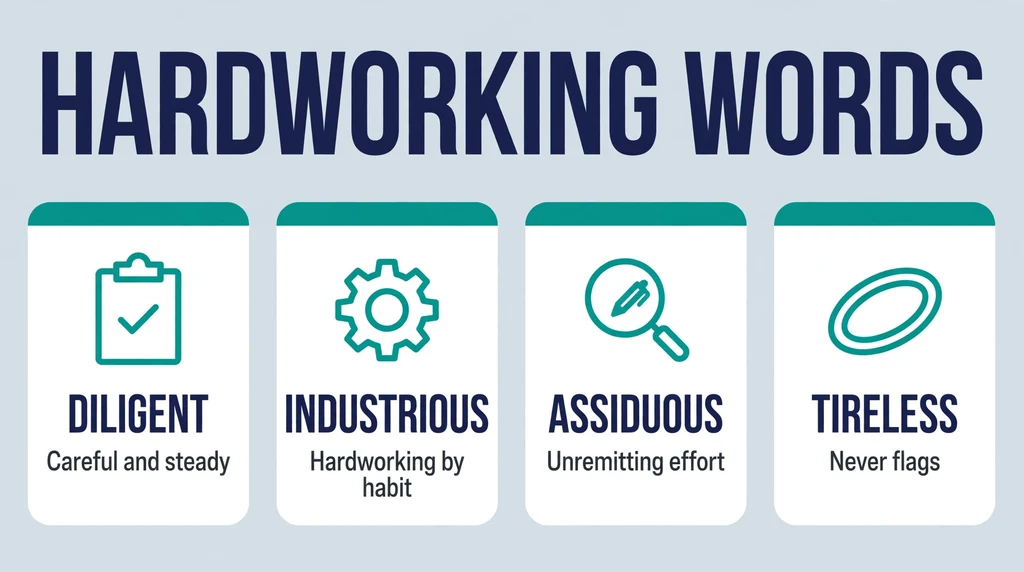
Some busy words praise the worker instead of the workload. Merriam-Webster makes the key point neatly: busy itself “chiefly stresses activity as opposed to idleness or leisure”. The words below add character to that activity.
Careful, steady workers
Diligent suggests earnest effort aimed at one clear goal. A diligent student is not rushing around; she is applying herself, steadily, to her degree. Pick diligent when focus matters more than speed.
Industrious goes further and describes a habit. An industrious team is not having one busy week; working hard is simply how they are. Because it describes character, it suits references, reports and formal writing.
Assiduous stresses careful, unremitting application. It often pairs with practice, attention and study. The word is formal, and it can sound stiff in casual speech, so save it for considered writing.
Sedulous is the rarest of the four. Merriam-Webster glosses it as painstaking and persevering application, as in a sedulous investigation. Most readers meet it in older or legal writing, so use it only when that flavour is welcome.
Energy that does not fade
Persevering highlights not giving up. It fits grant applications, profiles and speeches, where the struggle matters as much as the effort.
Tireless praises energy that does not fade. Campaigners, carers and volunteers are often called tireless. The word says the work is heavy and the person keeps lifting it anyway.
Energetic and brisk sit at the lighter end. A brisk trade or a brisk walk is busy with pace and spring in it, not buried under pressure. Collins lists brisk under the active sense of busy, and it keeps that cheerful tone.
The old simile as busy as a beaver belongs to this family too. Thesaurus lists keep it with the active words, and it still turns up in speech about people who are happily, visibly industrious. It is warm and slightly old-fashioned, which is sometimes exactly the tone a profile or speech needs.
Informal Synonyms for Busy and Overwhelmed
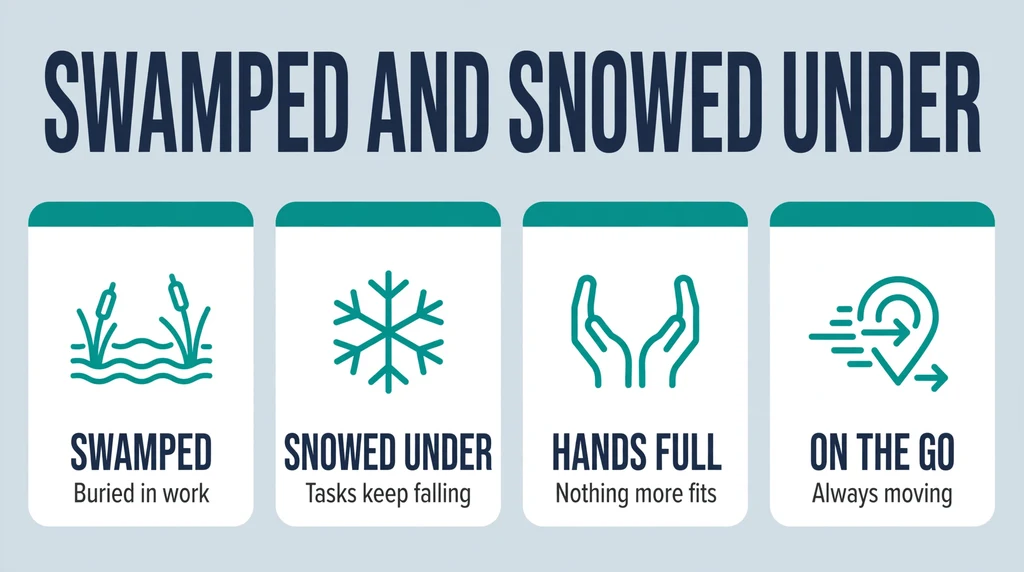
Plain busy says your diary is full. The words in this section say the fullness has become a problem. Every one of them is informal, so they belong in speech, messages and friendly writing, not in formal reports.
Buried under the load
Swamped is the modern default. It pictures work as floodwater rising around you. “We are swamped with applications” tells the listener two things at once: there are many, and we are struggling.
Snowed under paints the same picture in winter colours. The tasks keep falling until you are buried. It often takes a passive shape: “She is snowed under with paperwork.”
Overloaded borrows its image from vehicles and circuits. It suits people carrying more than their share, and it also works for systems, inboxes and servers. That makes it handy in offices, where one word can cover staff and software alike.
Buried is shorter and blunter. “I am buried today” needs no explanation among colleagues. Thesaurus lists put it among the strong matches for busy, and spoken English agrees.
Idioms for having too much
Rushed off your feet is the British favourite for service jobs. Waiters, nurses and shop assistants get rushed off their feet at peak hours. The phrase includes the body: there is no sitting down inside it.
Have your hands full shifts the picture to carrying. You cannot take anything else because dropping something is the alternative. Parents of toddlers use it constantly, and Cambridge lists it among the first phrases for having a lot to do.
Have a full plate is the diary version of the same idea. Up to your ears goes further still: the work has risen past your hands and plate, and only your head is clear. Both are joking complaints, best kept for people who know you.
Two Cambridge idioms describe busy motion that achieves little. Chasing your tail means effort that circles back on itself. Running round in circles, marked British and informal, means frantic activity with no progress to show for it. Reach for these when the problem is waste, not volume.
A warning on tone: all of these words complain a little. That is their charm with friends and their risk at work. And since being snowed under quickly leaves people drained, note that busy is not the same as exhausted; when the feeling matters more than the workload, see our guide to synonyms for tired.
Synonyms for a Busy Place or Busy Period
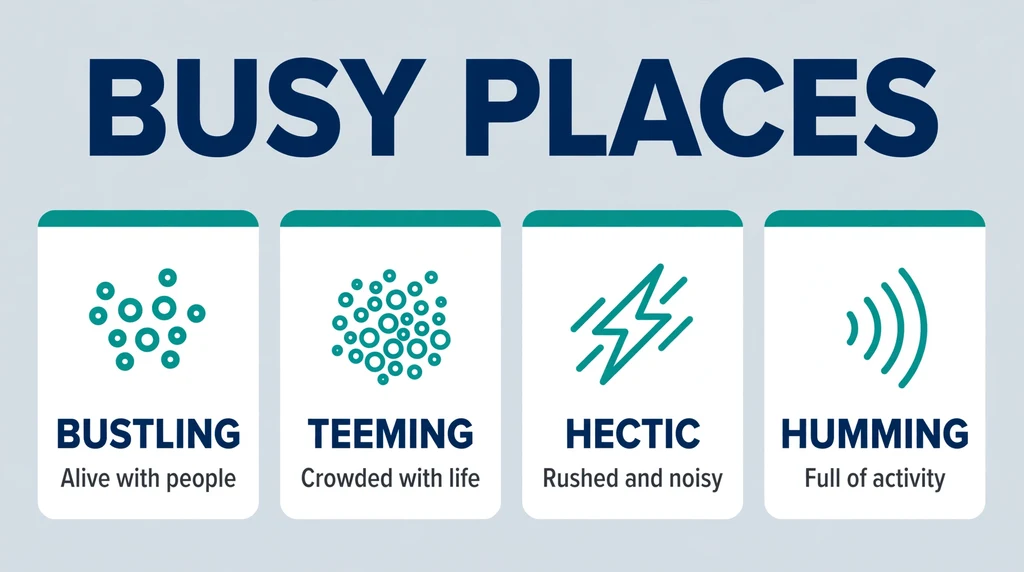
Places do not have diaries, yet we call them busy constantly. A busy street, a busy café and a busy December all share one feature: a lot is happening in a small space or a short time.
Places full of life
Bustling is the warmest word in this group. A bustling market is crowded, noisy and pleased with itself. Writers use it when the crowd is part of the attraction, not a problem to complain about.
Buzzing and humming add sound to the picture. Merriam-Webster defines this sense of busy as marked by much life, movement or activity, with the trading floor as its example. A café can be buzzing with conversation; a workshop can be humming by nine in the morning. Both words are informal and approving.
Lively stresses interest rather than numbers. A lively pub has talk, music and movement, even if it is not full. Cambridge places it right beside the busy group for exactly this reason.
Teeming and throngs words like thronged suit heavier crowds. A station teeming with travellers feels close to overflowing. Overflowing and mobbed go one step further: too many people for the space, said with alarm or with glee, depending on the event.
Packed and jam-packed count the bodies plainly. A packed train carriage is not lively or buzzing; it is simply full, and nobody is enjoying it much.
Periods that will not slow down
Hectic is the period word people reach for first. A hectic week is rushed and slightly disordered. Unlike bustling, hectic is rarely a compliment; it reports pressure.
Full sounds calmer. A full day or a full life has much fitted into it, and the fitting feels deliberate. Strenuous belongs to effort: a strenuous day drains the body, and Collins places it with the hectic group for that reason.
Frenetic is the strongest word here. It describes activity that is fast, wild and barely controlled. Save it for trading floors, newsrooms on election night and kitchens in a crisis.
Restless sits at the edge of this group, and thesaurus lists for the active sense include it. A restless city never quite settles, even at night. It describes mood more than numbers, so it suits travel writing better than reports.
In sentences, the place words sort themselves quickly. “The night market was bustling, every stall lit and loud.” “By midnight the square was still humming.” “The departure hall teemed with families and luggage.” Each verb of fullness agrees with its scene, and none of them would survive being swapped for the diary words above.
Roads that are busy
Traffic gets its own vocabulary, because a busy road is a blocked road. Congested is the standard report word. Gridlocked means the blockage spreads until nothing moves in any direction.
Backed up and jammed describe the queue itself. British reports add snarled up for roads tangled by an accident. Bumper to bumper is the driver’s view: a line of cars with no gaps at all.
None of these words praise the road. When the traffic finally clears and speed returns, drivers switch to a different family of words entirely, the ones collected in our list of synonyms for fast.
Synonyms for a Busy Schedule
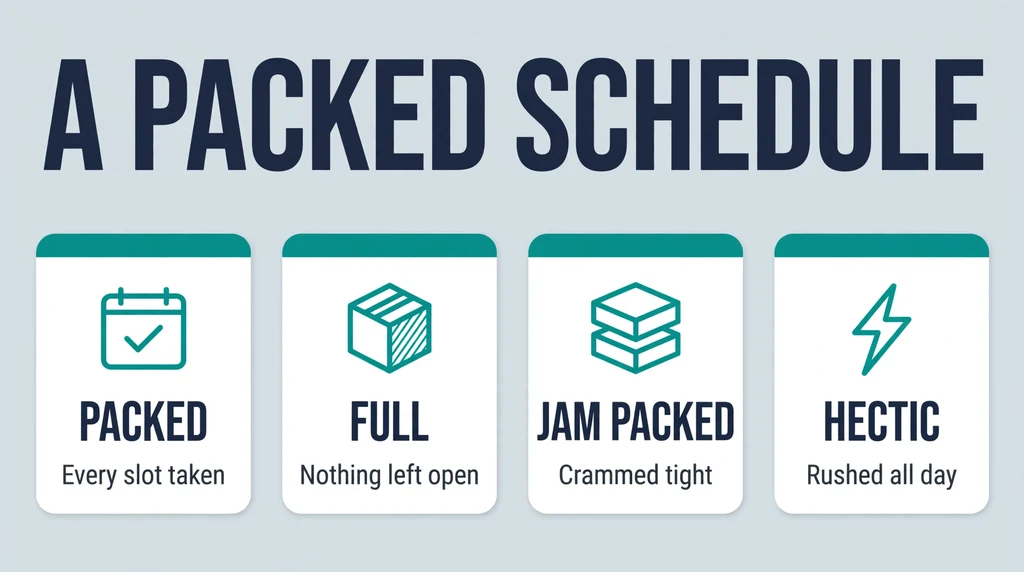
A schedule is busy when every slot is spoken for. The vocabulary is smaller here, but the differences matter, especially in work messages where tone travels fast.
Packed is the standard choice. A packed schedule has meetings, calls and deadlines fitted tightly together. It reports fullness without complaining, which makes it safe for clients and managers.
Full is the gentlest option. “My week is full” declines extra work while sounding organised rather than overwhelmed. Diaries, calendars and days all take full naturally.
Jam-packed adds squeeze and colour. It suits informal updates: “Friday is jam-packed.” Avoid it in formal writing, where its energy reads as exaggeration.
Hectic describes how the schedule feels from inside. Two schedules can hold the same nine appointments; the hectic one has clashes, dashes and no lunch. Cambridge reaches for hectic in exactly this spot, pairing it with schedules that leave no room for a holiday.
In messages and across seasons
Short swaps for messages: “fully booked” works for appointment-based work, and it comes from the same unavailable family as tied up. Keep the phrase for services and clinics, where booking is literal, rather than for a general week.
Whole industries plan around the same idea at a larger scale. Retail has its busy season before the winter holidays, accountants have tax season, and hotels have peak weeks when every room goes. In each case the honest schedule words still apply: the season is packed, the weeks are full, and the days inside them turn hectic. Naming the season, rather than just saying busy, tells the reader when the pressure starts and when it will end.
One more diary pattern deserves a line: the busy day that is really two calm halves around one collision. Writers often reach for hectic here, and they are half right. The day was not hectic throughout; it was full, with one frantic hour. Precision like that is what this whole page is for.
When Busy Means a Phone Line or a Pattern
Two senses of busy have almost nothing to do with activity, and both catch learners out.
The phone sense is the older everyday one. If a line is busy, someone is already talking on it, and your call cannot get through. American English keeps the word busy here, and the sound you hear is called a busy signal.
British English splits the job. Cambridge is explicit: for a phone line, British speakers say the number is engaged, and the sound is an engaged tone. So a British caller hears “the number is engaged”, while an American caller hears “the line is busy”. Same problem, two vocabularies.
The pattern sense is stranger still. A busy wallpaper, fabric or cover design has too many small details and colours fighting for attention. Cambridge marks this use disapproving, which tells you it is a criticism, not praise for effort.
There is no clean one-word replacement for this sense, and honesty beats invention here. Writers usually rewrite instead: “too detailed”, “too crowded” or, borrowing from the busy lists, “fussy”. If a pattern feels busy, say what it does to the eye, and the sentence will land better.
Watch the rewrite work in practice. “The busy cover hurt the book” says little. “The cover crams nine colours and four fonts onto one small square” shows the reader the problem. Busy was the label; the rewrite gives the evidence, and evidence is what design feedback needs.
How to Choose the Right Synonym for Busy
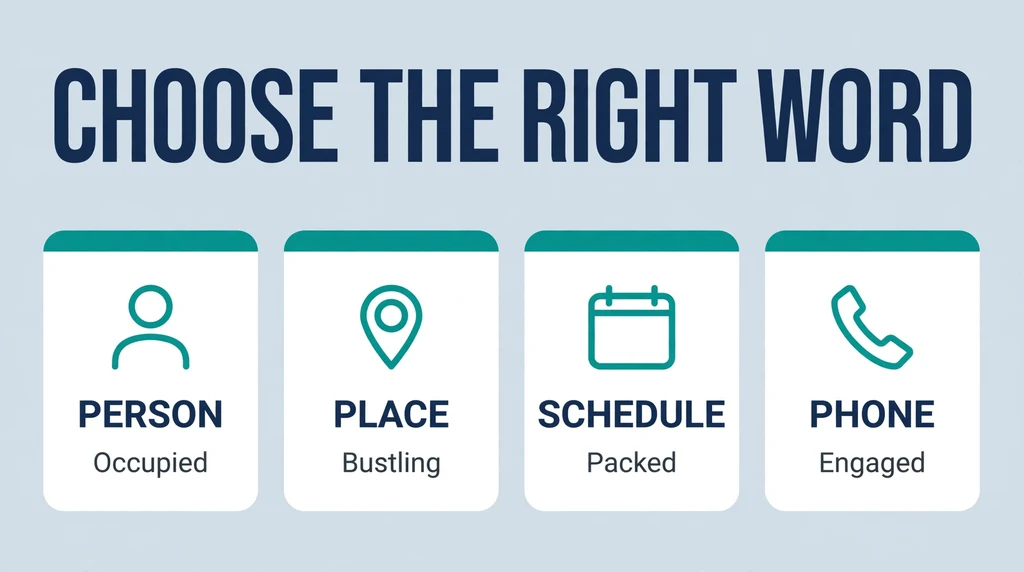
Start with the subject, then adjust for tone. The four questions below settle most choices in seconds.
Is it a person? Reach for occupied for a neutral report, engaged for a formal one, and tied up when the person cannot be interrupted. “The doctor is occupied with a patient” is calm. “The doctor is swamped” complains on her behalf.
Is it a place? Bustling praises the energy, hectic reports the strain, and packed simply counts heads. A market can be all three before lunch, but your word chooses the mood of the whole sentence.
Is it time? For a schedule, packed and full describe the diary, while hectic describes the experience. For a single day, strenuous adds physical effort that the others leave out.
Is it a phone? Use busy in American English and engaged in British English, and do not mix the systems inside one document.
Two finer points are worth keeping. First, swamped and snowed under are stronger than busy, never equal to it; they say the load has beaten the person. Second, if what changed is the pace of the work rather than the amount, a speed word may fit better than a busy word, like the choices gathered under synonyms for quickly. Busy counts the load; quickly times it.
Tone can flip a correct word into a wrong one. Tied up is friendly and temporary, while unavailable is cool and final; the same meeting produces both, depending on who is asking. Likewise bustling thanks a crowd for coming, while mobbed blames it. When in doubt, ask whether your sentence praises, reports or complains, then pick the word built for that job.
Worked examples
Try the test on one dull sentence: “The office was busy on Friday.” If people are the subject, “The office was swamped on Friday” admits the struggle. If the room is the subject, “The office was buzzing on Friday” celebrates it. If the diary is the subject, “Friday was packed from nine” respects the reader’s intelligence. Same Friday, three honest reports.
Busy in Formal and Informal Writing
In formal writing, busy is perfectly respectable, but its neighbours often do the job with more precision. Reports prefer occupied, engaged and unavailable, because each one states a fact without colour. An essay that calls a harbour busy three times will read better with bustling, crowded and congested used once each, matched to the sense.
Professional messages reward the unavailable family. “I am tied up until three, but free after that” gives a boundary and an opening in one breath. “I am swamped” may be true, yet it invites the reader to worry about your workload instead of the meeting.
Informal writing can take the whole informal shelf: swamped, snowed under, diaries described as jam-packed, and workshops described as humming. The risk is only repetition. One vivid word per paragraph is a style; four in a row is a weather report.
A final style note: busy itself is short, clear and understood everywhere. Replace it when a sharper word exists, not merely for variety. Readers trust writers who vary words only when the meaning sharpens too.
Here is the difference in miniature. Weak: “The port was busy. The market was busy too, and our guide was busy all day.” Sharper: “The port was congested by nine. The market beside it was bustling, and our guide stayed occupied until the last boat.” Nothing exotic was added; each sense simply got its own word, and the paragraph started to move.
Antonyms for Busy
Opposites split along the same senses as the synonyms.
For people: idle is the strongest opposite in thesaurus lists, followed by inactive and unoccupied. Free and available answer the unavailable sense directly: a free afternoon is one nobody has claimed. Off duty closes the working sense neatly.
For places: quiet is the standard opposite of a bustling street, and empty answers a packed or crowded room. A sleepy town sits further out in the same direction, calm to the point of dullness.
For periods and schedules: quiet again does most of the work, as in a quiet week. Light works for workloads, as in a light day, though it stays informal. Leisurely, by contrast, describes a pace chosen on purpose, which is the true opposite of a hectic one.
Free and available deserve one distinction. Available means nobody has booked the slot yet; free means nothing claims the time at all. A dentist can be available at two and still not be free that day, which is why careful assistants keep both words in play.
Words That Are Not True Synonyms for Busy
A few words travel with busy so often that they get mistaken for synonyms. Keeping them apart is what separates a careful writer from a thesaurus on autopilot.
Meddlesome, officious and nosy belong to a different sense entirely. Merriam-Webster lists a third meaning of busy: thrusting yourself where you are not welcome. That is the busybody sense. A meddlesome neighbour is not busy with work; he is busy with yours.
Employed needs care too. In the thesaurus lists it means kept occupied, as in “happily employed in the garden”. In daily life it means having a job. A retired gardener can be busy all day and employed in neither sense your reader expects.
Stressed and tired are consequences, not synonyms. Plenty of busy people are calm and fresh, and plenty of idle people are stressed. Swap them in only when the consequence is truly your subject.
Productive describes results, while busy describes activity. The two part company in every office: a morning can be extremely busy and produce nothing at all. If output is your point, say output.
Hectic finally deserves a footnote. It is a true synonym for the period sense, but it smuggles in disorder. Calling a well-run, fully booked clinic hectic accuses it of chaos it may not deserve; packed is the fairer word.
Active misleads in the opposite direction. It is a genuine busy word for people, as in an active volunteer. But an active schedule suggests sport and exercise, not a full diary, and an active road sounds like a volcano report. The word only travels safely with people and lifestyles.
Frequently Asked Questions
What is the best synonym for busy?
It depends on what is busy. For a person, occupied is the safest all-round swap. For a place, bustling is the most pleasing, while packed suits a schedule. There is no single winner, which is exactly why the senses stay separate on this page.
What is a formal synonym for busy?
Engaged, occupied and unavailable are the formal shelf. Engaged fits people absorbed in an activity, occupied suits reports, and unavailable is the polished way to say someone cannot be reached or booked.
What do British speakers say when a phone line is busy?
They say the number is engaged, and the sound is called an engaged tone. American English keeps busy for both the line and the signal. Cambridge notes this split directly in its entry for the word.
Is hectic the same as busy?
Only partly. Hectic adds rush and disorder to the basic idea of fullness. A hectic day is busy and chaotic; a packed day may be busy and perfectly calm. Choose hectic only when the disorder is real.
What is a stronger way to say very busy?
The informal shelf is strongest: swamped, snowed under, overloaded and rushed off your feet all say the load has overwhelmed the person. In formal writing, step sideways instead, and name the cause, such as fully booked or fully occupied.
What is the opposite of busy?
For people, idle, free and available cover most cases. For places, quiet and empty are the natural opposites. For a schedule, a quiet week or an open diary says it plainly.
Should I write busyness or business for the state of being busy?
Write busyness. Business is the older related noun, but today it chiefly means trade and companies, so readers will misunderstand you. Busyness names the state itself, with no detour through commerce.
What is another word for a busy street?
For the life of the street, bustling is the warmest choice, and teeming suits heavier crowds. For the traffic on it, switch families entirely: congested, jammed and gridlocked describe a street whose cars cannot move.
Final Thoughts
Busy is a small word carrying at least five different jobs. Once you know which job you mean, the right replacement is usually obvious: occupied for the worker, bustling for the street, packed for the diary, engaged for the British phone line, and swamped for the days when the load wins. Keep the senses apart, respect the tone, and your writing will sound sharper every time the word comes up.
For the full dictionary treatment, including more related words for every sense, see the Merriam-Webster Thesaurus entry for busy.