Have you ever caught yourself using the same word over and over in an email, an essay, or a social media caption? You know the feeling. You are trying to describe how an idea connected with people, but “resonate” keeps appearing in every sentence. It happens to writers, students, and professionals all the time.
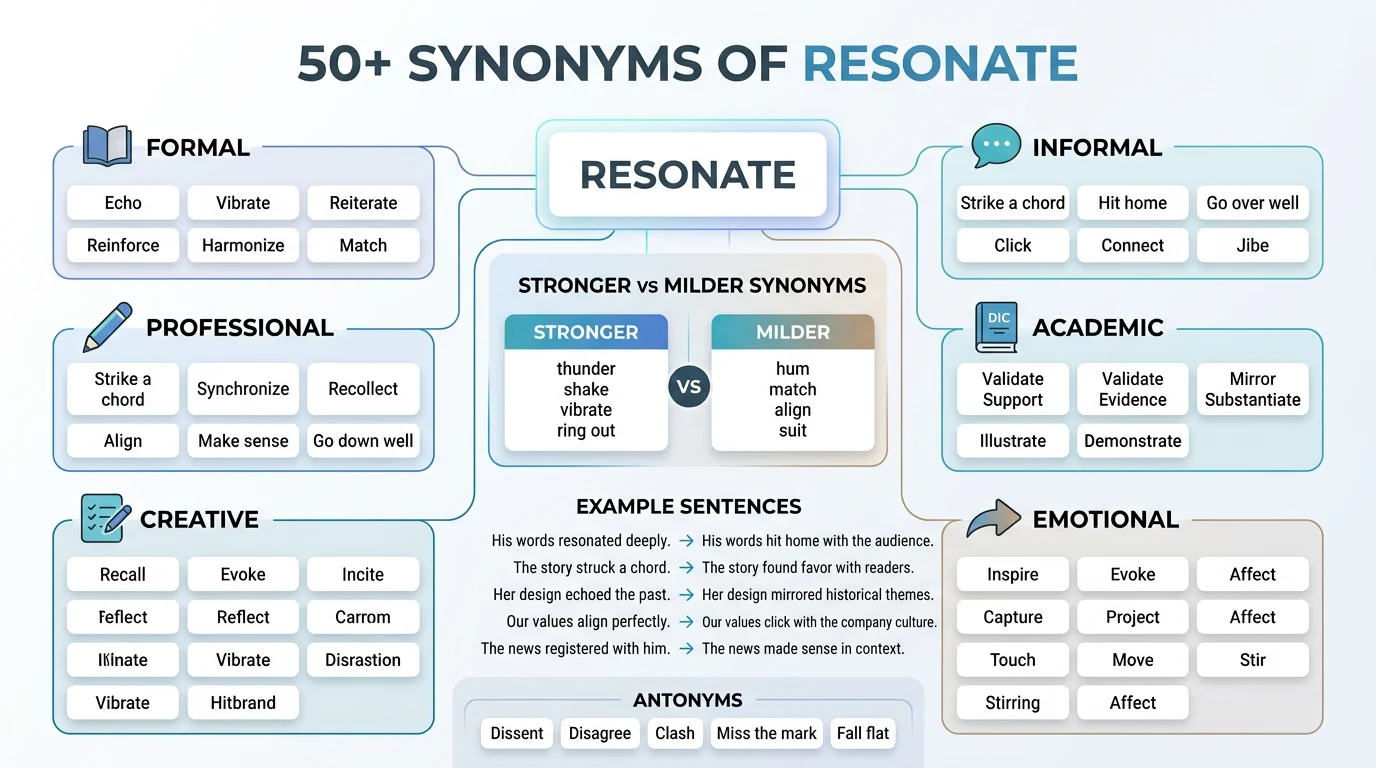
Finding the right synonyms of resonate can transform your writing from repetitive to powerful. The word itself carries weight, but using it too often makes your language feel flat. When you understand the synonyms of resonate, you gain the ability to match your word choice to your audience, your tone, and your purpose.
This guide will help you master every synonym of resonate. You will learn the exact meaning, the best alternatives for every context, and how to avoid common mistakes. By the end, you will choose the right word with confidence every single time.
What Are the Best Synonyms of “Resonate”?
“Resonate” means to produce a deep, clear sound or to evoke a strong emotional connection or understanding. The best formal synonyms include reverberate, resound, and echo. For casual conversation, use strike a chord or connect. In professional writing, choose impact or relate. For emotional or creative contexts, pierce, touch, or move work well.
Meaning, Tone, and Context
Simple Definition
Resonate is a verb that means to produce a deep, full, and reverberating sound through vibration. It also means to evoke a strong feeling, memory, or connection in someone. When an idea resonates, it feels important, familiar, or deeply meaningful to the person experiencing it.
Part of Speech
Verb (intransitive). Other forms include resonates, resonated, and *resonating”.
Overall Tone
Resonate is neutral but leans positive when used figuratively. It suggests meaningful connection, understanding, or impact.
Formality Level
Semi-formal to formal. The word is common in professional, academic, and business writing. It also appears in casual conversation, though less frequently than simpler alternatives.
Common Uses
Native English speakers use “resonate” in two main ways:
- Literal: Describing sound that vibrates deeply or fills a space. Example: “The bass resonated through the concert hall.”
- Figurative: Describing an idea, message, or experience that connects emotionally or intellectually. Example: “Her speech resonated with everyone in the room.”
The figurative use is far more common in everyday writing and speech.
Word Forms
- Verb: resonate, resonates, resonated, resonating
- Noun: resonance
- Adjective: resonant
- Adverb: resonantly
When and How to Use “Resonate”
Choose “resonate” when you want to describe a deep, meaningful connection between an idea or experience and an audience. It works best when the connection is emotional, intellectual, or both. The word suggests that something has “landed” and continues to have an effect.
Here are seven realistic examples showing how to use “resonate” in different contexts.
Professional
“The new marketing strategy resonated with our target demographic, leading to a fifteen percent increase in engagement.”
Academic
“The professor’s argument about climate policy resonated with students who had experienced extreme weather events firsthand.”
Workplace
“Her proposal resonated during the meeting because it directly addressed the team’s biggest concern about budget cuts.”
Personal
“That memoir resonated with me more than any book I have read this year. I saw my own struggles reflected in every chapter.”
“I wanted to follow up because your presentation resonated with our leadership team. They are eager to explore next steps.”
Resume
“Developed a company-wide training program that resonated with employees across all departments, improving retention by twelve percent.”
“This post resonated with thousands of readers who shared their own stories in the comments.”
Best Synonyms of “Resonate”
No synonym is identical in every situation. The right choice depends on your audience, your purpose, and the emotional weight you want to carry. Here are the best synonyms of resonate for specific contexts.
Professional writing: Impact – This word suggests measurable effect and results. It works well in business reports and performance reviews.
Academic writing: Resound – This carries a formal, authoritative tone suitable for research papers and scholarly essays.
Business communication: Land – This informal but professional term describes an idea that is clearly understood and accepted.
Casual conversation: Connect – Simple, direct, and widely understood. It describes emotional or intellectual alignment.
Emotional writing: Strike a chord – This phrase captures deep emotional共鸣 and is perfect for personal stories or persuasive pieces.
Creative writing: Pierce – This adds intensity and suggests that an idea or feeling cuts through emotional barriers.
Resume writing: Resonate (itself) or connect – Use “resonate” sparingly on resumes. “Connect” or “engage” often sound more active.
Workplace communication: Register – This describes an idea being noticed and understood, often in meetings or presentations.
Stronger meaning: Reverberate – This suggests a powerful, lasting effect that continues to be felt over time.
Softer meaning: Touch – This is gentler and suggests a mild emotional response without intensity.
When Not to Use “Resonate”
Using “resonate” is not always the best choice. Here are situations where the word falls short and what to use instead.
The word sounds too vague
If you are describing a specific action or result, “resonate” may feel unclear.
- Incorrect: “The changes resonated with the team.”
- Better: “The changes improved team morale and productivity.”
- Why: The second sentence states measurable outcomes rather than leaving the reader guessing.
When the word sounds too formal
In casual texts or quick conversations, “resonate” can feel stiff.
- Incorrect: “Your joke resonated with me.”
- Better: “Your joke really hit home.”
- Why: The alternative sounds more natural in informal settings.
When the word sounds too weak
If you need to describe a powerful, undeniable impact, “resonate” may not carry enough force.
- Incorrect: “The warning resonated with the public.”
- Better: “The warning galvanized the public into action.”
- Why: “Galvanize” suggests a stronger, more immediate response.
The word sounds outdated
In very modern or trendy writing, “resonate” can feel overused. Younger audiences may find it tired.
- Incorrect: “This brand resonates with Gen Z.”
- Better: “This brand speaks to Gen Z.”
- Why: “Speaks to” feels fresher and more conversational.
Words Commonly Confused With “Resonate”
Vs Echo
- Difference: “Echo” means to repeat a sound. “Resonate” means to amplify or expand a sound or feeling.
- When to Use It: Use “echo” for literal sound repetition or when an idea is repeated without deeper meaning. Use “resonate” for meaningful connection.
- Example: “The canyon echoed my shout.” vs “Her words resonated with my own experience.”
Vs Reverberate
- Difference: “Reverberate” describes sound bouncing back and forth. “Resonate” describes sustained vibration or emotional connection.
- When to Use It: Use “reverberate” for physical sound reflection or lasting effects. Use “resonate” for emotional or intellectual connection.
- Example: “The drums reverberated through the stadium.” vs “The speech resonated with the audience.”
Resonate vs Resound
- Difference: “Resound” means to fill a space with sound. “Resonate” means to produce sympathetic vibration or emotional alignment.
- When to Use It: Use “resound” for loud, filling sound. Use “resonate” for deeper connection.
- Example: “Cheers resounded through the arena.” vs “His message resonated with voters.”
Resonate vs Vibrate
- Difference: “Vibrate” is a physical movement. “Resonate” is a specific type of vibration that produces sound or emotional response.
- When to Use It: Use “vibrate” for physical shaking. Use “resonate” for sound or emotional impact.
- Example: “The phone vibrated on the table.” vs “The music resonated in my chest.”
Vs Relate
- Difference: “Relate” means to understand or identify with. “Resonate” implies a deeper, more profound connection.
- When to Use It: Use “relate” for general understanding. Use “resonate” for emotional or intellectual alignment.
- Example: “I can relate to your struggle.” vs “Your story resonates with my own journey.”
Resonate vs Impact
- Difference: “Impact” emphasizes effect or result. “Resonate” emphasizes connection or meaning.
- When to Use It: Use “impact” for measurable outcomes. Use “resonate” for emotional or intellectual significance.
- Example: “The policy impacted thousands of families.” vs “The policy resonated with voters who felt heard.”
Best Synonyms of “Resonate” by Context
| Context | Best Synonym | Why It Works | Example |
|---|---|---|---|
| Formal writing | Reverberate | Suggests lasting, powerful effect | “The reforms reverberated through every department.” |
| Academic writing | Resound | Carries authoritative, scholarly tone | “Her thesis resounded throughout the academic community.” |
| Professional communication | Impact | Emphasizes measurable results | “The training impacted employee performance positively.” |
| Business emails | Land | Casual yet professional; shows clear understanding | “Your proposal really landed with the executive team.” |
| Resume writing | Connect | Active and results-oriented | “Connected with diverse stakeholders to drive consensus.” |
| Workplace communication | Register | Describes awareness and understanding | “The new policy registered with staff after the town hall.” |
| Casual conversation | Strike a chord | Warm and emotionally expressive | “That song really strikes a chord with me.” |
| Everyday speaking | Hit home | Direct and relatable | “Her advice hit home for everyone in the room.” |
| Creative writing | Pierce | Intense and vivid | “The truth of his words pierced through her defenses.” |
| Storytelling | Echo | Creates a sense of recurring theme | “The theme of loss echoed through every chapter.” |
| Emotional writing | Touch | Gentle and heartfelt | “His letter touched everyone who read it.” |
| Strong emphasis | Galvanize | Suggests urgent, powerful action | “The crisis galvanized the community into action.” |
| Mild tone | Relate | Simple and accessible | “I can relate to what you are saying.” |
| Social media captions | Speak to | Modern and conversational | “This post speaks to everything we have been feeling.” |
| American English | Connect | Widely used and understood | “The message connected with audiences nationwide.” |
How to Choose the Best Synonym of “Resonate”
Choosing the right synonym of resonate does not have to be complicated. Ask yourself these questions before you write.
What is your meaning?
Are you describing sound, emotion, understanding, or effect? Sound-based synonyms include echo, reverberate, and resound. Emotion-based synonyms include strike a chord, touch, and move. Understanding-based synonyms include connect, relate, and register.
What is your tone?
Are you writing formally or casually? Formal writing calls for reverberate or resound. Casual writing works better with hit home, land, or speak to.
Who is your audience?
Are you writing for professionals, academics, or general readers? Professionals respond to impact and land. Academics prefer resound and reverberate. General readers connect with strike a chord and relate.
How much emotional strength do you need?
Do you want a mild effect or a powerful one? Mild options include touch and relate. Strong options include galvanize, pierce, and reverberate.
What is your writing purpose?
Are you persuading, informing, or entertaining? Persuasive writing benefits from strike a chord and galvanize. Informative writing works with connect and register. Entertaining writing suits echo and speak to.
Does it sound natural?
Read your sentence aloud. If the synonym feels forced or awkward, try another option. The best word is the one that sounds most natural in context.
Real Life Examples of “Resonate”
School
“The history lesson resonated with students when the teacher connected past events to current social issues.”
College
“The guest lecturer’s research resonated with aspiring scientists who saw their own career paths reflected in her journey.”
Workplace
“The CEO’s vision resonated across all levels of the organization, from entry-level employees to senior executives.”
Business
“The product launch resonated with early adopters, generating buzz that carried the campaign for months.”
“Your feedback resonated with our product team. We have already started implementing your suggestions.”
Resume
“Led a cross-functional initiative that resonated with stakeholders and secured buy-in for a five-year strategic plan.”
Conversation
“Everything you said resonated with me. I have been feeling the exact same way.”
Storytelling
“The old photograph resonated with a sadness that none of us could fully explain, but all of us could feel.”
Blogging
“This topic resonates with so many readers because it touches on a universal fear of failure.”
“This message resonated with over ten thousand people who shared their own experiences in the comments.”
18 Best Synonyms of “Resonate”
| Synonym | Simple Meaning | Best Used For | Example Sentence |
|---|---|---|---|
| Reverberate | To echo repeatedly with lasting effect | Formal writing, lasting impact | “The news reverberated through the entire company.” |
| Resound | To fill a space with sound | Academic writing, authoritative tone | “Her name resounded in academic circles for decades.” |
| Echo | To repeat or reflect sound | Storytelling, recurring themes | “His words echoed in my mind long after he left.” |
| Vibrate | To shake or move rapidly | Physical descriptions | “The floor vibrated with the heavy bass.” |
| Pulsate | To expand and contract rhythmically | Creative writing, rhythmic effects | “The energy in the room pulsated with anticipation.” |
| Strike a chord | To evoke an emotional response | Emotional writing, personal stories | “Her story struck a chord with everyone who heard it.” |
| Connect | To establish a relationship or understanding | Casual conversation, everyday use | “The movie connected with audiences of all ages.” |
| Impact | To have a strong effect | Professional writing, results | “The campaign impacted sales within the first week.” |
| Land | To be understood and accepted | Business communication, presentations | “Your point really landed with the board members.” |
| Register | To be noticed or understood | Workplace communication | “The warning registered with employees after the safety drill.” |
| Touch | To affect emotionally in a gentle way | Personal writing, heartfelt messages | “Her kindness touched everyone she met.” |
| Pierce | To penetrate emotionally or intellectually | Creative writing, intense moments | “The truth of his words pierced through her denial.” |
| Galvanize | To shock into action | Strong emphasis, calls to action | “The disaster galvanized the community to rebuild.” |
| Hit home | To be understood in a personal way | Casual conversation | “The reality of the situation hit home for all of us.” |
| Speak to | To address or appeal to | Modern writing, social media | “This design speaks to our core values as a brand.” |
| Ring true | To seem genuine or convincing | Evaluative writing | “His explanation rang true with everyone who heard it.” |
| Relate | To understand or identify with | General communication | “I can relate to the struggles you described.” |
| Come across | To be understood or perceived | Professional feedback | “Your message came across clearly in the presentation.” |
Synonyms of “Resonate” by Usage
Professional vs Personal Synonyms
Professional settings prefer words that suggest measurable outcomes and clear communication. Impact, land, and register work well in workplaces because they are direct and results-oriented. They help you sound competent without being overly emotional.
Personal settings favor words that express emotion and connection. Strike a chord, hit home, and touch feel warmer and more intimate. They are perfect for conversations with friends, family, or anyone you want to connect with on a deeper level.
Formal vs Conversational Synonyms
Formal writing such as reports, essays, and business presentations benefits from reverberate, resound, and echo. These words carry weight and authority. They sound sophisticated without being pretentious.
Conversational writing including texts, casual emails, and social media posts works better with connect, relate, and hit home. These words are shorter, simpler, and more direct. They feel natural in everyday speech.
Academic Synonyms
For research papers, essays, and academic discussions, choose resound, reverberate, and echo. These words sound authoritative and precise. They convey that an idea has been deeply felt or widely recognized within a scholarly community. Academic readers expect formal vocabulary, and these synonyms deliver without sounding forced.
Professional and Business Synonyms
In resumes, interviews, meetings, and client communications, use impact, land, and register. These words show that you understand results and clear communication. They are practical and action-oriented. Employers and clients respond to language that demonstrates effectiveness and clarity.
Creative and Literary Synonyms
For storytelling, fiction, poetry, and speeches, choose pierce, galvanize, and pulsate. These words add vivid imagery and emotional intensity. They help you paint pictures with language and create memorable moments for your readers or listeners.
Slang or Modern Synonyms
Land and speak to are modern, slightly informal synonyms that have gained popularity in business and digital communication. They are acceptable in professional settings but may feel too casual in academic writing. Avoid them in formal essays or research papers.
Strongest to Mildest Synonyms
This scale shows how emotional intensity changes across synonyms of resonate.
Mild: Relate, touch, connect – Gentle, accessible, and widely understood. These words suggest a basic level of understanding or emotional response without intensity.
Moderate: Resound, echo, strike a chord – These words carry more weight. They suggest that an idea or feeling has been clearly received and has some emotional or intellectual impact.
Strong: Reverberate, impact, galvanize – These words suggest lasting effects, measurable results, or powerful responses. They are appropriate when you need to emphasize significance.
Very Strong: Pierce, galvanize (in action contexts) – These words suggest intensity that cuts through barriers or shocks people into action. Use them sparingly for maximum effect.
Emotional vs Neutral Synonyms
Emotional Synonyms
Strike a chord, touch, pierce, galvanize, hit home – These words express stronger feelings. They are ideal for personal stories, persuasive writing, and any situation where you want to evoke emotion.
Use emotional synonyms when you are writing about experiences that matter deeply to you or your audience. They help readers feel what you feel.
Neutral Synonyms
Connect, relate, register, impact, land – These words simply communicate information without adding emotion. They are perfect for professional reports, business emails, and academic writing.
Use neutral synonyms when you need to stay objective or when emotional language would feel out of place.
Antonyms of “Resonate”
| Antonym | Meaning | Example Sentence |
|---|---|---|
| Dull | To make less sharp or intense | “The acoustics in the room dulled every sound.” |
| Muffle | To deaden or soften sound | “The heavy curtains muffled the street noise.” |
| Dampen | To reduce intensity or enthusiasm | “The bad news dampened the team’s excitement.” |
| Deaden | To make less sensitive or intense | “The medication deadened his emotional response.” |
| Suppress | To hold back or restrain | “She suppressed her urge to respond immediately.” |
| Ignore | To pay no attention to | “The committee ignored the consultant’s recommendations.” |
| Clash | To conflict or be incompatible | “His values clashed with the company culture.” |
| Conflict | To be in opposition | “The new policy conflicted with existing procedures.” |
| Disagree | To have a different opinion | “The data disagreed with his initial hypothesis.” |
| Discord | Lack of harmony or agreement | “Discord among team members slowed the project.” |
| Damp | To make less strong or vigorous | “The criticism damped his enthusiasm for the project.” |
| Mute | To soften or silence | “The thick walls muted the conversation next door.” |
| Quiet | To make or become silent | “The teacher quieted the noisy classroom.” |
| Disconnect | To break a connection | “The speaker disconnected from the audience immediately.” |
| Alienate | To make someone feel isolated | “The harsh tone alienated potential supporters.” |
Comparison: “Resonate” vs Similar Words
Resonate vs Reverberate
Main Difference
Resonate describes deep connection or sympathetic vibration. Reverberate describes sound bouncing back and forth or an effect that continues over time.
Which Is Stronger?
Reverberate is stronger. It suggests a more powerful, lasting impact that continues to be felt.
Which Is More Formal?
Reverberate is more formal. It appears more often in academic and literary writing.
When to Use Each
Use resonate when you mean emotional or intellectual connection. Use reverberate when you mean lasting effects or physical sound reflection.
Examples
- Resonate: “The message resonated with voters who felt ignored.”
- Reverberate: “The scandal reverberated through the industry for years.”
Resonate vs Echo
Main Difference
Echo means to repeat a sound. Resonate means to amplify or expand a sound or feeling.
Which Is Stronger?
Resonate is stronger. It suggests depth and meaning rather than simple repetition.
Which Is More Formal?
Both are formal, but resonate carries more emotional weight.
When to Use Each
Use echo for literal sound repetition or when an idea is repeated. Use resonate for meaningful connection.
Examples
- Resonate: “Her story resonated with my own experiences.”
- Echo: “The rumor echoed through the office all week.”
Resonate vs Resound
Main Difference
Resound means to fill a space with sound. Resonate means to produce sympathetic vibration or emotional alignment.
Which Is Stronger?
Resound is louder. Resonate is deeper.
Which Is More Formal?
Both are formal, but resound is often used in literary contexts.
When to Use Each
Use resound for loud, filling sound. Use resonate for deeper connection.
Examples
- Resonate: “The poem resonated with readers on a personal level.”
- Resound: “Applause resounded through the auditorium.”
Resonate vs Vibrate
Main Difference
Vibrate is physical movement. Resonate is a specific type of vibration that produces sound or emotional response.
Which Is Stronger?
Resonate is stronger emotionally. Vibrate is stronger physically.
Which Is More Formal?
Resonate is more formal in emotional contexts. Vibrate is neutral.
When to Use Each
Use vibrate for physical shaking. Use resonate for sound or emotional impact.
Examples
- Resonate: “The music resonated in my chest.”
- Vibrate: “The machine vibrated loudly.”
Resonate vs Relate
Main Difference
Relate means to understand or identify with. Resonate implies a deeper, more profound connection.
Which Is Stronger?
Resonate is stronger. It suggests emotional alignment rather than simple understanding.
Which Is More Formal?
Resonate is more formal. Relate is more casual.
When to Use Each
Use relate for general understanding. Use resonate for emotional or intellectual alignment.
Examples
- Resonate: “The character’s struggle resonated with me deeply.”
- Relate: “I can relate to what you are going through.”
Resonate vs Impact
Main Difference
Impact emphasizes effect or result. Resonate emphasizes connection or meaning.
Which Is Stronger?
Impact is stronger in terms of measurable results. Resonate is stronger in terms of emotional depth.
Which Is More Formal?
Impact is more formal in business contexts. Resonate is more formal in emotional contexts.
When to Use Each
Use impact for measurable outcomes. Use resonate for emotional or intellectual significance.
Examples
- Resonate: “The speech resonated with everyone in the room.”
- Impact: “The policy impacted thousands of families directly.”
Common Phrases and Expressions with “Resonate”
Resonate with someone
Meaning: To evoke a strong emotional or intellectual response in a person.
Example: “The speaker’s message resonated with everyone in the audience.”
Resonate deeply
Meaning: To affect someone very strongly on an emotional level.
Example: “The documentary resonated deeply with viewers who had experienced similar hardships.”
Resonate powerfully
Meaning: To have a strong, lasting impact.
Example: “Her words resonated powerfully with the next generation of activists.”
Resonate strongly
Meaning: To be clearly and significantly understood or felt.
Example: “The themes of the novel resonate strongly with contemporary readers.”
Resonate through something
Meaning: To spread through a place or group of people.
Example: “The news resonated through the entire community.”
Resonate in one’s memory
Meaning: To remain memorable or significant over time.
Example: “That moment resonated in my memory for years afterward.”
Common Mistakes to Avoid
1: Choosing a vague synonym instead of a precise one
- Incorrect: “The idea connected.”
- Better: “The idea struck a chord with the audience.”
- Why: “Connected” is vague. “Struck a chord” is specific and emotional.
2: Confusing resonate with resignate
- Incorrect: “Her words resignated with me.”
- Better: “Her words resonated with me.”
- Why: “Resignate” is a common misspelling and does not exist. The correct word is “resonate.”
3: Using an informal synonym in formal writing
- Incorrect: “The policy hit home with stakeholders.”
- Better: “The policy resonated with stakeholders.”
- Why: “Hit home” is casual. “Resonated” is more appropriate for formal contexts.
4: Selecting an overly dramatic synonym
- Incorrect: “The meeting minutes galvanized the team.”
- Better: “The meeting minutes resonated with the team.”
- Why: “Galvanized” is too strong for routine communication.
5: Repeating the same word too often
- Incorrect: “The speech resonated. The message resonated. The ideas resonated.”
- Better: “The speech resonated. The message struck a chord. The ideas connected.”
- Why: Variation keeps writing fresh and engaging.
6: Choosing a synonym with the wrong emotional tone
- Incorrect: “The sad news resonated with joy.”
- Better: “The sad news touched everyone deeply.”
- Why: “Resonate” with joy contradicts the emotional content.
7: Using slang in academic or professional writing
- Incorrect: “The theory really landed with the professors.”
- Better: “The theory resonated with the professors.”
- Why: “Landed” is too casual for academic contexts.
Frequently Asked Questions
1. What are the best synonyms of resonate?
The best synonyms of resonate depend on your context. Formal writing, use reverberate or resound. For casual conversation, use strike a chord or connect. For professional settings, use impact or land.
2. What are the best formal synonyms of resonate?
The best formal synonyms of resonate are reverberate, resound, and echo. These words carry authority and are appropriate for academic papers, business reports, and professional presentations.
3. What are common informal synonyms of resonate?
Common informal synonyms of resonate include strike a chord, hit home, and connect. These words are warm and relatable, perfect for everyday conversations and personal writing.
4. What is another word for resonate in professional writing?
In professional writing, impact and land are excellent alternatives to resonate. Impact emphasizes measurable results, while land suggests clear understanding and acceptance.
5. What is the difference between resonate and reverberate?
Resonate means to evoke a deep connection or sympathetic vibration. Reverberate means to echo repeatedly or have a lasting effect. Resonate is more about emotional alignment, while reverberate is about ongoing impact.
6. What is the opposite of resonate?
The opposites of resonate include dull, muffle, dampen, suppress, ignore, clash, conflict, and disagree. These words describe a lack of connection, understanding, or harmonious vibration.
Conclusion
Resonate is a powerful verb that describes deep sound, emotional connection, and meaningful understanding. It has two main uses: literal sound production and figurative emotional or intellectual alignment.
The best synonyms of resonate vary by context. Formal writing, choose reverberate or resound. For casual conversation, use strike a chord or connect. Professional settings, impact and land work well. For creative writing, pierce and galvanize add intensity.
No synonym works perfectly in every situation. Always consider your audience, your tone, and your purpose before choosing a word. The most effective communication comes from matching your vocabulary to your context.
Here is one practical tip: Before you write, ask yourself what you really mean. Are you describing sound, emotion, understanding, or effect? Choose the synonym that answers that question most clearly.