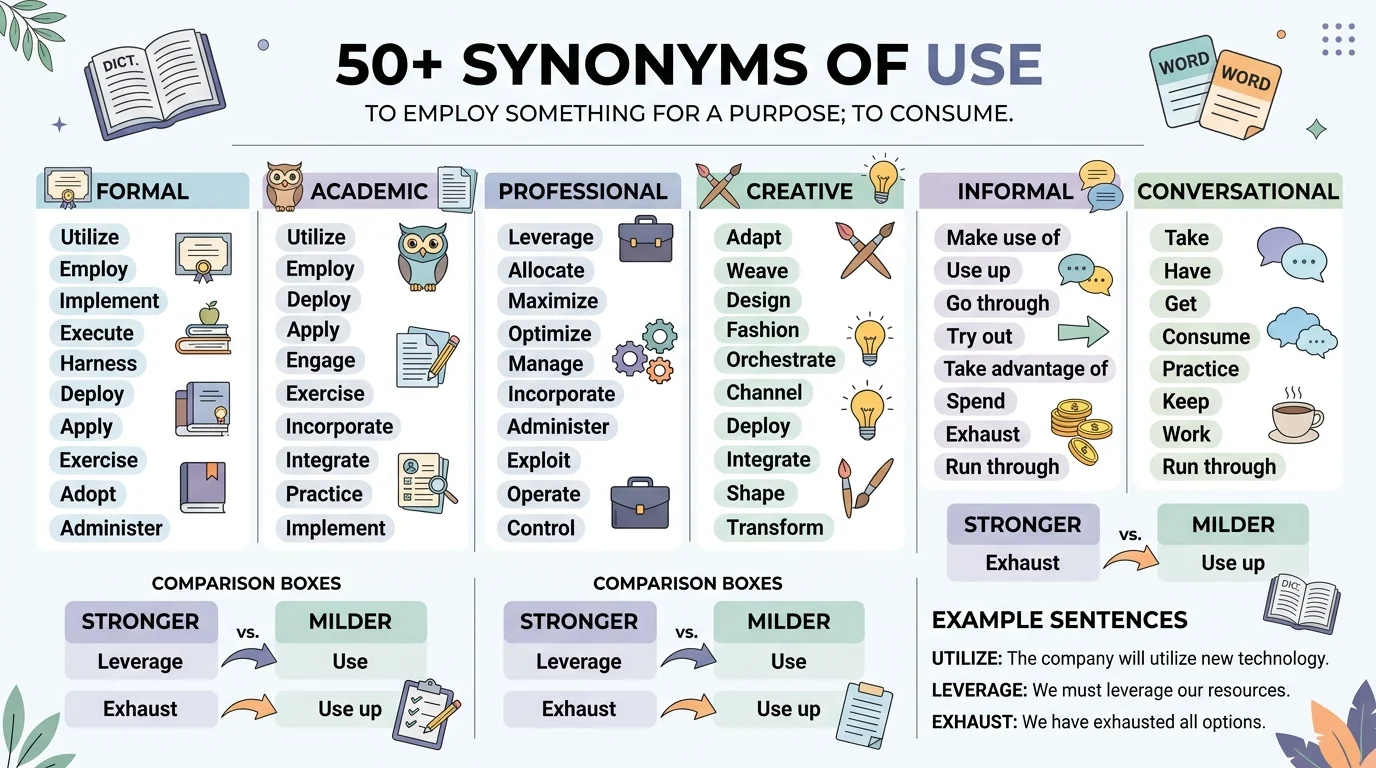
Have you ever stared at a sentence and realized you have written the word “use” four times in the same paragraph? It happens to everyone. Whether you are drafting an email, writing an essay, polishing a resume, or posting on social media, leaning too heavily on one word makes your writing feel flat and repetitive. Finding the right synonym of use can transform a dull sentence into something clear, professional, and memorable. The word “use” is one of the most common verbs in English, and while it is perfectly correct, relying on it too often weakens your communication. Choosing the right alternative helps you match your tone to your audience and say exactly what you mean.
What Are the Best Synonyms of “Use”?
The word “use” means to employ something for a purpose. For formal and academic writing, choose “utilize,” “employ,” or “apply.” For casual conversation, “make use of” or “put to use” work well. In professional contexts, “leverage” and “implement” are strong choices. For creative writing, try “wield” or “harness.”
Meaning, Tone, and Context
Simple Definition
To use something means to put it into service for a specific purpose. You use a pen to write, use a computer to research, or use a strategy to solve a problem.
Part of Speech
“Use” functions as both a verb and a noun. As a verb, it describes the action of employing something. As a noun, it refers to the act of using something or the purpose for which something is used.
Overall Tone
“Use” is neutral. It does not carry a positive or negative emotional charge on its own. The tone depends entirely on the context around it.
Formality Level
“Use” is neutral in formality. It works in every setting from casual texting to academic papers. This versatility is both its strength and its weakness. Because it fits everywhere, it can feel boring or imprecise when a more specific word would do a better job.
Common Uses
Native English speakers use “use” constantly in everyday speech, writing, and professional communication. It appears in instructions, explanations, requests, and descriptions. You will hear it in sentences like “Use your turn signal” and “I use this app every day.” It is the default verb for describing how people interact with tools, methods, and resources.
Word Forms
- Verb: use, uses, using, used
- Noun: use, uses
- Adjective: usable, useful, useless
- Adverb: usefully
When and How to Use “Use”
Choose “use” when you need a straightforward, clear verb that everyone will understand. It is the safest choice in most situations. However, when you want to sound more polished, precise, or professional, consider one of the alternatives discussed below.
Here are seven realistic examples showing how “use” appears in different contexts.
Professional: We use this software to track our monthly expenses.
Academic: The study uses data collected from over five thousand participants.
Workplace: Please use the new system for all expense reports going forward.
Personal: I use this recipe whenever I want to impress dinner guests.
Email: I will use the feedback you provided to revise the proposal.
Resume: Used analytical tools to identify cost-saving opportunities.
Social Media: Use this filter to make your photos look vintage.
Best Synonyms of “Use”
No synonym is identical in every situation. The best choice depends on your audience, your purpose, and the specific meaning you want to convey. Here are the top recommendations for different contexts.
Professional writing: “Employ” sounds polished without being pretentious. It suggests careful, intentional use of a method or resource.
Academic writing: “Utilize” indicates efficient or strategic use, though some style guides advise using it sparingly. “Employ” and “apply” are also excellent academic choices.
Business communication: “Leverage” suggests using something to gain an advantage. “Implement” works well for putting plans into action.
Casual conversation: “Make use of” sounds natural and conversational. “Put to use” is another friendly option.
Emotional writing: “Harness” suggests capturing and directing energy or power. “Wield” implies control and strength.
Creative writing: “Wield” and “harness” add vivid imagery. “Deploy” suggests strategic placement.
Resume writing: “Leveraged,” “implemented,” and “utilized” are strong choices that demonstrate impact.
Workplace communication: “Apply” and “employ” are clear and professional without sounding overly formal.
Stronger meaning: “Exploit” (use to full advantage, sometimes negatively), “leverage” (use for maximum benefit).
Softer meaning: “Make use of” and “put to use” feel gentler and less direct.
When Not to Use “Use”
When the Word Sounds Too General
Why it is less effective: “Use” is so broad that it often fails to communicate exactly what you mean. In academic and professional writing, vague language weakens your argument.
Better synonym: “Employ” or “apply”
Rewrite: Instead of “The researchers used a new method,” write “The researchers employed a new method.”
When the Word Sounds Too Vague
Why it is less effective: “Use” does not tell the reader whether you are applying a theory, operating a machine, or consuming a resource.
Better synonym: “Operate” for machines, “consume” for resources, “apply” for theories
Rewrite: Instead of “She used the equipment,” write “She operated the equipment.”
When the Word Sounds Too Informal
Why it is less effective: In very formal writing, such as legal documents or high-level academic papers, “use” can feel too simple.
Better synonym: “Utilize” or “employ”
Rewrite: Instead of “The organization used these funds,” write “The organization utilized these funds.”
When the Word Sounds Too Weak
Why it is less effective: “Use” does not convey strategic thinking or significant impact.
Better synonym: “Leverage”
Rewrite: Instead of “We used our network to find clients,” write “We leveraged our network to find clients.”
When the Word Sounds Outdated
“Use” itself is never outdated. However, some synonyms like “avail oneself of” can sound old-fashioned in modern writing.
Words Commonly Confused With “Use”
Use vs Utilize
Difference: “Utilize” means to use something effectively or in a way that is not originally intended. Many style guides, including the CDC Style Guide, recommend avoiding “utilize” when “use” works just as well.
When to use it: Use “utilize” only when you mean making practical or effective use of something, especially in a creative or nonstandard way.
Example: She utilized a paperclip as a bookmark.
Use vs Employ
Difference: “Employ” suggests using a person or thing that is available but perhaps not yet in service. It often refers to methods, strategies, or people.
When to use it: Use “employ” in formal writing when referring to methods, techniques, or approaches.
Example: The study employs a mixed-method research design.
Use vs Apply
Difference: “Apply” means to put something to use for a specific purpose, often by placing it onto or into something else.
When to use it: Use “apply” when talking about putting theories, knowledge, or substances into practice.
Example: Apply this cream to the affected area twice daily.
Use vs Leverage
Difference: “Leverage” means to use something to maximum advantage, often in a business or strategic context.
When to use it: Use “leverage” in professional and business writing when emphasizing strategic advantage.
Example: We can leverage our existing customer base to launch the new product.
Use vs Operate
Difference: “Operate” specifically refers to controlling the function of machinery, equipment, or systems.
When to use it: Use “operate” when describing the action of running machines or equipment.
Example: He operates the forklift in the warehouse.
Use vs Exploit
Difference: “Exploit” means to use something to full advantage, often with a negative connotation of taking unfair advantage.
When to use it: Use “exploit” carefully. In neutral contexts it can mean making full use of resources, but it often implies selfishness or harm.
Example: The company exploited its market position to eliminate competitors.
Best Synonyms of “Use” by Context
| Context | Best Synonym | Why It Works | Example |
|---|---|---|---|
| Formal writing | Employ | Sounds polished and intentional | The committee employed a rigorous review process. |
| Academic writing | Utilize | Suggests efficient, strategic use | Researchers utilized advanced software for data analysis. |
| Professional communication | Leverage | Conveys strategic advantage | We can leverage our expertise to win the contract. |
| Business emails | Apply | Clear and professional | Please apply these guidelines to your upcoming projects. |
| Resume writing | Implemented | Shows action and results | Implemented a new inventory system that reduced costs. |
| Workplace communication | Operate | Specific to equipment and systems | She operates the scheduling software. |
| Casual conversation | Make use of | Natural and conversational | I made use of the leftover ingredients for dinner. |
| Everyday speaking | Put to use | Friendly and direct | Let’s put this information to use. |
| Creative writing | Wield | Adds power and imagery | The author wields language with precision. |
| Storytelling | Harness | Suggests capturing energy or power | He harnessed his fear and turned it into determination. |
| Emotional writing | Deploy | Suggests strategic, purposeful action | She deployed every ounce of courage she had. |
| Strong emphasis | Exploit | Indicates full, sometimes aggressive use | The team exploited every opportunity. |
| Mild tone | Apply | Gentle and neutral | Apply gentle pressure to the wound. |
| Social media captions | Rock | Informal and trendy | Rock this look with our new collection. |
| American English | Use | The standard choice in all contexts | Use your turn signal before changing lanes. |
How to Choose the Best Synonym of “Use”
Choosing the right synonym starts with asking yourself a few simple questions.
What is your audience? For a formal report, choose “employ” or “utilize.” For a text message, stick with “use” or “make use of.”
What is your purpose? Are you describing routine action, strategic advantage, or creative application? Match your word to your intent.
What tone do you want? Neutral, professional, emotional, or casual? Your word choice sets the tone.
How strong should it be? “Make use of” is gentle. “Leverage” is assertive. “Exploit” is strong and potentially negative.
Does it sound natural? Read your sentence aloud. If the synonym feels awkward or forced, choose a different one.
The goal is not to replace every instance of “use” with a fancy alternative. The goal is to choose the word that communicates your message most clearly and appropriately for your audience.
Real Life Examples of “Use”
Here are realistic examples showing how “use” and its synonyms appear in everyday situations.
School: The teacher asked us to use examples from the text to support our arguments.
College: Students should utilize the library’s research databases for their term papers.
Workplace: Our team employs agile methodology to manage software development.
Business: The company leveraged its brand reputation to enter new markets.
Email: I will apply your suggestions to the final draft of the report.
Resume: Implemented a customer feedback system that improved satisfaction scores by 20 percent.
Conversation: You can make use of my notes if you missed the lecture.
Storytelling: The general deployed his troops strategically along the border.
Blogging: Use these tips to grow your social media following organically.
Social Media: Rock this summer look with our new sunglasses collection.
18 Best Synonyms of “Use”
| Synonym | Simple Meaning | Best Used For | Example Sentence |
|---|---|---|---|
| Employ | Use for a purpose, especially a method or strategy | Formal writing, academic papers | The study employs a longitudinal research design. |
| Utilize | Use effectively or in a nonstandard way | Academic, technical writing | We utilize solar panels to reduce energy costs. |
| Apply | Put into operation or practice | Instructions, professional settings | Apply this technique to improve your results. |
| Leverage | Use to maximum advantage | Business, professional writing | We can leverage our partnerships to expand globally. |
| Implement | Put a plan or system into effect | Project management, business | The team implemented the new software across all departments. |
| Operate | Control the function of equipment | Technical writing, workplace | She operates the heavy machinery safely. |
| Wield | Hold and use with power or skill | Creative writing, descriptive language | The speaker wielded influence over the audience. |
| Harness | Capture and direct for a purpose | Storytelling, motivational writing | He harnessed his anger and channeled it into action. |
| Deploy | Position strategically for use | Military, business, technology | The company deployed resources to the new project. |
| Exert | Bring to bear, apply force or influence | Formal writing, persuasive contexts | They exerted pressure on the committee to approve the plan. |
| Apply | Put to practical use | Everyday writing, professional contexts | Apply these principles to your daily work. |
| Make use of | Employ for a purpose | Casual conversation, friendly writing | I made use of the extra time to finish the project. |
| Put to use | Use for a practical purpose | Everyday speaking | Let’s put these skills to use in our next project. |
| Exercise | Use a right, power, or ability | Formal, legal, or academic contexts | Citizens should exercise their right to vote. |
| Consume | Use up resources | Economics, environmental writing | The factory consumes vast amounts of water. |
| Expend | Use up time, effort, or money | Formal, resource-focused writing | They expended considerable effort on the campaign. |
| Administer | Use or apply in a formal or official way | Medical, legal, official contexts | The nurse administered the medication carefully. |
| Bring to bear | Apply influence or pressure | Formal, persuasive writing | They brought all their resources to bear on the problem. |
Synonyms of “Use” by Usage
Professional vs Personal Synonyms
In professional settings, words like “leverage,” “implement,” and “employ” sound deliberate and strategic. They suggest that you are not just using something but using it thoughtfully. In personal conversations, “make use of” and “put to use” feel warmer and more natural. “Use” itself works perfectly in both contexts.
Formal vs Conversational Synonyms
For reports, essays, business writing, and presentations, choose “employ,” “utilize,” or “apply.” These words signal a formal register and demonstrate vocabulary range. For casual conversations and texting, “make use of,” “put to use,” or simply “use” are the right choices. Formal synonyms in casual settings can sound pretentious. Conversational synonyms in formal settings can sound too casual.
Academic Synonyms
In research papers, essays, and academic discussions, precision matters. “Employ” suggests intentional choice of methodology. “Utilize” indicates efficient or strategic use of resources. “Apply” shows the practical implementation of theory. “Implement” works for putting plans into action. These words sound authoritative because they are specific. They tell the reader exactly what kind of use you mean.
Professional and Business Synonyms
For resumes, interviews, meetings, presentations, and client communication, choose words that demonstrate impact. “Leveraged” shows you used something to gain advantage. “Implemented” shows you took action and got results. “Utilized” shows you made effective use of resources. “Deployed” suggests strategic allocation. These words make your accomplishments sound more significant and intentional.
Creative and Literary Synonyms
For storytelling, fiction, poetry, and descriptive writing, expressive alternatives add color and emotion. “Wield” suggests power and control. “Harness” suggests capturing and directing energy. “Deploy” suggests strategy and purpose. “Exert” suggests effort and force. These words create vivid images in the reader’s mind and make your writing more engaging.
Slang or Modern Synonyms
In very casual contexts, especially on social media, “rock” can mean to use or wear something with confidence. “Flex” can mean to show off or use something to impress others. These slang terms are acceptable in informal digital communication but should be avoided in professional, academic, or formal writing.
Strongest to Mildest Synonyms
Mild: Make use of, put to use, apply
Moderate: Use, employ, operate
Strong: Leverage, utilize, implement
Very Strong: Exploit, wield, harness
Emotional vs Neutral Synonyms
Emotional Synonyms: “Wield” implies power and control. “Harness” implies capturing and directing energy. “Exploit” implies taking full advantage, often with a negative edge. These words carry emotional weight and should be chosen carefully.
Neutral Synonyms: “Use,” “employ,” “apply,” and “operate” simply communicate information without adding emotion. They are safe choices when you want to be clear and objective.
Antonyms of “Use”
| Antonym | Meaning | Example Sentence |
|---|---|---|
| Misuse | Use incorrectly or improperly | Do not misuse company equipment for personal projects. |
| Abuse | Use in a harmful or excessive way | He abused his authority by demanding special treatment. |
| Neglect | Fail to use or care for | She neglected her health by skipping regular checkups. |
| Waste | Use without benefit | Do not waste time on tasks that do not matter. |
| Squander | Spend or use wastefully | They squandered their budget on unnecessary expenses. |
| Discard | Throw away, stop using | Discard any expired medication immediately. |
| Abandon | Give up using completely | The company abandoned the old system last year. |
| Ignore | Pay no attention to, not use | Do not ignore the warning signs. |
| Overlook | Fail to notice or use | We overlooked an important resource. |
| Disuse | State of not being used | The equipment fell into disuse after the upgrade. |
| Nonuse | Failure to use | The nonuse of safety gear led to injuries. |
| Misapply | Apply incorrectly | He misapplied the formula and got wrong results. |
| Misemploy | Use in the wrong way | The funds were misemployed on frivolous items. |
| Mishandle | Use or treat carelessly | She mishandled the fragile equipment. |
| Mismanage | Use or organize poorly | They mismanaged the project from the start. |
Comparison: “Use” vs Similar Words
Use vs Utilize
Main Difference: “Utilize” means to use something effectively, often in a way that is not its original purpose. “Use” is the general term for putting something into service.
Which Is Stronger? “Utilize” is stronger because it implies effective or creative use.
Which Is More Formal? “Utilize” is more formal and often criticized as unnecessary.
When to Use Each: Use “use” by default. Use “utilize” only when you mean using something in a new or effective way.
Examples:
- Use: I use my phone every day.
- Utilize: We utilized the conference room as a makeshift office.
Use vs Employ
Main Difference: “Employ” often refers to using methods, strategies, or people. It suggests intentional choice.
Which Is Stronger? “Employ” is slightly stronger because it suggests deliberate selection.
Which Is More Formal? “Employ” is more formal than “use.”
When to Use Each: Use “use” for general purposes. Use “employ” for methods, techniques, and approaches in formal writing.
Examples:
- Use: Use a ruler to measure the paper.
- Employ: The study employs a qualitative research approach.
Use vs Apply
Main Difference: “Apply” means to put something to use, often by placing it onto or into something else.
Which Is Stronger? “Apply” is similar in strength to “use” but more specific.
Which Is More Formal? “Apply” is neutral but often used in formal instructions.
When to Use Each: Use “use” for general actions. Use “apply” when putting knowledge, theories, or substances into practice.
Examples:
- Use: Use this key to open the door.
- Apply: Apply this theory to real-world situations.
Use vs Leverage
Main Difference: “Leverage” means to use something to maximum advantage, often in business or strategy contexts.
Which Is Stronger? “Leverage” is much stronger because it implies strategic advantage.
Which Is More Formal? “Leverage” is formal and business-oriented.
When to Use Each: Use “use” for neutral descriptions. Use “leverage” when emphasizing strategic benefit.
Examples:
- Use: We use social media for marketing.
- Leverage: We leverage social media to reach new audiences.
Use vs Operate
Main Difference: “Operate” specifically refers to controlling the function of machinery, equipment, or systems.
Which Is Stronger? “Operate” is more specific but not necessarily stronger.
Which Is More Formal? “Operate” is neutral but often used in technical contexts.
When to Use Each: Use “use” for general purposes. Use “operate” when describing the action of running equipment.
Examples:
- Use: Use the scanner to copy documents.
- Operate: She operates the printing press.
Use vs Exploit
Main Difference: “Exploit” means to use something to full advantage, often with a negative connotation of taking unfair advantage.
Which Is Stronger? “Exploit” is much stronger and carries moral weight.
Which Is More Formal? “Exploit” is formal but often negative.
When to Use Each: Use “use” for neutral descriptions. Use “exploit” carefully, only when you mean making full use, often in a way that may be seen as taking advantage.
Examples:
- Use: Use the available resources wisely.
- Exploit: The company exploited its workers by paying low wages.
Common Phrases and Expressions with “Use”
Make use of
Meaning: To use something for a purpose.
Example Sentence: You should make use of the free resources available online.
Put to use
Meaning: To start using something for a practical purpose.
Example Sentence: She put her language skills to use as a translator.
Use up
Meaning: To consume or exhaust a supply of something.
Example Sentence: We used up all the printer paper before the meeting.
Have no use for
Meaning: To not need or want something.
Example Sentence: I have no use for that old software anymore.
Use your head
Meaning: To think carefully and use good judgment.
Example Sentence: Use your head before making a big decision.
Use something to your advantage
Meaning: To benefit from a situation or resource.
Example Sentence: Use your experience to your advantage during the interview.
Use and abuse
Meaning: To use something excessively or in a harmful way.
Example Sentence: Some people use and abuse their power in the workplace.
Common Mistakes to Avoid
1: Using “utilize” to sound smarter
Incorrect: We will utilize the new software to track expenses.
Better: We will use the new software to track expenses.
Why: “Utilize” is often unnecessary and can make writing sound pretentious. “Use” is almost always the better choice.
2: Repeating “use” too often in a single paragraph
Incorrect: We use this tool to analyze data. We also use it to generate reports.
Better: We use this tool to analyze data. We also employ it to generate reports.
Why: Varying your word choice keeps writing engaging and demonstrates vocabulary range.
3: Choosing a vague synonym
Incorrect: We worked with the new system.
Better: We implemented the new system across all departments.
Why: “Worked with” is vague. “Implemented” tells the reader exactly what you did.
4: Using an informal synonym in formal writing
Incorrect: The researchers used up all their funding.
Better: The researchers expended all their funding.
Why: “Used up” is conversational. “Expended” is appropriate for academic and formal contexts.
5: Using an overly dramatic synonym for routine actions
Incorrect: I wielded my toothbrush to clean my teeth.
Better: I used my toothbrush to clean my teeth.
Why: “Wield” implies power and skill. It is inappropriate for mundane actions.
6: Using “leverage” incorrectly
Incorrect: I leveraged a pen to write a note.
Better: I used a pen to write a note.
Why: “Leverage” means using something to gain strategic advantage. Writing a note is not strategic. Use “leverage” only in business or strategy contexts.
7: Confusing “use” with “usage”
Incorrect: The usage of this tool is simple.
Better: The use of this tool is simple.
Why: “Usage” refers to the way language is used or the customary practice. “Use” refers to the act of employing something.
Frequently Asked Questions
What are the best synonyms of “use”?
The best synonyms depend on context. Formal writing, choose “employ” or “utilize.” For business, choose “leverage” or “implement.” For casual conversation, choose “make use of” or “put to use.”
What are the best formal synonyms of “use”?
The best formal synonyms include “employ,” “utilize,” “apply,” and “implement.” “Employ” is excellent for methods and strategies. “Utilize” suggests effective use. “Implement” works for putting plans into action.
What are common informal synonyms of “use”?
Common informal synonyms include “make use of,” “put to use,” and “put into practice.” These phrases sound natural in everyday conversation and friendly writing without being overly casual.
What is another word for “use” in professional writing?
“Leverage” and “implement” are excellent choices in professional writing. “Leverage” suggests using something to maximum advantage. “Implement” suggests putting a plan or system into effect.
What is the difference between “use” and “utilize”?
“Use” means to put something into service. “Utilize” means to use something effectively, often in a creative or nonstandard way. Many style guides recommend preferring “use” in most cases.
What is the opposite of “use”?
Common opposites include “misuse” (use incorrectly), “abuse” (use harmfully), “neglect” (fail to use), “waste” (use without benefit), and “discard” (stop using).
Conclusion
The word “use” is a workhorse of the English language. It is clear, correct, and universally understood. But relying on it too often makes your writing feel repetitive and imprecise. The best synonym of use depends entirely on your context, audience, and purpose. Formal and academic writing, “employ,” “utilize,” and “apply” add precision and polish. For professional and business contexts, “leverage” and “implement” convey strategy and impact. Creative writing, “wield” and “harness” add imagery and emotion. No single synonym works perfectly in every situation. The key to better writing is not avoiding “use” altogether. The key is choosing the word that communicates your message most clearly and appropriately. The next time you write, pause before you type “use.” Ask yourself if a more specific word would do a better job. Your readers will notice the difference.
Definitions, meanings, and usage recommendations should be verified with trusted language references before publication. Recommended sources include Cambridge Dictionary, Oxford English Dictionary, Merriam Webster, Collins Dictionary, and Britannica.