Have you ever written an email, an essay, or a social media caption and realized you used the same word three times in two sentences? Most writers have been there. You know what you want to say, but the right word just will not come to mind.
Maybe you are describing how a speech connected with an audience or how a song stayed with you long after it ended.That is where understanding the synonyms of resonates becomes essential. Choosing the right synonym does more than avoid repetition. It sharpens your meaning, adjusts your tone, and makes your communication more precise.
Whether you are writing a resume, crafting a business proposal, or posting on social media, the word you choose shapes how your message lands. This guide will help you find the perfect alternative every time.
What Are the Best Synonyms of “Resonates”?
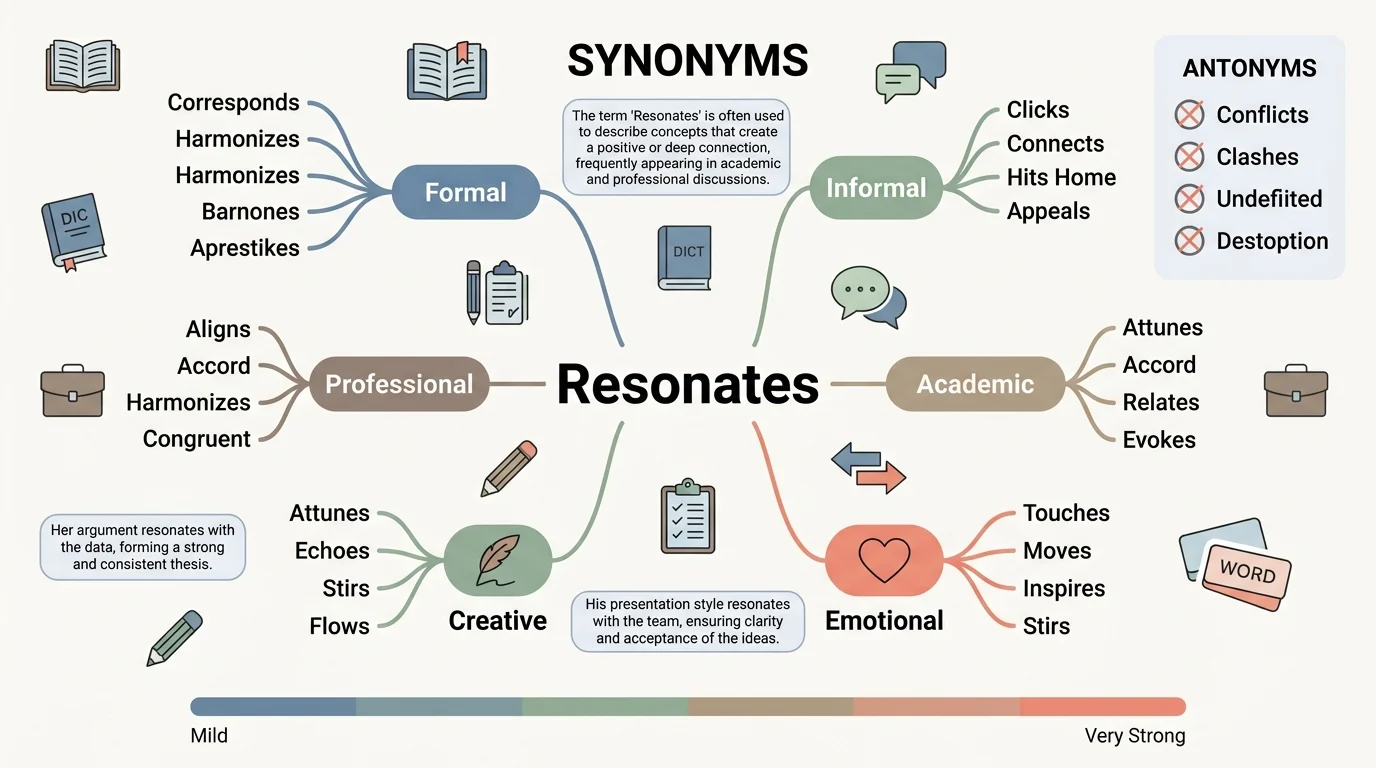
“Resonates” means to produce a deep, full sound or to evoke a strong emotional response and sense of connection. Formal writing, choose “reverberates” or “resounds.” For casual conversation, use “strikes a chord” or “connects.” For professional settings, “compels” or “impacts” work well.Emotional writing, try “touches” or “moves.”
Meaning, Tone, and Context
Simple Definition
“Resonates” has two primary meanings. First, it describes a physical sound that is deep, full, and continues for a period of time. Second, and more commonly in modern usage, it describes an idea, message, or experience that creates a strong emotional connection or sense of shared understanding with someone.
Part of Speech
Verb (intransitive). The third-person singular form is “resonates.” Past tense is “resonated.” Present participle is “resonating.”
Overall Tone
Neutral to positive. The word carries an inherently favorable connotation because it implies meaningful connection rather than mere acknowledgment. It suggests that something has landed well and created genuine impact.
Formality Level
Semi-formal to formal. “Resonates” appears frequently in professional writing, journalism, academic work, and business communication. It is also used in everyday conversation, though it sounds more sophisticated than casual alternatives.
Common Uses
Native English speakers use “resonates” in several ways:
- Describing sound: A voice, instrument, or noise that produces a deep, full, and lingering tone.
- Describing emotional impact: A story, message, or experience that feels personally meaningful or deeply relatable.
- Describing alignment: An idea or proposal that matches someone else’s values, beliefs, or experiences.
- Describing lasting effect: Something that continues to feel important or relevant over time.
Word Forms
| Form | Word | Example |
|---|---|---|
| Verb (base) | resonate | Her words resonate with me. |
| Verb (third person) | resonates | His message resonates with voters. |
| Verb (past) | resonated | The speech resonated with the audience. |
| Verb (present participle) | resonating | The sound is resonating through the hall. |
| Noun | resonance | The resonance of his words was powerful. |
| Adjective | resonant | She has a resonant speaking voice. |
When and How to Use “Resonates”
Choose “resonates” when you want to describe a meaningful connection between an idea, message, or experience and the person receiving it. The word works best when the connection feels genuine, deep, and somewhat emotional rather than purely intellectual.
Here are seven realistic examples showing “resonates” in different contexts.
Professional
The CEO’s vision for the company resonates with employees across every department.
Academic
The professor’s theory on social behavior resonates with several established frameworks in the field.
Workplace
Her proposal for flexible work hours resonates with team members who value work-life balance.
Personal
That poem resonates with me because it captures exactly how I felt during that time in my life.
Email
I believe this approach will resonate with our clients because it addresses their core concerns directly.
Resume
Crafted marketing campaigns that resonated with target audiences and increased engagement by 40 percent.
Social Media
This book resonates with so many readers because it tells a story that feels both personal and universal.
Best Synonyms of “Resonates”
No synonym is identical in every situation. The best choice depends on your audience, your purpose, and the emotional weight you want to carry. Here are the best synonyms for specific contexts.
Professional Writing: “Resounds”
“Resounds” suggests a clear, strong, and lasting impact. It works well in reports and professional correspondence because it sounds authoritative without being overly emotional.
Academic Writing: “Reverberates”
“Reverberates” implies a continuing effect that spreads outward. In academic contexts, this word suggests that an idea has far-reaching implications beyond its initial presentation.
Business Communication: “Connects”
“Connects” is straightforward and professional. It communicates alignment and understanding without sounding overly dramatic or emotional.
Casual Conversation: “Strikes a Chord”
This phrase feels natural and conversational. It suggests that something feels personally meaningful in an almost musical way.
Emotional Writing: “Moves”
“Moves” is simple but powerful. It describes an emotional response without being flowery or exaggerated.
Creative Writing: “Echoes”
“Echoes” suggests that something repeats or lingers in the mind. It works beautifully in descriptive and narrative writing.
Resume Writing: “Compelled”
“Compelled” suggests that your work created genuine motivation or action. It sounds active and results-oriented.
Workplace Communication: “Impacts”
“Impacts” is direct and professional. It describes effect without emotional elaboration.
Stronger Meaning: “Galvanizes”
“Galvanizes” suggests that something not only resonates but also inspires action or change. It carries more force than “resonates.”
Softer Meaning: “Registers”
“Registers” suggests that something is noticed and acknowledged but without the deep emotional connection that “resonates” implies.
When Not to Use “Resonates”
When the Word Sounds Too General
“Resonates” can feel vague when you need to describe a specific type of connection. If you are writing about a business proposal that addresses a clear problem, “addresses” or “solves” is more precise.
Weak: The solution resonates with the client’s needs.
Stronger: The solution directly addresses the client’s needs.
When the Word Sounds Too Formal
In casual conversation or text messaging, “resonates” can sound overly sophisticated. “Clicks” or “feels right” sounds more natural.
Weak: That idea really resonates with me.
Better: That idea really clicks with me.
When the Word Sounds Too Weak
Sometimes you need a word with more force. If a message inspired significant action, “galvanizes” or “energizes” carries more weight.
Weak: The announcement resonated with the staff.
Stronger: The announcement galvanized the staff into action.
When the Word Sounds Too Strong
“Resonates” implies a genuine emotional connection. If you only mean that something was noticed or understood, use “registers” or “lands” instead.
Weak: The memo resonated with everyone in the office.
Better: The memo registered with everyone in the office.
When the Word Sounds Outdated
“Resonates” remains current and widely used. However, in very informal digital contexts like social media comments, simpler words like “hits” or “feels” may sound more natural.
Words Commonly Confused With “Resonates”
Resonates vs Echoes
Difference: “Echoes” describes a sound that is repeated or reflected back. “Resonates” describes a sound that is amplified and deepened, or an idea that creates emotional connection. “Echo” is more about repetition; “resonate” is more about amplification and depth.
When to use “echoes”: When something repeats or reflects what already exists.
Example: Her concerns echo what many employees have already expressed.
When to use “resonates”: When something creates a new, deeper connection.
Example: Her message resonates with employees on a personal level.
Resonates vs Reverberates
Difference: “Reverberates” suggests a sound or effect that continues to bounce back and forth, often with diminishing intensity. “Resonates” suggests a sound or effect that is amplified and sustained. “Reverberates” implies ongoing repetition; “resonates” implies deepening impact.
When to use “reverberates”: When describing something that continues to have effects over time.
Example: The policy change reverberated throughout the entire organization.
When to use “resonates”: When describing something that creates a strong emotional connection.
Example: The policy change resonates with employees who value fairness.
Resonates vs Resounds
Difference: “Resounds” describes a sound that is loud, clear, and fills a space. “Resonates” can describe sound but more often describes emotional or intellectual connection. “Resounds” is more about volume and presence; “resonates” is more about depth and meaning.
When to use “resounds”: When something is loud, clear, and impossible to ignore.
Example: His voice resounded through the auditorium.
When to use “resonates”: When something creates a meaningful personal connection.
Example: His message resonates with everyone who hears it.
Resonates vs Vibrates
Difference: “Vibrates” describes a physical quivering or oscillating motion. “Resonates” describes a sympathetic response, either physical or emotional. “Vibrates” is purely physical; “resonates” can be physical, emotional, or intellectual.
When to use “vibrates”: When describing physical movement or oscillation.
Example: The guitar string vibrates when plucked.
When to use “resonates”: When describing emotional or intellectual connection.
Example: The guitar’s tone resonates with the listener.
Resonates vs Strikes a Chord
Difference: “Strikes a chord” is an idiom that means to evoke a strong emotional response because something feels personally familiar or meaningful. “Resonates” has a similar meaning but sounds more formal and sophisticated. “Strikes a chord” is more conversational.
When to use “strikes a chord”: In casual conversation or personal writing.
Example: His story about overcoming failure really struck a chord with me.
When to use “resonates”: In professional, academic, or formal writing.
Example: His story about overcoming failure resonates with professionals who have faced similar challenges.
Resonates vs Connects
Difference: “Connects” describes a general sense of understanding or relationship. “Resonates” describes a deeper, more meaningful emotional or intellectual alignment. “Connects” is broader; “resonates” is more specific and emotionally charged.
When to use “connects”: When describing general understanding or rapport.
Example: The speaker connects well with the audience.
When to use “resonates”: When describing deep emotional or intellectual alignment.
Example: The speaker’s message resonates deeply with the audience.
Best Synonyms of “Resonates” by Context
| Context | Best Synonym | Why It Works | Example |
|---|---|---|---|
| Formal writing | Resounds | Sounds authoritative and suggests strong, clear impact | The proposal resounds with clarity and purpose. |
| Academic writing | Reverberates | Implies far-reaching implications and continuing effect | Her research reverberates across multiple disciplines. |
| Professional communication | Connects | Direct, professional, and free of emotional exaggeration | The presentation connects with the client’s priorities. |
| Business emails | Lands | Concise and modern; suggests a message was received well | I hope this draft lands well with the stakeholders. |
| Resume writing | Compelled | Active and results-oriented; suggests you drove action | Compelled cross-functional teams to adopt new processes. |
| Workplace communication | Impacts | Direct, professional, and measurable | This training impacts employee retention positively. |
| Casual conversation | Strikes a chord | Natural, conversational, and emotionally resonant | That song really strikes a chord with me. |
| Everyday speaking | Clicks | Informal and modern; suggests easy understanding | The idea just clicks with everyone I talk to. |
| Creative writing | Echoes | Poetic and suggestive; implies lingering presence | Her laughter echoes through the empty halls. |
| Storytelling | Haunts | Suggests something stays with you in a powerful way | The memory haunts him to this day. |
| Emotional writing | Moves | Simple, powerful, and emotionally direct | The film moved me to tears. |
| Strong emphasis | Galvanizes | Suggests action and transformation, not just emotion | The crisis galvanized the community. |
| Mild tone | Registers | Suggests acknowledgment without deep emotional weight | The comment registered with a few audience members. |
| Social media captions | Hits | Modern, informal, and widely used in digital contexts | This quote hits different today. |
| American English | Resonates | Standard and widely used across all American contexts | The message resonates with American voters. |
How to Choose the Best Synonym of “Resonates”
Choosing the right synonym starts with understanding what you actually want to communicate. Ask yourself these questions before you decide.
What is the specific meaning you want to convey? If you mean emotional connection, choose “moves” or “touches.” If you mean intellectual alignment, choose “connects” or “aligns.” If you mean lasting impact, choose “reverberates” or “resounds.”
Who is your audience? For professional or academic readers, choose “resounds,” “reverberates,” or “compels.” For casual readers, choose “strikes a chord,” “clicks,” or “hits.”
How much emotional weight do you need? For strong emotion, choose “moves,” “touches,” or “galvanizes.” For neutral communication, choose “connects,” “impacts,” or “registers.”
What is your writing purpose? For persuasion, choose “compels” or “galvanizes.” For description, choose “echoes” or “haunts.” For reporting, choose “resounds” or “reverberates.”
Does the word sound natural in your sentence? Read your sentence aloud. If the synonym feels forced or awkward, try a different one. Natural-sounding writing always wins.
The most effective synonym is the one that communicates your intended message most clearly to your specific audience.
Real Life Examples of “Resonates”
School
The teacher’s explanation of fractions finally resonated with the students after she used pizza slices as examples.
College
The guest lecturer’s ideas about sustainable architecture resonated with the students who were already passionate about environmental design.
Workplace
The new company values resonated with the team because they reflected what employees had been asking for in feedback sessions.
Business
The marketing campaign resonated with customers because it addressed a problem they had been struggling with for years.
I believe this revised proposal will resonate with the board because it directly addresses their concerns about budget.
Resume
Developed training programs that resonated with employees, resulting in a 25 percent increase in completion rates.
Conversation
When she talked about growing up in a small town, it really resonated with me because I had a similar experience.
Storytelling
The old man’s words resonated in her mind for days, long after she had left his tiny shop on the corner.
Blogging
This recipe resonates with home cooks because it uses ingredients most people already have in their pantry.
Social Media
This post resonates with so many of you, and I am grateful for all the messages sharing your own stories.
18 Best Synonyms
| Synonym | Simple Meaning | Best Used For | Example Sentence |
|---|---|---|---|
| Reverberates | Continues to have effects over time; echoes repeatedly | Academic writing, describing lasting impact | The professor’s ideas reverberate throughout the field of psychology. |
| Resounds | Produces a loud, clear, and full sound | Formal writing, describing strong presence | His call for action resounds in every department meeting. |
| Echoes | Repeats or reflects a sound or idea | Descriptive writing, showing similarity or repetition | Her concerns echo what other employees have quietly expressed. |
| Strikes a chord | Creates a strong emotional connection through familiarity | Casual conversation, personal writing | That story about overcoming self-doubt really struck a chord with me. |
| Connects | Creates understanding or rapport | Professional writing, business communication | The speaker connects with audiences by sharing personal experiences. |
| Compels | Drives action or creates strong motivation | Resume writing, persuasive writing | The data compelled the team to rethink their entire strategy. |
| Moves | Creates a strong emotional response | Emotional writing, storytelling | The documentary moved audiences around the world. |
| Touches | Affects someone emotionally in a gentle way | Personal writing, sensitive topics | Her kindness touched everyone who knew her. |
| Impacts | Produces a measurable effect | Professional writing, business communication | The new policy impacts productivity across all teams. |
| Galvanizes | Inspires action and brings about change | Strong emphasis, persuasive writing | The crisis galvanized the community to demand change. |
| Vibrates | Quivers or oscillates physically | Scientific or physical descriptions | The floor vibrates whenever the train passes underneath. |
| Pulsates | Beats or throbs with a regular rhythm | Creative writing, describing rhythm or energy | The city pulsates with energy after dark. |
| Aligns | Matches or corresponds with something | Professional writing, describing agreement | The proposal aligns with the company’s long-term goals. |
| Registers | Is noticed or acknowledged | Mild tone, neutral description | The comment registered with a few people in the room. |
| Haunts | Stays in the mind in a powerful, often unsettling way | Storytelling, emotional writing | The memory of that conversation haunts her still. |
| Lands | Is received or understood by an audience | Modern professional writing, media | The joke landed perfectly with the crowd. |
| Clicks | Creates sudden understanding or connection | Casual conversation, informal writing | The two of them clicked immediately. |
| Rings true | Feels authentic and believable | Conversational writing, personal reflection | His explanation rings true based on what I know. |
Synonyms of “Resonates” by Usage
Professional vs Personal Synonyms
In professional settings, choose words that sound competent without being overly emotional. “Connects,” “impacts,” and “aligns” work well because they describe effect without dramatic language. In personal settings, you have more freedom to use emotionally charged words like “moves,” “touches,” or “strikes a chord.” These words sound natural in conversation but may feel too informal in a business report.
Formal vs Conversational Synonyms
Formal writing favors “reverberates,” “resounds,” and “compels.” These words appear in academic papers, legal documents, and formal reports. Conversational writing favors “strikes a chord,” “clicks,” and “hits.” These words appear in everyday speech, text messages, and social media posts. “Resonates” itself sits comfortably in the middle, acceptable in both formal and informal contexts.
Academic Synonyms
In academic writing, precision matters. “Reverberates” suggests that an idea has wide-ranging implications. “Resounds” suggests that an idea has been clearly heard and understood. “Aligns” suggests that new research corresponds with existing frameworks. These words sound authoritative because they describe intellectual impact without emotional exaggeration.
Professional and Business Synonyms
Resumes, interviews, and business communications demand words that sound active and results-oriented. “Compelled” suggests you drove action. “Impacts” suggests measurable results. “Connects” suggests strong communication skills. “Lands” is increasingly popular in modern business writing because it sounds confident and contemporary.
Creative and Literary Synonyms
Writers of fiction, poetry, and creative nonfiction need words that paint pictures and evoke emotions. “Echoes” suggests lingering presence. “Haunts” suggests something that stays with you in a powerful way. “Pulsates” suggests rhythm and energy. These words add texture and depth to descriptive writing.
Slang or Modern Synonyms
“Resonates” does not have widely used slang equivalents. However, “hits” and “clicks” serve similar functions in informal digital contexts. “Hits” appears frequently in social media comments (“this hits different”). “Clicks” describes sudden understanding or rapport (“we just clicked”). Use these in casual conversation but avoid them in professional or academic writing.
Strongest to Mildest Synonyms
| Intensity | Synonym | Emotional Weight |
|---|---|---|
| Mild | Registers | Barely noticed; acknowledged |
| Mild | Aligns | Matches; corresponds |
| Moderate | Connects | Creates understanding |
| Moderate | Impacts | Produces an effect |
| Moderate | Strikes a chord | Creates emotional familiarity |
| Strong | Moves | Creates emotional response |
| Strong | Compels | Drives action |
| Very Strong | Galvanizes | Inspires transformation |
| Very Strong | Haunts | Stays powerfully in the mind |
Emotional vs Neutral Synonyms
Emotional Synonyms: “Moves,” “touches,” “haunts,” “strikes a chord,” and “galvanizes” all carry significant emotional weight. These words describe feelings, not just facts. Use them when you want your reader to feel something.
Neutral Synonyms: “Connects,” “impacts,” “aligns,” “registers,” and “lands” communicate information without adding emotional color. Use them when you want to be professional, objective, or understated.
Antonyms of “Resonates”
| Antonym | Meaning | Example Sentence |
|---|---|---|
| Dampens | Reduces or deadens sound or effect | The poor acoustics dampen the music’s impact. |
| Mutes | Suppresses or softens sound or effect | His awkward delivery muted the power of his message. |
| Deadens | Makes less sensitive or less effective | The repetitive training deadens employee enthusiasm. |
| Suppresses | Prevents from being expressed or felt | The corporate culture suppresses honest feedback. |
| Ignores | Pays no attention to | The proposal ignores the concerns of frontline staff. |
| Dulls | Makes less sharp, intense, or interesting | The long presentation dulls the audience’s interest. |
| Quiets | Makes silent or less loud | The soundproofing quiets all outside noise. |
| Clashes | Conflicts or disagrees strongly | His aggressive style clashes with the team’s collaborative culture. |
| Discord | Lacks harmony or agreement | The new policy creates discord among department heads. |
| Fails to connect | Does not create understanding or rapport | The speaker fails to connect with younger audience members. |
| Alienates | Makes someone feel isolated or estranged | The rigid rules alienate creative employees. |
| Disconnects | Breaks the sense of understanding or relationship | The technical jargon disconnects the presentation from the audience. |
| Falls flat | Fails to have the intended effect | The joke fell flat with the serious crowd. |
| Misses the mark | Fails to achieve the intended impact | The campaign misses the mark with its target demographic. |
| Bounces off | Has no effect; is not absorbed or understood | The feedback bounces off him without any visible impact. |
Comparison: “Resonates” vs Similar Words
Resonates vs Echoes
Main Difference: “Echoes” describes repetition of a sound or idea. “Resonates” describes amplification and deepening of sound or emotional connection.
Which Is Stronger? “Resonates” carries more emotional and intellectual weight.
Which Is More Formal? Both are acceptable in formal writing, but “resonates” appears more frequently in professional contexts.
When to Use Each: Use “echoes” when describing repetition or reflection. Use “resonates” when describing meaningful connection.
Examples:
- Resonates: The speaker’s message resonates with the audience on a personal level.
- Echoes: The design echoes elements from the company’s original logo.
Resonates vs Reverberates
Main Difference: “Reverberates” suggests continued effects that bounce back and forth. “Resonates” suggests amplification and deepening of impact.
Which Is Stronger? “Reverberates” suggests broader, longer-lasting effects.
Which Is More Formal? Both are formal, though “reverberates” sounds slightly more academic.
When to Use Each: Use “reverberates” when describing far-reaching, continuing effects. Use “resonates” when describing personal or emotional connection.
Examples:
- Resonates: The coach’s words resonate with each player individually.
- Reverberates: The scandal reverberates through the entire political system.
Resonates vs Resounds
Main Difference: “Resounds” describes a loud, clear sound that fills a space. “Resonates” can describe sound but more often describes emotional or intellectual connection.
Which Is Stronger? “Resounds” suggests greater volume and presence.
Which Is More Formal? Both are formal, though “resounds” sounds more traditional.
When to Use Each: Use “resounds” when describing loud, clear presence. Use “resonates” when describing meaningful connection.
Examples:
- Resonates: His message resonates with people who have faced similar struggles.
- Resounds: Her voice resounds through the empty hall.
Resonates vs Connects
Main Difference: “Connects” describes general understanding or rapport. “Resonates” describes deeper emotional or intellectual alignment.
Which Is Stronger? “Resonates” carries more emotional weight and suggests a deeper connection.
Which Is More Formal? Both are professional, but “connects” is slightly more casual.
When to Use Each: Use “connects” for general rapport. Use “resonates” for deep, meaningful alignment.
Examples:
- Resonates: The novel resonates with readers who have experienced loss.
- Connects: The host connects well with guests during interviews.
Resonates vs Strikes a Chord
Main Difference: “Strikes a chord” is an idiom meaning to evoke strong emotion through familiarity. “Resonates” has a similar meaning but sounds more formal.
Which Is Stronger? Both carry significant emotional weight.
Which Is More Formal? “Resonates” is more formal.
When to Use Each: Use “strikes a chord” in casual or personal writing. Use “resonates” in professional or formal writing.
Examples:
- Resonates: The campaign resonates with voters who feel overlooked.
- Strikes a chord: Her story about balancing work and family really struck a chord with me.
Resonates vs Compels
Main Difference: “Compels” suggests driving action or creating strong motivation. “Resonates” suggests creating emotional or intellectual connection.
Which Is Stronger? “Compels” suggests more active, forceful impact.
Which Is More Formal? Both are professional, but “compels” sounds more active and results-oriented.
When to Use Each: Use “compels” when describing action or motivation. Use “resonates” when describing connection or understanding.
Examples:
- Resonates: The book resonates with readers who share the author’s background.
- Compels: The evidence compels us to reconsider our approach.
Common Phrases and Expressions with “Resonates”
Resonates with
Meaning: Creates a strong emotional or intellectual connection with someone.
Example Sentence: The message resonates with people who value authenticity.
Resonates deeply
Meaning: Creates an especially strong and meaningful connection.
Example Sentence: His words resonated deeply with everyone in the room.
Resonates throughout
Meaning: Spreads through and affects an entire space or group.
Example Sentence: The sound of the choir resonates throughout the cathedral.
Strike a resonant chord
Meaning: Create a strong emotional response through familiarity or shared experience.
Example Sentence: The documentary strikes a resonant chord with audiences who remember that era.
Find resonance
Meaning: Discover that something creates meaningful connection or agreement.
Example Sentence: Her ideas found resonance among younger voters.
Emotional resonance
Meaning: The quality of creating a strong emotional response.
Example Sentence: The film’s emotional resonance stayed with me for days.
Cultural resonance
Meaning: The quality of being meaningful or relevant within a particular culture.
Example Sentence: The show has cultural resonance because it reflects real social issues.
Common Mistakes to Avoid
Mistake 1: Choosing a Vague Synonym Instead of a Precise One
Using “connects” when you mean “compels” weakens your writing. “Connects” describes understanding; “compels” describes action. Choose the word that matches your actual meaning.
Incorrect: The data connects with the team to change their approach.
Better: The data compels the team to change their approach.
Mistake 2: Confusing “Resonates” with “Reflects”
“Reflects” means to show or mirror something. “Resonates” means to create connection or alignment. They are not interchangeable.
Incorrect: The new policy resonates the company’s values.
Better: The new policy reflects the company’s values.
Mistake 3: Using an Informal Synonym in Formal Writing
“Strikes a chord” sounds natural in conversation but may feel too casual in a business report. Choose “resonates” or “compels” instead.
Incorrect: The proposal strikes a chord with the board members.
Better: The proposal resonates with the board members.
Mistake 4: Selecting an Overly Dramatic Synonym
“Galvanizes” suggests significant action and change. Using it to describe a routine announcement sounds exaggerated and unnatural.
Incorrect: The weekly update galvanized the entire department.
Better: The weekly update resonated with the entire department.
Mistake 5: Repeating the Same Word Too Often
Using “resonates” multiple times in a single paragraph sounds repetitive. Vary your word choice based on the specific meaning you want to convey in each sentence.
Incorrect: The message resonates with employees. The strategy resonates with leadership. The vision resonates with everyone.
Better: The message resonates with employees. The strategy aligns with leadership’s goals. The vision compels everyone to act.
Mistake 6: Choosing a Synonym with the Wrong Emotional Tone
“Moves” and “touches” carry emotional weight. Use them only when you want to describe genuine emotional response. For neutral descriptions, choose “impacts” or “connects.”
Incorrect: The quarterly report moved the finance team.
Better: The quarterly report impacted the finance team’s decisions.
Mistake 7: Using “Resonates” Without “With”
“Resonates” is typically followed by “with” when describing connection to people or ideas. Omitting “with” can make the sentence sound incomplete or awkward.
Incorrect: The message resonates the audience.
Better: The message resonates with the audience.
Frequently Asked Questions
1. What are the best synonyms of “resonates”?
The best synonyms depend on your context. For formal writing, use “reverberates” or “resounds.” For casual conversation, use “strikes a chord” or “connects.” Professional writing, use “compels” or “impacts.” Each synonym carries a slightly different tone and level of emotional weight.
2. What are the best formal synonyms of “resonates”?
The best formal synonyms are “reverberates,” “resounds,” and “compels.” “Reverberates” suggests far-reaching effects. “Resounds” suggests clear, strong presence. “Compels” suggests driving action. These words appear frequently in academic papers, business reports, and professional correspondence.
3. What are common informal synonyms of “resonates”?
Common informal synonyms include “strikes a chord,” “clicks,” “hits,” and “feels right.” These phrases sound natural in conversation and casual writing. Use them in text messages, social media posts, and personal communication. Avoid them in formal or professional contexts.
4. What is another word for “resonates” in professional writing?
In professional writing, choose “connects,” “impacts,” “aligns,” or “compels.” “Connects” describes understanding and rapport. “Impacts” describes measurable effect. “Aligns” describes agreement with goals or values. “Compels” describes driving action. These words sound competent and professional without emotional exaggeration.
5. What is the difference between “resonates” and “echoes”?
“Resonates” means to amplify, deepen, and create emotional or intellectual connection. “Echoes” means to repeat or reflect a sound or idea. “Resonates” suggests meaningful connection; “echoes” suggests repetition or similarity. Use “resonates” for emotional impact; use “echoes” for reflection or imitation.
6. What is the opposite of “resonates”?
The opposite of “resonates” includes “dampens,” “mutes,” “deadens,” “suppresses,” and “ignores.” These words describe reducing impact, preventing connection, or failing to create response. In emotional contexts, “fails to connect,” “alienates,” or “falls flat” serve as opposites.
Conclusion
“Resonates” is a valuable word that describes both physical sound and emotional connection. It suggests depth, meaning, and genuine impact. But no single word works perfectly in every situation. The best synonym depends on your audience, your purpose, and the emotional weight you want to carry. For formal writing, choose “reverberates” or “resounds.” Professional communication, choose “connects” or “impacts.” For casual conversation, choose “strikes a chord” or “clicks.” Emotional writing, choose “moves” or “touches.” For strong emphasis, choose “galvanizes” or “compels.” Understanding the synonyms of resonates gives you more control over your writing. You can adjust tone, intensity, and clarity with precision. The next time you reach for “resonates,” ask yourself what you really mean. Then choose the word that communicates that meaning most clearly. Your readers will notice the difference.