We have all been there. You are writing an important email, crafting a thoughtful essay, or updating your resume. Suddenly you realize you have used the word “relationship” five times in two paragraphs. It feels repetitive and dull. You know there must be a better way to express yourself, but the right word escapes you.
This guide solves that problem. We will explore over 50 synonyms for relationship that fit every situation. Whether you need a formal term for a business report, a casual word for a social media caption, or a precise term for an academic paper, you will find the perfect alternative here.
What Does “Relationship” Mean?
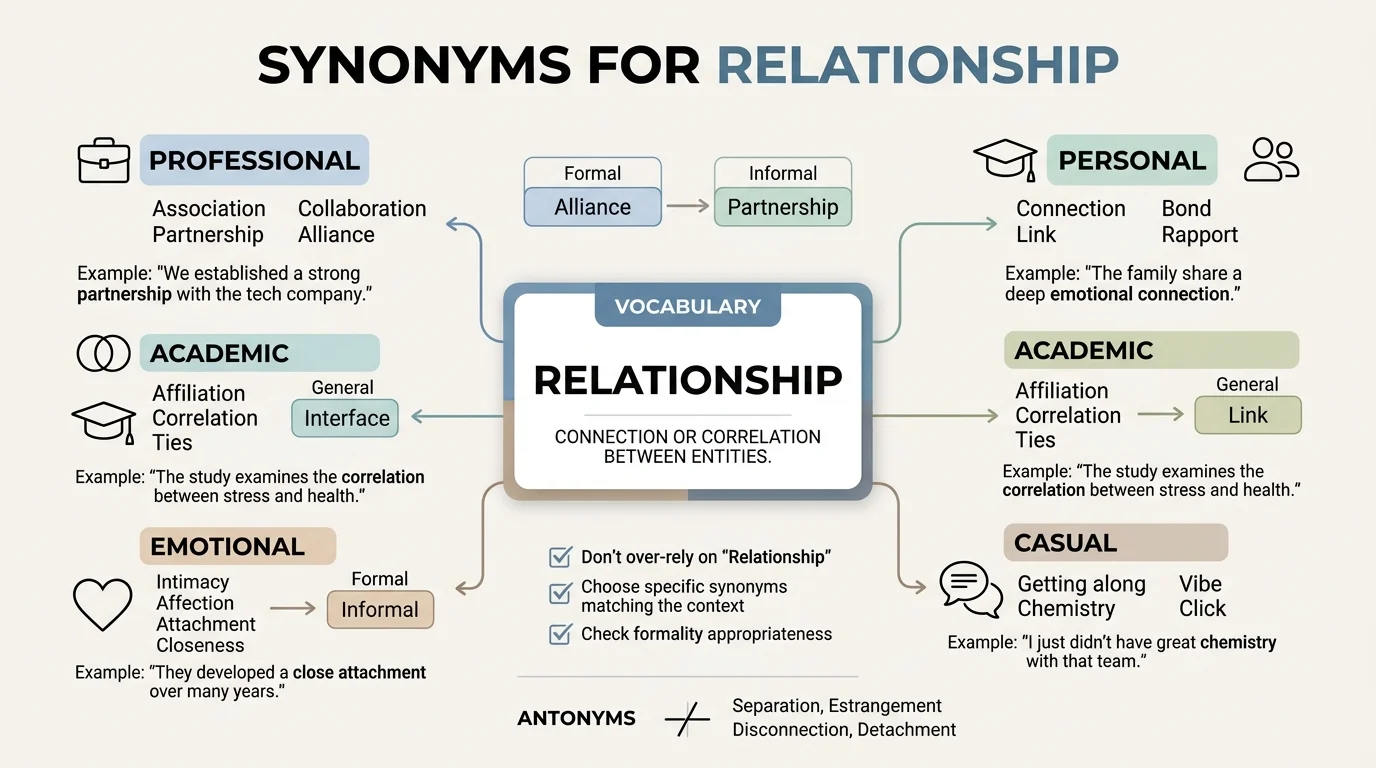
A relationship is the way two or more people, groups, or things are connected or behave toward one another. The best synonym depends on your context. Formal writing favors “association” or “connection.” Casual conversation uses “bond” or “tie.” Professional settings prefer “partnership” or “alliance.” Emotional contexts call for “attachment” or “affection.”
Meaning, Tone and Context
Simple Definition
A relationship refers to the state of being connected or associated with someone or something. This connection can be personal, professional, emotional, or logical.
Part of Speech
Relationship is a noun. It is a countable noun in most uses.
Tone
Relationship has a neutral tone on its own. The tone shifts based on the adjectives and context around it. It can be warm, clinical, positive, or negative depending on how you use it.
Formality Level
This word is moderately formal. It works in professional emails and casual conversations equally well. However, using it too often in casual speech can sound stiff. Using it in academic writing is appropriate but may require more precise alternatives.
Common Use Cases
You use relationship to describe family connections, romantic partnerships, professional collaborations, causal links between events, and business associations. It is one of the most versatile words in English.
Important Word Forms
The adjective form is “relational,” which describes things related to relationships. The verb “relate” and noun “relation” are closely connected forms.
When and How to Use “Relationship”
You should use relationship when describing how two or more entities interact. It works well as a general term. Use it when the specific nature of the connection is not the main focus. It is also appropriate when you want to emphasize mutual interaction rather than a one way connection.
Professional Example
“Our professional relationship has grown stronger through years of collaboration on complex projects.”
Personal Example
“She values her relationship with her grandmother more than anything else in the world.”
Academic Example
“The study examined the relationship between sleep quality and academic performance in college students.”
Emotional Example
“Building a healthy relationship requires trust, patience, and honest communication.”
Social Media Caption
“Celebrating five years of this beautiful relationship and all the memories we have created together.”
Resume Example
“Managed client relationships and increased customer retention by 25 percent over two years.”
Creative Writing Example
“The relationship between the two characters evolved slowly, revealing hidden depths with each interaction.”
Another Word for “Relationship”
Choosing the right alternative requires understanding what kind of connection you want to describe. Here are the best single replacements organized by context.
Professional Writing
Use “partnership” for business collaborations. Use “alliance” for strategic agreements. “association” for formal memberships.
Academic Writing
Use “correlation” for statistical connections. “interdependence” for mutual reliance. Use “linkage” for causal relationships.
Casual Conversation
Use “bond” for personal connections. “tie” for family connections. Use “connection” for general interactions.
Emotional Writing
“attachment” for deep emotional bonds. Use “affection” for warm feelings. Use “intimacy” for close personal connections.
Creative Writing
Use “dynamic” for ongoing interactions. Use “chemistry” for natural compatibility. “fusion” for blended connections.
Resume or Workplace Use
Use “partnership” for collaborative work. “collaboration” for joint efforts. Use “rapport” for positive working connections.
Social Media Captions
Use “vibe” for casual interactions. Use “connection” for meaningful bonds. “dynamic” for relationship energy.
Stronger Meaning
Use “entanglement” for complicated connections. Use “dependency” for reliant bonds. “obsession” for unhealthy attachments.
Softer Meaning
Use “acquaintance” for casual contacts. “familiarity” for comfortable connections. Use “association” for loose ties.
When Not to Use “Relationship”
Relationship sounds too vague when you need to specify the exact nature of a connection. It also becomes weak when you overuse it.
Too Vague Example
Weak: “We have a good relationship with our suppliers.”
Better: “We have a strong partnership with our suppliers.”
Too Casual for Formal Writing
Weak: “The relationship between the two variables needs examination.”
Better: “The correlation between the two variables requires statistical analysis.”
Too Formal for Casual Conversation
Weak: “I have a great relationship with my dog.”
Better: “I have a great bond with my dog.”
Too General for Emotional Depth
Weak: “Their relationship was special.”
Better: “Their connection was special.”
Too Weak for Professional Impact
Weak: “I maintained relationships with clients.”
Better: “I cultivated strong partnerships with clients.”
Words Commonly Confused With “Relationship”
Several words often get mixed up with relationship. Each has a distinct meaning.
Relationship vs. Relation
Relation refers to a single connection or a family member. Relationship describes the entire dynamic between entities. “Relation” is more technical and less personal.
Relationship vs. Association
Association implies a looser connection, often based on shared interests. Relationship suggests a deeper or more structured connection.
Relationship vs. Partnership
Partnership specifically involves joint effort toward shared goals. Relationship is more general. Partnership is always more active.
Relationship vs. Bond
Bond emphasizes emotional attachment and loyalty. Relationship is broader and can include purely professional connections.
Relationship vs. Connection
Connection is more abstract and can refer to ideas or feelings. Relationship implies an ongoing interaction between entities.
Relationship vs. Affiliation
Affiliation refers to being officially attached to an organization. Relationship is more personal and less institutional.
Best Synonym by Context for “Relationship”
| Context | Best Synonym | Why It Works | Example |
|---|---|---|---|
| Formal Writing | Association | It sounds professional and precise without emotional overtones | The association between economic growth and education is well documented |
| Academic Writing | Correlation | It implies a measurable, statistical connection between variables | Researchers found a positive correlation between exercise and mental health |
| Professional Business | Partnership | It suggests active collaboration and mutual investment | We formed a strategic partnership to expand into new markets |
| Resume Writing | Collaboration | It emphasizes teamwork and active contribution | Led cross functional collaboration on product development initiatives |
| Casual Conversation | Connection | It feels natural and conversational without being stiff | We have a great connection that makes everything easy |
| Creative Writing | Dynamic | It captures the evolving, interactive nature of relationships | The dynamic between the siblings drove the entire novel |
| Emotional Tone | Bond | It conveys warmth, trust, and deep personal attachment | Their bond grew stronger through years of shared experiences |
| Strong Intensity | Entanglement | It suggests complexity, difficulty, or intense involvement | The emotional entanglement between them became impossible to ignore |
| Soft Moderate Tone | Acquaintance | It suggests a light, familiar connection without intensity | They maintained a casual acquaintance through mutual friends |
| Social Media Captions | Vibe | It feels modern, casual, and captures the energy of a connection | The vibe between them is absolutely electric |
| US Usage | Connection | Americans prefer this word for personal and professional ties | Building connections is essential for career growth |
| UK Usage | Association | British English uses this more frequently in formal contexts | Their association dates back to university days |
Which Synonym Should You Choose?
Your choice depends on several key factors. Consider what you want to emphasize.
Think About Meaning
Ask yourself what kind of connection you are describing. Is it emotional, professional, statistical, or casual? Choose a synonym that matches your specific meaning.
Evaluate Formality
Match your word to your audience. “association” for formal reports. Use “bond” for personal conversations. Use “partnership” for business settings.
Consider Emotional Intensity
Some synonyms carry strong emotions. “Attachment” suggests deep feeling. “Affiliation” suggests no emotion at all. Pick the intensity level that fits your message.
Assess Professional Value
If you want to impress in a professional setting, use “partnership” or “collaboration.” These words suggest active value creation.
Look at Your Sentence Structure
Sometimes a synonym works simply because it sounds better in your specific sentence. Read alternatives aloud to hear how they flow.
Real Life Examples of “Relationship” in Sentences
School Context
“The relationship between classroom engagement and student achievement is well established in educational research.”
Workplace Context
“She excelled at building client relationships that generated repeat business and positive referrals.”
Writing Context
“The novel explores the relationship between identity and memory through its complex narrative structure.”
Conversation Context
“I really value the relationship we have built over these last few years of working together.”
Social Media Context
“Sharing this moment with you makes me appreciate our relationship even more.”
Resume Context
“Developed and maintained strategic relationships with key stakeholders across multiple departments.”
Email Context
“I appreciate the professional relationship we have established and look forward to future collaboration.”
Storytelling Context
“The relationship between the two friends weathered every storm life threw at them.”
15 Synonyms for “Relationship”
| Synonym | Simple Meaning | Best Used For | Example Sentence |
|---|---|---|---|
| Bond | A strong emotional connection | Personal, family, or close friendships | The bond between mother and child is one of life’s strongest forces |
| Connection | A general link between people or things | Casual, professional, or intellectual ties | She felt an immediate connection with her new team members |
| Partnership | A collaborative relationship with shared goals | Business, professional, or joint ventures | Their partnership produced some of the most innovative products in the industry |
| Association | A formal or official connection | Professional organizations, memberships, or institutions | His association with the university spanned over thirty years |
| Alliance | A strategic union for mutual benefit | Business deals, political agreements, or military cooperation | The alliance between the two companies disrupted the entire market |
| Affiliation | Official membership or connection to an organization | Professional memberships, academic institutions, or political parties | Her affiliation with the research institute gave her access to valuable resources |
| Correlation | A statistical or logical connection between variables | Academic research, data analysis, or scientific studies | The correlation between diet and heart health continues to gain scientific support |
| Interdependence | Mutual reliance between connected entities | Systems, economies, or complex organizations | The interdependence of global supply chains became clear during the crisis |
| Rapport | Positive, harmonious relationship with mutual understanding | Professional interactions, customer service, or teamwork | He built excellent rapport with clients through active listening and empathy |
| Dynamic | The interactive, evolving quality of a relationship | Creative writing, psychology, or interpersonal analysis | The dynamic between teacher and student can shape learning outcomes significantly |
| Attachment | An emotional bond with strong feelings of connection | Personal relationships, psychological contexts, or emotional writing | Her attachment to her childhood home influenced every decision she made |
| Affection | Warm feelings of fondness and care | Personal letters, emotional conversations, or romantic contexts | Their affection for each other was evident in every small gesture |
| Tie | A connection linking people or groups | Family bonds, social connections, or business links | Family ties kept them connected despite the geographic distance between them |
| Liaison | A communication or cooperation link between groups | Professional contexts, diplomatic work, or interdepartmental projects | She served as the liaison between the marketing and product development teams |
| Intersection | A point where things meet or overlap | Academic writing, creative description, or conceptual analysis | The intersection of art and technology created entirely new forms of expression |
Synonym Groups and Usage Differences
Professional vs. Personal Synonyms
Professional synonyms emphasize structure, goals, and mutual benefit. Partnership, alliance, and collaboration all suggest working together toward shared outcomes. These words sound confident and proactive.
Personal synonyms emphasize emotion, trust, and human connection. Bond, attachment, and affection all suggest deep feelings and care. These words create warmth and intimacy in your writing.
Formal vs. Conversational Synonyms
Formal synonyms work in reports, essays, speeches, and official documents. Association, affiliation, and correlation sound precise and academic. They avoid emotional coloring and stay neutral.
Conversational synonyms fit casual writing, texts, emails, and everyday speech. Connection and vibe sound natural and approachable. Bond feels warm without being overly formal.
Academic Synonyms
Academic writing demands precision and clarity. Correlation describes measurable statistical relationships. Interdependence captures complex mutual reliance. Intersection helps describe overlapping concepts. These words help you sound scholarly and exact.
Professional and Business Synonyms
Business contexts reward active, results oriented language. Partnership suggests joint effort and shared success. Alliance implies strategic advantage. Collaboration emphasizes teamwork and contribution. These words make you sound like a valuable professional.
Creative or Literary Synonyms
Creative writing benefits from descriptive language. Dynamic captures movement and evolution in relationships. Intersection suggests meeting points between ideas. Fusion implies blending and creation. These words add imagery and depth to your writing.
Slang or Modern Synonyms
Modern language sometimes uses “vibe” to describe the energy of a relationship. This word works well in social media captions and casual conversation. It does not work in professional or academic writing. Save it for relaxed contexts.
Strongest vs. Weaker Synonyms
Intensity Scale from Mild to Strongest
Mild: Acquaintance, association, connection
Moderate: Partnership, collaboration, alliance
Strong: Bond, attachment, affinity
Strongest: Entanglement, fusion, symbiosis
Emotional vs. Neutral Synonyms
Emotional Synonyms
Bond, attachment, affection, affinity, intimacy. These words carry feeling and warmth. Use them when you want to express care or emotional connection.
Neutral Synonyms
Association, correlation, relation, linkage, connection. These words stay factual and objective. Use them in reports, research, and professional documents.
Antonyms of “Relationship”
| Antonym | Meaning | Example Sentence |
|---|---|---|
| Disconnection | A state of being separated or not linked | The disconnection between their goals led to the project’s failure |
| Separation | The act of being apart or divided | Separation from her colleagues made collaboration impossible |
| Alienation | A feeling of being estranged or isolated | His alienation from the team became apparent during meetings |
| Isolation | Being alone or cut off from others | The isolation of the department hurt overall company performance |
| Division | A split or separation between groups | Division among team members prevented progress on the initiative |
| Independence | Self reliance without connection to others | Her independence from corporate influence allowed creative freedom |
| Autonomy | Self governance without external control | The branch office maintained autonomy from headquarters |
| Rift | A serious break in a relationship | The rift between partners made continuing the project impossible |
| Schism | A strong division or split | The schism in the organization created two opposing factions |
| Detachment | Emotional distance or lack of involvement | His detachment from the team affected productivity |
| Apathy | Lack of interest or concern | Apathy among employees replaced the previous enthusiasm |
| Dissociation | A disconnect in mental processes | His dissociation from the group became a professional liability |
| Disunion | A state of being divided | Disunion among the board members prevented any decisions |
| Variance | A difference that creates separation | Variance in values caused friction between the departments |
| Opposition | Active resistance or contrary position | Opposition between the two departments blocked innovation |
Comparison: Relationship vs. Similar Words
Relationship vs. Connection
The main difference is breadth. Relationship describes an ongoing, interactive connection. Connection is broader and can refer to instant recognition, shared interests, or even electronic links.
Connection is more informal and abstract. Relationship is more structured and implies an established pattern of interaction.
Relationship example: “Their relationship developed over years of working together.”
Connection example: “She felt an immediate connection with the new colleague.”
Relationship vs. Partnership
The key difference is purpose. Partnership specifically involves working together toward shared goals. Relationship is more general and does not require shared objectives.
Partnership is always active and collaborative. Relationship can be passive or observational.
Partnership example: “The partnership produced record sales this quarter.”
Relationship example: “The relationship between supply and demand determines prices.”
Relationship vs. Bond
The main difference is emotional strength. Bond emphasizes strong emotional attachment and loyalty. Relationship can be purely professional or casual.
Bond is more intimate and personal. Relationship is more neutral and flexible.
Bond example: “The bond between childhood friends never fades.”
Relationship example: “The relationship between the two companies improved after the merger.”
Relationship vs. Association
The distinction is formality. Association suggests a formal, sometimes official connection. Relationship covers both formal and informal ties.
Association often implies membership or affiliation. Relationship covers all types of interactions.
Association example: “His association with the professional organization gave him valuable contacts.”
Relationship example: “Her relationship with clients built the business’s reputation.”
Relationship vs. Affiliation
Affiliation means official membership or connection to an organization or group. Relationship is broader and includes personal ties.
Affiliation is always institutional. Relationship can be completely personal.
Affiliation example: “Her affiliation with the university opened research opportunities.”
Relationship example: “Their relationship improved after honest conversation.”
Relationship vs. Correlation
Correlation is purely statistical. It describes a measurable relationship between variables. Relationship can include statistics but also covers human interactions.
Correlation is always objective and numerical. Relationship can be subjective.
Correlation example: “Researchers found a correlation between income and education levels.”
Relationship example: “The relationship between teacher and student affected learning outcomes.”
Common Phrases and Expressions with “Relationship”
1. Working Relationship
Meaning: A professional connection focused on achieving work related goals.
Example sentence: We maintained a strong working relationship throughout the project.
2. Relationship Goals
Meaning: Aspirations for an ideal romantic or personal relationship.
Example sentence: Their mutual support and kindness set relationship goals for everyone.
3. Love Hate Relationship
Meaning: A connection with both positive and negative feelings.
Example sentence: She had a love hate relationship with her hometown.
4. In a Relationship
Meaning: Romantically involved with someone.
Example sentence: He updated his social media profile to show he was in a relationship.
5. Build a Relationship
Meaning: Develop a connection over time through interaction.
Example sentence: Building a relationship with clients takes patience and consistency.
6. Relationship Status
Meaning: A person’s current situation regarding romantic partnerships.
Example sentence: She kept her relationship status private on all platforms.
7. Power Relationship
Meaning: A connection defined by differences in authority or influence.
Example sentence: The power relationship between manager and employee affects team dynamics.
8. Cause and Effect Relationship
Meaning: A logical connection where one thing produces another.
Example sentence: The study proved a cause and effect relationship between exercise and health.
Common Mistakes to Avoid
1. Using Relationship When a More Precise Synonym Works Better
Weak: “We have a relationship with our suppliers.”
Strong: “We have a partnership with our suppliers.”
The second sentence sounds more active and valuable.
2. Confusing Relationship with Relation
Incorrect: “I have a good relation with my boss.”
Correct: “I have a good relationship with my boss.”
Relation refers to family members or technical connections.
3. Using a Casual Synonym in Formal Writing
Weak: “The vibe between the variables was clear.”
Strong: “The correlation between the variables was clear.”
Vibe is too informal for academic or professional contexts.
4. Using an Overly Dramatic Synonym for a Simple Situation
Weak: “I have a symbiotic entanglement with my coffee shop.”
Better: “I have a strong connection with my coffee shop.”
Dramatic synonyms sound out of place in everyday conversation.
5. Repeating the Same Word Too Often
Weak: “The relationship improved. The relationship strengthened. The relationship evolved.”
Strong: “The partnership improved. The bond strengthened. The connection evolved.”
Variety makes your writing more engaging.
6. Choosing a Synonym with the Wrong Emotional Tone
Weak: “I feel affiliation toward my children.”
Better: “I feel attachment toward my children.”
Affiliation sounds cold and organizational. Attachment sounds warm and caring.
7. Using Slang in Academic or Professional Writing
Weak: “The vibe between the variables showed strong correlation.”
Better: “The connection between the variables showed strong correlation.”
Save slang for casual situations only.
FAQs
1. What is the best synonym for relationship?
The best synonym depends on context. Partnership works well professionally. Bond works best personally. Correlation suits academic contexts.
2. What is a formal synonym for relationship?
Association serves as the most appropriate formal synonym. Affiliation and correlation also work in formal academic and professional settings.
3. What is an informal synonym for relationship?
Connection fits most informal situations well. Bond works for personal contexts. Vibe works for social media and casual conversation.
4. What is another word for relationship in professional writing?
Partnership and collaboration are excellent professional alternatives. They suggest active cooperation and shared goals in workplace contexts.
5. What is the difference between relationship and relation?
Relationship describes an ongoing interaction between entities. Relation refers to a specific connection or a family member in common usage.
6. What is the opposite of relationship?
Disconnection serves as the clearest opposite. Separation, isolation, and alienation also represent the absence of relationship.
Conclusion
Relationship remains a valuable word in your vocabulary. It describes countless connections in life. But using it too often weakens your writing. The right synonym can transform your communication.
Consider your context carefully. Choose partnership for business success. Pick bond for personal warmth. Use correlation for academic precision. Match your word to your situation.
The best vocabulary tip is to vary your language. Keep a list of synonyms for relationship handy. Practice using them in different contexts. Your writing will become more engaging and precise.
Remember that definition sources should be verified using trusted dictionaries such as Cambridge, Oxford, Merriam Webster, Collins, or Britannica before publication. Accuracy matters in professional communication.