Resilience is one of those words that gets used a lot in psychology, business, sports, and everyday conversation. But sometimes you need a different word.
Maybe you’re tired of repeating “resilience.” Maybe you’re writing and want more precision. Or maybe you’re looking for a word that fits a specific tone or context.
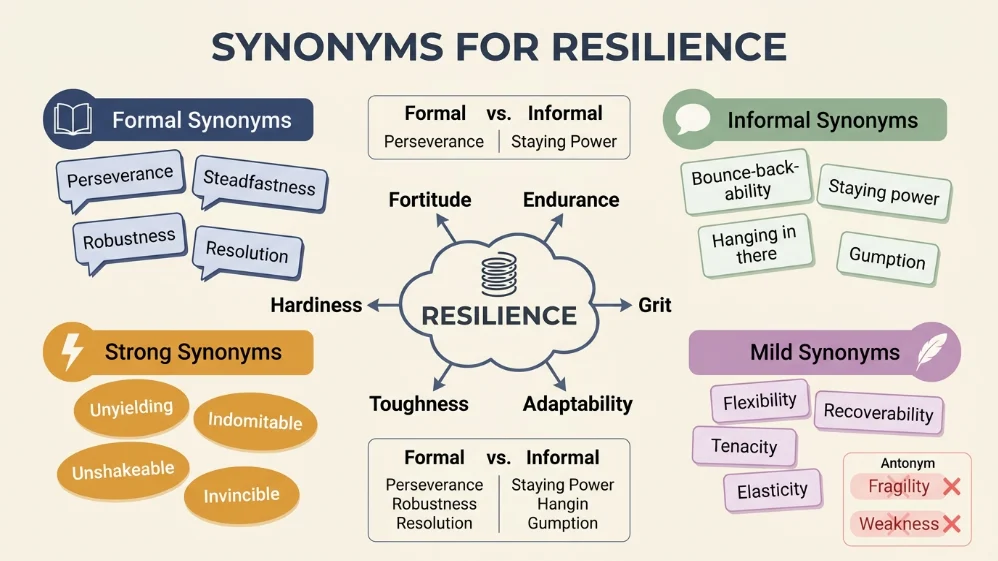
The best synonyms for resilience are fortitude, endurance, grit, and adaptability. The right choice depends on what you’re describing mental strength, physical toughness, emotional recovery, or the ability to bend without breaking.
This guide gives you a complete toolkit of synonyms for resilience. You’ll find formal and informal options, strong and mild alternatives, example sentences, and practical advice for choosing the right word every time.
Best Synonyms for Resilience
The best synonyms for resilience are fortitude, endurance, grit, and adaptability. Choose fortitude for formal writing about courage under hardship. Select endurance when you want to emphasize lasting through a long challenge.
Choose grit for a modern, conversational tone about determination. Choose adaptability when the focus is on adjusting to change rather than just surviving it.
What Does Resilience Mean?
Resilience is the ability to recover quickly from difficulties, setbacks, or adversity. It’s the capacity to bounce back after something bad happens and return to a healthy, strong, or successful state. The word comes from the Latin resiliens, meaning “to rebound” or “recoil.”
Resilience can describe people, communities, systems, or even materials. A resilient person handles stress without falling apart. Resilient community rebuilds after a disaster. A resilient economy absorbs shocks and keeps functioning. And a resilient material springs back to its original shape after being stretched or compressed.
Example sentences:
- The community showed remarkable resilience after the hurricane.
- Her resilience through years of treatment inspired everyone around her.
Core Meaning of Resilience
At its heart, resilience is about recovery and strength in the face of difficulty. It’s not about avoiding problems or pretending they don’t exist. It’s about facing them, adapting, and coming out the other side not unchanged, but not broken either.
Resilience involves several key elements:
- Bouncing back returning to a previous state of functioning after stress
- Adapting adjusting to new or difficult circumstances
- Enduring continuing despite hardship or pain
- Growing sometimes becoming stronger through the process
The American Psychological Association defines resilience as “the process and outcome of successfully adapting to difficult or challenging life experiences, especially through mental, emotional, and behavioral flexibility.” This definition captures something important: resilience isn’t a fixed trait you either have or don’t have. It’s a process that can be developed.
Grammar and Usage Notes
Part of speech: Resilience is a noun. The adjective form is resilient. The adverb is resiliently.
Pronunciation: /rɪˈzɪliəns/ stress the second syllable: rih-ZIL-yuns.
Common patterns:
- show resilience “She showed great resilience.”
- demonstrate resilience “The team demonstrated resilience under pressure.”
- build resilience “Exercise can help build resilience.”
- resilience to “Her resilience to stress is remarkable.”
- resilience in “They showed resilience in the face of adversity.”
Important usage note: Resilience is an uncountable noun. It does not have a plural form. Don’t say “resiliences.” Say “resilience.” Also, avoid saying “a resilience” it’s “great resilience” or “remarkable resilience,” not “a great resilience.”
When resilience sounds natural:
- Describing how someone handles trauma, loss, or failure
- Talking about recovery after illness or injury
- Discussing community or organizational recovery after crisis
- Writing about mental health, personal development, or leadership
- Describing physical materials that spring back
When a synonym may work better:
- If you want a more formal word → fortitude
- If you want to emphasize long-term persistence → endurance
- If you want a conversational, modern feel → grit
- If the focus is on bending without breaking → flexibility or elasticity
- If you want to describe emotional recovery → buoyancy
Best Synonyms for Resilience
| Synonym | Meaning | Tone | Best Use Case | Example Sentence |
| Fortitude | Courage and strength in pain or adversity | Formal | Academic writing, essays, speeches | “She faced the diagnosis with quiet fortitude.” |
| Endurance | Ability to withstand hardship over time | Formal/Neutral | Sports, long-term challenges, physical feats | “The marathon tested his physical endurance.” |
| Grit | Courage and resolve; determined persistence | Informal/Modern | Conversational writing, motivational content | “It took grit to start over from nothing.” |
| Adaptability | Ability to adjust to new conditions | Neutral | Business, workplace, change management | “Her adaptability made her valuable during the merger.” |
| Toughness | Ability to endure hardship; strength | Neutral/Informal | Everyday conversation, sports | “Mental toughness is what separates good athletes from great ones.” |
| Hardiness | Robust strength under difficult conditions | Formal/Neutral | Psychology, biology, outdoor contexts | “The plant’s hardiness allowed it to survive the frost.” |
| Elasticity | Ability to return to original shape or state | Technical/Formal | Physics, economics, technical writing | “The elasticity of the economy surprised the analysts.” |
| Buoyancy | Ability to recover emotionally; cheerfulness after difficulty | Literary/Neutral | Emotional descriptions, creative writing | “His natural buoyancy lifted the spirits of everyone around him.” |
| Perseverance | Continued effort despite difficulty | Formal/Neutral | Achievement, education, goal-setting | “Her perseverance through years of training finally paid off.” |
| Strength | Quality of being emotionally or physically powerful | Neutral | General use, everyday conversation | “He drew on inner strength he didn’t know he had.” |
| Bounce-back ability | Capacity to recover quickly | Informal | Casual conversation, everyday speech | “His bounce-back ability after setbacks is impressive.” |
| Mettle | Strength of character; courage and determination | Formal/Literary | Character descriptions, narratives | “The crisis revealed his true mettle.” |
Common Synonyms for Resilience
These are the everyday synonyms you’ll hear in normal conversation and writing. They’re versatile, widely understood, and work in most contexts.
Toughness
Meaning: The ability to endure hardship or difficulty. It can describe physical or mental strength.
Best context: Sports, parenting, everyday challenges, and any situation where someone handles pressure without breaking.
Example sentence: “The coach admired the team’s toughness after they played through injuries.”
Strength
Meaning: The quality of being emotionally or physically powerful. It’s a broad, positive word that works in almost any context.
Best context: General use describing people, communities, organizations, or even arguments.
Example sentence: “She found strength in her friends and family during the difficult time.”
Flexibility
Meaning: The ability to adapt to change or bend without breaking.
Best context: Workplaces, relationships, and any situation requiring adjustment to new circumstances.
Example sentence: “Flexibility is essential when you’re working in a startup environment.”
Endurance
Meaning: The capacity to keep going over a long period, especially through hardship.
Best context: Physical challenges, long-term projects, and situations that test stamina.
Example sentence: “Building a business requires more endurance than most people realize.”
Formal Synonyms for Resilience
When you’re writing for academic audiences, business reports, or professional publications, these formal alternatives will serve you well.
Fortitude
Fortitude is courage in the face of pain or adversity. It’s a dignified, slightly old-fashioned word that carries weight. Use it in essays, speeches, and formal writing when you want to emphasize moral or emotional strength.
Example sentence: “The soldiers displayed remarkable fortitude under enemy fire.”
Hardiness
Hardiness describes robust strength that can withstand harsh conditions. In psychology, it refers to a personality trait that helps people handle stress. In biology, it describes plants or animals that survive difficult environments.
Example sentence: “Psychological hardiness is a key factor in preventing burnout among healthcare workers.”
Perseverance
Perseverance is steady, continued effort despite difficulty or delay in achieving success. It emphasizes the ongoing nature of the struggle.
Example sentence: “His perseverance in the face of repeated rejections eventually led to a breakthrough.”
Mettle
Mettle is strength of character the inner quality that allows someone to face difficulty with courage. It’s often used in phrases like “prove one’s mettle” or “show one’s mettle.”
Example sentence: “The challenging project gave her a chance to prove her mettle.”
Equanimity
Equanimity is mental calmness and composure under stress. It’s about staying level-headed when things go wrong.
Example sentence: “She handled the crisis with remarkable equanimity, never raising her voice or losing focus.”
Durability
Durability is the ability to last and withstand wear, pressure, or damage. It’s often used for physical objects but can describe systems or relationships too.
Example sentence: “The durability of the building’s design was tested by the earthquake.”
Informal Synonyms for Resilience
These casual alternatives are perfect for conversation, social media, friendly writing, and personal messages. They’re less formal but more vivid and relatable.
Grit
Grit is courage and resolve a determined, stubborn persistence that doesn’t give up easily. It’s become very popular in modern self-help and motivational language.
Best context: Inspirational posts, personal stories, and casual conversation about overcoming obstacles.
Example sentence: “Getting through that year took a lot of grit.
Bounce-back ability (or bouncebackability)
This playful, informal term means exactly what it sounds like the ability to bounce back quickly from setbacks.
Best context: Sports commentary, casual conversation, and lighthearted writing.
Example sentence: “His bounce-back ability after losing the first set was incredible.”
Spine
Spine means courage and firmness the inner strength to stand up for yourself or endure difficulty.
Best context: Describing someone who doesn’t back down or give in.
Example sentence: “You have to have spine to survive in this industry.”
Pluck
Pluck is spirited courage and determination. It’s a slightly old-fashioned but charming word for someone who faces difficulty with energy and positivity.
Best context: Character descriptions, storytelling, and affectionate praise.
Example sentence: “The young boxer had more pluck than anyone expected.”
Moxie
Moxie is bold determination and nerve. It’s an American slang term that suggests not just courage but a certain feisty, can-do attitude.
Best context: Informal praise, motivational talk, and describing someone with attitude.
Example sentence: “You’ve got to have moxie to start a business at twenty-two.”
Guts
Guts is courage and resolve the willingness to take risks or face difficulty without backing down.
Best context: Very informal conversation. Use with friends or in casual writing.
Example sentence: “It took guts to quit her job and travel the world.”
Strong Synonyms for Resilience
These words carry more emotional weight, power, or intensity. Use them when you want to emphasize exceptional strength or when the stakes are high.
Fortitude
As mentioned above, fortitude suggests courage and strength in the face of significant pain or adversity. It’s a powerful word that commands respect.
When to use: When the difficulty is severe illness, loss, trauma, or great danger.
When it’s too strong: For everyday inconveniences or minor setbacks.
Grit
Grit implies a raw, stubborn determination that refuses to quit. It suggests not just surviving but pushing forward with intensity.
When to use: When describing someone who overcomes repeated obstacles through sheer willpower.
When it’s too strong: For situations that don’t require significant struggle.
Indomitability
Indomitability means an unconquerable spirit the quality of being impossible to defeat or subdue. This is a very strong word, almost poetic.
When to use: Epic struggles, historical figures, or describing someone who overcomes seemingly impossible odds.
When it’s too strong: Most everyday situations. Save this for extraordinary circumstances.
Invincibility
Invincibility is the apparent inability to be defeated. It suggests an almost superhuman level of resilience.
When to use: Sports champions, legendary figures, or metaphorical descriptions of someone who never seems to fail.
When it’s too strong: Realistic descriptions of people. Nobody is truly invincible.
Iron will
Iron will is a phrase, not a single word, but it’s worth including. It means an unbreakable determination.
When to use: Describing someone who refuses to give up no matter what.
When it’s too strong: Describing everyday decisions or minor challenges.
Mild Synonyms for Resilience
Sometimes you need a softer, more neutral word. These alternatives are gentler and less dramatic than the strong synonyms.
Adaptability
Adaptability is the ability to adjust to new conditions. It’s about changing rather than fighting. This is a calm, professional word that doesn’t carry the emotional weight of “grit” or “fortitude.”
When to use: Workplaces, change management, and any situation where adjustment is more important than struggle.
Flexibility
Flexibility is similar to adaptability but often implies a willingness to change plans or approaches. It suggests bending rather than breaking.
When to use: Relationships, teamwork, and situations that require compromise.
Composure
Composure is calmness and self-control under pressure. It’s about staying cool rather than fighting hard.
When to use: Describing someone who remains calm in a crisis.
Poise
Poise is graceful self-control and composure. It adds an element of elegance or dignity to the idea of staying calm.
When to use: Formal settings, public speaking, and descriptions of people who handle pressure gracefully.
Stability
Stability is the ability to remain steady and unchanged despite external pressures. It’s about not being shaken.
When to use: Describing systems, economies, relationships, or personalities that stay consistent.
Coping ability
Coping ability is the capacity to manage difficulties. It’s a practical, low-key term used in psychology and everyday conversation.
When to use: Discussing mental health, stress management, and everyday problem-solving.
Synonyms for Resilience by Context
The best synonym depends on what you’re writing about and who you’re writing for. Here’s how to choose based on context.
Everyday Conversation
In casual conversation, keep it simple. Toughness, strength, and grit work well. If you want something more colorful, try spine or pluck.
- “She’s got a lot of toughness.”
- “It takes grit to get through something like that.”
- “He showed real strength during the divorce.”
Professional Writing
In business and professional contexts, choose words that sound capable and composed. Adaptability, flexibility, durability, and resilience itself are all excellent choices.
- “The company’s adaptability allowed it to pivot quickly.”
- “Our team’s flexibility was key to meeting the deadline.”
- “The durability of the supply chain was tested by the disruption.”
Academic Writing
Academic audiences expect precision and formality. Fortitude, endurance, perseverance, hardiness, and equanimity are all appropriate.
- “The study examined the role of psychological hardiness in stress reduction.”
- “Participants demonstrated remarkable perseverance in completing the task.”
- “Equanimity was measured as a predictor of coping success.”
Creative Writing
Creative writing gives you the most freedom. Use vivid, evocative words like buoyancy, mettle, indomitability, and spring.
- “Her buoyancy was contagious, lifting everyone around her.”
- “The crisis revealed his true mettle.”
- “There was an indomitability about her that no setback could touch.”
Marketing Copy
Marketing and branding require words that inspire and connect. Grit, strength, toughness, and bounce-back ability all work well.
- “Built with grit for people who never quit.”
- “Strength you can count on when it matters most.”
- “Bounce-back ability that sets you apart.”
Emotional Expression
When you’re talking about feelings, recovery, and personal growth, choose words that capture the emotional journey. Buoyancy, recovery, inner strength, and emotional strength are all good options.
- “His emotional strength carried him through the darkest months.”
- “She found a quiet buoyancy that surprised even her.”
- “Recovery wasn’t quick, but it was real.”
Technical Writing
In technical fields engineering, materials science, ecology precision matters. Elasticity, durability, robustness, and damage tolerance are the right choices.
- “The elasticity of the polymer allows it to stretch and return.”
- “Robustness testing ensures the system can handle unexpected inputs.”
- “The material’s damage tolerance makes it suitable for aerospace applications.”
Another Word for Resilience in a Sentence
Here are 15 natural example sentences using different synonyms for resilience. Notice how the word choice changes the tone and emphasis.
- Fortitude: “She faced the long illness with quiet fortitude that inspired her whole family.”
- Endurance: “Polar explorers need incredible physical and mental endurance.”
- Grit: “He didn’t have talent, but he had grit and that was enough.”
- Adaptability: “The startup’s adaptability was its greatest asset during the economic downturn.”
- Toughness: “Mental toughness is what separates good athletes from great ones.”
- Hardiness: “The plant’s hardiness made it perfect for the harsh desert climate.”
- Elasticity: “The elasticity of the economy surprised the central bankers.”
- Buoyancy: “His natural buoyancy helped the team stay positive through the hard times.”
- Perseverance: “Her perseverance through years of rejection finally led to a book deal.”
- Strength: “He drew on inner strength he didn’t know he had.”
- Mettle: “The challenging assignment gave her a chance to show her mettle.”
- Equanimity: “She handled the stressful meeting with remarkable equanimity.”
- Pluck: “The young musician had more pluck than anyone gave her credit for.”
- Spine: “You need spine to stand up to that kind of pressure.”
- Indomitability: “There was an indomitability about the old woman that no one could explain.”
Resilience Synonyms Compared
Some synonyms for resilience are very close in meaning, but they’re not identical. Here’s how to tell them apart.
| Synonym | Core Meaning | Tone | Key Difference |
| Fortitude | Courage in pain or adversity | Formal | Emphasizes facing difficulty with courage |
| Endurance | Withstanding hardship over time | Formal | Emphasizes lasting through difficulty |
| Grit | Determined persistence | Informal | Emphasizes stubborn refusal to quit |
| Adaptability | Adjusting to new conditions | Neutral | Emphasizes changing rather than fighting |
| Toughness | Ability to endure hardship | Neutral | Emphasizes hardness and resistance |
| Hardiness | Robust strength under harsh conditions | Formal | Emphasizes thriving in difficult conditions |
| Elasticity | Returning to original state | Technical | Emphasizes recovery of shape or function |
| Buoyancy | Emotional recovery and cheerfulness | Literary | Emphasizes rising and staying positive |
Fortitude vs. Endurance: Fortitude is about courage in the face of pain. Endurance is about lasting through time. You show fortitude during a crisis. You show endurance over a long, grueling project.
Grit vs. Toughness: Grit implies passion and perseverance for long-term goals. Toughness is broader it can describe physical or mental resistance to any kind of pressure.
Adaptability vs. Flexibility: Adaptability is about changing to fit new circumstances. Flexibility is about being willing to change plans or approaches. They’re very similar, but adaptability often implies a deeper, more fundamental change.
Elasticity vs. Resilience: Elasticity is more technical and specific it’s about returning to an original state. Resilience can include growth, learning, and becoming stronger through the process.
Words Similar to Resilience
These words belong to the same semantic field as resilience, but they’re not always exact synonyms. They may emphasize a different aspect or only work in certain contexts.
Recovery: The process of returning to a normal state after disruption. This is more about the outcome than the ability. You show resilience; you experience recovery.
Rebound: A quick recovery after a setback. This emphasizes speed and springing back.
Robustness: The ability to withstand stress without failing. This is often used for systems and materials rather than people.
Stamina Physical or mental energy to sustain prolonged effort. This emphasizes energy and endurance rather than recovery.
Self-reliance The ability to depend on oneself. This is related but narrower it’s about independence rather than recovery.
Resourcefulness: The ability to cope cleverly and find solutions. This emphasizes creativity and problem-solving, not just endurance.
Courage: The ability to do something that frightens one. This is a component of resilience but not the whole picture.
Determination: Firmness of purpose. This is about resolve rather than recovery.
These words are useful when you want to describe a specific aspect of resilience. But they may not fully replace resilience in every sentence. For example, “resourcefulness” captures the clever problem-solving side of resilience but not the emotional recovery side.
Antonyms of Resilience
Understanding what resilience is not helps clarify what it is. Here are the most common antonyms.
| Antonym | Meaning | Example Sentence |
| Fragility | Easily broken or damaged | “The fragility of the economy was exposed by the crisis.” |
| Weakness | Lack of strength or power | “His weakness became apparent under pressure.” |
| Vulnerability | Susceptibility to harm or attack | “The vulnerability of the system was a major concern.” |
| Inflexibility | Unable to change or adapt | “Her inflexibility made it hard to work with her.” |
| Susceptibility | Likely to be affected by something | “His susceptibility to stress made the job difficult.” |
| Brittleness | Hard but easily broken | “The brittleness of the material made it unsuitable.” |
| Helplessness | Unable to defend oneself or act | “He felt a wave of helplessness as the situation worsened.” |
How to Choose the Right Synonym for Resilience
Choosing the right word isn’t complicated, but it does require some thought. Here’s a practical process.
1. Match the context. Are you writing an academic paper, a business report, a social media post, or a novel? Each context calls for a different level of formality.
2. Match the tone. Do you want to sound formal and dignified? Choose fortitude. Casual and modern? Choose grit. Professional and neutral? Choose adaptability or toughness.
3. Check the intensity. Is the situation extreme or ordinary? Use strong words like indomitability only for extreme circumstances. Use mild words like flexibility for everyday situations.
4. Think about your reader. Will they understand the word? Will it sound natural in the sentence? Don’t use a fancy word just to sound smart.
5. Check whether the synonym is exact or only related. Resourcefulness is related to resilience but not the same. Make sure the word you choose actually fits the meaning you want.
6. Keep the sentence natural. Read the sentence aloud. Does the word flow? Does it sound like something a real person would say?
7. Use simple words when clarity matters. If you’re not sure, choose a common word like strength or toughness. Clarity is more important than variety.
Common Mistakes When Using Synonyms for Resilience
Even experienced writers make these mistakes. Here’s what to watch out for.
Choosing a word with the wrong tone. Using grit in an academic paper might sound too casual. Fortitude in a text message might sound stiff and formal.
Using a synonym that is too strong. Describing someone as indomitable for handling a minor inconvenience is overkill. Save the strong words for strong situations.
Using a formal word in casual writing. Fortitude and equanimity sound out of place in a casual blog post or social media update.
Using a casual word in professional writing. Guts and pluck are too informal for most business or academic contexts.
Replacing resilience without checking meaning. Not every synonym for resilience means exactly the same thing. Elasticity is not a perfect substitute for fortitude. Make sure you understand the difference.
Treating related words as exact synonyms. Resourcefulness and self-reliance are related to resilience, but they’re not the same. Don’t use them interchangeably without checking.
Making the sentence sound unnatural. If you force a synonym into a sentence just to avoid repetition, the sentence will sound clunky. Read it aloud. If it doesn’t sound natural, choose a different word or keep the original.
Using resilience as a countable noun. Resilience is uncountable. Don’t say “resiliences” or “a resilience.”
Quick Synonym List for Resilience
Common Synonyms
- Toughness
- Strength
- Endurance
- Flexibility
- Adaptability
- Bounce-back ability
Formal Synonyms
- Fortitude
- Hardiness
- Perseverance
- Mettle
- Equanimity
- Durability
Informal Synonyms
- Grit
- Pluck
- Spine
- Guts
- Moxie
- Bouncebackability
Strong Synonyms
- Indomitability
- Invincibility
- Iron will
- Fortitude
- Grit
Mild Synonyms
- Adaptability
- Flexibility
- Composure
- Poise
- Stability
- Coping ability
Related Words
- Recovery
- Rebound
- Robustness
- Stamina
- Self-reliance
- Resourcefulness
- Courage
- Determination
FAQs
What is the best synonym for resilience?
The best synonym depends on your context. For formal writing, fortitude is excellent. For conversational writing, grit works well. Professional contexts, adaptability or toughness are safe choices. The “best” word is the one that fits your tone, audience, and meaning.
What is another word for resilience?
Common alternatives include toughness, strength, endurance, fortitude, grit, adaptability, and hardiness. Each has a slightly different shade of meaning, so choose based on what you’re trying to say.
What is a formal synonym for resilience?
Fortitude, perseverance, hardiness, and mettle are all formal synonyms. Use them in academic writing, business reports, essays, and professional communication. Fortitude is especially good for describing courage in the face of pain or adversity.
What is an informal synonym for resilience?
Grit, pluck, spine, and bounce-back ability are informal alternatives. They work well in conversation, social media, and casual writing. Grit is particularly popular in modern self-help and motivational language.
What is a stronger word for resilience?
Indomitability, invincibility, and fortitude are stronger than resilience. They suggest an almost unconquerable spirit or extraordinary courage. Use them only when the situation calls for that level of intensity.
What is a milder word for resilience?
Adaptability, flexibility, composure, and coping ability are milder alternatives. They focus on adjustment and calmness rather than struggle and recovery. These are good choices for professional or neutral contexts.
What words are similar to resilience?
Recovery, rebound, robustness, stamina, self-reliance, resourcefulness, courage, and determination are all related to resilience. However, they’re not always exact synonyms. They emphasize different aspects recovery, endurance, independence, cleverness, or resolve.
What is the opposite of resilience?
Common antonyms include fragility, weakness, vulnerability, inflexibility, and susceptibility. These words describe the inability to withstand or recover from difficulty.
How do I choose the right synonym for resilience?
Match the context, tone, and intensity. Think about your reader and whether the word sounds natural. If you’re unsure, choose a common word like strength or toughness. Clarity is more important than variety.
Conclusion
Resilience is a powerful word, but it’s not the only word. Whether you need fortitude for formal writing, grit for a conversational tone, adaptability for professional contexts, or endurance for long-term challenges, you now have a full toolkit of alternatives. The best synonym depends on your meaning, your tone, your context, and your reader. Use this guide to choose the right word every time and keep building your vocabulary and your own resilience along the way.