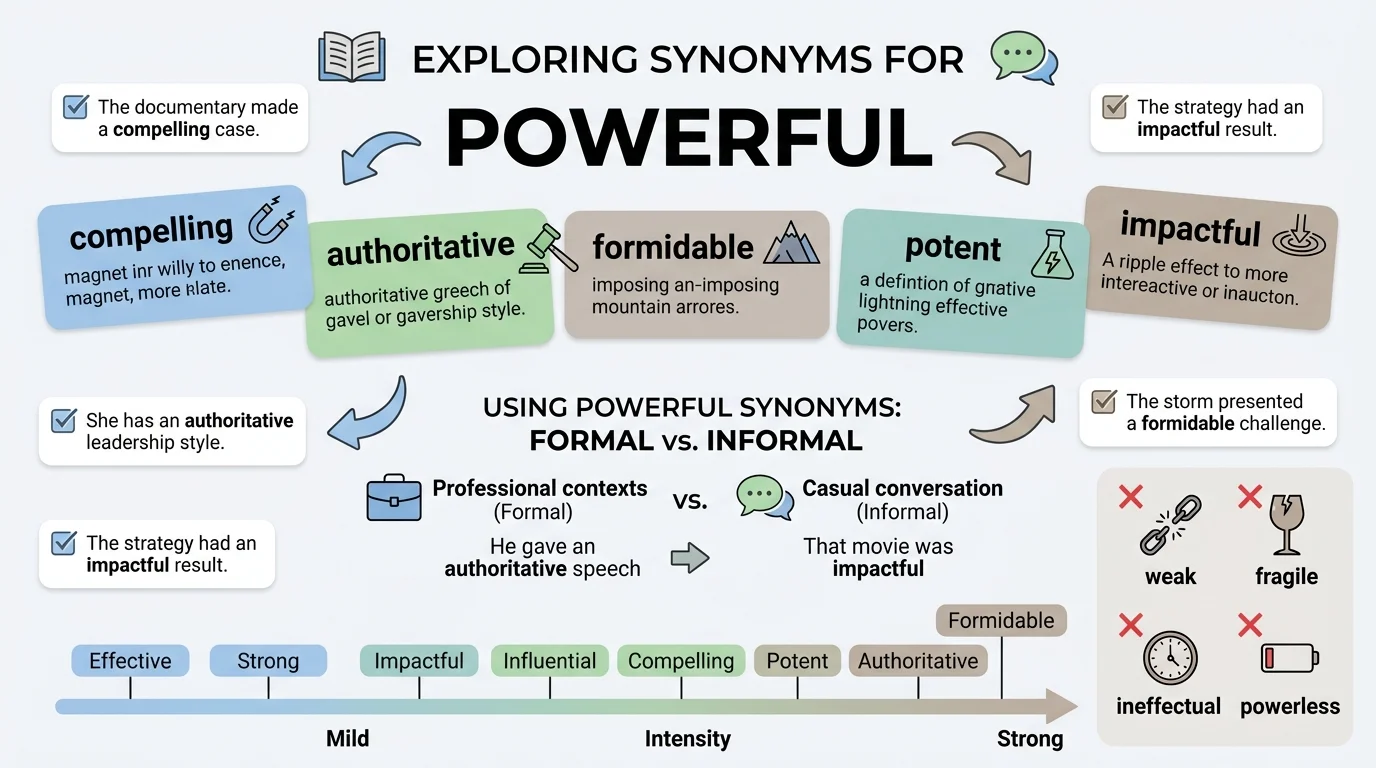
Do you find yourself using the word “powerful” over and over again in your writing? You are not alone.
Many English learners, students, and professionals rely on this common adjective far too often. It appears in emails, essays, resumes, captions, and everyday conversations. But repeating the same word makes your communication feel dull and uninspired.
The good news is that English offers a rich collection of synonyms for powerful. Each alternative carries its own shade of meaning, tone, and emotional weight. Choosing the right word can transform your writing from ordinary to exceptional.
This guide will help you master the synonyms of powerful with clear explanations, real examples, and practical advice. You will learn exactly which word to use in every situation.
What Does “Powerful” Mean?
The word powerful describes someone or something with great strength, force, influence, or effectiveness. The best synonyms depend on your context. For formal writing, use “potent” or “authoritative.” For casual conversation, try “mighty” or “compelling.” Academic work favors “substantial” or “influential.” Emotional writing benefits from “intense” or “overwhelming.” Creative contexts welcome “formidable” or “commanding.”
Meaning, Tone and Context
Understanding the core meaning of powerful helps you choose better alternatives.
- Simple definition: Powerful means having great physical strength, mental force, social influence, or effective impact on people and situations.
- Part of speech: Powerful is an adjective. The noun form is “power.” The adverb form is “powerfully.” The verb form is “empower.”
- Positive, negative, or neutral tone: Powerful is generally positive or neutral. It becomes negative when describing harmful force or oppressive control.
- Formality level: Powerful is neutral and works in almost all contexts. It is neither overly formal nor too casual.
- Common use cases: You use powerful for physical strength, emotional impact, persuasive arguments, influential people, effective tools, and significant events.
- Important word forms: Power (noun), powerfully (adverb), powerfulness (noun), powerless (opposite), empower (verb).
When and How to Use “Powerful”
Powerful works well in many situations, but variety makes your communication more engaging.
Here are realistic examples labeled by context:
Professional context: Her presentation delivered a powerful message about company values.
Personal context: The documentary left a powerful impression on everyone who watched it.
Academic context: The study provided powerful evidence supporting the new theory.
Emotional context: He felt a powerful sense of relief after completing the difficult project.
Creative context: The sunset painted a powerful image across the evening sky.
Social media caption: This book offers a powerful reminder of what truly matters in life.
Email context: Your support has made a powerful difference to our team’s success.
Resume context: Developed powerful strategies that increased sales by forty percent.
Another Word for “Powerful”
Finding the perfect replacement depends on your specific situation.
Professional writing: Use “influential” when describing people who shape opinions. Use “effective” for methods that produce results. Use “authoritative” for sources of reliable information.
Academic writing: Choose “substantial” for significant evidence. Use “robust” for strong statistical findings. Select “compelling” for convincing arguments.
Casual conversation: Say “mighty” for physical strength. Use “strong” as a simple alternative. Say “intense” for emotional experiences.
Emotional writing: Use “overwhelming” for feelings that are hard to handle. Choose “deep” for profound emotional experiences.
Creative writing: Pick “formidable” for characters with impressive abilities. Use “commanding” for leaders with natural authority.
Resume and workplace: Use “impactful” for contributions that made a difference. Choose “dynamic” for energetic leadership.
Social media captions: Say “powerful” works fine here. Try “striking” for visual content. Use “moving” for emotional posts.
Stronger meaning: Choose “overwhelming,” “unassailable,” or “invincible” for maximum intensity.
Softer meaning: Pick “notable,” “respectable,” or “considerable” for a milder effect.
When Not to Use “Powerful”
Powerful becomes vague when you need precision. It sounds too general in technical or scientific writing. It feels too casual in formal legal documents. lacks emotional depth in creative storytelling.
Consider this weak sentence: “The manager had a powerful influence on the team.”
Now compare with a precise alternative: “The manager exerted an authoritative influence that shaped every department’s decision making process.”
The second version tells the reader exactly what kind of influence occurred.
Words Commonly Confused With “Powerful”
Several related words cause confusion. Here is how they differ.
Powerful vs. Strong: Strong focuses on physical or mental capacity. Powerful emphasizes the effect or impact on others. A weightlifter is strong. A leader is powerful.
Powerful vs. Mighty: Mighty suggests grandeur or epic scale. Powerful is more practical and measurable. A mighty storm feels awe inspiring. A powerful engine produces measurable force.
Powerful vs. Influential: Influential specifically describes the ability to change opinions or behaviors. Powerful includes physical force and emotional impact.
vs. Potent: Potent suggests concentrated strength, often used for substances like medicine or chemicals. applies to broader contexts.
vs. Authoritative: Authoritative implies recognized expertise and command. Powerful describes general ability to affect outcomes.
Powerful vs. Dynamic: Dynamic suggests active, energetic, and changing force. describes established or potential force.
Best Synonym by Context for “Powerful”
This table shows the ideal synonym for each situation.
| Context | Best Synonym | Why It Works | Example |
|---|---|---|---|
| Formal writing | Potent | Conveys concentrated, measurable strength | The medication proved potent against the infection |
| Academic writing | Substantial | Indicates significant, meaningful evidence | The research provided substantial support for the hypothesis |
| Professional business | Authoritative | Suggests expertise and reliable command | The consultant gave an authoritative analysis of the market |
| Resume writing | Impactful | Highlights meaningful contributions | Created impactful marketing campaigns that boosted engagement |
| Casual conversation | Strong | Simple, clear, and universally understood | That coffee is really strong this morning |
| Creative writing | Formidable | Adds dramatic, impressive quality | The protagonist faced a formidable opponent |
| Emotional tone | Overwhelming | Captures intense feelings that are hard to process | She felt overwhelming gratitude for their kindness |
| Strong intensity | Unassailable | Conveys absolute, undeniable power | His argument was unassailable in the debate |
| Soft or moderate | Notable | Describes noticeable but not extreme power | She made a notable contribution to the project |
| Social media captions | Striking | Perfect for visual and emotional impact | The photograph offered a striking view of the city |
| US usage | Powerful | Standard American English preference | The machine has a powerful motor |
| UK usage | Mighty | More common in British casual contexts | That is a mighty fine cup of tea |
Which Synonym Should You Choose?
Selecting the right synonym requires considering five key factors.
First, think about your audience. Formal readers expect precise, academic words like “substantial” or “potent.” Casual readers appreciate simpler words like “strong” or “mighty.”
Second, consider your purpose. Are you persuading, describing, or informing? Persuasive writing benefits from “compelling.” Descriptive writing needs “vivid” or “striking.”
Third, evaluate the intensity level. “Overwhelming” is much stronger than “notable.” Choose the intensity that matches your true meaning.
Fourth, check the emotional tone. Some synonyms add warmth, like “moving.” Others feel cold and factual, like “effective.
Fifth, read your sentence aloud. The word should sound natural and flow smoothly. Awkward synonyms distract readers from your message.
Real Life Examples of “Powerful” in Sentences
Seeing powerful alternatives in action helps you understand their usage.
School context: The teacher delivered a compelling lesson that changed how students viewed history.
Workplace context: Her authoritative leadership style earned respect from every department manager.
Writing context: The author created an intense atmosphere that kept readers engaged until the final page.
Conversation context: That movie left a mighty impression on everyone who watched it.
Social media context: This video offers a striking reminder of what community support can achieve.
Resume context: Developed substantial partnerships that increased revenue by thirty percent.
Email context: Your generous support has made an overwhelming difference to our program.
Storytelling context: The commander stood as a formidable figure against the advancing army.
15 Synonyms for “Powerful”
This table provides fifteen accurate synonyms with unique explanations and natural examples.
| Synonym | Simple Meaning | Best Used For | Example Sentence |
|---|---|---|---|
| Strong | Having great physical or mental force | General everyday use | He has a strong will that never breaks under pressure |
| Mighty | Possessing impressive, epic strength | Casual and creative writing | The mighty oak tree stood for over two hundred years |
| Influential | Having power to affect opinions or actions | Describing people and ideas | She is one of the most influential thinkers in modern science |
| Potent | Concentrated, effective strength | Medical, chemical, or technical contexts | This potent formula works in just thirty minutes |
| Authoritative | Commanding and reliable | Professional and expert writing | The judge issued an authoritative ruling on the case |
| Compelling | Irresistibly convincing | Persuasive writing and arguments | His compelling testimony changed the jury’s decision |
| Formidable | Inspiring respect or fear | Describing challenges and opponents | The team faced a formidable competitor in the finals |
| Substantial | Significant and meaningful | Academic and business writing | The data showed substantial improvement over last year |
| Impactful | Making a noticeable difference | Resume and professional achievements | She led impactful projects across three continents |
| Dynamic | Energetic and actively powerful | Describing people and processes | The dynamic new manager transformed the department |
| Overwhelming | Extremely intense and hard to handle | Emotional and experiential writing | She felt overwhelming pride at her daughter’s graduation |
| Unassailable | Absolutely certain and undeniable | Formal and legal contexts | The evidence presented was unassailable in court |
| Striking | Visually or emotionally impressive | Creative writing and social media | The artist created a striking portrait of the leader |
| Effective | Producing desired results | Practical and professional contexts | This method proved highly effective for language learning |
| Commanding | Exercising authority with confidence | Leadership and military contexts | His commanding presence silenced the entire room |
Synonym Groups and Usage Differences
Organizing synonyms by category helps you choose the right word quickly.
Professional vs. Personal Synonyms
Professional contexts demand words like “authoritative,” “substantial,” and “impactful.” These words sound credible and serious. Personal contexts welcome warmer words like “moving,” “meaningful,” and “deep.” These words connect emotionally with individual experiences.
Formal vs. Conversational Synonyms
Formal writing benefits from “potent,” “unassailable,” and “authoritative.” These words appear in reports, academic papers, and legal documents. Conversational contexts accept “strong,” “mighty,” and “intense.” These words feel natural in texts, casual emails, and everyday speech.
Academic Synonyms
Academic writing requires precision and objectivity. “Substantial” indicates significant evidence. “Robust” describes reliable statistical results. “Compelling” works for well supported arguments. “Potent” suits scientific and medical research. Avoid emotional synonyms in academic contexts.
Professional and Business Synonyms
The workplace values words that demonstrate results. “Impactful” shows meaningful contributions. “Authoritative” suggests reliable expertise. “Dynamic” describes energetic leadership. “Effective” highlights practical success. “Commanding” suits management and executive roles.
Creative or Literary Synonyms
Creative writing benefits from vivid, descriptive words. “Formidable” adds dramatic weight to characters. “Striking” creates visual impact. “Overwhelming” builds emotional intensity. “Mighty” works well in epic storytelling. “Compelling” keeps readers engaged with narrative.
Slang or Modern Synonyms
Modern English includes casual synonyms like “hardcore,” “beast,” and “killer.” These words work in informal conversations and social media. They are too casual for professional or academic writing. Use them only with friends and in relaxed settings.
Strongest vs. Weaker Synonyms
This scale shows intensity from mild to extreme.
Mild: Notable, considerable, respectable
Moderate: Strong, effective, influential
Strong: Compelling, authoritative, formidable
Extremely Strong: Overwhelming, unassailable, invincible
Emotional vs. Neutral Synonyms
Emotional synonyms add feeling to your writing. “Overwhelming” conveys intense personal experience. “Moving” suggests deep emotional response. “Striking” creates visual and emotional impact.
Neutral synonyms stay factual and objective. “Effective” simply describes results. “Potent” measures concentrated strength. “Substantial” indicates measurable significance.
Antonyms of “Powerful”
These fifteen antonyms show the opposite meanings.
| Antonym | Meaning | Example Sentence |
|---|---|---|
| Weak | Lacking physical or mental strength | His weak argument failed to convince anyone |
| Powerless | Having no ability to affect outcomes | The powerless citizens could not change the policy |
| Feeble | Extremely weak and ineffective | She made a feeble attempt to lift the box |
| Impotent | Without power or influence | The manager felt impotent to stop the changes |
| Ineffective | Not producing desired results | The ineffective policy wasted taxpayer money |
| Helpless | Unable to protect or defend oneself | The helpless animal waited for rescue |
| Vulnerable | Open to harm or attack | Their position felt vulnerable without support |
| Fragile | Easily broken or damaged | The fragile peace lasted only two years |
| Delicate | Needing careful handling | The delicate ecosystem required protection |
| Submissive | Yielding to authority | His submissive attitude frustrated his colleagues |
| Inferior | Lower in quality or strength | The inferior product failed in the market |
| Inadequate | Not enough for the purpose | Their resources were inadequate for the project |
| Unconvincing | Failing to persuade | The witness gave an unconvincing testimony |
| Insignificant | Lacking importance or effect | The data showed an insignificant difference |
| Negligible | So small that it hardly matters | The financial impact was negligible |
Comparison: Powerful vs. Similar Words
Understanding subtle differences helps you choose with confidence.
Powerful vs. Strong
Main difference: Powerful emphasizes impact on others. Strong focuses on internal capacity. A ruler is powerful because they affect citizens. An athlete is strong because of physical ability.
Which is stronger: Powerful conveys more external influence.
Which is more formal: Powerful is slightly more formal in professional contexts.
Example for powerful: Her powerful speech moved the entire audience.
Example for strong: He has strong opinions about education reform.
Powerful vs. Mighty
Main difference: Mighty suggests grandeur and epic quality. Powerful is more practical and measurable.
Which is stronger: Mighty has a more dramatic, larger than life tone.
Which is more formal: Powerful is more formal and practical.
Example for powerful: The engine produces powerful acceleration.
Example for mighty: The mighty river carved the canyon over centuries.
Powerful vs. Influential
Main difference: Influential specifically means changing opinions or actions. Powerful includes physical and emotional force.
Which is stronger: Powerful has broader meaning.
Which is more formal: Influential is more common in social and political contexts.
Example for powerful: The medication has a powerful effect on symptoms.
Example for influential: The scientist has been highly influential in her field.
Powerful vs. Potent
Main difference: Potent usually refers to concentrated effectiveness, especially in substances. Powerful applies to wider contexts.
Which is stronger: Potent suggests maximum concentration.
Which is more formal: Potent is more formal and technical.
Example for powerful: The leader gave a powerful address.
Example for potent: This herb contains potent medicinal compounds.
Powerful vs. Authoritative
Main difference: Authoritative implies recognized expertise and command. Powerful describes general ability to affect outcomes.
Which is stronger: Authoritative carries more intellectual weight.
Which is more formal: Authoritative is more formal and specific.
Example for powerful: The storm was powerful enough to damage buildings.
Example for authoritative: Her book remains the authoritative text on the subject.
Powerful vs. Compelling
Main difference: Compelling suggests irresistible persuasion. Powerful focuses on general strength or effect.
Which is stronger: Compelling has a specific persuasive meaning.
Which is more formal: Both work in formal contexts.
Example for powerful: The telescope revealed powerful images of distant galaxies.
Example for compelling: The lawyer presented a compelling case for the defendant.
Common Phrases and Expressions with “Powerful”
These common phrases show how powerful appears in everyday English.
1. Powerful force
Meaning: A significant influence or energy that creates change.
Example sentence: Social media has become a powerful force in modern politics.
2. Powerful tool
Meaning: An effective resource for achieving a goal.
Example sentence: The new software is a powerful tool for data analysis.
3. Powerful message
Meaning: A communication that strongly affects its audience.
Example sentence: The campaign delivered a powerful message about equality.
4. Powerful impact
Meaning: A strong and noticeable effect on something or someone.
Example sentence: The teacher’s encouragement had a powerful impact on her students.
5. Powerful emotions
Meaning: Strong feelings that are difficult to control.
Example sentence: The film stirred powerful emotions in every viewer.
6. Powerful position
Meaning: A role or situation with significant authority.
Example sentence: He holds a powerful position in the organization.
7. Powerful reminder
Meaning: A strong prompt to remember something important.
Example sentence: The memorial serves as a powerful reminder of our history.
8. Powerful ally
Meaning: A strong and beneficial partner or supporter.
Example sentence: The community group found a powerful ally in the local senator.
Common Mistakes to Avoid
Learning from common errors improves your vocabulary skills.
Mistake 1: Using “powerful” when a more precise synonym fits better
Weak writing repeats “powerful” for every strong situation. Strong writing chooses specific words. Instead of “powerful argument,” use “compelling argument.” Instead of “powerful leader,” try “authoritative leader.”
Mistake 2: Confusing “powerful” with “strength”
Strength refers to internal capacity. Powerful focuses on external effect. You can be strong but not powerful if your strength does not affect others. A strong person lifts heavy objects. A powerful person influences many people.
Mistake 3: Using casual synonyms in formal writing
Words like “mighty” and “hardcore” sound inappropriate in professional documents. Reserve these for personal conversations and creative writing. Choose “substantial” and “potent” for formal work.
Mistake 4: Using overly dramatic synonyms for simple situations
Describing a comfortable chair as “overwhelming” sounds exaggerated and strange. Match your intensity to the situation. Use milder synonyms like “effective” or “notable” for everyday objects.
Mistake 5: Repeating the same synonym too often
Variety keeps writing fresh and engaging. If you use “influential” three times in one paragraph, find alternatives. Try “commanding” or “authoritative” to add variety.
Mistake 6: Choosing a synonym with the wrong emotional tone
“Overwhelming” conveys intense, sometimes negative emotion. “Compelling” feels positive and persuasive. Consider whether your synonym matches your intended feeling.
Mistake 7: Using slang in academic or professional writing
Resist the urge to write “killer presentation” in a business report. Use “impactful” or “compelling” instead. Save informal language for appropriate settings.
FAQs
What is the best synonym for powerful?
The best synonym depends on context. “Compelling” works for persuasive situations. “Authoritative” suits professional writing. “Mighty” fits casual conversation.
What is a formal synonym for powerful?
“Potent” and “substantial” are formal synonyms for powerful. “Authoritative” also works well in professional contexts.
What is an informal synonym for powerful?
“Strong” and “mighty” are common informal synonyms. “Hardcore” works in very casual settings.
What is another word for powerful in professional writing?
“Impactful” and “authoritative” are excellent choices for professional writing. “Dynamic” and “effective” also work well.
What is the difference between powerful and strong?
Powerful focuses on external impact and influence. Strong describes internal physical or mental capacity.
What is the opposite of powerful?
The direct opposite is “weak.” Other antonyms include “powerless,” “feeble,” and “ineffective.”
Conclusion
Powerful is a useful word, but relying on it too much weakens your writing. The English language offers dozens of precise alternatives for every situation.
The best synonym depends on your context, audience, and purpose. Formal writing demands “potent” and “authoritative.” Casual conversation welcomes “mighty” and “strong.” Academic work prefers “substantial” and “compelling.” Creative writing benefits from “formidable” and “striking.”
Remember this practical tip: before you write “powerful,” ask yourself what kind of power you mean. Is it physical, emotional, intellectual, or social? Does it persuade, impress, overwhelm, or command? Your answer will point you to the perfect synonym.
Review the synonyms in this guide and practice using them in your daily writing. Your vocabulary will grow stronger, and your communication will become more effective and engaging.