Do you find yourself using the word “explore” over and over again in your writing, emails, or conversations? Maybe you are writing a travel caption, drafting a professional report, or composing an academic essay. The word feels comfortable, but you know it is time to expand your vocabulary.
Many writers and professionals struggle with repetition. This guide will help you master every synonym for explore so you can choose the perfect word for any situation.
What Does “Explore” Mean?
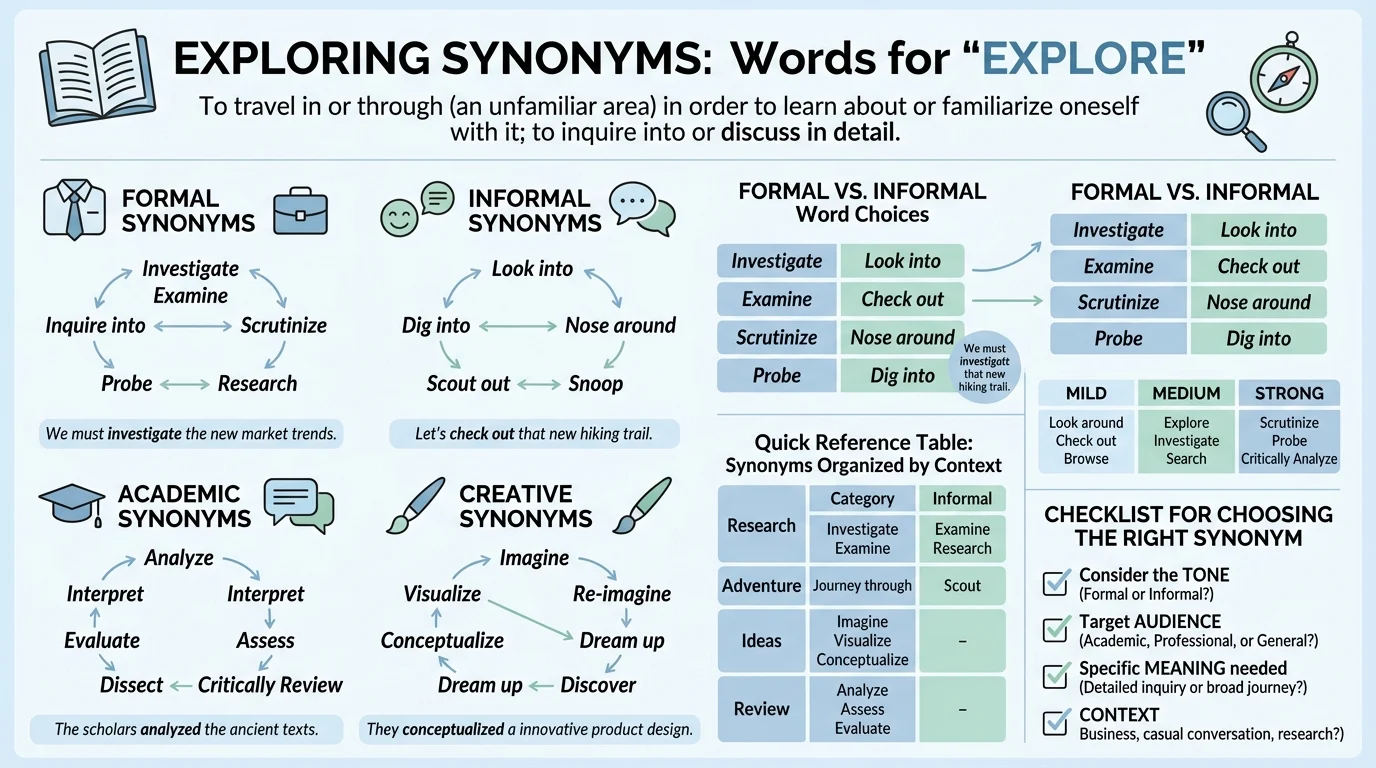
To explore means to travel through unfamiliar places to learn about them, or to examine something thoroughly to discover information. The best synonyms depend on your context. Use investigate for formal research, discover for emotional moments, delve into for academic depth, and check out for casual conversation.
Meaning, Tone and Context
Simple definition
Explore means to search through or travel across an area to discover something new. It can also mean to examine or analyze an idea, question, or topic in detail.
Part of speech
Verb. The noun form is exploration. The adjective form is exploratory.
Tone
Neutral. Explore has a positive, curious, and open minded tone in most contexts.
Formality level
Moderate. Explore works well in professional and academic writing but also fits casual conversation.
Common use cases
Travel writing, scientific research, academic essays, business presentations, personal growth content, and creative storytelling.
Important word forms
Exploration (noun), exploratory (adjective), explorer (noun), explorative (adjective).
When and How to Use “Explore”
Use explore when you want to describe a journey of discovery. This could be a physical journey to a new place. It could also be an intellectual journey through research. The word carries a sense of curiosity and open mindedness.
Here are examples in different contexts.
Professional context
Our team will explore several marketing strategies before making a final recommendation.
Academic context
The study aims to explore the relationship between sleep patterns and academic performance.
Personal context
I want to explore new hobbies this year, especially painting and photography.
Emotional context
She needed time to explore her feelings before responding to his question.
Creative context
The novel explores themes of identity and belonging in modern society.
Social media context
Ready to explore hidden gems in the city? Follow along for adventure!
Resume context
Explored new markets and identified three key growth opportunities.
Casual context
Let’s explore that new coffee shop downtown this weekend.
Another Word for “Explore”
The best single replacement for explore depends entirely on your situation. Here are the top alternatives organized by context.
Professional writing
Investigate is the best professional synonym for explore. It sounds serious and methodical. Use investigate for business reports and workplace communication.
Academic writing
Examine works beautifully in academic contexts. It suggests careful, systematic analysis of evidence or theories.
Casual conversation
Check out is the most natural casual alternative. It sounds friendly and relaxed for everyday use.
Emotional writing
Discover adds emotional weight and personal meaning. It suggests a meaningful or life changing revelation.
Creative writing
Delve into creates a sense of depth and immersion. It works well for descriptive and literary writing.
Resume or workplace use
Analyze demonstrates strong professional skills. It shows you can break down complex information.
Social media captions
Uncover creates intrigue and excitement. It makes your content feel like an exclusive revelation.
Stronger meaning
Probe suggests intense, focused inquiry. Use it when you want to emphasize thorough investigation.
Softer meaning
Browse suggests a lighter, more casual exploration. It works for surface level looking around.
When Not to Use “Explore”
Explore becomes problematic when it is too vague or overused. The word loses impact when you apply it to every situation. More precise synonyms often communicate your meaning better.
When explore sounds too vague
Weak sentence: We need to explore this problem.
Improved sentence: We need to analyze this problem and identify the root cause.
When explore sounds too casual
Weak sentence: The research team will explore the data.
Improved sentence: The research team will examine the data for significant patterns.
When explore sounds too gentle
Weak sentence: The detective explored the crime scene.
Improved sentence: The detective investigated the crime scene thoroughly.
When explore sounds too general
Weak sentence: She explored the menu.
Improved sentence: She scanned the menu for vegetarian options.
When explore sounds too soft for business
Weak sentence: We explored the competitor’s pricing.
Improved sentence: We analyzed the competitor’s pricing structure.
Words Commonly Confused With “Explore”
Many words relate to exploration, but they have distinct meanings. Understanding these differences will help you choose the right word every time.
Explore vs. Investigate
Explore suggests open ended curiosity and discovery. Investigate suggests a systematic search for facts or truth. Use explore for general discovery and investigate for formal inquiry.
Explore vs. Examine
Explore implies movement through a topic or place. Examine implies close, careful observation. Examine is more analytical and focused.
Explore vs. Discover
Explore is the action of searching. Discover is the result of finding something. You explore a forest and discover a hidden waterfall.
Explore vs. Survey
Survey suggests a broad overview rather than deep exploration. suggests deeper, more immersive investigation.
Explore vs. Research
Research is structured and academic. can be more casual and open ended. Use research for formal study and explore for preliminary investigation.
Explore vs. Tour
Tour suggests a guided or structured visit. Explore suggests independent discovery. You tour a museum but explore a city.
Best Synonym by Context for “Explore”
| Context | Best Synonym | Why It Works | Example |
|---|---|---|---|
| Formal writing | Investigate | Conveys seriousness and thoroughness | The committee will investigate all claims thoroughly |
| Academic writing | Examine | Suggests careful, systematic analysis | This paper examines the effects of climate change |
| Professional business | Analyze | Shows critical thinking and deep understanding | We need to analyze the quarterly sales figures |
| Resume use | Assess | Demonstrates evaluation and judgment skills | Assessed market conditions and identified new opportunities |
| Casual conversation | Check out | Sounds friendly and natural | Let’s check out that new restaurant |
| Creative writing | Delve into | Adds depth and literary quality | The story delves into the character’s troubled past |
| Emotional tone | Discover | Suggests meaningful personal revelation | She discovered her true passion for teaching |
| Strong intensity | Probe | Emphasizes deep, penetrating inquiry | The journalist probed the politician’s claims |
| Soft or moderate | Browse | Suggests light, casual looking around | Browse the shelves for interesting books |
| Social media | Uncover | Creates excitement and mystery | Uncover the best street art in the city |
| US usage | Scout | Suggests active, purposeful searching | We scouted locations for the new office |
| UK usage | Reconnoitre | Formal British term for military or strategic exploration | The team reconnoitred the area before construction |
Which Synonym Should You Choose?
Choosing the right synonym for explore requires careful consideration of your audience and purpose. Here is a practical decision guide.
Consider your audience
For professional or academic readers, choose investigate or examine. For friends and family, choose check out or browse. For mixed audiences, discover or uncover often work well.
Consider your formality level
Formal writing needs investigate, analyze, or examine. Casual writing welcomes check out, look into, or scout. Moderate writing works with explore or discover.
Consider your emotional intensity
For strong emotional impact, choose discover or uncover. For neutral, factual writing, choose examine or analyze. For creative expression, choose delve into or probe.
Consider your professional value
Resumes and workplace writing benefit from analyze, assess, or evaluate. These words demonstrate valuable professional skills.
Consider your sentence context
Look at the surrounding words. Match your synonym to the overall tone and meaning of your sentence. Consistency matters more than individual word choice.
Real Life Examples of “Explore” in Sentences
Here are realistic examples showing explore and its synonyms across different situations.
School context
The science students examined the local ecosystem to understand biodiversity patterns.
Workplace context
Our department will analyze customer feedback to improve our service offering.
Writing context
The author delves into the complexities of modern family life in her latest novel.
Conversation context
I want to check out that new bookstore everyone keeps talking about.
Social media context
Discover five hidden hiking trails within an hour of the city.
Resume context
Assessed current operational procedures and implemented efficiency improvements.
Email context
Please investigate the discrepancy in last month’s budget report.
Storytelling context
The explorer probed the ancient cave system with caution and curiosity.
25 Synonyms for “Explore”
| Synonym | Simple Meaning | Best Used For | Example Sentence |
|---|---|---|---|
| Investigate | Systematic inquiry for facts | Formal research and reporting | The detective investigated the crime scene thoroughly |
| Examine | Close, careful observation | Academic and analytical writing | The study examines the effects of nutrition on health |
| Analyze | Break down into components | Business and data contexts | We need to analyze the marketing campaign results |
| Discover | Find something unexpected | Emotional and personal writing | She discovered her hidden talent for painting |
| Delve into | Immerse deeply in a topic | Creative and literary writing | The book delves into the mystery of lost civilizations |
| Probe | Penetrating inquiry for truth | Intense investigative contexts | Scientists probed the depths of the ocean |
| Scout | Search for specific things | Practical and purposeful searching | The team scouted locations for the new store |
| Survey | Broad overview examination | General assessment contexts | The report surveys current market trends |
| Inspect | Carefully check for details | Technical and quality contexts | The engineer inspected the bridge for structural issues |
| Scan | Quick look for specific things | Fast, targeted searching | She scanned the document for key information |
| Browse | Casual, leisurely looking | Shopping and casual contexts | Browse the antique shop for hidden treasures |
| Uncover | Reveal something hidden | Social media and storytelling | The documentary uncovers the truth behind the scandal |
| Assess | Evaluate condition or value | Professional evaluation contexts | The manager assessed the team’s performance |
| Review | Look over for evaluation | Business and academic contexts | Review the proposal before submitting it |
| Research | Systematic academic study | Formal academic writing | The professor researched ancient trade routes |
| Reconnoiter | Explore for military strategy | Strategic, formal contexts | The scout reconnoitered the enemy position |
| Tour | Visit with a purpose | Travel and sightseeing | We toured the historic district all afternoon |
| Study | Apply the mind to learning | Academic and personal growth | She studied the culture before visiting the country |
| Scrutinize | Examine very carefully | Detailed analysis contexts | The lawyer scrutinized every clause in the contract |
| Pursue | Follow with continued effort | Goal oriented contexts | The researcher pursued the answer for years |
| Track | Follow the path of something | Scientific and investigative contexts | The team tracked the animal migration patterns |
| Search | Look for specific things | General finding contexts | Search the database for relevant articles |
| Rummage | Search untidily or casually | Informal, physical searching | She rummaged through the drawer for a pen |
| Peruse | Read or examine carefully | Formal reading contexts | Peruse the document before signing it |
| Pioneer | Explore new territory first | Innovative and groundbreaking contexts | She pioneered new approaches to education |
Synonym Groups and Usage Differences
Professional vs. Personal Synonyms
Professional contexts demand precise, action oriented words. Investigate, analyze, assess, and evaluate communicate competence and credibility. These words show that you are serious about your work.
Personal contexts allow for warmer, more emotional words. Discover, uncover, and check out feel friendly and relatable. These words build connection and engagement in personal writing.
Formal vs. Conversational Synonyms
Formal writing requires investigate, examine, analyze, and peruse. These words sound appropriate in reports, essays, and professional documents.
Conversational writing welcomes check out, browse, scout, and rummage. These words feel natural in texts, casual emails, and friendly conversations.
Academic Synonyms
Academic writing values precision and clarity. Examine, investigate, research, and study are standard choices. These words suggest systematic inquiry and careful methodology.
Delve into works well for literary or humanities writing. It suggests depth and intellectual engagement. Analyze and assess fit scientific and social science contexts.
Professional and Business Synonyms
Business communication favors action words. Analyze, assess, evaluate, review, and investigate dominate professional contexts. These words demonstrate analytical thinking and decision making skills.
Scout works well for practical business searching. Survey fits market research contexts. Track works for monitoring data and trends.
Creative or Literary Synonyms
Creative writing thrives on evocative language. Delve into, probe, uncover, and pioneer add depth and imagery. These words create emotional resonance and literary quality.
Discover works beautifully for narrative writing. It suggests meaningful personal transformation. Scout and explore fit adventure and travel writing.
Slang or Modern Synonyms
English offers few true slang synonyms for explore. “Check out” functions as a casual modern alternative. It is acceptable in social media, texts, and informal conversation.
Avoid “check out” in professional or academic writing. It sounds too casual for formal contexts. Stick with investigate or examine for serious writing.
Strongest vs. Weaker Synonyms
Intensity scale from mild to strongest:
Browse is the mildest synonym. It suggests surface level looking.
Scan and survey are moderate. They suggest a broad but quick view.
Examine and inspect are stronger. They suggest careful observation.
Investigate and probe are the strongest. They suggest deep, thorough inquiry.
Emotional vs. Neutral Synonyms
Emotional synonyms add feeling to your writing. Discover, uncover, and pioneer create excitement and personal meaning. These words connect with readers on an emotional level.
Neutral synonyms stay factual and objective. Examine, analyze, and investigate report information without emotional coloring. These words work best in academic and professional contexts.
Antonyms of “Explore”
| Antonym | Meaning | Example Sentence |
|---|---|---|
| Ignore | Pay no attention to | The manager chose to ignore the customer complaints |
| Overlook | Fail to notice | She overlooked an important detail in the report |
| Neglect | Give insufficient attention | He neglected his studies and fell behind |
| Disregard | Treat as unimportant | The committee disregarded the minority opinion |
| Skim | Read or glance through quickly | She skimmed the chapter instead of studying it carefully |
| Bypass | Go around instead of through | We bypassed the historical district on our tour |
| Avoid | Stay away from | Avoid the crowded tourist areas during peak season |
| Miss | Fail to discover or notice | The inspector missed the faulty wiring in the building |
| Glance | Look briefly without attention | He glanced at the document but didn’t read it |
| Guess | Form an opinion without sufficient information | The scientist guessed about the results instead of investigating |
| Presume | Assume without investigation | Do not presume the outcome without proper research |
| Speed | Move quickly without exploration | We sped through the museum in thirty minutes |
| Rush | Act quickly without consideration | Rushing through the analysis leads to errors |
| Pass | Move beyond without stopping | We passed the historic site without visiting it |
| Neglect | Leave unattended | The project was neglected for several months |
Comparison: Explore vs. Similar Words
Explore vs. Investigate
Main difference
Explore suggests open ended curiosity and discovery. Investigate suggests formal, systematic fact finding.
Which one is stronger
Investigate is stronger and more intense than explore. It implies a serious search for answers.
Which one is more formal
Investigate is more formal. It belongs in official reports, legal contexts, and academic research.
Example sentence with explore
The children explored the forest behind their house.
Example sentence with investigate
The police investigated the robbery for several months.
Explore vs. Examine
Main difference
Explore suggests movement and discovery. Examine suggests close, careful observation and analysis.
Which one is stronger
Examine suggests deeper, more focused attention than explore.
Which one is more formal
Examine is more formal and academic than explore.
Example sentence with explore
We need to explore different solutions to this problem.
Example sentence with examine
The doctor examined the patient’s test results carefully.
Explore vs. Discover
Main difference
Explore is the action of searching. Discover is the result of finding something.
Which one is stronger
Discover has a stronger emotional impact. It suggests a meaningful revelation.
Which one is more formal
Explore is more neutral in formality. Discover leans toward personal or narrative writing.
Example sentence with explore
The team explored the ancient temple ruins.
Example sentence with discover
She discovered an old photograph in her grandmother’s attic.
Explore vs. Research
Main difference
Research implies systematic, documented study. Explore implies preliminary or open ended inquiry.
Which one is stronger
Research suggests more rigor and depth than explore.
Which one is more formal
Research is more formal. It fits academic and professional contexts.
Example sentence with explore
We are exploring the possibility of expanding overseas.
Example sentence with research
The professor researched the effects of climate change for ten years.
Explore vs. Survey
Main difference
Survey suggests a broad overview. Explore suggests deeper, more detailed investigation.
Which one is stronger
Explore suggests more depth than survey. Survey covers more ground at a higher level.
Which one is more formal
Both are formal words. Survey is common in business and academic contexts.
Example sentence with explore
The team explored every aspect of the proposal.
Example sentence with survey
The report surveys current educational trends worldwide.
Explore vs. Scout
Main difference
Scout suggests purposeful searching for specific information or resources. Explore suggests general discovery.
Which one is stronger
Both are equally strong. Scout is more practical and focused.
Which one is more formal
Explore is more formal. Scout is common in business and practical contexts.
Example sentence with explore
Explore the options before making a decision.
Example sentence with scout
We scouted the area for the best office location.
Common Phrases and Expressions with “Explore”
1. Explore new horizons
Meaning
Venture into new areas of experience, knowledge, or opportunity.
Example sentence
After retirement, she decided to explore new horizons by traveling to Asia.
2. Explore every avenue
Meaning
Consider every possible option or approach to a problem.
Example sentence
The committee explored every avenue before selecting the final design.
3. Explore the possibilities
Meaning
Consider different options or opportunities.
Example sentence
We need to explore all possibilities before choosing a location.
4. Explore in depth
Meaning
Examine something thoroughly and comprehensively.
Example sentence
The report explores the topic of renewable energy in depth.
5. Explore the unknown
Meaning
Venture into unfamiliar territory or topics.
Example sentence
Scientists continue to explore the unknown depths of the ocean.
6. Explore one’s options
Meaning
Consider and evaluate different choices.
Example sentence
She took time to explore her options before changing careers.
7. Explore the world
Meaning
Travel widely and experience different cultures.
Example sentence
He left his job to explore the world for a year.
8. Explore the question
Meaning
Investigate or examine a specific issue or inquiry.
Example sentence
The study explores the question of how sleep affects memory.
Common Mistakes to Avoid
1. Using explore when a more precise synonym fits better
Many writers overuse explore in situations that call for more specific words. Your writing becomes vague and unclear.
Instead of “explore the data,” write “analyze the data.” Instead of “explore the options,” write “evaluate the options.”
2. Confusing explore with discover
Remember that explore is the action. Discover is the result. You explore an area and discover something within it.
Correct: She explored the cave and discovered ancient paintings.
Incorrect: She discovered the cave to find paintings.
3. Using casual synonyms in formal writing
“Check out” and “browse” sound inappropriate in reports, academic papers, and professional documents.
Formal: The committee will investigate the claims thoroughly.
Casual: The committee will check out the claims.
4. Using overly dramatic synonyms for simple situations
Probe and delve into sound strange for everyday activities. Save these words for deep, significant topics.
Better: I browsed the bookstore for new novels.
Too dramatic: I probed the bookstore for new novels.
5. Repeating the same synonym too often
Variety matters in good writing. Use different synonyms to keep your writing fresh and engaging.
Instead of three “explore” sentences, use explore, investigate, and examine. Your writing will improve significantly.
6. Choosing a synonym with the wrong emotional tone
Match the emotional weight of your word to your situation. Discover sounds too dramatic for routine events.
Correct: I explored the menu before ordering.
Too dramatic: I discovered the menu before ordering.
7. Using slang in academic or professional writing
Avoid “check out” in formal contexts. Use investigate, examine, or analyze instead.
FAQs
What is the best synonym for explore?
Investigate works best for formal contexts. Discover fits emotional writing. Check out suits casual conversation. The best synonym depends on your audience and purpose.
What is a formal synonym for explore?
Investigate, examine, and analyze are formal synonyms. These words work well in academic papers, business reports, and professional communication.
What is an informal synonym for explore?
Check out, browse, and scout work well in informal contexts. Use these in texts, casual emails, and friendly conversations.
What is another word for explore in professional writing?
Analyze and investigate are excellent professional alternatives. They demonstrate serious, methodical thinking. Assess and evaluate also work well.
What is the difference between explore and investigate?
Explore suggests open ended curiosity and general discovery. Investigate suggests systematic fact finding. Investigate is more formal and intense.
What is the opposite of explore?
Ignore, overlook, neglect, and avoid serve as opposites. These words suggest failing to examine or discover.
Conclusion
Explore is a versatile and useful word. It captures curiosity, discovery, and open minded investigation. But using explore in every situation makes your writing repetitive and imprecise.
The best synonyms for explore depend on your context. Use investigate for formal work. discover for emotional moments. check out for casual conversation.examine for academic writing. Use analyze for professional communication.
Consider your audience, your purpose, and your tone. Choose the synonym that fits your situation perfectly. Your writing will become clearer, stronger, and more engaging.
One practical tip: before you write “explore,” ask yourself what you really mean. Are you investigating, discovering, examining, or browsing? The answer will lead you to the perfect synonym.