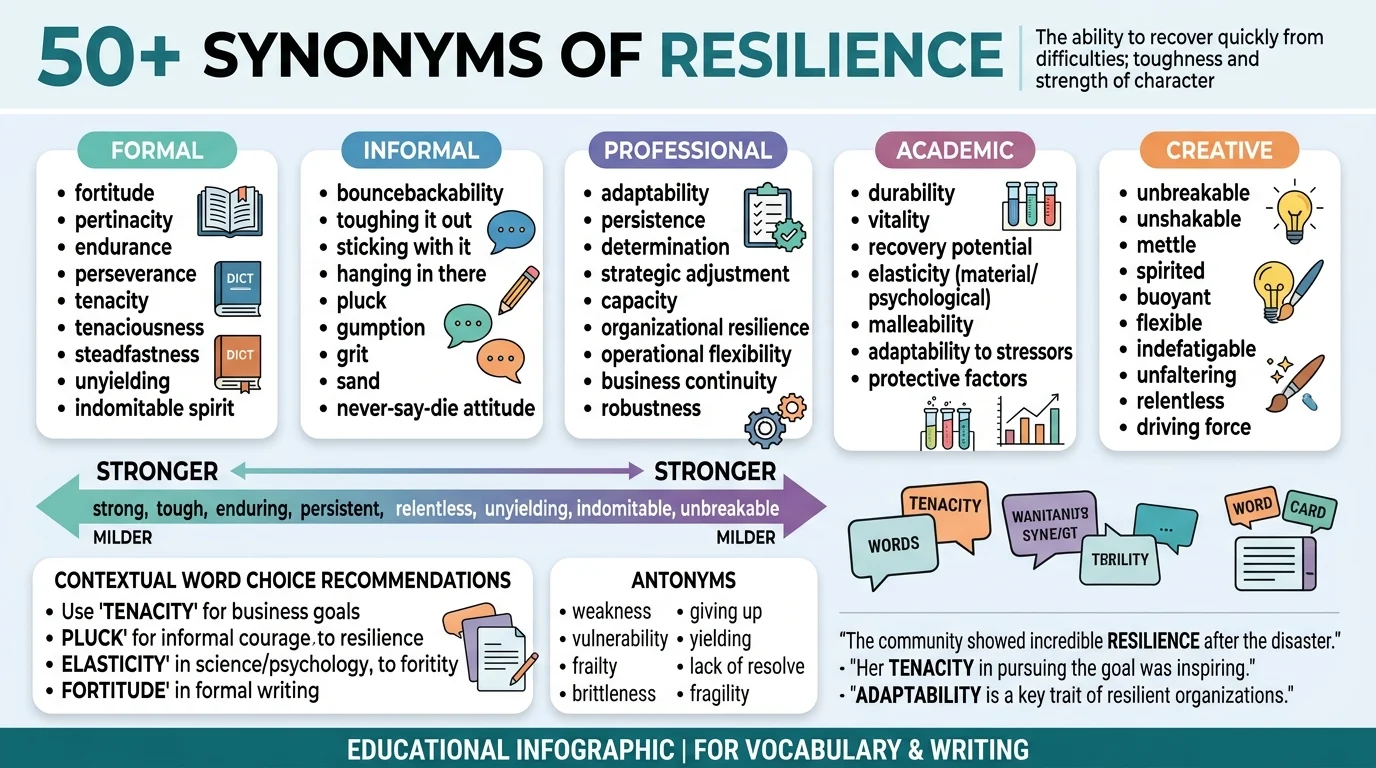
Have you ever found yourself writing an email, an essay, or a social media caption and realized you have used the word “resilience” three times in two paragraphs? It happens to everyone. You know what you want to say, but repeating the same word makes your writing feel flat and uninspired. That is exactly why understanding the synonyms of resilience matters. Choosing the right synonym does more than just avoid repetition. It sharpens your message, adjusts your tone, and helps your reader understand exactly what you mean. Whether you are writing a resume, crafting a business report, or simply trying to express yourself more clearly, having a strong vocabulary of alternatives makes all the difference.
What Are the Best Synonyms of “Resilience”?
Resilience is the ability to recover quickly from difficulties, adapt to change, and keep going despite setbacks. The best synonym depends on your context. Professional writing, choose “adaptability” or “robustness.” For emotional situations, use “fortitude” or “emotional strength.” For casual conversation, “grit” or “toughness” work well. In academic writing, “hardiness” or “tenacity” sound more precise.
Meaning, Tone, and Context
Simple Definition
Resilience is the capacity to bounce back from hardship, adapt to change, and continue moving forward despite obstacles. It applies to people, communities, systems, and even materials.
Part of Speech
Resilience is a noun. The adjective form is “resilient,” and the adverb form is “resiliently.” A less common variant is “resiliency,” which is used interchangeably in American English.
Overall Tone
Resilience carries a positive tone. It suggests strength, optimism, and the ability to overcome. Even when describing difficult situations, the word itself implies a hopeful outcome.
Formality Level
Resilience is semi-formal to formal. It works well in professional settings, academic writing, and serious conversations. It is not overly casual, but it is also not so stiff that it sounds out of place in everyday speech.
Common Uses
Native English speakers use resilience in many contexts. In business, they talk about “economic resilience” or “supply chain resilience.” In psychology, they discuss “emotional resilience” and “mental resilience.” In everyday life, people refer to a person’s resilience after going through a tough time. The word also appears in discussions about climate change, community strength, and personal development.
Word Forms
| Form | Word |
|---|---|
| Noun | Resilience (or resiliency) |
| Adjective | Resilient |
| Adverb | Resiliently |
| Verb (rare) | Resilize (very uncommon) |
When and How to Use “Resilience”
Choose “resilience” when you want to emphasize someone’s or something’s ability to withstand difficulty and come back stronger. It works best when the focus is on recovery and adaptation rather than just endurance.
Here are seven realistic examples showing how resilience is used in different contexts.
Professional
“Our team’s resilience during the merger allowed us to maintain productivity and meet every deadline.”
Academic
“The study examined the resilience of coastal communities following three major hurricanes over five years.”
Workplace
“She showed remarkable resilience by turning a failed project into a learning opportunity for the entire department.”
Personal
“After losing his job, his resilience helped him stay positive and land an even better position within two months.”
“I want to acknowledge your resilience throughout this challenging quarter. Your efforts have not gone unnoticed.”
Resume
“Demonstrated resilience by leading my team through a company-wide restructuring while maintaining a 95% client retention rate.”
“Resilience isn’t about avoiding the fall. It is about getting back up every single time.”
Best Synonyms of “Resilience”
No synonym perfectly matches “resilience” in every situation. Some emphasize recovery, others focus on endurance, and still others highlight adaptability. The best choice depends on your audience, your purpose, and the tone you want to strike.
Here are the best synonyms for specific contexts.
Professional writing: Choose “adaptability.” It sounds polished and focuses on the ability to adjust to new conditions, which employers and business leaders value highly.
Academic writing: Choose “tenacity” or “perseverance.” These words carry a scholarly weight and emphasize sustained effort over time.
Business communication: Choose “robustness.” It suggests strength and reliability, making it ideal for discussing systems, strategies, and organizational performance.
Casual conversation: Choose “grit.” It is informal, relatable, and captures the determination to keep going despite obstacles.
Emotional writing: Choose “fortitude.” It conveys courage and emotional strength in the face of pain or adversity.
Creative writing: Choose “buoyancy.” It adds a poetic quality while still communicating the idea of rising back up after being pushed down.
Resume writing: Choose “perseverance” or “determination.” These words show employers that you do not give up when things get difficult.
Workplace communication: Choose “hardiness.” It suggests durability and the ability to handle pressure without breaking.
Stronger meaning: Choose “indomitability.” This is a powerful word that suggests an unconquerable spirit.
Softer meaning: Choose “flexibility.” It tones down the intensity and focuses on the ability to bend rather than break.
When Not to Use “Resilience”
“Resilience” is a great word, but it is not always the right choice. Here are situations where you should consider alternatives.
When the word sounds too general
If you are describing a specific type of strength, resilience might be too broad. For example, if someone showed patience rather than recovery, “forbearance” or “patience” would be more accurate.
Instead of: “Her resilience during the long negotiation was impressive.”
Try: “Her patience during the long negotiation was impressive.”
When the word sounds too vague
Resilience can mean different things to different people. If your reader might misunderstand, choose a more specific word.
Instead of: “The system showed resilience.”
Try: “The system showed robustness under stress.”
When the word sounds too formal
In casual conversations or text messages, resilience can feel stiff. Use “toughness” or “grit” instead.
Instead of: “I admire your resilience.”
Try: “I admire your grit.”
When the word sounds too weak
If you need to emphasize extraordinary strength, resilience might not be strong enough. Use “fortitude” or “indomitability.”
Instead of: “She faced the tragedy with resilience.”
Try: “She faced the tragedy with extraordinary fortitude.”
When the word sounds too strong
If you are describing a minor setback, resilience can seem overdramatic. Use “flexibility” or “adaptability.”
Instead of: “His resilience helped him adjust to the new software.”
Try: “His adaptability helped him adjust to the new software.”
Words Commonly Confused With “Resilience”
Resilience vs. Perseverance
Difference: Resilience focuses on recovery and bouncing back. Perseverance focuses on continuing despite difficulty.
When to use it: Use resilience when emphasizing recovery. Use perseverance when emphasizing sustained effort.
Example: “Her resilience helped her recover from the failure.” vs. “Her perseverance helped her keep working toward her goal.”
Resilience vs. Tenacity
Difference: Tenacity suggests stubbornness and an unwillingness to let go. Resilience suggests flexibility and the ability to adapt.
When to use it: Use tenacity when describing someone who refuses to quit. Use resilience when describing someone who adapts and recovers.
Example: “His tenacity kept him pursuing the same approach.” vs. “His resilience allowed him to try a new approach.”
Resilience vs. Toughness
Difference: Toughness implies hardness and resistance to damage. Resilience implies the ability to recover after being damaged.
When to use it: Use toughness for physical or mental hardness. Use resilience for the ability to bounce back.
Example: “The material’s toughness prevented cracks.” vs. “The material’s resilience allowed it to return to its original shape.”
Resilience vs. Fortitude
Difference: Fortitude emphasizes courage in the face of pain. Resilience emphasizes recovery and adaptation.
When to use it: Use fortitude for courage during suffering. Use resilience for the ability to recover afterward.
Example: “She showed fortitude during her illness.” vs. “She showed resilience in her recovery.”
Resilience vs. Adaptability
Difference: Adaptability is the ability to adjust to new conditions. Resilience is the ability to recover from difficulty.
When to use it: Use adaptability when change is the main factor. Use resilience when adversity is the main factor.
Example: “His adaptability helped him thrive in a new role.” vs. “His resilience helped him survive the layoff.”
Resilience vs. Grit
Difference: Grit is a combination of passion and perseverance. Resilience is specifically about recovery from setbacks.
When to use it: Use grit for long-term passion and persistence. Use resilience for short-term recovery.
Example: “Her grit kept her pursuing her dream for years.” vs. “Her resilience helped her get back on track after each setback.”
Best Synonyms of “Resilience” by Context
| Context | Best Synonym | Why It Works | Example |
|---|---|---|---|
| Formal writing | Fortitude | Sounds authoritative and emphasizes courage | “The fortitude of the survivors inspired the nation.” |
| Academic writing | Tenacity | Precise and scholarly, emphasizes sustained effort | “The study measured the tenacity of students in challenging courses.” |
| Professional communication | Adaptability | Focuses on the ability to adjust, highly valued in business | “Our adaptability allowed us to pivot quickly when market conditions changed.” |
| Business emails | Robustness | Suggests reliability and strength in systems or strategies | “The robustness of our supply chain prevented major disruptions.” |
| Resume writing | Perseverance | Shows employers you do not give up | “Demonstrated perseverance by completing a complex project ahead of schedule.” |
| Workplace communication | Hardiness | Suggests durability and the ability to handle pressure | “Her hardiness made her a natural leader during the crisis.” |
| Casual conversation | Grit | Relatable, informal, and easy to understand | “It takes a lot of grit to keep going after that.” |
| Everyday speaking | Toughness | Simple and direct, works in most casual contexts | “You have to have toughness to make it in this industry.” |
| Creative writing | Buoyancy | Adds a poetic, uplifting quality | “Her buoyancy carried her through the darkest days.” |
| Storytelling | Mettle | Suggests inner strength and character revealed under pressure | “The battle tested his mettle and he emerged stronger.” |
| Emotional writing | Emotional strength | Clear and compassionate | “Emotional strength helped her navigate the grief.” |
| Strong emphasis | Indomitability | Powerful and dramatic, suggests an unconquerable spirit | “His indomitability in the face of impossible odds was legendary.” |
| Mild tone | Flexibility | Gentle and non-confrontational | “Flexibility in her approach made the transition smoother.” |
| Social media captions | Bouncebackability | Playful and modern, though informal | “Bouncebackability is my superpower.” |
| American English | Resiliency | Common variant used interchangeably with resilience | “Her resiliency was evident in everything she did.” |
How to Choose the Best Synonym of “Resilience”
Choosing the right synonym comes down to asking yourself a few simple questions.
What exactly do you mean?
Are you talking about recovery, endurance, adaptability, or courage? Each synonym emphasizes a different aspect. If you mean recovery, choose “buoyancy.”You mean endurance, choose “stamina.” If you mean adaptability, choose “flexibility.”
Who is your audience?
A business executive will respond better to “robustness” or “adaptability.” A friend will understand “grit” or “toughness.” An academic reader expects “tenacity” or “perseverance.”
What is your tone?
Formal writing calls for “fortitude” or “hardiness.” Casual writing calls for “grit” or “toughness.” Emotional writing benefits from “emotional strength” or “buoyancy.”
How strong do you want to sound?
For a mild tone, use “flexibility” or “adaptability.” A strong tone, use “indomitability” or “fortitude.” For a moderate tone, “resilience” itself works perfectly.
Does it sound natural?
Read your sentence out loud. If the synonym feels forced or awkward, try a different one. The best word is the one that sounds like something you would actually say.
Real Life Examples of “Resilience”
Seeing resilience in action helps you understand when and how to use it. Here are realistic examples across different situations. Some examples use “resilience,” while others replace it with stronger synonyms to show how word choice improves writing.
School
“The student’s resilience after failing the first exam was inspiring. She changed her study habits and passed with honors.”
College
“College life demands resilience. Between exams, part-time jobs, and social pressures, students who adapt survive and thrive.”
Workplace
“During the company’s financial crisis, the team’s resilience kept morale high and productivity steady.”
Business
“Market volatility tests a company’s resilience. Those with strong contingency plans weather the storm best.”
“I want to recognize your resilience this quarter. Your ability to stay focused despite the challenges made a real difference.”
Resume
“Demonstrated resilience by successfully managing a $2 million budget cut while maintaining all key deliverables.”
Conversation
“I do not know how she does it. Her resilience is incredible. She just keeps going no matter what life throws at her.”
Storytelling
“The old oak tree stood as a symbol of resilience. It had survived fires, floods, and a century of harsh winters.”
Blogging
“Building resilience is not about avoiding stress. It is about learning how to respond to stress in healthy ways.”
“Resilience is not about being unbreakable. It is about being able to put yourself back together.”
Now compare these improved versions using stronger synonyms:
Instead of: “The team showed resilience during the crisis.”
Try: “The team showed remarkable fortitude during the crisis.”
Instead of: “She has resilience in tough situations.”
Try: “She has grit in tough situations.”
Instead of: “The economy demonstrated resilience.”
Try: “The economy demonstrated remarkable robustness.”
18 Best Synonyms of “Resilience”
| Synonym | Simple Meaning | Best Used For | Example Sentence |
|---|---|---|---|
| Adaptability | Ability to adjust to new conditions | Professional and business writing | “Her adaptability made the transition to remote work seamless.” |
| Fortitude | Courage in the face of pain or adversity | Formal and emotional writing | “He faced the diagnosis with incredible fortitude.” |
| Tenacity | Persistent determination | Academic and formal writing | “Her tenacity in pursuing the research paid off.” |
| Grit | Courage and determination | Casual conversation and social media | “It takes grit to start over from nothing.” |
| Perseverance | Continued effort despite difficulty | Resumes and professional profiles | “Perseverance helped him complete the marathon despite the injury.” |
| Toughness | Ability to withstand hardship | Everyday conversation | “Toughness is required in this line of work.” |
| Hardiness | Strength to endure difficult conditions | Workplace and professional contexts | “The hardiness of the team impressed everyone.” |
| Buoyancy | Ability to recover emotionally | Creative and emotional writing | “Her buoyancy lifted everyone’s spirits.” |
| Robustness | Strength and reliability | Business and systems thinking | “The robustness of our infrastructure prevented outages.” |
| Elasticity | Ability to return to original state | Technical and physical contexts | “The elasticity of the material made it ideal for the application.” |
| Stamina | Endurance and staying power | Physical and mental contexts | “Building stamina is key to long-term success.” |
| Mettle | Inner strength revealed under pressure | Storytelling and character descriptions | “The crisis revealed his true mettle.” |
| Indomitability | Unconquerable spirit | Strong emphasis and dramatic writing | “Her indomitability inspired everyone around her.” |
| Flexibility | Ability to bend without breaking | Mild tone and everyday contexts | “Flexibility in her schedule made the project work.” |
| Persistence | Continuing despite obstacles | Academic and professional writing | “Persistence in the face of rejection finally led to success.” |
| Determination | Firmness of purpose | Resumes and goal-oriented writing | “Her determination drove the project to completion.” |
| Endurance | Ability to keep going | Physical and emotional contexts | “Endurance is what separates those who finish from those who quit.” |
| Emotional strength | Ability to handle emotional stress | Compassionate and supportive writing | “Emotional strength helped her navigate the difficult conversation.” |
Synonyms of “Resilience” by Usage
Professional vs Personal Synonyms
In professional settings, choose words that sound polished and demonstrate capability. “Adaptability,” “robustness,” and “hardiness” work well in business contexts because they suggest reliability and competence. In personal conversations, “grit,” “toughness,” and “bouncebackability” feel more natural and relatable.
Formal vs Conversational Synonyms
For reports, essays, and presentations, use “fortitude,” “tenacity,” or “perseverance.” These words carry weight and authority. For casual conversations, texting, or social media, use “grit,” “toughness,” or “backbone.”
Academic Synonyms
Academic writing demands precision and authority. “Tenacity,” “perseverance,” and “hardiness” are excellent choices for research papers, essays, and scholarly discussions. These words sound more rigorous than everyday alternatives and demonstrate a sophisticated vocabulary.
Professional and Business Synonyms
For resumes, interviews, and client communication, choose words that highlight your value. “Adaptability” shows you can handle change. “Perseverance” shows you do not quit. “Robustness” shows you can handle pressure. “Determination” shows you are goal-oriented.
Creative and Literary Synonyms
Writers and storytellers need words that paint pictures. “Buoyancy” suggests floating back up after being pushed down. “Mettle” suggests inner strength revealed through trials. “Indomitability” suggests an unconquerable spirit. These words add emotion and imagery to your writing.
Slang or Modern Synonyms
“Bouncebackability” is a playful, informal synonym that has gained popularity in recent years. It works well in social media captions, casual blogs, and friendly conversations. Avoid it in professional or academic writing.
Strongest to Mildest Synonyms
Mild
- Flexibility
- Adaptability
- Elasticity
Moderate
- Toughness
- Stamina
- Hardiness
Strong
- Perseverance
- Tenacity
- Fortitude
Very Strong
- Grit
- Indomitability
- Mettle
Emotional vs Neutral Synonyms
Emotional Synonyms
These words carry strong feelings and work well in personal, creative, or compassionate writing.
- Fortitude (courage in suffering)
- Grit (determination against odds)
- Buoyancy (emotional recovery)
- Mettle (inner strength revealed)
- Indomitability (unconquerable spirit)
Neutral Synonyms
These words communicate information without added emotion. They work well in professional, academic, and technical writing.
- Adaptability (ability to adjust)
- Robustness (strength and reliability)
- Elasticity (ability to return to shape)
- Hardiness (durability under stress)
Antonyms of “Resilience”
| Antonym | Meaning | Example Sentence |
|---|---|---|
| Fragility | Easily broken or damaged | “The fragility of the economy was exposed by the crisis.” |
| Vulnerability | Susceptibility to harm | “His vulnerability made it hard to cope with setbacks.” |
| Weakness | Lack of strength | “Weakness in the supply chain caused major delays.” |
| Rigidity | Inability to bend or adapt | “Rigidity in their approach prevented any progress.” |
| Brittleness | Easily shattered under pressure | “The brittleness of the material made it unsuitable.” |
| Instability | Lack of steadiness | “Political instability undermined the region’s recovery.” |
| Inflexibility | Unwillingness to change | “Inflexibility in the plan caused the project to fail.” |
| Frailty | Physical or moral weakness | “The frailty of the system was exposed under stress.” |
| Helplessness | Inability to help oneself | “Helplessness set in after repeated failures.” |
| Susceptibility | Likelihood of being affected | “Susceptibility to stress made the job difficult.” |
| Delicacy | Easily damaged | “The delicacy of the equipment required careful handling.” |
| Lethargy | Lack of energy or vitality | “Lethargy replaced their former drive and determination.” |
| Timidity | Lack of courage | “Timidity prevented him from taking necessary risks.” |
| Inertia | Resistance to change or action | “Inertia kept the organization stuck in old patterns.” |
| Spinelessness | Lack of courage or determination | “Spinelessness in leadership doomed the initiative.” |
Comparison: “Resilience” vs Similar Words
Resilience vs Fortitude
Main Difference: Resilience focuses on recovery and bouncing back. Fortitude focuses on courage and endurance during suffering.
Which Is Stronger? Fortitude often sounds stronger because it specifically addresses pain and hardship.
Which Is More Formal? Both are formal, but fortitude appears more often in formal and religious contexts.
When to Use Each: Use resilience when emphasizing recovery. Use fortitude when emphasizing courage during difficulty.
Examples:
- Resilience: “Her resilience helped her rebuild her life after the disaster.”
- Fortitude: “Her fortitude during the disaster inspired everyone.”
Resilience vs Tenacity
Main Difference: Resilience is about recovering from setbacks. Tenacity is about refusing to let go.
Which Is Stronger? Tenacity suggests a more stubborn, relentless quality.
Which Is More Formal? Tenacity is slightly more formal and academic.
When to Use Each: Use resilience when someone adapts and recovers. Use tenacity when someone refuses to give up.
Examples:
- Resilience: “He showed resilience by trying a new career after being laid off.”
- Tenacity: “He showed tenacity by applying for 200 jobs without giving up.”
Resilience vs Perseverance
Main Difference: Resilience emphasizes recovery. Perseverance emphasizes continued effort.
Which Is Stronger? Perseverance suggests a longer, more sustained effort.
Which Is More Formal? Both are formal, but perseverance is common in academic writing.
When to Use Each: Use resilience for bouncing back. Use perseverance for keeping going.
Examples:
- Resilience: “Her resilience allowed her to move forward after the breakup.”
- Perseverance: “Her perseverance kept her studying until she passed the bar exam.”
Resilience vs Grit
Main Difference: Resilience is about recovering from difficulty. Grit is about maintaining passion and perseverance over the long term.
Which Is Stronger? Grit suggests a combination of passion and persistence that is hard to beat.
Which Is More Formal? Grit is informal and conversational.
When to Use Each: Use resilience for specific setbacks. Use grit for long-term determination.
Examples:
- Resilience: “His resilience helped him get back on his feet after the accident.”
- Grit: “His grit kept him pursuing his dream for over a decade.”
Resilience vs Adaptability
Main Difference: Resilience is about recovering from adversity. Adaptability is about adjusting to change.
Which Is Stronger? Resilience is stronger because it implies overcoming difficulty.
Which Is More Formal? Adaptability is common in professional and business contexts.
When to Use Each: Use resilience when there is a setback. Use adaptability when there is change.
Examples:
- Resilience: “The community showed resilience after the flood.”
- Adaptability: “The community showed adaptability by embracing new farming methods.”
Resilience vs Toughness
Main Difference: Toughness implies hardness and resistance. Resilience implies the ability to recover after being affected.
Which Is Stronger? Toughness suggests an unyielding quality, while resilience suggests flexibility.
Which Is More Formal? Toughness is more casual.
When to Use Each: Use toughness for physical or mental hardness. Use resilience for the ability to bounce back.
Examples:
- Resilience: “The rubber band’s resilience allowed it to stretch and return to shape.”
- Toughness: “The steel’s toughness prevented it from bending under pressure.”
Common Phrases and Expressions with “Resilience”
Build resilience
Meaning: To develop the ability to recover from difficulties.
Example Sentence: “The training program is designed to build resilience in new employees.”
Show resilience
Meaning: To demonstrate the ability to recover from setbacks.
Example Sentence: “The team showed resilience by winning the championship after a losing streak.”
Emotional resilience
Meaning: The ability to handle emotional stress and recover from emotional challenges.
Example Sentence: “Emotional resilience is just as important as physical health.”
Mental resilience
Meaning: The ability to adapt to life’s challenges and maintain psychological well-being.
Example Sentence: “Mental resilience helps people cope with the demands of modern life.”
Economic resilience
Meaning: The ability of an economy to recover from shocks or disruptions.
Example Sentence: “Economic resilience depends on diversification and strong institutions.”
Resilience training
Meaning: Programs or exercises designed to improve a person’s ability to cope with stress and adversity.
Example Sentence: “Many companies now offer resilience training to reduce employee burnout.”
Common Mistakes to Avoid
1: Choosing a vague synonym instead of a precise one
Incorrect: “Her flexibility helped her recover from the tragedy.”
Better: “Her resilience helped her recover from the tragedy.”
Why: Flexibility is about adapting to change, not recovering from trauma. Resilience is the precise word for recovery from difficulty.
2: Confusing resilience with stubbornness
Incorrect: “His resilience kept him using the same failing strategy.”
Better: “His tenacity kept him using the same strategy, but his resilience would have helped him adapt.”
Why: Resilience involves adaptation, not blind persistence.
3: Using an informal synonym in formal writing
Incorrect: “The study measured the grit of the participants.”
Better: “The study measured the perseverance of the participants.”
Why: Grit is too informal for academic writing. Perseverance sounds more scholarly.
4: Selecting an overly dramatic synonym
Incorrect: “Her indomitability helped her fix a minor error in the report.”
Better: “Her diligence helped her fix a minor error in the report.”
Why: Indomitability is too strong for a small task. Diligence is more appropriate.
5: Repeating the same word too often
Incorrect: “Resilience is important. Resilience helps people cope. Without resilience, people struggle.”
Better: “Resilience is important. It helps people cope. Without this strength, people struggle.”
Why: Repeating the same word makes writing feel repetitive and unpolished.
6: Choosing a synonym with the wrong emotional tone
Incorrect: “The team’s hardiness made them seem cold and unfeeling.”
Better: “The team’s resilience kept them focused without losing their compassion.”
Why: Hardiness can suggest emotional coldness. Resilience suggests strength with warmth.
7: Using slang in professional writing
Incorrect: “Our bouncebackability got us through the quarter.”
Better: “Our resilience got us through the quarter.”
Why: Bouncebackability is too casual for business communication.
Frequently Asked Questions
What are the best synonyms of resilience?
The best synonyms depend on your context. Professional writing, choose “adaptability” or “robustness.” For emotional contexts, choose “fortitude” or “emotional strength.” Casual conversation, “grit” or “toughness” work well.
What are the best formal synonyms of resilience?
The best formal synonyms include “fortitude,” “tenacity,” “perseverance,” and “hardiness.” These words sound authoritative and work well in academic papers, business reports, and professional presentations.
What are common informal synonyms of resilience?
Common informal synonyms include “grit,” “toughness,” “backbone,” and “bouncebackability.” These words are perfect for everyday conversations, social media, and casual writing.
What is another word for resilience in professional writing?
In professional writing, “adaptability,” “robustness,” and “determination” are excellent alternatives. These words highlight the qualities employers value most.
What is the difference between resilience and perseverance?
Resilience is about recovering from setbacks. Perseverance is about continuing despite difficulty. Resilience emphasizes bouncing back. Perseverance emphasizes keeping going.
What is the opposite of resilience?
The opposite of resilience includes “fragility,” “vulnerability,” “weakness,” and “rigidity.” These words describe the inability to withstand or recover from difficulty.
Conclusion
Resilience is a powerful word that captures the human ability to recover, adapt, and grow through difficulty. But no single word works perfectly in every situation. The best communicators know when to use “resilience” and when to reach for “fortitude,” “grit,” “tenacity,” or “adaptability.” The key is understanding your audience, your purpose, and the tone you want to strike. The next time you write, ask yourself what you really mean. Are you describing recovery, endurance, adaptability, or courage? Choose the word that fits. Your readers will notice the difference, and your writing will become clearer, stronger, and more effective. And if you are ever unsure, remember that the synonyms of resilience are not just alternatives. They are tools that help you say exactly what you mean.