You are writing an important email, and you notice you have used the word “common” three times in the first two sentences. You are drafting a blog post, and every other paragraph seems to rely on the same tired word. Perhaps you are a student working on an essay, and your teacher has marked “common” as too vague. This happens to everyone. The word “common” is, well, common. It appears everywhere, and that is precisely the problem. When you overuse a word, your writing starts to feel dull and repetitive. Choosing the right synonym of common can instantly improve your clarity, tone, and overall communication.
In this guide, we will explore the best synonyms of common for formal writing, casual conversation, academic papers, professional emails, and creative storytelling. You will learn not just what words to use, but when and why to use them.
What Are the Best Synonyms of “Common”?
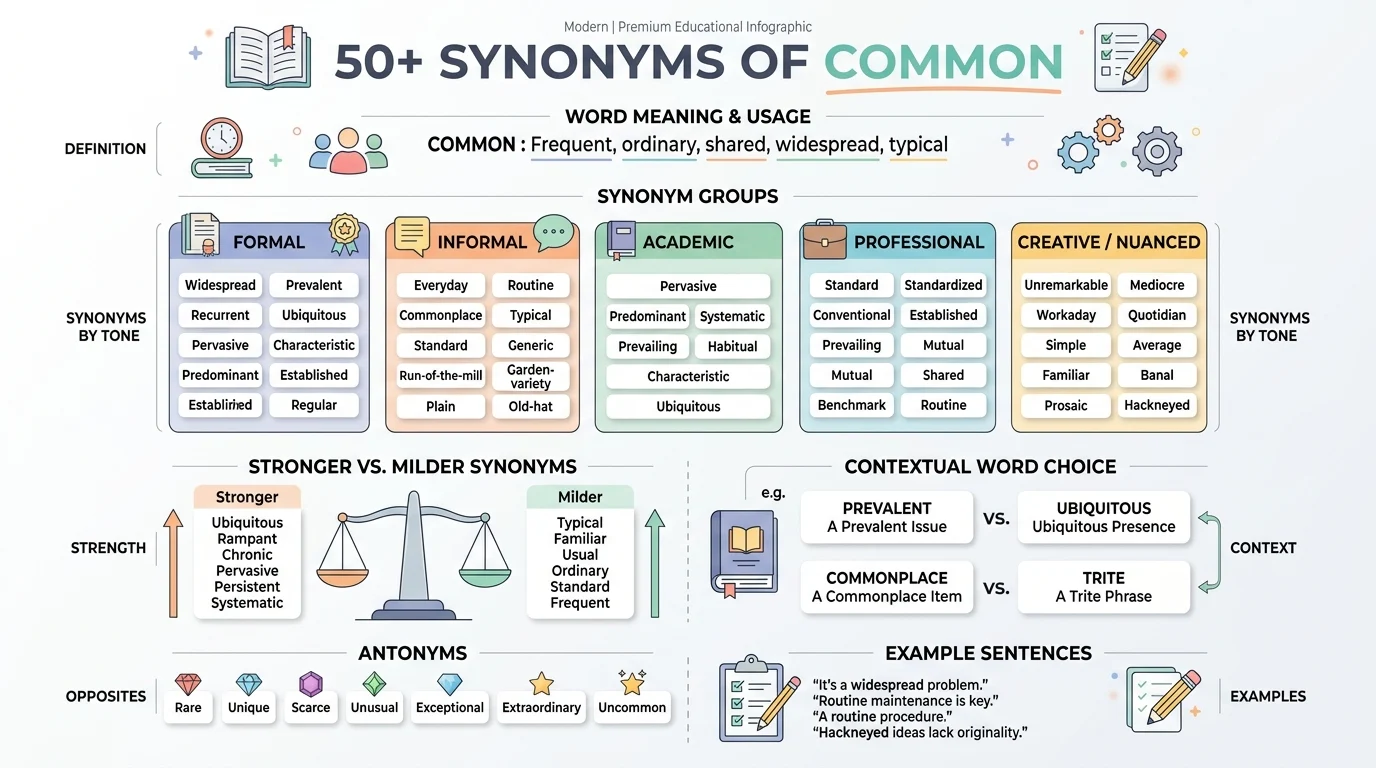
“Common” means something that happens often, is shared by many, or is ordinary and not special. For formal writing, choose “widespread” or “prevalent.” For casual conversation, use “everyday” or “regular.” In academic contexts, “ubiquitous” or “pervasive” sound more authoritative. For professional communication, “standard” and “routine” work well.
Meaning, Tone, and Context
Simple Definition
“Common” is an adjective that describes something that occurs frequently, is found in large numbers, is shared by multiple people or groups, or is ordinary and without special distinction.
Part of Speech
Adjective. It can also be used as a noun in specific contexts, such as “the common good” or “the commons” (a public area).
Overall Tone
Neutral. However, its tone can shift depending on context. In some cases, it can be slightly negative (implying something is ordinary or low-class). In others, it is purely descriptive.
Formality Level
Neutral to semi-formal. It is appropriate for most everyday writing and speaking but may be too vague for academic or highly professional contexts.
Common Uses
Native English speakers use “common” to describe everyday occurrences (“a common mistake”), shared interests (“a common goal”), and widespread phenomena (“a common belief”). It is also used in phrases like “common sense” and “common knowledge”.
Word Forms
- Adjective: common
- Adverb: commonly
- Noun: commonness, commonality
- Verb: (none)
When and How to Use “Common”
You should choose “common” when you need a straightforward, neutral word that everyone understands. It is the safe choice for general audiences. However, relying on it too often can make your writing feel uninspired. Here are seven examples showing how “common” is used in different contexts.
Professional:
“It is common practice in our industry to send a follow-up email after the initial meeting.”
Academic:
“The study found that this error is common among first-year university students.”
Workplace:
“We have a common goal: to increase our quarterly sales by ten percent.”
Personal:
“We discovered we had a common interest in vintage vinyl records.”
Email:
“It is common for new employees to have questions about the benefits package.”
Resume:
“Possesses common skills required for project management, including budgeting and scheduling.”
Social Media:
“This is a common question I get from followers, so I am answering it here.”
Best Synonyms of “Common”
No synonym is identical to “common” in every situation. The best choice depends on your audience, your purpose, and the specific shade of meaning you want to convey. Here are the best synonyms of common for various contexts.
- Professional writing: “Standard.” It implies an established, accepted norm.
- Academic writing: “Prevalent.” It suggests something is widespread and commonly found in research or data.
- Business communication: “Routine.” It emphasizes regular, scheduled, or habitual actions.
- Casual conversation: “Everyday.” It fits perfectly into natural, informal speech.
- Emotional writing: “Familiar.” It adds a touch of warmth and personal connection.
- Creative writing: “Ubiquitous.” This word adds a sophisticated, almost poetic flair.
- Resume writing: “Established.” It suggests a solid, proven track record.
- Stronger meaning: “Pervasive.” It conveys that something is everywhere and hard to escape.
- Softer meaning: “Typical.” It is less forceful and suggests something is simply expected.
When Not to Use “Common”
Using “common” is not always the best choice. Here are situations where you should consider a stronger, more precise alternative.
When it sounds too vague:
Incorrect: “We have a common problem.”
Better: “We have a recurring problem.” (This clarifies that the problem happens repeatedly.)
Why: “Recurring” is more specific and suggests a pattern that needs addressing.
When it sounds too formal:
Incorrect: “I have a common cup of coffee every morning.”
Better: “I have my usual cup of coffee every morning.”
Why: “Usual” feels more personal and natural for everyday habits.
It sounds too informal:
Incorrect: “The study found a common trend in the data.”
Better: “The study found a prevalent trend in the data.”
Why: “Prevalent” is more authoritative and precise for academic writing.
When it sounds too weak:
Incorrect: “Smartphones are common in modern society.”
Better: “Smartphones are ubiquitous in modern society.”
Why: “Ubiquitous” is much stronger and emphasizes that they are everywhere.
When it sounds outdated:
“Common” is rarely outdated, but in British English, it can mean “low-class” or “vulgar,” which is an old-fashioned usage. Avoid this meaning in American English.
Words Commonly Confused With “Common”
Many words are similar to “common,” but they are not always interchangeable. Understanding the differences will help you choose the right word every time.
Common vs. Ordinary
Difference: “Ordinary” emphasizes that something is average or unremarkable. “Common” emphasizes frequency or shared nature.
When to Use It: Use “ordinary” when you want to highlight that something is not special. Use “common” when you want to highlight that something happens often.
Example: “It was just an ordinary day.” vs. “It is common to see tourists in this area.”
Common vs. Usual
Difference: “Usual” is more personal and refers to what is expected based on habit or routine. “Common” refers to what is widespread among many people.
When to Use It: Use “usual” for personal routines. Use “common” for general observations.
Example: “I took my usual route to work.” vs. “It is common for people to take this route.”
Common vs. Normal
Difference: “Normal” implies conformity to a standard or what is considered typical or healthy. “Common” simply implies frequency.
When to Use It: Use “normal” when discussing standards or expectations. Use “common” when discussing frequency.
Example: “Her blood pressure is normal.” vs. “Headaches are common.”
Common vs. General
Difference: “General” is broader and refers to the whole or the majority. “Common” refers to something shared or frequently encountered.
When to Use It: Use “general” for overall concepts. Use “common” for specific, frequent occurrences.
Example: “The general opinion is that the movie is good.” vs. “It is common for people to enjoy this movie.”
Common vs. Widespread
Difference: “Widespread” specifically means found over a large area or among many people. “Common” is more general.
When to Use It: Use “widespread” when you want to emphasize geographic or demographic reach.
Example: “The disease is widespread in rural areas.” vs. “Colds are common in winter.”
Best Synonyms of “Common” by Context
How to Choose the Best Synonym of “Common”
Choosing the right synonym does not have to be difficult. Follow this practical decision guide.
- Ask yourself: What is the main point? If you are emphasizing frequency, choose words like “frequent” or “routine.” If you are emphasizing shared ownership, choose words like “collective” or “mutual.”
- Consider your audience. For a formal report, use “prevalent” or “widespread.” For a text message to a friend, use “usual” or “everyday.”
- Think about emotional strength. Do you want a neutral word like “standard”? Or a stronger word like “pervasive”?
- Check the tone. Is your writing positive, negative, or neutral? “Ordinary” can sometimes sound negative, while “familiar” sounds positive.
- Read the sentence aloud. The best synonym is the one that sounds most natural in your sentence.
Real Life Examples of “Common”
Here are realistic examples showing how to replace “common” with stronger synonyms in different situations.
School:
“Making spelling errors is common among young children.”
Improved: “Making spelling errors is typical among young children.”
College:
“It is common for students to feel stressed during exams.”
Improved: “It is prevalent for students to feel stressed during exams.”
Workplace:
“We have a common goal to finish this project.”
Improved: “We have a shared goal to finish this project.”
Business:
“This is a common complaint from our clients.”
Improved: “This is a frequent complaint from our clients.”
Email:
“It is common to have questions about the new software.”
Improved: “It is usual to have questions about the new software.”
Resume:
“I have common skills in Microsoft Office.”
Improved: “I have standard skills in Microsoft Office.”
Conversation:
“That is a common name around here.”
Improved: “That is a familiar name around here.”
Storytelling:
“The common sound of rain filled the night.”
Improved: “The familiar sound of rain filled the night.”
Blogging:
“This is a common mistake new bloggers make.”
Improved: “This is a routine mistake new bloggers make.”
Social Media:
“This is a common question I get.”
Improved: “This is a frequent question I get.”
18 Best Synonyms of “Common”
Synonyms of “Common” by Usage
Professional vs Personal Synonyms
In the workplace, you want to sound competent and clear. Use words like “standard,” “established,” and “routine.” In personal conversations, you can be more relaxed and use words like “usual,” “everyday,” and “regular.”
Formal vs Conversational Synonyms
For reports, essays, and business writing, choose formal synonyms like “widespread,” “prevalent,” and “ubiquitous.” For casual conversations, texting, and social media, choose conversational synonyms like “usual,” “everyday,” and “typical.
Academic Synonyms
In academic writing, precision is key. Use words like “prevalent,” “pervasive,” “ubiquitous,” and “widespread.” These words are commonly found in research papers and scholarly articles and sound more authoritative than “common.”
Professional and Business Synonyms
For resumes, interviews, and client communication, choose words that convey competence and reliability. “Standard,” “established,” “routine,” and “customary” are excellent choices. They suggest that you understand and follow professional norms.
Creative and Literary Synonyms
For storytelling, fiction, and poetry, choose words that add emotion and imagery. “Ubiquitous,” “pervasive,” and “familiar” can create a specific mood or atmosphere. “Ubiquitous” suggests something is everywhere, while “familiar” suggests warmth and recognition.
Slang or Modern Synonyms
While “common” does not have many direct slang equivalents, phrases like “dime a dozen” are used informally to mean something is very common and not special. This phrase is acceptable in casual conversation but should be avoided in formal writing.
Strongest to Mildest Synonyms
Mild → Moderate → Strong → Very Strong
- Mild: Typical, Plain, Usual
- Moderate: Ordinary, Regular, Everyday
- Strong: Standard, Widespread, Prevalent
- Very Strong: Ubiquitous, Pervasive
Emotional vs Neutral Synonyms
Emotional Synonyms: “Familiar” (warmth), “Pervasive” (anxiety or fear), “Ubiquitous” (awe). These words carry a feeling.
Neutral Synonyms: “Standard,” “Routine,” “Usual,” “Regular.” These words simply communicate information without adding emotion.
Antonyms of “Common”
| Antonym | Meaning | Example Sentence |
|---|---|---|
| Rare | Not found often | “This is a rare flower.” |
| Uncommon | Not common | “It is uncommon to see snow in July.” |
| Unique | Being the only one of its kind | “Each snowflake is unique.” |
| Exceptional | Unusually good | “She has exceptional talent.” |
| Peculiar | Strange or unusual | “He has a peculiar habit.” |
| Extraordinary | Very unusual or remarkable | “The view was extraordinary.” |
| Special | Better or different from usual | “Today is a special day.” |
| Particular | Specific, not general | “She has a particular preference.” |
| Individual | Single, separate | “Each person has an individual style.” |
| Private | Not public or shared | “This is a private matter.” |
| Personal | Belonging to a specific person | “That is my personal opinion.” |
| Distinct | Clearly different | “The two species are distinct.” |
| Notable | Worthy of attention | “He made a notable contribution.” |
| Infrequent | Not happening often | “Visits are infrequent.” |
| Rarefied | Belonging to a select group | “She moved in rarefied circles.” |
Comparison: “Common” vs Similar Words
Common vs Prevalent
Main Difference: “Common” means happening often. “Prevalent” means widespread in a particular place or among a particular group.
Which Is Stronger? Prevalent is stronger and more specific.
Which Is More Formal? Prevalent is more formal and academic.
When to Use Each: Use “common” for general frequency. Use “prevalent” for research or scientific contexts.
Examples:
- Common: “Rain is common in April.”
- Prevalent: “Malaria is prevalent in tropical regions.”
Common vs Ubiquitous
Main Difference: “Common” means happening often. “Ubiquitous” means appearing everywhere.
Which Is Stronger? Ubiquitous is much stronger.
Which Is More Formal? Ubiquitous is more formal and literary.
When to Use Each: Use “common” for general observations. Use “ubiquitous” for dramatic emphasis.
Examples:
- Common: “Coffee shops are common in this city.”
- Ubiquitous: “Coffee shops are ubiquitous in this city.”
Common vs Widespread
Main Difference: “Common” means happening often. “Widespread” means found over a large area.
Which Is Stronger? Widespread is stronger in terms of reach.
Which Is More Formal? Widespread is more formal.
When to Use Each: Use “common” for frequency. Use “widespread” for geographic or demographic distribution.
Examples:
- Common: “The flu is common in winter.”
- Widespread: “The flu is widespread across the country.”
Common vs Typical
Main Difference: “Common” means happening often. Typical” means serving as a representative example.
Which Is Stronger? Neither is inherently stronger; they have different meanings.
Which Is More Formal? Both are neutral.
When to Use Each: Use “common” for frequency. Use “typical” for examples or expectations.
Examples:
- Common: “This is a common mistake.”
- Typical: “This is a typical mistake for beginners.”
Common vs Standard
Main Difference: “Common” means happening often. “Standard” means established as a model or norm.
Which Is Stronger? Standard implies authority.
Which Is More Formal? Standard is more formal and professional.
When to Use Each: Use “common” for general frequency. Use “standard” for procedures and expectations.
Examples:
- Common: “This is a common procedure.”
- Standard: “This is the standard procedure.”
Common vs Ordinary
Main Difference: “Common” means happening often or shared. “Ordinary” means average or not special.
Which Is Stronger? Neither is inherently stronger.
Which Is More Formal? Both are neutral.
When to Use Each: Use “common” for frequency or shared nature. Use “ordinary” for lack of distinction.
Examples:
- Common: “This is a common problem.”
- Ordinary: “This is an ordinary problem.”
Common Phrases and Expressions with “Common”
Common Mistakes to Avoid
1: Choosing a vague synonym instead of a precise one.
Incorrect: “We have a common issue with the software.”
Better: “We have a recurring issue with the software.”
Why: “Recurring” is more precise and suggests a pattern.
2: Confusing “common” with “ordinary.”
Incorrect: “It is an ordinary mistake.” (When you mean it happens often.)
Better: “It is a common mistake.” (When you mean it happens often.)
Why: “Ordinary” means not special, while “common” means frequent.
3: Using an informal synonym in formal writing.
Incorrect: “This problem is a dime a dozen.” (In a formal report.)
Better: “This problem is widespread.” (In a formal report.)
Why: “Dime a dozen” is too informal for professional or academic writing.
4: Selecting an overly dramatic synonym.
Incorrect: “The problem is ubiquitous.” (When you only mean it happens sometimes.)
Better: “The problem is common.” (When you only mean it happens sometimes.)
Why: “Ubiquitous” means everywhere, which is too strong for many situations.
5: Repeating the same word too often.
Incorrect: “It is common to see this. It is also common to see that.”
Better: “It is common to see this. It is also typical to see that.”
Why: Varying your word choice makes your writing more interesting.
6: Choosing a synonym with the wrong emotional tone.
Incorrect: “The familiar rain ruined our picnic.” (When you mean it happens often.)
Better: “The common rain ruined our picnic.” (When you mean it happens often.)
Why: “Familiar” has a warm, positive tone, while “common” is neutral.
Frequently Asked Questions
1. What are the best synonyms of “common”?
The best synonyms depend on the context. Frequency, use “usual” or “regular.” For shared nature, use “mutual” or “collective.” For ordinariness, use “ordinary” or “typical.”
2. What are the best formal synonyms of “common”?
The best formal synonyms are “widespread,” “prevalent,” “ubiquitous,” and “pervasive.” These words are commonly used in academic and professional writing.
3. What are common informal synonyms of “common”?
Common informal synonyms include “everyday,” “regular,” “usual,” and “plain.” These words are perfect for casual conversations and everyday writing.
4. What is another word for “common” in professional writing?
In professional writing, “standard,” “routine,” “customary,” and “established” are excellent alternatives to “common”.
5. What is the difference between “common” and “ordinary”?
“Common” emphasizes frequency or shared nature, while “ordinary” emphasizes that something is average or not special. “Common” is about how often something happens; “ordinary” is about how special something is.
6. What is the opposite of “common”?
The opposite of “common” is “rare,” “uncommon,” “unique,” or “exceptional”. These words describe things that do not happen often or are not shared by many.
Conclusion
“Common” is a versatile word that describes frequent occurrences, shared interests, and ordinary things. While it is a useful word, it is not always the best choice. By learning the synonyms of common, you can make your writing more precise, engaging, and professional. Remember that no synonym works perfectly in every situation. The best word depends on your audience, your tone, and your purpose. Whether you are writing a formal report, a casual email, or a creative story, there is a perfect synonym waiting for you. Challenge yourself to replace “common” with a stronger, more specific word in your next piece of writing. You will be surprised at how much your communication improves.
Definitions, meanings, and usage recommendations should be verified with trusted language references before publication. Recommended sources include Cambridge Dictionary, Oxford English Dictionary, Merriam Webster, Collins Dictionary, and Britannica.
2 thoughts on “50+ Synonyms of Common | Meanings, Uses, Examples, and Best Alternatives”