Do you find yourself using the word “increase” too often in your writing? You are not alone. Many writers, students, and professionals rely on this common word repeatedly. This habit can make your content sound dull and repetitive.
Imagine you are writing a business report about sales growth. You write “increase” five times in one paragraph. Your reader notices the repetition immediately. Your message loses its impact and your credibility suffers.
This guide solves that problem. You will learn over 50 powerful synonyms for increase. Each alternative comes with clear meanings, context based usage, and practical examples. You will never overuse “increase” again.
What Does “Increase” Mean?
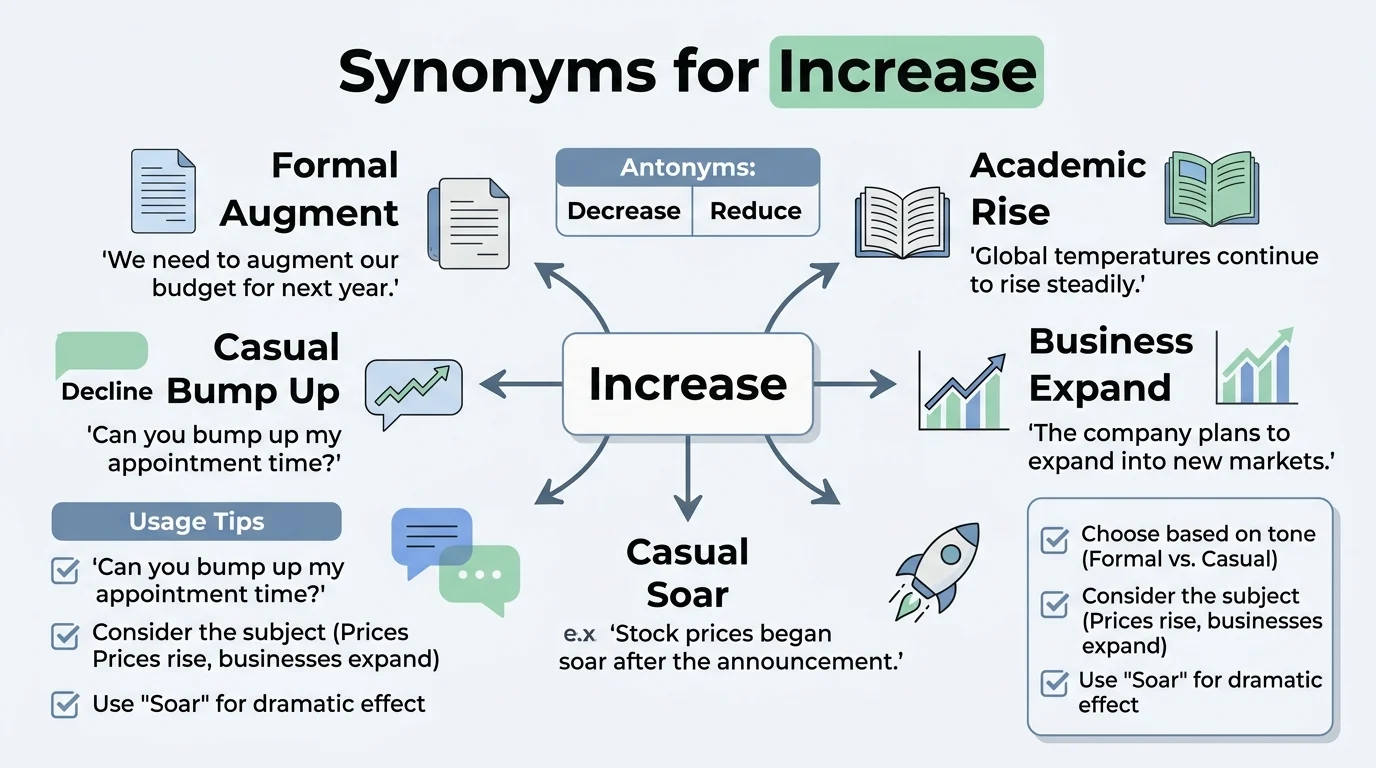
Increase means to become larger or greater in size, amount, number, or degree. The best synonyms depend on your context. Use “grow” for general situations, “escalate” for intense changes, “expand” for physical or business growth, and “rise” for upward movement. Formal writing prefers “augment” while casual conversation uses “bump up.”
Meaning, Tone and Context
Simple Definition
Increase means to make or become larger, greater, or more numerous. It describes positive growth or upward change in quantity, intensity, or value.
Part of Speech
Increase functions as both a verb and a noun. As a verb, it shows action: “Sales increase each quarter.” As a noun, it names the change: “We saw an increase in traffic.”
Tone
Neutral and factual. The tone depends entirely on how you use it. Increase itself carries no strong emotion. It simply states a change in size or amount.
Formality Level
Standard formality. The word works in nearly every situation. You can use it in casual conversation, academic papers, and professional reports. It is not too formal or too casual.
Common Use Cases
Business reports, academic essays, news articles, financial documents, scientific writing, everyday conversation, and professional emails.
Important Word Forms
Adjective: increased. Noun: increase. Verb: increase. Opposite: decrease. Related: increasingly.
When and How to Use “Increase”
Use “increase” when you need a straightforward, neutral word for growth. It works best for general statements about numbers, amounts, or levels.
Here are realistic examples across different contexts:
Professional
Our quarterly revenue increased by 15 percent compared to last year.
Personal
My daily step count increased after I started walking to work.
Academic
The study found that student engagement increased with smaller class sizes.
Emotional
Her confidence increased steadily after each successful presentation.
Creative
The tension increased with every passing moment as the storm approached.
Social Media
Our follower count increased dramatically after the viral video.
Email
We plan to increase our marketing budget for the upcoming quarter.
Resume
Increased departmental efficiency by implementing new workflow systems.
Another Word for “Increase”
The best single replacement depends entirely on your situation. Here are direct recommendations for specific contexts:
Professional Writing
Use “grow” for general business growth. Use “expand” for market or operations growth. Use “boost” for performance improvement.
Academic Writing
Use “rise” for statistical changes. Use “escalate” for intensity. Use “augment” for deliberate additions.
Casual Conversation
Use “bump up” for small increases. Use “crank up” for intensity. Use “pick up” for speed or momentum.
Emotional Writing
Use “swell” for emotional growth. Use “surge” for sudden powerful feelings. Use “heighten” for awareness or sensitivity.
Creative Writing
Use “burgeon” for rapid growth. Use “mushroom” for explosive increase. Use “snowball” for accumulating growth.
Resume and Workplace
Use “maximize” for reaching full potential. Use “optimize” for efficiency gains. Use “accelerate” for speed increases.
Social Media Captions
Use “blow up” for viral content. Use “skyrocket” for dramatic growth. Use “pop off” for sudden popularity.
Stronger Meaning
Use “surge” for sudden powerful increases. Use “spike” for sharp upward movement. Use “soar” for reaching high levels.
Softer Meaning
Use “edge up” for slight increases. Use “creep up” for gradual movement. Use “inch up” for very small gains.
When Not to Use “Increase”
The word “increase” sounds too vague and neutral for many situations. It fails to capture intensity, speed, or emotional weight.
Consider this weak sentence:
“The company increased its profits.”
Now compare it with a stronger alternative:
“The company maximized its profits through strategic investments.”
The second sentence shows intention and action. The first sentence simply states a fact.
Do not use “increase” when you need to show:
- Dramatic change: use “surge” or “soar”
- Deliberate action: use “boost” or “augment”
- Emotional impact: use “heighten” or “intensify”
- Physical expansion: use “expand” or “swell”
- Precise measurements: use “rise” or “climb”
Words Commonly Confused With “Increase”
Many words seem similar to increase but carry distinct meanings. Understanding these differences will improve your word choice.
Increase vs. Multiply
“Multiply” suggests repeated growth or reproduction. Use it for exponential growth or repeated additions. “The bacteria multiplied rapidly.” Use “increase” for simple growth. “Our sales increased this month.”
Increase vs. Expand
“Expand” suggests growth in size, scope, or area. Use it for physical or conceptual broadening. “We expanded our product line.” Use “increase” for quantity or amount. “We increased our production volume.”
Increase vs. Escalate
“Escalate” suggests intensifying conflict or serious situations. Use it for tension or problems. “The dispute escalated quickly.” Use “increase” for neutral changes. “The temperature increased gradually.”
Increase vs. Enlarge
“Enlarge” specifically refers to making something physically bigger. Use it for images or objects. “We enlarged the photograph.” Use “increase” for abstract quantities. “We increased our budget.”
Increase vs. Amplify
“Amplify” means to make louder or more intense. Use it for sound or effect. “The microphone amplified her voice.” Use “increase” for general growth. “We increased our efforts.”
Increase vs. Accrue
“Accrue” means to accumulate over time. Use it for gradual building. “Interest accrues on the account.” Use “increase” for any growth pattern. “Our savings increased.”
Best Synonym by Context for “Increase”
| Context | Best Synonym | Why It Works | Example |
|---|---|---|---|
| Formal Writing | Augment | Sounds precise and deliberate | The committee voted to augment the funding for research programs |
| Academic Writing | Rise | Shows statistical or measured growth | The data shows a significant rise in literacy rates |
| Professional Business | Expand | Suggests strategic growth and development | We plan to expand our operations into European markets |
| Resume Writing | Maximize | Demonstrates achievement of full potential | Maximized team productivity through improved training methods |
| Casual Conversation | Bump up | Feels natural and conversational | We should bump up the price a little |
| Creative Writing | Burgeon | Adds literary elegance and imagery | Her talent burgeoned with each passing year |
| Emotional Tone | Heighten | Captures increased awareness or feeling | The music heightened the emotional impact of the scene |
| Strong Intensity | Soar | Shows dramatic powerful growth | Stock prices soared to record highs |
| Soft Moderate Tone | Edge up | Describes small gradual increases | Housing prices continue to edge up slowly |
| Social Media Captions | Skyrocket | Creates excitement about rapid growth | Our engagement skyrocketed after that post |
| Technical Writing | Accelerate | Describes speed increases | The reaction accelerates when heat is applied |
| Financial Writing | Appreciate | Refers to value increases over time | Real estate values appreciate steadily |
| Medical Writing | Elevate | Describes rising levels or pressure | The medication elevates blood pressure slightly |
| Environmental Writing | Escalate | Shows intensifying problems or effects | Climate change escalates weather pattern disruptions |
| Everyday Speech | Pick up | Sounds natural for speed or momentum | Business finally picked up after the holidays |
Which Synonym Should You Choose?
Your choice depends on several key factors. Consider meaning first. What type of increase are you describing? Is it physical size, quantity, intensity, or value?
Think about formality. Professional documents need precise words like “augment” or “expand.” Casual conversations work better with “bump up” or “pick up.”
Consider emotional intensity. Do you want to sound neutral or passionate? Use “soar” for dramatic growth. Use “rise” for factual statements.
Examine your sentence structure. Some synonyms work better with specific objects. You expand a business but heighten awareness. You boost performance but augment resources.
Think about your audience. Academic readers expect “rise” or “escalate.” Business readers prefer “expand” or “grow.” Social media followers respond to “skyrocket” or “blow up.”
Real Life Examples of “Increase” in Sentences
Here are examples showing how increase and its synonyms work across different situations.
School
The teacher noticed that reading comprehension increased after daily practice sessions.
Workplace
Our department expanded its influence by collaborating with other teams.
Writing
The author heightened the suspense by revealing clues slowly.
Conversation
I need to bump up my workout intensity to see better results.
Social Media
Our views skyrocketed after the influencer shared our content.
Resume
Accelerated product development timelines by streamlining approval processes.
Email
We plan to boost our advertising spend in the coming quarter.
Storytelling
Tension soared as the hero approached the dragon’s lair.
15 Synonyms for “Increase”
| Synonym | Simple Meaning | Best Used For | Example Sentence |
|---|---|---|---|
| Grow | Become larger naturally or gradually | General growth and development | The business grew steadily over five years |
| Rise | Move upward or become higher | Statistics, levels, and quantities | Unemployment rates rose sharply last month |
| Expand | Increase in size, scope, or extent | Business, operations, or physical space | We expanded our warehouse to accommodate more inventory |
| Boost | Give an upward push or improvement | Performance, morale, or energy | The new strategy boosted employee engagement |
| Augment | Make greater through addition | Formal writing and deliberate increases | The university augmented its scholarship program |
| Escalate | Increase in intensity or seriousness | Tension, conflict, or dangerous situations | Costs escalated beyond our initial estimates |
| Soar | Rise to a very high level | Dramatic and impressive growth | Profits soared after the product launch |
| Surge | Rise suddenly and powerfully | Rapid and powerful increases | Demand surged during the holiday season |
| Heighten | Make more intense or acute | Emotions, awareness, or sensitivity | The incident heightened security concerns |
| Swell | Become larger in size or volume | Physical size or emotional feelings | Her pride swelled after winning the award |
| Enlarge | Make physically larger | Images, objects, or physical spaces | We enlarged the seating area for more customers |
| Amplify | Increase in strength or intensity | Sound, effects, or significance | The amplifier amplified the music |
| Accumulate | Gather together over time | Gradual building of quantities | Dust accumulated on the old bookshelves |
| Multiply | Increase in number through reproduction | Population, problems, or repeated growth | Rabbits multiply quickly in favorable conditions |
| Snowball | Increase rapidly in size or impact | Problems, success, or momentum | The protest snowballed into a national movement |
Synonym Groups and Usage Differences
Professional vs. Personal Synonyms
Professional contexts favor precise, action oriented words. “Expand” shows strategic business growth. “Boost” suggests measurable improvement. “Maximize” demonstrates efficiency.
Personal situations welcome more casual options. “Bump up” works for everyday increases. “Pick up” describes momentum. “Crank up” fits informal intensity.
Formal vs. Conversational Synonyms
Formal writing demands elevated vocabulary. “Augment” appears in official documents. “Escalate” suits serious discussions. “Amplify” works for scientific writing.
Conversational English prefers simple words. “Grow” sounds natural in speech. “Rise” appears in everyday news. “Boost” fits casual professional talk.
Academic Synonyms
Academic writing values precision and clarity. “Rise” describes statistical data. “Escalate” indicates increasing trends. “Accumulate” shows gradual building.
Research papers use “augment” for deliberate additions. Scientific writing employs “elevate” for measurable levels. Formal essays prefer “heighten” for awareness.
Professional and Business Synonyms
Business communication needs action words. “Expand” shows growth strategy. “Boost” indicates improvement. “Maximize” suggests optimization.
Reports use “grow” for market development. Presentations favor “surge” for dramatic results. Emails use “bump up” for informal planning.
Creative or Literary Synonyms
Creative writing benefits from vivid imagery. “Burgeon” suggests beautiful growth. “Swell” captures emotional expansion. “Soar” creates dramatic visual impact.
Poetry uses “heighten” for sensory details. Novels employ “escalate” for rising tension. Descriptive writing uses “amplify” for atmospheric effects.
Strongest vs. Weaker Synonyms
Intensity scale from mild to strongest:
- Edge up: very small increase
- Inch up: barely noticeable growth
- Grow: steady natural increase
- Rise: upward movement
- Expand: significant broadening
- Boost: active improvement
- Surge: sudden powerful rise
- Soar: dramatic high increase
- Skyrocket: explosive growth
- Explode: extreme sudden growth
Emotional vs. Neutral Synonyms
Emotional synonyms add feeling and intensity. “Swell” suggests pride or joy. “Heighten” indicates increased awareness. “Surge” shows powerful emotional movement.
Neutral synonyms stay factual and objective. “Grow” simply states development. “Rise” reports upward change. “Expand” describes scope increase.
Antonyms of “Increase”
| Antonym | Meaning | Example Sentence |
|---|---|---|
| Decrease | Become smaller or less | Costs decreased after the price adjustment |
| Reduce | Make smaller in size or amount | We reduced our carbon footprint |
| Decline | Become smaller or weaker | Sales declined during the recession |
| Diminish | Make or become less important | His influence diminished over time |
| Shrink | Become smaller in size | The market shrank during the downturn |
| Lessen | Make or become less in degree | Pain lessened after treatment |
| Lower | Move something downward | The company lowered its prices |
| Drop | Fall or decrease in amount | Temperatures dropped overnight |
| Fall | Decrease in level or amount | Housing prices fell sharply |
| Deplete | Reduce the amount of something | Resources were depleted quickly |
| Contract | Become smaller or shorter | The economy contracted last year |
| Ebb | Recede or flow back | Support began to ebb |
| Wane | Become weaker or smaller | Public interest waned |
| Slump | Decline significantly | Sales slumped during the summer |
| Plummet | Fall suddenly and steeply | Stock values plummeted |
Comparison: Increase vs. Similar Words
Increase vs. Grow
Main difference: Increase focuses on quantity and amount. Grow suggests natural development and expansion.
Which is stronger: Increase feels more technical. Grow sounds more organic.
Which is more formal: Increase works better in formal documents. Grow fits general writing.
Example with increase: “We increased our production capacity.”
Example with grow: “Our business grew organically.”
Increase vs. Rise
Main difference: Rise specifically suggests upward movement. Increase covers any type of growth.
Which is stronger: Rise feels more dynamic. Increase sounds more measured.
Which is more formal: Both are formal but rise suits statistics better.
Example with increase: “The temperature increased by five degrees.”
Example with rise: “Sea levels continue to rise.”
Increase vs. Boost
Main difference: Boost implies deliberate action to improve. Increase simply states change.
Which is stronger: Boost suggests active effort. Increase seems more passive.
Which is more formal: Boost is less formal than increase.
Example with increase: “Funding increased this year.”
Example with boost: “We boosted our marketing efforts.”
Increase vs. Expand
Main difference: Expand refers to physical or conceptual breadth. Increase refers to quantity.
Which is stronger: Expand suggests significant change. Increase can mean any change.
Which is more formal: Expand works well in business writing.
Example with increase: “Our staff increased to fifty people.”
Example with expand: “We expanded our services nationwide.”
Increase vs. Escalate
Main difference: Escalate suggests intensifying problems or conflict. Increase is neutral.
Which is stronger: Escalate carries more intensity.
Which is more formal: Escalate is formal but specific.
Example with increase: “Costs increased gradually.”
Example with escalate: “The conflict escalated quickly.”
Increase vs. Surge
Main difference: Surge describes sudden powerful growth. Increase can be slow or fast.
Which is stronger: Surge is much stronger and more dramatic.
Which is more formal: Surge is less formal than increase.
Example with increase: “Demand increased slightly.”
Example with surge: “Demand surged after the announcement.”
Common Phrases and Expressions with “Increase”
1. On the increase
Meaning: Becoming more frequent or common
Example sentence: Smartphone usage is on the increase among young children.
2. Increase by leaps and bounds
Meaning: Grow very rapidly
Example sentence: Her confidence increased by leaps and bounds after the training program.
3. A sharp increase
Meaning: A sudden significant rise
Example sentence: The economy saw a sharp increase in employment rates.
4. A steady increase
Meaning: Consistent gradual growth
Example sentence: We observed a steady increase in website traffic.
5. Increase in value
Meaning: Become worth more money
Example sentence: Real estate has increased in value over the past decade.
6. Increase the stakes
Meaning: Raise the level of risk or commitment
Example sentence: The new partnership increased the stakes for both companies.
7. Increase productivity
Meaning: Improve output or efficiency
Example sentence: Technology has helped us increase productivity significantly.
8. Increase awareness
Meaning: Make more people know about something
Example sentence: Social media campaigns increase awareness about important issues.
Common Mistakes to Avoid
1. Using a Vague Synonym
Do not use “increase” when a more precise word exists. “The problem increased” sounds weak. “The problem escalated” creates stronger impact.
2. Confusing Similar Words
Do not confuse “increase” with “amplify.” Amplify specifically relates to sound or effect. Increase works for general growth.
3. Using Casual Language Formally
Avoid “bump up” in professional reports. Use “augment” or “expand” for formal writing.
4. Overdramatizing Simple Situations
Do not use “skyrocket” for small changes. “Temperatures skyrocketed by two degrees” sounds ridiculous. Use “increased slightly” for modest changes.
5. Repeating the Same Word
Vary your vocabulary. Using “increase” five times in one paragraph shows poor writing. Rotate between “grow,” “rise,” and “expand.”
6. Choosing Wrong Emotional Tone
Avoid “swell” for negative situations. Swell suggests positive emotional growth. Use “escalate” for negative increases.
7. Using Slang in Professional Writing
Never use “crank up” in formal documents. Keep professional writing polished and precise.
FAQs
1. What is the best synonym for increase?
The best synonym depends on your context. Use “grow” for general situations, “expand” for business, and “rise” for statistics.
2. What is a formal synonym for increase?
“Augment” and “escalate” work well in formal writing. “Accumulate” fits academic contexts.
3. What is an informal synonym for increase?
“Bump up” and “crank up” are casual options. “Pick up” works for everyday conversation.
4. What is another word for increase in professional writing?
“Expand,” “boost,” and “maximize” work best in professional contexts. These words show strategic growth.
5. What is the difference between increase and grow?
Increase focuses on quantity and amount. Grow suggests natural organic development and expansion.
6. What is the opposite of increase?
The primary opposite is “decrease.” Other antonyms include “reduce,” “decline,” and “diminish.”
Conclusion
The word “increase” serves a useful purpose in everyday language. It provides a clear neutral way to describe growth. However, overusing this common word makes your writing feel flat and repetitive.
The best approach combines variety with precision. Choose your synonym based on context, formality, and emotional tone. Use “expand” for business growth. Pick “surge” for sudden changes. Select “heighten” for emotional intensity.
Remember that strong writing shows rather than tells. Instead of saying “sales increased,” describe how they “surged” or “soared.” The right word choice transforms ordinary sentences into memorable communication.
Your vocabulary toolkit now contains over 50 alternatives for increase. Practice using them in your daily writing. Your readers will notice the improvement in clarity and impact.