Have you ever found yourself writing an essay, a report, or a social media post and realized you’ve used the word “marginalized” three times in two paragraphs? You know the meaning you want to convey, but repeating the same word makes your writing feel flat and uninspired. Whether you are drafting a research paper on social inequality, crafting a business proposal about inclusion initiatives, or writing a blog post about community advocacy, choosing the right synonym for “marginalized” can transform your communication. The word carries significant weight, and using it thoughtfully shows linguistic precision. This guide explores the best synonyms of marginalized so you can write with clarity, confidence, and impact.
What Are the Best Synonyms of “Marginalized”?
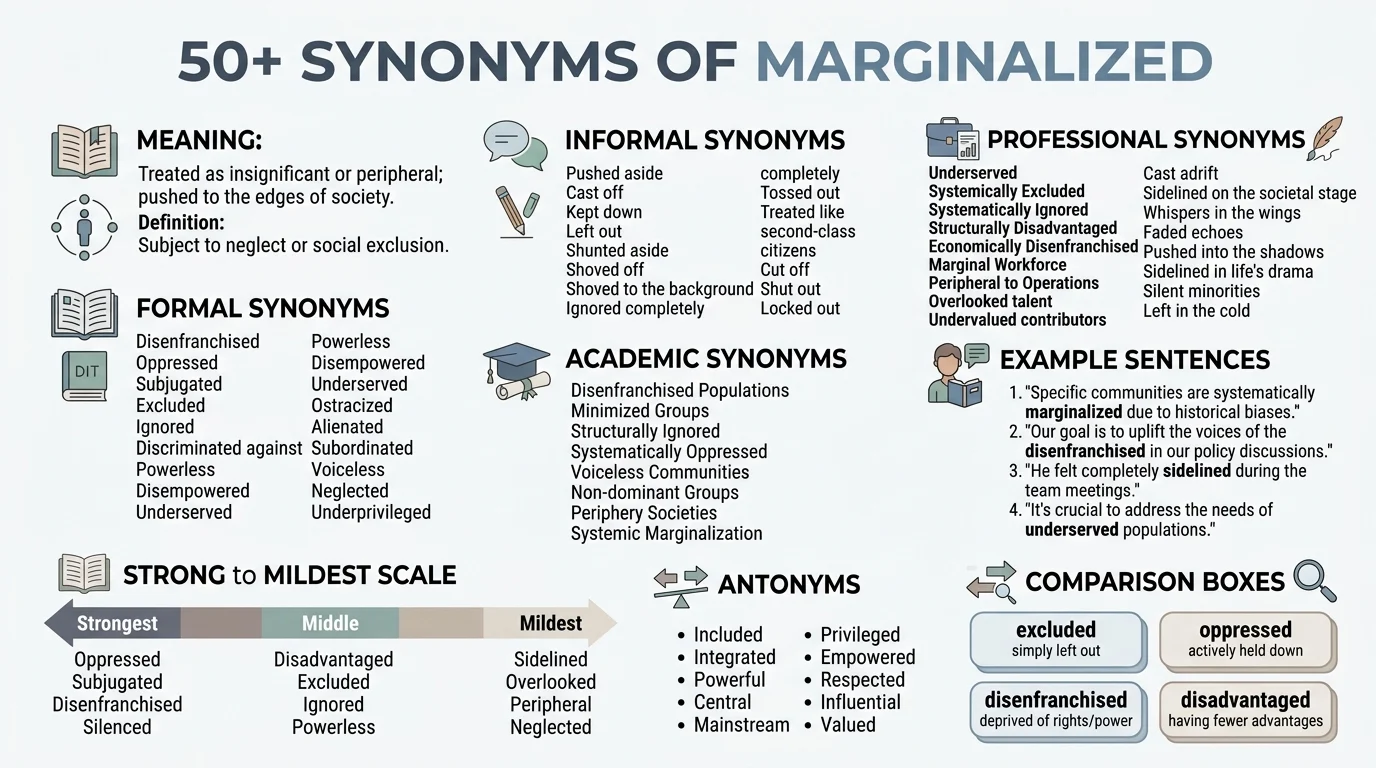
“Marginalized” means pushed to the edges of society or treated as unimportant and powerless. Formal writing, use “disenfranchised” or “disadvantaged.” For academic contexts, choose “peripheralized” or “excluded.” For professional communication, “underrepresented” or “sidelined” work well. In casual conversation, “overlooked” or “left out” are natural choices.
Meaning, Tone, and Context
Simple Definition
To be marginalized means to be relegated to an unimportant or powerless position within a society or group. Marginalized people are treated as insignificant and pushed to the edges of social, economic, or political life.
Part of Speech
Adjective (past participle used as an adjective) and verb (past tense of marginalize).
Overall Tone
Neutral to negative. The word describes an unfair or unjust condition. It is not positive, but it is used objectively in academic, social, and professional writing to describe systemic inequality.
Formality Level
Formal to semi-formal. “Marginalized” is commonly used in academic papers, news articles, policy discussions, and professional reports. It is less common in casual everyday conversation.
Common Uses
Native English speakers use “marginalized” most frequently in discussions about social justice, politics, economics, and community development. Common collocations include:
- marginalized communities
- marginalized groups
- marginalized people
- socially marginalized
- economically marginalized
- marginalized voices
Word Forms
| Form | Word |
|---|---|
| Noun | Marginalization |
| Verb | Marginalize |
| Adjective | Marginalized |
| Adverb | (Marginally — different meaning) |
| Opposite | Empowered, included, mainstreamed |
When and How to Use “Marginalized”
Choose “marginalized” when you need to describe people or groups who have been systematically excluded from power, opportunity, or social participation. The word carries a sense of injustice and structural inequality. Use it in serious discussions about social conditions, not for minor exclusions.
7 Realistic Examples
Professional:
“The company’s diversity report highlighted how employees from certain backgrounds remain marginalized in leadership roles.”
Academic:
“Researchers have documented how marginalized populations experience poorer health outcomes due to limited access to care.”
Workplace:
“Our task force is dedicated to addressing concerns raised by marginalized staff members.”
Personal:
“She grew up in a marginalized neighborhood where opportunities for education were scarce.”
Email:
“I would like to propose a new initiative that specifically supports marginalized students in our program.”
Resume:
“Developed outreach programs that connected marginalized communities with essential social services.”
Social Media:
“It is time we listen to marginalized voices and take their concerns seriously.”
Best Synonyms of “Marginalized”
No synonym is identical in every situation. The best choice depends on your audience, purpose, and the specific shade of meaning you want to convey.
Professional Writing
Underrepresented. This synonym is widely used in workplace and institutional contexts. It focuses on the lack of proportional presence rather than the active process of being pushed out. It sounds objective and solution-oriented.
Academic Writing
Peripheralized. This term carries a strong theoretical foundation and is often used in sociology and political science. It emphasizes the process of being moved to the periphery or margins of society.
Business Communication
Disadvantaged. This word is direct and commonly understood in business settings. It highlights the lack of resources and opportunities without sounding overly political.
Casual Conversation
Left out. This is the most natural choice for everyday speech. It is simple, clear, and does not carry the heavy academic weight of “marginalized.”
Emotional Writing
Cast aside. This phrase adds a human, emotional dimension. It conveys rejection and abandonment, making it powerful for personal narratives or opinion pieces.
Creative Writing
Forgotten. In storytelling, “forgotten” evokes a sense of neglect and isolation. It paints a vivid picture of people or places that have been left behind.
Resume Writing
Underresourced. This word describes communities or groups that lack access to essential resources. It sounds professional and action-oriented.
Workplace Communication
Sidelined. This synonym is excellent for describing individuals or teams that have been pushed aside or deprived of influence within an organization.
Stronger Meaning
Oppressed. This word conveys severe and sustained mistreatment. Use it when the marginalization involves active domination and control.
Softer Meaning
Overlooked. This is a milder alternative. It suggests being forgotten or not noticed rather than actively excluded or mistreated.
When Not to Use “Marginalized”
Too General
Incorrect: “I felt marginalized when my friend didn’t invite me to the party.”
Better: “I felt left out when my friend didn’t invite me to the party.”
Why: “Marginalized” describes systemic exclusion, not minor social slights. Using it for small personal hurts diminishes its meaning.
Too Vague
Incorrect: “The policy marginalized many people.”
Better: “The policy disadvantaged rural communities by limiting their access to healthcare.”
Why: The first sentence is vague. The second specifies who was affected and how.
Too Formal
Incorrect: “I was marginalized by my coworkers during lunch.”
Better: “My coworkers excluded me during lunch.”
Why: In casual conversation, “excluded” sounds more natural and less academic.
Too Weak
Incorrect: “The regime marginalized political dissidents.”
Better: “The regime persecuted political dissidents.”
Why: When describing severe oppression, “persecuted” conveys the appropriate level of intensity.
Too Strong
Incorrect: “The new seating arrangement marginalized the accounting department.”
Better: “The new seating arrangement isolated the accounting department.”
Why: “Marginalized” is too heavy for a minor workplace change. “Isolated” is more proportionate.
Words Commonly Confused With “Marginalized”
Marginalized vs Excluded
Difference: “Excluded” means deliberately kept out, while “marginalized” implies being pushed to the edges but not necessarily entirely excluded.
When to Use It: Use “excluded” when someone is actively barred from participation. Use “marginalized” when someone is present but treated as unimportant.
Example (Excluded): “The committee excluded her from the decision-making process.”
Example (Marginalized): “Her opinions were marginalized during the meeting.”
Marginalized vs Disadvantaged
Difference: “Disadvantaged” focuses on lack of resources and opportunities. “Marginalized” focuses on social positioning and powerlessness.
When to Use It: Use “disadvantaged” when discussing economic or educational barriers. Use “marginalized” when discussing social and political exclusion.
Example (Disadvantaged): “Students from disadvantaged backgrounds received scholarships.”
Example (Marginalized): “Marginalized communities often lack political representation.”
Marginalized vs Oppressed
Difference: “Oppressed” implies active, sustained cruelty and domination. “Marginalized” can describe a broader range of exclusion, including passive neglect.
When to Use It: Use “oppressed” for severe cases involving violence or systemic cruelty. Use “marginalized” for more general exclusion.
Example (Oppressed): “The oppressed population rose up against the dictatorship.”
Example (Marginalized): “The marginalized minority group advocated for equal rights.”
Marginalized vs Sidelined
Difference: “Sidelined” often implies being pushed aside in a specific context, like a workplace or project. “Marginalized” refers to broader social positioning.
When to Use It: Use “sidelined” in professional or team settings. Use “marginalized” in social or political discussions.
Example (Sidelined): “He was sidelined after the department reorganization.”
Example (Marginalized): “Women have been marginalized in corporate leadership for decades.”
Marginalized vs Alienated
Difference: “Alienated” emphasizes the feeling of estrangement and disconnection. “Marginalized” emphasizes the structural position of being pushed to the edges.
When to Use It: Use “alienated” when describing emotional or psychological isolation. Use “marginalized” when describing social or political positioning.
Example (Alienated): “The new policy made him feel alienated from his colleagues.”
Example (Marginalized): “The policy marginalized entire communities.”
Best Synonyms of “Marginalized” by Context
| Context | Best Synonym | Why It Works | Example |
|---|---|---|---|
| Formal writing | Disenfranchised | Sounds authoritative and precise in legal and political contexts | “Disenfranchised voters struggled to make their voices heard.” |
| Academic writing | Peripheralized | Carries strong theoretical weight in sociology and political science | “Peripheralized groups are often excluded from policy discussions.” |
| Professional communication | Underrepresented | Objective and solution-focused; common in workplace diversity discussions | “Underrepresented minorities received targeted mentorship opportunities.” |
| Business emails | Disadvantaged | Direct and widely understood; avoids political overtones | “The program assists disadvantaged small business owners.” |
| Resume writing | Underresourced | Professional and action-oriented; implies need for support | “Expanded services for underresourced communities.” |
| Workplace communication | Sidelined | Perfect for describing loss of influence within an organization | “Her team was sidelined after the merger.” |
| Casual conversation | Left out | Simple, clear, and natural in everyday speech | “I felt left out of the conversation.” |
| Everyday speaking | Overlooked | Mild and relatable; suggests being forgotten rather than excluded | “His contributions were overlooked.” |
| Creative writing | Forgotten | Evocative and poetic; paints a vivid picture of neglect | “The forgotten village lay beyond the hills.” |
| Storytelling | Cast aside | Adds emotional weight and imagery of rejection | “The old traditions were cast aside.” |
| Emotional writing | Silenced | Powerful; conveys suppression of voice and agency | “She refused to remain silenced any longer.” |
| Strong emphasis | Oppressed | Conveys severe, active mistreatment and domination | “Oppressed communities demanded justice.” |
| Mild tone | Neglected | Softer; implies lack of attention rather than active exclusion | “Neglected neighborhoods received new funding.” |
| Social media captions | Ignored | Short, punchy, and relatable for online audiences | “Ignored no more. We stand together.” |
| American English | Marginalized | Standard US spelling | “Marginalized groups need our support.” |
How to Choose the Best Synonym of “Marginalized”
Choosing the right synonym starts with understanding your purpose and audience.
Consider your meaning. Are you describing systemic exclusion? Use “peripheralized” or “disenfranchised.” Are you describing a lack of resources? Use “disadvantaged” or “underresourced.” Are you describing emotional isolation? Use “alienated” or “silenced.”
Consider your tone. Formal writing calls for precise vocabulary like “disenfranchised” or “peripheralized.” Casual conversation calls for simple words like “left out” or “overlooked.” Emotional writing benefits from evocative words like “cast aside” or “forgotten.”
Consider your audience. Academic readers expect theoretical precision. Business readers appreciate clarity and action-orientation. General readers respond to simple, relatable language.
Consider emotional strength. If you need to convey severe oppression, choose “oppressed” or “subjugated.” If you need a milder tone, choose “neglected” or “overlooked.”
Consider naturalness. Always read your sentence aloud. If the synonym sounds forced or awkward, choose a different one. The best synonym is the one that communicates your message most clearly.
Real Life Examples of “Marginalized”
School: “The school implemented programs to support marginalized students who were falling behind.”
College: “Her research focused on how marginalized groups navigate higher education institutions.”
Workplace: “The company’s leadership team lacked diversity, with marginalized employees rarely promoted to senior roles.”
Business: “Our new initiative targets marginalized suppliers and helps them access corporate contracts.”
Email: “I am writing to propose a workshop that addresses the needs of marginalized team members.”
Resume: “Led community outreach efforts that increased engagement among marginalized populations by 40 percent.”
Conversation: “I think we need to do more to include people who have been marginalized in these discussions.”
Storytelling: “The old cottage stood at the edge of the village, marginalized and forgotten by the townspeople.”
Blogging: “In my latest post, I explore how marginalized communities are leading the fight for climate justice.”
Social Media: “Amplify marginalized voices. Share their stories. Make space for their perspectives.”
18 Best Synonyms of “Marginalized”
| Synonym | Simple Meaning | Best Used For | Example Sentence |
|---|---|---|---|
| Disenfranchised | Deprived of rights or power | Political and legal contexts | “Disenfranchised citizens demanded voting rights.” |
| Peripheralized | Pushed to the outer edges | Academic and sociological writing | “Peripheralized regions received little government investment.” |
| Underrepresented | Insufficiently represented | Workplace and institutional diversity discussions | “Underrepresented groups gained greater visibility.” |
| Disadvantaged | Lacking resources and opportunities | Business and social policy | “Disadvantaged families received housing assistance.” |
| Sidelined | Pushed aside from influence | Workplace and team settings | “The experienced manager was sidelined in the reorganization.” |
| Excluded | Deliberately kept out | General use when active exclusion occurs | “The committee excluded her from the final vote.” |
| Alienated | Made to feel isolated or estranged | Emotional and psychological contexts | “He felt alienated from his coworkers after the incident.” |
| Ostracized | Shunned or excluded by a group | Social rejection contexts | “She was ostracized by her peers for speaking out.” |
| Overlooked | Not noticed or considered | Mild tone; general use | “His hard work was consistently overlooked.” |
| Neglected | Not given proper attention | Mild to moderate tone | “Neglected communities received new funding.” |
| Oppressed | Subject to prolonged cruel treatment | Severe injustice contexts | “Oppressed people fought for their freedom.” |
| Disempowered | Deprived of power or agency | Social and political contexts | “Disempowered workers organized for better conditions.” |
| Silenced | Prevented from speaking or being heard | Expression and voice contexts | “The government silenced dissenting voices.” |
| Cast aside | Rejected and abandoned | Emotional and creative writing | “The old traditions were cast aside as irrelevant.” |
| Forgotten | Left behind or ignored | Storytelling and descriptive writing | “The forgotten village lay in ruins.” |
| Downtrodden | Treated badly and oppressed | Emphatic social commentary | “The downtrodden workers demanded fair wages.” |
| Ignored | Deliberately not paid attention to | General use; casual and social media | “Her warnings were ignored by management.” |
| Subjugated | Brought under complete control | Strong oppression contexts | “The subjugated population had no political rights.” |
Synonyms of “Marginalized” by Usage
Professional vs Personal Synonyms
In professional settings, choose words that sound objective and solution-oriented: “underrepresented,” “disadvantaged,” and “underresourced.” These terms are widely understood in business and institutional contexts. They focus on conditions rather than blame.
In personal conversations, choose simpler, more relatable words: “left out,” “overlooked,” and “ignored.” These sound natural and avoid the heavy academic weight of “marginalized.”
Formal vs Conversational Synonyms
Formal (reports, essays, presentations, business writing): “Disenfranchised,” “peripheralized,” “disadvantaged,” “underrepresented.” These words carry authority and precision.
Conversational (casual conversations, texting, social media): “Left out,” “overlooked,” “ignored,” “pushed aside.” These are clear and approachable.
Academic Synonyms
For research papers, essays, and academic discussions, choose precise vocabulary that sounds authoritative: “peripheralized,” “disenfranchised,” “disempowered,” and “excluded.” These terms are widely used in sociology, political science, and economics. They convey theoretical understanding and scholarly rigor.
Professional and Business Synonyms
For resumes, interviews, meetings, and client communication, choose words that sound professional and action-oriented: “underrepresented,” “disadvantaged,” “underresourced,” and “sidelined.” These terms are clear, direct, and commonly used in corporate diversity and inclusion discussions.
Creative and Literary Synonyms
For storytelling, fiction, poetry, and speeches, choose expressive alternatives that add emotion and imagery: “forgotten,” “cast aside,” “silenced,” and “downtrodden.” These words paint vivid pictures and evoke strong emotional responses.
Slang or Modern Synonyms
“Marginalized” does not have widely recognized slang equivalents. The closest modern or informal alternatives are “left out” and “pushed aside.” These are acceptable in casual conversation but should be avoided in formal writing.
Strongest to Mildest Synonyms
| Intensity | Synonyms |
|---|---|
| Mild | Overlooked, neglected, ignored |
| Moderate | Excluded, sidelined, alienated |
| Strong | Disenfranchised, disadvantaged, underrepresented |
| Very Strong | Oppressed, subjugated, downtrodden, silenced |
Emotional vs Neutral Synonyms
Emotional Synonyms: “Oppressed,” “silenced,” “cast aside,” “downtrodden,” “forgotten.” These words express strong feelings of injustice, pain, or abandonment. Use them in opinion pieces, personal narratives, and creative writing.
Neutral Synonyms: “Disadvantaged,” “underrepresented,” “excluded,” “overlooked.” These words simply communicate information without adding strong emotion. Use them in reports, business writing, and academic papers.
Antonyms of “Marginalized”
| Antonym | Meaning | Example Sentence |
|---|---|---|
| Empowered | Given power and authority | “Empowered communities took control of their future.” |
| Included | Brought into a group | “All team members felt included in the decision.” |
| Integrated | Fully combined into a group | “Integrated schools benefited all students.” |
| Mainstreamed | Brought into the mainstream | “Mainstreamed students received equal opportunities.” |
| Central | Placed at the center | “Her ideas were central to the discussion.” |
| Privileged | Having special advantages | “Privileged groups often have greater influence.” |
| Accepted | Received and approved | “She felt accepted by her new colleagues.” |
| Appreciated | Valued and recognized | “His contributions were appreciated by everyone.” |
| Respected | Held in high regard | “Respected leaders guided the organization.” |
| Promoted | Advanced to a higher position | “Promoted employees had greater responsibilities.” |
| Elevated | Raised to a higher position | “Elevated voices finally received attention.” |
| Valued | Considered important and worthwhile | “Valued employees received recognition.” |
| Celebrated | Widely praised and honored | “Celebrated artists inspired the next generation.” |
| Honored | Given public respect and recognition | “Honored guests were welcomed warmly.” |
| Embraced | Accepted and welcomed enthusiastically | “New ideas were embraced by the team.” |
Comparison: “Marginalized” vs Similar Words
Marginalized vs Disenfranchised
Main Difference: “Disenfranchised” specifically refers to being deprived of rights, especially voting rights. “Marginalized” is broader and refers to being pushed to the edges of society.
Which Is Stronger? “Disenfranchised” is stronger because it implies a legal or political deprivation.
Which Is More Formal? Both are formal, but “disenfranchised” is more common in legal and political writing.
When to Use Each: Use “disenfranchised” when discussing voting rights or legal exclusion. Use “marginalized” for broader social and economic exclusion.
Examples:
- Marginalized: “Marginalized communities often lack access to healthcare.”
- Disenfranchised: “Disenfranchised citizens were unable to vote in the election.”
Marginalized vs Alienated
Main Difference: “Alienated” focuses on the feeling of estrangement and disconnection. “Marginalized” focuses on the structural position of being pushed to the edges.
Which Is Stronger? “Alienated” is stronger emotionally. “Marginalized” is stronger structurally.
Which Is More Formal? Both are formal, but “marginalized” is more common in academic and policy writing.
When to Use Each: Use “alienated” when describing emotional isolation. Use “marginalized” when describing social or political exclusion.
Examples:
- Marginalized: “Marginalized groups have little political influence.”
- Alienated: “The policy left many workers feeling alienated.”
Marginalized vs Excluded
Main Difference: “Excluded” means deliberately kept out. “Marginalized” means pushed to the edges but not necessarily entirely excluded.
Which Is Stronger? “Excluded” is stronger in terms of active rejection. “Marginalized” is stronger in terms of systemic, ongoing positioning.
Which Is More Formal? Both are formal, but “marginalized” is more common in academic writing.
When to Use Each: Use “excluded” when active exclusion occurs. Use “marginalized” for broader, systemic positioning.
Examples:
- Marginalized: “Marginalized workers had limited opportunities for advancement.”
- Excluded: “The committee excluded her from the final vote.”
Marginalized vs Oppressed
Main Difference: “Oppressed” implies active, sustained cruelty and domination. “Marginalized” can describe a broader range of exclusion.
Which Is Stronger? “Oppressed” is significantly stronger.
Which Is More Formal? Both are formal.
When to Use Each: Use “oppressed” for severe cases involving violence or systemic cruelty. Use “marginalized” for more general exclusion.
Examples:
- Marginalized: “Marginalized communities face systemic barriers.”
- Oppressed: “Oppressed populations rose up against the dictatorship.”
Marginalized vs Sidelined
Main Difference: “Sidelined” often implies being pushed aside in a specific context like a workplace. “Marginalized” refers to broader social positioning.
Which Is Stronger? “Marginalized” is stronger because it implies systemic, long-term positioning.
Which Is More Formal? “Marginalized” is more formal. “Sidelined” is more common in workplace contexts.
When to Use Each: Use “sidelined” in professional or team settings. Use “marginalized” in social or political discussions.
Examples:
- Marginalized: “Marginalized groups have been excluded from power for generations.”
- Sidelined: “He was sidelined after the department reorganization.”
Marginalized vs Neglected
Main Difference: “Neglected” implies lack of attention. “Marginalized” implies being pushed to a position of little power.
Which Is Stronger? “Marginalized” is stronger because it implies active positioning rather than passive neglect.
Which Is More Formal? Both are formal, but “marginalized” is more common in academic writing.
When to Use Each: Use “neglected” when describing lack of attention. Use “marginalized” when describing powerlessness and exclusion.
Examples:
- Marginalized: “Marginalized populations have little political representation.”
- Neglected: “Neglected neighborhoods received new funding.”
Common Phrases and Expressions with “Marginalized”
Marginalized communities
Meaning: Groups of people who are treated as insignificant and pushed to the edges of society.
Example Sentence: “The organization works to support marginalized communities through education and advocacy.”
Marginalized groups
Meaning: Social groups that experience exclusion and powerlessness.
Example Sentence: “Policies must address the needs of marginalized groups.”
Marginalized people
Meaning: Individuals who are treated as unimportant or insignificant.
Example Sentence: “Marginalized people often face barriers to employment.”
Marginalized voices
Meaning: Perspectives and opinions from people who are typically ignored or excluded.
Example Sentence: “We need to amplify marginalized voices in this conversation.”
Socially marginalized
Meaning: Excluded from social participation and acceptance.
Example Sentence: “Socially marginalized individuals often experience isolation.”
Economically marginalized
Meaning: Excluded from economic opportunities and resources.
Example Sentence: “Economically marginalized families struggle to meet basic needs.”
Politically marginalized
Meaning: Excluded from political participation and power.
Example Sentence: “Politically marginalized groups have little influence over legislation.”
Common Mistakes to Avoid
1: Using “Marginalized” for Minor Exclusion
Incorrect: “I felt marginalized when my friend didn’t text me back.”
Better: “I felt ignored when my friend didn’t text me back.”
Why: “Marginalized” describes systemic exclusion, not minor social slights. Using it for small personal hurts diminishes its meaning.
2: Choosing a Vague Synonym
Incorrect: “The policy marginalized many people.”
Better: “The policy disadvantaged rural communities by limiting their healthcare access.”
Why: The first sentence is vague. The second specifies who was affected and how.
3: Using an Informal Synonym in Formal Writing
Incorrect: “The report examined how minority groups were left out of economic growth.”
Better: “The report examined how minority groups were excluded from economic growth.”
Why: “Excluded” sounds more professional and precise than “left out” in formal writing.
4: Selecting an Overly Dramatic Synonym
Incorrect: “The new seating arrangement oppressed the interns.”
Better: “The new seating arrangement isolated the interns.”
Why: “Oppressed” is too strong for a minor workplace change. “Isolated” is more proportionate.
5: Confusing “Marginalized” with “Marginal”
Incorrect: “The marginal group received little attention.”
Better: “The marginalized group received little attention.”
Why: “Marginal” means minor or peripheral, while “marginalized” means pushed to the edges through systemic exclusion.
6: Repeating the Same Word Too Often
Incorrect: “Marginalized communities face many challenges. Marginalized groups need support. Marginalized people deserve better.”
Better: “Marginalized communities face many challenges. These disadvantaged groups need support. Underrepresented people deserve better.”
Why: Varying your vocabulary makes your writing more engaging and precise.
7: Using Slang in Academic Writing
Incorrect: “The study focused on communities that got pushed aside by economic policies.”
Better: “The study focused on communities that were marginalized by economic policies.”
Why: “Pushed aside” is too informal for academic writing. “Marginalized” is the appropriate formal term.
Frequently Asked Questions
1. What are the best synonyms of “marginalized”?
The best synonyms depend on your context. Formal writing, use “disenfranchised” or “peripheralized.” For professional settings, choose “underrepresented” or “disadvantaged.” For casual conversation, “left out” or “overlooked” work well.
2. What are the best formal synonyms of “marginalized”?
The best formal synonyms are “disenfranchised,” “peripheralized,” “disadvantaged,” and “underrepresented.” These words are precise, authoritative, and commonly used in academic and professional writing.
3. What are common informal synonyms of “marginalized”?
Common informal synonyms include “left out,” “overlooked,” “ignored,” and “pushed aside.” These are simple, clear, and natural in everyday conversation and casual writing.
4. What is another word for “marginalized” in professional writing?
In professional writing, “underrepresented” is an excellent choice. It is objective, solution-focused, and widely used in workplace diversity and inclusion discussions. “Disadvantaged” and “sidelined” are also effective.
5. What is the difference between “marginalized” and “excluded”?
“Excluded” means deliberately kept out of a group or activity. “Marginalized” means pushed to the edges and treated as unimportant, but not necessarily entirely excluded. Marginalization is often a broader, more systemic condition.
6. What is the opposite of “marginalized”?
The opposite of “marginalized” includes “empowered,” “included,” “integrated,” “mainstreamed,” and “privileged”. These words describe people or groups who have power, influence, and full participation in society.
Conclusion
“Marginalized” is a powerful word that describes people or groups pushed to the edges of society and treated as insignificant. It carries weight and should be used thoughtfully. The best synonym depends on your context, audience, and purpose. Formal writing, choose “disenfranchised” or “peripheralized.” For professional settings, use “underrepresented” or “disadvantaged.” For casual conversation, “left out” or “overlooked” work naturally. No synonym works perfectly in every situation, so always consider tone, emotional strength, and clarity. The goal is not to sound impressive but to communicate your message with precision and confidence. One practical tip: before you write, ask yourself what you really mean. Then choose the word that captures that meaning most accurately. With the right synonym, your writing will be clearer, stronger, and more impactful.