Have you ever found yourself writing an email, essay, or social media caption and realized you have used the word “story” five times in three sentences? It happens to everyone. You want to describe something interesting, but the same word keeps appearing. Your writing starts to feel repetitive and dull.
Finding fresh synonyms for story can transform your communication. The right word adds clarity, emotion, and precision. Whether you are a student writing an essay, a professional crafting a report, or a blogger creating engaging content, your word choices matter. They shape how people understand your message.
This guide will give you over 50 powerful alternatives for the word story. You will learn which synonym works best for every situation. You will understand the subtle differences in tone and meaning. And you will never feel stuck using the same tired word again.
What Does “Story” Mean?
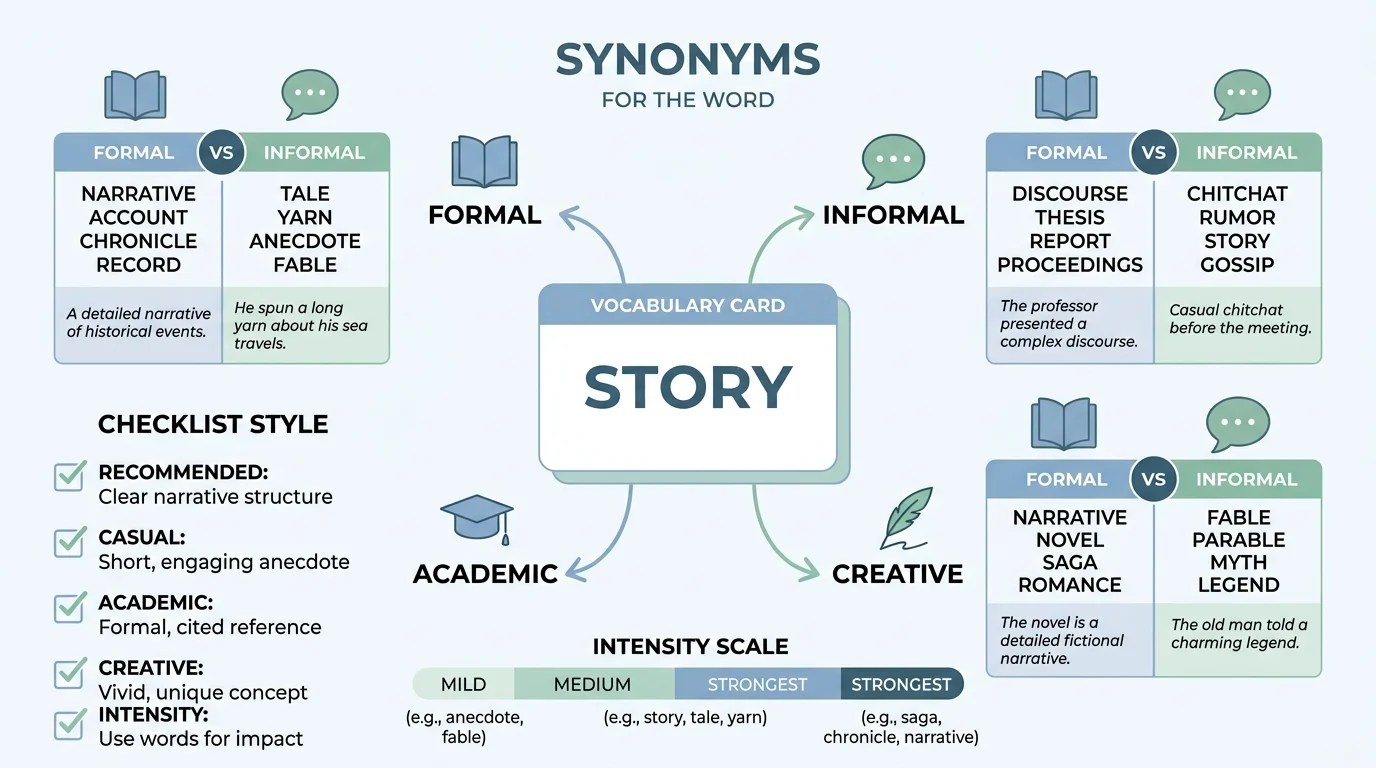
A story is a narrative account of real or imaginary events. The best synonyms for story depend on context. For professional writing, consider “account” or “report.” For casual conversations, try “tale” or “yarn.” Academic work often calls for “narrative” or “chronicle.” Emotional contexts may favor “anecdote” or “recollection.”
Meaning, Tone and Context
1. Simple Definition
A story is a description of events that happened or are imagined. It can be true or fictional. It usually has a beginning, middle, and end. Stories convey information, entertain, or teach lessons.
2. Part of Speech
Story is primarily a noun. You can tell a story, write a story, or hear a story. It can also function as a verb in informal contexts, meaning to tell a falsehood.
3. Positive, Negative, or Neutral Tone
The word story has a neutral tone. It becomes positive or negative based on context. A “success story” feels inspiring. A “cover story” can imply deception.
4. Formality Level
Story is neutral in formality. It works in casual conversation and many professional settings. For academic or legal writing, more formal synonyms may be better.
5. Common Use Cases
You use story in daily conversation, writing, and professional communication. It appears in books, movies, news, and personal sharing. It is one of the most common words in English.
6. Important Word Forms
Story has related forms. The adjective is “storylike.” The noun can be pluralized as “stories.” The verb form “to story” appears rarely.
When and How to Use “Story”
Story works best when you need a general word for a sequence of events. It is simple and widely understood. Use it when clarity matters more than style.
Professional Example
The annual report presented a clear story of company growth over the past fiscal year.
Personal Example
My grandmother always tells the same story about how she met my grandfather.
Academic Example
The historian analyzed the creation story from multiple cultural perspectives.
Creative Example
She wrote a beautiful story about a young artist finding her voice.
Social Media Example
Here is a quick story about why I started this wellness journey.
Emotional Example
His story about losing his childhood home moved everyone in the room.
Casual Example
Did I ever tell you the story about the time we got lost in Tokyo?
Another Word for “Story”
The best single replacement for story depends entirely on your context. No one word fits every situation perfectly.
1. Professional Writing
Use “account” for workplace communication. It sounds more serious and factual. The word “report” works well for official documents.
2. Academic Writing
Narrative” is the strongest academic synonym. “Chronicle” works for historical writing. Both sound precise and scholarly.
3. Casual Conversation
“Tale” adds a friendly, conversational tone. “Yarn” works for informal storytelling among friends.
4. Emotional Writing
“Testimony” conveys personal experience and truth. “Confession” implies vulnerability and honesty.
5. Creative Writing
“Legend” adds mythical weight. “Fable” suggests a moral lesson. “Myth” implies cultural significance.
6. Resume or Workplace Use
“Track record” works for professional achievements. “Portfolio” applies to creative work samples.
7. Social Media Captions
“Post” works for content. “Update” fits personal news. “Reel” applies to video content.
8. Stronger Meaning
“Epic” suggests grand scale. “Saga” implies length and drama. “Odyssey” suggests a long journey.
9. Softer Meaning
“Sketch” implies brevity. “Outline” suggests a basic structure. “Glimpse” means a partial view.
When Not to Use “Story”
Avoid using story when you need precision. It can sound too vague or casual for formal contexts.
Too Vague Example
Weak: The report contains the story of our project.
Better: The report contains the narrative of our project.
Too Casual Example
Weak: We need the story of your professional experience.
Better: We need an account of your professional experience.
Too General Example
Weak: Her story about the accident was confusing.
Better: Her testimony about the accident was confusing.
Too Informal Example
Weak: The scientist told a story about her research.
Better: The scientist presented an overview of her research.
Words Commonly Confused With “Story”
1. Story vs. Narrative
A story is any account of events. A narrative is a structured account with a specific perspective. Narrative is more formal and implies a crafted presentation.
2. Story vs. Tale
A tale often suggests a simpler, more traditional account. It can imply folklore or a story passed down through generations. Story is more modern and versatile.
3. Story vs. Account
An account emphasizes factual reporting. It sounds objective and reliable. A story can be fictional or true. Account is always about actual events.
4. Story vs. Report
A report is formal and structured. It presents facts and data. A story can be personal and emotional. Use report for business and academic contexts.
5. Story vs. Anecdote
An anecdote is a short, personal story about a specific incident. It is brief and often humorous. A story can be long and complex.
6. Story vs. Chronicle
A chronicle is a factual record of events in time order. It emphasizes accuracy and completeness. A story can arrange events for dramatic effect.
Best Synonym by Context for “Story”
| Context | Best Synonym | Why It Works | Example |
|---|---|---|---|
| Formal Writing | Account | Sounds professional and objective | The witness provided a detailed account of the incident |
| Academic Writing | Narrative | Emphasizes structure and perspective | This narrative challenges traditional historical interpretations |
| Professional Business | Report | Conveys facts and analysis | The quarterly report shows significant market growth |
| Resume Use | Portfolio | Shows collection of work samples | My portfolio includes projects from five major clients |
| Casual Conversation | Tale | Friendly and approachable | Let me tell you a tale about my travels through Spain |
| Creative Writing | Legend | Adds weight and cultural significance | The legend of the lost city has inspired many explorers |
| Emotional Tone | Testimony | Conveys personal truth and vulnerability | Her testimony about the experience touched everyone who heard it |
| Strong Intensity | Epic | Suggests grand scale and importance | Their journey became an epic of survival and courage |
| Soft Tone | Sketch | Implies brevity and simplicity | He gave a brief sketch of his childhood memories |
| Social Media Captions | Update | Modern and applicable to online content | Quick update on my fitness journey this week |
Which Synonym Should You Choose?
Choosing the right synonym requires considering several factors. Your audience matters most. A formal report needs different language than a personal blog post.
Think about your purpose. Are you informing, entertaining, or persuading? Informative contexts favor words like “account” or “report.” Entertaining contexts work well with “tale” or “legend.” Persuasive writing may use “testimony” or “manifesto.”
Consider the emotional intensity you want. “Epic” and “saga” carry weight. “Sketch” and “outline” feel lighter. Match your word to the emotional tone of your message.
Real Life Examples of “Story” in Sentences
School Context
The student presented a compelling narrative about climate change in her science class.
Workplace Context
Our marketing manager shared a powerful account of the product’s development process.
Writing Context
The author crafted an unforgettable tale of friendship and loss set during wartime.
Conversation Context
My colleague told an amusing anecdote about her first day at the company.
Social Media Context
Here is a quick update on our latest project developments this month.
Email Context
Please provide a brief summary of the events from your perspective.
Storytelling Context
The grandmother recounted a legend from her homeland that had been passed down for centuries.
25 Synonyms for “Story”
| Synonym | Simple Meaning | Best Used For | Example Sentence |
|---|---|---|---|
| Account | A factual description of events | Professional and formal writing | The witness gave a clear account of what happened |
| Narrative | A structured story with a perspective | Academic and literary contexts | The documentary presents a compelling narrative about inequality |
| Tale | A traditional or informal story | Casual conversation and storytelling | My grandfather told a wonderful tale about his childhood adventures |
| Chronicle | A historical record of events | Historical writing and records | The chronicle documents the rise and fall of the ancient empire |
| Anecdote | A short, personal story | Conversation and speeches | She shared a funny anecdote about her travel mishaps |
| Legend | A traditional story of cultural significance | Mythological or heroic contexts | The legend of King Arthur continues to captivate readers |
| Myth | A traditional story explaining natural phenomena | Cultural and literary analysis | The creation myth varies across different civilizations |
| Fable | A story with a moral lesson | Teaching and children’s literature | The fable taught the importance of honesty |
| Saga | A long story of heroic achievements | Epic adventures and family histories | The family saga spanned three generations |
| Epic | A grand story of heroic deeds | Large scale narratives and journeys | His journey became an epic of determination |
| Report | A formal account of facts | Business and academic writing | The annual report details our environmental initiatives |
| Testimony | A formal statement of truth | Legal and personal contexts | Her testimony moved the entire courtroom |
| Memoir | A biographical account of personal experience | Personal writing and history | She wrote a powerful memoir about her immigrant experience |
| Diary | A daily personal record | Personal journals and reflections | The diary revealed her private thoughts during difficult times |
| Biography | An account of someone’s life | Literary and historical writing | The new biography explores his artistic development |
| Autobiography | A self-written life story | Personal and literary works | His autobiography covers five decades of creative work |
| History | A systematic account of past events | Academic and general education | The history of the region is complex and fascinating |
| Sketch | A brief outline or description | Informal and quick writing | He gave a sketch of his plans for the future |
| Outline | A general description without details | Planning and presentations | The outline covered the main points of the project |
| Summary | A brief statement of main points | Reports and quick communication | A summary of the findings was presented at the meeting |
| Recount | A detailed description of events | Formal and personal storytelling | She gave a detailed recount of her travel experience |
| Mythos | A system of traditional stories | Cultural and literary analysis | The Greek mythos includes numerous tales of heroism |
| Folklore | Traditional beliefs and stories | Cultural studies and anthropology | The folklore of the community preserves their heritage |
| Parable | A simple story illustrating a lesson | Religious and moral teaching | The parable teaches forgiveness and compassion |
| Novel | A lengthy fictional story | Literature and entertainment | Her novel explores themes of identity and belonging |
Synonym Groups and Usage Differences
Professional vs. Personal Synonyms
Professional contexts demand precision and formality. “Report” and “account” work well in business settings. These words sound objective and reliable.
Personal contexts allow more warmth and creativity. “Tale” and “anecdote” feel intimate and engaging. They connect with readers on an emotional level.
Formal vs. Conversational Synonyms
Formal writing benefits from words like “narrative” and “chronicle.” These terms appear in academic papers and official documents. They establish credibility and authority.
Conversational synonyms like “yarn” and “tale” create a friendly atmosphere. They work well in blogs, social media, and casual correspondence.
Academic Synonyms
Academic writing needs precise, analytical language. “Narrative” appears frequently in literary analysis. “Discourse” suggests a broader framework. “Historiography” applies to historical writing.
Professional and Business Synonyms
Business communication benefits from professional alternatives. “Account” suggests reliability. “Report” indicates factual information. “Brief” implies concise presentation. “Update” works for current developments.
Creative or Literary Synonyms
Creative writing thrives on vivid language. “Legend” and “myth” carry cultural weight. “Parable” suggests moral depth. “Epic” conveys grand scale. These words add richness and texture.
Slang or Modern Synonyms
Modern usage includes words like “reel” for video content. “Tea” means gossip in social media contexts. “Scoop” implies exclusive information. These terms work in casual online communication but fail in formal contexts.
Strongest vs. Weaker Synonyms
Intensity matters in word choice. “Epic” and “saga” suggest enormous scope and importance. “Sketch” and “outline” imply brevity and simplicity. Choose intensity based on your subject matter.
Emotional vs. Neutral Synonyms
Emotional words add feeling to your writing. “Testimony” implies vulnerability and truth. “Confession” suggests honesty about difficult experiences. “Memoir” evokes personal reflection.
Neutral synonyms keep an objective tone. “Account” and “report” stay factual. “Summary” focuses on information without emotion. These work well in professional contexts.
Antonyms of “Story”
| Antonym | Meaning | Example Sentence |
|---|---|---|
| Truth | A statement consistent with fact | The truth of the matter was eventually revealed |
| Reality | What actually exists | The reality of the situation was different from the story |
| Fact | Something known to be true | The fact remains that we need more evidence |
| Silence | The absence of speech or narrative | His silence about the events was telling |
| Secrecy | The state of being hidden | The secrecy surrounding the project caused concern |
| Certainty | A firmly held belief | The certainty of his position removed all doubt |
| Proof | Evidence establishing truth | We need proof rather than stories |
| Evidence | Facts indicating whether something is true | The evidence contradicted the witness account |
| Veracity | The quality of being truthful | The veracity of her statement was never questioned |
| Disregard | Lack of attention or consideration | His disregard for the facts was frustrating |
| Neglect | Failure to care for or include | The neglect of important details weakened the argument |
| Denial | Refusal to acknowledge the truth | Her denial of the events surprised everyone |
| Inaccuracy | The quality of being incorrect | The inaccuracy of the report damaged its credibility |
| Misinformation | False or inaccurate information | The misinformation spread quickly through social media |
| Oblivion | The state of being completely forgotten | The events eventually faded into oblivion |
Comparison: Story vs. Similar Words
Story vs. Account
The main difference lies in formality and reliability. An account suggests a factual, objective retelling. A story can be fictional or subjective.
Account is more formal and professional. Use “account” when reliability matters. Use “story” for general purposes.
Example with Account: The journalist provided a detailed account of the political events.
Example with Story: She told an engaging story about her summer travels.
Story vs. Narrative
Narrative emphasizes structure and perspective. A narrative often presents a specific viewpoint. A story may be more straightforward.
Narrative is more academic and analytical. Story is more accessible and casual.
Example with Narrative: The film presents a complex narrative about social justice.
Example with Story: The film tells a simple story about friendship.
Story vs. Tale
Tale often implies a traditional or simpler form. It can suggest folklore or oral tradition. Story is more modern and versatile.
Tale works well for fictional or historical subjects. Story fits any subject or context.
Example with Tale: The old fisherman told tales of sea monsters.
Example with Story: The businessman told a story about his first sale.
Story vs. Anecdote
An anecdote is always short and personal. It often includes humor or surprise. A story can be any length.
Use anecdote for brief, personal examples. Use story for longer or more complex subjects.
Example with Anecdote: He shared a funny anecdote about his first day at work.
Example with Story: She wrote a long story about her family history.
Story vs. Chronicle
A chronicle is a factual record in time order. It emphasizes accuracy and completeness. A story can be creative and flexible.
Chronicle suits historical or scientific writing. Story suits creative or personal writing.
Example with Chronicle: The chronicle records the battle in meticulous detail.
Example with Story: The story describes the battle from a soldier’s perspective.
Story vs. Report
A report presents facts and analysis formally. It often includes data and conclusions. A story focuses on events and characters.
Report works for business and science. Story works for any subject.
Example with Report: The report concluded that sales increased by 20 percent.
Example with Story: The story explained how the company turned around.
Common Phrases and Expressions with “Story”
1. Tall Tale
Meaning: An exaggerated or improbable story.
Example: The sailor told a tall tale about catching a fish the size of a boat.
2. Inside Story
Meaning: Information known only to those involved.
Example: The journalist got the inside story from a confidential source.
3. Cover Story
Meaning: A false explanation used to hide the truth.
Example: The spies created a cover story to explain their presence in the country.
4. Love Story
Meaning: A narrative about romantic relationships.
Example: Their love story began in college and lasted sixty years.
5. Life Story
Meaning: The full account of a person’s life.
Example: She recorded her life story for her grandchildren.
6. Story of My Life
Meaning: An expression of repeated personal experience.
Example: Missing the bus again. That is the story of my life.
7. So the Story Goes
Meaning: As the narrative is traditionally told.
Example: So the story goes, the treasure remains hidden to this day.
Common Mistakes to Avoid
1. Using Story When a More Precise Synonym Is Better
Avoid using story when you need specific language. A legal document needs “testimony” or “deposition.” A scientific paper needs “data” or “findings.” Choose precision over convenience.
2. Confusing Story with a Related Word
Remember the differences. A “tale” suggests tradition. An “anecdote” is brief and personal. A “report” is factual. Use each word correctly.
3. Using a Casual Synonym in Formal Writing
Avoid “yarn” or “tale” in academic papers. Use “narrative” or “chronicle” instead. Match your word to the formality of your context.
4. Using an Overly Dramatic Synonym for a Simple Situation
Do not call a minor event an “epic” or “saga.” These words imply great importance. Reserve them for truly significant subjects.
5. Repeating the Same Word Too Often
Readers notice repetition. Vary your language. Use different synonyms for story throughout your writing.
6. Choosing a Synonym with the Wrong Emotional Tone
Check your word’s emotional weight. “Testimony” sounds serious. “Tale” sounds light. Choose the emotion that fits your message.
7. Using Slang in Academic or Professional Writing
Avoid words like “tea” or “reel” in formal contexts. These terms work for social media but not for professional communication.
FAQs
1. What is the best synonym for story?
The best synonym depends on your context. “Narrative” works well for academic writing. “Account” suits professional settings. “Tale” fits casual conversation.
2. What is a formal synonym for story?
“Narrative” and “account” are formal alternatives for story. “Chronicle” works for historical writing. “Testimony” fits legal contexts.
3. What is an informal synonym for story?
“Tale” and “yarn” are informal synonyms for story. “Anecdote” works for short personal stories. These words are friendly and conversational.
4. What is another word for story in professional writing?
Use “account” or “report” in professional writing. “Brief” and “summary” work for concise communication. “Portfolio” applies to collected work.
5. What is the difference between story and narrative?
A story is any account of events. A narrative is a structured account with a specific perspective. Narrative is more formal and analytical.
6. What is the opposite of story?
The opposite of story includes “silence,” “secrecy,” and “truth.” “Reality” and “fact” also contrast with story.
Conclusion
The word story serves as a versatile foundation for describing events and experiences. Its synonyms allow you to communicate with greater precision and style. The key is matching your word choice to your audience and purpose.
Remember that context determines the best synonym. Formal writing calls for words like “narrative” and “account.” Casual conversation welcomes “tale” and “yarn.” Creative expression thrives on “legend,” “myth,” and “epic.”
Build your vocabulary gradually. Start with a few new synonyms and practice using them in your daily writing. Pay attention to how professional writers choose their words. Notice the emotional and stylistic effects of different synonyms.
Your communication skills will improve with every deliberate word choice. The right synonym can transform a boring sentence into something memorable. It can turn vague statements into clear messages. It can connect you more deeply with your readers.