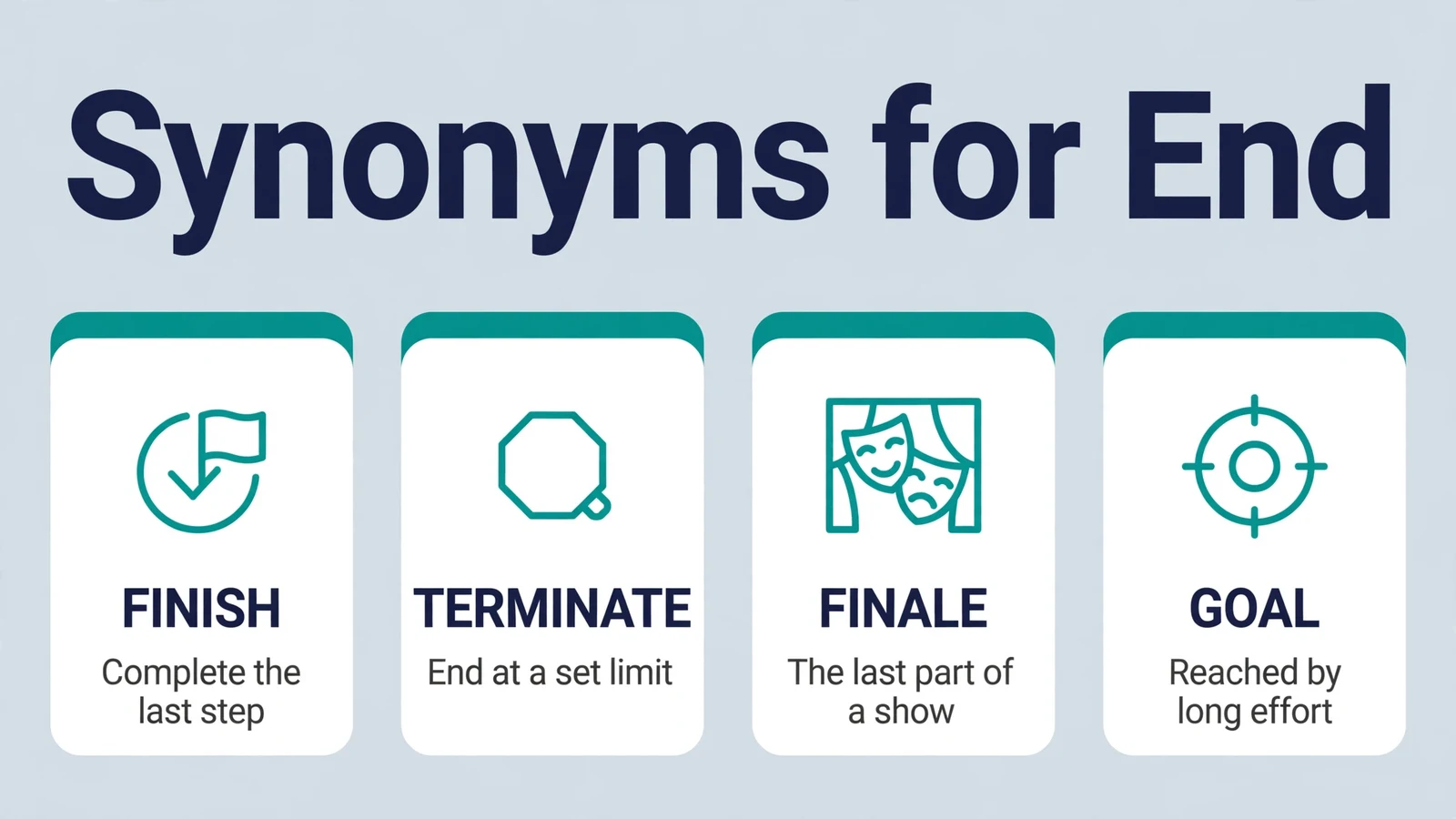
Few short words work as hard as end. You end a meeting, a road ends at the sea, and a charity runs for one end only: helping people. Each job needs its own synonyms, and mixing them up produces odd sentences. A contract does not have a finale, and a film does not get terminated.
For the verb, the core synonyms are finish, complete, conclude, close and terminate. For the noun, the everyday choices are ending, finale and conclusion, while aim, goal and objective cover the sense of purpose. This guide keeps the verb and the noun apart, group by group, so you can pick the word that matches your sentence instead of the first word that comes to mind.
Quick Reference: Top Synonyms for End
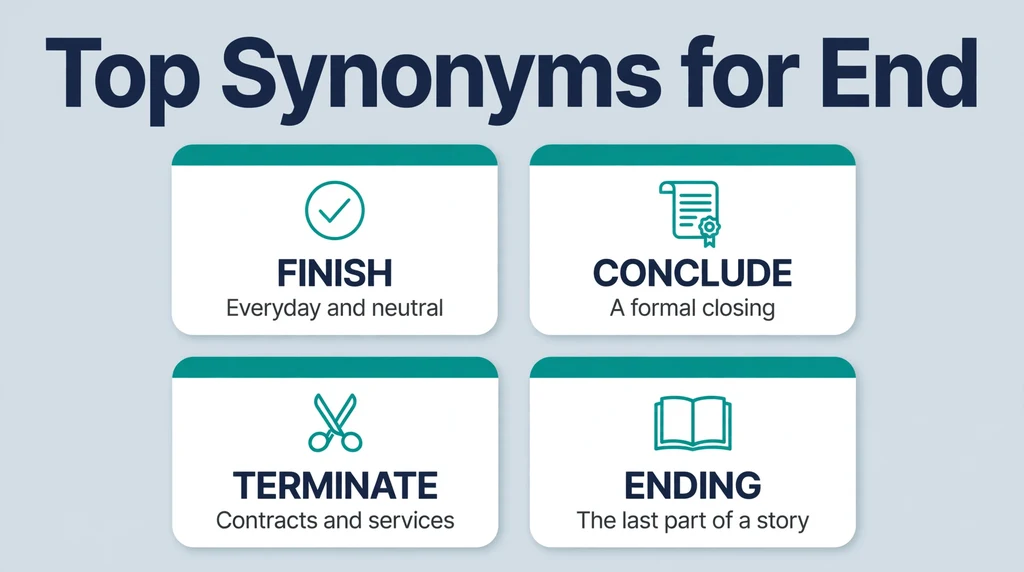
Start here if you need a word fast. The table holds the most useful synonyms for end, with the job each one does best.
| Word | Meaning in one line | Best for / tone |
|---|---|---|
| finish | Complete the last step of something | Everyday, neutral |
| complete | Finish with nothing missing | Neutral, thorough |
| conclude | Bring something to a formal close | Formal |
| close | End something that was open | Neutral, events |
| terminate | End at a set limit in time or space | Formal, contracts |
| cease | Stop doing or stop happening | Formal |
| stop | Make something no longer continue | Everyday, neutral |
| halt | Stop suddenly or by decision | Neutral, news style |
| discontinue | Stop providing or producing something | Formal, business |
| culminate | Reach a final high point | Formal, events |
| wrap up | Finish something off | Informal phrase |
| ending | The final part of a story or event | Neutral |
| finale | The last part of a show or series | Performances |
| conclusion | The end of something, or a judgment | Formal |
| completion | The act of finishing completely | Formal |
| closure | An ending that settles something | Neutral, emotional or official |
| expiry | The point where a period runs out | Contracts, documents |
| extremity | The farthest point of something | Formal |
| tip | The thin or pointed end of an object | Everyday |
More quick picks: aims, results and leftovers
| Word | Meaning in one line | Best for / tone |
|---|---|---|
| purpose | The reason something is done | Neutral |
| aim | What you direct your efforts toward | Neutral |
| goal | Something reached by long effort | Neutral |
| objective | A clear, measurable target | Formal, business |
| outcome | The result of an action or event | Neutral |
| demise | The end or death of something | Formal, euphemistic |
| remnant | A small part left over | Neutral |
What Does End Mean? The Verb and the Noun
End is an old word. Merriam-Webster traces it to Old English, through Middle English *ende*, and its first known use dates to before the 12th century. Its relatives include German *Ende* and, further back, Latin *ante*, meaning before. The word has had centuries to collect meanings, and it shows.
End as a verb
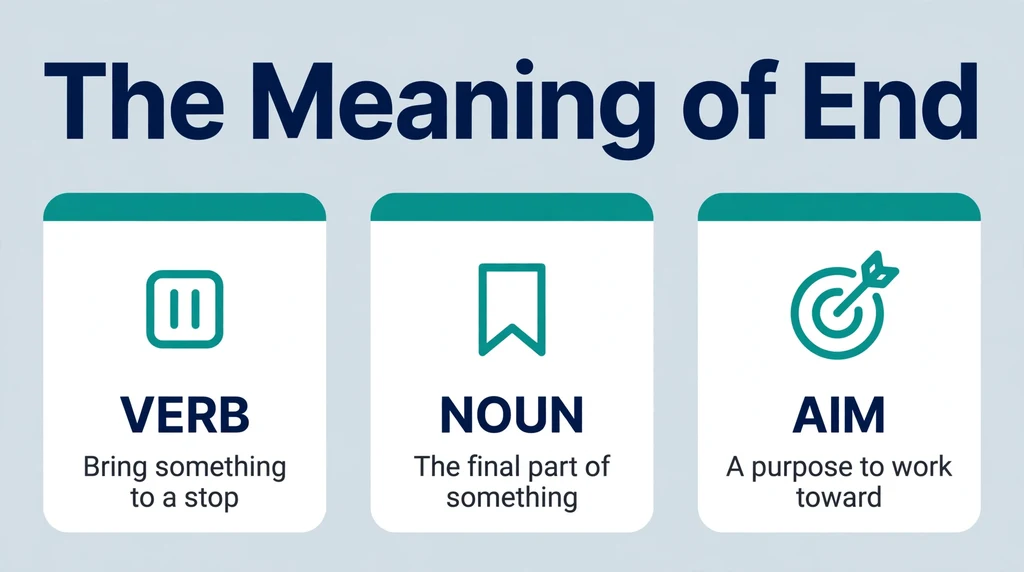
As a verb, end means to bring something to a stop, or to come to a stop yourself. It works in two directions. A chairperson ends a meeting, so the word takes an object. The meeting ends at noon, so nothing is being acted on. Merriam-Webster notes that end, as a verb, conveys a strong sense of finality. When something ends, it does not pause. It is over.
End as a noun
As a noun, end splits into several clear senses. First comes the final part of something: the end of the book, the end of the road. Next is a boundary point, the place where something stops or reaches its limit. The third is completely different. An end can be a purpose, the thing you are trying to achieve, which is why English says “a means to an end.” Keeping these senses apart is the key to choosing the right synonym every time.
The word even moonlights as an adjective in fixed compounds. An end product is what a process finally produces. An end user is the person a system is built for. In both, end simply means final, and no synonym replaces it gracefully, which is why these compounds stay as they are.
End in set phrases
The word also hides inside phrases that learners meet early. To end up somewhere means to reach a final situation, often by accident: “We ended up as the last guests.” Merriam-Webster notes this use for reaching a final place or rank. Something with no end in sight will clearly continue for a long time. A task done for days on end goes on without a break. These phrases use end as a fixed landmark, so they rarely swap with synonyms.
Verb Synonyms for End: Finishing and Completing
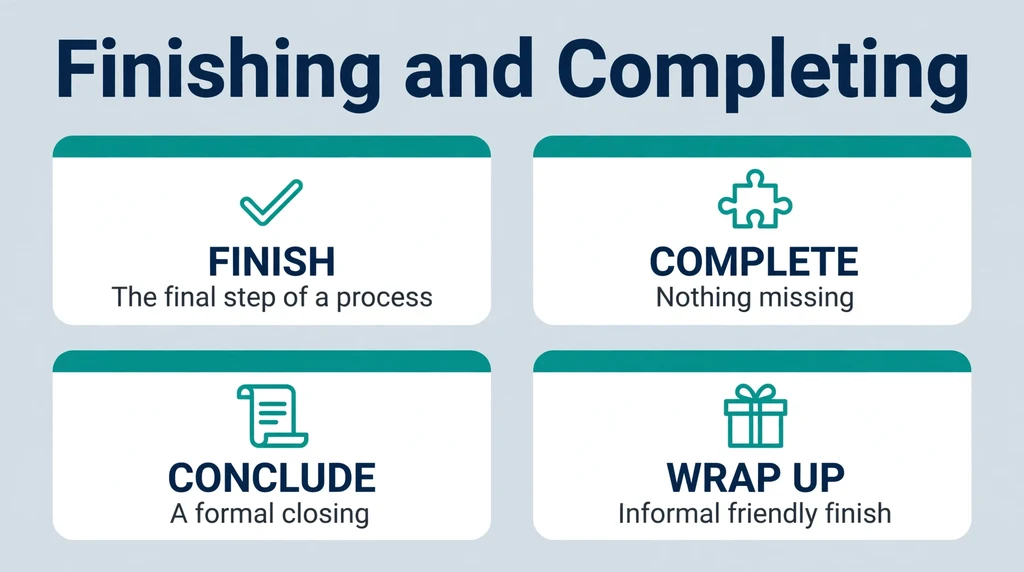
The friendliest verb synonyms describe finishing something properly, with the work done rather than cut off. These are the words to use when a task, event or process reaches its natural last step.
Everyday finishers: finish, complete and close
Finish is the closest everyday match. Merriam-Webster explains that finish may stress completion of the final step in a process. You finish a race, finish your homework, finish painting a room. The focus sits on the last action that makes the thing done.
Complete goes one step further. It implies that every deficiency has been removed, so nothing is missing. A completed form has every box filled. A completed building has its roof, windows and doors. Choose complete when wholeness matters, not just stopping.
Close fits things that were open in some way. You close a meeting, close a debate or close a deal. Merriam-Webster notes that close usually implies something has been open as well as unfinished. It sounds natural for ceremonies, accounts and periods of trading.
Formal closers: conclude and culminate
Conclude is the formal choice for events with a program. It may imply a formal closing, as of a meeting. So a conference concludes with a speech, and a ceremony concludes with a blessing. In reports and academic writing, conclude also does double duty, since a conclusion is where findings are summed up.
Culminate describes a build toward a final high point. A festival culminates in a fireworks display. Years of training culminate in one performance. The word always takes *in* or *with* after it, and it flatters whatever came before, because the ending is presented as the peak.
Informal ways to finish: wrap up and wind up
Wrap up is the relaxed way to say finish. Cambridge marks this sense informal and defines it as completing something successfully. A manager says, “Let us wrap up this meeting,” and a team wraps up a project before the holidays.
Wind up works the same way for events and activities. You wind up a game, a discussion or a party when it is time to finish. Both phrases suggest tidying the last loose pieces rather than stopping abruptly, which is why they sound friendly in everyday speech.
When things end by themselves
Many of these verbs also work without an object, for events that simply run their course. The concert ended late. Talks will conclude tomorrow. On Sunday, the exhibition closes. Collins groups these together: things finish, close, conclude, culminate or terminate on their own schedule. Two phrases cover the same ground gracefully. An era comes to an end, and a long meeting draws to a close. The second phrase feels slower and more literary, so storytellers reach for it when the ending matters.
Verb Synonyms for End: Stopping and Terminating
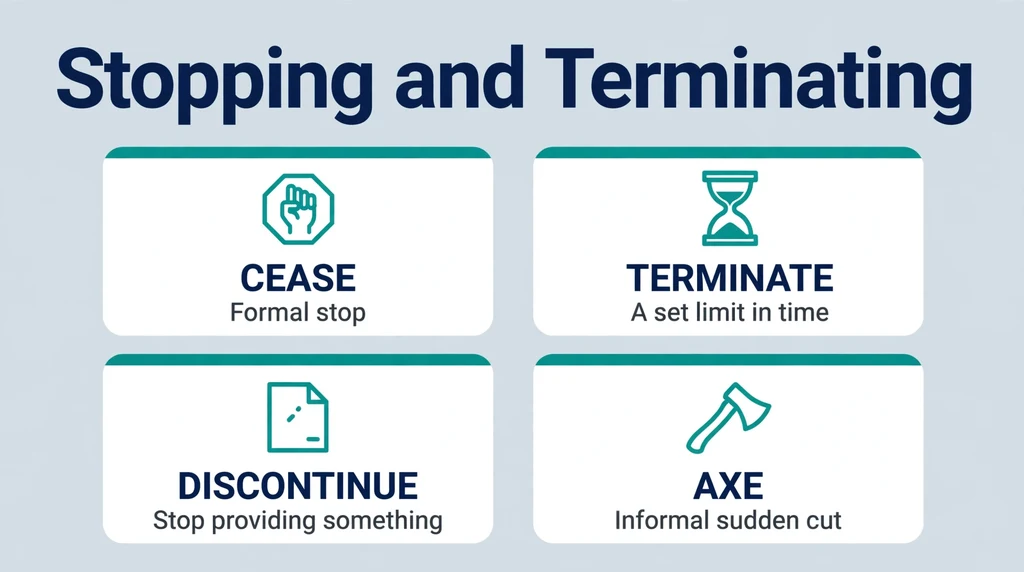
The second verb family is cooler in tone. These words describe stopping something, sometimes before it would naturally finish. Officials, companies and contracts live in this section.
Neutral stop words: stop, halt and cease
Stop is the plain, general word. It says only that something no longer continues. Unlike end, stop leaves the future open: the rain stopped, then started again. Use stop when finality is not the point.
Halt adds suddenness or a decision from above. Trains halt at a station. A court halts a project. News writing loves halt because it sounds firm and immediate, and it often describes production, work or movement brought to a standstill.
Cease is formal and a little old fashioned in the best way. Companies cease trading. A noise ceases. It takes either a noun or an *-ing* form after it, as in “cease production” or “cease talking.” In legal notices, cease is the standard word, usually paired in the phrase “cease and desist.”
Formal and official: terminate, discontinue, dissolve, abolish and expire
Terminate implies the setting of a limit in time or space. Your employment terminates after three months. Airlines terminate flights at a final station. Because it points to a fixed boundary, terminate is the natural word for contracts, agreements, services and employment.
Discontinue means to stop making, selling or providing something. A company discontinues a product line. A clinic discontinues a treatment. It sounds businesslike rather than harsh.
Dissolve ends things that were formally joined together. Parliaments are dissolved before elections. Committees, partnerships and marriages can be dissolved. The image underneath is of something solid coming apart.
Abolish ends a law, system or practice by authority. Governments abolish taxes, examinations or entire institutions. It carries moral weight, so writers use it when the ending is presented as a deliberate reform.
Expire belongs to agreements and documents. A passport expires. A lease expires. The period simply runs out on a stated date, with nobody actively stopping anything.
Phrases and informal choices
Several set phrases end things with more color. You call off a wedding or a search, meaning you cancel it. Gossip or a bad habit is something you put an end to. You bring a meeting or an era to an end, and you can call a halt to spending or construction. Nip in the bud ends something early, before it grows. Collins marks axe as informal: governments axe programs, and managers axe projects. Pull the plug on is its informal partner for funding and ventures, suggesting the support is switched off.
Endings at work: contracts, jobs and services
Official English combines these words in predictable ways, and learning the combinations saves guesswork. A contract terminates on its final date, or either side terminates it early under a clause. Employment ceases on retirement in formal letters. A manufacturer discontinues a model and then ends support for it. A partnership dissolves when the partners separate. When a report says a program was axed, the writer chose the informal newspaper word, and the tone tells you the decision was sudden. Read the verb, and you usually know who ended what, and how abruptly.
Noun Synonyms for End: The Final Part
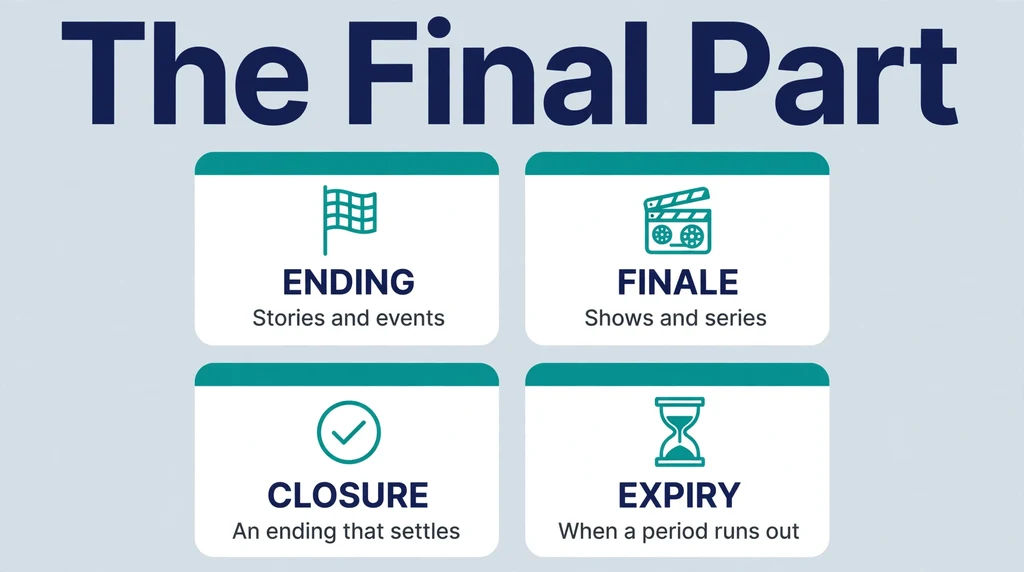
When end is a noun meaning the last part of something, the right synonym depends on what is ending. A story, a contract and a rope each take different words.
Endings of stories, shows and events
Ending is the standard word for narratives. Readers debate the ending of a novel. Viewers complain about a rushed ending. It belongs to stories, films, plays and games, where the final part is a crafted piece in its own right.
Finale is the ending as a performance. A series finale, a grand finale, the finale of a symphony. It promises drama and a deliberate climax, so it feels wrong for ordinary events. A meeting has no finale unless someone is joking.
Conclusion suits arguments, events and processes. At the conclusion of the ceremony, guests stood up. It is also the judgment you reach after thinking, which makes it the anchor word of essays and reports. Culmination names the end as a highest point: the culmination of years of work. Completion names the state of being fully finished, as in “on completion of the course.” Endpoint is the precise, slightly technical word for where a process is designed to stop, common in negotiations, medicine and computing.
Stopping points and limits in time
Termination is the official noun for terminate: the termination of a contract. Closure adds the feeling of settlement. Workers wanted closure after the factory shut. A family seeks closure after a loss. Official reports also use it for the shutting of a facility. Expiry is the moment a document or agreement runs out, as in an expiry date. Consummation is rare and formal, used for the completion of a deal or agreement in legal and literary writing.
The far end: limits and physical points
End also marks the farthest point of a thing. Extremity is the formal word for that outer limit, and extreme itself can name one side of a scale, as in “the extremes of success and failure.” Edge, border, boundary and margin describe where one area gives way to another: the edge of the field, the boundary of the property. For objects, tip is the thin pointed end, as in the tip of a knife, while point, head and peak appear for blades, pins and mountains. These words keep the physical picture that the abstract senses grew from.
Endings in time: days, years and eras
Time borrows the same vocabulary. Traders watch prices at the close of the trading day, a phrase Cambridge uses for the end of business. A reign, a century or a golden age reaches its end, and historians often prefer close for the final stretch: the close of the century. When a period is presented as a peak rather than a fade, culmination returns. And when nothing dramatic happens at all, English simply says the year came to an end, the plainest closing phrase of all.
End as an Aim: Purpose, Goal and Objective
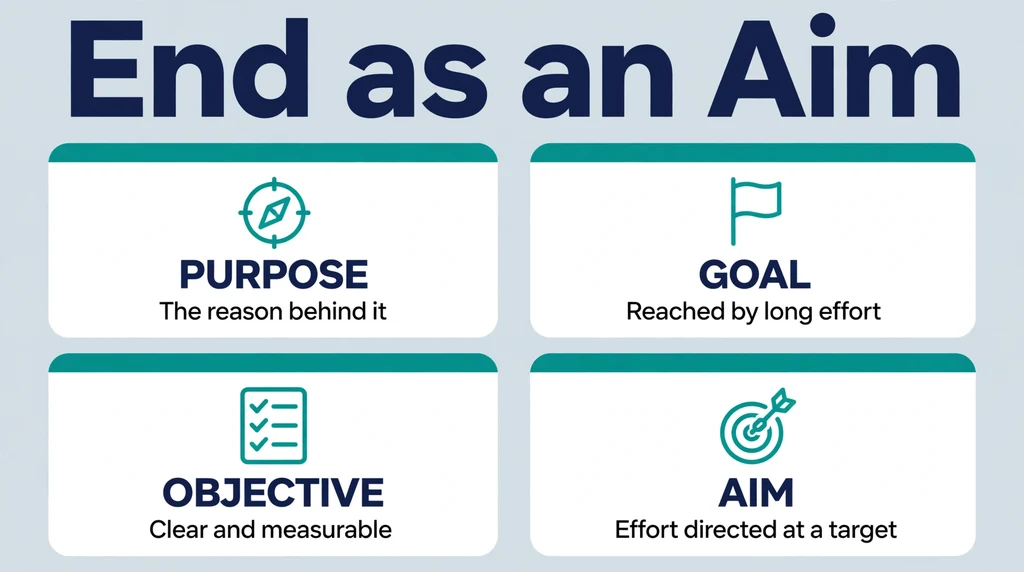
The most surprising noun sense of end has nothing to do with stopping. In the phrase “a means to an end,” end means the purpose you are working toward. Merriam-Webster defines this end as an outcome worked toward: a purpose. Means are how you get there. The end is why you bother.
The everyday words in this family are purpose, aim, goal and objective. Purpose is the broadest: the reason something exists or is done. Aim points at what your efforts are directed toward, as in “her aim was to raise film to an art form.” Goal suggests something reached only by prolonged effort and hardship, which is why athletes and students set goals. Objective is the businesslike cousin: tangible, clear and often measurable, as in sales objectives for the quarter.
Targets, missions and hopes
Around them sit target, the specific number or result aimed at, and object, a slightly formal word for a personally chosen wish, as in “the object of the exercise.” Intention and intent describe what someone plans to do, with intent sounding more deliberate and legal. Mission raises the stakes: a mission is a purpose someone feels called to carry out. Design implies a carefully calculated plan, and it often hints at secrecy. Reason and point serve in questions: “What is the point of this rule?” Aspiration names a hope for the future rather than a fixed plan.
In academic writing, this sense explains classic sentences. Kant wrote of treating people as ends in themselves, never merely as means. Historians ask what end a policy served. Once you see the aim sense clearly, these sentences stop looking like riddles.
Intent, design and the finer shades
Two shades in this family deserve a closer look. Intent sounds more deliberate than intention: Merriam-Webster says it suggests clearer formulation, as in “the clear intent of the statute.” And end itself stresses the intended effect, set against the action taken to reach it. That contrast is exactly why “the end justifies the means” remains such an argued-about sentence: it weighs an outcome against the methods used to get it.
How to Choose the Right Synonym for End
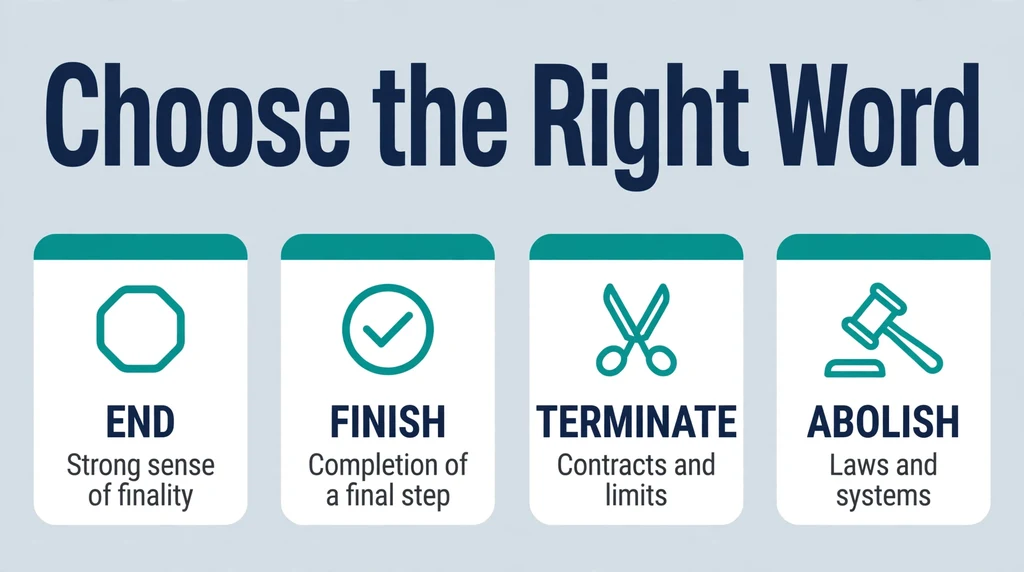
Most mistakes with these words come from swapping near matches that stress different things. The pairs below follow the distinctions the dictionaries themselves draw.
End vs finish
This is the pair everyone asks about, and Merriam-Webster draws the line cleanly. End conveys a strong sense of finality. Finish may stress completion of the final step in a process. So you finish your dinner, your homework and a marathon, because each has a last step that completes it. Things end when they are simply over: the day ends, the road ends, the war ended. A quick test helps. If the subject did the work, finish usually fits. If time simply ran out, end fits.
End vs complete and conclude
Choose complete when something could have missing pieces: complete the application, complete the set. End says nothing about pieces. Choose conclude when people gather formally: the trial concluded, the service concluded with a blessing. A wedding does not usually “terminate,” and a contract does not usually “conclude” in everyday speech, although lawyers do write “the agreement concludes” in some regions. Register decides.
Terminate vs abolish vs discontinue
All three are formal, and each claims different territory. Terminate a contract, a lease or employment, because a limit was set in advance. Abolish a law, a tax or a practice, because an authority removes it completely. Discontinue a product, a bus route or a treatment, because a provider stops supplying it. Mixing them sounds off: a company discontinues a shampoo, but it cannot abolish one.
Ending vs finale, goal vs objective
Reserve finale for performances and ending for stories and ordinary events. In the aim sense, pick goal for long efforts and personal ambitions, objective for short, measurable targets at work, and purpose when you mean the reason behind everything. A runner’s goal is the marathon. Her objective this week is forty miles. Her purpose is raising money for the hospital.
Cease vs stop, and the cancel family
Cease and stop divide by register and grammar. Cease is formal, and it takes a noun or an *-ing* form: cease fire, cease talking. Stop is the everyday word and also works with *to*: stop to rest, which actually means pausing in order to rest. For cancelled events, prefer call off: the match was called off, not “ceased.” For projects losing support, axe and pull the plug on carry the informal, decisive tone that official words avoid.
Synonyms for End in Writing: Formal vs Informal
Writers reach for end more than almost any other word, because every essay, story and report has to land somewhere. Matching the word to the setting keeps the landing graceful.
In essays and academic work
Formal writing prefers conclusion, completion and culmination. Your final paragraph is a conclusion, and signposting phrases carry the reader there. Students often pair it with ordering words, so it helps to know in conclusion and its alternatives for the last paragraph of an essay. Avoid repeating “in the end” in every paragraph. Vary the machinery: finally, ultimately, in short, to sum up. Each signals a slightly different closing move.
At work and in official writing
Professional writing lives in the terminate family. Contracts terminate on a date. Services are discontinued with notice. Policies expire. Meetings close with action points. These words sound neutral because they point to rules and dates rather than feelings. When a human decision cuts something short, halt and suspend appear in reports, although suspend only pauses, which matters legally.
In stories and everyday speech
Storytellers choose color. A tale reaches its ending, a series earns a finale, and a quest reaches its culmination. Everyday speech is looser still. Friends wrap up a game night. A boss might joke about axing a failing project. The informal words promise friendliness, so keep them out of formal documents, where they can sound careless.
In speeches and presentations
Speakers signal the landing early, because listeners relax once they hear it coming. Formal talks conclude with thanks and a summary. A chair closes the session and invites questions. Online presenters borrow the informal habit and wrap up in the last five minutes. The pattern is the same at every level: name the ending, deliver the final point, then stop cleanly instead of trailing away.
More Noun Senses: Results, Remnants and Final Outcomes
Three smaller noun senses round out the word. Each has its own tidy synonym set, and each appears in set phrases worth learning.
Results and outcomes
Sometimes the end of a thing means what came of it. Outcome is the neutral modern choice: the outcome of the election. Result is the plain everyday word. Consequence tilts negative, since consequences are usually costs. Upshot is the informal summary word: “The upshot is, we leave on Friday.” Sequel names what follows as a direct result, and storytellers borrowed it for follow-up books and films. This family sits behind the saying “the end justifies the means,” where end means the final outcome, good or bad.
Remnants: the little piece left
An end can also be the small leftover piece of a thing. Cigarette ends fill ashtrays. The set here is remnant, stub, butt, scrap, fragment, stump and remainder, with tail end for the last part of a period or procession. Merriam-Webster defines this sense as something incomplete, fragmentary or undersized. Seamstresses buy remnants of cloth cheaply, and a stump of candle burns in old novels.
The end of a life or an era
In its darkest sense, end means death or destruction. Demise is the polite, euphemistic version, used for people, companies and kings. Dissolution ends organizations and empires slowly. Extinction ends species completely. Writers also reach for ruin and destruction when the emphasis falls on damage rather than timing. Handle these words with care: they carry real weight. The old idiom meet your end belongs here too. Cambridge glosses it simply as dying, usually in dramatic circumstances, which is why it survives in Westerns, war stories and crime reports rather than in obituaries.
Antonyms of End
Every ending implies a beginning. For the verb, the opposites are begin, start, commence and open: a ceremony opens, a term commences, a story begins. When something has been stopped, the natural opposite is continue or resume, since the thing carries on instead. Cambridge lists, for the noun in its final-part sense, the contrast set beginning, start, opening and commencement, with kick-off as the informal sports word. If you are building vocabulary in pairs, our guide to synonyms for begin covers the starting side of the line in the same grouped style.
Notice how the pairs reverse cleanly in sentences. The meeting began at nine and ended at noon. The opening of the festival drew a crowd, and its close drew tears. Writers exploit the symmetry constantly, which is one more reason to learn the two families together.
Common Mistakes: Words That Are Not True Synonyms for End
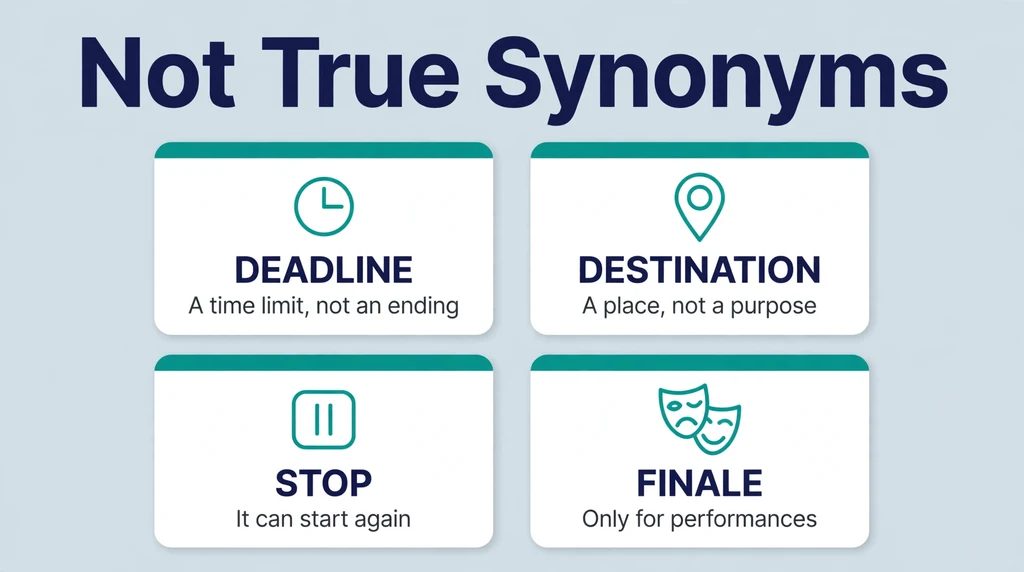
A few words sit close to end without matching it. Knowing the gaps protects your sentences.
Deadline is not an end
A deadline is the latest time by which something must be done. The work ends at the deadline, hopefully, but the deadline itself is a limit in the future, not an ending. Saying “the deadline of the project” when you mean its conclusion confuses readers.
Destination is not an aim
A destination is the place you travel to. It can feel like a goal, yet it names a location, not a purpose. “The destination of the money” is wrong; you want “the purpose of the money” or simply where the money went. Keep destination for journeys.
Stop does not promise finality
Because stop allows a restart, it misleads in final contexts. “The service stopped in 2020” suggests it may return. If it never came back, write ended, closed or was discontinued. The reverse error also happens: “the rain ended” sounds strangely dramatic for weather that simply paused.
Terminate is harsh for people and events
Terminate points to a set limit, so it suits contracts and employment in official language. Applied to friendships, parties or lives, it sounds cold or threatening, because it also lives in violent contexts. Choose end, finish or conclude for human occasions.
Final is not a finale
The adjective final and the noun finale look alike and behave differently. Final simply means last: the final chapter, the final warning. A finale is a showpiece ending, the last number of a concert or the last episode of a series. Calling a routine last step a finale promises drama you may not deliver. Keep finale for stages and screens, and let final do the plain work everywhere else.
At the end vs in the end
These two phrases differ. At the end points to a position or moment: at the end of the street, at the end of the film. In the end means after everything was considered, or after a long process: “We argued for hours, but in the end we agreed.” Swapping them is one of the most common learner errors with this word.
Frequently Asked Questions
What is the best synonym for end?
It depends on the sense. Finish and complete are the safest choices for a task. For a formal closing, use conclude. Contracts and services take terminate as standard. For the last part of a story, ending works almost everywhere.
What is a formal synonym for end?
The formal verb choices are conclude, terminate, discontinue and cease. The formal nouns include conclusion, completion, termination and culmination. Legal and business documents rely on these because they sound precise and neutral.
What is another word for the end of a story?
Ending is the general word. Use finale for the last episode of a series or the closing piece of a performance. Conclusion fits essays and reports better than fiction. Writers also use denouement for the part after the climax where loose threads are settled, although that word names a stage of the ending rather than the ending itself.
Is finish the same as end?
Nearly, but not quite. Merriam-Webster says end conveys a strong sense of finality, while finish may stress completion of the final step in a process. That is why you finish your homework but the day ends, and why a road can end but cannot really finish.
What is a synonym for end when it means a purpose?
The aim family: purpose, aim, goal, objective, target and intention. This is the sense in “a means to an end” and “an end in itself.” Goal stresses long effort, while objective stresses a clear, measurable target.
What is the opposite of end?
For the noun, the opposites are beginning, start, opening and commencement. For the verb, they are begin, start, commence and open, and for something that was stopped, continue or resume. Everyday English pairs them automatically: every ending is a new beginning.
What does “a means to an end” mean?
It means something done only as a step toward a result. The means is the method. The end is the aim or outcome. Saving money can be a means to an end, where the end is buying a house. The phrase can sound cold, because it suggests the step has no value of its own.
How do you say end in an essay conclusion?
Signal the close with in conclusion, finally or to sum up, then restate your main point in fresh words. The synonyms for finally guide sorts the ordering words, while this article’s conclusion and culmination cover the content of the ending itself.
Final Thoughts
End earns its keep by doing many jobs at once, and its synonyms divide those jobs among themselves. Finish the task. Conclude the ceremony. Terminate the contract. Read the ending. Chase the goal. Once you know which sense you mean, the right word is rarely far away. Keep this page nearby the next time a sentence of yours needs to stop well, because a strong ending, in writing as in everything else, is the part readers remember. For the full dictionary treatment, including every sense and the complete synonym lists, see the Merriam-Webster Thesaurus entry for end.