Have you ever written an email, an essay, or a social media post and realized you used the word “joy” four times in a single paragraph? You are not alone. Many writers, students, and professionals fall back on the same vocabulary without realizing how many better alternatives exist. Exploring the synonyms of joy opens up a world of more precise and powerful language. Choosing the right word improves your writing clarity, sets the proper tone, and helps you connect with your audience more effectively.
The word “joy” carries a beautiful meaning, but using it repeatedly can make your writing feel flat and uninspired. Whether you are crafting a professional email, writing a heartfelt personal note, or creating compelling content for your blog, having a rich vocabulary of joyful words at your disposal makes a significant difference. This guide will help you understand the best synonyms of joy, when to use each one, and how to avoid common mistakes.
What Are the Best Synonyms of “Joy”?
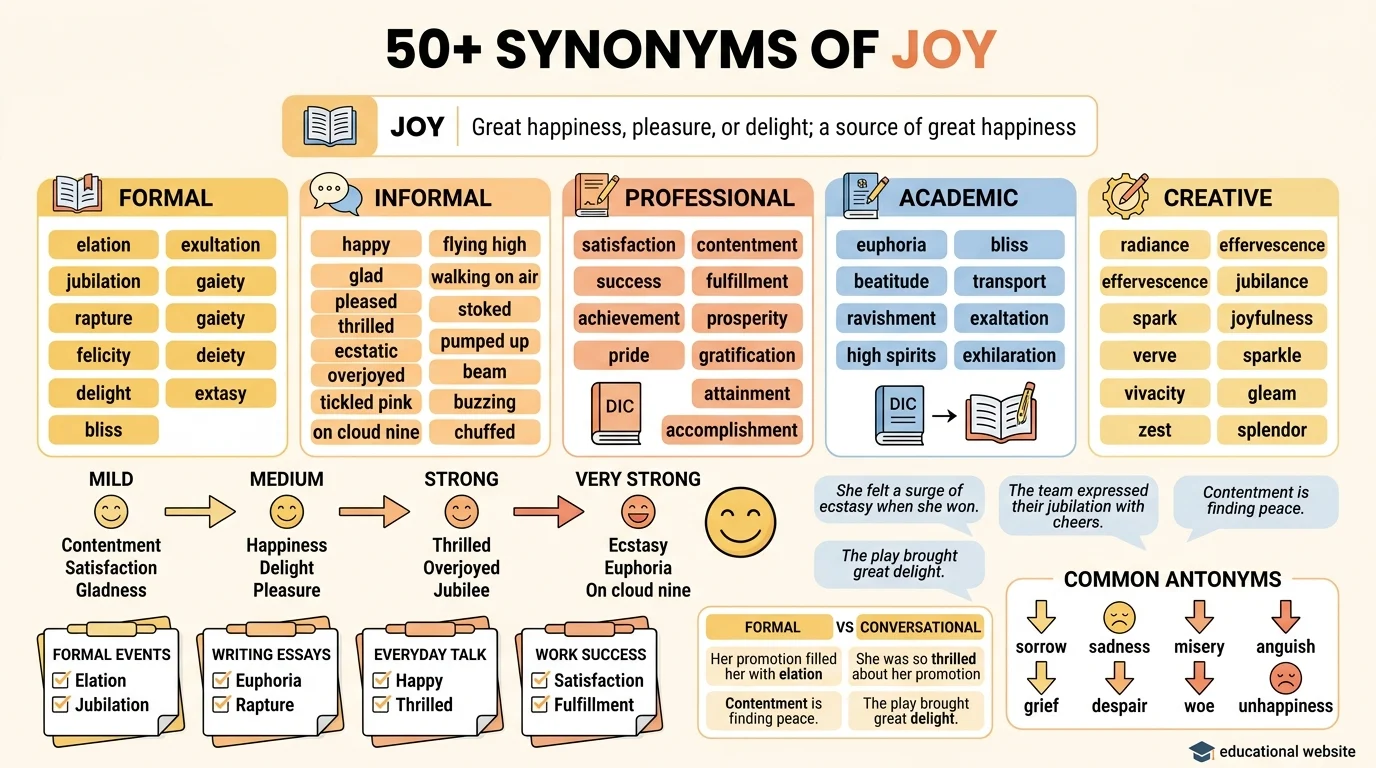
Joy is a deep feeling of happiness and emotional well-being. The best synonym depends on your context. Formal writing, use “delight” or “contentment.” For casual conversation, try “happiness” or “cheer.” For professional communication, “satisfaction” works well. Emotional writing, “bliss” or “rapture” express stronger feelings. Creative writing benefits from “glee” or “exhilaration.”
Meaning, Tone, and Context
Simple Definition
Joy is an intense feeling of happiness, pleasure, or emotional satisfaction. It often arises from positive experiences, achievements, or meaningful connections with others.
Part of Speech
- Noun: “Her joy was contagious.”
- Verb: “He joyed in his children’s success.”
Overall Tone
Positive and uplifting.
Formality Level
Joy is neutral. It works in both casual and formal settings, though it carries a slightly more elevated and emotional tone than “happiness.”
Common Uses
Native English speakers use joy in personal conversations, emotional writing, religious contexts, and moments of celebration. The word appears frequently in literature, greeting cards, and sentimental messages.
Word Forms
- Noun: joy
- Verb: joy (rare), rejoice
- Adjective: joyful, joyous, joyless
- Adverb: joyfully, joyously
When and How to Use “Joy”
Choose joy when you want to express genuine happiness connected to meaningful experiences. Joy often suggests a deeper, more lasting emotional state than simple pleasure.
Here are seven realistic examples showing how joy fits different contexts:
Professional
“The team expressed their joy at receiving the industry recognition.”
Academic
“The study measured participants’ levels of joy and life satisfaction.”
Workplace
“She found great joy in mentoring new employees.”
Personal
“Watching my daughter take her first steps filled me with pure joy.”
Email
“I cannot tell you the joy I felt when I received your thoughtful message.”
Resume
“Finding creative solutions to client challenges brings me deep professional joy.”
Social Media
“Nothing compares to the joy of a perfect sunset.”
Best Synonyms of “Joy”
No single synonym perfectly replaces joy in every situation. Each alternative carries a slightly different shade of meaning, emotional intensity, and formality level. Here are the best choices for specific contexts.
Professional Writing
Use “satisfaction.” This word sounds polished and measured, making it ideal for workplace communication.
Academic Writing
Use “contentment.” This word suggests sustained emotional well-being without excessive emotional language.
Business Communication
Use “gratification.” This term implies a sense of reward and achievement.
Casual Conversation
Use “happiness.” This direct, simple word works best for everyday speech.
Emotional Writing
Use “bliss.” This word suggests complete, absolute happiness.
Creative Writing
Use “exhilaration.” This word captures the excited, energetic side of joy.
Resume Writing
Use “fulfillment.” This word suggests meaning and purpose in your work.
Workplace Communication
Use “appreciation.” This word focuses on positive feelings toward others.
Stronger Meaning
Use “rapture.” This word suggests overwhelming, ecstatic joy.
Softer Meaning
Use “cheer.” This word suggests a lighter, more gentle happiness.
When Not to Use “Joy”
When the Word Sounds Too General
Joy can feel vague when you need a more specific emotion.
Incorrect: “I felt joy at the concert.”
Better: “I felt exhilaration at the concert.”
Why: Exhilaration better captures the energetic, thrilling experience of live music.
When the Word Sounds Too Formal
Joy might sound overly proper in casual conversation.
Incorrect: “I have great joy for pizza.”
Better: “I love pizza.”
Why: Love expresses the casual enthusiasm more naturally in everyday speech.
When the Word Sounds Too Weak
Joy may not capture the intensity of your feeling.
Incorrect: “She experienced joy when she won the lottery.”
Better: “She experienced ecstasy when she won the lottery.”
Why: Ecstasy better conveys the overwhelming emotion of such a life-changing event.
When the Word Sounds Too Strong
Joy can feel too intense for everyday situations.
Incorrect: “I felt joy about my coffee this morning.”
Better: “I felt cheerful about my coffee this morning.”
Why: Cheerful matches the light, pleasant feeling more appropriately.
When the Word Sounds Outdated
Joy sometimes feels old-fashioned in modern business writing.
Incorrect: “I take great joy in your report.”
Better: “I appreciate your report.”
Why: Appreciation sounds more contemporary and professional.
Words Commonly Confused With “Joy”
Joy vs Happiness
Difference: Joy suggests a deeper, more sustained emotional state, while happiness often refers to a temporary positive feeling.
When to Use It: Choose joy for meaningful, lasting feelings. Choose happiness for everyday pleasant emotions.
Example: “Her joy came from raising her children,” versus “I found happiness in my morning coffee.”
Joy vs Pleasure
Difference: Pleasure focuses on sensory or physical enjoyment, while joy connects to emotional fulfillment.
When to Use It: Choose pleasure for enjoyable activities and sensations. Choose joy for deeper emotional experiences.
Example: “The massage gave me great pleasure,” versus “Watching my son graduate filled me with joy.”
Joy vs Delight
Difference: Delight often describes a reaction to something specific and pleasing, while joy is more general and lasting.
When to Use It: Choose delight for reactions to specific events. Choose joy for overall emotional states.
Example: “I was delighted by the surprise party,” versus “The surprise party brought me great joy.”
Joy vs Bliss
Difference: Bliss suggests complete, perfect happiness, often in romantic or spiritual contexts. Joy is less extreme.
When to Use It: Choose bliss for moments of perfect happiness. Choose joy for genuine but more moderate feelings.
Example: “They lived in blissful harmony,” versus “They found joy in their shared hobbies.”
Joy vs Contentment
Difference: Contentment suggests satisfaction and peace, while joy is more active and enthusiastic.
When to Use It: Choose contentment for peaceful satisfaction. Choose joy for more vibrant happiness.
Example: “He felt contentment sitting by the fire,” versus “He felt joy watching his grandchildren play.”
Joy vs Exhilaration
Difference: Exhilaration emphasizes excitement and energy, while joy is calmer and deeper.
When to Use It: Choose exhilaration for thrilling experiences. Choose joy for meaningful moments.
Example: “The roller coaster gave me exhilaration,” versus “My daughter’s first steps gave me joy.”
Best Synonyms of “Joy” by Context
| Context | Best Synonym | Why It Works | Example |
|---|---|---|---|
| Formal Writing | Delight | Sounds polished and appropriate for official documents | “We note with delight your contributions to the project.” |
| Academic Writing | Contentment | Suggests sustained well-being without excessive emotion | “The study measured participants’ contentment levels.” |
| Professional Communication | Satisfaction | Sounds measured and professional | “The team expressed satisfaction with the outcome.” |
| Business Emails | Gratification | Implies reward and achievement | “Your positive feedback brought us great gratification.” |
| Resume Writing | Fulfillment | Suggests purpose and meaning in work | “I find professional fulfillment in solving complex problems.” |
| Workplace Communication | Appreciation | Focuses on positive feelings toward others | “I want to express my appreciation for your hard work.” |
| Casual Conversation | Happiness | Direct, simple, and natural for everyday use | “Her happiness was obvious to everyone.” |
| Everyday Speaking | Cheer | Light and gentle for ordinary situations | “His cheerful attitude lifted everyone’s spirits.” |
| Creative Writing | Exhilaration | Captures excitement and energy | “The exhilaration of victory filled the stadium.” |
| Storytelling | Glee | Suggests playful, joyful excitement | “The children’s glee was infectious.” |
| Emotional Writing | Bliss | Expresses perfect, complete happiness | “They spent their honeymoon in blissful seclusion.” |
| Strong Emphasis | Rapture | Suggests overwhelming, ecstatic joy | “She was in rapture at the beautiful performance.” |
| Mild Tone | Contentment | Soft, peaceful satisfaction | “A feeling of contentment settled over him.” |
| Social Media Captions | Joyful | Simple, positive, and visually appealing | “Feeling joyful today!” |
| American English | Joy | The standard choice across all contexts | “She brings joy to everyone she meets.” |
How to Choose the Best Synonym of “Joy”
Choosing the right synonym of joy depends on several factors. Consider the following questions before you decide.
What is your audience? Choose formal words for professional audiences. Choose casual words for friends and family.
What is your purpose? Use emotional words for personal writing. Use measured words for business communication.
What level of intensity do you need? Choose strong words like “ecstasy” for powerful emotions. Choose mild words like “cheer” for gentle feelings.
What is your writing style? Use sophisticated vocabulary for academic papers. Use simple language for social media.
How formal is your setting? Use “delight” and “contentment” in formal contexts. Use “happiness” and “cheer” in informal settings.
Which word sounds most natural? Read your sentence aloud. The right word should flow smoothly without sounding forced.
Real Life Examples of “Joy”
School
“The students expressed their joy when the principal announced the field trip.”
College
“Graduation day brought immense joy to the entire family.”
Workplace
“Sarah found joy in helping her colleagues solve difficult problems.”
Business
“Our customer satisfaction scores filled the leadership team with joy.”
Email
“Words cannot describe the joy we felt when we received your donation.”
Resume
“Building strong client relationships brings me professional joy.”
Conversation
“The joy in his voice was unmistakable when he talked about his grandchildren.”
Storytelling
“Her heart swelled with joy as she watched the sunrise over the mountains.”
Blogging
“These small moments of joy make life truly beautiful.”
Social Media
“Spread joy wherever you go today! The world needs more kindness.”
18 Best Synonyms of “Joy”
| Synonym | Simple Meaning | Best Used For | Example Sentence |
|---|---|---|---|
| Happiness | A general state of well-being | Everyday conversation | Her happiness was contagious. |
| Delight | Great pleasure from something specific | Expressing enjoyment | I was delighted by your thoughtful gift. |
| Contentment | Peaceful satisfaction | Describing quiet happiness | She found contentment in her simple life. |
| Satisfaction | Fulfillment of desires or needs | Professional contexts | The project gave me deep satisfaction. |
| Glee | Playful, joyful excitement | Lighthearted moments | The children’s glee was adorable. |
| Bliss | Perfect, complete happiness | Emotional and romantic writing | They lived in wedded bliss. |
| Exhilaration | Exciting, thrilling joy | High-energy experiences | The roller coaster ride was pure exhilaration. |
| Euphoria | Intense, overwhelming happiness | Extreme positive experiences | Winning the championship caused euphoria. |
| Rapture | Ecstatic, transcendent joy | Strong emotional writing | She listened to the music in rapture. |
| Cheer | Light, gentle happiness | Casual, friendly contexts | His good cheer brightened the room. |
| Elation | Elevated, proud happiness | Celebratory occasions | The team felt elation after the victory. |
| Fulfillment | Satisfaction through achievement | Resume and career writing | I find fulfillment in meaningful work. |
| Appreciation | Positive recognition | Workplace gratitude | I want to express my appreciation. |
| Enjoyment | Pleasure from an activity | Leisure and entertainment | The movie provided great enjoyment. |
| Jubilation | Celebratory, triumphant joy | Major achievements | Jubilation filled the streets after the announcement. |
| Gladness | Simple, heartfelt happiness | Personal and emotional contexts | Her gladness was evident in her smile. |
| Pleasure | Physical or sensory enjoyment | Describing experiences | The meal gave me great pleasure. |
| Ecstasy | Overwhelming, rapturous joy | Intense emotional experiences | The concert sent her into ecstasy. |
Synonyms of “Joy” by Usage
Professional vs Personal Synonyms
In professional settings, choose measured synonyms like “satisfaction,” “fulfillment,” and “appreciation.” These words sound polished and appropriate for workplace communication.
In personal contexts, choose warmer synonyms like “happiness,” “glee,” and “bliss.” These words express genuine feeling without sounding overly formal.
Professional: “I find satisfaction in achieving our team goals.”
Personal: “I find joy in spending time with my family.”
Formal vs Conversational Synonyms
Formal writing benefits from “delight,” “contentment,” and “gratification.” These words elevate your writing without sounding pretentious.
Conversational contexts call for “happiness,” “cheer,” and “gladness.” These words feel natural in everyday speech.
Formal: “The committee expressed their delight with the proposal.”
Conversational: “I was so happy to see you!”
Academic Synonyms
Academic writing requires precise vocabulary. “Contentment” works well for psychological studies. “Well-being” appears frequently in research papers. “Life satisfaction” is a standard term in social science research.
These words sound authoritative and avoid excessive emotional language. Academic readers expect measured vocabulary that reflects careful thinking.
Professional and Business Synonyms
Resumes benefit from “fulfillment” and “satisfaction.” Interviews call for “appreciation” and “gratification.” Business emails should use “delight” and “pleasure.”
These words project professionalism and emotional intelligence. They show you can express positive feelings appropriately in the workplace.
Creative and Literary Synonyms
Storytelling benefits from “glee,” “exhilaration,” and “rapture.” Poetry often uses “bliss” and “ecstasy.” Descriptive writing calls for “jubilation” and “elation.”
Creative synonyms add color and emotion to your writing. They help readers feel the experience rather than simply understanding it.
Slang or Modern Synonyms
No true slang synonyms exist for joy. However, modern expressions like “stoked” and “psyched” capture excitement related to joy. Use these in casual conversation only. Avoid them in any formal or professional context.
Strongest to Mildest Synonyms
Mild: Cheer, gladness, contentment
Moderate: Happiness, enjoyment, satisfaction
Strong: Elation, exhilaration, delight
Very Strong: Euphoria, ecstasy, rapture, bliss
Understanding this scale helps you choose the right intensity for your message. A gentle feeling calls for a mild synonym. A powerful emotion needs a strong alternative.
Emotional vs Neutral Synonyms
Emotional Synonyms: Bliss, ecstasy, rapture, glee, euphoria
Neutral Synonyms: Satisfaction, contentment, happiness, enjoyment
synonyms express strong feelings and work best in personal or creative writing. Neutral synonyms communicate information without adding emotional weight, making them suitable for professional and academic contexts.
Antonyms of “Joy”
| Antonym | Meaning | Example Sentence |
|---|---|---|
| Sadness | A feeling of sorrow or unhappiness | The news filled her with sadness. |
| Grief | Deep sorrow, especially from loss | He was overwhelmed by grief. |
| Misery | Extreme unhappiness or suffering | The prisoners lived in misery. |
| Despair | Complete loss of hope | She fell into despair after losing her job. |
| Melancholy | A deep, thoughtful sadness | A melancholy settled over him. |
| Sorrow | Pain caused by loss or disappointment | Her sorrow was evident in her eyes. |
| Anguish | Severe mental or physical pain | He cried out in anguish. |
| Discontent | Lack of satisfaction | Discontent grew among the workers. |
| Depression | Persistent sadness and hopelessness | He struggled with depression for years. |
| Despondency | Low spirits from loss of hope | Despondency filled her heart. |
| Misery | Extreme suffering or unhappiness | His life was filled with misery. |
| Unhappiness | A state of being unhappy | Unhappiness had become his constant companion. |
| Gloom | Darkness or sadness | Gloom hung over the entire household. |
| Dejection | Low spirits, usually from failure | She felt dejection after the rejection. |
| Woe | Great sorrow or distress | The refugees told stories of woe. |
Comparison: “Joy” vs Similar Words
Joy vs Happiness
Main Difference: Joy is deeper and more lasting. Happiness is often temporary.
Which Is Stronger? Joy is stronger and more profound.
Which Is More Formal? Joy is slightly more formal, especially in literary contexts.
When to Use Each: Use joy for meaningful, lasting feelings. Use happiness for everyday pleasant emotions.
Joy: “Her joy at becoming a grandmother was immeasurable.”
Happiness: “I found happiness in a good cup of coffee.”
Joy vs Pleasure
Main Difference: Pleasure relates to physical or sensory experiences. Joy connects to emotional fulfillment.
Which Is Stronger? Joy is generally stronger and more meaningful.
Which Is More Formal? Both are neutral, but pleasure is more common in academic writing.
When to Use Each: Use pleasure for enjoyable activities. Use joy for deeper emotional experiences.
Joy: “The joy of raising children enriched her life.”
Pleasure: “The pleasure of a warm bath relaxed her.”
Joy vs Delight
Main Difference: Delight often reacts to a specific event. Joy is a more general state.
Which Is Stronger? Joy is generally deeper and more lasting.
Which Is More Formal? Delight is slightly more formal, especially in British English.
When to Use Each: Use delight for reactions. Use joy for states of being.
Joy: “He experienced great joy in retirement.”
Delight: “She was delighted by the thoughtful card.”
Joy vs Bliss
Main Difference: Bliss suggests perfect happiness. Joy is more realistic and achievable.
Which Is Stronger? Bliss is stronger and suggests completeness.
Which Is More Formal? Both are emotional and used in personal contexts.
When to Use Each: Use bliss for moments of perfect happiness. Use joy for genuine, realistic happiness.
Joy: “She found joy in her daily routines.”
Bliss: “The couple lived in marital bliss.”
Joy vs Contentment
Main Difference: Contentment is peaceful and calm. Joy is active and vibrant.
Which Is Stronger? Joy is more energetic and emotionally intense.
Which Is More Formal? Contentment is often used in formal and academic writing.
When to Use Each: Use contentment for peaceful satisfaction. Use joy for enthusiastic happiness.
Joy: “The celebration filled everyone with joy.”
Contentment: “He sat in quiet contentment.”
Joy vs Exhilaration
Main Difference: Exhilaration emphasizes excitement. Joy emphasizes emotional warmth.
Which Is Stronger? Both are strong, but exhilaration is more intense.
Which Is More Formal? Exhilaration is more literary and descriptive.
When to Use Each: Use exhilaration for thrilling experiences. Use joy for heartfelt moments.
Joy: “Her joy at seeing her family was evident.”
Exhilaration: “The skydiver felt exhilaration.”
Common Phrases and Expressions with “Joy”
Phrase: “Jump for joy”
Meaning: To be extremely happy about something.
Example Sentence: “She jumped for joy when she received the acceptance letter.”
Phrase: “Pride and joy”
Meaning: Something or someone that makes you feel very proud.
Example Sentence: “His classic car collection is his pride and joy.”
Phrase: “Full of joy”
Meaning: Extremely happy and cheerful.
Example Sentence: “The children were full of joy on Christmas morning.”
Phrase: “A joy to behold”
Meaning: Something beautiful or pleasing to see.
Example Sentence: “The sunset was a joy to behold.”
Phrase: “Tears of joy”
Meaning: Crying because you are so happy.
Example Sentence: “She wept tears of joy at the surprise party.”
Phrase: “Enjoy”
Meaning: To take pleasure in something; derived from “enjoy” which means to have joy.
Example Sentence: “We hope you enjoy your meal.”
Phrase: “Joyful occasion”
Meaning: A happy, celebratory event.
Example Sentence: “Their wedding was a joyful occasion.”
Phrase: “My joy knows no bounds”
Meaning: I am extremely happy beyond measure.
Example Sentence: “After hearing the good news, my joy knows no bounds.”
Common Mistakes to Avoid
1: Choosing a Vague Synonym Instead of a Precise One
Sometimes writers choose “happy” when a more specific word would work better.
Incorrect: “I was very happy at the concert.”
Better: “I felt exhilaration at the concert.”
Why: Exhilaration better captures the exciting energy of a live performance.
2: Confusing Joy with a Similar Word
Many writers mix up joy and pleasure.
Incorrect: “Taking care of my mother gives me great pleasure.”
Better: “Taking care of my mother gives me great joy.”
Why: Joy better expresses the deep emotional fulfillment of caring for a loved one.
3: Using an Informal Synonym in Formal Writing
Casual words like “stoked” belong in conversation, not reports.
Incorrect: “I was so stoked about the project results.”
Better: “We were delighted with the project results.”
Why: Delight sounds professional and appropriate for business communication.
4: Selecting an Overly Dramatic Synonym
Words like “ecstasy” sound excessive in everyday situations.
Incorrect: “I was in ecstasy about my promotion.”
Better: “I felt elation about my promotion.”
Why: Elation expresses strong happiness without sounding exaggerated.
5: Repeating the Same Word Too Often
Using joy repeatedly weakens your writing.
Incorrect: “Her joy was obvious. His joy was also clear.”
Better: “Her joy was obvious. His happiness was also clear.”
Why: Varying your vocabulary keeps your writing fresh and interesting.
6: Choosing a Synonym with the Wrong Emotional Tone
Some synonyms suggest different emotional colors.
Incorrect: “He felt intense joy watching the sunset.”
Better: “He felt peaceful contentment watching the sunset.”
Why: Contentment better matches the calm, reflective mood of watching a sunset.
7: Using Slang in Academic or Professional Writing
Modern expressions are inappropriate in formal contexts.
Incorrect: “The researcher was psyched about the results.”
Better: “The researcher was delighted with the results.”
Why: Delight maintains academic professionalism.
Frequently Asked Questions
1. What are the best synonyms of joy?
The best synonyms of joy depend on your context. “Delight” works for formal writing. “Happiness” fits casual conversation. “Contentment” suits academic contexts. “Satisfaction” sounds professional. “Bliss” expresses strong emotional writing.
2. What are the best formal synonyms of joy?
The best formal synonyms of joy include “delight,” “contentment,” “satisfaction,” “gratification,” and “appreciation.” These words sound polished and appropriate for professional, academic, and business writing.
3. What are common informal synonyms of joy?
Common informal synonyms of joy include “happiness,” “cheer,” “glee,” and “gladness.” These words work well in everyday conversation, personal messages, and casual social media posts.
4. What is another word for joy in professional writing?
“Satisfaction” is the most professional synonym for joy in workplace communication. “Fulfillment” works well on resumes. “Appreciation” is excellent for emails and team interactions.
5. What is the difference between joy and happiness?
Joy is deeper and more lasting than happiness. Happiness often describes temporary positive feelings. Joy reflects meaningful emotional fulfillment. Use joy for profound experiences. Use happiness for everyday pleasant moments.
6. What is the opposite of joy?
The opposite of joy is “sadness.” Other antonyms include “grief,” “misery,” “despair,” and “melancholy.” These words represent varying degrees of unhappiness and sorrow.
Conclusion
Understanding the synonyms of joy helps you express happiness with greater precision and impact. No single synonym works perfectly in every situation. “Delight” shines in formal writing. “Happiness” rules casual conversation. “Satisfaction” sounds professional. “Bliss” expresses deep emotion. “Contentment” captures peaceful happiness.
The best writers choose words based on their audience, purpose, tone, and emotional intensity. Developing this skill takes practice, but the effort pays off in clearer, more engaging communication. Start by replacing one repetitive word with a more specific synonym today.
Remember, exploring synonyms of joy is not just about avoiding repetition. It is about finding the exact word that captures your intended meaning. Choose carefully, and your readers will understand your message exactly as you intend.