Have you ever found yourself writing a recommendation letter, crafting a resume, or describing someone’s character, only to realize you have used the word “courage” three times in two paragraphs? You are not alone. Many writers struggle to find fresh alternatives for this powerful word. Choosing the right synonym of courage can transform your writing from repetitive to compelling. The word itself carries significant weight, but using the same term repeatedly weakens your message. Whether you are writing an email, an essay, or a social media post, understanding synonyms of courage helps you communicate more precisely and keep your audience engaged.
What Are the Best Synonyms of “Courage”?
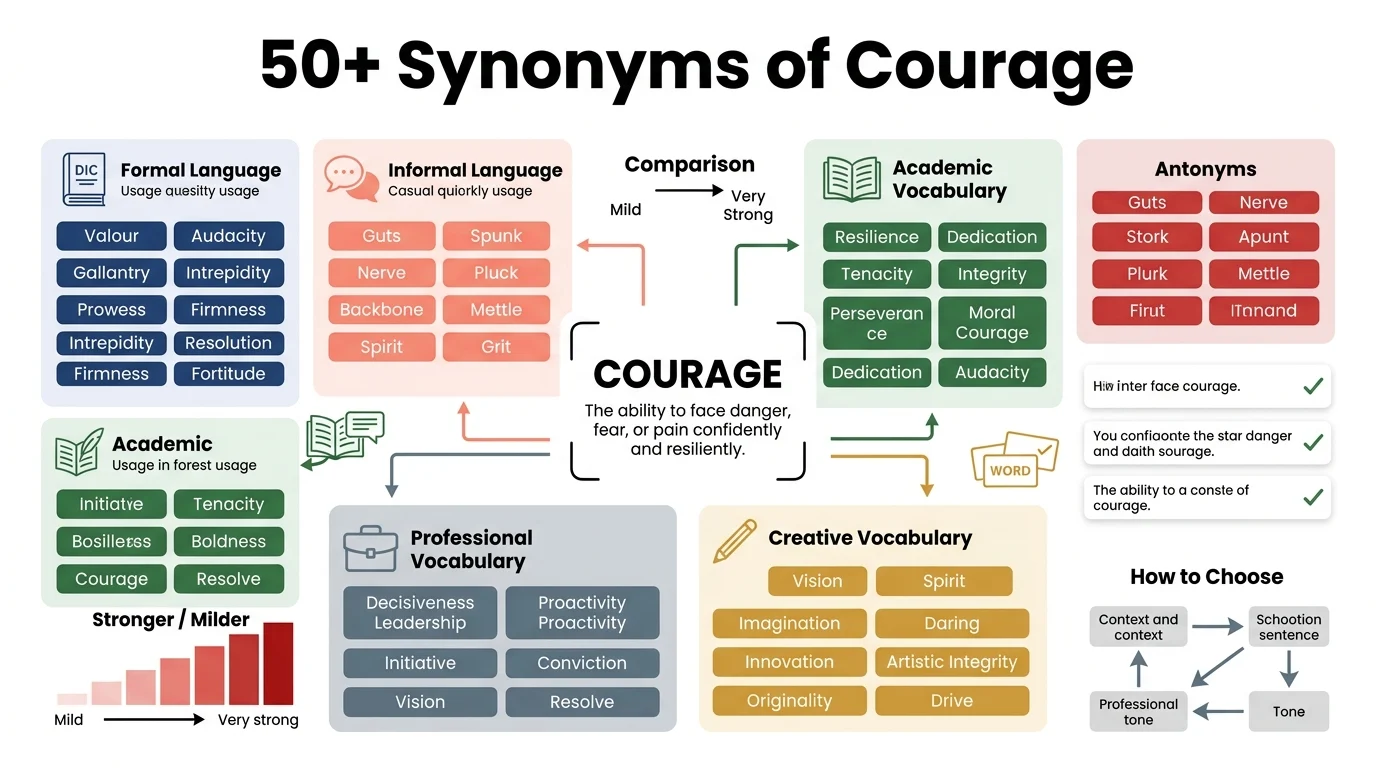
Courage means the ability to face fear, pain, danger, or uncertainty without being overcome by those feelings. For formal writing, choose “fortitude” or “valor.” For casual conversation, use “guts” or “nerve.” Professional settings call for “resolve” or “determination.” Academic writing benefits from “tenacity” or “perseverance,” while creative writing suits “audacity” or “daring.”
Meaning, Tone, and Context
Simple Definition
Courage is the mental or moral strength to face difficulty, danger, or fear without giving in to panic or despair. It involves taking action despite feeling afraid.
Part of Speech
Noun
Overall Tone
Positive. Courage is always viewed favorably across all contexts.
Formality Level
Neutral. Courage works well in formal writing, professional communication, casual conversation, and everything in between.
Common Uses
Native English speakers commonly use courage in several situations. Use it when talking about personal achievements, such as overcoming a fear of public speaking. Use it when describing acts of heroism, like firefighters running into burning buildings. Use it in professional settings when discussing leadership decisions. They also use it in everyday conversation when encouraging someone to try something difficult or new.
Word Forms
Noun: courage
Adjective: courageous
Adverb: courageously
Verb: encourage (to give courage to someone)
Related Forms: courageousness, encouragement, discouragement
Opposite Form: cowardice
When and How to Use “Courage”
Choose courage when you want to acknowledge someone’s strength in facing a difficult situation. The word works well across virtually all contexts. It carries a universally positive meaning and is never misinterpreted as negative.
Examples by Context
Professional:
The project required tremendous courage from the team to adopt new technology before industry standards existed.
Academic:
Researchers demonstrated intellectual courage by challenging established theories in their field.
Workplace:
His courage in speaking up about workplace safety concerns saved the company from potential liability.
Personal:
It took real courage for Maria to move across the country without knowing anyone in her new city.
Email:
I want to acknowledge the courage you showed during this difficult transition period.
Resume:
Demonstrated courage by proposing innovative solutions during company restructuring.
Social Media:
Courage isn’t about being fearless. It is about moving forward when fear is present.
Best Synonyms of “Courage”
No synonym captures exactly the same meaning as courage in every situation. Each alternative carries its own emotional weight, formality level, and contextual fit. The best choice depends on your audience, purpose, and intended tone.
Professional Writing
Fortitude: This word suggests mental and emotional strength over time, not just a single brave act. It works exceptionally well in workplace communications and leadership contexts.
Academic Writing
Perseverance: This word emphasizes continued effort despite obstacles. It fits scholarly discussions of human behavior, historical figures, and psychological research.
Business Communication
Resolve: This word suggests firm determination to achieve a goal. It communicates strength of purpose without emotional excess.
Casual Conversation
Guts: This informal word carries a sense of raw, instinctive bravery. It works well with friends and in everyday situations.
Emotional Writing
Valor: This word carries deep respect and admiration for bravery, especially in difficult or dangerous situations.
Creative Writing
Audacity: This word suggests boldness that may border on recklessness. It adds a dramatic, attention-grabbing quality to descriptions.
Resume Writing
Tenacity: This word communicates persistence and determination to achieve specific outcomes. Hiring managers respond well to this quality.
Workplace Communication
Boldness: This word suggests willingness to take risks and stand out from the crowd in a professional setting.
Stronger Meaning
Mettle: This word suggests inherent strength of character that is tested and proven under pressure.
Softer Meaning
Heart: This word suggests emotional bravery and the willingness to show vulnerability.
When Not to Use “Courage”
When the Word Sounds Too General
Sometimes courage is too broad for what you want to describe. If someone simply endured a tedious task, calling it courage can feel exaggerated.
Ineffective:
She showed courage by sitting through the three-hour meeting.
Better Alternative:
She showed patience by sitting through the three-hour meeting.
When the Word Sounds Too Formal
In casual conversation with friends, using courage can feel overly serious for minor challenges.
Ineffective:
I must summon the courage to order the spicy noodles.
Better Alternative:
I need to be brave and order the spicy noodles.
When the Word Sounds Too Weak
Some situations demand a stronger word than courage, especially when describing extraordinary acts.
Ineffective:
The soldiers showed courage in the battle.
Better Alternative:
The soldiers showed valor in the battle.
When the Word Sounds Outdated
Although courage itself never sounds outdated, using it in extremely informal digital contexts can feel old-fashioned.
Ineffective:
Having the courage to swipe right on the dating app.
Better Alternative:
Having the nerve to swipe right on the dating app.
Words Commonly Confused With “Courage”
Courage vs Bravery
Difference: Courage involves facing fear while acknowledging it. Bravery often implies acting without showing fear, even when fear exists. Many people use these interchangeably, but courage emphasizes the internal struggle, while bravery emphasizes external action.
When to Use It: Choose bravery when describing visible, immediate acts of fearlessness. Choose courage when discussing internal strength and persistence over time.
Example: His courage helped him survive the illness. His bravery was visible when he walked into the operating room.
Courage vs Valor
Difference: Valor specifically describes heroic courage in battle or dangerous situations. Courage applies to all difficulties, from personal struggles to professional challenges.
When to Use It: Use valor only for acts involving physical danger or military contexts. Use courage for everyday challenges.
Example: The medal recognized his valor during the rescue mission. The promotion recognized her courage in transforming the department.
Courage vs Guts
Difference: Guts is informal and suggests instinctive, almost reckless bravery. Courage is more refined and suggests thoughtful decision-making.
When to Use It: Use guts in casual conversation. Use courage in professional writing.
Example: It took guts to quit his job without another offer lined up. It took courage to build his own business from scratch.
Courage vs Fortitude
Difference: Fortitude emphasizes enduring pain or hardship over time. Courage can describe a single brave act or ongoing strength.
When to Use It: Use fortitude for long-term endurance. Use courage for specific moments of bravery.
Example: She showed incredible fortitude during her lengthy recovery. She showed courage when she asked for help.
Courage vs Audacity
Difference: Audacity often carries a hint of disrespect or recklessness. Courage is always positive and socially acceptable.
When to Use It: Use audacity for bold actions that might upset others. Use courage for universally admirable acts.
Example: He had the audacity to ask his boss for a raise on his first day. He had the courage to ask for fair compensation.
Courage vs Nerve
Difference: Nerve suggests the confidence to do something others might find frightening or inappropriate. Courage suggests moral or emotional strength.
When to Use It: Use nerve for challenges involving social risk. Use courage for deeper, more significant challenges.
Example: She had the nerve to interrupt the CEO. She had the courage to present her unpopular idea to the board.
Best Synonyms of “Courage” by Context
| Context | Best Synonym | Why It Works | Example |
|---|---|---|---|
| Formal writing | Fortitude | Emphasizes mental strength and endurance over time | The committee admired her fortitude through decades of public service |
| Academic writing | Perseverance | Highlights sustained effort in pursuit of knowledge | His perseverance in research led to significant discoveries |
| Professional communication | Resolve | Communicates firm determination without emotional excess | The team showed remarkable resolve in meeting the deadline |
| Business emails | Determination | Clear, direct, and universally understood | Your determination to complete the project is appreciated |
| Resume writing | Tenacity | Suggests persistence that leads to concrete results | Demonstrated tenacity in acquiring new skills during certification |
| Workplace communication | Boldness | Suggests willingness to take calculated risks | Her boldness in suggesting new approaches improved efficiency |
| Casual conversation | Guts | Informal, relatable, and easy to understand | It took guts to apologize in front of everyone |
| Everyday speaking | Nerve | Natural and conversational in most settings | I can’t believe you had the nerve to ask him that question |
| Creative writing | Audacity | Adds drama and attention-grabbing quality | The audacity of her plan shocked everyone at the table |
| Storytelling | Daring | Conveys excitement and bold adventure | His daring rescue saved the child from danger |
| Emotional writing | Valor | Carries deep respect and admiration | The community honored their valor and selflessness |
| Strong emphasis | Mettle | Suggests character tested and proven under pressure | The crisis revealed their true mettle to the world |
| Mild tone | Heart | Gentle, warm, and emotionally accessible | She showed great heart in forgiving those who wronged her |
| Social media captions | Grit | Modern, relevant, and inspiring | Grit and determination got her to where she is today |
| American English | Courage | Direct, strong, and widely preferred | Courage is choosing action over comfort |
| British English | Pluck | More common in UK usage | She showed plenty of pluck in her political career |
How to Choose the Best Synonym of “Courage”
Choosing the right synonym requires careful consideration of several factors.
Consider Your Audience
Think about who will read your writing. Executives and academics appreciate formal synonyms like “fortitude” and “tenacity.” Friends and social media followers respond better to informal words like “guts” and “nerve.” Choose words your audience uses naturally.
Consider Your Purpose
Are you inspiring action, praising achievement, or describing character? “Valor” inspires admiration. “Determination” praises achievement. “Guts” describes character in everyday terms. Match your synonym to your communication goal.
Consider Emotional Strength
Some synonyms carry strong emotional weight. “Valor” and “mettle” create a powerful impression. “Nerve” and “guts” feel more casual. Decide how much emotional impact your writing needs.
Consider Writing Formality
Academic writing requires precise language. Professional writing needs confident, clear terms. Casual writing allows for informal expressions. Match your synonym to your context.
Consider Natural Sounding Language
Read your sentence aloud with the chosen synonym. Does it sound natural? Does it fit the rhythm of your writing? Trust your ear when choosing between closely related options.
Consider Specificity
“Courage” can apply to many situations. Sometimes you need a more specific word. “Tenacity” describes persistence. “Valor” describes physical bravery. “Audacity” describes bold risk-taking. Choose the word that captures the exact meaning you intend.
Real Life Examples of “Courage”
School
Original:
The student showed courage by asking the teacher to explain the concept again.
Improved:
The student showed initiative by asking the teacher to explain the concept again.
College
Original:
Graduating college required courage to navigate all the challenges.
Improved:
Graduating college required perseverance to navigate all the challenges.
Workplace
Original:
My colleague showed courage by applying for the leadership position despite the competition.
Improved:
My colleague showed ambition by applying for the leadership position despite the competition.
Business
Original:
The startup needed courage to enter a competitive market.
Improved:
The startup needed audacity to enter a competitive market.
Original:
I appreciate the courage you have shown during this transition.
Improved:
I appreciate the resilience you have shown during this transition.
Resume
Original:
Showed courage in proposing cost-saving measures.
Improved:
Demonstrated initiative by proposing cost-saving measures to leadership.
Conversation
Original:
He had the courage to ask her for a date.
Improved:
He had the nerve to ask her for a date.
Storytelling
Original:
The knight showed courage in facing the dragon.
Improved:
The knight showed valor in facing the dragon.
Blogging
Original:
Starting a blog takes courage when you are a beginner.
Improved:
Starting a blog takes grit when you are a beginner.
Social Media
Original:
Courage is doing what scares you.
Improved:
Boldness is doing what scares you anyway.
18 Best Synonyms of “Courage”
| Synonym | Simple Meaning | Best Used For | Example Sentence |
|---|---|---|---|
| Valor | Heroic bravery in danger or battle | Military contexts, heroic acts, formal praise | The firefighter received recognition for his valor in rescuing three families |
| Fortitude | Mental and emotional strength over time | Professional writing, personal challenges | Her fortitude through the long legal battle impressed everyone |
| Tenacity | Persistent determination to succeed | Resumes, professional communication | His tenacity in acquiring new skills made him the ideal candidate |
| Resolve | Firm determination to achieve goals | Business writing, goal-oriented contexts | The team showed remarkable resolve in completing the project early |
| Guts | Raw, instinctive bravery in casual terms | Social media, everyday conversation | It took guts to quit his job and travel the world |
| Nerve | Confidence to face frightening situations | Casual writing, social situations | She had the nerve to speak up in the board meeting |
| Audacity | Boldness with a hint of recklessness | Creative writing, dramatic descriptions | The audacity of the plan shocked the committee members |
| Mettle | Strength of character tested under pressure | Literary writing, character descriptions | The true mettle of the team emerged during the crisis |
| Daring | Adventurous boldness | Storytelling, action-oriented contexts | His daring escape from the building became local legend |
| Grit | Passion and persistence for long-term goals | Modern writing, motivational content | Grit matters more than talent when building a successful business |
| Boldness | Willingness to take risks and stand out | Professional writing, leadership contexts | Her boldness in decision-making earned her the promotion |
| Perseverance | Continued effort despite obstacles | Academic writing, educational contexts | His perseverance through academic challenges inspired fellow students |
| Bravery | Acting without showing fear | General writing, visible acts of courage | The child’s bravery at the hospital amazed the medical staff |
| Heroism | Outstanding courage worthy of admiration | News writing, community recognition | The teacher’s heroism during the emergency saved every student |
| Determination | Firm commitment to achieving a specific outcome | Email writing, professional communication | Your determination to improve department efficiency is appreciated |
| Spirit | Inner strength of character | Personal writing, emotional contexts | The team showed great spirit despite their narrow loss |
| Heart | Emotional bravery and willingness to be vulnerable | Personal letters, warm contexts | She showed heart in speaking honestly about her feelings |
| Pluck | Spirited courage (common in British English) | UK contexts, character descriptions | The young candidate showed plenty of pluck in the debate |
Synonyms of “Courage” by Usage
Professional vs Personal Synonyms
Professional settings favor words that sound confident and measured. “Resolve,” “tenacity,” and “fortitude” fit workplaces perfectly. Personal settings allow more emotional and informal expressions. “Guts,” “nerve,” and “heart” sound natural among friends and family.
Professional choices communicate competence without emotional excess. Personal choices connect with others on an emotional level. Match your synonym to your relationship with your audience.
Formal vs Conversational Synonyms
Formal writing requires precise, dignified language. “Valor,” “fortitude,” and “mettle” suit essays, reports, and professional presentations. Conversational language allows casual, accessible words. “Guts,” “nerve,” and “pluck” work well in daily conversation and informal writing.
Formal synonyms carry authority. Conversational synonyms build connection. Choose based on your communication context.
Academic Synonyms
Academic writing demands precise vocabulary that conveys intellectual authority. “Perseverance,” “tenacity,” and “fortitude” work exceptionally well in research papers and scholarly discussions. These words suggest sustained intellectual effort rather than emotional reaction.
These terms sound more authoritative than simpler alternatives. They demonstrate vocabulary sophistication while maintaining clarity. Academic readers respect precise language that matches the seriousness of scholarly work.
Professional and Business Synonyms
Professional environments reward confident, clear communication. “Resolve,” “determination,” and “tenacity” stand out as strong choices. These words suggest focused effort toward measurable outcomes. Hiring managers notice candidates who demonstrate these qualities.
“Boldness” and “initiative” also work well in professional contexts. They suggest willingness to take calculated risks and step outside comfort zones. These qualities drive business success and career advancement.
Creative and Literary Synonyms
Creative writing thrives on vivid, emotionally charged language. “Audacity,” “daring,” and “mettle” add drama and depth to descriptions. These words create imagery that engages readers’ imaginations.
“Valor” and “heroism” carry epic weight suitable for adventure writing. “Spirit” and “heart” bring emotional warmth to character development. These synonyms help writers craft memorable, distinctive prose.
Slang or Modern Synonyms
“Guts” and “nerve” function as slang synonyms in American English. They are acceptable in casual conversation, social media, and informal writing. They should be avoided in professional reports, academic papers, and formal correspondence.
“Stones” is a more informal, somewhat crude alternative rarely used in polite writing. “Coño” has very limited usage in specific cultural contexts. Most writers should stick with “guts” and “nerve” for informal needs.
Strongest to Mildest Synonyms
Mild:
Heart, spirit, pluck
Moderate:
Courage, bravery, determination
Strong:
Resolve, tenacity, fortitude
Very Strong:
Valor, mettle, audacity, heroism
Emotional vs Neutral Synonyms
Emotional synonyms express feelings and personal connection. “Valor” evokes admiration. “Heart” evokes warmth. “Heroism” evokes inspiration. These words work well in personal writing, speeches, and creative contexts.
Neutral synonyms communicate information without adding emotion. “Determination” simply states a fact. “Perseverance” describes behavior objectively. These words suit business writing, academic work, and professional communication.
Choose emotional synonyms when you want to move your audience. Choose neutral synonyms when you want to inform without influencing emotion.
Antonyms of “Courage”
| Antonym | Meaning | Example Sentence |
|---|---|---|
| Cowardice | Lack of bravery in facing danger | His cowardice in the emergency disappointed his colleagues |
| Fear | Unpleasant emotion caused by perceived threat | Fear prevented her from pursuing her dream career |
| Timidity | Lack of confidence to take action | His timidity in meetings prevented him from sharing good ideas |
| Weakness | Lack of mental or moral strength | Her weakness in decision-making frustrated the team |
| Spinelessness | Complete lack of courage or character | The manager’s spinelessness allowed problems to grow unchecked |
| Hesitation | Pausing due to doubt or fear | His hesitation during the presentation cost him the promotion |
| Insecurity | Lack of confidence in one’s abilities | Her insecurity prevented her from taking leadership roles |
| Apprehension | Fearful anticipation of future events | His apprehension about change made him resist improvements |
| Trepidation | Trembling fear or nervousness | She approached the interview with visible trepidation |
| Pusillanimity | Lack of courage or determination | The politician’s pusillanimity angered his supporters |
| Dastardliness | Disgraceful cowardice | His dastardliness in abandoning his team was unforgivable |
| Fearfulness | Tending to be afraid of many things | The child’s fearfulness prevented participation in activities |
| Faint-heartedness | Lack of courage to face challenges | His faint-heartedness became evident during the crisis |
| Cravenness | Extreme cowardice | The soldier’s cravenness led to disciplinary action |
| Chickenshit | Extreme cowardice in vulgar terms | His chickenshit attitude made him unreliable in emergencies |
Comparison: “Courage” vs Similar Words
Courage vs Bravery
Main Difference: Courage involves acknowledging fear and acting anyway. Bravery often implies acting without visible fear. Courage emphasizes internal struggle. Bravery emphasizes external action.
Which Is Stronger: Bravery often appears stronger in immediate situations. Courage suggests deeper, more sustained strength.
Which Is More Formal: Courage is slightly more formal and versatile. Bravery appears more often in storytelling.
When to Use Each: Use bravery for immediate, visible acts. Use courage for ongoing, internal struggles.
Examples:
Courage: Her courage in surviving the illness inspired her family.
Bravery: His bravery in the burning building saved lives.
Courage vs Valor
Main Difference: Valor specifically applies to heroism in danger or battle. Courage applies to all difficult situations.
Which Is Stronger: Valor carries greater intensity and admiration.
Which Is More Formal: Valor is more formal and specific.
When to Use Each: Use valor for military or heroic acts. Use courage for everyday and professional challenges.
Examples:
Courage: She showed courage by starting her own business.
Valor: He received a medal for valor during the rescue mission.
Courage vs Guts
Main Difference: Guts is informal and suggests instinctive bravery. Courage is formal and suggests thoughtful decision-making.
Which Is Stronger: Guts sounds more raw and immediate. Courage sounds more measured and admirable.
Which Is More Formal: Courage is formal. Guts is casual.
When to Use Each: Use guts with friends and on social media. Use courage in professional and academic writing.
Examples:
Courage: The CEO showed courage in restructuring the company.
Guts: It took guts to tell your boss the truth.
Courage vs Fortitude
Main Difference: Fortitude emphasizes enduring hardship over time. Courage can describe a single act or sustained effort.
Which Is Stronger: Fortitude suggests greater endurance. Courage suggests greater variety of application.
Which Is More Formal: Fortitude is more formal and specific.
When to Use Each: Use fortitude for long-term challenges. Use courage for specific moments of bravery.
Examples:
Courage: She showed courage when she asked for help.
Fortitude: She showed fortitude through years of caregiving.
Courage vs Audacity
Main Difference: Audacity often carries a hint of disrespect or recklessness. Courage is always positive and admirable.
Which Is Stronger: Audacity suggests greater boldness and risk.
Which Is More Formal: Audacity is less formal in professional contexts. Courage is widely appropriate.
When to Use Each: Use audacity for bold, risky actions. Use courage for universally admirable acts.
Examples:
Courage: He showed courage in challenging the established procedure.
Audacity: He had the audacity to rewrite the company’s manual without approval.
Courage vs Nerve
Main Difference: Nerve suggests confidence to face frightening social situations. Courage suggests deeper moral or emotional strength.
Which Is Stronger: Courage is stronger for significant challenges. Nerve works best for everyday social risk.
Which Is More Formal: Nerve is casual. Courage works in all contexts.
When to Use Each: Use nerve for social risk and minor challenges. Use courage for significant personal or professional obstacles.
Examples:
Courage: She had the courage to change careers at age 45.
Nerve: She had the nerve to ask her boss for a raise.
Common Phrases and Expressions with “Courage”
Dutch Courage
Meaning: False courage gained from drinking alcohol.
Example Sentence: He only asked her to dance because he had some Dutch courage from the open bar.
Pluck Up Courage
Meaning: To summon the bravery needed to do something.
Example Sentence: She finally plucked up the courage to ask her boss for a promotion.
Take Courage
Meaning: To find the bravery to face a difficult situation.
Example Sentence: Take courage from the fact that everyone before you has been in this position.
Courage of One’s Convictions
Meaning: Bravery to act according to one’s beliefs despite opposition.
Example Sentence: The politician showed the courage of her convictions by voting against her party.
Screw Up One’s Courage
Meaning: To force oneself to be brave.
Example Sentence: He screwed up his courage and delivered the difficult news to his team.
Have the Courage to
Meaning: To be brave enough to do something specific.
Example Sentence: Do you have the courage to admit when you are wrong?
Show Courage
Meaning: To demonstrate bravery in a situation.
Example Sentence: The team showed courage by continuing the project despite significant setbacks.
Lose Courage
Meaning: To become afraid and give up.
Example Sentence: She refused to lose courage even when the project seemed hopeless.
Common Mistakes to Avoid
Choosing a Vague Synonym Instead of a Precise One
Incorrect:
She showed bravery by staying in a difficult marriage.
Better:
She showed fortitude by staying in a difficult marriage.
Why It Works: Fortitude captures the endurance and patience involved, while bravery suggests a single moment of action.
Confusing Courage with Recklessness
Incorrect:
He had the courage to invest his entire savings in the risky venture.
Better:
He had the audacity to invest his entire savings in the risky venture.
Why It Works: Audacity captures the bold, slightly risky nature of the action. Courage suggests more admirable decision-making.
Using an Informal Synonym in Formal Writing
Incorrect:
The candidate has the guts to transform company culture.
Better:
The candidate has the resolve to transform company culture.
Why It Works: Resolve sounds professional and confident. Guts sounds too casual for workplace communication.
Selecting an Overly Dramatic Synonym
Incorrect:
She showed heroism by waking up early to study every day.
Better:
She showed dedication by waking up early to study every day.
Why It Works: Heroism suggests extreme bravery. Dedication accurately describes consistent effort.
Repeating the Same Synonym Too Often
Incorrect:
His courage impressed the team. His courage helped him succeed. Everyone admired his courage.
Better:
His courage impressed the team. His determination helped him succeed. Everyone admired his fortitude.
Why It Works: Varying synonyms improves readability and maintains reader engagement.
Choosing a Synonym with the Wrong Emotional Tone
Incorrect:
She had the nerve to care for her sick mother for ten years.
Better:
She had the fortitude to care for her sick mother for ten years.
Why It Works: Nerve suggests a single bold moment. Fortitude captures long-term endurance and compassion.
Using Slang in Academic or Professional Writing
Incorrect:
The researcher needed guts to challenge the established theory.
Better:
The researcher needed intellectual courage to challenge the established theory.
Why It Works: Guts is too informal for academic contexts. Intellectual courage sounds appropriate and sophisticated.
Frequently Asked Questions
1. What are the best synonyms of “courage”?
The best synonyms depend on your context. “Fortitude” fits formal writing. “Guts” works in casual conversation. “Resolve” suits professional communication. “Valor” suits heroic contexts. “Tenacity” works well in resumes. “Perseverance” fits academic writing.
2. What are the best formal synonyms of “courage”?
The best formal synonyms include “fortitude,” “valor,” “mettle,” and “tenacity.” These words appear in academic papers, professional reports, and formal speeches. They communicate strength without emotional excess and command respect from educated audiences.
3. What are common informal synonyms of “courage”?
Common informal synonyms include “guts,” “nerve,” and “pluck.” These words work well in casual conversation, social media posts, and personal writing. They sound natural and relatable but should be avoided in formal or professional contexts.
4. What is another word for “courage” in professional writing?
“Resolve” and “determination” are excellent alternatives in professional writing. “Tenacity” works well for resumes. “Fortitude” suits workplace evaluations and recommendations. These words communicate strength of character while maintaining appropriate professional tone.
5. What is the difference between “courage” and “bravery”?
Courage involves facing fear while acknowledging it. Bravery often implies acting without showing fear. Courage emphasizes internal strength and persistence. Bravery emphasizes visible, immediate action. Both are positive, but courage suggests deeper, more sustained character.
6. What is the opposite of “courage”?
The opposite of courage is “cowardice.” Other antonyms include “timidity,” “fearfulness,” “weakness,” and “spinelessness.” “Cowardice” captures the complete absence of bravery. “Timidity” suggests lack of confidence rather than moral failing.
Conclusion
Courage is a powerful word that describes the strength to face fear, danger, and difficulty. Throughout this guide, we have explored numerous synonyms that help writers express this concept more precisely. No single synonym works perfectly in every situation. The best choice depends on your audience, context, and purpose. Formal settings benefit from “fortitude” and “valor.” Casual conversations welcome “guts” and “nerve.” Professional writing rewards “resolve” and “determination.” Creative writing thrives on “audacity” and “daring.”
Remember that mastering synonyms of courage is not about sounding smart. It is about communicating clearly and connecting with your audience. The more precisely you choose your words, the more effectively you express your ideas. Keep this guide nearby when you write. Experiment with different synonyms. Pay attention to how they sound in context. Over time, choosing the perfect word will become second nature.
Vocabulary improvement tip: Keep a personal word journal. Each time you encounter a new synonym in your reading, write down the sentence where you found it. Review your journal regularly. This habit builds vocabulary naturally and helps you internalize appropriate usage.
Definitions, meanings, and usage recommendations should be verified with trusted language references before publication. Recommended sources include Cambridge Dictionary, Oxford English Dictionary, Merriam Webster, Collins Dictionary, and Britannica.