You end an email with “I hope to hear from you soon.” You write in your journal about “hoping for better days.” Tell a friend, “I hope everything works out.”
Hope is a beautiful word. But when it appears in every other sentence, your writing loses its emotional texture. This guide gives you the right synonyms for hope, organized by tone, intensity, and context, so you can express exactly what you mean.
Quick Answer: What Does “Hope” Mean?
“Hope” means a feeling of expectation and desire for a certain thing to happen. It combines wishing with believing something good is possible. The best synonyms depend on context: aspiration for formal writing, optimism for professional settings, faith for emotional depth, and longing for creative or poetic expression.
Meaning, Tone and Context
The word “hope” carries a fundamentally positive and forward looking tone. It implies uncertainty paired with desire, and it often reflects resilience, patience, or quiet strength.
Part of speech: Verb and noun
Tone: Positive, uplifting, sometimes fragile
Formality level: Neutral, suitable for most situations
Common use cases: Expressing wishes, offering encouragement, describing goals, reflecting on challenges, closing letters, and framing future plans
Related forms: Hopeful (adjective), hopefully (adverb), hopeless (adjective), hopefulness (noun)
In professional settings, “hope” can sound a little passive if overused. In personal writing, it carries warmth and vulnerability. Understanding its emotional weight helps you choose the right alternative for every situation.
When and How to Use “Hope”
Use “hope” when you want to express a sincere desire for a positive outcome, especially when the result is uncertain. It works in personal reflection, encouragement, and polite professional communication.
Here are realistic examples using “hope” across different contexts.
We hope to finalize the contract by Friday afternoon. (professional)
The study offers hope for patients with rare conditions. (academic)
I hope you feel better soon. (personal)
She held onto hope through months of difficult treatment. (emotional)
The poem speaks of hope as a bird that never stops singing. (creative)
Fingers crossed. Hoping for the best today. (social media)
I hope this email finds you well. (email)
Another Word for “Hope”
If you want a single versatile replacement, “optimism” is often your best choice. It captures positive expectation without sounding passive, and it works across formal, professional, and personal settings. However, the right synonym depends on what shade of hope you want to express.
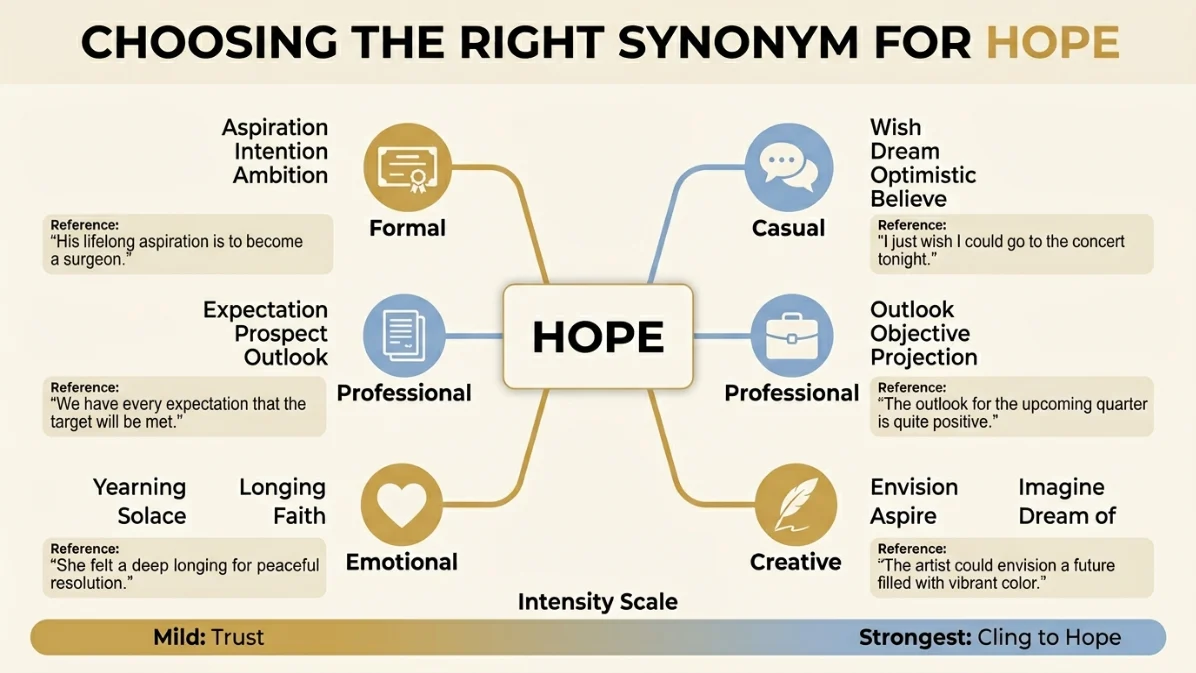
For professional writing, use “expect,” “anticipate,” or “aim to.” For academic writing, “aspire” and “envision” carry intellectual weight. In casual conversation, “keep my fingers crossed” or “wish” feel natural. For emotional depth, “faith,” “trust,” and “longing” resonate strongly. In creative writing, “yearning,” “dreaming,” and “aching for” add poetic texture. On resumes, “driven” or “committed to” demonstrate ambition without passive hoping.
When Not to Use “Hope”
“Hope” can sound too passive, too uncertain, or too soft in situations that call for confidence and action.
We hope to meet our quarterly targets.
We are on track to exceed our quarterly targets.
If you have a clear plan and strong evidence, use language that reflects certainty. Save “hope” for genuine uncertainty or when you want to soften a request politely. In business writing, overusing “hope” can undermine your authority. Replace it with “expect,” “plan to,” or “am confident that” when appropriate.
Words Commonly Confused With “Hope”
Several words overlap with “hope” but carry distinct meanings. Mixing them up can confuse your reader or weaken your message.
- Hope vs. Wish
Hope implies belief that something is possible. Wish often suggests something unlikely or imaginary. You hope for a promotion you worked hard for. You wish upon a shooting star. - Hope vs. Optimism
Optimism is a general attitude of expecting good outcomes. Hope is more specific and often tied to a particular desire. Optimism describes a personality trait. Hope describes an active feeling about a situation. - Hope vs. Faith
Faith implies complete trust, often without needing evidence. Hope acknowledges uncertainty. Faith in a person means you believe they will come through. Hope means you want them to. - Hope vs. Expectation
Expectation assumes something will happen based on reason or evidence. Hope desires something but accepts it might not happen. Expectation carries confidence. Hope carries longing. - Hope vs. Dream
Dream suggests ambitious, sometimes unrealistic aspirations. Hope can be modest and grounded. You dream of becoming a famous actor. You hope to get a callback after the audition. - Hope vs. Ambition
Ambition focuses on personal drive and achievement. Hope focuses on desired outcomes, not necessarily through your own action. Ambition gets you up early to work. Hope keeps you going through setbacks.
Best Synonym by Context for “Hope”
| Context | Best Synonym | Why It Works | Example |
|---|---|---|---|
| Formal writing | Aspiration | Dignified and forward looking | The policy reflects the aspirations of the community. |
| Academic writing | Envision | Intellectual and goal oriented | The researchers envision a future without the disease. |
| Professional or business use | Anticipate | Confident and proactive | We anticipate a positive response from stakeholders. |
| Resume | Aim to | Active and achievement focused | I aim to contribute to innovative product development. |
| Casual conversation | Keep my fingers crossed | Natural and warm | I am keeping my fingers crossed for your interview. |
| Creative writing | Yearning | Poetic and emotionally rich | A deep yearning for home filled every page of her letter. |
| Emotional tone | Faith | Deep trust and conviction | She held onto faith through the darkest months. |
| Strong intensity | Cling to the belief | Desperate or powerful hope | They clung to the belief that rescue would come. |
| Soft or moderate tone | Trust | Gentle and relational | I trust that everything will work out in time. |
| Social media captions | Manifesting | Modern and aspirational | Manifesting good vibes and big wins this week. |
| US and UK usage | Counting on | Universally understood | I am counting on you to make the right call. |
Which Synonym Should You Choose?
Ask yourself three questions. First, how much control do you have over the outcome? If you have agency, choose active words like “aim to” or “plan to.” If the outcome depends on external factors, “trust” or “remain hopeful” fit better. Second, what is the emotional weight? Choose “yearning” for deep longing, “optimism” for cheerful expectation, and “faith” for profound trust. Third, is the context personal or professional? Let formality guide your final choice.
Real Life Examples of “Hope” in Sentences
Seeing synonyms in action shows how a single word swap changes the emotional and professional energy of a sentence.
- School: She aspires to study medicine after graduation.
- Workplace: The team anticipates launching the new feature next month.
- Writing: The novel’s narrator clings to the belief that justice will prevail.
- Conversation: I am really rooting for you this weekend.
- Social media: Claiming this energy. Manifesting a successful week ahead.
- Resume: Committed to driving sustainable growth through strategic leadership.
- Email: I look forward to hearing your thoughts on the proposal.
- Storytelling: A quiet trust in the future kept the family moving forward.
25 Synonyms for “Hope”
| Synonym | Simple Meaning | Best Used For | Example Sentence |
|---|---|---|---|
| Aspiration | A strong desire to achieve something high | Formal and academic contexts | Her aspiration to lead the organization inspired her team. |
| Optimism | A general feeling that good things will happen | Professional and everyday use | His optimism about the merger boosted company morale. |
| Faith | Complete trust without needing proof | Emotional and spiritual writing | Their faith in each other carried them through the crisis. |
| Trust | Firm belief in someone or something | Personal and relational contexts | I trust that you will make the right decision. |
| Anticipation | Excited expectation | Business and event planning | The anticipation surrounding the product launch grew daily. |
| Expectation | A strong belief that something will happen | Formal and professional writing | Our expectation is that sales will rise this quarter. |
| Wish | A desire for something unlikely or magical | Casual and sentimental speech | I wish you could stay a little longer. |
| Dream | A cherished ambition, often ambitious | Creative and personal writing | Her dream of opening a bakery finally came true. |
| Yearning | Deep emotional longing | Literary and poetic expression | The poem captured his yearning for a lost homeland. |
| Longing | A strong persistent desire | Emotional and reflective writing | She felt a quiet longing for simpler times. |
| Ambition | Strong determination to achieve success | Career and goal setting | His ambition pushed him to pursue the executive role. |
| Aim | A purpose or intention | Resumes and professional plans | We aim to reduce waste by thirty percent this year. |
| Desire | A strong feeling of wanting | Personal and emotional writing | His desire to help others shaped his entire career. |
| Aspire | To direct hopes toward achieving something | Academic and formal prose | She aspires to become a leader in renewable energy. |
| Count on | To rely on with confidence | Casual and conversational use | I am counting on you to bring the supplies. |
| Root for | To support enthusiastically | Informal encouragement | The whole town rooted for the underdog team. |
| Look forward to | To await something with pleasure | Email and polite communication | I look forward to meeting you in person next week. |
| Cling to hope | To hold onto hope desperately | Dramatic and emotional writing | The family clung to hope during the long search. |
| Pray | To hope earnestly, often with spiritual weight | Religious and deeply personal writing | They prayed for a peaceful resolution. |
| Envision | To imagine a future possibility | Academic and visionary writing | She envisions a city powered entirely by clean energy. |
| Manifest | To will something into reality through belief | Modern wellness and social media | She believes in manifesting her career goals daily. |
| Trust in | To place confidence in a process or person | Supportive and gentle tone | Trust in the journey, even when the path is unclear. |
| Hold out hope | To continue hoping despite difficulty | Emotional and narrative writing | He held out hope that his missing dog would return. |
| Presume | To suppose something is true based on evidence | Formal and legal contexts | We presume the shipment will arrive on schedule. |
| Dream of | To imagine achieving something deeply desired | Personal and aspirational speech | She dreams of traveling to every continent. |
Synonym Groups and Usage Differences
Professional vs. Personal Synonyms
In professional settings, words like “anticipate,” “expect,” “aim to,” and “envision” communicate confidence and direction. They show you have a plan, not just a wish.
In personal relationships, “trust,” “keep my fingers crossed,” “root for,” and “have faith in you” carry warmth and emotional support. Telling a friend “I have faith in you” feels deeply personal. Telling a client “I anticipate positive results” sounds competent and reassuring.
Formal vs. Conversational Synonyms
Formal writing rewards nouns and verbs that sound dignified and measured. Use “aspiration,” “expectation,” “anticipation,” and “envision” in reports, speeches, and academic papers.
Conversational English thrives on warmth and simplicity. Words like “counting on,” “fingers crossed,” “rooting for,” and “can’t wait” keep dialogue natural and friendly. An email to a close colleague might say “I’m rooting for the team,” while a board report uses “We anticipate favorable market conditions.”
Academic Synonyms
Academic writing values precision and intellectual framing. “Aspire,” “envision,” and “anticipate” work well because they imply reasoned expectation rather than passive desire. Avoid emotional or spiritual synonyms like “faith” or “pray” in most academic contexts unless discussing those concepts as subjects of study.
Professional and Business Synonyms
Business communication rewards language that projects certainty and initiative. “Anticipate” shows you are thinking ahead. “Aim to” and “expect” communicate clear goals. On resumes, avoid “hope to” entirely. Replace it with “committed to,” “driven to,” or “focused on achieving.” An employer wants confidence, not wishful thinking.
Creative or Literary Synonyms
Creative writing flourishes with synonyms that evoke emotion and imagery. “Yearning,” “longing,” “aching for,” and “clinging to hope” paint vivid emotional landscapes. “Dream” and “envision” open imaginative possibilities. These words invite readers to feel the weight of desire and the tension of uncertainty.
Slang or Modern Synonyms
Terms like “manifesting,” “claiming,” “vibes,” and “fingers crossed” energize social media captions and casual conversation. “Manifesting” has become especially popular in wellness and lifestyle content. These words are perfect for Instagram, TikTok, and informal blog posts. Avoid them in professional, academic, or formal writing where they can undermine your credibility.
Strongest vs. Weaker Synonyms
Consider hope synonyms on an intensity scale from mild to strongest.
Mild: Trust, look forward to, anticipate
Moderate: Optimism, expect, aim to
Strong: Faith, yearning, clinging to hope
Strongest: Desperately hoping, praying, aching for
Match the emotional intensity to the stakes of the situation.
Emotional vs. Neutral Synonyms
“Faith,” “yearning,” “longing,” and “clinging to hope” carry deep emotional resonance. Use them when you want readers to feel the weight of desire. “Anticipate,” “expect,” and “look forward to” stay professional and measured. Choose emotional synonyms for personal writing, storytelling, and motivation. Choose neutral synonyms for business updates and academic analysis.
Antonyms of “Hope”
| Antonym | Meaning | Example Sentence |
|---|---|---|
| Despair | Complete loss of hope | Despair settled over the community after the news. |
| Hopelessness | Feeling that nothing good will happen | He fought against the hopelessness that threatened to consume him. |
| Pessimism | Tendency to expect the worst | Her pessimism about the project surprised her optimistic team. |
| Doubt | Uncertainty or lack of conviction | Doubt crept in as the deadline approached without progress. |
| Discouragement | Loss of confidence or enthusiasm | Discouragement nearly made her quit the training program. |
| Resignation | Acceptance of something undesirable | A quiet resignation replaced their earlier fighting spirit. |
| Defeatism | Attitude of expecting failure | Defeatism spread through the office after the budget cuts. |
| Cynicism | Belief that people act only from self interest | His cynicism made it hard for him to trust the charity’s motives. |
| Despondency | Low spirits from loss of hope | The long job search left her in a state of despondency. |
| Gloom | A state of darkness or depression | The gloom in the room lifted when good news arrived. |
| Fear | An unpleasant emotion caused by threat | Fear about the future kept him awake at night. |
| Worry | Anxiety about actual or potential problems | Worry about the test results consumed her thoughts. |
| Distrust | Lack of trust or confidence | Distrust of the new management spread among employees. |
| Apathy | Lack of interest or concern | Apathy replaced the passion that once drove the movement. |
| Surrender | To stop trying to resist or fight | Surrender felt easier than continuing the uphill battle. |
Comparison: Hope vs. Similar Words
Hope vs. Wish
Main difference: Hope includes belief in possibility. Wish often implies fantasy or improbability.
Which one is stronger: Hope is stronger because it carries conviction.
Which one is more formal: Both are neutral and widely used.
Example: I hope the surgery goes well. I wish I could fly.
Hope vs. Optimism
Main difference: Optimism is a general outlook. Hope is tied to a specific outcome.
Which one is stronger: Optimism is stronger as a sustained trait.
Which one is more formal: Optimism appears more in academic and professional writing.
Example: She felt hope about the test results. His optimism influenced everyone around him.
Hope vs. Faith
Main difference: Faith implies certainty without needing evidence. Hope acknowledges uncertainty.
Which one is stronger: Faith is stronger. It suggests complete trust.
Which one is more formal: Both appear in formal and personal writing. Faith carries more spiritual weight.
Example: I hope the treatment works. She has faith that the treatment will work.
Hope vs. Expectation
Main difference: Expectation assumes an outcome based on reason. Hope desires an outcome while accepting it may not happen.
Which one is stronger: Expectation is stronger. It suggests confidence.
Which one is more formal: Expectation is more formal and businesslike.
Example: We hope sales increase. Our expectation is a ten percent sales increase.
Hope vs. Dream
Main difference: Dream implies ambitious, often grand aspirations. Hope can be modest and grounded.
Which one is stronger: Dream is stronger in ambition and scope.
Which one is more formal: Hope is more appropriate for formal contexts.
Example: I hope to save enough for a vacation. She dreams of building a global nonprofit.
Hope vs. Ambition
Main difference: Ambition focuses on personal drive and determination. Hope focuses on desired outcomes that may depend on external factors.
Which one is stronger: Ambition is stronger in terms of personal agency.
Which one is more formal: Ambition carries professional weight. Hope can sound passive.
Example: I hope the promotion comes through. Her ambition drove her to pursue the promotion relentlessly.
Common Phrases and Expressions with “Hope”
1. A glimmer of hope
Meaning: A small sign that something good might happen.
Example sentence: The ceasefire brought a glimmer of hope to the war torn region.
2. Hope against hope
Meaning: To continue hoping even when the situation seems hopeless.
Example sentence: She hoped against hope that the missing documents would turn up.
3. Don’t get your hopes up
Meaning: A warning not to expect too much to avoid disappointment.
Example sentence: The interview went well, but I won’t get my hopes up yet.
4. Ray of hope
Meaning: Something that provides a small amount of optimism.
Example sentence: The new treatment offers a ray of hope for patients.
5. False hope
Meaning: Hope based on incorrect or misleading information.
Example sentence: The doctor cautioned against giving the family false hope.
6. Beyond hope
Meaning: In a situation too far gone to be improved.
Example sentence: The ancient manuscript was beyond hope of restoration.
7. Hope springs eternal
Meaning: People continue to hope even after repeated disappointments.
Example sentence: He applied for the role a third time. Hope springs eternal.
8. Soar on wings of hope
Meaning: To feel uplifted and encouraged by optimism.
Example sentence: The scholarship news let her soar on wings of hope for her future.
Common Mistakes to Avoid
Using “hope” in professional settings where you need to project confidence weakens your authority. Replace “I hope to complete” with “I plan to complete” or “I will complete” when you control the outcome.
Confusing “hope” with “expect” can create miscommunication. Telling a client “I hope to deliver by Friday” sounds uncertain. “I expect to deliver by Friday” communicates reliability.
Overusing “hope” in resumes and cover letters makes you sound passive. Employers want to see drive and intention. Use “aim to,” “committed to,” and “driven to” instead.
Choosing an emotionally heavy synonym like “yearning” for a simple preference sounds melodramatic. Save deep longing words for deep longing situations.
Using spiritual or faith based synonyms like “pray” in secular business writing can feel out of place. Match your language to your audience’s expectations.
Repeating the same synonym across a paragraph defeats the purpose of varying your vocabulary. Rotate between “anticipate,” “trust,” “look forward to,” and “envision” to maintain freshness.
Applying modern slang like “manifesting” in academic or formal professional documents damages your credibility. Reserve it for social media and casual writing.
FAQs
What is the best synonym for hope?
The best synonym depends on context. “Optimism” works professionally, “faith” suits emotional writing, “anticipate” fits business use, and “yearning” adds poetic depth to creative work.
What is a formal synonym for hope?
“Aspiration,” “expectation,” and “anticipation” are strong formal synonyms. They work effectively in reports, academic papers, speeches, and professional correspondence.
What is an informal synonym for hope?
“Keep my fingers crossed,” “rooting for,” “counting on,” and “manifesting” are effective informal synonyms. They fit naturally in casual conversation, texts, and social media posts.
What is another word for hope in professional writing?
“Anticipate,” “expect,” “aim to,” and “look forward to” work well in professional writing. They communicate confidence and proactive thinking rather than passive desire.
What is the difference between hope and faith?
“Hope” desires an outcome while acknowledging uncertainty. “Faith” implies complete trust without needing proof. Faith carries deeper conviction and often spiritual weight.
What is the opposite of hope?
“Despair” is the most direct opposite. Other common antonyms include “hopelessness,” “pessimism,” “doubt,” “discouragement,” and “resignation,” each carrying distinct emotional shading.
Conclusion
“Hope” is a warm, human word that connects us to possibility and resilience. But your writing becomes more precise and emotionally resonant when you choose synonyms that match the exact shade of hope you mean.
Build a mental toolkit of reliable alternatives: “optimism” for a positive outlook, “anticipate” for confident professionalism, “faith” for deep trust, “yearning” for creative depth, and “aim to” for active determination. The right word turns a passive wish into a powerful statement of intention and belief.