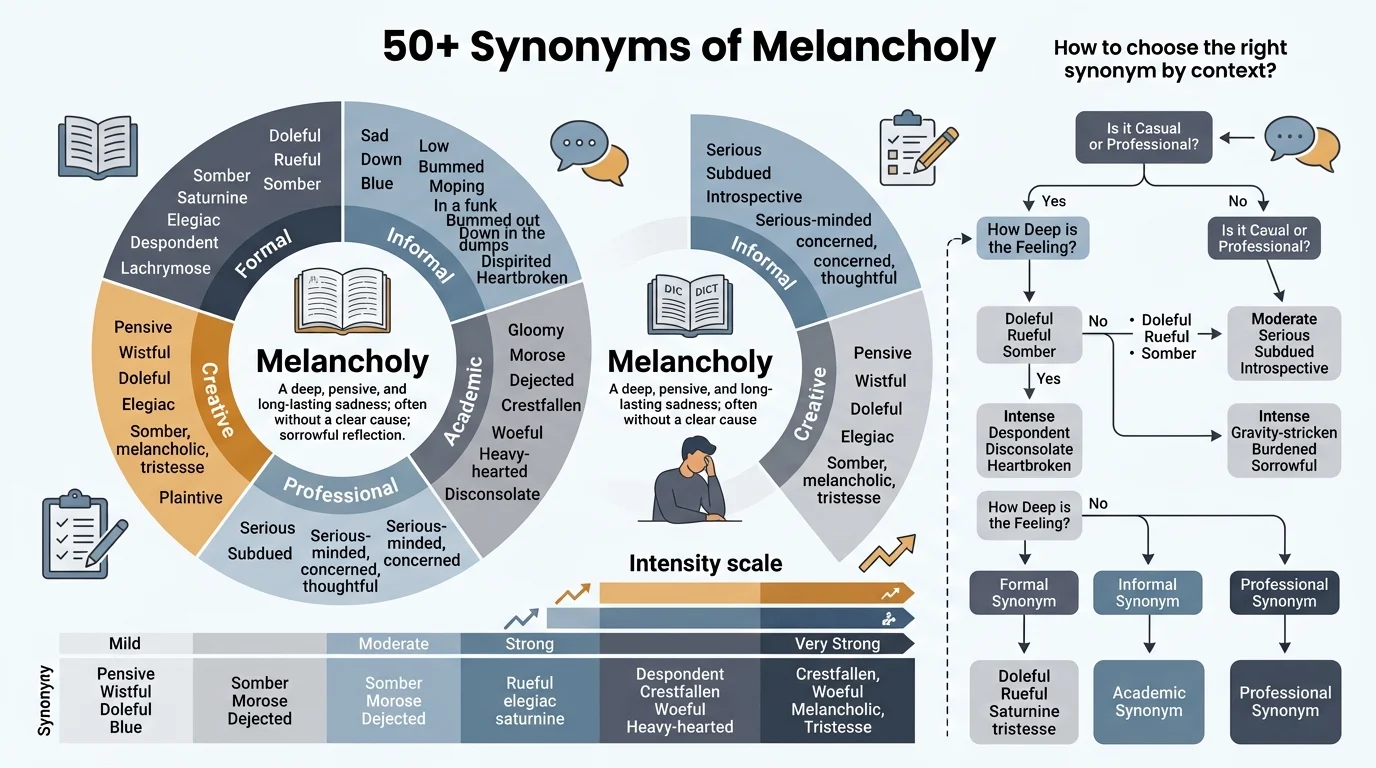
Have you ever written an email, a social media caption, or a school essay and found yourself using the same sad words over and over? It happens to everyone. You type “sad” or “depressed” repeatedly, and your writing starts to feel flat and uninspired. But you know there is a better word out there. You just cannot find it. That is where understanding the synonyms of melancholy can transform your writing from repetitive to precise and powerful.
Choosing the right synonym is not just about avoiding repetition. It is about clarity. The right word conveys the exact shade of emotion you intend, whether you are writing a professional email, a creative story, or a personal message. This guide will help you understand the meaning of melancholy, explore its best synonyms, and learn how to choose the perfect word for every situation.
Quick Answer: What Are the Best Synonyms of “Melancholy”?
Melancholy is a deep, thoughtful, and often prolonged sadness, frequently tinged with reflection or nostalgia. The best synonym depends on your context. Formal writing, choose sorrow or despondency. Casual conversation, use blue or down. For academic or professional settings, consider depression or wistfulness. For creative writing, mournful or pensive work beautifully.
Meaning, Tone, and Context
Simple Definition
Melancholy is a feeling of deep, thoughtful sadness that often lasts for a long time and can affect your mood and outlook. Unlike a brief moment of unhappiness, melancholy is a lingering, reflective state that may not have a clear cause.
Part of Speech
- Noun: A feeling of pensive sadness (e.g., “He sank into a deep melancholy”).
- Adjective: Feeling or showing pensive sadness (e.g., “She wore a melancholy expression”).
Overall Tone
Melancholy is a negative emotion, but it carries a softer, more thoughtful quality than sharp grief or severe depression. It is often associated with introspection, nostalgia, and a quiet, almost poetic sadness.
Formality Level
Formal. Melancholy is considered a formal or literary word. It is more common in written English, academic discussions, and serious literature than in everyday conversation.
Common Uses
Native English speakers use “melancholy” to describe:
- A mood or atmosphere that is sad and reflective.
- A piece of music, art, or literature that evokes a thoughtful sadness.
- A person’s disposition or long-term emotional state.
- A nostalgic longing for the past.
Word Forms
- Noun: melancholy
- Adjective: melancholy / melancholic
- Adverb: melancholily
When and How to Use “Melancholy”
Choose “melancholy” when you want to describe a quiet, thoughtful, and lingering sadness. It is not the right word for acute pain or temporary disappointment. It is the word for a reflective, sometimes beautiful, sadness that settles in and makes you think.
Here are seven realistic examples showing how to use “melancholy” in different contexts:
- Professional: “The quarterly report presented a melancholy picture of the company’s declining market share.”
- Academic: “The poet’s work is characterized by a profound melancholy that reflects the existential concerns of the post-war era.”
- Workplace: “There was a melancholy atmosphere in the office after the announcement of the upcoming layoffs.”
- Personal: “Looking through old photo albums always brings a wave of melancholy over me.”
- Email: “I write to you with a melancholy heart to inform you of my decision to resign from the committee.”
- Resume/Cover Letter: “While my last project ended on a melancholy note due to budget cuts, I am proud of the work we accomplished.”
- Social Media: “There is something melancholy about watching the sunset on the last day of summer.”
Best Synonyms of “Melancholy”
No synonym is identical to “melancholy” in every situation. The best choice depends on your audience, purpose, and the specific shade of meaning you want to convey.
- Professional Writing: Sorrow. It is formal, clear, and universally understood. It conveys serious sadness without the clinical weight of “depression”.
- Academic Writing: Despondency. This word suggests a loss of hope and spirit, which fits well in analytical or psychological discussions.
- Business Communication: Wistfulness. This is a softer, more reflective term that works well when discussing change or missed opportunities without sounding overly negative.
- Casual Conversation: Blue. This is the most common and natural informal synonym. Saying “I’m feeling blue” is a gentle way to express sadness.
- Emotional Writing: Mournful. This word explicitly connects sadness to a sense of loss or grief, adding a layer of depth to emotional writing.
- Creative Writing: Pensive. This word captures the thoughtful, reflective side of melancholy without focusing solely on the sadness.
- Resume Writing: Somber. Use this to describe a serious or grave situation without implying personal emotional weakness.
- Workplace Communication: Gloomy. This is a straightforward way to describe a negative outlook or atmosphere in a professional setting.
- Stronger Meaning: Despair. This conveys a complete loss of hope, which is a much more intense emotion than melancholy.
- Softer Meaning: Down. This is a mild, informal way to say you are not feeling your best.
When Not to Use “Melancholy”
Using “melancholy” in the wrong context can make your writing sound out of touch, overly dramatic, or simply unclear.
- When it sounds too formal: In a text message to a friend, saying “I am feeling melancholy” sounds stiff and unnatural.
- Better: “I’m feeling a bit down today.”
- When it sounds too vague: If you are describing a sharp, specific pain like grief after a sudden loss, “melancholy” is too mild and general.
- Better: “I am overwhelmed with grief.”
- When it sounds too weak: If you are describing a clinical condition like major depressive disorder, “melancholy” is far too weak and romanticized.
- Better: “She is struggling with severe depression.”
- When it sounds too dramatic: Using “melancholy” to describe a minor disappointment, like a canceled lunch date, sounds exaggerated.
- Better: “I was a little disappointed when the meeting was canceled.”
Words Commonly Confused With “Melancholy”
Many words related to sadness are often used interchangeably with “melancholy,” but they have distinct meanings.
| Word | Difference | When to Use It | Example |
|---|---|---|---|
| Sad | A general, catch-all term for unhappiness. | When you need a simple, clear word that everyone understands. | “She felt sad when her friend moved away.” |
| Depressed | A clinical term for a severe, prolonged state of low mood that affects daily life. | In medical, psychological, or serious personal contexts. | “He has been diagnosed with clinical depression.” |
| Sorrowful | Implies deep distress, often caused by a specific loss or regret. | When sadness is linked to a clear, painful event. | “The family was sorrowful after the funeral.” |
| Gloomy | Suggests a dark, pessimistic, or hopeless outlook. | To describe a negative mood, a dark place, or a bleak forecast. | “The economic outlook for the next quarter is gloomy.” |
| Nostalgic | A sentimental longing or wistful affection for the past. | When sadness is mixed with fond memories of a past time. | Looking at her childhood home made her feel nostalgic. |
| Pensive | Engaged in deep or serious thought, often with a hint of sadness. | To describe someone who is quietly thinking, perhaps about something sad. | “He sat in a pensive silence, staring out the window.” |
Best Synonyms of “Melancholy” by Context
How to Choose the Best Synonym of “Melancholy”
Choosing the right word is about understanding your audience and your goal. Follow this practical decision guide:
- Identify your audience: Are you writing for a professor, a boss, a friend, or the general public? This will determine the level of formality.
- Define the intensity: How strong is the feeling? Is it a mild sadness or a deep, crushing despair?
- Consider the cause: Is the sadness linked to a specific loss, a general feeling, or a nostalgic memory? This will help you choose between words like “sorrowful,” “gloomy,” and “nostalgic.”
- Think about the purpose: Are you trying to evoke empathy, state a fact, or create a specific mood? Creative writing benefits from evocative words like “mournful,” while business writing requires clarity and professionalism.
- Read it aloud: Does the word sound natural in your sentence? If it feels forced or out of place, try a different synonym.
The best synonym is the one that communicates your intended message most clearly and naturally to your specific reader.
Real Life Examples of “Melancholy”
Seeing words used in context is the best way to understand them. Here are examples of how “melancholy” and its synonyms can be used in various real-life situations.
- School: “The history of the ancient civilization was marked by a melancholy that echoed through its ruins.”
- College: “The protagonist’s melancholy is a central theme in the novel, reflecting the disillusionment of the post-war generation.”
- Workplace: “After the company was acquired, a sense of wistfulness lingered among the long-time employees.”
- Business: “The board met with a somber mood, fully aware of the difficult decisions that lay ahead.”
- Email: “It is with a heavy heart that I announce my departure from the team.”
- Resume: “I successfully managed the project through a period of significant uncertainty.”
- Conversation: “My grandmother often talks about the past with a hint of nostalgia in her voice.”
- Storytelling: “The abandoned house stood as a forlorn reminder of happier times.”
- Blogging: “There is a certain beauty in the melancholy of autumn.”
- Social Media: “Feeling a bit blue today. Anyone else?”
18 Best Synonyms of “Melancholy”
Synonyms of “Melancholy” by Usage
Professional vs Personal Synonyms
- Professional: Sorrow, despondency, somber, regret. These words are formal and convey seriousness without being overly emotional.
- Personal: Blue, down, low. These are casual and gentle, perfect for expressing feelings to friends and family.
Formal vs Conversational Synonyms
- Formal: Sorrow, despondency, wistfulness, melancholy itself. Use these in reports, academic essays, presentations, and formal emails.
- Conversational: Blue, down, gloomy. These are common in everyday speech and texting.
Academic Synonyms
For research papers, essays, and academic discussions, use precise and authoritative words like despondency, depression, and sorrow. These terms are well-defined and carry the weight required for scholarly work.
Professional and Business Synonyms
In the workplace, choose words that are clear and professional. Sorrow and regret are excellent for formal communication. Somber is great for describing serious meetings or situations. For performance reviews, you might use disappointed or concerned to avoid sounding overly emotional.
Creative and Literary Synonyms
Writers have a wealth of expressive alternatives. Mournful, pensive, forlorn, and disconsolate add emotion and imagery to storytelling, fiction, and poetry. These words help create a specific mood and bring characters to life.
Slang or Modern Synonyms
While there is no direct slang synonym for “melancholy,” phrases like “down in the dumps” or “in a funk” are common informal expressions that convey a similar feeling. These are best used in casual conversation and should be avoided in professional or academic writing.
Strongest to Mildest Synonyms
The emotional intensity of synonyms for melancholy varies widely.
- Mild: Down, low, blue. These are gentle ways to express a slight dip in mood.
- Moderate: Gloomy, wistful, pensive. These words suggest a more noticeable, but still manageable, sadness.
- Strong: Sorrow, mournful, dejected. These convey a deeper, more painful sadness.
- Very Strong: Despondency, despair, disconsolate. These words indicate a profound loss of hope and intense suffering.
Emotional vs Neutral Synonyms
- Emotional Synonyms: Words like mournful, forlorn, and heartache are rich with feeling and are perfect for personal, creative, or emotional writing. They help the reader connect with the emotion on a deeper level.
- Neutral Synonyms: Words like somber, gloomy, and dismal are more descriptive and less personal. They are excellent for reports, analyses, and professional communication where you need to describe a situation without becoming overly emotional.
Antonyms of “Melancholy”
| Antonym | Meaning | Example Sentence |
|---|---|---|
| Joy | A feeling of great pleasure and happiness. | “The room was filled with joy and laughter.” |
| Happiness | The state of being happy. | “She found happiness in the simple things in life.” |
| Cheerfulness | The quality of being noticeably happy and optimistic. | “His cheerfulness was contagious.” |
| Elation | Great happiness and exhilaration. | “She felt a sense of elation after winning the award.” |
| Gaiety | The state of being cheerful and lively. | “The gaiety of the festival was a welcome relief.” |
| Euphoria | A feeling or state of intense excitement and happiness. | “The news sent him into a state of euphoria.” |
| Contentment | A state of happiness and satisfaction. | “He felt a deep sense of contentment with his life.” |
| Exhilaration | A feeling of excitement, happiness, or elation. | “The exhilaration of the climb was unforgettable.” |
| Bliss | Perfect happiness; great joy. | “They were in a state of marital bliss.” |
| Exuberance | The quality of being full of energy, excitement, and cheerfulness. | “Her exuberance was infectious.” |
| Optimism | Hopefulness and confidence about the future. | “His optimism helped the team get through the tough times.” |
| Lightheartedness | The quality of being free from care, anxiety, or seriousness. | “She approached the task with a sense of lightheartedness.” |
| Merriment | Cheerfulness and lively enjoyment. | “The party was full of merriment.” |
| Joviality | The quality of being cheerful and friendly. | “His joviality made him popular with everyone.” |
| Delight | Great pleasure or satisfaction. | “The children squealed with delight.” |
Comparison: “Melancholy” vs Similar Words
Melancholy vs Sad
Main Difference: “Sad” is a general term for unhappiness, while “melancholy” is a specific, more profound, and reflective type of sadness.
Which Is Stronger?: Melancholy is stronger and deeper.
Which Is More Formal?: Melancholy is much more formal.
When to Use Each: Use “sad” in everyday conversation for any type of unhappiness. Use “melancholy” in writing or formal speech to describe a thoughtful, lingering sadness.
- Melancholy: “The music had a melancholy beauty that stayed with me all day.”
- Sad: “I was sad to hear that you lost your job.”
Melancholy vs Depressed
Main Difference: “Depressed” is a clinical term for a severe mental health condition, while “melancholy” is an emotional state.
Which Is Stronger?: Depressed is significantly stronger and more serious.
Which Is More Formal?: Both are formal, but “depressed” is more clinical.
When to Use Each: Use “depressed” only when referring to the clinical condition or a very severe state. Use “melancholy” for a less severe, more thoughtful sadness.
- Melancholy: “He fell into a state of melancholy after his friend moved away.”
- Depressed: “He has been diagnosed with clinical depression.”
Melancholy vs Sorrowful
Main Difference: “Sorrowful” implies a sadness caused by a specific, often painful, event like a loss. “Melancholy” can be a more general, often unexplained feeling.
Which Is Stronger?: Sorrowful is more intense and focused.
Which Is More Formal?: Both are formal.
When to Use Each: Use “sorrowful” when the cause of sadness is clear and painful. Use “melancholy” for a more diffuse, reflective sadness.
- Melancholy: “There was a melancholy in the air as autumn arrived.”
- Sorrowful: “The widow was sorrowful at the funeral.”
Melancholy vs Nostalgic
Main Difference: “Nostalgic” specifically involves a sentimental longing for the past, while “melancholy” can be about the present or future as well.
Which Is Stronger?: Melancholy is generally a stronger feeling of sadness.
Which Is More Formal?: Both are neutral to formal.
When to Use Each: Use “nostalgic” when the sadness is tied to fond memories. Use “melancholy” when the sadness is more general or existential.
- Melancholy: “He felt a deep melancholy about the state of the world.”
- Nostalgic: “The old photograph made her feel nostalgic for her childhood.”
Melancholy vs Gloomy
Main Difference: “Gloomy” often describes a negative outlook or a dark, depressing atmosphere. “Melancholy” is more introspective.
Which Is Stronger?: Melancholy is a deeper, more internal feeling.
Which Is More Formal?: Melancholy is more formal.
When to Use Each: Use “gloomy” to describe a forecast, a room, or a pessimistic person. Use “melancholy” to describe a personal, reflective state.
- Melancholy: “She had a melancholy expression as she stared out the window.”
- Gloomy: “The weather forecast is gloomy for the entire weekend.”
Melancholy vs Pensive
Main Difference: “Pensive” focuses on the act of deep thought, which may or may not be sad. “Melancholy” is inherently sad.
Which Is Stronger?: Melancholy is the stronger, more emotional word.
Which Is More Formal?: Both are formal.
When to Use Each: Use “pensive” when you want to emphasize that someone is thinking deeply. Use “melancholy” when you want to emphasize the sadness of that thought.
- Melancholy: “The melancholy poem reflected on the brevity of life.”
- Pensive: “He was pensive, lost in thought about his future.”
Common Phrases and Expressions with “Melancholy”
| Phrase | Meaning | Example Sentence |
|---|---|---|
| A melancholy air | A sad or thoughtful atmosphere or manner. | “There was a melancholy air about the old, deserted house.” |
| Melancholy beauty | Beauty that is tinged with or evokes sadness. | “The painting captured the melancholy beauty of a fading sunset.” |
| Melancholy smile | A smile that expresses sadness or wistfulness. | “She gave him a melancholy smile as she said goodbye.” |
| Sink into melancholy | To become deeply and persistently sad. | “After the accident, he seemed to sink into a deep melancholy.” |
| Melancholy tune/song | A piece of music that is sad and reflective. | “The melancholy tune brought tears to her eyes.” |
| Melancholy reflection | A thought or consideration that is sad. | “He was lost in a melancholy reflection on his past mistakes.” |
Common Mistakes to Avoid
- Using “melancholy” for everyday sadness: It sounds overly dramatic for minor disappointments.
- Incorrect: “I was melancholy when my sandwich fell on the floor.”
- Better: “I was disappointed when my sandwich fell on the floor.”
- Confusing “melancholy” with “depressed”: They are not interchangeable. One is an emotion; the other is a clinical condition.
- Incorrect: “I think I have a bit of melancholy today.” (If you mean a clinical condition, this is wrong.)
- Better: “I’m feeling a bit down today.” (For a mood) or “I think I am experiencing depression.” (For a clinical condition).
- Using an informal synonym in formal writing: “Blue” or “down” have no place in academic essays or professional reports.
- Choosing a vague synonym: Using “sad” when a more precise word like “mournful” or “nostalgic” would be more accurate.
- Using a synonym with the wrong emotional tone: “Despair” is too strong for a situation that calls for “wistfulness.”
Frequently Asked Questions
1. What are the best synonyms of “melancholy”?
The best synonyms depend on the context. Formal writing, use sorrow or despondency. For casual conversation, use blue or down. For creative writing, consider mournful or pensive.
2. What are the best formal synonyms of “melancholy”?
The best formal synonyms are sorrow, despondency, depression, and wistfulness(). These words are suitable for academic papers, professional emails, and formal reports.
3. What are common informal synonyms of “melancholy”?
Common informal synonyms include blue, down, and low. These are perfect for texting, social media, and everyday conversations with friends.
4. What is another word for “melancholy” in professional writing?
In professional writing, the best alternatives are sorrow, regret, and somber. These words maintain a professional tone while accurately conveying the intended meaning.
5. What is the difference between “melancholy” and “depressed”?
Melancholy is an emotional state of deep, reflective sadness. Depressed is a clinical term for a severe mental health condition that affects daily life.
6. What is the opposite of “melancholy”?
The most common opposites (antonyms) of “melancholy” are joy, happiness, cheerfulness, and elation. These represent positive, uplifting emotional states.
Conclusion
Melancholy is a unique word that captures a deep, thoughtful, and often lingering sadness. It is a formal and literary term that evokes reflection and introspection. While it is a powerful word, it is not always the best choice. The key to great writing is knowing when to use it and when to choose a more precise synonym.
For formal writing, sorrow and despondency are excellent choices. For casual conversation, blue and down are more natural. In creative writing, mournful and pensive can bring your descriptions to life. No synonym works perfectly in every situation. The best writers choose their words based on their audience, their purpose, and the specific shade of meaning they want to convey.
Keep this guide handy the next time you are searching for the perfect word. And remember, the best way to improve your vocabulary is to practice. Try using one new synonym of melancholy in your writing this week and see how it transforms your communication.