Have you ever written an email, an essay, or a social media caption and realized you used the word “passion” three times in two sentences? You are not alone. Many writers, students, and professionals reach for this powerful word again and again. But relying on the same term can make your writing feel repetitive and less impactful. Learning the best synonyms of passion will help you communicate with greater clarity, precision, and emotional range. Whether you are writing a resume, crafting a story, or sending a professional email, choosing the right word makes all the difference.
Quick Answer: What Are the Best Synonyms of “Passion”?
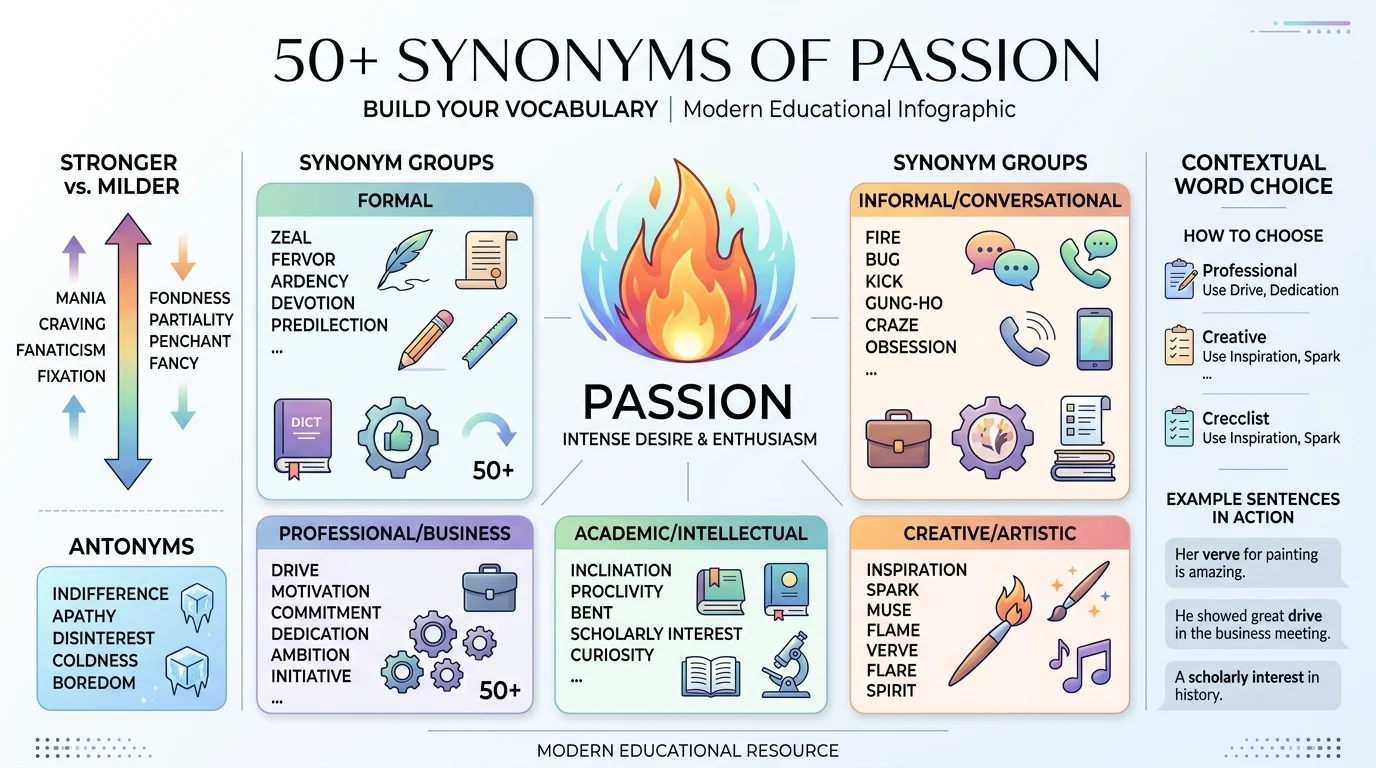
Passion means a strong, intense emotion or enthusiasm for something or someone. For formal writing, use “ardor” or “fervor.” For casual conversation, try “love” or “enthusiasm.” In professional settings, “dedication” and “commitment” work best. Academic writing benefits from “zeal” or “devotion.” For emotional or creative writing, consider “fire” or “intensity.”
Meaning, Tone, and Context
Simple Definition
Passion is a powerful and compelling emotion or feeling. It can refer to strong romantic love, intense enthusiasm for an activity, or even strong anger. The word describes something that deeply moves a person and often drives them to action.
Part of Speech
Passion is a noun.
Overall Tone
Passion is a neutral word in terms of positive or negative meaning. It can describe love, hatred, anger, or enthusiasm. The tone depends entirely on the context. In most modern usage, however, passion carries a positive connotation of enthusiasm and dedication.
Formality Level
Passion is neutral in formality. It works in casual conversation, professional emails, academic papers, and creative writing. It is not overly formal or overly casual.
Common Uses
Native English speakers use passion in several common ways:
- To describe strong romantic or sexual feelings
- To express deep enthusiasm for a hobby, career, or activity
- To convey intense emotion like anger or excitement
- To refer to the object of someone’s strong interest
Word Forms
- Noun: passion
- Adjective: passionate
- Adverb: passionately
- Related noun: passionateness
- Opposite form: passionless (rare), apathy
When and How to Use “Passion”
Choose “passion” when you want to convey a deep, overwhelming emotion or strong enthusiasm. It works best when the feeling is genuine and intense, not mild or casual.
Here are seven realistic examples showing how to use passion in different contexts:
Professional:
“Her passion for data analysis transformed the way our team approaches market research.”
Academic:
“The researcher’s passion for ancient history was evident in every chapter of her dissertation.”
Workplace:
“Our manager brings passion to every meeting, and it inspires the entire department.”
Personal:
“Gardening has always been his passion, and his backyard looks like a botanical garden.”
Email:
“I wanted to express my passion for this project and my eagerness to contribute to your team.”
Resume:
“Marketing professional with a passion for brand storytelling and consumer behavior.”
Social Media:
“Turning my passion for photography into a full-time career has been the best decision I ever made.”
Best Synonyms of “Passion”
No synonym is identical to “passion” in every situation. Each alternative carries its own shade of meaning, emotional weight, and level of formality. Here are the best synonyms for specific contexts:
Professional writing: “Dedication” works best because it suggests commitment and reliability without sounding overly emotional.
Academic writing: “Zeal” is excellent for scholarly work because it conveys enthusiastic pursuit of knowledge.
Business communication: “Commitment” signals reliability and long-term investment in goals.
Casual conversation: “Love” is the most natural and widely understood alternative.
Emotional writing: “Ardor” adds a poetic, intense quality that works well for romantic or deeply felt subjects.
Creative writing: “Fire” brings vivid imagery and energy to descriptive passages.
Resume writing: “Drive” suggests motivation and results-oriented energy.
Workplace communication: “Enthusiasm” conveys positive energy without the intensity that “passion” sometimes implies.
Stronger meaning: “Fervor” suggests burning, sustained intensity.
Softer meaning: “Interest” is milder and more appropriate for casual or professional contexts where intense emotion is not required.
When Not to Use “Passion”
There are situations where using “passion” is not the best choice. Here is why and what to use instead.
When it sounds too general:
Passion is a broad word. If you need to be specific about what you feel, choose a more precise term.
- Less effective: “I have a passion for my work.”
- Better: “I have a deep commitment to delivering excellent results.”
When it sounds too vague:
Passion does not explain what kind of emotion you feel or why.
- Less effective: “She spoke with passion.”
- Better: “She spoke with fervor and conviction.”
It sounds too formal:
In casual conversation, “passion” can feel heavy or dramatic.
- Less effective: “I have a passion for pizza.”
- Better: “I love pizza.”
It sounds too informal:
In very formal academic or legal writing, “passion” may feel too emotional.
- Less effective: “The defendant acted with passion.”
- Better: “The defendant acted with strong emotion.”
When it sounds too weak:
If you need to convey extreme intensity, “passion” may not be strong enough.
- Less effective: “His passion for justice was admirable.”
- Better: “His zeal for justice was unwavering.”
It sounds outdated:
In some contexts, “passion” can feel old-fashioned, especially when used to describe romantic feelings. “Attraction” or “desire” may feel more modern.
Words Commonly Confused With “Passion”
Passion vs Love
Difference: Love is a deep feeling of affection and care. Passion is a broader term that can include love but also includes anger, enthusiasm, and desire.
When to Use It: Use “love” for personal relationships and deep affection. Use “passion” for intense enthusiasm about activities or for strong emotions in general.
Example: “Their love for each other never faded.” vs “His passion for music drove him to practice for hours.”
Passion vs Enthusiasm
Difference: Enthusiasm is lively interest or excitement. Passion is deeper and more overwhelming.
When to Use It: Use “enthusiasm” for positive energy about something. Use “passion” when the feeling is so strong it almost controls you.
Example: “She showed great enthusiasm for the new project.” vs “His passion for the cause consumed his life.”
Passion vs Zeal
Difference: Zeal is energetic and unflagging devotion to a cause or goal. Passion is a broader, more intense emotion.
When to Use It: Use “zeal” when emphasizing tireless effort toward a specific purpose. Use “passion” for a wider range of intense emotions.
Example: “The missionary worked with religious zeal.” vs “He had a passion for exploring new places.”
Passion vs Fervor
Difference: Fervor implies a warm, steady, and sustained intensity. Passion can be more overwhelming and less controlled.
When to Use It: Use “fervor” for steady, burning emotion. Use “passion” for emotion that can be overwhelming or uncontrollable.
Example: “She argued her case with fervor.” vs “He was a slave to his passions.”
Passion vs Ardor
Difference: Ardor suggests a fiery, sometimes restless intensity. Passion is a deeper, more overwhelming emotion.
When to Use It: Use “ardor” for romantic or poetic contexts. Use “passion” for a broader range of intense feelings.
Example: “The young lovers were consumed by ardor.” vs “His passion for justice was unshakeable.”
Passion vs Emotion
Difference: Emotion is any strong feeling. Passion is an emotion of extreme intensity.
When to Use It: Use “emotion” when you want a neutral term for any feeling. Use “passion” when you want to emphasize extreme intensity.
Example: “She struggled to control her emotions.” vs “She was overcome with passion.”
Best Synonyms of “Passion” by Context
| Context | Best Synonym | Why It Works | Example |
|---|---|---|---|
| Formal writing | Ardor | Elevates the tone and suggests poetic intensity | “The senator spoke with ardor about educational reform.” |
| Academic writing | Zeal | Conveys scholarly devotion and tireless pursuit of knowledge | “The professor’s zeal for historical accuracy was evident in every footnote.” |
| Professional communication | Dedication | Signals reliability and long-term investment | “Her dedication to client satisfaction sets her apart.” |
| Business emails | Commitment | Sounds professional and trustworthy | “I appreciate your commitment to this partnership.” |
| Resume writing | Drive | Suggests motivation and results-oriented energy | “Results-driven professional with a drive for innovation.” |
| Workplace communication | Enthusiasm | Conveys positive energy without excessive intensity | “His enthusiasm for the new software was contagious.” |
| Casual conversation | Love | Natural, simple, and widely understood | “I love cooking Italian food on weekends.” |
| Everyday speaking | Interest | Mild and appropriate for most casual contexts | “She has a strong interest in photography.” |
| Creative writing | Fire | Adds vivid imagery and energy | “The fire in his eyes told the whole story.” |
| Storytelling | Intensity | Creates dramatic tension and emotional depth | “The intensity of their argument shook the entire room.” |
| Emotional writing | Fervor | Suggests sustained, burning emotion | “She wrote with a fervor that moved everyone who read her words.” |
| Strong emphasis | Vehemence | Conveys forceful, passionate intensity | “He argued with such vehemence that no one dared interrupt.” |
| Mild tone | Affection | Warm but not overwhelming | “She looked at the old photograph with affection.” |
| Social media captions | Obsession | Playful and engaging for casual content | “My current obsession: homemade sourdough bread.” |
How to Choose the Best Synonym of “Passion”
Choosing the right synonym depends on several factors. Here is a practical decision guide to help you select the best word every time.
Consider your audience. Are you writing for a professor, a boss, a friend, or a general audience? Academic and professional audiences prefer words like “zeal,” “dedication,” and “commitment.” Friends and casual readers respond better to “love,” “enthusiasm,” and “obsession.”
Consider your tone. Do you want to sound formal, casual, emotional, or neutral? Formal contexts call for “ardor” or “fervor.” Casual contexts work well with “love” or “enthusiasm.” Emotional writing benefits from “fire” or “intensity.”
Consider the strength of the feeling. Is the emotion mild, moderate, or overwhelming? Mild feelings call for “interest” or “affection.” Moderate feelings work with “enthusiasm” or “dedication.” Overwhelming feelings need “zeal,” “fervor,” or “ardor.”
Consider your purpose. Are you trying to persuade, inform, entertain, or express yourself? Persuasive writing benefits from strong words like “zeal” and “fervor.” Informative writing works better with neutral words like “interest” or “dedication.” Creative writing allows for more expressive choices like “fire” and “intensity.”
Consider naturalness. Does the word sound natural in your sentence? Read your sentence aloud. If it sounds forced or awkward, choose a different synonym.
Real Life Examples of “Passion”
Here are realistic examples showing how to use passion and its synonyms in different situations.
School:
“My science teacher’s passion for biology made every class fascinating.”
College:
“Her passion for literature led her to major in English and pursue a career in publishing.”
Workplace:
“The team’s passion for the project was evident in the quality of their work.”
Business:
“Our company values employees who bring passion and creativity to their roles.”
Email:
“Thank you for sharing your passion for sustainable design. We would love to discuss potential collaboration.”
Resume:
“Passionate educator with a drive to inspire lifelong learning in students.”
Conversation:
“You can really see his passion when he talks about classic cars.”
Storytelling:
“The passion in her voice was unmistakable as she described her journey.”
Blogging:
“Finding your passion is the first step toward building a fulfilling career.”
Social Media:
“Chasing my passion for travel one destination at a time. ✈️”
Improved versions using stronger synonyms:
“My science teacher’s zeal for biology made every class fascinating.”
“Her ardor for literature led her to major in English.”
“The team’s dedication to the project was evident in the quality of their work.”
“Our company values employees who bring enthusiasm and creativity to their roles.”
18 Best Synonyms of “Passion”
| Synonym | Simple Meaning | Best Used For | Example Sentence |
|---|---|---|---|
| Love | Deep affection and care | Personal relationships, casual conversation | “His love for his family was obvious to everyone.” |
| Enthusiasm | Lively interest and excitement | Workplace, casual contexts | “Her enthusiasm for the new policy was contagious.” |
| Zeal | Energetic devotion to a cause | Academic, religious, or cause-driven contexts | “He pursued environmental justice with unwavering zeal.” |
| Fervor | Warm, steady, intense emotion | Emotional writing, speeches | “She spoke with a fervor that captivated the audience.” |
| Ardor | Fiery, passionate intensity | Romantic, poetic, or literary writing | “Their ardor for each other never faded.” |
| Dedication | Strong commitment to a purpose | Professional, workplace contexts | “Her dedication to the project earned her a promotion.” |
| Commitment | Long-term investment in a goal | Business, professional writing | “His commitment to excellence set the standard for the team.” |
| Drive | Motivation and ambition | Resumes, career contexts | “Her drive to succeed was evident from day one.” |
| Fire | Burning, powerful emotion | Creative writing, storytelling | “The fire in his heart could not be extinguished.” |
| Intensity | Extreme emotional force | Dramatic writing, strong emphasis | “The intensity of their debate surprised everyone.” |
| Devotion | Deep loyalty and dedication | Religious, personal, or cause-driven contexts | “Her devotion to her students was truly inspiring.” |
| Eagerness | Keen and enthusiastic interest | Casual, professional contexts | “His eagerness to learn made him a valuable intern.” |
| Affection | Warm fondness | Personal, mild emotional contexts | “She looked at her grandmother with affection.” |
| Obsession | Fixated, consuming interest | Social media, casual, creative writing | “His obsession with vintage guitars was well known.” |
| Gusto | Enthusiastic enjoyment | Casual, energetic contexts | “She tackled the project with great gusto.” |
| Heart | Deep emotional investment | Poetic, emotional writing | “He put his whole heart into the performance.” |
| Spirit | Lively energy and enthusiasm | Team contexts, motivational writing | “The team played with spirit and determination.” |
| Vim | Vigorous energy and enthusiasm | Casual, lively contexts | “She approached every challenge with vim and determination.” |
Synonyms of “Passion” by Usage
Professional vs Personal Synonyms
Professional synonyms like “dedication,” “commitment,” and “drive” work best in resumes, business emails, and workplace communication. They sound reliable and results-oriented without being overly emotional.
Personal synonyms like “love,” “affection,” and “obsession” feel more natural in conversations with friends, social media posts, and personal writing. They are warmer and more expressive.
Formal vs Conversational Synonyms
Formal synonyms include “ardor,” “fervor,” and “zeal.” These words fit reports, essays, business writing, presentations, and formal emails. They sound authoritative and polished.
Conversational synonyms include “love,” “enthusiasm,” and “obsession.” These words work well in casual conversations, texting, and informal writing. They sound natural and approachable.
Academic Synonyms
For research papers, essays, reports, and academic discussions, choose precise vocabulary like “zeal,” “devotion,” “ardor,” and “fervor.” These words sound more authoritative and scholarly than casual alternatives. Academic readers expect language that conveys serious intellectual engagement.
Professional and Business Synonyms
For resumes, interviews, meetings, presentations, performance reviews, client communication, and business emails, choose “dedication,” “commitment,” “drive,” and “enthusiasm.” These words project professionalism and competence. They show employers and clients that you are reliable and motivated without sounding overly emotional.
Creative and Literary Synonyms
For storytelling, fiction, poetry, descriptive writing, and speeches, choose expressive alternatives like “fire,” “intensity,” “ardor,” and “fervor.” These words add emotion and vivid imagery to your writing. They help readers feel the emotion rather than just read about it.
Slang or Modern Synonyms
“Obsession” is commonly used in modern, casual contexts to describe a strong interest. It works well on social media and in conversations with friends. Avoid it in professional or academic writing where it sounds too intense or unhealthy.
Strongest to Mildest Synonyms
Intensity Scale from Mild to Very Strong:
Mild: Interest → Affection → Enthusiasm
Moderate: Love → Dedication → Commitment
Strong: Devotion → Zeal → Fervor
Very Strong: Ardor → Obsession → Fire
The emotional intensity changes significantly across this scale. Choose milder words for casual or professional contexts. Choose stronger words for emotional writing or when you need to emphasize extreme feeling.
Emotional vs Neutral Synonyms
Emotional Synonyms: Ardor, fervor, fire, obsession, zeal. These words express stronger feelings and work well in emotional writing, storytelling, and personal expression. They add depth and intensity to your message.
Neutral Synonyms: Interest, dedication, commitment, enthusiasm. These words communicate information without adding strong emotion. They work well in professional, academic, and business contexts where objectivity matters.
Antonyms of “Passion”
Comparison: “Passion” vs Similar Words
Passion vs Enthusiasm
Main Difference: Passion is a deep, overwhelming emotion. Enthusiasm is lively excitement and interest.
Which Is Stronger? Passion is significantly stronger. It implies an emotion that can take over your judgment.
Which Is More Formal? Both are neutral in formality, but “enthusiasm” is slightly more professional in business contexts.
When to Use Each: Use “passion” when the feeling is intense and consuming. Use “enthusiasm” when the feeling is positive and energetic but not overwhelming.
Examples:
- Passion: “His passion for justice drove him to become a lawyer.”
- Enthusiasm: “Her enthusiasm for the new software made training sessions fun.”
Passion vs Zeal
Main Difference: Passion is a broad intense emotion. Zeal is energetic devotion to a specific cause or goal.
Which Is Stronger? Both are strong, but “zeal” implies sustained, tireless effort.
Which Is More Formal? Both work in formal contexts, but “zeal” has a slightly more academic or religious tone.
When to Use Each: Use “passion” for a wide range of intense emotions. Use “zeal” when emphasizing tireless dedication to a purpose.
Examples:
- Passion: “She had a passion for painting landscapes.”
- Zeal: “He pursued his research with scientific zeal.”
Passion vs Fervor
Main Difference: Passion is deep and can be overwhelming. Fervor is a warm, steady intensity.
Which Is Stronger? Both are strong, but “passion” implies a more uncontrollable emotion.
Which Is More Formal? “Fervor” is slightly more formal and literary.
When to Use Each: Use “passion” when the emotion is powerful and potentially uncontrollable. Use “fervor” for sustained, burning intensity.
Examples:
- Passion: “He was a slave to his passions.”
- Fervor: “She read the poem aloud with great fervor.”
Passion vs Ardor
Main Difference: Passion is deep and overwhelming. Ardor is fiery, sometimes restless intensity.
Which Is Stronger? Both are very strong. “Ardor” often carries a romantic or poetic connotation.
Which Is More Formal? “Ardor” is more formal and literary.
When to Use Each: Use “passion” for general intense emotion. Use “ardor” for romantic, poetic, or elevated contexts.
Examples:
- Passion: “Her passion for the cause inspired everyone.”
- Ardor: “The ardor of their honeymoon soon faded.”
Passion vs Devotion
Main Difference: Passion is intense emotion. Devotion is deep loyalty and dedication.
Which Is Stronger? “Passion” implies more intense emotion. “Devotion” implies more consistent loyalty.
Which Is More Formal? Both work in formal contexts. “Devotion” is slightly more neutral.
When to Use Each: Use “passion” when emphasizing emotional intensity. Use “devotion” when emphasizing loyalty and commitment over time.
Examples:
- Passion: “He spoke with passion about his beliefs.”
- Devotion: “Her devotion to her students was unwavering.”
Passion vs Obsession
Main Difference: Passion is intense emotion. Obsession is a fixated, consuming interest.
Which Is Stronger? “Obsession” implies an unhealthy or uncontrollable focus.
Which Is More Formal? “Passion” is more formal. “Obsession” is casual and often negative.
When to Use Each: Use “passion” for positive or neutral intense emotion. Use “obsession” for a consuming, often unhealthy interest.
Examples:
- Passion: “His passion for music led to a successful career.”
- Obsession: “His obsession with perfection made him impossible to work with.”
Common Phrases and Expressions with “Passion”
Crime of passion
Meaning: A crime, usually murder, committed in the heat of strong emotion rather than premeditation.
Example Sentence: “The defense argued that the attack was a crime of passion, not premeditated murder.”
Follow your passion
Meaning: Pursue the activities or career that you love most.
Example Sentence: “She quit her corporate job to follow her passion for organic farming.”
Passion project
Meaning: A project that someone pursues out of strong personal interest rather than for profit or obligation.
Example Sentence: “His documentary about local artists was a true passion project.”
Burning passion
Meaning: An extremely strong and intense enthusiasm or desire.
Example Sentence: “She pursued her career in music with a burning passion that inspired everyone around her.”
A night of passion
Meaning: A night of romantic or sexual intimacy.
Example Sentence: “Their romantic getaway turned into a night of passion they would never forget.”
Shared passion
Meaning: A common interest or enthusiasm shared by two or more people.
Example Sentence: “Elliot and Nina discovered a shared passion for poetry.”
Lifelong passion
Meaning: An interest or enthusiasm that lasts throughout a person’s life.
Example Sentence: “Gardening was his lifelong passion, and his garden was his sanctuary.”
Common Mistakes to Avoid
Mistake 1: Using the Wrong Preposition
Incorrect: “I have passion in music.”
Better: “I have a passion for music.”
Why: The correct preposition is “for,” not “in.” You have a passion for something.
Mistake 2: Forgetting the Article
Incorrect: “I have passion for cooking.”
Better: “I have a passion for cooking.”
Why: “Passion” is a countable noun in this context and needs the article “a.”
Mistake 3: Using a Vague Synonym
Incorrect: “She has strong feelings about environmental issues.”
Better: “She has a deep commitment to environmental issues.”
Why: “Strong feelings” is vague. “Commitment” is more precise and professional.
Mistake 4: Confusing Passion with Passive
Incorrect: “He gave a passive performance.”
Better: “He gave a passionate performance.”
Why: “Passive” means not active or responsive. “Passionate” means full of strong emotion. They are completely different words.
Mistake 5: Using an Informal Synonym in Formal Writing
Incorrect: “My obsession with historical research is well documented.”
Better: “My dedication to historical research is well documented.”
Why: “Obsession” sounds unhealthy and informal. “Dedication” sounds professional and respectable.
Mistake 6: Selecting an Overly Dramatic Synonym
Incorrect: “I have an ardor for trying new restaurants.”
Better: “I have an enthusiasm for trying new restaurants.”
Why: “Ardor” is too intense and poetic for casual topics like restaurants. Save it for romantic or deeply meaningful subjects.
Mistake 7: Repeating the Same Word Too Often
Incorrect: “Her passion for teaching was evident. Her passion for students was clear. Her passion for education was inspiring.”
Better: “Her passion for teaching was evident. Her dedication to students was clear. Her enthusiasm for education was inspiring.”
Why: Varying your word choice keeps writing fresh and engaging.
Frequently Asked Questions
1. What are the best synonyms of “passion”?
The best synonyms depend on your context. For professional writing, use “dedication” or “commitment.” For casual conversation, use “love” or “enthusiasm.” Emotional writing, use “ardor” or “fervor.” Academic contexts, use “zeal” or “devotion.”
2. What are the best formal synonyms of “passion”?
The best formal synonyms are “ardor,” “fervor,” and “zeal.” These words convey intense emotion in a polished, sophisticated way. They work well in academic papers, formal speeches, and professional writing.
3. What are common informal synonyms of “passion”?
Common informal synonyms include “love,” “obsession,” and “thing.” “Gardening is her thing” sounds casual and natural. These words work well in conversations with friends, social media posts, and personal writing.
4. What is another word for “passion” in professional writing?
“Dedication,” “commitment,” and “drive” are excellent alternatives for professional writing. They sound reliable and results-oriented without being overly emotional. Use them in resumes, business emails, and performance reviews.
5. What is the difference between “passion” and “enthusiasm”?
Passion is a deep, overwhelming emotion that can take over your judgment. Enthusiasm is lively interest and excitement that is more controlled and positive. Passion is stronger and more consuming than enthusiasm.
6. What is the opposite of “passion”?
The opposite of passion is “apathy” or “indifference.” Apathy means a complete lack of interest or emotion. Indifference means a lack of concern or caring. Both describe the absence of the strong feelings that passion represents.
Conclusion
Passion is a powerful word that describes intense emotion, enthusiasm, and deep interest. But using the same word repeatedly weakens your writing. The best synonyms of passion depend on your context, audience, and purpose. “Dedication” and “commitment” work well in professional settings. “Love” and “enthusiasm” feel natural in casual conversation. “Ardor” and “fervor” add poetic intensity to creative writing. “Zeal” and “devotion” bring authority to academic work. No synonym works perfectly in every situation. Choose words based on tone, emotional strength, and what sounds most natural. The next time you reach for “passion,” pause and ask yourself if a more precise word would communicate your message more clearly. Your readers will notice the difference.