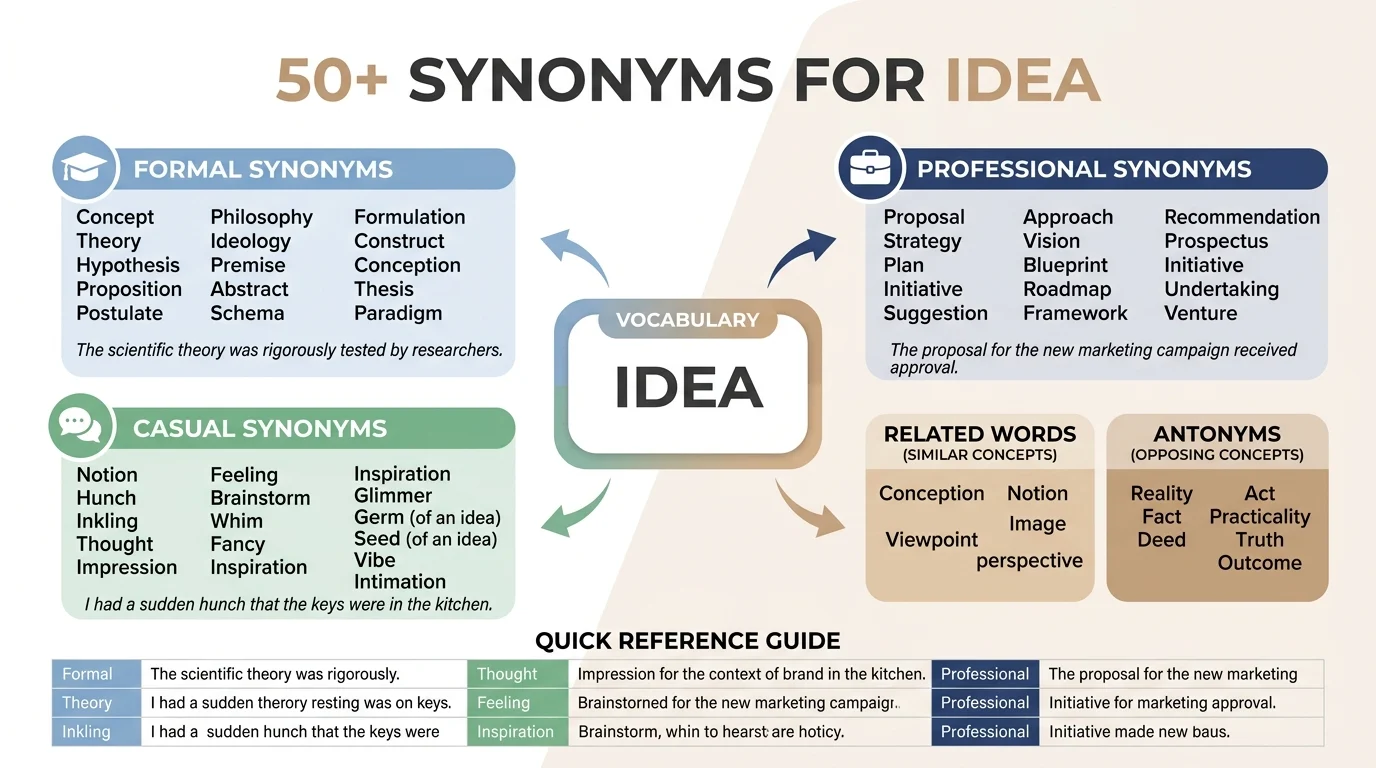
Do you find yourself repeating the word “idea” too often in your emails, essays, or conversations? You are not alone. Many writers, students, and professionals struggle with overusing this common noun.
The good news is that English offers many alternatives to help you express your thoughts with precision and variety. This guide will show you exactly how to choose the right synonym for idea in any situation.
What Does “Idea” Mean?
An idea is a thought, suggestion, or mental image about something. The best synonyms for idea depend on your context. For professional writing, try “concept” or “proposal.” For casual conversation, use “notion” or “hunch.” Academic work calls for “theory” or “hypothesis.” Creative writing benefits from “vision” or “inspiration.”
Meaning, Tone and Context
Simple Definition
An idea is a mental representation or thought that forms in your mind. It can be a plan, belief, suggestion, or mental impression.
Part of Speech
Idea is a noun. The plural form is ideas.
Tone
Neutral. The word itself carries no strong emotional charge. The tone changes based on the words you pair with it.
Formality Level
Idea works in all settings. It is appropriate for casual chats, professional emails, and academic papers. However, more precise synonyms often improve your writing.
Common Use Cases
People use idea in brainstorming sessions, problem solving, creative projects, business planning, academic discussions, and everyday decision making.
Important Word Forms
The adjective form is “ideal.” The adverb is “ideally.” The verb form “idealize” means to regard something as perfect.
When and How to Use “Idea”
Use idea when you want a simple, clear word for a thought or suggestion. It works well in general statements and everyday communication. For formal or specialized writing, choose a more precise synonym.
Professional Context
“I presented my idea for improving customer retention at the team meeting.”
Personal Context
“I have an idea for where we should go on vacation this summer.”
Academic Context
“The researcher tested the idea that sleep improves memory consolidation.”
Creative Context
“The initial idea for the novel came from a dream she had as a child.”
Casual Conversation
“Do you have any ideas for dinner tonight?”
Social Media Context
“Just had a brilliant idea for my next YouTube video.”
Email Context
“I am writing to share an idea that might help streamline our approval process.”
Another Word for “Idea”
The best single replacement depends entirely on your specific meaning and situation.
For Professional Writing
Use “concept” when discussing abstract principles. “proposal” when suggesting a plan of action. Use “strategy” for business planning.
For Academic Writing
Use “theory” for testable explanations. Use “hypothesis” for an educated guess. “paradigm” for a framework of thought.
For Casual Conversation
Use “notion” for a vague thought. Use “hunch” for an intuitive feeling. “thought” for any mental content.
For Emotional Writing
Use “dream” for aspirational ideas. Use “vision” for inspiring possibilities. “inspiration” for creative sparks.
For Creative Writing
Use “concept” for story themes. “notion” for character beliefs. Use “vision” for descriptive imagery.
For Resume or Workplace Use
Use “initiative” for a self started project. “solution” for problem solving. Use “innovation” for novel contributions.
For Social Media Captions
Use “thought” for personal reflections. “notion” for playful musings. Use “brainwave” for sudden insights.
For Stronger Meaning
Use “conviction” for a firmly held belief. “doctrine” for a system of principles. Use “dogma” for rigid beliefs.
For Softer Meaning
Use “impression” for a faint idea. “suggestion” for a gentle proposal. Use “inkling” for a slight notion.
When Not to Use “Idea”
Avoid idea when you need more precision. The word can sound vague or weak in important contexts.
When Idea Sounds Too Vague
Original sentence: “I have an idea about the project.”
Better: “I have a strategic plan for the project.”
When Idea Sounds Too Casual
Original sentence: “My idea for the research is that sleep affects mood.”
Better: “My hypothesis for the research is that sleep affects mood.”
When Idea Sounds Too Weak
Original sentence: “The CEO rejected my idea.”
Better: “The CEO rejected my proposal.”
When Idea Sounds Too General
Original sentence: “She presented her idea at the conference.”
Better: “She presented her theory at the conference.”
When Idea Fails to Capture Importance
Original sentence: “His idea changed the company.”
Better: “His vision changed the company.”
Words Commonly Confused With “Idea”
Idea vs. Concept
An idea is a basic thought. A concept is a more developed abstract notion. Use idea for simple thoughts. Use concept for complex frameworks.
Idea vs. Thought
Idea often implies a plan or suggestion. Thought refers to any mental activity. Use idea when proposing something. Use thought for general reflection.
Idea vs. Opinion
An idea is a mental construct. An opinion is a personal judgment or belief. Use idea for neutral thoughts. Use opinion for subjective views.
Idea vs. Theory
An idea is a general thought. A theory is a tested explanation supported by evidence. Use idea for casual thinking. Use theory for scientific contexts.
Idea vs. Belief
An idea is cognitive. A belief involves acceptance and conviction. Use idea for thoughts you consider. Use belief for things you hold true.
Idea vs. Plan
An idea is still forming. A plan includes specific steps and details. Use idea for early stage thinking. Use plan for actionable strategies.
Best Synonym by Context for “Idea”
| Context | Best Synonym | Why It Works | Example |
|---|---|---|---|
| Formal Writing | Concept | Sounds academic and precise | “The concept of democracy evolved over centuries.” |
| Academic Writing | Theory | Indicates a tested framework | “Einstein’s theory revolutionized physics.” |
| Professional Business | Strategy | Implies actionable planning | “Our strategy focuses on customer retention.” |
| Resume Use | Initiative | Highlights proactive contributions | “Led an initiative to reduce operational costs.” |
| Casual Conversation | Notion | Feels natural and conversational | “I have a notion about where we should eat.” |
| Creative Writing | Vision | Adds imagery and inspiration | “Her vision for the novel was deeply personal.” |
| Emotional Tone | Dream | Conveys hope and aspiration | “His dream of becoming a doctor never faded.” |
| Strong Intensity | Doctrine | Suggests firm principles | “The company doctrine emphasized innovation.” |
| Soft Moderate Tone | Suggestion | Feels gentle and non imposing | “I have a suggestion for improving the process.” |
| Social Media Captions | Brainwave | Sounds fun and spontaneous | “Just had a brainwave for my next project.” |
Which Synonym Should You Choose?
Consider Your Meaning
Think about what you are actually trying to say. Are you proposing a plan? Sharing a thought? Expressing a belief? The most accurate synonym will match your specific meaning.
Consider Your Audience
Your word choice should match who you are speaking to. Use “concept” or “theory” for academics. “notion” or “thought” for friends. Use “strategy” or “proposal” for business colleagues.
Consider Your Purpose
Are you trying to persuade, inform, or entertain? Persuasive writing benefits from strong words like “vision” or “conviction.” Informative writing uses precise terms like “hypothesis” or “analysis.”
Consider Emotional Intensity
Choose “notion” for light topics. Choose “conviction” for deeply held beliefs. Match your word intensity to your message weight.
Consider Sentence Flow
Sometimes the best synonym is simply the one that sounds natural in your sentence. Read your sentence aloud and trust your ear.
Real Life Examples of “Idea” in Sentences
School
“The student’s research idea earned her a scholarship to the summer program.”
Workplace
“The marketing team brainstormed ideas for the new product launch campaign.”
Writing
“The author struggled to find a fresh idea for her next mystery novel.”
Conversation
“That is actually a brilliant idea. I never thought of approaching the problem that way.”
Social Media
“New idea alert. What if we started a podcast about everyday adventures?”
“Thank you for sharing your idea. I would like to discuss it further at our next meeting.”
Storytelling
“The idea came to him in a flash. He knew he had to write it down before it disappeared.”
25 Synonyms for “Idea”
| Synonym | Simple Meaning | Best Used For | Example Sentence |
|---|---|---|---|
| Concept | An abstract general notion | Academic and professional writing | “The concept of freedom is central to her philosophy.” |
| Thought | A mental process or product | General everyday use | “I just had a thought about our vacation plans.” |
| Notion | A vague or general idea | Casual conversations | “She has this notion that everything will work out.” |
| Theory | A tested explanation | Scientific or academic contexts | “The theory explains why birds migrate seasonally.” |
| Hypothesis | An educated guess | Research and experiments | “We need to test this hypothesis with new data.” |
| Vision | A mental image of the future | Leadership and creative work | “Her vision transformed the struggling organization.” |
| Dream | An aspiration or hope | Emotional and motivational writing | “His dream of traveling the world inspired his work.” |
| Proposal | A suggested plan | Business and professional settings | “The proposal outlined a new marketing approach.” |
| Strategy | A careful plan for success | Business and military contexts | “Our strategy focuses on sustainable growth.” |
| Plan | A detailed course of action | Practical implementation | “We need a plan before we start this project.” |
| Brainwave | A sudden clever idea | Informal creative moments | “He had a brainwave during his morning shower.” |
| Inspiration | A creative influence | Artistic and motivational contexts | “She found inspiration in the natural landscape.” |
| Conception | The origin or beginning of an idea | Formal writing about origins | “The conception of the project took several months.” |
| Impression | A vague feeling or idea | Subjective observations | “I have the impression that something has changed.” |
| Suggestion | A gentle proposal | Polite recommendations | “Do you have any suggestions for improving this process?” |
| Inkling | A slight or vague notion | Intuitive feelings | “I had an inkling that something was about to happen.” |
| Hunch | An intuitive feeling | Gut feelings and predictions | “My hunch tells me we should wait a little longer.” |
| Belief | An acceptance that something is true | Personal convictions | “Her belief in education changed her life’s path.” |
| Opinion | A personal viewpoint | Subjective judgments | “In my opinion, we should postpone the decision.” |
| Notion | A general understanding | Casual thinking | “He has this notion that money solves every problem.” |
| Construct | A theoretical creation | Academic and philosophical contexts | “Gender is a social construct, not a biological fact.” |
| Paradigm | A model or framework | Scientific and academic contexts | “The research created a new paradigm for understanding memory.” |
| Creed | A system of beliefs | Religious or philosophical systems | “His creed emphasized compassion above all else.” |
| Conviction | A firmly held belief | Strong personal statements | “She spoke with conviction about social justice.” |
| Motive | A reason for doing something | Psychological or mystery contexts | “What was his motive for making that decision?” |
Synonym Groups and Usage Differences
Professional vs. Personal Synonyms
Professional contexts call for “proposal,” “strategy,” and “initiative.” Personal contexts work well with “notion,” “thought,” and “hunch.” Choose based on your setting and the weight of your message.
Formal vs. Conversational Synonyms
Formal writing uses “concept,” “theory,” and “paradigm.” Conversational English uses “notion,” “brainwave,” and “hunch.” Academic reports need precision. Text messages need clarity.
Academic Synonyms
Academic writing benefits from “hypothesis,” “theory,” “construct,” and “paradigm.” These words signal careful thinking and research based knowledge. They show that you understand the scholarly tradition of your field.
Professional and Business Synonyms
Business communication uses “proposal,” “strategy,” “initiative,” and “solution.” These words show action orientation and practical thinking. They demonstrate that you can move from thought to execution.
Creative or Literary Synonyms
Creative writing uses “vision,” “inspiration,” “dream,” and “conception.” These words add depth and emotional resonance. They help readers connect with characters and ideas on a deeper level.
Slang or Modern Synonyms
“Brainwave” is a playful informal synonym. “Notion” works in casual conversation. Avoid these in formal writing. They are acceptable in social media, text messages, and friendly emails.
Strongest vs. Weaker Synonyms
Mild synonyms include “notion,” “impression,” and “inkling.” These suggest vague or tentative thoughts. Moderate synonyms include “concept” and “thought.” Strongest synonyms include “conviction,” “doctrine,” and “paradigm.” These suggest deeply held or systematic ideas.
Emotional vs. Neutral Synonyms
Emotional synonyms include “dream,” “vision,” and “inspiration.” These words carry positive feelings and aspirations. Neutral synonyms include “concept,” “theory,” and “proposal.” These words stay factual and objective.
Antonyms of “Idea”
| Antonym | Meaning | Example Sentence |
|---|---|---|
| Certainty | Complete lack of doubt | “He had certainty about the outcome.” |
| Fact | Something known to be true | “The fact was impossible to dispute.” |
| Reality | The state of things as they exist | “Her plan ignored the reality of the situation.” |
| Truth | That which is true | “The truth eventually came to light.” |
| Evidence | Proof supporting a claim | “The evidence contradicted his idea.” |
| Ignorance | Lack of knowledge | “Ignorance of the issue led to poor decisions.” |
| Confusion | Lack of understanding | “Confusion replaced clarity in her mind.” |
| Absurdity | Extreme irrationality | “The absurdity of the claim was obvious.” |
| Nonsense | Meaningless words | “His argument was nothing but nonsense.” |
| Inanity | Lack of sense or meaning | “The conversation was filled with inanity.” |
| Folly | Foolishness or lack of wisdom | “The folly of the plan was quickly exposed.” |
| Stupidity | Lack of intelligence | “The stupidity of the decision cost them dearly.” |
| Unreality | The state of not being real | “She lived in a world of unreality.” |
| Misconception | A wrong understanding | “The misconception led to many errors.” |
| Fallacy | A mistaken belief | “The fallacy in his reasoning was easy to spot.” |
Comparison: Idea vs. Similar Words
Idea vs. Concept
Main difference: An idea is a simple thought. A concept is an abstract framework. Concept is more formal and developed. Example with idea: “I have an idea for a new business.” Example with concept: “The concept of supply and demand is fundamental to economics.”
Idea vs. Thought
Main difference: Idea often implies a suggestion or plan. Thought refers to any mental process. Thought is broader. Idea is more specific. Example with idea: “Your idea might actually work.” Example with thought: “I was lost in thought all morning.”
Idea vs. Opinion
Main difference: An idea is neutral. An opinion is a personal judgment. Opinion is subjective. Idea can be objective. Example with idea: “The team brainstormed new ideas.” Example with opinion: “In my opinion, we should wait.”
Idea vs. Theory
Main difference: An idea is a basic thought. A theory is a tested explanation. Theory requires evidence. Idea can be casual. Example with idea: “I have an idea about why plants grow this way.” Example with theory: “The theory of evolution is supported by extensive evidence.”
Idea vs. Belief
Main difference: An idea is cognitive. A belief involves acceptance and conviction. Belief is emotional and personal. Idea is mental and neutral. Example with idea: “She shared her idea with the group.” Example with belief: “His belief in fairness guided all his decisions.”
Idea vs. Plan
Main difference: An idea is a starting point. A plan is a detailed course of action. Plan includes steps and timelines. Idea is more abstract. Example with idea: “We need a fresh idea for this campaign.” Example with plan: “We need a detailed plan for this campaign.”
Common Phrases and Expressions with “Idea”
1. Bright Idea
Meaning: A clever or intelligent thought.
Example sentence: “That was a bright idea to start the project early.”
2. No Idea
Meaning: Complete lack of knowledge or understanding.
Example sentence: “I have no idea where she went after the meeting.”
3. Big Idea
Meaning: An important or major concept or plan.
Example sentence: “The big idea behind the company is sustainability.”
4. Have an Idea
Meaning: To think of something.
Example sentence: “I have an idea for improving the website design.”
5. Idea Whose Time Has Come
Meaning: A concept that is now relevant and accepted.
Example sentence: “Electric vehicles are an idea whose time has come.”
6. Toy with an Idea
Meaning: To consider something casually.
Example sentence: “He is toying with the idea of changing careers.”
7. Put an Idea Forward
Meaning: To suggest or propose something.
Example sentence: “She put forward an idea that changed the entire project.”
8. Reject an Idea
Meaning: To refuse to accept a suggestion.
Example sentence: “The committee rejected his idea without much discussion.”
Common Mistakes to Avoid
Mistake 1: Using Idea When a More Precise Synonym Is Better
Instead of “I have an idea for the business,” try “I have a strategy for the business.” The second sentence shows more careful thought and planning.
Mistake 2: Confusing Idea With Opinion
An idea is a thought. An opinion is a judgment. You can have an idea about how to solve a problem. You have an opinion about which solution is best.
Mistake 3: Using a Casual Synonym in Formal Writing
Using “notion” in an academic paper can sound imprecise. Use “concept” or “theory” instead. Match your word to your context.
Mistake 4: Using an Overly Dramatic Synonym for a Simple Situation
You do not need to call every thought a “vision” or “conviction.” Sometimes a simple “thought” or “notion” works perfectly.
Mistake 5: Repeating the Same Word Too Often
Vary your word choice. Use “concept,” “notion,” and “proposal” instead of repeating “idea” in every sentence. Your writing will sound more sophisticated.
Mistake 6: Choosing a Synonym With the Wrong Emotional Tone
Do not use “dream” for a business plan unless you want to sound aspirational. Do not use “theory” for casual thoughts unless you want to sound academic.
Mistake 7: Using Slang in Academic or Professional Writing
Avoid “brainwave” and “hunch” in formal settings. These words work well in casual conversations but undermine your authority in professional contexts.
FAQs
1. What is the best synonym for idea?
The best synonym depends on your context. Use “concept” for formal writing, “notion” for casual conversation, “theory” for academic work, and “proposal” for business settings.
2. What is a formal synonym for idea?
“Concept” and “theory” are formal synonyms for idea. They work well in academic papers, professional reports, and formal speeches.
3. What is an informal synonym for idea?
“Notion” and “hunch” are informal synonyms for idea. They work well in casual conversations, text messages, and friendly emails.
4. What is another word for idea in professional writing?
“Proposal,” “strategy,” and “initiative” are excellent professional alternatives. They suggest action oriented thinking and careful planning.
5. What is the difference between idea and concept?
An idea is a simple thought. A concept is an abstract framework. Concept is more developed and formal. Use idea for everyday thoughts. Use concept for academic or professional contexts.
6. What is the opposite of idea?
The opposite of idea includes “certainty,” “fact,” “reality,” and “evidence.” These words suggest what is known rather than what is thought.
Conclusion
The word “idea” is a useful and versatile noun, but it should not be your only choice. English offers a rich vocabulary of alternatives that can make your writing more precise and engaging. The key is matching your word to your meaning, audience, and purpose.
Your practical vocabulary tip: Before you write, ask yourself what kind of thought you are expressing. Are you sharing a casual notion, proposing a business strategy, or developing an academic theory? The answer will guide your word choice.
Remember that context determines the best synonym for idea. Pay attention to tone, formality, and emotional weight. With practice, you will naturally choose the right word for every situation. Your communication will become more effective and your vocabulary will grow stronger with each thoughtful choice.