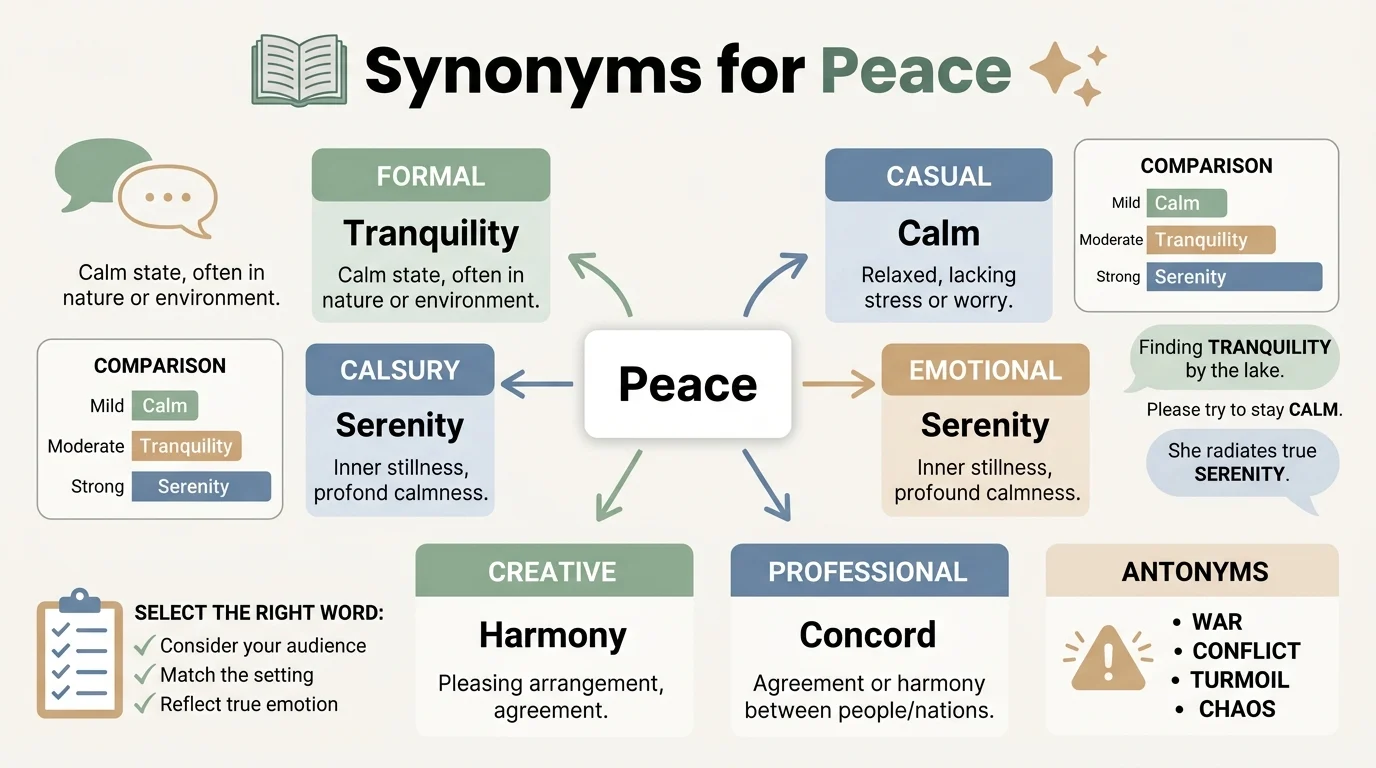
Peace is more than the absence of conflict. It can describe calmness, harmony, safety, or a quiet state of mind. But sometimes, using the word peace again and again can make your writing feel plain. That is where the right synonym can help.
Whether you are writing an essay, a speech, a message, or a creative piece, choosing the right word matters. Some synonyms for peace suggest calm and quiet. Others express harmony, friendship, or an end to conflict. Understanding these differences helps you choose a word that fits your exact meaning.
In this guide, you will find useful peace synonyms in English, along with simple meanings and examples. If you are looking for another word for peace, other words for peace, or a peaceful synonym, you will find practical options here. These synonyms of peace can make your writing clearer, more natural, and more expressive.
What Does “Peace” Mean?
Peace means a state of calm, quiet, and freedom from disturbance or conflict. For formal use, try tranquility or harmony. For casual use, try calm or quiet. Academic writers often prefer concord or serenity. Emotional contexts call for solace or stillness. Creative writing benefits from words like hush or repose. The best synonym for peace depends entirely on your situation and audience.
Meaning, Tone and Context
- Simple definition: Peace is a condition of quiet, rest, or freedom from conflict and worry.
- Part of speech: Peace is a noun. The adjective form is peaceful. The adverb form is peacefully.
- Positive, negative, or neutral tone: Peace is almost always positive. It suggests safety, comfort, and well being.
- Formality level: Peace is neutral. It works in casual conversation and formal writing equally well.
- Common use cases: Emails, essays, speeches, social media, poetry, resumes, and everyday conversation.
- Important word forms: Peaceful (adjective), peacefully (adverb), peacefulness (noun), peaceable (adjective).
When and How to Use “Peace”
You should use peace when you want to describe a lack of disturbance or conflict. It works well in general statements and everyday language. However, it can feel too general in professional or academic settings. More precise synonyms often create stronger impact. Below are examples showing peace in different contexts.
Professional context: The team worked in peace to meet the project deadline.
Personal context: I find my peace during morning walks in the park.
Academic context: The study examined how peace affects community development.
Emotional context: She felt a deep sense of peace after forgiving herself.
Creative context: The forest held an ancient peace that words could not capture.
Social media context: Sending you peace and positive energy today.
Email context: I hope this email finds you in peace.
Casual context: Let me finish my coffee in peace.
Another Word for “Peace”
The best single replacement for peace depends on your exact meaning. Here are the top choices by situation.
Professional writing: Try harmony. It suggests cooperative balance in workplace relationships.
Academic writing: Try concord. This word sounds precise and scholarly in research papers.
Casual conversation: Try calm. It is natural and easy to understand in everyday talk.
Emotional writing: Try solace. This word captures comfort during difficult times.
Creative writing: Try hush. It adds poetic imagery and sensory detail.
Resume and workplace use: Try stability. This shows reliability and steady performance.
Social media captions: Try stillness. It feels modern and visually descriptive.
Stronger meaning: Try serenity. This conveys deep, unshakeable tranquility.
Softer meaning: Try quiet. This suggests mild calm without intensity.
When Not to Use “Peace”
Peace is a wonderful word, but it does not fit every situation. It can sound too general or too vague. Sometimes you need a more precise word to communicate clearly.
For example, if you are writing a report about a calm work environment, “harmony” or “stability” would be more professional. In an emotional letter, “solace” or “comfort” carries more weight. On social media, “serenity” or “stillness” sounds more engaging.
Consider this sentence: “The team worked in peace.” This is fine, but “The team worked in harmony” sounds more collaborative. Another example: “She found peace in the garden” works, but “She found solace in the garden” feels more emotionally resonant.
Words Commonly Confused With “Peace”
Many words relate to peace, but each has a distinct meaning. Understanding these differences will help you choose the right word every time.
Peace vs. Calm: Peace suggests freedom from conflict. Calm suggests freedom from agitation. Use peace for broader situations. Use calm for temporary states.
Peace vs. Serenity: Peace is general. Serenity suggests a deeper, more spiritual calm. Use serenity for emotional depth.
Peace vs. Harmony: Peace focuses on absence of conflict. Harmony focuses on positive cooperation. Use harmony for relationships and collaboration.
Peace vs. Tranquility: Peace is common. Tranquility is more formal and poetic. Use tranquility in descriptive or literary writing.
Peace vs. Stillness: Peace includes mental quiet. Stillness focuses on physical lack of movement. Use stillness for visual descriptions.
Peace vs. Quiet: Peace suggests inner calm. Quiet suggests low noise. Use quiet for physical surroundings.
Best Synonym by Context for “Peace”
| Context | Best Synonym | Why It Works | Example |
|---|---|---|---|
| Formal Writing | Tranquility | Sounds elegant and refined | The treaty ensured tranquility between nations. |
| Academic Writing | Concord | Precise and scholarly | The research explored concord among diverse communities. |
| Professional Use | Harmony | Suggests successful collaboration | Our department operates in harmony with company goals. |
| Resume Writing | Stability | Shows reliability and consistency | Maintained stability during organizational changes. |
| Casual Conversation | Calm | Natural and easy to understand | I need some calm after that busy week. |
| Creative Writing | Stillness | Adds sensory depth and imagery | The morning stillness wrapped the town in silver light. |
| Emotional Tone | Solace | Conveys comfort and healing | Music gave her solace after the loss. |
| Strong Intensity | Serenity | Suggests deep spiritual calm | Her serenity inspired everyone around her. |
| Soft Tone | Quiet | Gentle and unassuming | She enjoyed the quiet of the library. |
| Social Media | Peaceful Vibes | Modern and engaging | Sending peaceful vibes to everyone today. |
Which Synonym Should You Choose?
Choosing the right synonym is simple if you consider four factors: meaning, formality, intensity, and audience.
First, think about what you really mean. Are you describing the absence of noise, the absence of conflict, or a feeling of emotional comfort? Each meaning has its own best word.
Second, consider your audience. Formal reports need words like tranquility or concord. Casual conversations need words like calm or quiet. Professional emails need words like harmony or stability.
Third, consider intensity. If you want to emphasize a deep, lasting calm, choose serenity. If you want a lighter touch, choose quiet.
Fourth, consider your sentence. Read your sentence aloud with each synonym. Choose the one that sounds most natural and precise.
Real Life Examples of “Peace” in Sentences
School context: The students finally found peace during their summer break.
Workplace context: The manager promoted a culture of peace and mutual respect.
Writing context: Her novel explores the fragile peace between two rival families.
Conversation context: I just need some peace after that argument.
Social media context: Wishing everyone peace and happiness this weekend.
Email context: We appreciate your patience and hope you enjoy the peace of your new home.
Resume context: Restored peace among cross functional teams through effective mediation.
Storytelling context: The soldier returned home longing for the peace he had once known.
25 Synonyms for “Peace”
| Synonym | Simple Meaning | Best Used For | Example Sentence |
|---|---|---|---|
| Calm | Absence of agitation | Everyday conversation | The calm before the storm was unsettling. |
| Serenity | Deep spiritual calm | Emotional and reflective writing | Her serenity made everyone feel safe. |
| Tranquility | Formal, elegant calm | Formal and academic writing | The garden offered perfect tranquility. |
| Harmony | Positive cooperation | Professional and relationship contexts | The choir sang in perfect harmony. |
| Stillness | Lack of movement | Creative and descriptive writing | The stillness of the lake reflected the sky. |
| Quiet | Low noise or disturbance | Casual and descriptive use | I love the quiet of early mornings. |
| Solace | Comfort during distress | Emotional and personal writing | She found solace in her grandmother’s advice. |
| Repose | Restful calm | Literary and poetic use | His face held the repose of deep sleep. |
| Concord | Agreement and harmony | Academic and formal writing | The concord between the groups was remarkable. |
| Stability | Steady and reliable | Professional and resume writing | The new policy brought stability to the team. |
| Order | Organized calm | Professional and academic contexts | The judge restored order in the courtroom. |
| Ease | Freedom from difficulty | Casual and professional use | She handled the situation with ease. |
| Rest | Relief from effort | Casual and personal contexts | The hiker stopped for a moment of rest. |
| Composure | Self controlled calm | Emotional and professional contexts | He maintained composure under pressure. |
| Equanimity | Mental calm in difficulty | Formal and academic writing | Her equanimity impressed the interview panel. |
| Placidity | Gentle calm | Descriptive and literary use | The placidity of the pond was soothing. |
| Amity | Friendly peace | Relationship and diplomatic contexts | The amity between neighbors was heartwarming. |
| Accord | Official agreement | Formal and diplomatic contexts | The nations reached an accord on trade. |
| Restfulness | Quality of being restful | Descriptive and lifestyle contexts | The hotel had a restfulness that eased travelers. |
| Balance | Stable equilibrium | Professional and wellness contexts | She maintained balance in her hectic life. |
| Contentment | Satisfied calm | Personal and emotional contexts | His contentment was visible in his smile. |
| Gentleness | Mild and kind calm | Descriptive and relationship contexts | The gentleness of her voice calmed the child. |
| Peacefulness | Quality of being peaceful | General and everyday use | The peacefulness of the forest amazed us. |
| Hush | Quiet and stillness | Creative and literary use | A hush fell over the crowded room. |
| Composedness | State of being composed | Professional and formal contexts | Her composedness during the crisis was admirable. |
Synonym Groups and Usage Differences
Professional vs. Personal Synonyms
Professional synonyms for peace focus on cooperation and stability. Harmony and stability work best in workplace settings. They suggest successful collaboration and reliable performance. Personal synonyms focus on emotional comfort. Solace and contentment fit better in private, reflective writing. They address inner feelings rather than external relationships.
Formal vs. Conversational Synonyms
Formal writing demands precise, elegant words. Tranquility and concord sound sophisticated and measured. They belong in reports, essays, and official documents. Conversational language prefers simple, accessible words. Calm and quiet are natural in texts, emails, and everyday talk. They sound friendly without being stiff.
Academic Synonyms
Academic writing values clarity and precision. Concord and equanimity are excellent choices. They show command of scholarly vocabulary. Stability and order also work well in research contexts. These words sound objective and measured.
Professional and Business Synonyms
Business communication needs words that convey reliability. Harmony shows teamwork and positive collaboration. Stability suggests dependable performance. Order indicates organized efficiency. Use these words in emails, reviews, presentations, and resumes.
Creative or Literary Synonyms
Creative writing benefits from sensory, evocative words. Stillness paints a vivid picture of physical calm. Hush creates an intimate, quiet atmosphere. Repose adds a poetic, restful quality. These words enrich descriptions and emotional scenes.
Slang or Modern Synonyms
Slang for peace includes “chill” and “zen.” These words are acceptable in casual conversation and social media. However, they are too informal for professional or academic writing. Use them only with close friends or in relaxed settings.
Strongest vs. Weaker Synonyms
Mild words: quiet, rest, ease.
Moderate words: calm, peacefulness, balance.
Strong words: serenity, tranquility, equanimity.
Strongest words: concord, composure, harmony.
Emotional vs. Neutral Synonyms
Emotional synonyms: solace, contentment, serenity. They carry feeling and personal meaning.
Neutral synonyms: order, stability, accord. They stay factual and objective.
Antonyms of “Peace”
| Antonym | Meaning | Example Sentence |
|---|---|---|
| War | Armed conflict | The war devastated the region. |
| Chaos | Complete disorder | The protest descended into chaos. |
| Conflict | Active disagreement | The conflict between neighbors escalated. |
| Turmoil | State of confusion | The company faced financial turmoil. |
| Discord | Lack of harmony | Discord among team members hurt productivity. |
| Strife | Angry conflict | The community suffered from internal strife. |
| Violence | Physical force | Violence broke out during the demonstration. |
| Unrest | Discontent and disturbance | Social unrest led to widespread protests. |
| Clamor | Loud noise | The clamor of traffic filled the street. |
| Anger | Strong displeasure | Her anger was impossible to calm. |
| Turbulence | Violent disturbance | The pilot warned about air turbulence. |
| Disturbance | Interruption of calm | A loud disturbance woke the neighborhood. |
| Agitation | State of nervousness | His agitation was visible to everyone. |
| Tension | Mental or emotional strain | The tension in the room was overwhelming. |
| Disorder | Lack of order | The library fell into complete disorder. |
Comparison: Peace vs. Similar Words
Peace vs. Calm
Main difference: Peace implies freedom from conflict. Calm implies freedom from agitation.
Which is stronger: Peace is stronger and broader.
Which is more formal: Peace is neutral. Calm is slightly more casual.
Example for peace: The peace of the countryside refreshed her.
Example for calm: She remained calm during the emergency.
Peace vs. Serenity
Main difference: Peace is general. Serenity implies deep spiritual calm.
Which is stronger: Serenity is stronger.
Which is more formal: Serenity is more formal and poetic.
Example for peace: He enjoyed the peace of his retirement.
Example for serenity: Her serenity inspired admiration from all.
Peace vs. Harmony
Main difference: Peace focuses on absence of conflict. Harmony focuses on positive cooperation.
Which is stronger: Harmony is stronger in positive contexts.
Which is more formal: Harmony is slightly more formal.
Example for peace: The two nations signed a peace treaty.
Example for harmony: The choir sang in perfect harmony.
Peace vs. Tranquility
Main difference: Peace is common. Tranquility is elegant and descriptive.
Which is stronger: Tranquility is stronger and more refined.
Which is more formal: Tranquility is more formal.
Example for peace: The morning peace was beautiful.
Example for tranquility: The tranquility of the lake amazed visitors.
Peace vs. Stillness
Main difference: Peace includes mental calm. Stillness focuses on physical lack of movement.
Which is stronger: Peace is broader. Stillness is more specific.
Which is more formal: Both are neutral, but stillness is more descriptive.
Example for peace: He found peace after meditation.
Example for stillness: The stillness of the forest was haunting.
Peace vs. Solace
Main difference: Peace is general calm. Solace is comfort during distress.
Which is stronger: Solace carries more emotional weight.
Which is more formal: Solace is slightly more formal.
Example for peace: She sought peace in nature.
Example for solace: He found solace in his faith.
Common Phrases and Expressions with “Peace”
1. Rest in Peace
Meaning: A traditional blessing for someone who has died.
Example sentence: The community mourned his passing and wished him to rest in peace.
2. Peace of Mind
Meaning: A state of being free from worry.
Example sentence: Knowing my family was safe gave me peace of mind.
3. Keep the Peace
Meaning: To maintain calm and prevent conflict.
Example sentence: The teacher worked hard to keep the peace among her students.
4. Peace Offering
Meaning: A gift given to end an argument.
Example sentence: He bought flowers as a peace offering after their fight.
5. At Peace
Meaning: In a state of calm or acceptance.
Example sentence: She felt at peace with her decision.
6. Hold Your Peace
Meaning: To remain silent, especially during a disagreement.
Example sentence: He decided to hold his peace rather than argue.
7. Peace and Quiet
Meaning: Complete calm and silence.
Example sentence: The cottage offered the peace and quiet she needed.
8. Make Peace
Meaning: To end a conflict or disagreement.
Example sentence: The two friends decided to make peace and move forward.
Common Mistakes to Avoid
- Using peace when you need a more precise word. Peace is general. If you mean harmony, use harmony. If you mean serenity, use serenity.
- Confusing peace with calm. Peace is broader. Calm is more specific to agitation.
- Using a casual synonym in formal writing. Avoid “chill” or “zen” in professional documents.
- Using an overly dramatic synonym for a simple situation. “Serenity” may be too strong for a quiet afternoon.
- Repeating the same word too often. Vary your vocabulary to keep writing fresh.
- Choosing a synonym with the wrong emotional tone. “Solace” is comforting. “Repose” is restful. Know the difference.
- Using slang in academic or professional writing. Stick to formal synonyms in these contexts.
FAQs
1. What is the best synonym for peace?
The best synonym depends on context. For formal writing, use tranquility. casual use, use calm. For emotional depth, use solace.
2. What is a formal synonym for peace?
Tranquility and concord are excellent formal synonyms. They work well in academic and professional writing.
3. What is an informal synonym for peace?
Calm and quiet are the best informal synonyms. They are natural and easy to understand.
4. What is another word for peace in professional writing?
Harmony and stability are ideal for professional contexts. They suggest cooperation and reliability.
5. What is the difference between peace and serenity?
Peace is general and broad. Serenity implies deeper, more spiritual calm. Use peace for everyday situations. Use serenity for emotional depth.
6. What is the opposite of peace?
War, chaos, and conflict are direct opposites. They represent disturbance and disagreement.
Conclusion
Peace is a beautiful and essential word, but it is not the only word. By exploring its many synonyms, you can make your writing more precise, engaging, and professional. Remember that context matters. Formal writing benefits from words like tranquility and concord. Casual conversation works well with calm and quiet. Emotional writing comes alive with solace and serenity. Creative writing shines with stillness and hush.
The best vocabulary tip is simple: think about your audience. Consider what you really want to say. Choose the word that fits perfectly. Your readers will notice the difference. Your writing will feel more natural and powerful. Keep this guide handy. Refer to it whenever you need the perfect synonym for peace.
Please verify all definitions using trusted dictionaries such as Cambridge, Oxford, Merriam Webster, Collins, or Britannica before publishing.