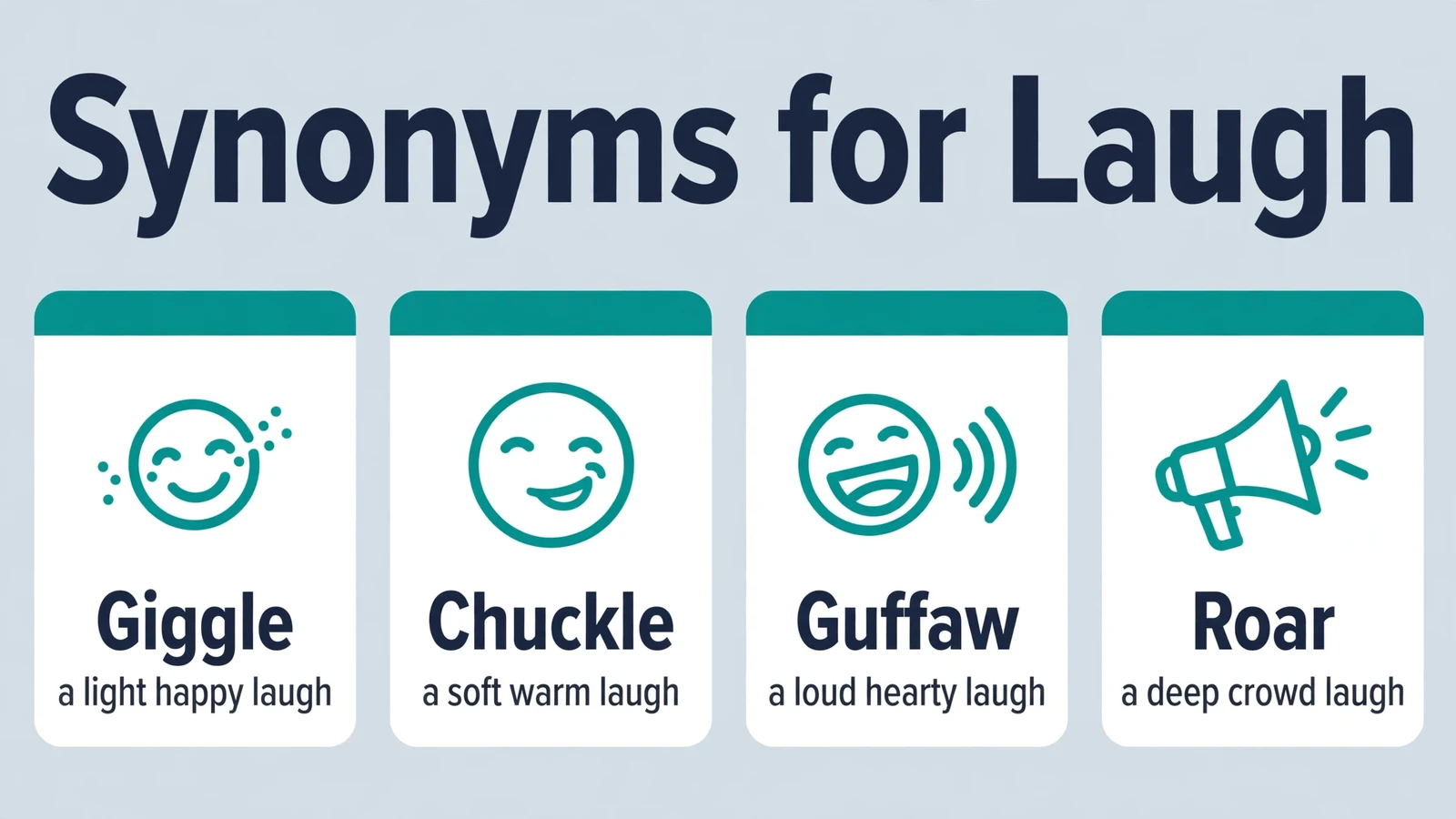
Few words in English cover as much ground as *laugh*. It names the tiny sound you hide behind your hand in a quiet meeting. It also names the roar that fills a comedy club. Luckily, English keeps a precise word for almost every point between those two extremes.
The most useful synonyms for laugh are chuckle, giggle, chortle, guffaw, cackle, titter, snicker, howl and roar. Each one paints a different sound, a different feeling and a different person. A nervous student titters. A happy grandfather chuckles. A villain in a story cackles.
This guide sorts more than 100 synonyms for laugh by intensity, by sound and by tone. It also covers the mocking words, the texting words and the traps to avoid. By the end, you will know exactly which laugh your sentence needs.
Quick Reference: Top 30 Synonyms for Laugh
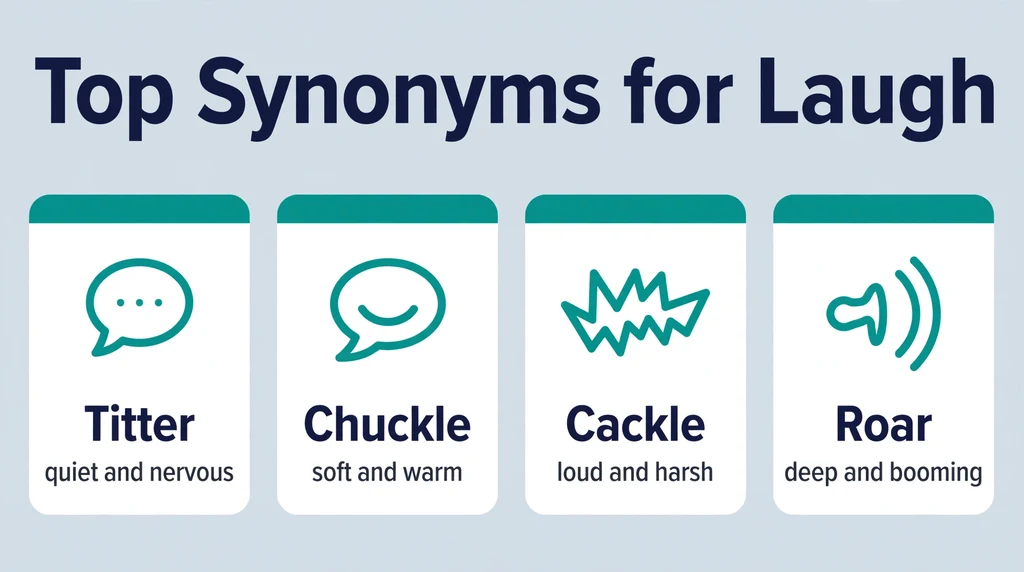
Start here when you need a word fast. The table below ranks the 30 most useful options from the quietest sound to the loudest outburst. After the table, the full sections explain each group in more depth.
| Word | Meaning in one line | Best for / tone |
|---|---|---|
| tee-hee | a tiny, playful written or spoken giggle | playful, old fashioned |
| titter | a short, nervous, half hidden laugh | embarrassment, nerves |
| snort | a sudden laugh pushed out through the nose | surprise, no time to hold it in |
| giggle | a light, high laugh in short bursts | young, silly, happy |
| snicker | a quiet, half hidden laugh, often unkind | secrets, someone’s mistake |
| snigger | the British twin of snicker | secrets, disrespect |
| chuckle | a soft, low, warm laugh | mild amusement, pleasure |
| chortle | a happy laugh mixed with a snort | delight, triumph |
| cackle | a loud, high, harsh laugh | villains, wild amusement |
| guffaw | a loud, hearty burst of laughter | jokes, groups, big reactions |
| howl | to laugh long and loudly | something extremely funny |
| roar | to laugh with a deep, booming sound | crowds, whole rooms |
| shriek | a high, piercing laugh | shock mixed with laughter |
| scream | to laugh wildly and loudly | informal, extreme reactions |
| whoop | a loud cry of joy mixed with laughter | celebration, excitement |
Phrases, Nouns and Texting Words
The second half of the table changes shape. It moves from single sound words to whole phrases, then to nouns, mocking verbs and the written forms people type every day.
| Word | Meaning in one line | Best for / tone |
|---|---|---|
| crack up | to suddenly start laughing hard | informal, everyday speech |
| burst out laughing | to start laughing suddenly | neutral, all contexts |
| be in stitches | to laugh so hard it almost hurts | informal, very funny moments |
| split your sides | to laugh uncontrollably | informal, exaggeration |
| roll in the aisles | to make an audience laugh nonstop | theatres, performances |
| die laughing | to laugh as if it could kill you | informal hyperbole |
| laughter | the sound of laughing in general | neutral noun, uncountable |
| belly laugh | a deep, whole body laugh | hearty noun, warm |
| peal of laughter | a long, ringing burst of laughter | literary noun |
| mirth | joyful laughter and happiness | formal, literary noun |
| mock | to laugh at someone in a scornful way | unkind, criticism |
| ridicule | to make someone the object of laughter | formal, unkind |
| jeer | to shout mocking laughter at someone | crowds, hostility |
| lol | laughing out loud, written in chats | texting, light amusement |
| lmao | laughing my ass off, a stronger lol | texting, friends only |
Notice how the top of the table whispers and the bottom half shouts. That climb from quiet to loud is the single most useful way to organize these words. The next section walks up that ladder one rung at a time.
Synonyms for Laugh by Intensity: Quiet to Loud
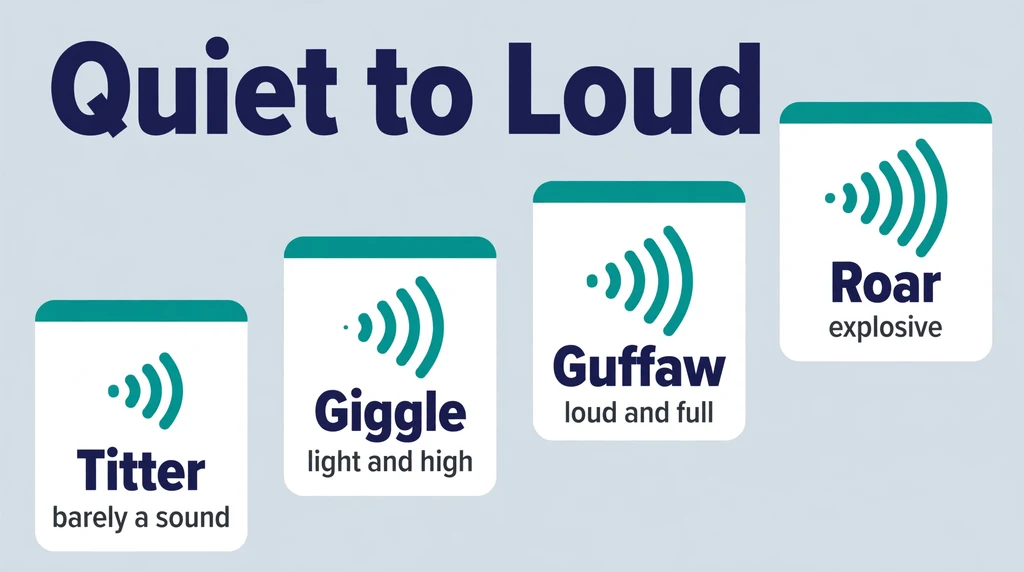
Intensity is the first thing readers hear in a laugh word. Choose the wrong rung and the scene sounds wrong. A bride does not guffaw at the altar, and a pirate captain does not titter at a treasure map. Read the ladder from the bottom up, and notice how each rung adds air, noise and body. The word you pick also hints at character, because soft laughers and loud laughers feel like different people on the page.
Rung 1: Barely a Sound
Some laughs almost escape before the laugher can stop them. A snort is a sudden burst of air through the nose when a laugh slips out. A titter is a short, restrained laugh, often nervous or embarrassed. People titter in classrooms, in meetings and at awkward family dinners. Tee-hee imitates that small sound, and today it feels playful or old fashioned. Picture a speaker dropping his notes on stage. Nobody laughs out loud, but a soft titter runs through the front rows.
Rung 2: Light and High
A giggle is a light laugh in short, high bursts. It suggests youth, silliness or nerves, and it often comes in fits. Snicker and snigger sit nearby, but they carry a secret. Both mean a half hidden laugh, often at someone else’s mistake. American writers usually choose *snicker*, while British writers usually choose *snigger*. A giggle can fill a whole bus stop on a school morning. A snicker, by contrast, usually travels between just two people who share a secret.
Rung 3: Warm and Open
The chuckle is the friendliest laugh in English. It is soft and low, and it signals mild amusement or quiet pleasure. A chortle adds a snort of delight to that warmth. Lewis Carroll coined *chortle* in 1871 as a blend of *chuckle* and *snort*. Writers use it when someone laughs with satisfaction or gentle triumph. A reader chuckles alone at a clever twist. A chess player chortles when a trap closes exactly as planned.
Rung 4: Loud and Full
Now the volume rises sharply. To cackle is to laugh in a loud, high and rather harsh voice. Dictionaries compare the sound to a hen, which is why storybook witches cackle. A guffaw is warmer but just as loud. It bursts out suddenly, often at a joke, and it fills the chest. A crow of laughter is a loud cry of joy or triumph. One guffaw from the back of a hall can set a whole audience off, because loud laughter is deeply contagious.
Rung 5: Explosive
At the top of the ladder, laughter takes over the whole body. People howl when something is so funny that the sound keeps coming. A crowd roars, producing one deep, booming wave of laughter. Someone may shriek or scream with laughter at a sudden shock. Fans whoop with joy at a match. The rare literary verb cachinnate means to laugh loudly and without restraint. Its cousin hee-haw imitates the braying sound of the loudest laugh of all. At this level, people lose words entirely. They hold their sides, wipe their eyes and gasp for air between waves of sound.
Synonyms for Laugh by Sound
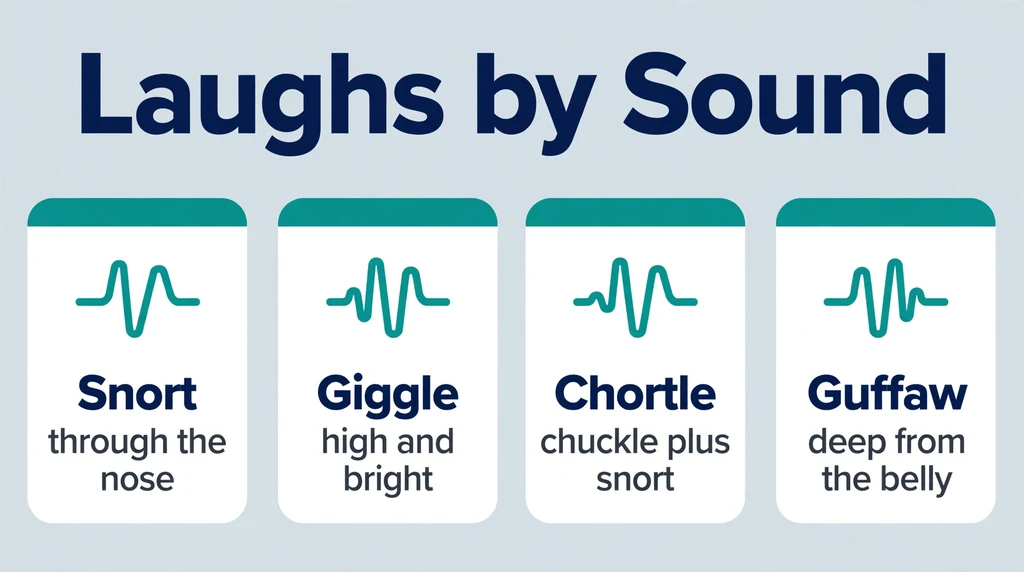
Intensity tells you how loud a laugh is. Sound tells you where it comes from. Many laugh words began as imitations of the noise itself, so each one lets a reader hear the scene.
Through the Nose
Nose-based laughs are quick and hard to control. A snort escapes when you try to hold a laugh in and lose. A snicker stays half trapped, which is why it suits secrets and guilty amusement. Its British spelling twin, snigger, sounds the same and means the same. The chortle also passes through the nose, but happily, mixing a chuckle with a snort.
High and Bright
Some laughs ring out high and light. A giggle rises in quick, bubbling bursts. A titter is thinner and more restrained, like a giggle wearing formal clothes. A cackle turns that high pitch harsh and loud, full of energy. A shriek of laughter pierces the air, usually when surprise and amusement hit at the same moment.
Deep and Booming
Low laughs carry weight and warmth. A guffaw rolls out of the belly, not the throat. A belly laugh names that same deep, whole body sound as a noun. When hundreds of people laugh together, writers reach for roar, because a crowd sounds like one huge animal. A peal of laughter rings out like a bell, long and clear. Sound based choices shine in description, because readers do not just understand them. They hear the room.
Where Laugh Words Come From
Many of these words started as pure sound. Language imitated the noise first, and the spelling came later. Merriam-Webster notes that *giggle* and *guffaw* are both believed to be modeled on the sound of laughter itself. Say them out loud and you can hear why. Each one performs a tiny version of the laugh it names.
*Titter* is probably imitative too. Dictionaries trace it to the early 1600s, possibly through Scandinavian relatives connected to quivering. The word still shakes a little when you say it. *Cackle* copies the hen first and the human laugh second, which is why it keeps its farmyard roughness.
One famous laugh word was invented on purpose. Lewis Carroll created *chortle* for *Through the Looking-Glass* in 1871. He blended *chuckle* with *snort*, and the blend escaped the book into everyday English. The grandest word on the ladder has older roots. *Cachinnate* comes from the Latin *cachinnare*, meaning to laugh loudly, and English has used it since 1824. Latin built that verb from the sound as well. Across two thousand years, the pattern never changes: first the laugh, then the word.
Laughing at Someone: Mocking Synonyms for Laugh
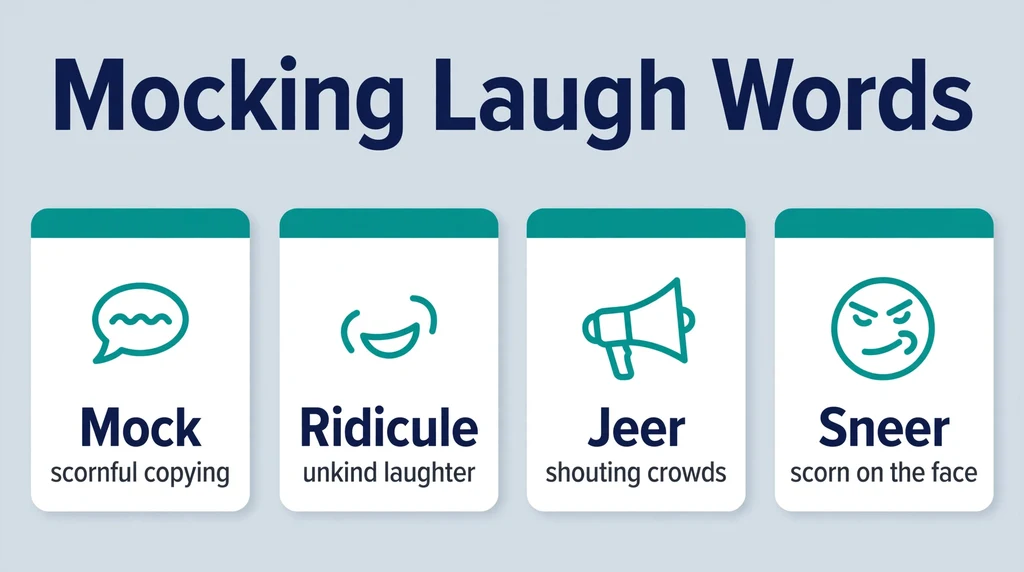
Everything so far has been friendly. This group is not. English treats laughing *at* a person as a separate sense, and the verbs here express scorn, not joy.
To mock someone is to laugh at them in a scornful way, often by copying them. Ridicule makes a person or idea the object of unkind laughter, and it sounds more formal. Deride goes further still. Dictionaries describe derision as contemptuous and often bitter. A crowd jeers when it shouts mocking laughter at a speaker or a player.
Other words work through the face and the voice. To sneer is to show scornful amusement, mostly on the face, as in the challenge “Don’t make me laugh!” To scoff is to speak about something with open contempt, as people first scoffed at many famous inventions. A gibe is a mocking remark, and to taunt is to provoke someone with jeering words.
Gentle Teasing vs Real Mockery
Not every laugh at someone is cruel. To tease and to poke fun at a friend can stay affectionate, especially when the target laughs too. Make fun of sits in the middle and depends on tone. Rag on is informal American English for teasing or criticizing. British speakers may take the mickey out of someone, which means teasing them, often gently. Context decides whether these words wound or bond, so choose them with care.
Mocking Words in the Wild
Real life supplies these words with constant work. Fans jeer a referee after a terrible call. Critics deride a proposal they consider foolish. Satire shows lampoon politicians by copying their speeches with a twist. A careless design can become a laughingstock, a target everyone laughs at. Notice that none of these scenes feels joyful for the target. That sting is exactly what separates this family from the friendly ladder above.
Idioms and Phrases for Laughing Hard
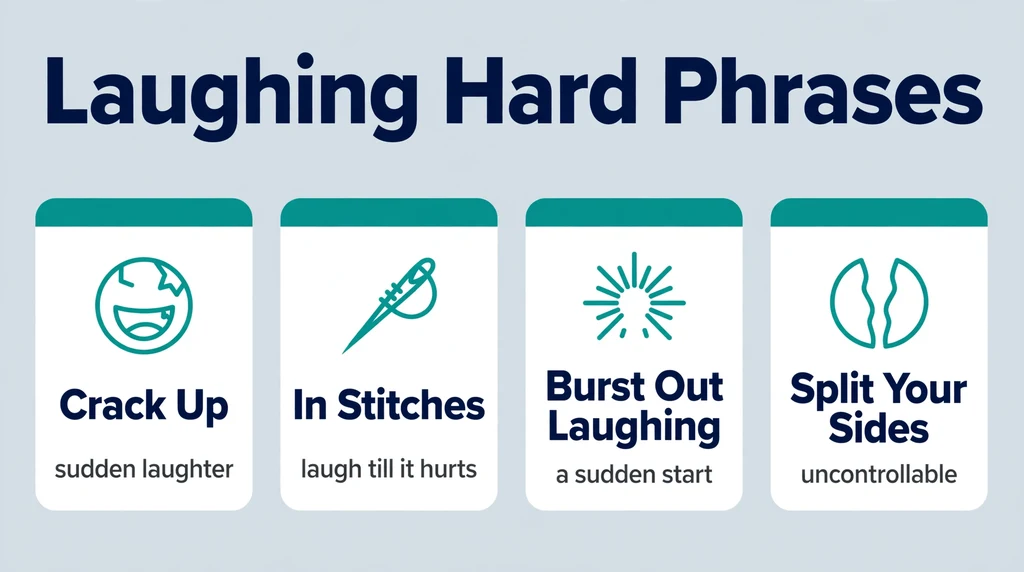
Single words sometimes feel too small for a huge reaction. English fills that gap with vivid phrases, and most of them exaggerate the body falling apart.
- Crack up: to suddenly start laughing, often without warning. “The whole class cracked up.”
- Burst out laughing: the neutral, all purpose option for a sudden start.
- Burst into laughter: the same idea in slightly more written, formal dress.
- Dissolve into laughter: to melt gradually into helpless laughing.
- Double up with laughter: to bend over because laughing hurts.
- Be in stitches: to laugh so hard that your sides feel sewn up with pain.
- Split your sides: to laugh uncontrollably, as if your body might tear.
- Roll in the aisles: used when a show makes a whole audience helpless.
- Bust a gut: informal and physical, like laughing until something breaks.
- Laugh your head off: a classic exaggeration for very hard laughter.
- Die laughing: pure hyperbole, common in casual speech.
- Be convulsed: to shake with laughter, slightly old fashioned.
- Crease up: British informal for laughing uncontrollably.
- Fall about laughing: British, like collapsing with laughter.
Writers should treat these phrases as spice, not the main dish. One strong phrase paints the scene. Three in a row turn real laughter into a cartoon.
Synonyms for a Laugh: The Noun Forms
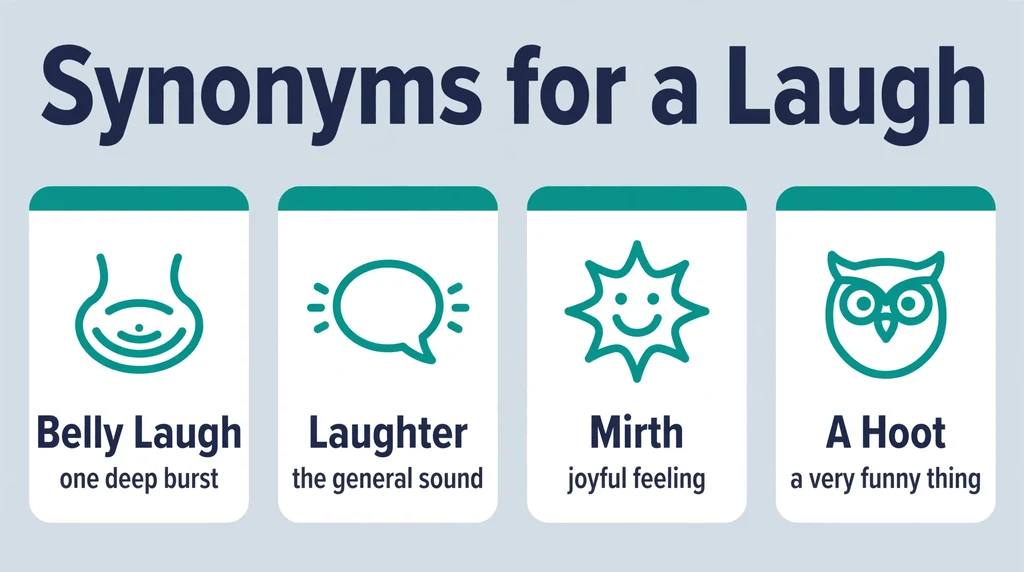
So far, most words have been verbs. English also keeps a rich shelf of laugh nouns. They fall into three groups: a single sound, laughter as a longer event, and the funny thing or person that causes it.
One Single Laugh
Most verb words double as nouns for one burst of sound. You can give a soft chuckle, a nervous titter or a loud guffaw. A snort of laughter escapes before you can stop it. A belly laugh is one deep, satisfying burst from the stomach. A horse laugh is loud and coarse. Written imitations work as nouns too: a quick ha-ha, a hearty haw-haw or a small hee-haw. Grammar matters here, because *a laugh* is countable. You can hear three laughs in a row.
Laughter as an Event
Laughter itself is the general, uncountable noun. Writers never say “a laughter”; they describe its shape instead. A peal of laughter rings out and fades. A gale of laughter sweeps through a room like wind. A fit of laughter seizes someone and will not let go. A burst of laughter starts and ends suddenly. For the joyful feeling behind the sound, English offers mirth, merriment, hilarity, glee and amusement. The heavy formal noun cachinnation means immoderate, noisy laughter.
Laughter in Groups
Crowds laugh in their own vocabulary. A theater audience answers a great line with roars of laughter, one deep sound made by hundreds of voices. A wave of laughter rolls across a room, rising and falling. A chorus of laughter suggests many people laughing together in rough harmony. News reports and novels use these phrases because a group laugh feels bigger than any single voice inside it.
A Laugh: The Funny Thing or Person
In informal English, *a laugh* can also name whatever causes the laughter. A great joke can be a real hoot. A wild party might be a riot, and a hilarious uncle is an absolute scream. British speakers call a fun adventure a lark. A person who keeps everyone laughing is a card, a wag or a joker. Professionals earn the titles comedian, comic, wit and entertainer. If you want the adjectives instead, see the full list of synonyms for funny in our companion guide.
Written Laughter: LOL, LMAO and Laughing in Texts
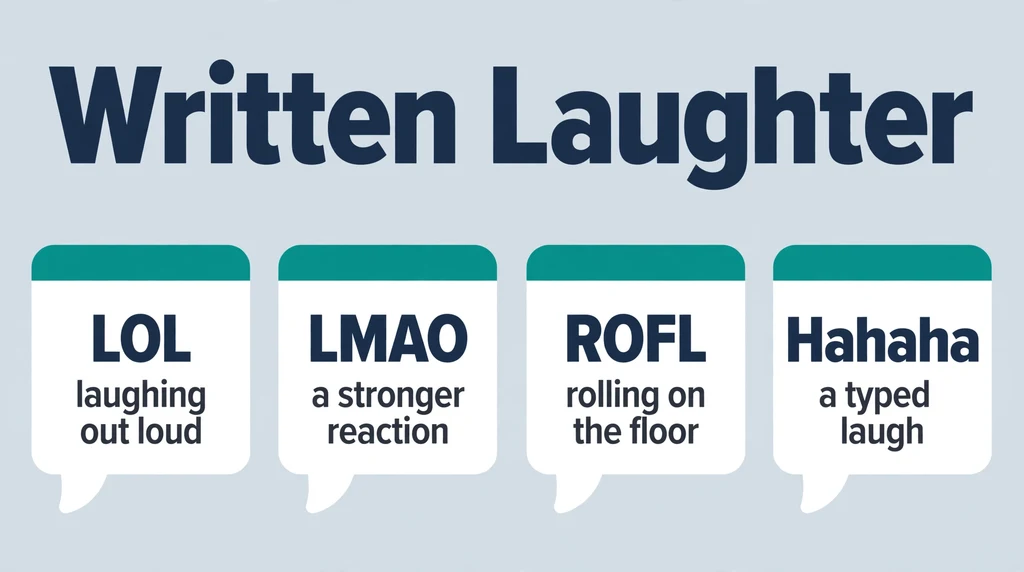
Laughter now happens on screens more often than in rooms. Texting has built its own ladder of written laughs, and the rungs are surprisingly precise.
LOL stands for “laughing out loud.” It entered the Oxford English Dictionary in March 2011, which made its place in the language official. Yet modern LOL rarely reports real laughter. People type it to show light amusement, to soften a blunt message or simply to say “I acknowledge your joke.” It works like a smile in text form. If that softer, facial side of amusement interests you, our guide to synonyms for happy covers the feeling itself.
LMAO means “laughing my ass off,” and it reports a much stronger reaction. Dictionaries flag it as mildly vulgar, so it belongs with friends, not with your manager. LMFAO adds a stronger swear word, which makes it clearly rude. ROFL paints a cartoon picture: “rolling on the floor laughing.” The combined form ROFLMAO stacks both images for maximum, often ironic, effect.
Finally, the oldest written laugh still works beautifully. Haha is a quiet nod. Hahaha is a real laugh. Stretching the word, “hahahaha,” makes the laugh look and feel longer, just as repeating letters stretches any shout online. Choose the length the way you would choose a volume knob.
Screens also gave laughter a face. The “face with tears of joy” emoji is the standard pictorial laugh in chats worldwide. Its wilder cousin, “rolling on the floor laughing,” tips sideways and borrows the ROFL image directly. Unicode added that second emoji in 2016, proof that written laughter keeps evolving. On screen, as in speech, the smallest forms do the everyday work.
Choosing Laugh Words for Real Situations
Context makes the final call. The same person laughs differently at a desk, at a dinner table and in a stadium seat.
At Work and at School
Quiet settings demand quiet words. Colleagues chuckle at a slide, students titter when a phone rings in a silent hall. A snort might escape before you can catch it, and everyone understands. What never belongs here is mockery. Snickering at a classmate’s answer can damage trust far beyond one lesson.
With Friends and Family
Warm settings allow the full middle of the ladder. Friends giggle over old photos and chortle at family stories. Someone retells the famous camping disaster, and the table cracks up all over again. Teasing stays gentle here, because everyone expects a turn as the target.
At Shows and in Crowds
Public laughter is collective, so the big words take over. Audiences roar at a comedian’s best line. Fans whoop and howl when a joke lands during a match replay. Performers live for the sound of a room in stitches, and reviewers reach for *uproarious* when the whole theater shakes.
Synonyms for Laugh in Example Sentences
Seeing each word inside a sentence locks its meaning in place. Read these examples aloud and notice how the sound changes from line to line.
Quiet Laughs in Sentences
- Giggle: “The twins giggled through the entire puppet show.” Light, young and helpless.
- Titter: “A nervous titter spread through the class when the vase wobbled.” Restrained and embarrassed.
- Snort: “She snorted at his text before she could stop herself.” Sudden, through the nose.
- Snicker: “The boys snickered behind the teacher’s back.” Secretive, slightly unkind.
- Chuckle: “Grandpa chuckled as he reread the old letter.” Warm, low and content.
Loud Laughs in Sentences
- Chortle: “He chortled when the final puzzle piece clicked in.” Pleased with himself.
- Guffaw: “The joke earned a huge guffaw from the truck driver.” Big, sudden and hearty.
- Cackle: “The witch cackled as the gate slammed shut.” High, harsh and theatrical.
- Howl: “We howled at his impression of the principal.” Long, loud and uncontrolled.
- Roar: “The stadium crowd roared with laughter at the replay.” One booming group sound.
Phrases in Sentences
- Crack up: “Everyone cracked up when the dog stole the microphone.”
- In stitches: “Her travel stories kept us in stitches all evening.”
- Burst out laughing: “He burst out laughing at the worst possible moment.”
- Split your sides: “That sketch is so sharp it will split your sides.”
Notice the pattern in every example. The laugh word does not just report a sound. It quietly describes the person, the place and the feeling around the sound.
How to Choose the Right Synonym for Laugh
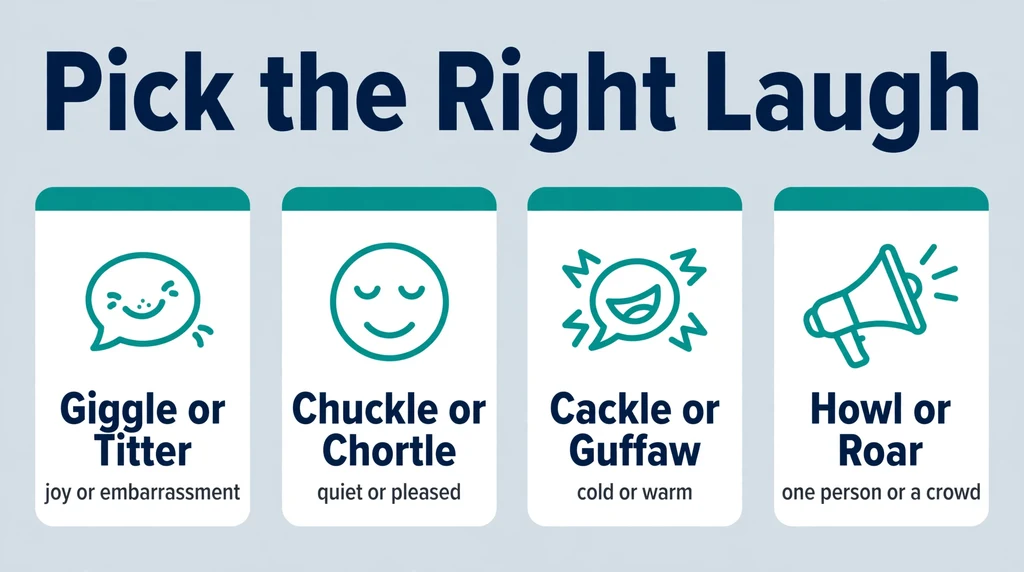
Five pairs cause most of the confusion. Learn these contrasts and your writing will sound sharper at once.
Giggle vs Titter
Both are light and high. A giggle is open, bubbly and often uncontrollable, like children at a sleepover. A titter is restrained and self conscious, like guests at a formal dinner who should not be laughing at all. Choose *giggle* for joy and *titter* for embarrassment.
Snicker vs Snigger
These two are the same word in different spellings. American English prefers *snicker*, and British English prefers *snigger*. Both describe a half suppressed laugh, often at a secret or at someone’s expense. Match the spelling to your audience, and remember the slight unkindness built into both.
Chuckle vs Chortle
A chuckle is quiet, low and private, the laugh of a reader alone with a good line. A chortle is louder and more pleased with itself. Because Carroll built it from *chuckle* and *snort*, a chortle always sounds satisfied, sometimes even triumphant.
Cackle vs Guffaw
Both are loud, but they feel opposite. A cackle is high, harsh and a little wild, so fiction gives it to villains and witches. A guffaw is deep, warm and honest, the sound of a friend who cannot hold a joke in. Pick by temperature: cackle runs cold, guffaw runs warm.
Howl vs Roar
A howl stretches one person’s laughter over time. A roar belongs to a group, or to a sound so big it seems to come from everywhere. An synonyms for excited crowd at a final match might roar. One viewer at home, watching the replay, might howl instead.
Laugh vs Laughter
This pair is grammar, not volume. *Laugh* is a countable noun and a verb: one laugh, two laughs, she laughed. *Laughter* is uncountable and names the sound in general. You can hear laughter from the next room, but you cannot count it. When a sentence feels wrong, this distinction usually fixes it.
Crack Up vs Burst Out Laughing
Both describe a sudden start. *Burst out laughing* is neutral and safe in any context, including formal reports. *Crack up* is informal and conversational, and it also carries a second meaning about losing emotional control under stress. In careful writing, prefer *burst out laughing* unless the voice is deliberately casual.
Laugh Words in Stories, Essays and Formal Writing
Different kinds of writing need different laughs. Dialogue in a story can carry almost any word in this guide, because characters laugh in every possible way. “She snorted” tells the reader more than “she laughed” ever could. “He guffawed” builds a body, a mood and a volume in two syllables.
Essays and reports ask for restraint. In academic writing, people rarely giggle or cackle on the page. Writers instead describe amusement, mirth or a wave of laughter moving through an audience. The mocking verbs need special care in formal prose. *Ridicule* and *deride* are acceptable because they are precise, while *jeer* and *scoff* carry a stronger emotional charge.
Professional writing sits between the two. A presentation recap can say the audience laughed or chuckled at a slide. It should avoid texting forms entirely. LOL in a work email reads as careless, and LMAO can read as rude. When in doubt, choose the plain verb *laugh* and let an adverb do the fine tuning: laughed softly, laughed nervously, laughed out loud.
Antonyms for Laugh
The true opposites of laughing are the sounds of crying. To cry is the general word. To weep is quieter and more literary, while to sob means crying with short, catching breaths. A wail is a long, high cry of grief. Someone may whimper, moan, bawl or snivel, or simply burst into tears.
Faces offer a second set of opposites. A frown, a scowl and a pout close the face down instead of opening it in laughter. These are expressions rather than sounds, so they oppose *smile* most directly. Still, writers often pair them against laughter in descriptions, because a room can fall silent and trade its laughter for frowns in a single line.
Verbs of grief extend the list further. To grieve and to mourn describe sorrow that lasts far longer than a single cry. To lament is to express that sorrow in words or in sound. A groan can signal pain rather than tears, yet it still belongs to the same unhappy family. Together, these words mark the emotional pole that laughter stands against.
Words That Are Not True Synonyms for Laugh
Some familiar words sit close to *laugh* without truly matching it. Keeping them apart will protect your writing from subtle mistakes.
Smile, grin and beam move the mouth and cheeks, but they make no sound. A person can grin through an entire meeting and never laugh once. Smirk adds self satisfaction to that silent expression, and it often annoys people. Simper is a silly, affected smile, again silent. Dictionaries only connect *smile* to laugh through one narrow sense: the scornful face in “Don’t make me laugh!”
Laughable is the biggest trap. It does not simply mean funny. It means so bad or foolish that it deserves scorn: a laughable excuse, a laughable attempt. Calling a comedian’s show laughable is an insult, not praise. Reach for *hilarious* or *uproarious* instead when something causes joyful laughter. A related trap is laughingstock. It names a person or thing that everyone laughs at, never the sound of laughing itself.
Frequently Asked Questions
What is the best synonym for laugh?
The best all round synonym is chuckle for a gentle laugh and guffaw for a loud one. If you need a neutral replacement that fits almost anywhere, *laugh* itself, or the phrase *burst out laughing*, is safest. Match the word to the volume of the moment.
What is a fancy or formal word for laugh?
The most formal options are the nouns mirth and cachinnation. *Cachinnation* means loud, immoderate laughter, and it comes from the Latin verb *cachinnare*. In formal prose, *amusement* and *laughter* are usually wiser choices than rare display words.
What is the difference between a giggle and a chuckle?
A giggle is light, high and repetitive, and it often signals youth or nerves. A chuckle is lower, softer and warmer, and it usually signals quiet pleasure. Think of a school corridor for the giggle and a reader’s armchair for the chuckle.
Is snicker or snigger correct?
Both are correct. *Snicker* is the usual American spelling, and *snigger* is the usual British spelling. They mean the same thing: a quiet, half hidden laugh, often at something secret or someone’s misfortune.
What do LOL and LMAO actually mean?
LOL stands for “laughing out loud,” although today it often marks light amusement rather than real laughter. LMAO stands for “laughing my ass off” and signals a much stronger reaction. Because it contains a mild swear word, keep LMAO for friends and informal chats.
What is a stronger word for laughing a lot?
For one person, try howl, crack up or be in stitches. For a group, roar with laughter is the strongest natural choice. Phrases like *split your sides* and *die laughing* push the idea into playful exaggeration.
Which synonyms for laugh do people use most often?
In everyday writing, chuckle and giggle do most of the work, with roar close behind for groups. They are easy to picture, safe in almost any tone and instantly understood. The rarer words, like *cachinnate* or *tee-hee*, appear mainly when a writer wants a special flavor.
What is the opposite of laugh?
The direct opposites are cry, weep and sob. For the face rather than the voice, the opposites are *frown* and *scowl*. Serious is the opposite adjective for something that causes laughter, since a serious story is not meant to be funny.
Final Thoughts
Laughter is one of the most human sounds we make, and English honors it with an unusually rich vocabulary. A titter hides. A chuckle warms. A guffaw bursts, a cackle crackles and a roar lifts the whole room. Once you can hear those differences, plain *laugh* starts to feel like a black and white photo of a colorful moment.
Keep this ladder nearby when you write dialogue, essays or even messages. Choose the word whose volume, sound and kindness match the scene. Your readers will hear the difference immediately, even if they never notice the choice itself. That is the quiet power of a well chosen synonym: it disappears, and only the laughter remains. For deeper reading, the Merriam-Webster Thesaurus entry for laugh is an excellent next step, and it shows how lexicographers group these same words by sense.