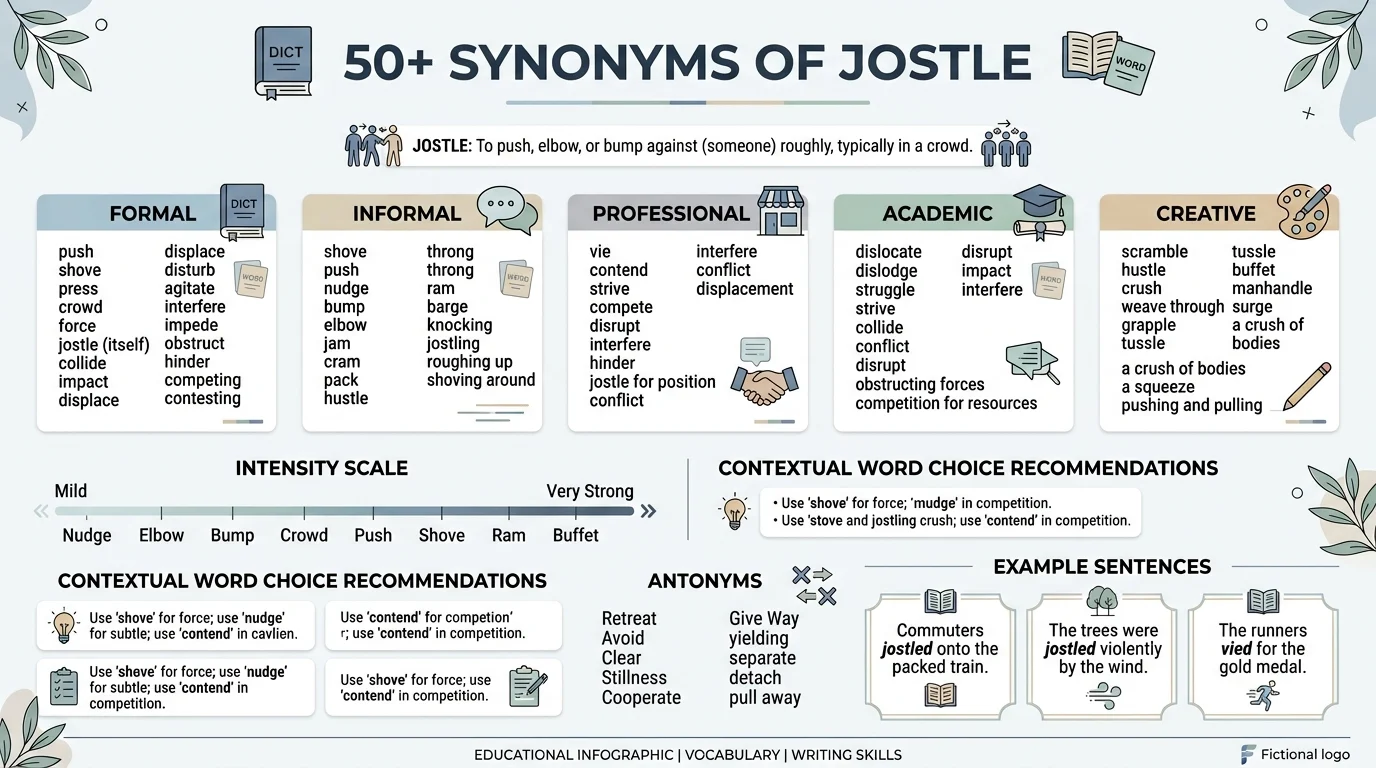
You are writing a business email about a crowded conference, and you keep using the word “push” over and over. Or perhaps you are describing a busy marketplace in a story, and every sentence sounds the same. This is where knowing the synonyms of jostle can transform your writing. Choosing the right word adds precision, tone, and clarity to your message. Whether you are a student, a professional, or a creative writer, understanding the subtle differences between similar words helps you communicate more effectively. This guide explores the meaning of jostle, provides the best synonyms for every situation, and helps you avoid common mistakes.
What Are the Best Synonyms of “Jostle”?
Jostle means to bump, push, or shove against someone, typically in a crowded space. It can also mean to compete for position or attention. The best synonyms depend on your context. Formal writing, use “elbow” or “shoulder.” For casual conversation, try “bump” or “shove.” Professional settings, “maneuver” or “position” work well. For creative writing, consider “throng” or “scramble.”
Meaning, Tone, and Context
Simple Definition
To jostle is to bump, push, or brush against someone roughly, especially in a crowd. It can also mean to compete or struggle for position, attention, or advantage.
Part of Speech
Verb (transitive and intransitive). Noun (rare, meaning the act of jostling).
Overall Tone
Neutral to slightly negative. The word implies physical contact that is unwanted or forceful but not necessarily aggressive.
Formality Level
Semi-formal to neutral. “Jostle” is appropriate in both casual conversation and more formal writing, though it is not highly academic.
Common Uses
Native English speakers use “jostle” in several ways:
- Describing physical movement in crowded places like concerts, subways, or markets.
- Describing competition for resources, attention, or power.
- Describing the chaotic interaction of people or things in close proximity.
Word Forms
- Verb: jostle, jostles, jostled, jostling
- Noun: jostle, jostling
When and How to Use “Jostle”
Choose “jostle” when you want to describe physical contact in a crowd or competition for a goal. The word works well in both literal and figurative contexts.
Here are seven realistic examples:
- Professional (Conference): “Attendees jostled for position near the stage to get a better view of the keynote speaker.”
- Academic (Research Paper): “Multiple theories jostle for dominance in the field of behavioral economics.”
- Workplace (Office): “Employees jostled in the narrow hallway, trying to reach the conference room on time.”
- Personal (Concert): “We spent the entire concert jostling with the crowd, trying to get closer to the stage.”
- Email (Informal): “The subway was so packed this morning that I got jostled the whole way to work.”
- Resume (Action Verb): “Jostled for market share by implementing a new customer retention strategy.” (Use with caution; “competed” or “vied” may be stronger.)
- Social Media (Caption): “Jostling through the festival crowds for the perfect photo.”
Best Synonyms of “Jostle”
No synonym is identical in every situation. The right word depends on your tone, audience, and purpose.
Professional Writing: Maneuver
“Maneuver” suggests strategic movement rather than chaotic pushing. It sounds more controlled and intentional.
Academic Writing: Vie
“Vie” is the best choice for academic contexts. It means to compete eagerly for something and carries a sophisticated tone.
Business Communication: Compete
“Compete” is direct and professional. It clearly communicates rivalry for customers, contracts, or market position.
Casual Conversation: Bump
“Bump” is simple, conversational, and easily understood. It lacks the intensity of “shove” or “jostle.”
Emotional Writing: Scramble
“Scramble” conveys desperation and urgency. It adds emotional weight to the action.
Creative Writing: Throng
“Throng” paints a vivid picture of a dense, moving crowd. It is more literary than “jostle.”
Resume Writing: Vie
“Vie” signals ambition and competitive drive in a professional context. It is more sophisticated than “competed.”
Workplace Communication: Shoulder
“Shoulder” suggests using one’s body to move through a crowd without being overly aggressive.
Stronger Meaning: Shove
“Shove” implies greater force and intentionality. Use it when the action is rough or aggressive.
Softer Meaning: Nudge
“Nudge” is a gentle push, often used to get someone’s attention or guide them subtly.
When Not to Use “Jostle”
When the Action Is Too Gentle
If you are describing a light touch or a gentle push, “jostle” is too strong.
- Less Effective: “She jostled me to get my attention.”
- Better: “She nudged me to get my attention.”
When the Context Is Too Formal
In highly formal or legal writing, “jostle” may sound too casual.
- Less Effective: “The defendant jostled the plaintiff.”
- Better: “The defendant pushed the plaintiff.”
When the Action Is Intentional and Aggressive
If the pushing is deliberate and hostile, “jostle” may sound too mild.
- Less Effective: “He jostled her out of anger.”
- Better: “He shoved her out of anger.”
When Describing a Slow, Orderly Movement
“Jostle” implies chaos and disorder. It does not fit orderly movement.
- Less Effective: “The line jostled forward slowly.”
- Better: “The line moved forward slowly.”
When You Need a More Specific Word
If you need to describe a specific type of movement, use a more precise verb.
- Less Effective: “He jostled through the crowd.”
- Better: “He elbowed his way through the crowd.”
Words Commonly Confused With “Jostle”
Jostle vs Push
Difference: “Push” is a general term for applying force to move something. “Jostle” implies pushing in a crowd, often with multiple contacts.
When to Use It: Use “push” for a single, deliberate act. Use “jostle” for chaotic, repeated contact in a crowd.
Example: “He pushed the door open.” vs “The crowd jostled him as he walked through.”
Jostle vs Shove
Difference: “Shove” is a rough, forceful push. “Jostle” is less aggressive and more chaotic.
When to Use It: Use “shove” when the action is violent or intentional. Use “jostle” for accidental or chaotic contact.
Example: “She shoved him against the wall.” vs “Commuters jostled each other on the crowded train.”
Jostle vs Elbow
Difference: “Elbow” specifically means to push with one’s elbow. “Jostle” is a general term for bumping or pushing.
When to Use It: Use “elbow” when you want to emphasize the use of elbows to move through a crowd.
Example: “He elbowed his way to the front of the line.”
Jostle vs Hustle
Difference: “Hustle” implies quick, energetic movement, often with a purpose. “Jostle” is more about physical contact in a crowd.
When to Use It: Use “hustle” when speed and urgency are the main ideas.
Example: “The guards hustled him out of the building.”
Jostle vs Jolt
Difference: “Jolt” means to shake or jerk suddenly. “Jostle” means to bump or push against.
When to Use It: Use “jolt” for a sudden, jarring movement, often caused by a vehicle or impact.
Example: “The train jolted to a stop.”
Best Synonyms of “Jostle” by Context
| Context | Best Synonym | Why It Works | Example |
|---|---|---|---|
| Formal writing | Vie | Sophisticated and precise for competition. | “Several candidates vied for the prestigious award.” |
| Academic writing | Contend | Suggests reasoned competition or argument. | “Scholars contend for the most accurate interpretation.” |
| Professional communication | Compete | Clear and professional. | “Our team competes for market leadership.” |
| Business emails | Maneuver | Suggests strategic positioning. | “We need to maneuver for a better position in the market.” |
| Resume writing | Vie | Signals ambition and drive. | “Vied for top sales position and exceeded targets.” |
| Workplace communication | Shoulder | Physical but not overly aggressive. | “She shouldered her way through the crowded office.” |
| Casual conversation | Bump | Simple and easy to understand. | “I bumped into someone on the subway.” |
| Everyday speaking | Push | The most common and versatile word. | “People were pushing to get on the bus.” |
| Creative writing | Throng | Vivid and literary. | “The fans thronged the stage, desperate for a glimpse.” |
| Storytelling | Scramble | Adds urgency and emotion. | “They scrambled for the last remaining tickets.” |
| Emotional writing | Struggle | Conveys effort and difficulty. | “She struggled against the crowd to reach her child.” |
| Strong emphasis | Shove | Implies force and aggression. | “He shoved his way through the protestors.” |
| Mild tone | Nudge | Gentle and subtle. | “She nudged him to get his attention.” |
| Social media captions | Jostle | Authentic and relatable for crowded events. | “Jostling through the festival crowds.” |
How to Choose the Best Synonym of “Jostle”
Choosing the right synonym depends on several factors.
Consider the meaning. Are you describing physical contact or competition? For physical contact, “bump” or “shove” may work. For competition, “vie” or “contend” are better.
Consider the tone. Is the situation neutral, negative, or positive? “Jostle” is neutral to slightly negative. If you want a more neutral word, use “push.” If you want a stronger negative, use “shove.”
Consider your audience. Are you writing for a professional, academic, or casual audience? “Vie” and “contend” suit academic and professional writing. “Bump” and “push” suit casual conversation.
Consider the emotional strength. How strong is the action? “Nudge” is mild, “jostle” is moderate, and “shove” is strong.
Consider the writing purpose. Are you telling a story, writing a report, or sending an email? Creative writing benefits from vivid words like “throng” and “scramble.” Reports benefit from precise words like “compete” and “maneuver.”
Choose the word that communicates your intended message most clearly. If you are unsure, read your sentence aloud and see which word sounds most natural.
Real Life Examples of “Jostle”
School: “Students jostled in the hallway between classes, trying to reach their lockers.”
College: “Dozens of student organizations jostled for attention during the club fair.”
Workplace: “Colleagues jostled for the best seats in the conference room.”
Business: “Startups jostle for venture capital funding in a competitive market.”
Email: “I got jostled on the train this morning and spilled my coffee.”
Resume: “Vied for key accounts and secured a 20% increase in revenue.”
Conversation: “The concert was amazing, but we got jostled around quite a bit.”
Storytelling: “The soldiers jostled for position on the battlefield, each trying to gain an advantage.”
Blogging: “Travelers jostle for space on popular beaches during peak season.”
Social Media: “Jostling through the crowd to see the main act.”
18 Best Synonyms of “Jostle”
Synonyms of “Jostle” by Usage
Professional vs Personal Synonyms
In professional settings, choose words that sound strategic and controlled, such as “maneuver,” “position,” or “vie.” In personal conversations, simpler words like “bump,” “push,” or “shove” are more natural.
Formal vs Conversational Synonyms
For formal writing, such as reports, essays, and business presentations, use “contend,” “vie,” or “compete.” For casual conversations, emails, and texting, use “push,” “bump,” or “shove.”
Academic Synonyms
Academic writing benefits from precise, sophisticated vocabulary. “Vie,” “contend,” and “compete” are all appropriate for research papers, essays, and academic discussions. They sound authoritative and demonstrate a strong command of language.
Professional and Business Synonyms
For resumes, interviews, meetings, and business emails, choose words that convey ambition and strategic thinking. “Vie,” “compete,” and “maneuver” are excellent choices. “Vie” signals that you actively pursued a goal. “Compete” is direct and professional. “Maneuver” suggests strategic positioning.
Creative and Literary Synonyms
Creative writing benefits from vivid, expressive language. “Throng,” “scramble,” and “struggle” add emotion and imagery to your descriptions. “Throng” paints a picture of a dense, moving crowd. “Scramble” conveys urgency and chaos. “Struggle” adds a sense of effort and difficulty.
Slang or Modern Synonyms
There are no widely used slang synonyms for “jostle” in modern English. The word itself is already informal enough for most casual contexts.
Strongest to Mildest Synonyms
This scale shows how emotional intensity changes across synonyms.
- Mild: Nudge, Jog, Bump
- Moderate: Push, Jostle, Crowd, Squeeze
- Strong: Shove, Thrust, Elbow, Shoulder
- Very Strong: Scramble, Struggle, Hustle
Emotional vs Neutral Synonyms
Emotional Synonyms
“Scramble,” “struggle,” and “hustle” express stronger feelings of urgency, desperation, or effort. Use them when you want to convey emotion. For example, “They scrambled for the last lifeboat” conveys desperation.
Neutral Synonyms
“Push,” “bump,” and “crowd” simply communicate information without adding emotion. Use them when you want to describe an action objectively. For example, “The crowd pushed toward the exit” is a neutral description.
Antonyms of “Jostle”
| Antonym | Meaning | Example Sentence |
|---|---|---|
| Leave alone | To refrain from touching or disturbing. | “Please leave the artwork alone.” |
| Avoid | To stay away from. | “She avoided the crowded area.” |
| Yield | To give way to others. | “He yielded to the oncoming traffic.” |
| Retreat | To move back or withdraw. | “The crowd retreated from the stage.” |
| Harmonize | To coexist peacefully. | “The two groups harmonized their efforts.” |
| Coordinate | To organize or work together. | “The teams coordinated their schedules.” |
| Assist | To help or support. | “She assisted him through the crowd.” |
| Aid | To provide help or support. | “The guide aided the tourists.” |
| Stand still | To remain in one place. | “He stood still while others moved around him.” |
| Wait | To stay in place until something happens. | “We waited patiently in line.” |
| Queue | To form a line and wait. | “The crowd queued outside the theater.” |
| Disperse | To scatter or spread out. | “The police dispersed the crowd.” |
| Withdraw | To remove oneself from a situation. | “She withdrew from the crowded room.” |
| Sidestep | To step aside or avoid. | “He sidestepped to let her pass.” |
| Give way | To yield or make room. | “The crowd gave way for the ambulance.” |
Comparison: “Jostle” vs Similar Words
Jostle vs Push
Main Difference: “Push” is a general term. “Jostle” implies contact in a crowd.
Which Is Stronger? “Jostle” is stronger because it implies multiple contacts.
Which Is More Formal? Both are neutral, but “jostle” is slightly more specific.
When to Use Each: Use “push” for a single act. Use “jostle” for chaotic crowd movement.
Examples:
- Jostle: “Commuters jostled each other on the crowded train.”
- Push: “He pushed the door open.”
Jostle vs Shove
Main Difference: “Shove” is rougher and more forceful.
Which Is Stronger? “Shove” is stronger.
Which Is More Formal? Both are informal.
When to Use Each: Use “jostle” for accidental or chaotic contact. Use “shove” for intentional, aggressive pushing.
Examples:
- Jostle: “The crowd jostled him as he walked through.”
- Shove: “She shoved him against the wall.”
Jostle vs Elbow
Main Difference: “Elbow” specifically means to push with one’s elbow.
Which Is Stronger? “Elbow” can be quite forceful.
Which Is More Formal? Both are informal.
When to Use Each: Use “elbow” when you want to emphasize the use of elbows to move through a crowd.
Examples:
- Jostle: “The crowd jostled her.”
- Elbow: “He elbowed his way to the front.”
Jostle vs Hustle
Main Difference: “Hustle” implies speed and urgency.
Which Is Stronger? “Hustle” implies more purposeful action.
Which Is More Formal? Both are informal.
When to Use Each: Use “hustle” when speed is the main idea. Use “jostle” for physical contact.
Examples:
- Jostle: “People jostled for space.”
- Hustle: “The guards hustled him out.”
Jostle vs Jolt
Main Difference: “Jolt” means a sudden shake or jerk.
Which Is Stronger? “Jolt” implies a sudden, jarring movement.
Which Is More Formal? Both are neutral.
When to Use Each: Use “jolt” for sudden movements caused by impacts or vehicles.
Examples:
- Jostle: “The crowd jostled him.”
- Jolt: “The train jolted to a stop.”
Jostle vs Scramble
Main Difference: “Scramble” implies hurried, clumsy movement.
Which Is Stronger? “Scramble” is more emotional and urgent.
Which Is More Formal? “Scramble” is informal.
When to Use Each: Use “scramble” for urgent, chaotic situations. Use “jostle” for general crowd contact.
Examples:
- Jostle: “Fans jostled for a view.”
- Scramble: “Fans scrambled for tickets.”
Common Phrases and Expressions with “Jostle”
Jostle for position
Meaning: To compete for a better physical or strategic position.
Example Sentence: “Executives jostled for position as the CEO entered the room.”
Jostle for attention
Meaning: To compete to be noticed.
Example Sentence: “Several loud voices jostled for attention in the crowded room.”
Jostle for power
Meaning: To compete aggressively for control.
Example Sentence: “The rival factions jostled for power within the organization.”
Jostle for space
Meaning: To compete for physical room.
Example Sentence: “Passengers jostled for space on the packed subway.”
Jostle one’s way
Meaning: To move forward by pushing through a crowd.
Example Sentence: “We had to jostle our way to the front of the stage.”
Common Mistakes to Avoid
1: Using “Jostle” for a Single, Gentle Push
Incorrect: “She jostled me to get my attention.”
Better: “She nudged me to get my attention.”
Why: “Jostle” implies chaotic, repeated contact, not a gentle nudge.
2: Using “Jostle” in Highly Formal Writing
Incorrect: “The defendant jostled the plaintiff.”
Better: “The defendant pushed the plaintiff.”
Why: “Jostle” sounds too casual for legal or highly formal contexts.
3: Confusing “Jostle” with “Shove”
Incorrect: “He jostled her out of anger.”
Better: “He shoved her out of anger.”
Why: “Shove” implies intentional aggression, while “jostle” implies chaotic or accidental contact.
4: Using “Jostle” for Orderly Movement
Incorrect: “The line jostled forward slowly.”
Better: “The line moved forward slowly.”
Why: “Jostle” implies disorder and chaos, not orderly movement.
5: Overusing “Jostle” in Writing
Incorrect: “The crowd jostled. People jostled. Everyone jostled.”
Better: “The crowd pushed. People scrambled. Everyone vied for space.”
Why: Repeating the same word makes writing dull. Vary your vocabulary.
6: Choosing an Overly Dramatic Synonym
Incorrect: “He struggled through the empty room.”
Better: “He walked through the empty room.”
Why: “Struggle” implies effort and difficulty, which does not fit an empty room.
7: Using Slang in Academic Writing
There is no slang for “jostle,” but using overly casual synonyms like “bump” in academic writing can weaken your tone. Choose “vie” or “contend” instead.
Frequently Asked Questions
What are the best synonyms of “jostle”?
The best synonyms depend on context. For physical contact, use “push,” “shove,” or “bump.” Competition, use “vie,” “contend,” or “compete.” For creative writing, use “throng” or “scramble.”
What are the best formal synonyms of “jostle”?
For formal writing, use “vie,” “contend,” or “compete.” These words sound sophisticated and precise, making them suitable for academic papers, reports, and professional documents.
What are common informal synonyms of “jostle”?
Common informal synonyms include “push,” “shove,” “bump,” and “elbow.” These words are simple and conversational, perfect for everyday speech, emails, and social media.
What is another word for “jostle” in professional writing?
In professional writing, use “compete,” “vie,” or “maneuver.” “Compete” is direct and clear. “Vie” adds a touch of sophistication. “Maneuver” suggests strategic positioning.
What is the difference between “jostle” and “shove”?
“Shove” is a rough, forceful push, while “jostle” implies bumping or pushing in a crowd, often chaotically. “Shove” is more aggressive and intentional.
What is the opposite of “jostle”?
The opposite of “jostle” includes “leave alone,” “avoid,” “yield,” “retreat,” and “stand still.” These words describe staying away or remaining in place rather than pushing or competing.
Conclusion
Jostle is a versatile word that describes both physical contact in a crowd and competition for position or attention. The best synonyms of jostle depend on your context, tone, and audience. Formal writing, choose “vie” or “contend.” For casual conversation, use “push” or “bump.” For creative writing, try “throng” or “scramble.” Remember that no synonym works perfectly in every situation. Choose the word that communicates your intended message most clearly. A practical tip for improving your vocabulary is to read widely and note how skilled writers use synonyms to add variety and precision to their work.
Definitions, meanings, and usage recommendations should be verified with trusted language references before publication. Recommended sources include Cambridge Dictionary, Oxford English Dictionary, Merriam-Webster, Collins Dictionary, and Britannica.