Have you ever written an email, a social media caption, or an essay where you used the word “joy” three times in two sentences? You knew the meaning was right, but the repetition made your writing feel flat and uninspired.
This happens to everyone. English learners, professional writers, and even seasoned editors fall into the habit of relying on the same familiar words. The English language offers remarkable depth, and choosing the right synonym for joy can transform your communication from ordinary to memorable.
This guide will help you master the full spectrum of words that express happiness, delight, and satisfaction. You will learn exactly which synonym fits each situation, whether you are writing a formal report, a personal note, or a creative story. Let us explore the rich vocabulary of positive emotion together.
What Does “Joy” Mean?
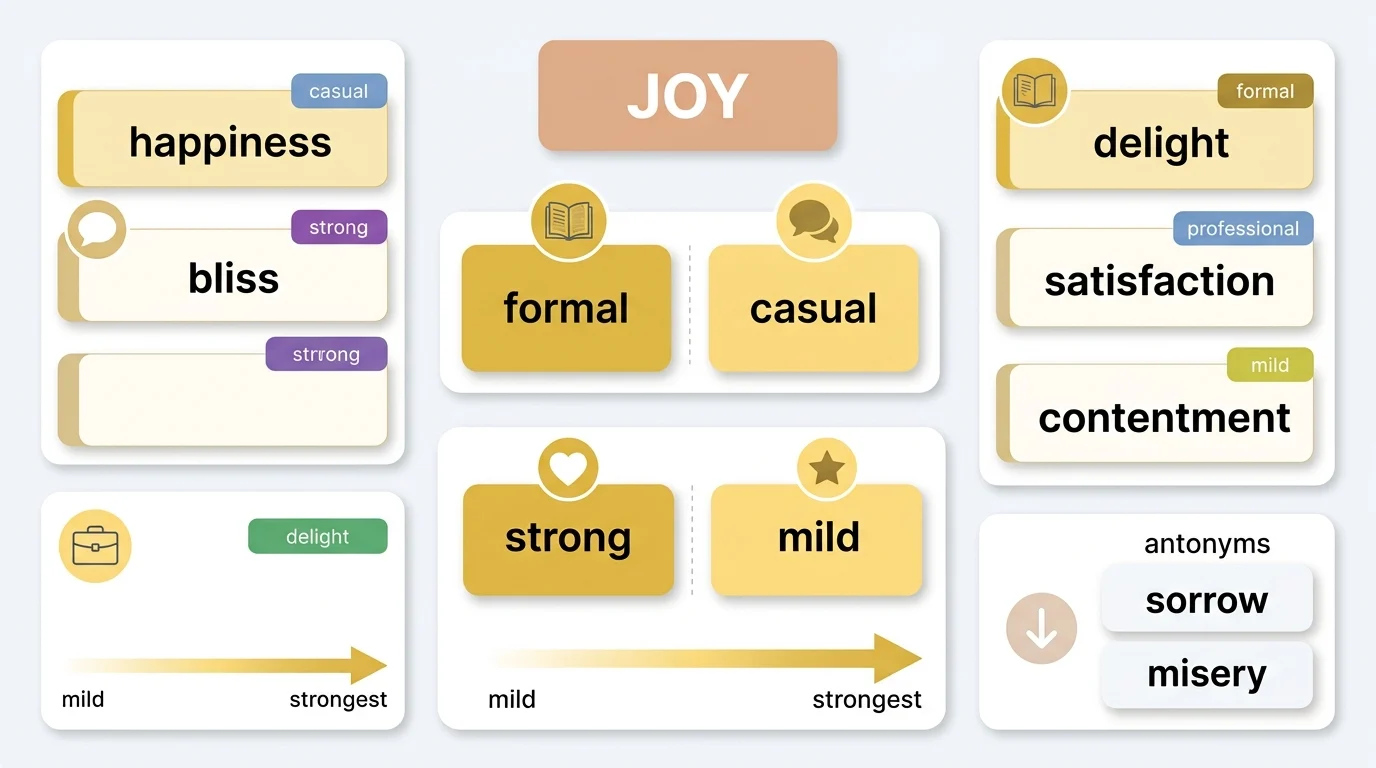
Joy is a deep feeling of happiness or pleasure that often comes from something specific like good news, a meaningful experience, or a positive outcome. The best synonyms for joy include delight, happiness, bliss, and elation. Choose delight for polite conversation, bliss for intense emotional experiences, and elation for excitement about achievements.
Meaning, Tone and Context
1. Simple Definition
Joy is a powerful emotion of great happiness and satisfaction that often feels lasting and meaningful. It goes beyond simple amusement or temporary pleasure.
2. Part of Speech
Joy functions primarily as a noun. You can feel joy, experience joy, or bring joy to others. The related adjective is joyful, and the adverb form is joyfully. The verb form is rejoice, though it appears less frequently in everyday writing.
3. Positive, Negative, or Neutral Tone
Joy carries an unmistakably positive tone. This word always signals something good, uplifting, or emotionally fulfilling. It never appears in neutral or negative contexts.
4. Formality Level
Joy sits comfortably in the middle of the formality spectrum. You can use it in casual conversation, professional emails, academic papers, and creative writing without sounding out of place.
5. Common Use Cases
Joy appears frequently in personal writing, greeting cards, social media posts, and emotional expressions. It also shows up in professional contexts when discussing workplace culture, customer satisfaction, or personal achievements.
6. Important Word Forms
The most useful forms include joyful as an adjective, joyfully as an adverb, and joyfulness as another noun form. The opposite form is joyless, which describes a lack of happiness or pleasure.
When and How to Use “Joy”
Joy works best when you want to express genuine, heartfelt happiness. It feels authentic and warm without being overly dramatic or casual. The word carries emotional weight, so reserve it for moments that truly matter.
Here are practical examples across different contexts:
Professional Context
After the project completion, the team experienced genuine joy in their shared accomplishment.
Personal Context
She felt pure joy when her daughter took her first steps across the living room.
Academic Context
The study examined the relationship between gratitude and joy in adolescent development.
Emotional Context
His unexpected visit brought such joy to her heart that she could barely speak.
Creative Writing
Joy radiated from her smile like sunlight breaking through morning clouds.
Social Media Caption
Today brought unexpected joy in the form of a handwritten letter from an old friend.
Email Context
It brings me great joy to announce that we have reached our fundraising goal for the year.
Resume Context
I find deep joy in mentoring junior colleagues and watching them grow professionally.
Another Word for “Joy”
Finding the perfect single replacement for joy depends entirely on your context. Here are the best options for specific situations:
Professional Writing
Use “satisfaction” to sound measured and workplace appropriate. This conveys positive feeling without becoming too emotional.
Academic Writing
Use “happiness” or “well being” for research papers and scholarly work. These terms feel precise and objective.
Casual Conversation
Use “delight” for friendly, natural communication. It sounds warm without being excessive.
Emotional Writing
Use “bliss” for intense, overwhelming happiness. This word captures the deepest emotional experiences.
Creative Writing
Use “rapture” to add literary depth and emotional intensity. It works beautifully in poetry and descriptive prose.
Resume or Workplace Use
Use “fulfillment” to express professional satisfaction. This suggests lasting meaning rather than temporary excitement.
Social Media Captions
Use “glee” for a playful, lighthearted tone that feels fresh and contemporary.
Stronger Meaning
Use “ecstasy” when you need to express extreme, overwhelming happiness that feels almost physical.
Softer Meaning
Use “contentment” when you want to describe a calm, peaceful form of happiness without high intensity.
When Not to Use “Joy”
Joy loses its power when you use it for every positive experience. Consider these situations where a more precise synonym improves your writing.
When the emotion is too mild
Using joy for minor pleasures like enjoying a good cup of coffee sounds exaggerated. Choose “pleasure” or “enjoyment” instead.
When the tone should be neutral
Describing routine business outcomes as joyful can feel unprofessional. Use “positive outcome” or “satisfactory result” for workplace updates.
When the feeling is temporary
Joy suggests lasting emotional significance. For fleeting moments, use “happiness” or “amusement.”
When you need to sound objective
Academic writing about general well being may call for “positive affect” or “emotional satisfaction” rather than joy.
Compare these sentences:
Weak: “The meeting ended with joy when we finished early.”
Better: “The meeting ended with satisfaction when we finished early.”
Words Commonly Confused With “Joy”
Many positive emotion words overlap with joy, but each has distinct qualities. Understanding these differences will make your writing more precise.
Joy vs. Happiness
Happiness is broader and often describes a general state of well being. Joy tends to feel more intense and connected to specific moments or experiences. You might be happy with your life overall, but you feel joy when your child wins an award.
Joy vs. Delight
Delight often comes from unexpected pleasures or charming surprises. Joy carries more emotional weight and depth. A thoughtful gift might bring delight, while a life changing achievement brings joy.
Joy vs. Contentment
Contentment feels calm and peaceful, lacking the emotional peak of joy. You feel content when everything is comfortable and secure. You feel joy when something extraordinary happens.
Joy vs. Ecstasy
Ecstasy represents the most extreme level of happiness, often overwhelming and almost physical. feels deeper and more lasting than ecstasy, which can be fleeting.
Joy vs. Glee
Glee has a playful, almost mischievous quality. It suggests lighthearted pleasure rather than deep emotional fulfillment. Glee fits casual situations, while joy fits meaningful ones.
Joy vs. Bliss
Bliss suggests perfect happiness, often associated with spiritual or profound experiences. Joy feels more accessible and everyday. You can experience joy in ordinary moments, but bliss feels extraordinary.
Best Synonym by Context for “Joy”
| Context | Best Synonym | Why It Works | Example |
|---|---|---|---|
| Formal Writing | Happiness | Sounds objective and appropriate for serious documents | The research measured overall happiness among participants |
| Academic Writing | Well being | Precise and professional for scholarly work | Positive emotions contribute to overall well being |
| Professional Use | Satisfaction | Measured and workplace friendly | Employee satisfaction improved after the policy change |
| Resume | Fulfillment | Suggests lasting professional meaning | Teaching provides deep fulfillment in my career |
| Casual Conversation | Delight | Warm and natural without being excessive | What a delight to see you at the party |
| Creative Writing | Rapture | Adds literary depth and emotional power | He stood in rapture before the beautiful painting |
| Emotional Tone | Bliss | Captures profound, overwhelming happiness | Their wedding day was absolute bliss |
| Strong Intensity | Elation | Perfect for achievements and special news | Elation filled the room when they won the championship |
| Soft or Moderate | Contentment | Calm and peaceful without high intensity | She found contentment in her simple daily routine |
| Social Media | Glee | Playful and fresh for modern platforms | Watching the puppy play brought me such glee |
| Deep Emotion | Exhilaration | Conveys exciting, energizing happiness | The mountain climb brought exhilaration and pride |
Which Synonym Should You Choose?
Choosing the right synonym for joy starts with understanding your writing purpose and audience. Follow this practical decision guide.
Start with emotional intensity
Ask yourself how strong the feeling really is. Mild pleasure calls for pleasure or enjoyment. Deep fulfillment calls for joy or bliss. Extreme excitement calls for elation or ecstasy.
Consider your audience
Professional documents need measured language like satisfaction or fulfillment. Personal writing allows emotional words like bliss or rapture. Academic writing requires objective terms like well being or positive affect.
Match the formality level
Formal contexts like reports and speeches work best with satisfaction and happiness. Casual contexts like texts and social media allow glee and delight. Creative writing opens the door to rapture and ecstasy.
Check the duration
Lasting emotional states work with joy and contentment. Brief moments work with delight and pleasure. Intense peaks work with elation and exhilaration.
Avoid repetition
If you already used joy once in a paragraph, choose a synonym with a slightly different shade of meaning. This keeps your writing fresh and engaging.
Real Life Examples of “Joy” in Sentences
Academic Setting
The students expressed pure joy when the professor announced the field trip to the science museum.
Workplace Communication
Her promotion brought joy to the entire department, as everyone recognized her hard work.
Creative Writing
Joy danced in her eyes as she watched the sunset paint the sky in brilliant colors.
Personal Conversation
I cannot describe the joy I felt when I finally held my published book in my hands.
Social Media Post
Finding this hidden café in the middle of the city was an unexpected joy on a rainy afternoon.
Professional Email
It gives me great joy to welcome our new team members to the company.
Storytelling Context
The old man’s joy was evident in his laughter as his grandchildren gathered around him.
Resume or Cover Letter
I approach my work with genuine joy and enthusiasm for solving complex challenges.
25 Synonyms for “Joy”
| Synonym | Simple Meaning | Best Used For | Example Sentence |
|---|---|---|---|
| Happiness | General state of well being | All contexts, especially everyday use | Her happiness was contagious to everyone around her |
| Delight | Pleasure from something pleasing | Casual and polite conversation | The children’s delight at the puppy was unmistakable |
| Bliss | Perfect, complete happiness | Deep emotional experiences | Their honeymoon was pure bliss on a tropical island |
| Elation | Excited happiness | Achievements and exciting news | Elation spread through the crowd when the team won |
| Ecstasy | Overwhelming happiness | Very intense emotional moments | He listened to the symphony in ecstasy |
| Euphoria | Intense happiness and excitement | Temporary but powerful experiences | Euphoria followed her acceptance to graduate school |
| Exhilaration | Exciting, energizing happiness | Adventures and thrilling moments | The roller coaster brought pure exhilaration |
| Rapture | Great joy and pleasure | Creative and literary writing | The painting filled him with rapture |
| Glee | Playful, lighthearted joy | Social media and casual writing | She clapped her hands with glee at the surprise |
| Contentment | Peaceful, calm satisfaction | Quiet and stable happiness | Retirement brought him a sense of contentment |
| Fulfillment | Satisfaction from achievement | Professional and personal growth | She found fulfillment in her volunteer work |
| Satisfaction | Pleasure from meeting expectations | Workplace and daily situations | Customer satisfaction improved after the changes |
| Enjoyment | Pleasure from an activity | Mild and casual situations | The movie provided hours of enjoyment |
| Pleasure | General positive feeling | Everyday pleasant experiences | Reading brings me simple pleasure |
| Cheer | Bright, optimistic happiness | Uplifting and encouraging contexts | His cheer lifted the spirits of the whole team |
| Gladness | Simple, straightforward happiness | Clear and direct expression | I felt gladness at the news of their engagement |
| Glee | Playful happiness | Light, fun situations | The child’s glee was obvious as she opened her gift |
| Cheerfulness | Consistently positive mood | Describing personality or atmosphere | Her cheerfulness made her a favorite colleague |
| Joyfulness | Active, visible happiness | When joy is clearly shown | The joyfulness of the celebration was unforgettable |
| Jubilation | Celebratory happiness | Major achievements and events | Jubilation filled the streets after the victory |
| Exultation | Triumphant happiness | Victory and success | His exultation was clear after winning the prize |
| Gratification | Satisfaction from effort | Achievement and reward | Teaching brought her deep gratification |
| Rejoicing | Happiness expressed openly | Celebrations and gatherings | The whole town joined in the rejoicing |
| Sprightliness | Lively, cheerful energy | Describing personality | Her sprightliness made every meeting more enjoyable |
| Buoyancy | Light, optimistic happiness | Describing mood or spirit | His buoyancy kept everyone optimistic during tough times |
Synonym Groups and Usage Differences
Professional vs. Personal Synonyms
Professional writing benefits from words like satisfaction, fulfillment, and gratification. These terms sound measured and appropriate for workplace communication. Personal writing allows deeper emotional words like bliss, rapture, and elation. Choose satisfaction for performance reviews and bliss for personal journaling.
Formal vs. Conversational Synonyms
Formal contexts like academic papers, speeches, and business reports call for happiness, well being, and satisfaction. Conversational contexts allow delight, glee, and pleasure. You can use enjoyment in both settings, making it a versatile choice.
Academic Synonyms
Academic writing requires precise, objective language. Well being appears frequently in research papers. Positive affect serves as a clinical term in psychology studies. Life satisfaction works well for social science research. These words sound professional while maintaining academic rigor.
Professional and Business Synonyms
Workplace communication favors satisfaction, fulfillment, and gratification. These words suggest emotional reward without becoming unprofessional. Satisfaction works for customer feedback. Fulfillment suits career development discussions. Gratification fits project completion and goal achievement.
Creative or Literary Synonyms
Creative writing thrives on vivid, emotional words. Rapture adds dramatic depth. Exultation captures triumphant moments. Jubilation brings celebratory energy. Ecstasy conveys overwhelming emotion. These words paint pictures and evoke feelings in readers.
Slang or Modern Synonyms
Slang synonyms for joy change quickly with culture. “Stoked” appears in casual conversation among younger speakers. “Lit” describes exciting experiences. These words work for social media and casual texts. They remain inappropriate for professional or academic writing.
Strongest vs. Weaker Synonyms
Mild to Strong Intensity Scale
Mild: Enjoyment, pleasure, satisfaction
Moderate: Happiness, contentment, delight
Strong: Elation, exhilaration, jubilation
Extreme: Ecstasy, rapture, euphoria
Deep: Bliss, fulfillment, joy
Emotional vs. Neutral Synonyms
Emotionally Charged Synonyms
Joy, bliss, rapture, ecstasy, elation, euphoria, jubilation
Neutral or Factual Synonyms
Satisfaction, well being, positive affect, life satisfaction, gratification
Emotionally charged words add warmth and depth to personal writing. Neutral words fit objective descriptions and professional documents.
Antonyms of “Joy”
| Antonym | Meaning | Example Sentence |
|---|---|---|
| Sorrow | Deep sadness or grief | Sorrow filled her heart after the loss of her friend |
| Misery | Extreme unhappiness and suffering | The family lived in misery during the difficult winter |
| Despair | Complete loss of hope | He fell into despair when he lost his job |
| Grief | Deep emotional pain from loss | Grief overwhelmed the community after the tragedy |
| Melancholy | Sadness without a clear cause | A feeling of melancholy settled over him on rainy days |
| Anguish | Severe physical or emotional pain | She cried out in anguish at the terrible news |
| Distress | Anxiety or suffering | The news caused her great distress |
| Unhappiness | General state of being unhappy | His unhappiness affected his relationships |
| Gloom | Darkness and sadness | Gloom filled the room on the anniversary of the accident |
| Heartache | Emotional pain from disappointment | Heartache followed the end of their relationship |
| Depression | Persistent sadness and loss of interest | The doctor helped her manage her depression |
| Woe | Great sorrow or distress | Tales of woe poured from the disaster survivors |
| Sullenness | Gloomy, bad-tempered silence | His sullenness made conversation difficult |
| Dejection | Low spirits and sadness | Dejection showed in his slumped shoulders |
| Dismay | Sudden disappointment or concern | Dismay spread across her face at the news |
Comparison: Joy vs. Similar Words
Joy vs. Happiness
Main Difference
Happiness describes a general state of well being. Joy refers to specific moments of deep emotional fulfillment.
Which One Is Stronger
Joy carries more emotional weight and intensity than happiness.
Which One Is More Formal
Happiness appears more frequently in formal writing and academic research.
Example for Joy
Joy filled her heart when she saw her newborn child for the first time.
Example for Happiness
Regular exercise contributes to overall happiness and well being.
Joy vs. Delight
Main Difference
Delight comes from unexpected or charming pleasures. Joy comes from meaningful, significant experiences.
Which One Is More Formal
Joy works in both formal and informal contexts. Delight leans slightly more toward casual use.
Which One Is More Emotional
Joy feels deeper and more lasting. Delight feels lighter and more momentary.
Example for Joy
She experienced profound joy at her graduation ceremony.
Example for Delight
The children’s delight at the magician’s tricks was obvious.
Joy vs. Elation
Main Difference
Elation involves excitement and triumph. Joy feels warmer and more personal.
Which One Is Stronger
Elation feels more intense in the moment. Joy feels more enduring.
Which One Is More Formal
Joy fits most contexts. Elation appears more in creative and descriptive writing.
Example for Joy
The family reunion brought joy to everyone who attended.
Example for Elation
Elation swept through the stadium when the team scored the winning goal.
Joy vs. Bliss
Main Difference
Bliss suggests perfect happiness without any negative elements. Joy acknowledges happiness that exists alongside life’s challenges.
Which One Is More Formal
Joy is the more standard choice for most writing. Bliss leans more toward creative and emotional expression.
Which One Is More Emotional
Bliss represents an even deeper emotional state than joy.
Example for Joy
She found joy in her daily routine despite its challenges.
Example for Bliss
The couple enjoyed bliss during their peaceful weekend retreat.
Joy vs. Contentment
Main Difference
Contentment is calm and peaceful. Joy is active and emotionally engaged.
Which One Is More Formal
Contentment works well in formal writing. Joy works across all contexts.
Which One Is More Emotional
Joy carries stronger emotional energy. Contentment feels quieter.
Example for Joy
He radiated joy as he accepted the community service award.
Example for Contentment
She felt contentment as she sipped tea by the fireplace.
Joy vs. Exhilaration
Main Difference
Exhilaration comes from exciting, thrilling experiences. Joy comes from meaningful, fulfilling experiences.
Which One Is More Formal
Joy is the safer choice for formal contexts. Exhilaration fits creative writing.
Which One Is More Physical
Exhilaration often involves physical excitement. Joy is more emotional and spiritual.
Example for Joy
His speech brought joy to everyone who heard his inspiring message.
Example for Exhilaration
The skydiving experience filled her with exhilaration and pride.
Common Phrases and Expressions with “Joy”
1. Jump for Joy
Meaning
To express extreme happiness through physical excitement.
Example Sentence
The children jumped for joy when their parents announced the trip to the beach.
2. My Heart Filled with Joy
Meaning
To experience deep emotional happiness.
Example Sentence
My heart filled with joy when I saw the surprise party my friends had planned.
3. Pure Joy
Meaning
Happiness that is completely genuine and free from doubt.
Example Sentence
The puppy’s excitement was pure joy to watch.
4. Joy to Behold
Meaning
Something beautiful or admirable that brings happiness.
Example Sentence
The sunset over the mountains was a joy to behold.
5. Share Someone’s Joy
Meaning
To feel happy about another person’s good fortune.
Example Sentence
We all shared her joy when she announced her engagement.
6. Bring Joy
Meaning
To make someone happy through actions or presence.
Example Sentence
His kind words brought joy to everyone who heard them.
7. Tears of Joy
Meaning
Crying caused by extreme happiness.
Example Sentence
She shed tears of joy when she received the surprise gift.
8. Source of Joy
Meaning
Something that consistently provides happiness.
Example Sentence
Her grandchildren were the greatest source of joy in her retirement.
Common Mistakes to Avoid
1. Using Joy for Minor Experiences
Reserve joy for meaningful moments. Simple pleasures deserve words like enjoyment or pleasure. Save joy for experiences that genuinely move you emotionally.
2. Confusing Joy with Other Positive Emotions
Understanding the differences between joy, happiness, and elation will make your writing more accurate. Each word carries unique meaning and emotional weight.
3. Using Casual Synonyms in Formal Writing
Words like glee and bliss feel too casual for business reports and academic papers. Choose satisfaction, fulfillment, or happiness for professional contexts.
4. Using Overly Dramatic Synonyms for Simple Situations
Describing a good meal as ecstasy sounds exaggerated and loses credibility. Match your synonym intensity to the actual experience.
5. Repeating the Same Word Too Often
Repeating joy multiple times in a single paragraph creates monotony. Use synonyms to vary your language and maintain reader interest.
6. Choosing a Synonym with the Wrong Emotional Tone
Some synonyms sound positive but carry different emotional shades. Glee feels playful, while rapture feels serious. Pick the one that fits your intended mood.
7. Using Slang in Academic or Professional Writing
Words like stoked or lit have no place in formal documents. Reserve casual language for personal conversations and social media.
FAQs
1. What is the best synonym for joy?
Delight works as the most versatile synonym for joy across most everyday situations. Bliss fits emotional experiences, and satisfaction suits professional contexts.
2. What is a formal synonym for joy?
Happiness and satisfaction serve as formal synonyms for joy in academic and professional writing. Well being also works for formal research contexts.
3. What is an informal synonym for joy?
Glee and pleasure are informal synonyms for joy that work well in casual conversation and social media captions.
4. What is another word for joy in professional writing?
Satisfaction and fulfillment are the best synonyms for joy in professional writing. They sound measured and appropriate for workplace communication.
5. What is the difference between joy and happiness?
Joy describes specific deep moments of happiness, while happiness refers to a general state of well being. Happiness is broader, and joy is more intense.
6. What is the opposite of joy?
Sorrow serves as the most direct opposite of joy. Other opposites include misery, grief, despair, melancholy, and unhappiness.
Conclusion
Joy represents one of the most meaningful emotions in human experience. It goes beyond simple amusement or temporary pleasure to describe something deeper and more lasting. Understanding the many synonyms for joy allows you to express this powerful emotion with precision and impact.
The right word depends entirely on your context. Professional writing calls for satisfaction and fulfillment. Personal writing welcomes bliss and rapture. Academic work favors happiness and well being. Creative writing thrives on jubilation and exhilaration. Casual conversation embraces glee and delight.
Remember that word choice shapes how your message lands. A thoughtful synonym can turn an ordinary sentence into something memorable. It can convey exactly the right shade of meaning and emotional intensity. It can show your audience that you understand both language and human experience.
Before you publish any important writing, always verify definitions using trusted sources like Cambridge, Oxford, Merriam Webster, Collins, or Britannica. This ensures accuracy and builds credibility with your readers.
The English language gives you remarkable tools. Use them wisely. Choose words that fit your situation. Match your tone to your audience. And never be afraid to explore the beautiful range of expression that synonyms provide.