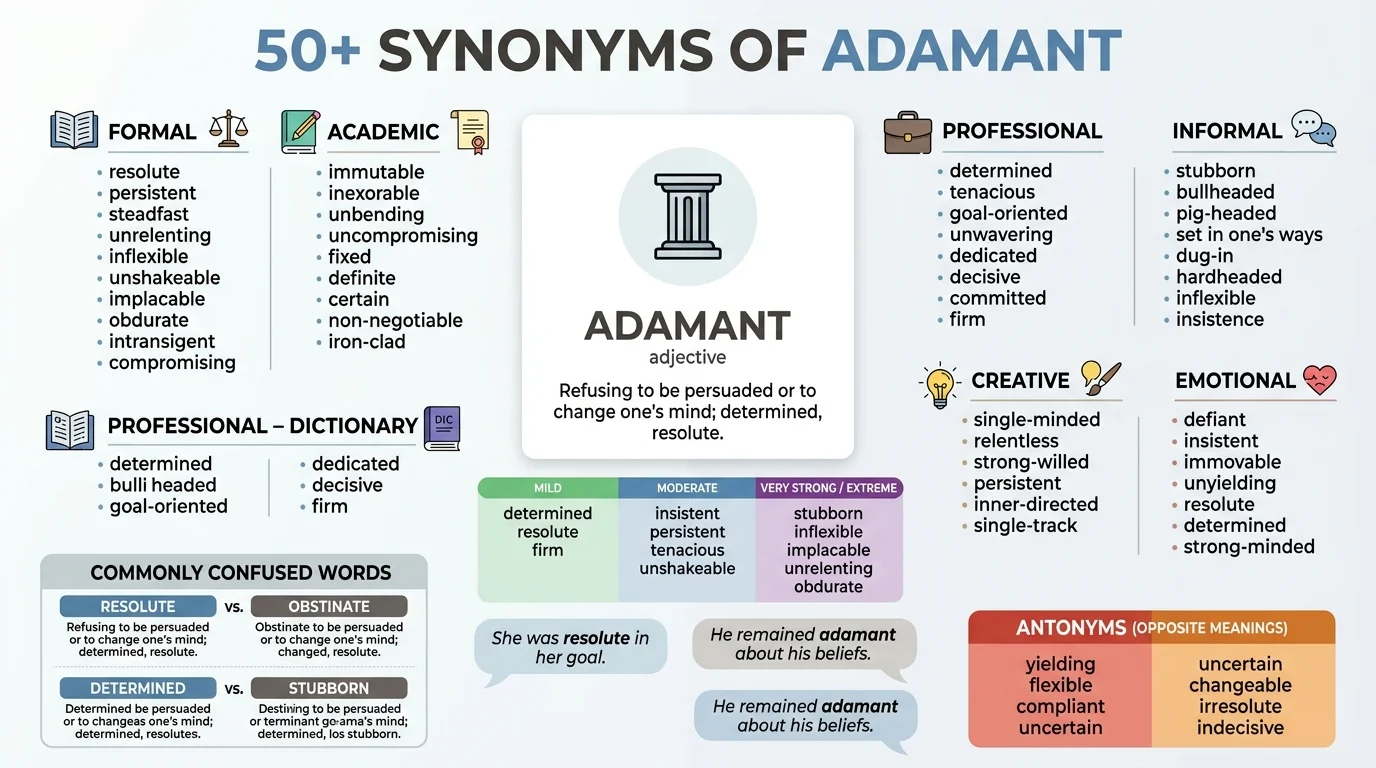
Have you ever found yourself writing an email, an essay, or a social media post and realized you have used the word “adamant” three times in two paragraphs? You know what you want to say, but repeating the same word makes your writing feel flat and uninspired. Finding the right synonyms of adamant can transform your communication, making it clearer, more precise, and more engaging. Whether you are a student working on an assignment, a professional drafting a business email, or a content creator looking for variety, understanding the subtle differences between synonyms helps you choose the perfect word for every situation. This guide will help you master the vocabulary of determination and firmness so you can communicate with confidence.
What Are the Best Synonyms of “Adamant”?
Adamant means refusing to change your mind or be persuaded, showing unyielding determination. Formal writing, choose unyielding or intransigent. Casual conversation, stubborn or dead set work well. For professional contexts, resolute and uncompromising are excellent choices. For academic writing, inexorable and obdurate add authority. Emotional emphasis, steadfast and unwavering convey deep conviction.
Meaning, Tone, and Context
Simple Definition
Adamant describes someone who is determined not to change their opinion or decision, no matter what anyone says or does. When you are adamant about something, you stand firm and refuse to be persuaded.
Part of Speech
Adamant is primarily used as an adjective. It can also function as a noun referring to an extremely hard substance, though this usage is rare in modern English.
Overall Tone
Adamant is neutral in tone but carries a sense of strength and conviction. It does not necessarily imply negativity, though it can depending on context.
Formality Level
Adamant is semi-formal to formal. It appears frequently in news reporting, professional writing, and academic contexts, but it is also used in everyday conversation.
Common Uses
Native English speakers use adamant to describe:
- Refusals that cannot be overcome
- Strongly held beliefs or positions
- Decisions that will not change
- Stances in negotiations or debates
- Personal convictions about important matters
Word Forms
| Form | Word | Example |
|---|---|---|
| Adjective | adamant | She was adamant about her decision. |
| Adverb | adamantly | He adamantly refused to compromise. |
| Noun (rare) | adamant | The stone was as hard as adamant. |
| Related adjective | adamantine | Her adamantine will could not be broken. |
When and How to Use “Adamant”
Choose “adamant” when you want to emphasize that someone will not change their position, especially after facing persuasion or pressure. Use it to describe stances that are firm, resolute, and unwavering.
Professional Context
The CEO remained adamant that the merger would proceed despite shareholder concerns.
Academic Context
The researcher was adamant that the data supported her hypothesis, rejecting all counterarguments.
Workplace Communication
Our team leader is adamant about meeting the deadline, even if we have to work overtime.
Personal Context
My mother was adamant that we attend the family reunion, and nobody dared to argue.
Email Writing
I am adamant that we maintain quality standards, so please review all deliverables before submission.
Resume Writing
Adamant about delivering results, I consistently exceeded sales targets by 20 percent.
Social Media
I am adamant that everyone deserves access to quality education, and I will keep fighting for it.
Best Synonyms of “Adamant”
No synonym is identical to another in every situation. The best choice depends on your audience, purpose, and the emotional tone you want to convey.
Professional Writing: Uncompromising
This synonym suggests firmness with a sense of integrity and high standards. It works well in business contexts where quality or principles are at stake.
Academic Writing: Inexorable
This word carries a sense of inevitability and is excellent for research papers or scholarly discussions. It suggests that something cannot be stopped or altered.
Business Communication: Resolute
Resolute implies determination with purpose and clarity. It sounds professional and confident without being harsh.
Casual Conversation: Dead Set
This informal phrase means completely determined. It is natural in everyday speech and conveys strong commitment in a relaxed way.
Emotional Writing: Steadfast
Steadfast suggests loyalty and unwavering support. It adds warmth and emotional depth to descriptions of personal convictions.
Creative Writing: Adamantine
This literary synonym connects to the word’s origin and suggests hardness like diamond. It adds poetic flair to descriptive writing.
Resume Writing: Unwavering
Unwavering suggests reliability and consistency. It is an excellent choice for describing work ethic or dedication.
Workplace Communication: Firm
Firm is direct and clear without being aggressive. It works well in team settings where clarity matters.
Stronger Meaning: Intransigent
This word suggests extreme refusal to compromise, often with a negative connotation. Use it when describing particularly rigid positions.
Softer Meaning: Determined
Determined is a milder, more positive alternative. It suggests motivation and purpose rather than stubbornness.
When Not to Use “Adamant”
When the Word Sounds Too Strong
If the situation does not require extreme firmness, adamant can sound overly dramatic.
Incorrect: I am adamant about ordering pizza for lunch.
Better: I am set on ordering pizza for lunch.
Why: Lunch preferences do not require the intensity of adamant.
When the Word Sounds Too Formal
In casual texts or friendly conversations, adamant can feel stiff and out of place.
Incorrect: I am adamant that this movie is the best.
Better: I am absolutely sure this movie is the best.
Why: Casual settings call for more relaxed language.
When the Word Sounds Too Negative
Adamant can imply stubbornness or inflexibility. If you want to sound positive and motivated, choose a milder synonym.
Incorrect: She was adamant about finishing the project, which annoyed her team.
Better: She was determined to finish the project, which inspired her team.
Why: Determined carries a positive, motivating tone.
When You Need to Sound Open-Minded
Using adamant suggests you will not change your mind. If you want to appear flexible or collaborative, avoid it.
Incorrect: I am adamant that my approach is the only way.
Better: I strongly believe my approach is effective, but I am open to other ideas.
Why: The revised version shows confidence without closing the door to collaboration.
Words Commonly Confused With “Adamant”
Adamant vs Stubborn
Difference: Adamant describes a firm position on a specific issue. Stubborn describes a personality trait that shows up repeatedly.
When to Use It: Use adamant for specific situations. Use stubborn for describing someone’s general character.
Example: She was adamant about not attending the meeting. He is a stubborn person who never changes his mind.
Adamant vs Determined
Difference: Determined suggests motivation and purpose. Adamant suggests resistance to persuasion.
When to Use It: Use determined when focusing on goals and effort. Use adamant when focusing on refusal to change.
Example: She was determined to succeed. She was adamant that she would not compromise her values.
Adamant vs Resolute
Difference: Resolute implies firmness with clarity and purpose. Adamant emphasizes resistance to outside pressure.
When to Use It: Use resolute in leadership and professional contexts. Use adamant when describing stances against opposition.
Example: The leader remained resolute in her vision. The negotiator was adamant about the terms.
Adamant vs Inflexible
Difference: Inflexible suggests an inability to adapt. Adamant suggests a choice to stand firm.
When to Use It: Use inflexible for rules, systems, or people who cannot bend. Use adamant for people who choose not to bend.
Example: The company’s inflexible policies frustrated employees. The manager was adamant about maintaining quality.
Adamant vs Obdurate
Difference: Obdurate suggests hardness of heart and insensitivity. Adamant suggests firm conviction without the same emotional coldness.
When to Use It: Use obdurate for particularly harsh or unfeeling refusals. Use adamant for firm but not necessarily cold positions.
Example: The obdurate judge showed no mercy. The parent was adamant about curfew rules.
Adamant vs Unyielding
Difference: Unyielding describes something that does not give way physically or metaphorically. Adamant specifically applies to opinions and decisions.
When to Use It: Use unyielding for both physical and metaphorical firmness. Use adamant specifically for mental or positional firmness.
Example: The unyielding rock face defeated the climbers. She was adamant in her refusal.
Best Synonyms of “Adamant” by Context
| Context | Best Synonym | Why It Works | Example |
|---|---|---|---|
| Formal writing | Unyielding | Sounds authoritative and precise | The committee remained unyielding in its decision. |
| Academic writing | Inexorable | Suggests inevitability and scholarly weight | The inexorable logic of the argument convinced everyone. |
| Professional communication | Resolute | Conveys confidence and purpose | The manager remained resolute despite the challenges. |
| Business emails | Uncompromising | Emphasizes standards and integrity | We are uncompromising about product quality. |
| Resume writing | Unwavering | Suggests reliability and consistency | Unwavering commitment to excellence defined my career. |
| Workplace communication | Firm | Direct, clear, and professional | The supervisor was firm about the deadline. |
| Casual conversation | Dead set | Natural and relaxed in everyday speech | I am dead set on going to that concert. |
| Everyday speaking | Determined | Positive and widely understood | She is determined to finish this today. |
| Creative writing | Adamantine | Poetic and rich with literary imagery | Her adamantine will could not be shaken. |
| Storytelling | Steadfast | Suggests loyalty and emotional strength | The steadfast knight never abandoned his quest. |
| Emotional writing | Unwavering | Conveys deep, unchanging conviction | His unwavering love gave her strength. |
| Strong emphasis | Intransigent | Extremely firm, often with negative tone | The intransigent dictator refused all negotiations. |
| Mild tone | Set | Gentle and understated | I am set on my decision. |
| Social media captions | Strong-willed | Relatable and engaging | Strong-willed and proud of it. |
| American English | Stubborn | Widely used and easily understood | He is too stubborn to admit he is wrong. |
How to Choose the Best Synonym of “Adamant”
Consider Your Meaning
Ask yourself: Are you describing a refusal, a commitment, a personality trait, or a position? Choose a synonym that matches your specific meaning.
Consider Your Audience
For professional audiences, choose resolute, unyielding, or uncompromising. For friends and family, choose determined, set, or stubborn.
Consider Your Tone
For a positive tone, choose determined, resolute, or steadfast. For a negative tone, choose stubborn, obstinate, or intransigent.
Consider Emotional Strength
For mild emphasis, choose set or firm.Moderate emphasis, choose determined or unyielding. For strong emphasis, choose intransigent or obdurate.
Consider Your Purpose
For inspiring others, choose resolute or steadfast. Describing a conflict, choose intransigent or uncompromising. For describing personal goals, choose determined or unwavering.
Choose What Sounds Natural
Read your sentence aloud. Does the synonym fit the rhythm and flow? If it sounds forced or awkward, try a different word.
Real Life Examples of “Adamant”
School
The student was adamant that she had completed the assignment on time, even though the teacher could not find it.
College
The professor remained adamant that plagiarism would not be tolerated, no matter the circumstances.
Workplace
My boss is adamant that all reports must be submitted by Friday afternoon.
Business
The investors were adamant about seeing a clear return on investment before committing more funds.
I want to be adamant about this point: customer satisfaction must come before all other considerations.
Resume
Adamant about professional growth, I pursued additional certifications and training every year.
Conversation
“I am adamant that we should take the scenic route,” she said, crossing her arms.
Storytelling
The general was adamant that his troops would hold the line, and they did.
Blogging
I am adamant that sustainable living is not just a trend but a necessity for our future.
Social Media
Adamant that kindness matters more than being right. Choose compassion every time.
Improved with stronger synonyms:
Instead of: The manager was adamant about the new policy.
Try: The manager was unyielding about the new policy.
Instead of: She was adamant that she would not change her mind.
Try: She was intransigent in her refusal to change her mind.
Instead of: He was adamant about his beliefs.
Try: He was steadfast in his beliefs.
18 Best Synonyms of “Adamant”
| Synonym | Simple Meaning | Best Used For | Example Sentence |
|---|---|---|---|
| Unyielding | Not giving way under pressure | Formal writing and professional contexts | The negotiator remained unyielding on the core terms. |
| Resolute | Firm and determined with purpose | Leadership and professional communication | She was resolute in her decision to start her own business. |
| Uncompromising | Refusing to lower standards or accept less | Business and quality-focused contexts | The chef was uncompromising about using only fresh ingredients. |
| Intransigent | Extreme refusal to compromise | Describing rigid positions or conflicts | The intransigent politician refused all bipartisan efforts. |
| Inflexible | Unable or unwilling to bend or adapt | Rules, systems, or rigid people | The inflexible schedule left no room for emergencies. |
| Steadfast | Loyal, unwavering, and emotionally strong | Personal relationships and emotional writing | Her steadfast support never wavered through difficult times. |
| Unwavering | Not changing or faltering | Resume writing and professional dedication | His unwavering focus on quality earned him a promotion. |
| Obdurate | Hardhearted and unfeeling in refusal | Negative contexts and harsh refusals | The obdurate landlord refused to make any repairs. |
| Inexorable | Impossible to stop or prevent | Academic writing and inevitable processes | The inexorable march of technology changed everything. |
| Unbending | Rigid and not flexible in attitude | Describing strict positions | The judge was unbending in his interpretation of the law. |
| Determined | Having a firm purpose and motivation | Everyday conversation and positive contexts | She was determined to finish the marathon. |
| Firm | Strong and steady in position | Workplace and professional communication | The manager was firm about the new policy. |
| Fixed | Settled and not subject to change | Describing unchangeable opinions | His fixed ideas made collaboration difficult. |
| Immovable | Cannot be moved or changed | Strong emphasis and dramatic contexts | His position on the matter was immovable. |
| Stubborn | Refusing to change despite reason | Casual conversation, sometimes negative | He is too stubborn to ask for directions. |
| Obstinate | Stubbornly refusing to change | Negative contexts and criticism | Her obstinate refusal to listen frustrated everyone. |
| Adamantine | Having the hardness of diamond | Creative and literary writing | Her adamantine resolve inspired the entire team. |
| Strong-willed | Having a strong and determined character | Resume writing and personal descriptions | A strong-willed leader who never backs down from challenges. |
Synonyms of “Adamant” by Usage
Professional vs Personal Synonyms
Professional synonyms include resolute, unyielding, uncompromising, and unwavering. These words sound confident and authoritative in business settings.
Personal synonyms include stubborn, dead set, determined, and strong-willed. These words feel natural in conversations with friends and family.
Formal vs Conversational Synonyms
Formal synonyms suitable for reports, essays, and business writing include inexorable, intransigent, obdurate, and adamantine. These words add weight and sophistication to formal documents.
Conversational synonyms for texting and casual talks include dead set, stuck on, determined, and set. These words keep communication relaxed and approachable.
Academic Synonyms
For research papers and scholarly discussions, choose inexorable, intransigent, or unyielding. These words convey authority and precision. Inexorable works well for describing forces or trends that cannot be stopped. Intransigent fits descriptions of ideological positions.
Professional and Business Synonyms
For resumes, interviews, and client communication, choose resolute, unwavering, or uncompromising. Resolute suggests confident leadership. Unwavering implies reliability and consistency. Uncompromising communicates high standards and integrity.
Creative and Literary Synonyms
For storytelling and descriptive writing, choose adamantine, steadfast, or immovable. Adamantine connects to the word’s diamond origins and adds poetic flair. Steadfast suggests loyalty and emotional depth. Immovable creates powerful visual imagery.
Slang or Modern Synonyms
Adamant does not have widely used slang equivalents. The informal phrase dead set is the closest casual alternative. Avoid using slang synonyms in professional or academic writing.
Strongest to Mildest Synonyms
Mild → Moderate → Strong → Very Strong
| Intensity | Synonyms |
|---|---|
| Mild | Set, firm, determined |
| Moderate | Resolute, unwavering, steadfast |
| Strong | Unyielding, uncompromising, inflexible |
| Very Strong | Intransigent, obdurate, inexorable |
The mildest synonyms suggest purpose and motivation. The strongest synonyms suggest absolute refusal that cannot be overcome by any force or argument.
Emotional vs Neutral Synonyms
Emotional Synonyms
These words express stronger feelings and personal conviction:
- Steadfast suggests loyalty and emotional commitment
- Unwavering implies deep, unchanging belief
- Adamantine carries poetic and dramatic weight
- Strong-willed suggests character and determination
Use emotional synonyms in personal writing, storytelling, and when describing deeply held values.
Neutral Synonyms
These words communicate information without adding strong emotion:
- Unyielding describes firmness objectively
- Resolute suggests purpose without sentiment
- Firm is direct and unemotional
- Fixed describes a settled position
Use neutral synonyms in professional reports, academic papers, and objective descriptions.
Antonyms of “Adamant”
| Antonym | Meaning | Example Sentence |
|---|---|---|
| Flexible | Willing to change or adapt | The flexible manager adjusted the schedule to help everyone. |
| Yielding | Giving way under pressure | The yielding negotiator accepted the compromise. |
| Compliant | Willing to follow rules or requests | The compliant employee followed every instruction. |
| Persuadable | Open to being convinced | She was persuadable and changed her mind after hearing the evidence. |
| Accommodating | Willing to help or adjust | The accommodating host changed the menu to suit her guests. |
| Easygoing | Relaxed and not easily upset | His easygoing nature made him popular with everyone. |
| Pliant | Easily bent or influenced | The pliant committee accepted the proposal without debate. |
| Receptive | Open to new ideas | The receptive audience welcomed the new concept. |
| Submissive | Yielding to authority | The submissive employee never questioned decisions. |
| Tractable | Easily managed or controlled | The tractable students followed every instruction. |
| Wavering | Showing doubt or indecision | His wavering commitment worried the team. |
| Indecisive | Unable to make decisions | The indecisive leader could not choose a direction. |
| Compromising | Willing to meet halfway | The compromising couple found a solution that worked for both. |
| Open-minded | Willing to consider new ideas | The open-minded professor encouraged diverse viewpoints. |
| Adaptable | Able to change as needed | The adaptable team thrived in the changing market. |
Comparison: “Adamant” vs Similar Words
Adamant vs Stubborn
Main Difference: Adamant describes a firm position on a specific issue. Stubborn describes a personality trait that appears repeatedly.
Which Is Stronger? Adamant is often stronger in the moment because it suggests active resistance to persuasion. Stubborn can be weaker if it describes a habitual but passive resistance.
Which Is More Formal? Adamant is more formal. Stubborn is conversational.
When to Use Each: Use adamant for specific refusals or positions. Use stubborn for describing someone’s general character.
Examples:
- Adamant: She was adamant that she would not sign the contract.
- Stubborn: He is too stubborn to admit when he is wrong.
Adamant vs Determined
Main Difference: Determined focuses on goals and motivation. Adamant focuses on refusal to change.
Which Is Stronger? Adamant is stronger in terms of resistance. Determined is stronger in terms of positive motivation.
Which Is More Formal? Both are semi-formal, but adamant appears more often in formal writing.
When to Use Each: Use determined when describing effort toward a goal. Use adamant when describing a position that will not change.
Examples:
- Determined: She was determined to finish the project on time.
- Adamant: She was adamant that the project would be finished on time.
Adamant vs Resolute
Main Difference: Resolute implies clarity and purpose. Adamant emphasizes resistance to pressure.
Which Is Stronger? Both are strong. Resolute sounds more positive and purposeful.
Which Is More Formal? Resolute is slightly more formal and often appears in leadership contexts.
When to Use Each: Use resolute in professional and leadership contexts. Use adamant when describing stances against opposition.
Examples:
- Resolute: The leader remained resolute in her vision for the company.
- Adamant: The negotiator was adamant about the non-negotiable terms.
Adamant vs Inflexible
Main Difference: Inflexible suggests an inability to adapt. Adamant suggests a choice to stand firm.
Which Is Stronger? Inflexible can be stronger because it suggests a fundamental inability to change.
Which Is More Formal? Both are formal. Inflexible is often used for rules and systems.
When to Use Each: Use inflexible for rules, systems, or people who cannot bend. Use adamant for people who choose not to bend.
Examples:
- Inflexible: The company’s inflexible policies frustrated employees.
- Adamant: The manager was adamant about maintaining quality.
Adamant vs Obdurate
Main Difference: Obdurate suggests hardness of heart and insensitivity. Adamant suggests firm conviction without coldness.
Which Is Stronger? Obdurate is stronger and more negative.
Which Is More Formal? Both are formal. Obdurate is more literary and less common.
When to Use Each: Use obdurate for harsh, unfeeling refusals. Use adamant for firm but not cold positions.
Examples:
- Obdurate: The obdurate judge showed no mercy.
- Adamant: The parent was adamant about curfew rules.
Adamant vs Unyielding
Main Difference: Unyielding applies to physical and metaphorical firmness. Adamant applies specifically to opinions and decisions.
Which Is Stronger? Both are equally strong. Unyielding can suggest more physical or absolute resistance.
Which Is More Formal? Both are formal. Unyielding is slightly more versatile.
When to Use Each: Use unyielding for both physical and metaphorical firmness. Use adamant specifically for mental or positional firmness.
Examples:
- Unyielding: The unyielding rock face defeated the climbers.
- Adamant: She was adamant in her refusal.
Common Phrases and Expressions with “Adamant”
Adamant about something
Meaning: Firmly determined or refusing to change regarding a specific topic.
Example Sentence: She is adamant about keeping her private life out of the public eye.
Remain adamant
Meaning: Continue to be firm and unwilling to change.
Example Sentence: The government remained adamant that no more funding was available.
Adamant refusal
Meaning: A refusal that is absolute and will not be reconsidered.
Example Sentence: His adamant refusal to compromise ended the negotiations.
Adamant stance
Meaning: A position or opinion that is firmly held and defended.
Example Sentence: The senator took an adamant stance against the proposed legislation.
Adamant that
Meaning: Followed by a clause expressing what someone firmly believes or insists.
Example Sentence: She was adamant that she had followed all the instructions correctly.
Adamant in one’s belief
Meaning: Holding a belief that cannot be shaken.
Example Sentence: He remained adamant in his belief that honesty is always the best policy.
Common Mistakes to Avoid
1: Choosing a Vague Synonym Instead of a Precise One
Incorrect: She was hard about her decision.
Better: She was adamant about her decision.
Why: “Hard” is too vague. “Adamant” clearly communicates unyielding determination.
2: Confusing Adamant with Stubborn
Incorrect: He is an adamant person.
Better: He is a stubborn person. OR He was adamant about that particular issue.
Why: Adamant describes specific positions, not personality traits.
3: Using an Informal Synonym in Formal Writing
Incorrect: The committee was dead set against the proposal.
Better: The committee was adamantly opposed to the proposal.
Why: “Dead set” is too casual for formal reports and academic papers.
4: Selecting an Overly Dramatic Synonym
Incorrect: I am intransigent about ordering coffee instead of tea.
Better: I am set on ordering coffee instead of tea.
Why: “Intransigent” is too strong for minor preferences.
5: Repeating the Same Word Too Often
Incorrect: She was adamant. The team was adamant. The manager was adamant.
Better: She was adamant. The team was resolute. The manager was unwavering.
Why: Varying synonyms keeps writing fresh and engaging.
6: Choosing a Synonym with the Wrong Emotional Tone
Incorrect: Her stubborn commitment inspired the team.
Better: Her steadfast commitment inspired the team.
Why: “Stubborn” has a negative tone. “Steadfast” has a positive, inspiring tone.
7: Using Slang in Academic or Professional Writing
Incorrect: The researcher was dead set on her hypothesis.
Better: The researcher was unwavering in her hypothesis.
Why: Slang undermines credibility in academic and professional contexts.
Frequently Asked Questions
1. What are the best synonyms of “adamant”?
The best synonyms depend on context. Formal writing, use unyielding or resolute. For casual conversation, use stubborn or determined.Professional contexts, use uncompromising or unwavering. For academic writing, use inexorable or intransigent.
2. What are the best formal synonyms of “adamant”?
The best formal synonyms are unyielding, resolute, uncompromising, intransigent, and inexorable. These words appear in academic papers, business reports, and professional correspondence.
3. What are common informal synonyms of “adamant”?
Common informal synonyms include stubborn, dead set, determined, and set. These words work well in everyday conversation, text messages, and casual writing.
4. What is another word for “adamant” in professional writing?
In professional writing, choose resolute, unyielding, or unwavering. These words convey confidence, reliability, and high standards without sounding aggressive or negative.
5. What is the difference between “adamant” and “stubborn”?
Adamant describes a firm position on a specific issue. Stubborn describes a personality trait that appears repeatedly. You can be adamant about one thing without being a stubborn person overall.
6. What is the opposite of “adamant”?
The opposite of adamant is flexible, yielding, or compliant. These words describe people who are willing to change their minds, adapt, or compromise.
Conclusion
Adamant is a powerful word that describes unyielding determination and refusal to change. Whether you choose resolute for professional contexts, steadfast for emotional writing, or stubborn for casual conversation, the right synonym depends on your audience, tone, and purpose. No synonym works perfectly in every situation, so consider your meaning, the emotional strength you want to convey, and the formality level required. The best vocabulary choice is the one that communicates your message most clearly and naturally. Next time you reach for “adamant,” pause and ask yourself which synonym of adamant will serve your purpose best. Your readers will notice the difference.