Do you find yourself repeating the word “enjoy” too often in your writing or conversations? Whether you are drafting an email, crafting a social media caption, or writing an essay, using the same word repeatedly can make your language feel dull and uninspired.
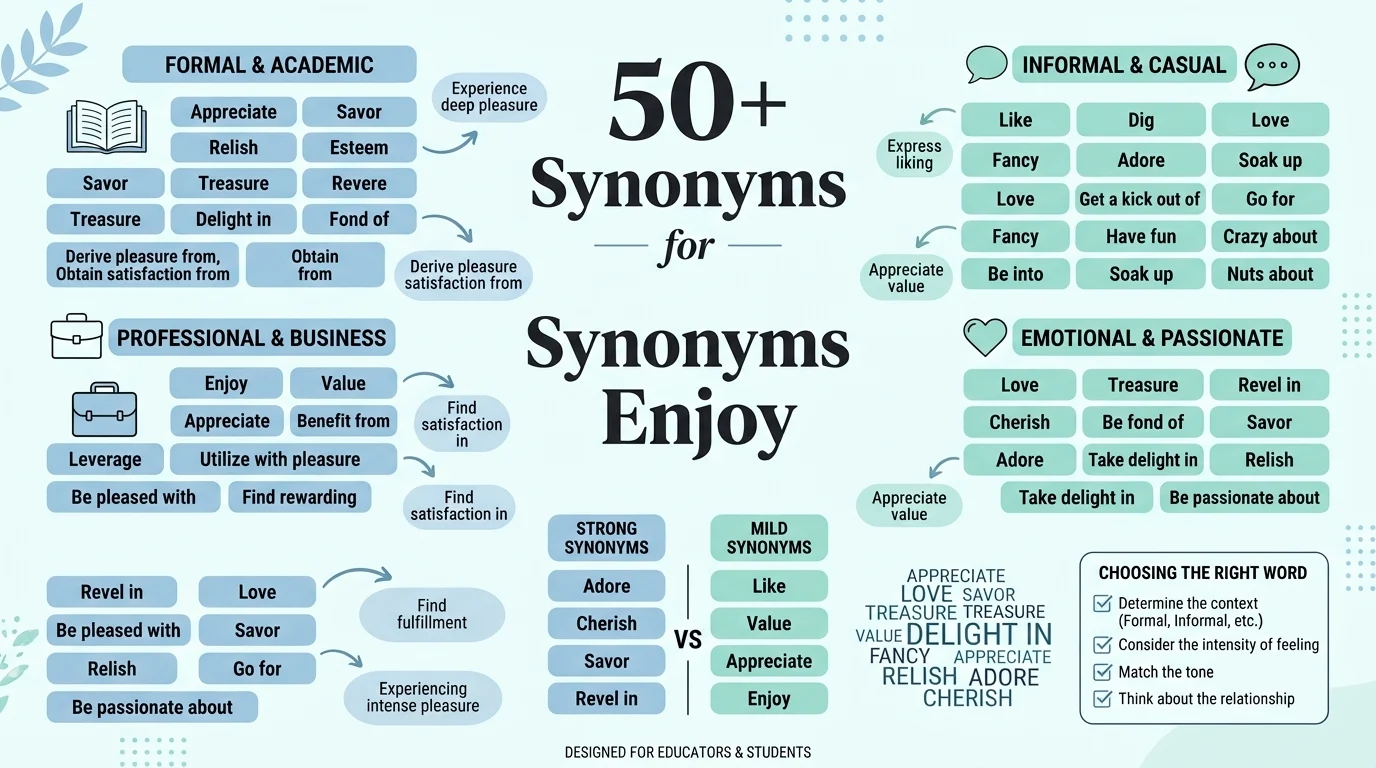
A richer vocabulary helps you express exactly what you mean, and it makes your communication more engaging. This guide explores over 50 synonyms for enjoy, breaking them down by context, tone, and intensity. You will learn exactly which word to use when you want to sound more professional, more emotional, or simply more precise.
What Does “Enjoy” Mean?
The word “enjoy” means to take pleasure or satisfaction in an activity, experience, or possession. For formal situations, choose “appreciate” or “value.” For casual settings, “love” or “like” work well.
Professional writing, use “benefit from” or “find fulfillment in.” For emotional depth, select “relish” or “savor.” For creative expression, consider “delight in” or “glory in.”
Meaning, Tone and Context
The primary meaning of “enjoy” centers on experiencing pleasure, satisfaction, or happiness from something. It is a positive word that conveys a sense of contentment and approval.
Part of Speech: Verb
Tone: Positive
Formality Level: Neutral to slightly informal. This word works in most situations but may feel too casual in highly formal writing.
Common Use Cases:
- Expressing likes and preferences
- Describing pleasant experiences
- Talking about hobbies and interests
- Giving feedback about food, entertainment, or events
- Discussing activities that bring happiness
Important Word Forms:
- Adjective: enjoyable
- Noun: enjoyment
- Adverb: enjoyably
- Opposite: dislike, hate, detest
When and How to Use “Enjoy”
The word “enjoy” is versatile and works well in many everyday situations. Use it when you want to express that you get pleasure from something. It fits naturally in personal conversations, casual emails, and informal writing. You can also use it professionally when the tone is friendly and approachable. For best results, pair it with specific details about what you are enjoying.
Professional Example:
I hope you enjoy the new marketing strategy presentation.
Personal Example:
My grandmother really enjoys her morning walks in the park.
Academic Example:
Students who enjoy reading tend to perform better on comprehension tests.
Emotional Example:
I truly enjoyed every moment we spent together at the beach.
Creative Example:
She enjoys the way sunlight filters through the leaves in autumn.
Social Media Caption Example:
Enjoying a quiet sunrise before the city wakes up.
Resume Example:
I enjoy collaborating with cross functional teams to solve complex problems.
Another Word for “Enjoy”
Finding the perfect replacement depends entirely on your situation. Here are the best single word alternatives organized by context.
Professional Writing: Appreciate. This sounds polished and respectful.
Academic Writing: Value. This implies considered judgment and importance.
Casual Conversation: Love. This feels warm and natural among friends.
Emotional Writing: Cherish. This shows deep affection and care.
Creative Writing: Savor. This adds sensory richness to your description.
Resume or Workplace: Thrive on. This conveys energy and enthusiasm for work.
Social Media Captions: Obsessed with. This matches the casual, expressive style of social platforms.
Stronger Meaning: Adore. This communicates intense pleasure.
Softer Meaning: Like. This expresses mild approval without strong emotion.
When Not to Use “Enjoy”
Avoid using “enjoy” when you want to communicate specific professional feedback or when the situation demands more precise language. The word is too general for performance reviews or detailed project evaluations. It also sounds vague in academic writing where you need to show analytical thinking. Relying on “enjoy” in these contexts can make your writing feel unsophisticated.
Weak Sentence:
I enjoyed the quarterly report.
Improved Sentence:
I found the quarterly report insightful and well organized.
Weak Sentence:
She enjoys working on this project.
Improved Sentence:
She finds this project intellectually stimulating and professionally rewarding.
Words Commonly Confused With “Enjoy”
Many words are similar to “enjoy” but carry distinct meanings. Understanding these differences helps you choose the right word every time.
Enjoy vs. Like
“Enjoy” implies active participation and genuine pleasure. “Like” is broader and can mean simple approval without deep engagement. You can like an idea but enjoy the experience of implementing it.
Enjoy vs. Love
“Love” expresses much stronger emotion than “enjoy.” You enjoy a good meal, but you love your family. Use “love” when the feeling is intense and personal.
Enjoy vs. Appreciate
“Appreciate” carries more formality and implies recognition of value. You appreciate someone’s effort, but you enjoy the result of that effort.
Enjoy vs. Delight
“Delight” suggests a higher level of pleasure and often involves surprise or unexpected joy. You enjoy a movie, but you delight in a surprise birthday party.
Enjoy vs. Savor
“Savor” emphasizes slow, mindful enjoyment. You enjoy a meal, but you savor each bite of an exquisite dessert.
Enjoy vs. Cherish
“Cherish” implies deep emotional attachment and long term appreciation. You enjoy a friendship, but you cherish your oldest friends.
Best Synonym by Context for “Enjoy”
| Context | Best Synonym | Why It Works | Example |
|---|---|---|---|
| Formal Writing | Appreciate | Adds sophistication and respect | We appreciate the opportunity to present our findings. |
| Academic Writing | Value | Shows analytical thought | Researchers value the contributions of peer review. |
| Professional or Business | Benefit from | Emphasizes practical outcomes | Employees benefit from flexible work arrangements. |
| Resume | Excel at | Highlights competence and satisfaction | I excel at building strong client relationships. |
| Casual Conversation | Love | Feels natural and friendly | I love trying new restaurants. |
| Creative Writing | Delight in | Adds imagery and sensory detail | She delights in the simple beauty of a blooming garden. |
| Emotional Tone | Savor | Conveys deep, mindful pleasure | He savored every word of her letter. |
| Strong Intensity | Adore | Shows powerful positive emotion | I absolutely adore spending time with my nieces. |
| Soft or Moderate Tone | Like | Expresses mild approval without overstatement | I like how you organized the conference agenda. |
| Social Media Captions | Relish | Adds energy and personality | Relishing every moment of this summer adventure. |
| US Usage | Enjoy | Standard American English | Enjoy your holiday weekend. |
| UK Usage | Fancy | British informal expression | Do you fancy going for a walk? |
Which Synonym Should You Choose?
Selecting the right synonym depends on several factors. First, consider your audience. Formal settings like business reports require words like “appreciate” or “value.” Casual conversations allow for “love” or “like.” Second, think about intensity. Are you feeling mild approval or deep passion? Choose “like” for mild feelings and “adore” for intense ones.
Third, evaluate the context. Professional emails need professional language. Social media captions can be more playful and expressive. Finally, consider the specific activity. You savor experiences, relish moments, and cherish relationships. Match your synonym to what exactly you are enjoying.
Real Life Examples of “Enjoy” in Sentences
School Setting:
She enjoys studying history because it helps her understand the present.
Workplace Setting:
Our team enjoys the collaborative atmosphere in our new office space.
Writing Practice:
I enjoy revising my drafts because each edit makes the writing stronger.
Conversation:
Do you enjoy hiking in the mountains, or do you prefer the beach?
Social Media:
Enjoying a peaceful afternoon with good books and strong coffee.
Resume:
I enjoy analyzing data to uncover meaningful business insights.
Email Communication:
I hope you enjoy the attached proposal we prepared for your team.
Storytelling:
The children enjoyed the magical tales their grandfather told them by the fire.
25 Synonyms for “Enjoy”
| Synonym | Simple Meaning | Best Used For | Example Sentence |
|---|---|---|---|
| Appreciate | To recognize and value | Formal and professional communication | I appreciate your thoughtful feedback on my presentation. |
| Relish | To take great pleasure | Emphasizing enthusiastic enjoyment | She relishes the challenge of solving difficult puzzles. |
| Savor | To enjoy slowly and mindfully | Sensory experiences and intimate moments | He savored the quiet morning with his coffee. |
| Delight in | To find great joy | Creative and descriptive writing | The children delight in building sandcastles at the beach. |
| Love | To feel strong affection | Casual and emotional expression | I love the way this song makes me feel. |
| Like | To feel approval or interest | Mild, neutral expressions | I like the new design of your website. |
| Adore | To love intensely | Strong emotional expression | She adores spending time with her grandchildren. |
| Treasure | To hold as valuable | Relationships and meaningful experiences | I treasure the memories we created during our trip. |
| Prize | To value highly | Formal and professional contexts | Our company prizes innovation and creative thinking. |
| Cherish | To care for deeply | Emotional and heartfelt writing | I cherish every moment we share together. |
| Glorify | To express high praise | Creative and religious contexts | The poet glorified the beauty of nature. |
| Rejoice in | To feel joyful celebration | Strong, happy occasions | We rejoice in the success of our community project. |
| Fancy | To feel a liking for | British casual conversation | Do you fancy watching the game tonight? |
| Dig | To enjoy or approve | Modern, casual slang | I really dig the vibe of this coffee shop. |
| Be into | To be interested in | Modern conversational English | She is really into photography these days. |
| Have a blast | To have great fun | Celebratory and recreational activities | We had a blast at the music festival. |
| Thrill at | To experience excitement | Describing stimulating experiences | He thrills at the prospect of traveling to new places. |
| Revel in | To take unrestrained pleasure | Emphasizing delight without reservation | The actors reveled in the standing ovation. |
| Take pleasure in | To find happiness | Formal and reflective writing | I take pleasure in helping others achieve their goals. |
| Be fond of | To have a liking for | Gentle, affectionate expression | She is fond of the little café on the corner. |
| Have a weakness for | To enjoy despite knowing better | Personal and relatable sharing | I have a weakness for dark chocolate. |
| Get a kick out of | To find amusement or fun | Casual and playful contexts | I get a kick out of watching funny animal videos. |
| Take to | To develop a liking for | Describing new interests | He took to gardening during his retirement. |
| Bask in | To enjoy warmth or attention | Emotional and descriptive writing | She basked in the glow of her team’s achievement. |
| Be gratified by | To feel satisfaction | Professional and formal acknowledgment | We are gratified by the positive response. |
Synonym Groups and Usage Differences
Professional vs. Personal Synonyms
Professional situations call for words that sound polished and respectful. Use “appreciate” and “value” when communicating with colleagues or clients. These words show you are thoughtful and professional. Personal situations allow for warmer language. Use “love” and “adore” with friends and family. “Cherish” works well for expressing deep personal feelings.
Formal vs. Conversational Synonyms
Formal writing demands precision and sophistication. Words like “appreciate,” “value,” and “take pleasure in” fit reports, essays, and official documents. These choices show careful consideration. Conversational English embraces simpler, more direct words. “Love,” “like,” and “enjoy” work naturally in everyday talk. “Savor” adds a nice touch to more thoughtful conversations.
Academic Synonyms
Academic writing requires words that show analytical thinking and precision. “Value” demonstrates that you are making a considered judgment. “Take pleasure in” sounds appropriately formal for research papers. “Find fulfillment in” works well for discussing personal motivation in academic contexts. Avoid casual words like “love” or “dig” in scholarly work.
Professional and Business Synonyms
Workplace communication benefits from words that sound competent and positive. “Benefit from” emphasizes practical professional gains. “Thrive on” shows energy and enthusiasm. “Excel at” highlights your strengths and satisfaction. “Appreciate” works well in emails and meetings. These choices help you sound engaged and professional.
Creative or Literary Synonyms
Creative writing thrives on vivid, evocative language. “Delight in” adds charm to descriptions. “Revel in” creates a sense of abandon and joy. “Savor” brings sensory richness to your prose. “Bask in” suggests warmth and comfort. These words paint pictures and stir emotions in your readers.
Slang or Modern Synonyms
Modern language offers playful alternatives that work in casual settings. “Dig” evokes vintage cool. “Be into” sounds contemporary and natural. “Get a kick out of” is fun and expressive. “Have a blast” captures joyful celebration. Use these with friends and on social media. Avoid them in professional or academic writing.
Strongest vs. Weaker Synonyms
Strongest Intensity Scale from Mild to Strong:
- Like – mild approval
- Enjoy – general pleasure
- Love – strong positive emotion
- Adore – intense affection
- Cherish – deep emotional value
- Rejoice in – ecstatic celebration
Emotional vs. Neutral Synonyms
Emotional synonyms add warmth and feeling to your language. “Adore,” “cherish,” and “revel in” convey strong sentiment. These words touch the heart and create connection. Neutral synonyms stay factual and measured. “Appreciate,” “value,” and “benefit from” communicate satisfaction without strong emotion. Choose emotional words for personal writing. Choose neutral words for professional and academic contexts.
Antonyms of “Enjoy”
| Antonym | Meaning | Example Sentence |
|---|---|---|
| Dislike | To not find pleasure in something | I dislike waiting in long lines. |
| Hate | To feel intense aversion | She hates the sound of construction noise. |
| Detest | To strongly dislike | He detests dishonest people. |
| Abhor | To regard with disgust | They abhor acts of cruelty. |
| Loathe | To feel intense hatred | I loathe the taste of bitter melon. |
| Despise | To look down on with contempt | She despises careless mistakes. |
| Dread | To fear or anticipate with anxiety | He dreads public speaking. |
| Shun | To deliberately avoid | Some people shun large social gatherings. |
| Scorn | To reject with contempt | He scorns modern art as meaningless. |
| Repudiate | To reject strongly | The community repudiated the unfair policy. |
| Eschew | To deliberately avoid | Many athletes eschew unhealthy foods. |
| Recoil from | To shrink back in aversion | She recoils from the thought of failure. |
| Resist | To oppose or push back against | He resists new technology changes. |
| Object to | To express dislike or opposition | I object to the company’s new dress code. |
| Bemoan | To complain about | Students often bemoan difficult assignments. |
Comparison: Enjoy vs. Similar Words
Enjoy vs. Appreciate
“Enjoy” focuses on personal pleasure and satisfaction. “Appreciate” emphasizes recognizing value and showing gratitude. “Enjoy” is more personal. “Appreciate” is more formal. Example: I enjoy this book. I appreciate your help.
Enjoy vs. Like
“Enjoy” implies active engagement and real pleasure. “Like” is broader and can mean simple approval. “Enjoy” feels more involved. “Like” feels more casual. Example: I enjoy playing the piano. I like your new haircut.
Enjoy vs. Love
“Love” conveys much stronger emotional intensity than “enjoy.” “Enjoy” suits everyday experiences. “Love” fits deeply important people and things. “Enjoy” is safe for casual contexts. “Love” is reserved for strong feelings. Example: I enjoy this band. I love my children.
Enjoy vs. Savor
“Savor” involves mindful, slow enjoyment. “Enjoy” is more general and immediate. “Savor” adds richness and depth. “Enjoy” works for all experiences. “Savor” works best for sensory pleasures. Example: I enjoy my morning coffee. I savor each sip.
Enjoy vs. Cherish
“Cherish” implies deep emotional attachment and long term appreciation. “Enjoy” is more fleeting and casual. “Cherish” shows lasting value. “Enjoy” shows present moment pleasure. Example: I enjoy this new phone. I cherish my grandmother’s locket.
Enjoy vs. Delight
“Delight” suggests surprise and a higher level of pleasure. “Enjoy” is more steady and predictable. “Delight” adds an element of unexpected joy. “Enjoy” is reliable and consistent. Example: I enjoy going to the park. I delight in finding a rare bird.
Common Phrases and Expressions with “Enjoy”
1. Enjoy yourself
Meaning: A wish for someone to have a good time.
Example sentence: I hope you enjoy yourself at the party tonight.
2. Enjoy the fruits of your labor
Meaning: To benefit from your hard work.
Example sentence: After years of building the business, she finally enjoyed the fruits of her labor.
3. Enjoy the ride
Meaning: To appreciate a process or experience as it happens.
Example sentence: Life changes fast, so try to enjoy the ride.
4. Enjoy each other’s company
Meaning: To appreciate being together.
Example sentence: They enjoy each other’s company during their weekly book club meetings.
5. Enjoy your meal
Meaning: A polite phrase said before eating.
Example sentence: The waiter said, “Enjoy your meal” as he placed the plates on the table.
6. Enjoy the moment
Meaning: To stay present and appreciate what is happening now.
Example sentence: Stop worrying about tomorrow and just enjoy the moment.
7. Enjoy the great outdoors
Meaning: To appreciate nature and outdoor activities.
Example sentence: Our family loves to hike and enjoy the great outdoors on weekends.
8. Enjoy your stay
Meaning: A welcome wish for visitors.
Example sentence: The hotel staff wished us to enjoy our stay in the city.
Common Mistakes to Avoid
1. Using “enjoy” when a more precise synonym is better.
Instead of saying “I enjoyed the report,” say “I found the report insightful and well structured.” This adds specific value to your feedback.
2. Confusing “enjoy” with “like.”
“Enjoy” implies active participation and deeper pleasure. “Like” is more passive. Use “enjoy” for experiences you actively engage in. Use “like” for simple approval.
3. Using a casual synonym in formal writing.
Avoid “love” or “dig” in formal contexts. Instead, choose “appreciate” or “value” to maintain professionalism.
4. Using an overly dramatic synonym for a simple situation.
Reserve “adore” and “cherish” for things that truly matter. For ordinary experiences, stick with “enjoy” or “like.”
5. Repeating the same word too often.
Vary your vocabulary. Use this guide to choose fresh alternatives that fit your context and meaning.
6. Choosing a synonym with the wrong emotional tone.
“Relish” shows enthusiastic enjoyment. “Like” shows mild approval. Match your emotional intensity to the situation.
7. Using slang in academic or professional writing.
Avoid “dig,” “be into,” and “get a kick out of” in formal work. These expressions are too casual for serious contexts.
FAQs
1. What is the best synonym for enjoy?
The best synonym depends on your context. For formal writing, use “appreciate.” Casual conversation, use “love.” For emotional depth, use “cherish.”
2. What is a formal synonym for enjoy?
The most formal synonyms include “appreciate,” “value,” and “take pleasure in.” These work well in professional and academic contexts.
3. What is an informal synonym for enjoy?
Informal synonyms include “love,” “like,” “dig,” and “be into.” These feel natural in casual conversation and social media.
4. What is another word for enjoy in professional writing?
Professional writers often choose “appreciate,” “benefit from,” or “thrive on.” These words sound polished and workplace appropriate.
5. What is the difference between enjoy and appreciate?
“Enjoy” focuses on personal pleasure and satisfaction. “Appreciate” emphasizes recognizing value and showing gratitude. “Appreciate” is more formal.
6. What is the opposite of enjoy?
Common antonyms include “dislike,” “hate,” “detest,” “abhor,” and “loathe.” Choose based on the intensity of your negative feeling.
Conclusion
The word “enjoy” is a solid, reliable verb that communicates pleasure and satisfaction. Its real power comes from knowing when to use it and when to choose a more precise alternative. A rich vocabulary lets you express exactly what you mean with the right tone and intensity. For professional settings, lean on “appreciate” and “value.” Personal moments, “love” and “cherish” add warmth. For creative writing, “savor” and “delight in” bring your descriptions to life. Remember that context, audience, and emotional intensity should guide your word choice. Start practicing with the synonyms in this guide. Your writing and speaking will become more engaging, expressive, and effective.