Have you ever caught yourself using the word “journey” over and over again in an essay, email, or social media caption? This happens to almost everyone. Writers, students, and professionals often rely on the same word without realizing how many better alternatives exist.
The word “journey” is useful and flexible, but it can become repetitive. Expanding your vocabulary with precise synonyms will make your communication clearer, more interesting, and more professional. This guide will help you choose the perfect word for every situation, whether you are writing a resume, posting on social media, or crafting an academic paper.
What Does “Journey” Mean?
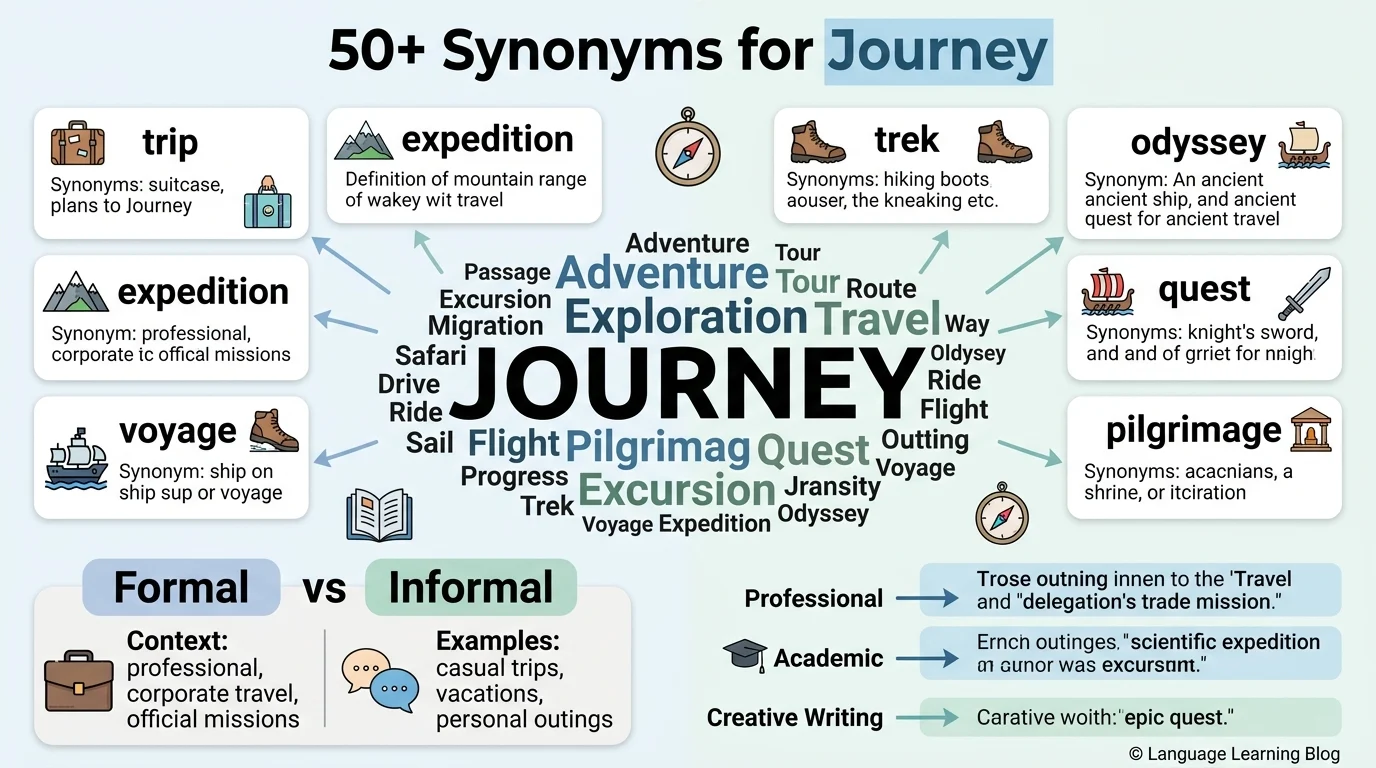
The word “journey” means the act of traveling from one place to another, or it can refer to a process of personal growth and change. The best synonyms depend on your context. For formal writing, use “expedition” or “odyssey.” For casual conversation, try “trip” or “jaunt.”emotional or personal contexts, consider “quest” or “pilgrimage.” Academic writing often prefers “exploration” or “research mission.”
Meaning, Tone and Context
Simple definition: A journey is an act of traveling from one location to another. It can also describe a process of personal development or a series of events that lead to change.
Part of speech: The word “journey” is primarily used as a noun. However, it can also be used as a verb, meaning to travel.
Tone: The tone of “journey” is generally neutral to positive. Moreover, it can carry a sense of adventure, discovery, or personal growth.
Formality level: The word “journey” is quite versatile. Consequently, it works in both formal and informal settings, making it a safe choice for most writing and speaking situations.
Common use cases: You will find “journey” used in travel writing, personal development content, motivational speeches, and business contexts describing career paths. Additionally, it appears in academic work about historical exploration or research projects.
Word forms: The noun form is “journey.” The verb form is “journey” as in “to journey across the desert.” The adjective form is “journeying.” The related noun “journeyman” describes a skilled worker who has completed an apprenticeship, though this is a separate meaning.
When and How to Use “Journey”
You should use “journey” when you want to describe a process that involves movement, change, or development over time. Specifically, it works well for physical travel, personal growth, career progression, or any transformative experience.
Here are realistic examples in different contexts:
Professional context: “My professional journey has included roles in marketing, sales, and product development.”
Personal context: “My fitness journey began with a simple daily walk around the neighborhood.”
Academic context: “The researchers documented their scientific journey through the Amazon rainforest.”
Emotional context: “Her journey through grief was difficult, but she emerged stronger and more compassionate.”
Creative context: “The novel follows the main character’s journey from innocence to wisdom.”
Social media context: “Grateful for this journey and everyone who has supported me along the way.”
Resume context: “Throughout my career journey, I have developed strong leadership and project management skills.”
Another Word for “Journey”
The best single replacement depends entirely on your meaning and context. Therefore, consider the following suggestions.
For professional writing: Use “career path” or “professional development.” These terms sound more business appropriate.
For academic writing: Use “exploration” or “investigation.” These words convey research and discovery.
For casual conversation: Use “trip” or “outing.” These words are simple and friendly.
For emotional writing: Use “quest” or “pilgrimage.” These words suggest deep personal meaning.
For creative writing: Use “odyssey” or “trek.” These words add color and adventure.
For resume or workplace use: Use “career progression” or “professional trajectory.” These terms sound strategic.
For social media captions: Use “adventure” or “experience.” These words engage followers.
For a stronger meaning: Use “expedition” or “crusade.” These words imply significant challenge or purpose.
For a softer meaning: Use “excursion” or “jaunt.” These words suggest a lighter, shorter experience.
When Not to Use “Journey”
The word “journey” sounds too vague when you need to be specific about a travel method or destination. Additionally, it feels too grand for everyday activities like commuting to work or walking to the store.
Example of vague usage: “I went on a journey to the grocery store.”
Improved with a precise synonym: “I walked to the grocery store.”
Example of overused usage: “My journey through college was challenging.”
Improved with a specific alternative: “My college experience was challenging.”
You should also avoid using “journey” in technical or scientific writing when describing steps in a process. Instead, words like “sequence,” “procedure,” or “cycle” are more accurate.
Words Commonly Confused With “Journey”
Journey vs. Trip: A journey often implies a significant experience or process, while a trip is more casual. For example, a trip can be a short visit, but a journey usually involves meaningful movement.
Journey vs. Voyage: A voyage specifically refers to travel by water or through space. In contrast, a journey can happen on land, sea, or air.
Journey vs. Excursion: An excursion is a short, planned trip for pleasure. Meanwhile, a journey is typically longer and more purposeful.
Journey vs. Trek: A trek is a long, difficult journey on foot, often in rough terrain. On the other hand, a journey can be easier and more comfortable.
Journey vs. Pilgrimage: A pilgrimage is a journey with a religious or spiritual purpose. Conversely, a journey can have any purpose.
Journey vs. Odyssey: An odyssey is a long, adventurous journey with many experiences and changes. However, a journey can be simpler and more direct.
Best Synonym by Context for “Journey”
| Context | Best Synonym | Why It Works | Example |
|---|---|---|---|
| Formal writing | Expedition | It sounds organized and purposeful | The scientific expedition collected valuable data. |
| Academic writing | Exploration | It suggests research and discovery | Her exploration of medieval literature uncovered new insights. |
| Professional business | Career path | It sounds strategic and focused | His career path included leadership roles across three continents. |
| Resume writing | Professional progression | It shows advancement and growth | My professional progression demonstrates increasing responsibility. |
| Casual conversation | Trip | It is simple and easy to understand | Our trip to the mountains was relaxing. |
| Creative writing | Odyssey | It adds epic and adventurous imagery | The novel is an odyssey through war and peace. |
| Emotional tone | Quest | It suggests deep personal meaning | Her quest for inner peace inspired everyone around her. |
| Strong intensity | Expedition | It implies challenge and importance | The expedition to the Arctic required years of preparation. |
| Soft or moderate | Jaunt | It sounds light and enjoyable | We took a jaunt through the countryside. |
| Social media captions | Adventure | It captures attention and excitement | Every adventure begins with a single step. |
| US usage | Trip | This is the most common American English term | We planned a road trip across the United States. |
| UK usage | Journey | This is more common in British English | The train journey through the countryside was lovely. |
Which Synonym Should You Choose?
Choosing the right synonym depends on three main factors: meaning, formality, and emotion.
Start by asking yourself what kind of journey you are describing. Is it physical travel or personal growth? For physical travel, words like “trip,” “excursion,” or “voyage” work well. For personal growth, “quest,” “pilgrimage,” or “odyssey” are better.
Next, consider your audience and setting. Formal writing requires words like “expedition” or “exploration.” Casual writing allows for “trip,” “jaunt,” or “outing.”
Finally, think about emotional intensity. Do you want to inspire, inform, or entertain? Strong words like “crusade” create passion. Neutral words like “passage” keep things factual. Soft words like “ramble” feel gentle.
The best choice makes your writing clearer, more precise, and more engaging. Therefore, avoid picking a synonym just because it sounds impressive. Instead, choose the word that fits your meaning perfectly.
Real Life Examples of “Journey” in Sentences
School context: The students documented their academic journey through detailed research projects and presentations.
Workplace context: Her journey from intern to executive director took fifteen years of dedicated effort.
Writing context: The author’s journey through revision transformed a rough draft into a published novel.
Conversation context: My journey to becoming a chef started when I was eight years old.
Social media context: This journey has taught me patience, resilience, and gratitude. Thank you for following along.
Resume context: My professional journey reflects a commitment to continuous learning and improvement.
Email context: I would like to share my journey with you and discuss how it shaped my perspective.
Storytelling context: The hero’s journey followed a classic pattern of departure, initiation, and return.
25 Synonyms
| Synonym | Simple Meaning | Best Used For | Example Sentence |
|---|---|---|---|
| Trip | A short travel experience | Casual conversation | Our trip to the beach was perfect. |
| Voyage | Travel by water or space | Nautical or space contexts | The voyage across the Atlantic took six weeks. |
| Expedition | An organized journey with a purpose | Scientific or exploratory missions | The expedition searched for rare plant species. |
| Trek | A long, difficult walk | Hiking or adventure travel | We prepared for the trek through the mountains. |
| Odyssey | A long, adventurous journey | Creative or epic storytelling | The space odyssey captivated millions of readers. |
| Pilgrimage | A spiritual or religious journey | Personal or faith based contexts | Her pilgrimage to the shrine brought her peace. |
| Quest | A search for something important | Personal growth or heroic tales | His quest for knowledge took him to many countries. |
| Excursion | A short trip for pleasure | Tourism or day trips | The school excursion to the museum was educational. |
| Jaunt | A short, enjoyable trip | Casual outings | We enjoyed a jaunt through the old town. |
| Passage | Travel from one place to another | Literary or formal writing | The passage through the desert was dangerous. |
| Tour | A trip with planned stops | Sightseeing or business travel | The tour included visits to major cities. |
| Itinerary | A planned route of travel | Travel planning documents | Our itinerary included five countries in two weeks. |
| Circuit | A journey that returns to the start | Repeated or circular routes | The lecture circuit kept him busy for months. |
| Trajectory | A path of movement | Professional or scientific contexts | Her career trajectory showed steady growth. |
| Path | A course of action or movement | Personal development | His path to success was not easy. |
| Trail | A marked route | Hiking or nature travel | The trail led through dense forests. |
| Route | A specific way to travel | Navigation or planning | We chose the scenic route through the mountains. |
| Mission | A journey with a specific goal | Professional or military contexts | The mission required careful planning and teamwork. |
| Crusade | A passionate journey for a cause | Advocacy or social movements | Her crusade for education reform inspired many. |
| Sojourn | A temporary stay or journey | Literary or formal usage | His sojourn in Paris influenced his art. |
| Travels | Journeys in general | Storytelling or personal accounts | His travels took him to every continent. |
| Wandering | Aimless or curious travel | Creative or reflective writing | His wandering through the city led to unexpected discoveries. |
| Progress | Forward movement or development | Professional or personal growth | The project made steady progress over the year. |
| Migration | Movement from one region to another | Scientific or historical contexts | Bird migration follows seasonal patterns. |
| Touring | Traveling for pleasure or performance | Music or entertainment contexts | The band spent the summer touring Europe. |
Professional vs. Personal Synonyms
Professional synonyms like “career path,” “professional progression,” and “trajectory” focus on growth and achievement. Consequently, they are suitable for resumes, performance reviews, and business presentations.
Personal synonyms like”quest,” and “adventure” emphasize individual experience and emotion. Therefore, they work well in personal essays, social media posts, and conversations with friends.
Formal vs. Conversational Synonyms
Formal synonyms include “expedition,” “exploration,” “voyage,” and “mission.” These words sound serious and organized. As a result, they belong in reports, academic papers, and official documents.
Conversational synonyms include “trip,” “jaunt,” “outing,” and “tour.” These words are friendly and approachable. Thus, they work well in emails to colleagues, text messages, and everyday speech.
Academic Synonyms
Academic writing benefits from words like “exploration,” “investigation,” “research mission,” and “field work.” These terms suggest systematic study and scholarly purpose.
Use “exploration” when describing the discovery of new ideas or territories. Similarly, use “investigation” when discussing research into a specific topic. These words add precision to academic work.
Professional and Business Synonyms
In business contexts, use “career path,” “professional development,” “career progression,” and “corporate journey.” These terms show ambition and strategic thinking.
“Trajectory” is excellent for describing growth patterns. Likewise, “mission” works well for project based travel or goal oriented assignments.
Creative or Literary Synonyms
Creative writing benefits from vivid synonyms like “odyssey,” “pilgrimage,” “quest,” and “wandering.” These words create strong imagery and emotional resonance.
“Odyssey” suggests epic scale and many adventures. Meanwhile, “pilgrimage” implies deep personal meaning. “Quest” evokes heroic effort, while “wandering” creates a reflective, contemplative mood.
Slang or Modern Synonyms
Modern informal synonyms include “road trip,” “getting around,” and “adventure time.” These phrases are casual and trendy. Accordingly, they work well on social media and in friendly conversation.
Nevertheless, avoid slang in formal writing. Save these fun terms for personal posts, text messages, and casual storytelling.
Strongest vs. Weaker Synonyms
Mildest: Walk, commute, outing, jaunt
Moderate: Trip, tour, journey, passage
Strong: Expedition, voyage, trek, pilgrimage
Strongest: Odyssey, crusade, epic journey, heroic quest
Choose mild words for everyday activities. Use moderate words for standard travel. Select strong or strongest words for significant experiences.
Emotional vs. Neutral Synonyms
Emotional synonyms include “quest,” “pilgrimage,” “odyssey,” and “crusade.” These words add feeling and personal meaning to your writing.
Neutral synonyms include “trip,” “tour,” “passage,” and “route.” These words convey information without added emotion.
Choose emotional synonyms when you want to inspire or connect with readers. In contrast, select neutral synonyms when you need to be objective and factual.
Antonyms of “Journey”
| Antonym | Meaning | Example Sentence |
|---|---|---|
| Stillness | Complete lack of movement | The stillness of the lake calmed her mind. |
| Stagnation | No growth or progress | Career stagnation worried him. |
| Rest | A period of calm | After the trip, she needed rest. |
| Idleness | Inactivity | His idleness bothered his coworkers. |
| Immobility | Inability to move | The injury caused temporary immobility. |
| Pause | A brief stop | The team took a pause to regroup. |
| Inaction | Lack of action | Inaction would cost the company money. |
| Halt | An abrupt stop | The project came to a sudden halt. |
| Cessation | Complete ending | The cessation of travel was disappointing. |
| Stationary | Not moving | The vehicle remained stationary. |
| Return | Coming back to the start | The return journey was quicker. |
| Stay | Remaining in one place | A long stay in London changed her life. |
| Residence | Living in one location | His residence in Paris lasted three years. |
| Inactivity | Lack of movement | The cold weather caused inactivity. |
| Arrest | A stop or cessation | The arrest of progress worried the team. |
Comparison: Journey vs. Similar Words
Journey vs. Trip
The main difference is length and significance. A trip is usually short and casual. A journey often involves more time, distance, or personal meaning.
Journey is stronger and more formal. Trip is milder and more casual.
Journey example: “Her journey across the desert took three months.”
Trip example: “Our trip to the store took twenty minutes.”
Journey vs. Voyage
A voyage specifically occurs on water or in space. A journey can happen anywhere.
Voyage is more specific and formal. Journey is more general.
Voyage example: “The voyage to America lasted six weeks.”
Journey example: “The journey through Europe was educational.”
Journey vs. Expedition
An expedition is an organized journey with a specific purpose, often scientific or exploratory. A journey can be personal and unplanned.
Expedition is more purposeful and formal. Journey is more personal and flexible.
Expedition example: “The expedition studied penguins in Antarctica.”
Journey example: “His journey through the national park was relaxing.”
Journey vs. Trek
A trek is a difficult journey on foot, especially in rough terrain. A journey can be easier and use any form of transport.
Trek is more strenuous. Journey is more general.
Trek example: “The trek through the Himalayas took two weeks.”
Journey example: “The journey by train was comfortable.”
Journey vs. Pilgrimage
A pilgrimage is a journey with religious or spiritual meaning. A journey can have any purpose.
Pilgrimage is more personal and spiritual. Journey is more general.
Pilgrimage example: “Her pilgrimage to Mecca was a lifelong dream.”
Journey example: “His journey to find a new job took months.”
Journey vs. Odyssey
An odyssey is an extremely long and adventurous journey with many experiences. A journey can be shorter and simpler.
Odyssey suggests epic scale and many adventures. Journey can be straightforward.
Odyssey example: “His odyssey across Asia took two years.”
Journey example: “Her journey to the airport was uneventful.”
Common Phrases and Expressions with “Journey”
1. Hero’s journey
Meaning: A classic story pattern where a hero goes on an adventure, faces challenges, and returns transformed.
Example sentence: The novel follows the classic hero’s journey structure from departure to return.
2. Life’s journey
Meaning: The process of living and experiencing life from birth to death.
Example sentence: Life’s journey is full of unexpected turns and valuable lessons.
3. Journey of a thousand miles begins with a single step
Meaning: Big achievements start with small actions.
Example sentence: Remember that a journey of a thousand miles begins with a single step, so start today.
4. Emotional journey
Meaning: A process of experiencing and processing emotions over time.
Example sentence: Watching the film was an emotional journey from laughter to tears.
5. Journey man
Meaning: A skilled worker who has completed an apprenticeship and is qualified to work independently.
Example sentence: He worked as a journey man electrician for many years before starting his own business.
6. Journey’s end
Meaning: The completion of a journey, often used metaphorically.
Example sentence: At journey’s end, she felt a deep sense of accomplishment.
7. Spiritual journey
Meaning: A process of personal growth and spiritual development.
Example sentence: His spiritual journey led him to explore different religions.
8. Return journey
Meaning: The trip back from a destination.
Example sentence: The return journey seemed shorter than the outbound trip.
Common Mistakes to Avoid
1. Using “journey” when a more specific synonym is better
Instead of saying “The journey to the store took ten minutes,” say “The walk to the store took ten minutes.”
2. Confusing “journey” with “voyage” incorrectly
A “voyage” is specifically by water or space. Therefore, do not use it for land travel. Say “journey” for land travel.
3. Using a casual synonym in formal writing
Avoid “jaunt” or “trip” in academic papers. Use “expedition,” “exploration,” or “research mission” instead.
4. Using an overly dramatic synonym for a simple situation
Saying “my odyssey to the supermarket” sounds silly. Save “odyssey” for truly epic experiences.
5. Repeating the same synonym too often
Vary your word choice to keep writing interesting. For instance, use “journey,” “expedition,” and “trip” in different sentences.
6. Choosing a synonym with the wrong emotional tone
Using “crusade” for a personal journey implies passion and purpose. If you mean a simple trip, use “outing.”
7. Using slang in academic or professional writing
Avoid “road trip” or “adventure time” in formal documents. Stick to professional synonyms.
8. Using “journey” to describe a series of unrelated events
A journey implies connected progress. If events are random, use “experiences” or “events” instead.
9. Forgetting about formality levels
Match your synonym to your audience. For example, casual words for friends, formal words for bosses.
10. Choosing the wrong synonym for the mode of travel
Use “trek” for walking, “voyage” for ships, and “flight” for airplanes. Be specific when possible.
FAQs
1. What is the best synonym for journey?
The best synonym depends on your context. For general use, “trip” works well. personal growth, “quest” is excellent. For formal writing, “expedition” is appropriate.
2. What is a formal synonym for journey?
Formal synonyms include “expedition,” “exploration,” “voyage,” and “mission.” These words are suitable for academic and professional contexts.
3. What is an informal synonym for journey?
Informal synonyms include “trip,” “jaunt,” “outing,” and “road trip.” These words work well in casual conversation and social media.
4. What is another word for journey in professional writing?
Professional writing benefits from “career path,” “professional progression,” “trajectory,” and “development.” These terms sound strategic and focused.
5. What is the difference between journey and voyage?
A voyage specifically refers to travel by water or through space. A journey can occur on land, sea, or air and may be shorter and less formal.
6. What is the opposite of journey?
The opposites of journey include “stillness,” “stagnation,” “rest,” “pause,” and “immobility.” These words describe lack of movement or progress.
Conclusion
The word “journey” is wonderfully versatile, but it should not be your only choice. Understanding synonyms allows you to choose the perfect word for every context, whether you are writing a formal report, a personal story, a social media caption, or a professional email. Remember to consider meaning, formality, emotional tone, and audience when selecting synonyms. The best writers vary their vocabulary to keep readers engaged and to convey precise meaning. Start applying these synonyms today and watch your communication become more vibrant and effective. Your vocabulary journey has just begun.