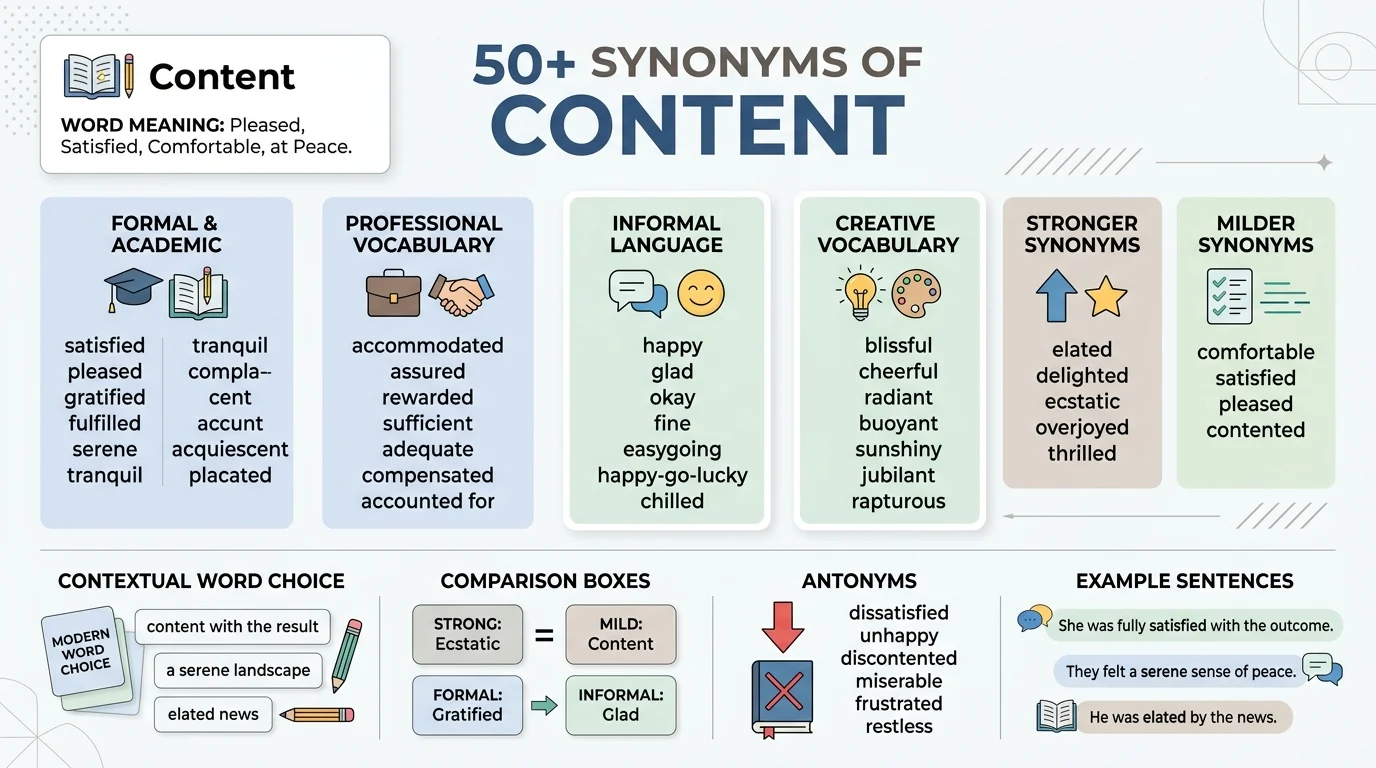
Have you ever caught yourself using the word “content” over and over again in an email, blog post, or school essay? Maybe you wrote a report and realized that “content” appeared fifteen times. You know the meaning, but you need fresh ways to express the same idea. Finding the right synonyms of content can transform your writing from repetitive to engaging.
Understanding synonyms of content goes beyond memorizing a list of words. Different synonyms carry different tones, formality levels, and emotional weight. Choosing the right alternative can make your writing clearer, more professional, or more relatable depending on your audience. This guide will help you master every synonym of content so you can write with confidence and precision.
What Are the Best Synonyms of “Content”?
“Content” means the subject matter, substance, or information contained within something such as a book, document, website, speech, or conversation. The best synonyms depend on context. Formal writing, use “substance” or “subject matter.” For casual conversation, try “stuff” or “material.” For academic writing, choose “subject matter” or “composition.”
Meaning, Tone, and Context
Simple Definition
Content refers to the ideas, information, or material that makes up something. It is what is inside rather than the outside form.
Part of Speech
Content functions as a noun. It can be singular or plural. When discussing digital content, it is often treated as a mass noun.
Overall Tone
Content is neutral. It simply describes what something contains without adding emotion or judgment.
Formality Level
Content is a neutral word. It works in formal, semi-formal, and informal contexts. However, in very casual speech, people often replace it with more relaxed alternatives.
Common Uses
Native English speakers use “content” constantly. You will hear it in business meetings about website content. Teachers discuss content in essays and assignments. Writers refer to content in books and articles. Social media managers talk about creating content for platforms. Professionals across every field use this word regularly.
Word Forms
Content primarily appears as a noun. The verb form “to content” means to satisfy someone, which is a completely different meaning. The adjective “content” means satisfied. This guide focuses only on the noun form meaning material or substance.
When and How to Use “Content”
You should use “content” when you need a neutral, general word for what something contains. Here are realistic examples across different contexts.
Professional
The content of the report needs to include more supporting data before we present it to the board.
Academic
The professor emphasized that the content of our research papers must directly address the thesis statement.
Workplace
Can you review the content of these slides and check for any outdated information?
Personal
I love the content of that podcast episode. They covered so many interesting topics.
Email
Please review the attached document and confirm that the content meets your expectations.
Resume
Developed engaging website content that increased user engagement by 35 percent over six months.
Social Media
The content of this post really resonated with our followers and generated meaningful conversations.
Best Synonyms of “Content”
No synonym works perfectly in every situation. Each alternative carries its own nuance, formality, and emotional tone. Here are the best synonyms for different contexts.
Professional Writing
Choose “substance” when you want to emphasize that the material has value and depth. This word suggests the content is meaningful rather than superficial.
Academic Writing
“Subject matter” provides the precision and formality that academic readers expect. It clearly indicates the topic being discussed or analyzed.
Business Communication
“Material” works well in business contexts because it sounds professional while remaining approachable and practical.
Casual Conversation
“Stuff” is informal but widely used. It works perfectly in everyday speech when you are discussing what something contains.
Emotional Writing
“Essence” adds emotional weight. It suggests the most important, core part of something rather than just its surface information.
Creative Writing
“Substance” also serves creative writing well. It implies depth, meaning, and importance beyond surface details.
Resume Writing
“Material” communicates that you worked with meaningful information, resources, or content professionally.
Workplace Communication
“Information” focuses on the factual, data-driven aspect of content in business settings.
Stronger Meaning
“Essence” conveys the deepest, most vital part of something. It is stronger than the neutral “content.”
Softer Meaning
“Stuff” is gentler and more relaxed. It does not carry the weight or formality of other alternatives.
When Not to Use “Content”
There are situations where “content” sounds too vague, too weak, or simply the wrong choice.
When It Sounds Too General
If you are discussing the specific ideas within a book, “content” can feel lazy. A more precise word like “arguments” or “themes” communicates clearer meaning.
Weak sentence: The content of the book is compelling.
Better sentence: The arguments presented in the book are compelling.
When It Sounds Too Vague
In business writing, saying “website content” lacks specificity. Are you discussing text, images, videos, or all of the above? “Text” or “visuals” would be more accurate.
Weak sentence: We need to update the content on the homepage.
Better sentence: We need to update the text on the homepage.
When It Sounds Too Formal
In casual conversations with friends, “content” can sound stiff. “Stuff” or “things” feel more natural.
Stiff sentence: The content of the movie was fascinating.
Natural sentence: The movie had so much interesting stuff in it.
When It Sounds Too Weak
When discussing the most important part of a speech or article, “content” fails to communicate significance. “Substance” or “essence” would be stronger.
Weak sentence: The content of her argument convinced everyone.
Stronger sentence: The substance of her argument convinced everyone.
Words Commonly Confused With “Content”
Several words relate to “content” but carry distinct meanings. Understanding these differences helps you choose the right word every time.
Content vs. Context
The main difference is scope. Content is the actual material or information. Context is the surrounding circumstances that help explain the content. You need both to understand meaning fully. The content of a statement matters, but the context determines how you interpret it.
Example: The content of his message was simple, but the context made it difficult to understand his true intentions.
Content vs. Substance
Substance implies depth, value, and importance. Content is neutral and simply describes what exists. When you use “substance,” you suggest the material is meaningful or significant.
Example: The article had plenty of content, but it lacked substance and failed to offer new insights.
Content vs. Material
Material suggests something that can be used, collected, or referenced. It is practical and resource-oriented. Content is broader and includes both useful and non-useful information.
Example: We gathered all the material for the presentation, but the content still needed better organization.
Content vs. Information
Information is specifically about facts, data, or knowledge. Content is a broader category that includes information but also includes entertainment, opinions, and other material.
Example: The website provides excellent information, but the overall content lacks visual appeal.
Content vs. Meaning
Meaning refers to significance or what something communicates. Content is the actual material itself. Something can have content without conveying much meaning.
Example: The content of the poem was clear, but its deeper meaning remained mysterious to most readers.
Content vs. Table of Contents
A table of contents is a list that tells you where to find different parts of content. The table of contents is not the content itself. It is a roadmap to the content.
Example: Check the table of contents to see where the content about marketing strategy is located.
Best Synonyms of “Content” by Context
| Context | Best Synonym | Why It Works | Example |
|---|---|---|---|
| Formal writing | Substance | Emphasizes depth and value | The substance of the proposal needs careful review. |
| Academic writing | Subject matter | Precise and authoritative | The subject matter of this course covers 19th century literature. |
| Professional communication | Material | Practical and clear | Please review the training material before the meeting. |
| Business emails | Information | Direct and professional | The information in your report clarified several issues. |
| Resume writing | Material | Demonstrates practical experience | Created marketing material for national campaigns. |
| Workplace communication | Information | Focuses on factual data | The information you provided helped us make better decisions. |
| Casual conversation | Stuff | Relaxed and natural | I loved the stuff they talked about in that podcast. |
| Everyday speaking | Things | Informal and universal | The things in that article were really surprising. |
| Creative writing | Essence | Adds depth and emotion | The essence of her story stayed with me long after I finished reading. |
| Storytelling | Substance | Gives weight to narrative | The substance of his tale was both tragic and uplifting. |
| Emotional writing | Core | Focuses on what matters most | At the core of his argument was a simple truth. |
| Strong emphasis | Essence | Conveys vital importance | The essence of the discussion was about fairness. |
| Mild tone | Material | Remains neutral and approachable | The material covered in class was well organized. |
| Social media captions | Content | Standard industry term | Our content strategy focuses on authentic storytelling. |
| American English | Content | Direct and widely understood | The content quality matters more than quantity. |
How to Choose the Best Synonym of “Content”
Choosing the right synonym requires considering several factors. Start by thinking about your audience. Are you writing for professors, colleagues, or friends? The audience determines the level of formality.
Consider your tone. Do you want to sound professional, casual, emotional, or neutral? Each synonym carries a distinct tone. “Substance” sounds serious and meaningful. “Stuff” sounds friendly and informal.
Evaluate the emotional strength you need. “Essence” and “core” carry emotional weight. “Material” and “information” remain neutral. Use emotional synonyms when you want readers to feel something. Use neutral synonyms when you simply need to communicate facts.
Think about your purpose. You are writing a resume, choose professional words like “material.” If you are writing a blog post, “content” or “information” works well. If you are writing a personal email, “stuff” or “things” feels natural.
Consider the naturalness of your choice. Some synonyms sound awkward in certain contexts. “Content” fits digital contexts perfectly. “Substance” fits discussions about meaningful work. Choose the word that sounds most natural to native English speakers.
Real Life Examples of “Content”
School
The teacher asked us to summarize the content of the chapter in our own words. I focused on the main ideas rather than every detail.
Improved: The teacher asked us to summarize the substance of the chapter in our own words. This emphasized the deeper meaning rather than surface details.
College
Our group project required us to present the content of our research clearly and concisely to the entire class.
Improved: Our group project required us to present the substance of our research clearly and concisely, demonstrating that we truly understood the material.
Workplace
The team spent two hours reviewing the content of the new policy document before asking questions.
Improved: The team spent two hours reviewing the material in the new policy document before asking clarifying questions.
Business
We need to update the content on our website to reflect our new brand identity and product offerings.
Improved: We need to update the information on our website to reflect our new brand identity and product offerings.
I reviewed the content of your proposal and have some suggestions for improvement before we submit it.
Improved: I reviewed the substance of your proposal and have some suggestions for strengthening the key arguments.
Resume
Created compelling content for the company blog that increased readership by 40 percent.
Improved: Created compelling material for the company blog that increased readership by 40 percent.
Conversation
The content of that documentary was incredibly thought-provoking. I learned so much.
Improved: The substance of that documentary was incredibly thought-provoking. It really made me think deeply.
Storytelling
The content of her speech moved everyone in the audience to tears.
Improved: The essence of her speech moved everyone in the audience to tears. Her core message about hope and resilience lingered long after she finished.
Blogging
Creating high quality content is the most important factor in building a successful blog audience.
Improved: Creating high quality material is the most important factor in building a successful blog audience that trusts your expertise.
Social Media
The content of this video sparked a lot of discussion in the comments section.
Improved: The substance of this video sparked a lot of meaningful discussion in the comments section.
18 Best Synonyms
| Synonym | Simple Meaning | Best Used For | Example Sentence |
|---|---|---|---|
| Substance | The most important or valuable part | Formal writing, serious discussions | The substance of the report convinced the board to approve the project. |
| Material | Information, facts, or resources | Professional contexts, business writing | We need more material before we can finalize the presentation. |
| Subject matter | The specific topic being discussed | Academic writing, educational contexts | The subject matter of this course requires prior knowledge of basic economics. |
| Information | Facts and details about something | Professional communication, emails | The information you provided helped us resolve the issue quickly. |
| Stuff | General things or material | Casual conversation, everyday speech | I loved all the stuff they included in that museum exhibition. |
| Things | General items or topics | Informal speech, personal communication | The things she mentioned in her speech were really interesting. |
| Essence | The most important, core part | Emotional writing, creative expression | The essence of her argument was simple but powerful. |
| Core | The central, most important part | Strong emphasis, professional writing | At the core of the strategy was a focus on customer satisfaction. |
| Composition | The way parts are arranged or combined | Academic writing, analytical contexts | The composition of the document made it difficult to follow. |
| Elements | The individual parts that make up content | Technical writing, analytical contexts | The elements of the report include research, analysis, and recommendations. |
| Text | Written words specifically | Digital content, publishing | The text of the article needs to be edited for clarity and style. |
| Copy | Written material for advertising | Marketing, advertising, business | The copy on the website needs to be more engaging and persuasive. |
| Data | Factual information used for analysis | Technical contexts, research | The data from the study supports our initial hypothesis. |
| Details | Specific pieces of information | Practical contexts, explanations | The details of the proposal will be shared in the next meeting. |
| Gist | The main point or general idea | Casual contexts, summaries | I understood the gist of his argument even without every detail. |
| Narrative | The story or account of events | Creative writing, storytelling | The narrative of the book captured the challenges of modern life. |
| Script | Written text for performance | Entertainment, media | The script for the commercial needed several revisions before filming. |
| Manuscript | Written or typed text | Publishing, academic contexts | The manuscript was reviewed by three experts before publication. |
Synonyms of “Content” by Usage
Professional vs Personal Synonyms
Professional synonyms focus on value, practicality, and precision. In workplaces, choose “material,” “information,” or “substance” to sound competent and serious. These words suggest you understand the importance of what you are discussing.
Personal synonyms feel more relaxed and natural in everyday situations. “Stuff” and “things” are perfect for conversations with friends, family, or anyone you know well. They communicate the same general idea without formality.
Professional recommendation: The material in the training session will help employees understand new procedures.
Personal recommendation: I loved the stuff we talked about over coffee this morning.
Formal vs Conversational Synonyms
Formal synonyms fit reports, essays, business writing, presentations, and professional emails. “Substance,” “subject matter,” and “material” project authority and professionalism. They signal that you take the topic seriously.
Conversational synonyms suit casual conversations, texting, and informal emails. “Stuff,” “things,” and “gist” help you sound natural and relatable. They make your communication feel effortless and friendly.
Formal example: The subject matter of the conference addressed emerging trends in artificial intelligence.
Conversational example: The gist of the conference was all about new AI technology.
Academic Synonyms
Academic writing demands precision and authority. “Subject matter” is the most common academic choice. It clearly indicates what is being studied or analyzed. “Composition” works well when discussing how content is structured. “Elements” helps when breaking content into individual components for analysis.
These synonyms sound authoritative because they are specific and formal. Professors and researchers expect this vocabulary. Using the right academic synonym demonstrates your understanding of scholarly conventions.
Example: The subject matter of the dissertation focuses on urban development policies in major American cities.
Professional and Business Synonyms
In business settings, choose synonyms that sound competent and practical. “Material” is excellent for general use. It suggests something useful and actionable. “Information” focuses on the factual side of business communication. “Copy” is the standard term in marketing and advertising.
These synonyms fit resumes, interviews, meetings, presentations, performance reviews, and client communication. They help you sound professional without seeming stiff or outdated.
Example: The marketing material we created for the product launch exceeded our client’s expectations.
Creative and Literary Synonyms
Creative writers need expressive alternatives. “Essence” adds emotional depth and philosophical weight. “Narrative” emphasizes the storytelling aspect of content. “Substance” works well when discussing meaning and importance.
These words add imagery and emotion to your writing. They help readers connect with the material on a deeper level. Use them in fiction, poetry, descriptive writing, speeches, and any creative context.
Example: The essence of the character’s journey was about finding courage in unexpected places.
Slang or Modern Synonyms
The noun form of “content” does not have widely recognized slang equivalents in American English. “Stuff” is the closest informal alternative and is used constantly in casual speech. In digital contexts, “content” remains the standard term even in casual settings.
Avoid forced slang. If you need an informal word, “stuff” or “things” are your safest and most natural choices. They work in almost any casual conversation.
Strongest to Mildest Synonyms
Understanding intensity helps you choose the right emotional weight for your message.
Mild Synonyms
These words communicate information simply and neutrally. They add no particular emotional emphasis.
- Things
- Stuff
- Details
- Material
- Information
Moderate Synonyms
These words suggest some importance or value without being dramatic.
- Substance
- Elements
- Text
- Data
Strong Synonyms
These words carry emotional weight and significance. They tell readers that what you are discussing matters deeply.
- Essence
- Core
- Narrative
Very Strong Synonyms
These words emphasize the deepest, most vital importance. Use them when you want to communicate profound meaning.
- Heart
- Soul
- Foundation
Emotional vs Neutral Synonyms
Emotional Synonyms
These words express feelings, importance, and significance. Use them when you want to connect emotionally with readers.
Essence: Suggests the most important, meaningful part of something.
Core: Emphasizes centrality and fundamental importance.
Narrative: Suggests story, meaning, and human experience.
These words work well in creative writing, personal essays, speeches, and emotional contexts. They help readers feel the importance of what you are saying.
Example: The essence of the community was its kindness and willingness to help strangers.
Neutral Synonyms
These words simply communicate information without adding emotional weight. Use them when you need to state facts clearly and objectively.
Material: Practical and straightforward.
Information: Factual and precise.
Details: Specific and factual.
These words fit professional, academic, and technical contexts where emotional language would be inappropriate.
Example: The material in the handbook covers all safety procedures thoroughly.
Antonyms of “Content”
Understanding opposites helps clarify meaning and expands your vocabulary options.
| Antonym | Meaning | Example Sentence |
|---|---|---|
| Form | The outer shape or structure | The form of the document looked professional, but the content lacked substance. |
| Style | The way something is expressed | His writing style was engaging, but the content was shallow. |
| Structure | The arrangement of parts | The structure of the essay was clear, but the content needed more research. |
| Appearance | How something looks | The appearance of the website was impressive, but the content was outdated. |
| Packaging | The outer presentation | The packaging of the product was beautiful, but the content inside was disappointing. |
| Surface | The outer layer | She only discussed the surface of the topic rather than the content beneath. |
| Framework | The supporting structure | The framework of the argument was solid, but the content needed stronger evidence. |
| Outline | A general plan without details | The outline gave us direction, but the content required significant expansion. |
| Format | The arrangement and design | The format was confusing, making the content difficult to follow. |
| Container | Something that holds content | The container was labeled, but the content had been removed. |
| Emptiness | The state of containing nothing | The emptiness of the presentation disappointed everyone who attended. |
| Void | Complete absence of content | The void in his argument left everyone unconvinced. |
| Vacuum | A space without content | The vacuum of information made decision making impossible. |
| Hollow | Empty of real meaning | His promises were hollow and lacked any substantive content. |
| Triviality | Unimportant material | The triviality of the discussion wasted everyone’s valuable time. |
Comparison: “Content” vs Similar Words
Content vs Substance
Main Difference
Content is neutral and describes what exists. Substance suggests depth, importance, and value. When you use “substance,” you imply that the material is meaningful and worth considering.
Which Is Stronger?
Substance is significantly stronger. It carries weight and significance that “content” lacks entirely.
Which Is More Formal?
Both words work in formal contexts, but “substance” sounds more sophisticated and serious.
When to Use Each
Use content when you need a neutral description. Use substance when you want to emphasize value and importance.
Examples
Content: The content of the course covers basic programming concepts.
Substance: The substance of the course prepares students for real world programming challenges.
Content vs Material
Main Difference
Material suggests practical, usable information or resources. Content is a broader term that includes any information regardless of usefulness.
Which Is Stronger?
Material has a practical strength. It implies something can be used or referenced.
Which Is More Formal?
Both are moderately formal, but “material” sounds slightly more professional in business contexts.
When to Use Each
Use content when discussing general information. Use material when referring to resources or information with practical application.
Examples
Content: The content of the book was interesting but not very useful.
Material: The material in the book helped me complete my project successfully.
Content vs Information
Main Difference
Information specifically refers to facts, data, and knowledge. Content includes information plus other elements like entertainment, opinions, and visual material.
Which Is Stronger?
Information is more precise. It focuses specifically on factual knowledge.
Which Is More Formal?
Information is highly formal and common in professional and academic contexts.
When to Use Each
Use content when discussing a broad collection of material. Use information when referring specifically to facts and data.
Examples
Content: The website content includes articles, videos, and user comments.
Information: The information on the website helped us make an informed decision.
Content vs Subject Matter
Main Difference
Subject matter specifically refers to the topic or theme being discussed. Content can include that topic plus additional supporting material.
Which Is Stronger?
Subject matter is more precise and focused.
Which Is More Formal?
Subject matter is highly formal and common in academic and educational contexts.
When to Use Each
Use content when discussing everything included. Use subject matter when focusing specifically on the main topic.
Examples
Content: The content of the documentary included interviews, historical footage, and expert analysis.
Subject matter: The subject matter of the documentary was climate change.
Content vs Essence
Main Difference
Essence means the most important, fundamental part of something. Content includes everything, both important and unimportant.
Which Is Stronger?
Essence is much stronger emotionally and intellectually.
Which Is More Formal?
Essence is formal but carries emotional and philosophical weight.
When to Use Each
Use content for general references. Use essence when discussing the deepest, most significant part of something.
Examples
Content: The content of the speech lasted forty five minutes and covered many topics.
Essence: The essence of the speech was about the power of community.
Content vs Copy
Main Difference
Copy specifically refers to written text used in advertising, marketing, or publishing. Content is a broader term that includes visual, audio, and other material.
Which Is Stronger?
Copy is more specific and industry focused.
Which Is More Formal?
Copy is standard professional terminology in marketing contexts.
When to Use Each
Use content when discussing all types of material. Use copy when specifically discussing marketing or advertising text.
Examples
Content: The content for the campaign includes videos, images, and written articles.
Copy: The copy for the ad needs to be punchy and persuasive.
Common Phrases and Expressions with “Content”
Content Creator
Meaning: A person who produces content for media platforms, especially online.
Example: The content creator posted three new videos this week to keep her audience engaged.
Content Marketing
Meaning: A marketing strategy focused on creating valuable content to attract customers.
Example: Our content marketing strategy has increased website traffic by 50 percent this year.
Content Management
Meaning: The process of creating, organizing, and maintaining digital content.
Example: We use a content management system to update our website easily.
Content Strategy
Meaning: A plan for creating and distributing content to achieve business goals.
Example: The content strategy focuses on answering common customer questions through blog posts.
Table of Contents
Meaning: A list of sections and their page numbers in a book or document.
Example: Check the table of contents to find the chapter about sustainable energy.
Content Analysis
Meaning: Research method for analyzing the content of communication materials.
Example: The content analysis revealed that most news coverage focused on economic issues.
Digital Content
Meaning: Content delivered through digital media such as websites, apps, and social platforms.
Example: The company invested heavily in digital content to reach younger audiences.
Content Management System
Meaning: Software used to create and manage digital content.
Example: WordPress is the most popular content management system for websites.
Common Mistakes to Avoid
Choosing a Vague Synonym Instead of a Precise One
Many writers choose “stuff” in situations where a more precise word would improve clarity.
Incorrect: The stuff in the report needs to be checked.
Better: The data in the report needs to be checked.
Why: “Data” is specific and professional. “Stuff” is too vague for workplace communication.
Confusing Content with Context
Some people use “content” when they actually mean “context.” This changes the meaning entirely.
Incorrect: The content of the situation made it clear what he meant.
Better: The context of the situation made it clear what he meant.
Why: Context refers to surrounding circumstances, not the content itself.
Using an Informal Synonym in Formal Writing
“Stuff” and “things” have no place in academic essays or professional reports.
Incorrect: The stuff in the research paper was difficult to understand.
Better: The subject matter of the research paper was difficult to understand.
Why: “Subject matter” is precise and academic. “Stuff” sounds careless and unprofessional.
Selecting an Overly Dramatic Synonym
Using “essence” when you simply mean basic information adds unnecessary emotional weight.
Incorrect: The essence of the email said the meeting was canceled.
Better: The content of the email said the meeting was canceled.
Why: “Essence” implies deep significance. “Content” works better for straightforward factual information.
Repeating the Same Word Too Often
Using “content” repeatedly makes writing sound monotonous and unpolished.
Incorrect: The content of the book was interesting. The content of the movie was similar. Both types of content kept me engaged.
Better: The content of the book was interesting. The substance of the movie was similar. Both forms of material kept me engaged.
Why: Varying synonyms improves readability and demonstrates vocabulary range.
Choosing a Synonym with the Wrong Emotional Tone
Using casual synonyms in serious professional writing can undermine your credibility.
Incorrect: The stuff in the annual report shows we met our goals.
Better: The data in the annual report shows we met our goals.
Why: “Data” is professional and appropriate for business reporting. “Stuff” is too casual.
Using Slang in Academic Writing
Avoid informal words like “stuff” and “things” in academic contexts.
Incorrect: The stuff in the journal article supports the hypothesis.
Better: The material in the journal article supports the hypothesis.
Why: “Material” sounds academic and credible. “Stuff” sounds like everyday conversation.
Frequently Asked Questions
1. What are the best synonyms of “content”?
The best synonyms depend on your context. Formal writing, choose “substance” or “subject matter.” For casual conversation, use “stuff” or “things.” For professional writing, “material” or “information” works well.
2. What are the best formal synonyms of “content”?
The best formal synonyms include “substance,” “subject matter,” “material,” “information,” and “composition.” These words project authority and professionalism in academic, business, and official contexts.
3. What are common informal synonyms of “content”?
The most common informal synonyms are “stuff” and “things.” These words are widely used in everyday American English. They help you sound natural and relaxed in casual conversations and personal writing.
4. What is another word for “content” in professional writing?
In professional writing, “material” is often the best choice. It sounds practical and competent. “Information” works well when focusing on facts. “Substance” is excellent for emphasizing value and depth.
5. What is the difference between “content” and “substance”?
Content describes what something contains. Substance describes what is valuable or meaningful within that content. All substance is content, but not all content has substance.
6. What is the opposite of “content”?
The opposites include “form,” “style,” “structure,” “appearance,” and “surface.” These words describe the outer aspects rather than the inner material. “Emptiness” and “void” describe an absence of content entirely.
Conclusion
The word “content” describes the material, information, or substance contained within something. It is a neutral, versatile word that fits many contexts. However, using the same word repeatedly makes writing boring and imprecise.
The best synonyms of content depend on your audience, purpose, and tone. Formal writing, “substance” and “subject matter” add authority. In professional contexts, “material” and “information” communicate competence. In casual conversations, “stuff” and “things” feel natural and friendly. Creative writing benefits from “essence” and “narrative.”
No synonym works perfectly in every situation. Choosing the right word requires understanding your context and audience. The most effective writers carefully select each word to communicate exactly what they mean. They consider tone, formality, emotional weight, and clarity before making a choice.
Remember this practical tip for improving your vocabulary. Before you write, think about the specific meaning you want to communicate. Then choose the most precise synonym rather than settling for the first word that comes to mind. This habit will make your writing clearer, stronger, and more engaging for every reader.