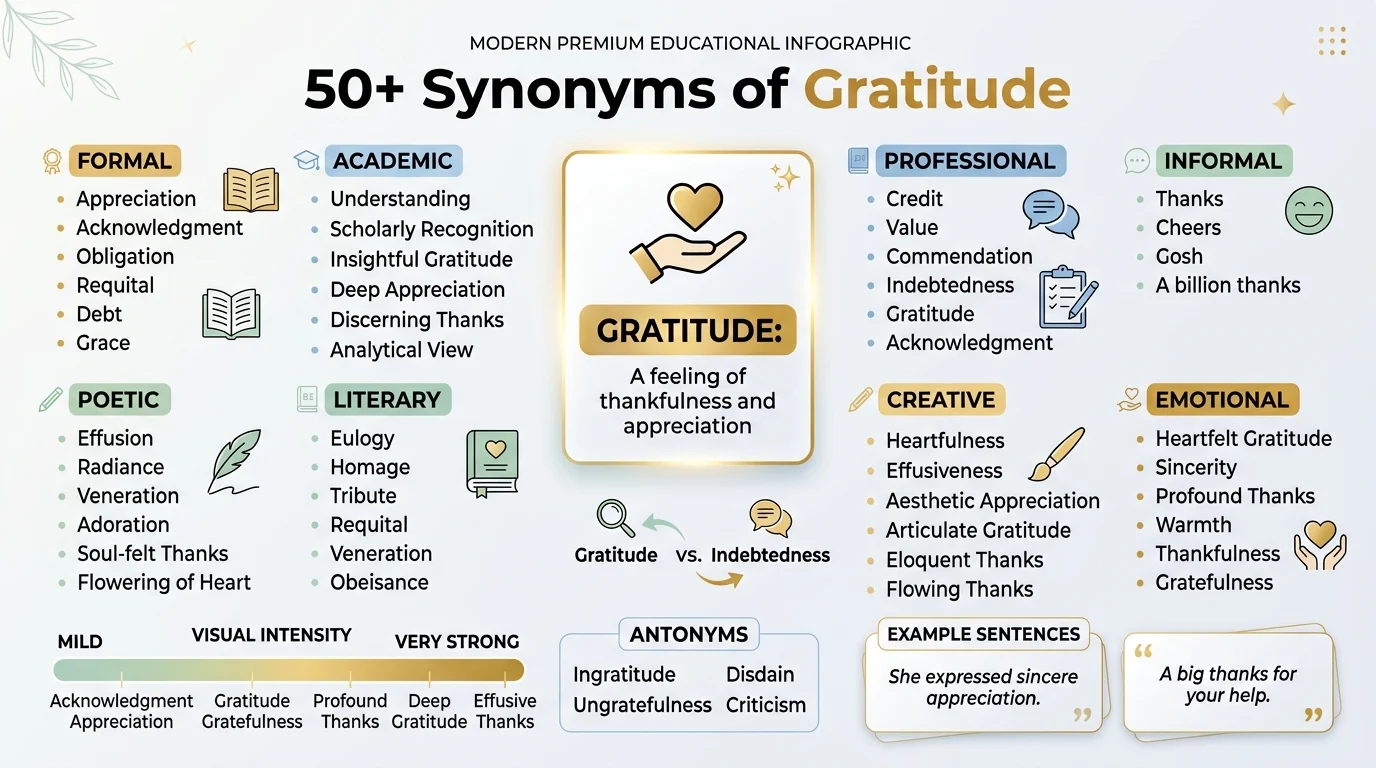
Have you ever found yourself writing an email, a thank‑you note, or even a social media caption and realized you have used the word “gratitude” three times in two paragraphs? It happens to everyone. You know what you want to say, but repeating the same noun makes your writing feel flat and uninspired. The good news is that English offers a rich collection of synonyms of gratitude that can add precision, emotion, and variety to your communication. Choosing the right synonym of gratitude is not about showing off your vocabulary. It is about matching your tone to your audience, your purpose, and the specific feeling you want to convey. This guide will help you understand the meaning of gratitude, explore the best synonyms of gratitude for every context, and avoid the common mistakes that even experienced writers make.
What Are the Best Synonyms of “Gratitude”?
Gratitude is the warm feeling of thankfulness and appreciation toward someone who has given you help, kindness, or a gift. The best synonyms depend on your context. Formal writing, use “appreciation” or “recognition.” For casual conversation, “thanks” or “thankfulness” work well. For professional communication, “acknowledgment” and “indebtedness” sound polished. Emotional writing, “gratefulness” and “blessing” add warmth.
Meaning, Tone, and Context
Simple Definition
Gratitude is the quality or feeling of being thankful and appreciative. It is a readiness to show appreciation for kindness received and a willingness to return that kindness. The word comes from the Latin gratus, which means pleasing, thankful, or agreeable.
Part of Speech
Gratitude is a noun. It is uncountable, meaning you do not typically say “gratitudes” in standard English.
Overall Tone
Gratitude is a highly positive and emotional word. It carries warmth, sincerity, and a sense of connection between people.
Formality Level
Gratitude sits in the neutral to slightly formal range. It is appropriate for most written and spoken contexts, from personal letters to business correspondence. However, in very casual conversation, native speakers often prefer shorter words like “thanks.”
Common Uses
Native English speakers commonly use gratitude in:
- Thank‑you notes and letters
- Speeches and toasts
- Professional emails
- Personal reflections and journaling
- Academic writing about psychology, philosophy, or well‑being
- Religious or spiritual contexts
Word Forms
| Form | Word |
|---|---|
| Noun | Gratitude |
| Adjective | Grateful |
| Adverb | Gratefully |
| Related noun | Gratefulness |
| Opposite noun | Ingratitude |
When and How to Use “Gratitude”
Choose “gratitude” when you want to express a sincere, thoughtful appreciation that goes beyond a simple “thank you.” It works best when you want to acknowledge a meaningful gift, favor, or kindness.
Here are seven realistic examples, each labeled by context.
Professional
I would like to express my gratitude to the entire team for their dedication during the project.
Academic
The study measured participants’ levels of gratitude and their overall life satisfaction.
Workplace
Her gratitude for the mentorship she received was evident in her farewell speech.
Personal
Every night, I write down three things I feel gratitude for.
Please accept my sincere gratitude for your generous support of our initiative.
Resume
I approach every opportunity with gratitude for the chance to learn and grow.
Feeling immense gratitude for the beautiful community that supports this small business.
Best Synonyms of “Gratitude”
No synonym is identical in every situation. The best choice depends on your tone, audience, and the specific emotion you want to convey.
Professional writing: Appreciation – It sounds polished and measured without being overly emotional.
Academic writing: Recognition – It implies a thoughtful, objective acknowledgment of value.
Business communication: Acknowledgment – It conveys professionalism and attention to detail.
Casual conversation: Thanks – It is simple, natural, and universally understood.
Emotional writing: Gratefulness – It adds warmth and personal feeling.
Creative writing: Blessing – It brings a poetic, reflective quality.
Resume writing: Appreciation – It shows emotional intelligence without sounding dramatic.
Workplace communication: Indebtedness – It communicates a sincere sense of obligation and respect.
Stronger meaning: Indebtedness – It conveys a deeper sense of owing something.
Softer meaning: Thankfulness – It is gentle, approachable, and everyday.
When Not to Use “Gratitude”
When the Word Sounds Too Formal
Gratitude can feel stiff in casual texts or quick conversations with friends.
Less effective: I feel gratitude for the pizza.
Better: Thanks for the pizza.
When the Word Sounds Too Vague
Gratitude is a broad term. If you need to specify exactly what you appreciate, a more precise word works better.
Less effective: I have gratitude for your advice.
Better: I appreciate your advice on the presentation.
When the Word Sounds Too Emotional
In highly technical or detached writing, gratitude may feel out of place.
Less effective: The report expresses gratitude for the data provided.
Better: The report acknowledges the data provided.
When the Word Sounds Too Weak
Sometimes gratitude does not capture the depth of what you feel.
Less effective: I have gratitude for everything you sacrificed.
Better: I am forever indebted to you for everything you sacrificed.
Words Commonly Confused With “Gratitude”
| Word | Difference | When to Use It | Example |
|---|---|---|---|
| Thanks | Thanks is the simplest, most direct expression. It is often used as an interjection. | Casual conversation, quick emails, everyday situations. | Thanks for picking up my mail. |
| Appreciation | Appreciation focuses on recognizing the value or quality of something. It is slightly more analytical than gratitude. | Professional settings, performance reviews, valuing someone’s work. | I have great appreciation for your attention to detail. |
| Gratefulness | Gratefulness is nearly identical to gratitude but feels slightly more personal and emotional. | Personal letters, emotional writing, heartfelt expressions. | My gratefulness for your kindness knows no bounds. |
| Thankfulness | Thankfulness is a conscious awareness of benefits received. It is often a response to a specific event. | Everyday conversation, expressing relief or appreciation. | I am full of thankfulness for this opportunity. |
| Indebtedness | Indebtedness implies a strong sense of owing something in return. It carries a weight of obligation. | Formal letters, expressing deep gratitude for major help. | I acknowledge my indebtedness to my mentors. |
| Obligation | Obligation focuses on the duty to repay kindness rather than the warm feeling itself. | Business or legal contexts, discussing responsibilities. | I feel a sense of obligation to help them in return. |
Best Synonyms of “Gratitude” by Context
| Context | Best Synonym | Why It Works | Example |
|---|---|---|---|
| Formal writing | Appreciation | Sounds polished and professional | We extend our appreciation for your continued partnership. |
| Academic writing | Recognition | Implies thoughtful, objective acknowledgment | The study received recognition for its contribution to the field. |
| Professional communication | Acknowledgment | Conveys attention to detail and respect | Please accept this as acknowledgment of your contribution. |
| Business emails | Thanks | Direct, clear, and appropriate for most business correspondence | Thanks for your prompt response to our inquiry. |
| Resume writing | Appreciation | Shows emotional intelligence without being overly emotional | I have a deep appreciation for collaborative work environments. |
| Workplace communication | Indebtedness | Communicates sincere respect and obligation | I feel a sense of indebtedness to my team for their support. |
| Casual conversation | Thanks | Simple, natural, and universally understood | Thanks for helping me move last weekend. |
| Everyday speaking | Thankfulness | Gentle and approachable | I feel a lot of thankfulness for my family. |
| Creative writing | Blessing | Brings a poetic, reflective quality | She counted her blessings every morning. |
| Storytelling | Gratefulness | Adds warmth and personal feeling | His gratefulness for her sacrifice was overwhelming. |
| Emotional writing | Gratefulness | Conveys deep personal warmth | My gratefulness for your friendship is immeasurable. |
| Strong emphasis | Indebtedness | Conveys a deep sense of owing | I am in a state of indebtedness to you. |
| Mild tone | Thankfulness | Gentle and everyday | I have a quiet thankfulness for small joys. |
| Social media captions | Thanks or Grateful | Short, relatable, and engaging | Grateful for this beautiful day. |
How to Choose the Best Synonym of “Gratitude”
Ask yourself these questions before you choose.
What is my audience?
If you are writing to a colleague, choose “appreciation” or “acknowledgment.” If you are texting a friend, choose “thanks.”
What is my tone?
Formal reports call for “recognition.” Personal journals call for “gratefulness.”
How strong is my emotion?
For mild appreciation, use “thankfulness.” For deep, life‑changing gratitude, use “indebtedness.”
What is my purpose?
Are you acknowledging a specific action? Use “recognition.” Are you expressing a general feeling? Use “gratitude” itself or “appreciation.”
What sounds most natural?
Read your sentence aloud. If it feels stiff or forced, try a simpler synonym.
Real Life Examples of “Gratitude”
School
The teacher expressed her gratitude to the students who volunteered after class.
College
In his graduation speech, he spoke with gratitude about the professors who shaped his thinking.
Workplace
She sent a note of gratitude to her manager for supporting her professional development.
Business
The company issued a statement of gratitude to its customers for their loyalty during the challenging year.
I am writing to express my sincere gratitude for the time you spent reviewing my proposal.
Resume
I approach every project with gratitude for the opportunity to contribute and learn.
Conversation
“I really feel a lot of gratitude for everything you have done.”
Storytelling
Tears welled in her eyes as she whispered her gratitude to the stranger who had saved her dog.
Blogging
Practicing daily gratitude has transformed the way I see challenges.
Gratitude is not just a word. It is a way of life. Thank you to everyone who has supported this journey.
18 Best Synonyms of “Gratitude”
Synonyms of “Gratitude” by Usage
Professional vs Personal Synonyms
In workplaces, choose “appreciation,” “recognition,” or “acknowledgment.” These sound measured and professional. In personal conversations, choose “thankfulness,” “gratefulness,” or simply “thanks.” These feel warmer and more intimate.
Formal vs Conversational Synonyms
For reports, essays, and business writing, use “appreciation,” “recognition,” or “indebtedness.” For emails, texts, and casual conversations, use “thanks” or “thankfulness.”
Academic Synonyms
In research papers and essays, “recognition” and “acknowledgment” sound authoritative and precise. These words imply a thoughtful, evidence‑based appreciation.
Professional and Business Synonyms
For resumes, interviews, and client communication, “appreciation” and “indebtedness” convey emotional intelligence and sincerity without sounding overly emotional.
Creative and Literary Synonyms
For storytelling and poetry, “blessing,” “grace,” and “warmth” add imagery and emotional depth. These words paint a picture and evoke feeling.
Slang or Modern Synonyms
There are no widely used slang synonyms for the noun “gratitude.” In informal speech, native speakers simply use “thanks” or “much appreciated.” Avoid forced slang in this category.
Strongest to Mildest Synonyms
| Intensity | Synonyms |
|---|---|
| Mild | Thanks, thankfulness |
| Moderate | Appreciation, gratefulness, acknowledgment |
| Strong | Recognition, indebtedness, obligation |
| Very Strong | Devotion, heartfelt thanks, blessing |
Emotional vs Neutral Synonyms
Emotional Synonyms: Gratefulness, blessing, warmth, joy, devotion, heartfelt thanks. These words express strong personal feeling.
Neutral Synonyms: Appreciation, recognition, acknowledgment, thanks. These words communicate gratitude without adding extra emotion.
Use emotional synonyms when you want to connect with someone on a deeper level. Use neutral synonyms when you want to stay professional or objective.
Antonyms of “Gratitude”
Comparison: “Gratitude” vs Similar Words
Gratitude vs Appreciation
Main Difference: Gratitude is the feeling of thankfulness toward a person. Appreciation is the recognition of value or quality in something or someone.
Which Is Stronger? Gratitude is often more emotional. Appreciation can be more intellectual.
Which Is More Formal? Appreciation is slightly more formal and versatile.
When to Use Each: Use gratitude when you are thankful to a person. Use appreciation when you are recognizing the value of an action, object, or quality.
Examples:
- Gratitude: I feel deep gratitude for my mother’s support.
- Appreciation: I have a great appreciation for classical music.
Gratitude vs Thankfulness
Main Difference: Thankfulness is often a response to a specific event. Gratitude is a broader, more enduring sense of appreciation.
Which Is Stronger? Gratitude is generally deeper and more enduring.
Which Is More Formal? Both are neutral, but gratitude is slightly more formal.
When to Use Each: Use thankfulness for immediate, specific reactions. Use gratitude for a lasting, general feeling.
Examples:
- Thankfulness: I feel thankfulness that we arrived safely.
- Gratitude: I have gratitude for the life I have been given.
Gratitude vs Gratefulness
Main Difference: These are nearly identical. Gratefulness feels slightly more personal and emotional.
Which Is Stronger? Gratefulness often feels warmer and more intimate.
Which Is More Formal? Gratitude is more common in formal writing.
When to Use Each: Use gratitude in most contexts. Use gratefulness when you want a softer, more personal tone.
Examples:
- Gratitude: The organization expressed its gratitude to donors.
- Gratefulness: My gratefulness for your friendship is endless.
Gratitude vs Indebtedness
Main Difference: Indebtedness implies a sense of owing something in return. Gratitude is the warm feeling itself.
Which Is Stronger? Indebtedness carries a heavier sense of obligation.
Which Is More Formal? Indebtedness is more formal and weighty.
When to Use Each: Use gratitude for general appreciation. Use indebtedness when you feel a strong duty to repay kindness.
Examples:
- Gratitude: I express my gratitude for your guidance.
- Indebtedness: I am forever indebted to you for your sacrifice.
Gratitude vs Recognition
Main Difference: Recognition is the act of acknowledging something. Gratitude is the emotional response.
Which Is Stronger? Gratitude is more emotional. Recognition is more neutral.
Which Is More Formal? Recognition is common in academic and professional contexts.
When to Use Each: Use gratitude when you feel thankful. Use recognition when you are formally acknowledging someone’s contribution.
Examples:
- Gratitude: She felt gratitude for his kindness.
- Recognition: He received recognition for his years of service.
Gratitude vs Acknowledgment
Main Difference: Acknowledgment is the act of recognizing or admitting something. Gratitude is the feeling of thanks.
Which Is Stronger? Gratitude carries more emotional weight.
Which Is More Formal? Acknowledgment is often used in official or legal contexts.
When to Use Each: Use gratitude when expressing thanks. Use acknowledgment when formally recognizing a contribution or receipt.
Examples:
- Gratitude: I want to express my gratitude to everyone who helped.
- Acknowledgment: We received acknowledgment of your application.
Common Phrases and Expressions with “Gratitude”
| Phrase | Meaning | Example Sentence |
|---|---|---|
| Express gratitude | To say or show that you are thankful | She took a moment to express her gratitude to the team. |
| Debt of gratitude | A strong feeling that you owe thanks to someone | The nation owes him a debt of gratitude for his service. |
| Show gratitude | To demonstrate thankfulness through actions or words | He showed his gratitude by volunteering at the shelter. |
| With gratitude | A formal way to sign off a letter or email | With gratitude, I remain yours sincerely. |
| Feel gratitude | To experience the emotion of being thankful | I feel deep gratitude for the opportunities I have received. |
| Profound gratitude | Very deep and sincere thankfulness | Please accept my profound gratitude for your support. |
| Sincere gratitude | Genuine and honest thankfulness | I offer my sincere gratitude for your kindness. |
Common Mistakes to Avoid
1: Using a Vague Synonym
Incorrect: I have thankfulness for you.
Better: I am thankful for you.
Why: “Thankfulness” is a noun. Using it as a noun in this structure sounds awkward. The adjective “thankful” sounds more natural.
2: Confusing “Gratitude” with “Gratuity”
Incorrect: I left a gratitude for the waiter.
Better: I left a gratuity for the waiter.
Why: A gratuity is a tip or money given for service. Gratitude is a feeling.
3: Using an Informal Synonym in Formal Writing
Incorrect: I want to give a big thanks to the board of directors.
Better: I wish to express my appreciation to the board of directors.
Why: “Big thanks” sounds casual. “Appreciation” sounds professional.
4: Using an Overly Dramatic Synonym
Incorrect: I am indebted to you for making coffee.
Better: Thanks for making coffee.
Why: “Indebted” is too strong for a small favor.
5: Repeating the Same Word
Incorrect: I feel gratitude for my family. I also feel gratitude for my friends.
Better: I feel gratitude for my family. I also feel appreciation for my friends.
Why: Varying your word choice keeps your writing fresh and engaging.
6: Choosing a Synonym with the Wrong Emotional Tone
Incorrect: I have a sense of obligation to my best friend.
Better: I have deep gratitude for my best friend.
Why: “Obligation” sounds like duty, not affection.
7: Using Slang in Professional Writing
Incorrect: Props to the team for their hard work.
Better: I extend my appreciation to the team for their hard work.
Why: “Props” is informal slang. “Appreciation” is professional.
Frequently Asked Questions
1. What are the best synonyms of “gratitude”?
The best synonyms depend on your context. Formal writing, use “appreciation” or “recognition.” For casual conversation, use “thanks” or “thankfulness.” For emotional writing, use “gratefulness” or “blessing.”
2. What are the best formal synonyms of “gratitude”?
The best formal synonyms include “appreciation,” “recognition,” “acknowledgment,” and “indebtedness.” These words sound polished and professional in reports, business letters, and academic writing.
3. What are common informal synonyms of “gratitude”?
Common informal synonyms include “thanks,” “thankfulness,” and “much appreciated.” These words work well in everyday conversation, texts, and casual emails.
4. What is another word for “gratitude” in professional writing?
In professional writing, “appreciation” and “acknowledgment” are excellent choices. They convey respect and sincerity without sounding overly emotional or casual.
5. What is the difference between “gratitude” and “appreciation”?
Gratitude is the warm feeling of thankfulness toward a person. Appreciation is the recognition of value or quality in something or someone. Gratitude is more emotional; appreciation is more intellectual.
6. What is the opposite of “gratitude”?
The most direct opposite is “ingratitude,” which means a lack of thankfulness. Other opposites include “ungratefulness,” “thanklessness,” and “unappreciation.”
Conclusion
Gratitude is a warm, positive feeling of thankfulness and appreciation toward someone who has given you help, kindness, or a gift. The best synonyms of gratitude depend on your context, audience, and the strength of your emotion. Formal writing, choose “appreciation” or “recognition.” For casual conversation, choose “thanks” or “thankfulness.” For emotional writing, choose “gratefulness” or “blessing.” No single synonym works perfectly in every situation. The key is to match your word to your purpose. The next time you write a thank‑you note, an email, or a social media post, take a moment to choose the synonym that communicates your feeling most clearly. Your readers will notice the difference.
1 thought on “50+ Synonyms of Gratitude | Meanings, Uses, Examples, and Best Alternatives”