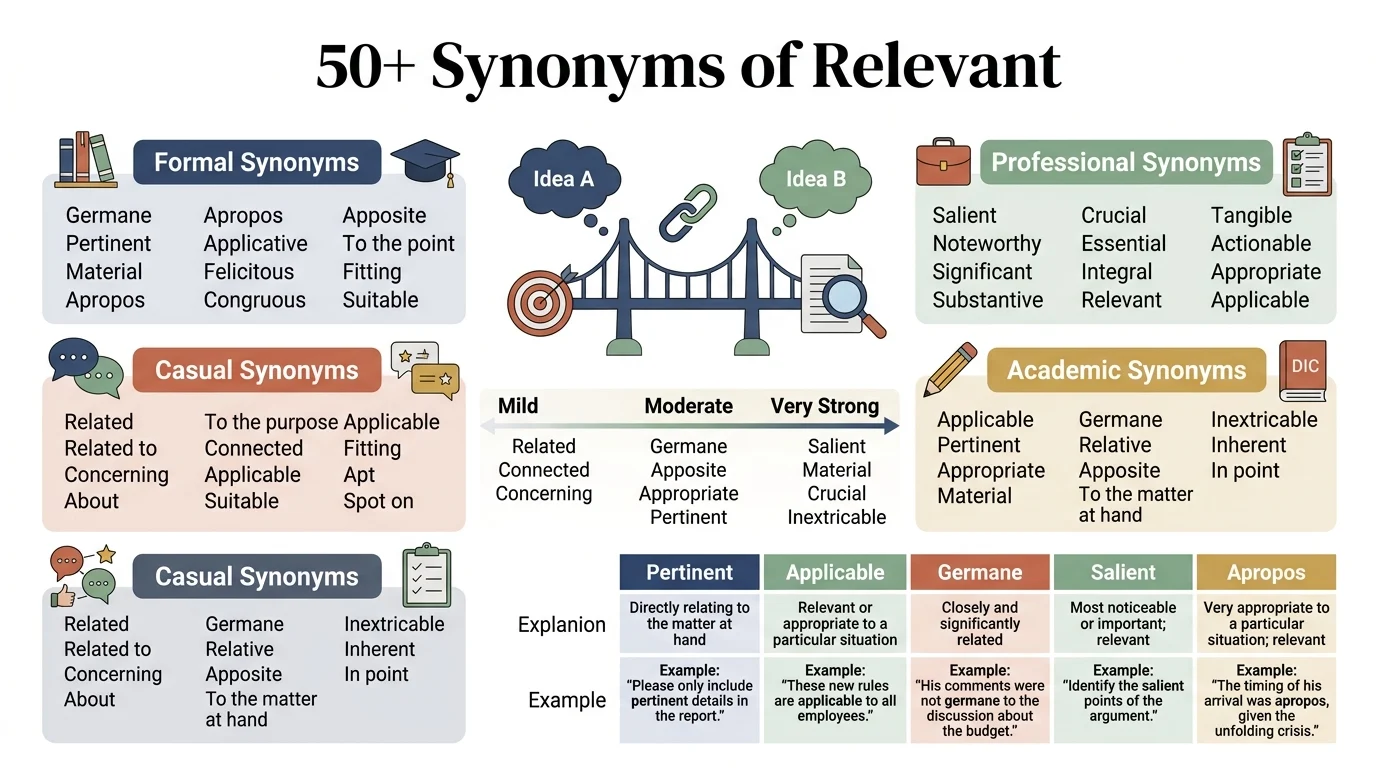
Have you ever caught yourself writing an email, an essay, or a social media caption and realized you have used the word “relevant” three times in two paragraphs? It happens to everyone. You know what you want to say, but the word starts to feel stale and overused. Finding the right synonyms of relevant can transform your writing from repetitive and bland to sharp, precise, and engaging. Choosing a more accurate word does more than just avoid repetition. It clarifies your meaning, adjusts your tone, and shows your reader that you have command over your language.
What Are the Best Synonyms of “Relevant”?
Relevant” means having a clear and meaningful connection to the subject or matter being discussed. It carries a neutral, practical tone. For formal writing, choose pertinent or germane. For casual conversation, use on point or fitting. In professional settings, applicable and material work well. For academic work, apposite is an excellent choice.
Meaning, Tone, and Context
Simple Definition
Something is relevant when it relates directly to the topic at hand and helps to understand, solve, or decide that topic. It is not just connected in any way; the connection must matter.
Part of Speech
Adjective.
Overall Tone
Neutral. The word itself does not carry a strong positive or negative feeling. It simply states a fact about a relationship between two things.
Formality Level
Neutral to semi-formal. “Relevant” works in almost any setting, from casual conversation to academic journals. However, some synonyms are much more formal, and others are more casual.
Common Uses
Native English speakers use “relevant” constantly in both spoken and written English. You will hear it in meetings, classrooms, and everyday conversations. It appears frequently in resumes, job descriptions, emails, and news articles. People use it to filter information, judge importance, and connect ideas.
Word Forms
- Noun: relevance or relevancy
- Adverb: relevantly
- Adjective: relevant
- Antonym: irrelevant
When and How to Use “Relevant”
You should choose “relevant” when you need a clear, straightforward word that connects one thing to another in a meaningful way. It is a safe, versatile choice for most situations. Here are seven examples that show how native speakers use it in real life.
Professional
“Please send me all relevant documents before our meeting on Thursday.”
Academic
“The study reviewed all relevant literature published in the last ten years.”
Workplace
“Her previous management experience is highly relevant to this position.”
Personal
“I know this story is not relevant to the conversation, but I wanted to share it anyway.”
Email
“We have attached the relevant files for your review.”
Resume
“Relevant coursework includes data analysis, marketing strategy, and consumer behavior.”
Social Media
“This documentary feels more relevant today than when it was first released.”
Best Synonyms of “Relevant”
No two synonyms are exactly the same. Each word carries its own shade of meaning, tone, and level of formality. Here are the best alternatives for specific situations.
Professional writing: Applicable. This word emphasizes that something can be successfully used or applied in a particular situation. It sounds practical and action-oriented.
Academic writing: Germane. This is a highly formal word that suggests a deep and appropriate connection to the subject. It adds a layer of sophistication to research papers and essays.
Business communication: Pertinent. This word is slightly more formal than “relevant” and implies that something fits the point exactly. It is perfect for reports and presentations.
Casual conversation: On point. This informal phrase means exactly what it says. It is a relaxed way to say something is relevant and well-stated.
Emotional writing: Significant. This word adds weight and importance to the connection. It suggests that the relevance is not just logical but also meaningful.
Creative writing: Apposite. This is a beautiful word for creative and literary contexts. It means strikingly appropriate and well-suited to the situation.
Resume writing: Applicable. Recruiters love this word because it shows that your skills and experience can be directly applied to the job.
Workplace communication: Material. This formal word is often used in legal and business contexts to describe information that is significant and relevant to a decision.
Stronger meaning: Crucial. This word takes relevance to the next level. It suggests that the connection is not just meaningful but absolutely necessary.
Softer meaning: Related. This is a gentler word that simply states a connection without implying that the connection is important or useful.
When Not to Use “Relevant”
Sometimes “relevant” is not the best choice. It can sound too vague, too weak, or simply wrong for the tone you are trying to achieve.
Too General
“When you are providing feedback, make sure your comments are relevant.” This sentence is correct but bland. It does not tell the reader what kind of relevance you mean.
Better: “When you are providing feedback, make sure your comments are pertinent to the specific goals we discussed.”
Too Vague
“The new policy is relevant to our department.” This statement is true but lacks impact.
Better: “The new policy is directly applicable to our department’s daily operations.”
Too Formal
In a text message to a friend, saying “Your opinion is not relevant to this decision” sounds stiff and cold.
Better: “Your opinion doesn’t really matter here.”
Too Weak
“The data is relevant to our hypothesis.” This sentence is accurate but does not convey the importance of the data.
Better: “The data is critical to our hypothesis.”
Too Strong
Using “crucial” when you only mean “related” will make your writing sound exaggerated and untrustworthy.
Words Commonly Confused With “Relevant”
Many words are similar to “relevant,” but they are not interchangeable. Here are the most common confusions.
Related vs. Relevant
- Difference: “Related” simply means two things are connected. Relevant” means the connection is meaningful and important to the topic at hand.
- When to Use It: Use “related” when you only want to state a connection. Use “relevant” when that connection matters.
- Example (Related): “My hobby is related to my work, but it is not directly relevant to my job performance.”
Pertinent vs. Relevant
- Difference: “Pertinent” is more formal and suggests a precise, logical fit. “Relevant” is broader and more general.
- When to Use It: Use “pertinent” in formal writing when you want to emphasize that something fits the point exactly.
- Example (Pertinent): “She raised a pertinent question that no one had considered.”
Applicable vs. Relevant
- Difference: “Applicable” focuses on whether something can be successfully used or applied. “Relevant” focuses on the connection itself.
- When to Use It: Use “applicable” when you are talking about rules, laws, skills, or solutions that can be put into practice.
- Example (Applicable): “These safety regulations are applicable to all construction sites.”
Germane vs. Relevant
- Difference: “Germane” is much more formal and implies a deep, appropriate, and often subtle connection.
- When to Use It: Use “germane” in academic or highly formal writing.
- Example (Germane): “The professor’s comments were germane to the central thesis of the paper.”
Appropriate vs. Relevant
- Difference: “Appropriate” means suitable or proper for a particular person, place, or situation. “Relevant” means connected to the matter at hand.
- When to Use It: Use “appropriate” when you are talking about behavior, dress, or language. Use “relevant” when you are talking about information or ideas.
- Example (Appropriate): “Casual clothing is not appropriate for a job interview.”
Material vs. Relevant
- Difference: “Material” is a formal, often legal term that means significant and relevant enough to influence a decision.
- When to Use It: Use “material” in legal, business, or formal contexts.
- Example (Material): “The witness provided material evidence that changed the outcome of the case.”
Best Synonyms of “Relevant” by Context
| Context | Best Synonym | Why It Works | Example |
|---|---|---|---|
| Formal writing | Pertinent | It sounds precise and authoritative. | “The committee addressed all pertinent issues.” |
| Academic writing | Germane | It is highly formal and suggests a deep connection. | “Her research is germane to the field of cognitive psychology.” |
| Professional communication | Applicable | It emphasizes practical use and action. | “This training is applicable to all new hires.” |
| Business emails | Pertinent | It is professional without being overly complex. | “Please see the pertinent details in the attached file.” |
| Resume writing | Applicable | It shows recruiters that your skills can be used. | “Applicable skills include project management and data analysis.” |
| Workplace communication | Material | It is formal and suggests importance. | “This information is material to our decision.” |
| Casual conversation | On point | It is relaxed and easy to understand. | “Your comments were on point.” |
| Everyday speaking | Related | It is simple and does not overstate the connection. | “This is related to what we were talking about.” |
| Creative writing | Apposite | It is elegant and adds a literary flair. | “The metaphor was apposite and beautifully crafted.” |
| Storytelling | Fitting | It suggests that something is suitable and satisfying. | “It was a fitting end to the story.” |
| Emotional writing | Significant | It adds weight and importance. | “This discovery is significant for the entire community.” |
| Strong emphasis | Crucial | It shows that the connection is absolutely necessary. | “This data is crucial to our success.” |
| Mild tone | Related | It is gentle and does not demand attention. | “This topic is related, but we can discuss it later.” |
| Social media captions | On point | It is trendy and engaging. | “This outfit is on point for the summer.” |
| American English | Relevant | The standard, neutral choice. | “That is a relevant point.” |
How to Choose the Best Synonym of “Relevant”
Choosing the right synonym is about understanding your audience and your purpose. Here is a practical decision guide.
- Identify your audience. Are you writing for a professor, a boss, a friend, or the general public? Your audience determines the level of formality.
- Define your purpose. Are you trying to inform, persuade, entertain, or instruct? Different purposes call for different tones.
- Assess the emotional weight. Do you need a neutral word, or do you want to add emphasis and importance?
- Consider the strength of the connection. Is the connection merely related, or is it absolutely crucial?
- Read your sentence aloud. Does the synonym sound natural? Does it fit the rhythm of your writing?
The goal is not to use the fanciest word. The goal is to use the most accurate word that communicates your message clearly and naturally.
Real Life Examples of “Relevant”
Here are realistic examples showing how “relevant” and its synonyms can be used in different situations.
School
“My teacher said my essay was good but suggested I include more pertinent examples from the text.”
College
“The professor assigned readings that are germane to our final research project.”
Workplace
“During the meeting, she asked if the new software would be applicable to our team’s workflow.”
Business
“The CEO emphasized that customer feedback is material to our product development strategy.”
Email
“Thank you for your inquiry. I have attached the relevant documents for your reference.”
Resume
“Relevant experience includes five years of project management in the tech industry.”
Conversation
“His jokes were funny but not really on point for the serious topic we were discussing.”
Storytelling
“The detective found a germane clue that finally connected all the pieces of the puzzle.”
Blogging
“This advice is pertinent for anyone starting a small business.”
Social Media
“This recipe is on point for a quick and healthy dinner.”
18 Best Synonyms of “Relevant”
| Synonym | Simple Meaning | Best Used For | Example Sentence |
|---|---|---|---|
| Pertinent | Fitting the point exactly | Formal writing, reports | “She asked a pertinent question during the presentation.” |
| Applicable | Can be used or applied | Professional, resume writing | “These skills are applicable to a wide range of jobs.” |
| Germane | Deeply and appropriately connected | Academic writing, formal essays | “His arguments were not germane to the discussion.” |
| Apposite | Strikingly appropriate | Creative writing, literary contexts | “Her choice of words was apposite and powerful.” |
| Material | Significant and relevant to a decision | Legal, business, formal contexts | “This evidence is material to the case.” |
| Apropos | Appropriate and to the point | Formal and semi-formal writing | “His comment was apropos and well received.” |
| Fitting | Suitable and right for the situation | Storytelling, general use | “It was a fitting tribute to her career.” |
| On point | Exactly right and relevant | Casual conversation, social media | “Your analysis is on point.” |
| Significant | Having importance and meaning | Emotional writing, emphasis | “This finding is significant for future research.” |
| Crucial | Absolutely necessary and relevant | Strong emphasis | “This information is crucial to the project’s success.” |
| Related | Connected in some way | Mild tone, everyday speaking | “I have a related question about the budget.” |
| Connected | Having a link or relationship | General use | “The two issues are closely connected.” |
| Appropriate | Suitable for the situation | General use, behavioral contexts | “Please wear appropriate attire for the event.” |
| Suitable | Right for a particular purpose | General use | “This software is suitable for small businesses.” |
| To the point | Direct and relevant | Clear communication | “His feedback was concise and to the point.” |
| Salient | Most noticeable and important | Formal writing, reports | “The salient points are summarized on page one.” |
| Topical | Related to current events | News, blogging, social media | “This is a highly topical issue.” |
| Ad rem | Directly to the point | Very formal, legal, or philosophical | “The judge’s ruling was strictly ad rem.” |
Synonyms of “Relevant” by Usage
Professional vs Personal Synonyms
In professional settings, words like pertinent, applicable, and material project competence and precision. They show that you understand the importance of being on topic and practical. In personal conversations, on point, fitting, and related sound more natural and relaxed. Using overly formal words with friends can make you sound stiff or pretentious.
Formal vs Conversational Synonyms
Formal: Germane, apposite, material, pertinent, ad rem. Use these in reports, academic essays, business presentations, and formal emails.
Conversational: On point, related, fitting, connected. Use these in everyday speech, text messages, and casual social media posts.
Academic Synonyms
Germane, apposite, and pertinent are the gold standards for academic writing. They sound authoritative and precise. For example, saying “This theory is germane to our analysis” sounds much more sophisticated than “This theory is relevant to our analysis.” These words show that you have a deep understanding of the subject and its connections.
Professional and Business Synonyms
Applicable, pertinent, and material are the strongest choices for the workplace. Recruiters want to see “applicable skills” on a resume. Managers want to hear “pertinent questions” in a meeting. Lawyers and executives value “material information” in a report. These words convey professionalism and a focused mind.
Creative and Literary Synonyms
Apposite and apropos are excellent for creative writing. They add elegance and precision. Fitting is also a great choice for storytelling because it suggests a satisfying and suitable connection. Using these words can elevate your prose and make your descriptions more vivid.
Slang or Modern Synonyms
On point is the most common informal synonym. It is widely used and understood. It is acceptable in casual conversation, social media, and blogs. However, avoid it in formal academic or professional writing.
Strongest to Mildest Synonyms
Here is an intensity scale for synonyms of “relevant.”
Mild: Related, connected
Moderate: Relevant, applicable, appropriate, suitable
Strong: Pertinent, germane, apposite, material, apropos
Very Strong: Crucial, salient, significant
The emotional intensity changes from a simple statement of connection to a powerful declaration of importance.
Emotional vs Neutral Synonyms
Emotional Synonyms: Significant, crucial. These words add weight and feeling. They are not just stating a fact; they are telling the reader that this connection matters deeply.
Neutral Synonyms: Related, connected, applicable. These words simply communicate information. They are objective and do not add any emotional coloring. Choose neutral synonyms when you want to be factual and unemotional. Choose emotional synonyms when you want to persuade or emphasize.
Antonyms of “Relevant”
| Antonym | Meaning | Example Sentence |
|---|---|---|
| Irrelevant | Not connected or important to the matter at hand | “His comments were completely irrelevant to the discussion.” |
| Extraneous | Coming from outside and not essential | “Please remove all extraneous details from your report.” |
| Immaterial | Not important or relevant under the circumstances | “The color of the car is immaterial to its performance.” |
| Impertinent | Not showing proper respect; also means not relevant | “Her question was impertinent and off topic.” |
| Inapplicable | Not capable of being applied | “These rules are inapplicable to our situation.” |
| Unrelated | Not connected or associated | “His hobby is completely unrelated to his profession.” |
| Beside the point | Not relevant to the subject being discussed | “That argument is beside the point.” |
| Off topic | Not on the subject | “The discussion went off topic very quickly.” |
| Tangential | Only slightly related and not central | “She made a tangential remark that confused everyone.” |
| Peripheral | On the edge or margin; not central | “These are peripheral issues that we can address later.” |
| Inappropriate | Not suitable or proper | “His behavior was inappropriate for the formal setting.” |
| Unsuitable | Not fitting or appropriate | “This software is unsuitable for our needs.” |
| Trivial | Of little value or importance | “The error was trivial and did not affect the outcome.” |
| Pointless | Having no purpose or relevance | “Continuing this argument is pointless.” |
| Insignificant | Too small or unimportant to be worth considering | “The difference between the two products is insignificant.” |
Comparison: “Relevant” vs Similar Words
Relevant vs Pertinent
Main Difference: “Pertinent” is more formal and precise. It implies a logical and exact connection. “Relevant” is broader and more general.
Which Is Stronger? Pertinent is slightly stronger because it is more specific.
Which Is More Formal? Pertinent is more formal.
When to Use Each: Use “relevant” in most situations. Use “pertinent” when you want to sound more formal and emphasize that something fits the point exactly.
Examples:
- Relevant: “The article contained relevant information for my research.”
- Pertinent: “The article contained pertinent information that directly addressed my research question.”
Relevant vs Applicable
Main Difference: “Applicable” focuses on whether something can be used or applied. “Relevant” focuses on whether something is connected.
Which Is Stronger? Neither is inherently stronger, but “applicable” is more action-oriented.
Which Is More Formal? Both are similar in formality.
When to Use Each: Use “relevant” for connections. Use “applicable” for rules, skills, and solutions that can be put into practice.
Examples:
- Relevant: “This data is relevant to our discussion.”
- Applicable: “This data is applicable to our marketing strategy.”
Relevant vs Germane
Main Difference: “Germane” is much more formal and suggests a deeper, more appropriate connection.
Which Is Stronger? Germane is stronger and more emphatic.
Which Is More Formal? Germane is highly formal.
When to Use Each: Use “relevant” in most contexts. Use “germane” in academic or highly formal writing when you want to impress with your vocabulary.
Examples:
- Relevant: “Her comments were relevant to the topic.”
- Germane: “Her comments were germane to the central thesis of the paper.”
Relevant vs Related
Main Difference: “Related” simply means connected. Relevant” means the connection is meaningful and important.
Which Is Stronger? Relevant is stronger because it implies importance.
Which Is More Formal? Relevant is slightly more formal.
When to Use Each: Use “related” when you only want to state a connection. Use “relevant” when that connection matters.
Examples:
- Related: “My major is related to my minor.”
- Relevant: “My major is relevant to the job I am applying for.”
Relevant vs Apposite
Main Difference: “Apposite” means strikingly appropriate and well-suited. It is a more elegant and literary word.
Which Is Stronger? Apposite is stronger because it suggests a perfect fit.
Which Is More Formal? Apposite is formal and often used in literary contexts.
When to Use Each: Use “relevant” in everyday writing. Use “apposite” in creative or literary writing when you want to sound sophisticated.
Examples:
- Relevant: “The example was relevant to the lesson.”
- Apposite: “The example was apposite and illuminated the lesson perfectly.”
Relevant vs Material
Main Difference: “Material” is a formal word, often used in legal contexts, meaning significant and relevant enough to influence a decision.
Which Is Stronger? Material is stronger because it implies consequence.
Which Is More Formal? Material is highly formal.
When to Use Each: Use “relevant” for general connections. Use “material” in legal, business, or formal contexts when the information has significant weight.
Examples:
- Relevant: “This witness is relevant to the case.”
- Material: “This witness can provide material evidence for the case.”
Common Phrases and Expressions with “Relevant”
| Phrase | Meaning | Example Sentence |
|---|---|---|
| Relevant information | Information that is connected and useful | “Please send me all relevant information about the project.” |
| Relevant experience | Work or life experience that relates to a job | “She has relevant experience in the healthcare industry.” |
| Relevant to the discussion | Connected to what is being talked about | “That point is not relevant to the discussion.” |
| Highly relevant | Very important and connected | “Her research is highly relevant to current public health issues.” |
| Directly relevant | Clearly and obviously connected | “The new policy is directly relevant to our department.” |
| Relevant factors | Important elements that should be considered | “We must consider all relevant factors before making a decision.” |
| Relevant authorities | The people or organizations with the power to decide | “The matter has been referred to the relevant authorities.” |
Common Mistakes to Avoid
1: Using a vague synonym when a precise one is needed.
- Incorrect: “The information was related to the case.” (This is true but vague.)
- Better: “The information was pertinent to the case.” (This shows the information directly applied.)
2: Confusing “relevant” with “related.”
- Incorrect: “This data is related to our goal.” (This only states a connection.)
- Better: “This data is relevant to our goal.” (This states the connection is important.)
3: Using an informal synonym in formal writing.
- Incorrect: “The professor’s feedback was on point.” (Too casual for academic writing.)
- Better: “The professor’s feedback was pertinent.” (More appropriate for an academic context.)
4: Selecting an overly dramatic synonym.
- Incorrect: “The color of the logo is crucial to our success.” (Overstates the importance of a minor detail.)
- Better: “The color of the logo is relevant to our branding.” (More accurate and less exaggerated.)
5: Repeating the same word too often.
- Incorrect: “The relevant data is in the relevant report. The relevant findings are on page ten.”
- Better: “The pertinent data is in the applicable report. The key findings are on page ten.”
6: Choosing a synonym with the wrong emotional tone.
- Incorrect: “Her casual remark was significant to the meeting.” (Overstates the importance.)
- Better: “Her casual remark was related to the meeting.” (More accurate and less dramatic.)
7: Using slang in professional writing.
- Incorrect: “Our strategy is on point for this quarter.” (Too informal for a business report.)
- Better: “Our strategy is applicable for this quarter.” (More professional.)
Frequently Asked Questions
1. What are the best synonyms of “relevant”?
The best synonyms depend on your context. Formal writing, use pertinent or germane. For professional settings, use applicable. For casual conversation, use on point.
2. What are the best formal synonyms of “relevant”?
The best formal synonyms are pertinent, germane, apposite, and material. These words are commonly used in academic, legal, and business writing.
3. What are common informal synonyms of “relevant”?
Common informal synonyms include on point, fitting, and related. These are best for casual conversations, text messages, and social media.
4. What is another word for “relevant” in professional writing?
Applicable and pertinent are excellent choices for professional writing. They sound competent and precise, which is exactly what you want in a workplace setting.
5. What is the difference between “relevant” and “related”?
Relevant” means the connection is meaningful and important. “Related” simply means there is a connection, without implying that it matters.
6. What is the opposite of “relevant”?
The most common opposite is irrelevant. Other antonyms include extraneous, immaterial, unrelated, and beside the point.
Conclusion
“Relevant” is a workhorse of the English language. It is useful, clear, and versatile. But sometimes you need a word that fits a specific situation, audience, or tone. The synonyms of relevant offer a rich palette of choices, from the formal precision of “pertinent” to the casual ease of “on point.” No synonym works perfectly in every situation. The key to strong writing is choosing the word that communicates your intended message with the greatest clarity and impact. Consider your audience, your purpose, and the emotional weight you want to carry. The next time you reach for “relevant,” pause and ask yourself if another word might serve you better. Your writing will become sharper, more engaging, and more effective.