You are writing a cover letter and notice you have used the word “freedom” three times in a single paragraph. Your resume describes how you value “freedom” in your work. An important email mentions the “freedom” your team enjoys. The word is correct, but repetition makes your writing feel flat and unpolished.
Finding the right synonyms of freedom can transform your writing from repetitive to precise. The word itself carries deep meaning. It appears in political speeches, personal development books, and everyday conversations. But using it too often or in the wrong context can weaken your message.
This guide will help you understand what freedom truly means. You will discover the best synonyms for every situation. You will learn which words work in professional settings and which ones sound better in casual conversation. By the end, you will choose the exact word your audience needs to hear.
What Are the Best Synonyms of “Freedom”?
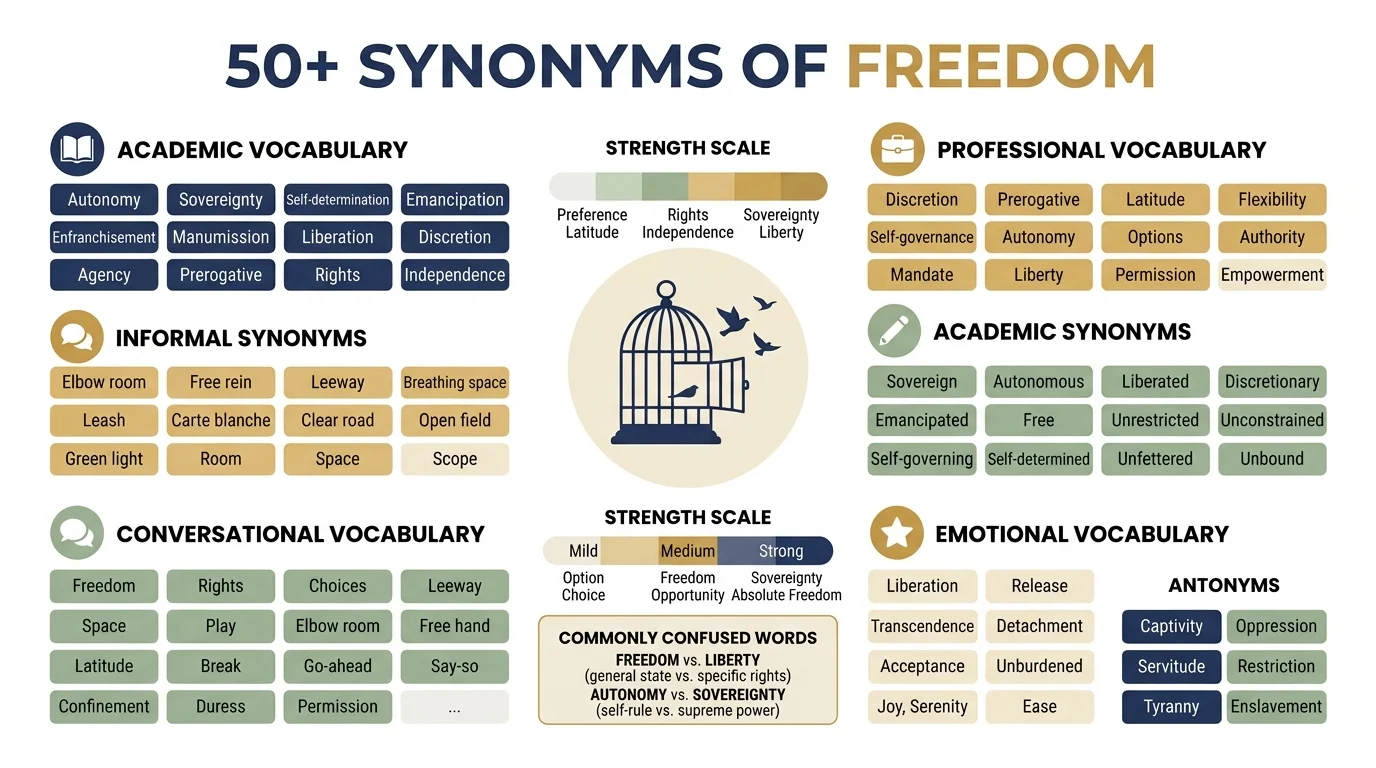
Freedom means having the power or right to act, speak, or think without external restraint. It represents the ability to choose your path and control your own life. Formal writing, choose autonomy or independence. For casual conversation, use liberty or leeway. Emotional expression, select emancipation or deliverance. For professional settings, consider discretion or self-determination. Creative writing benefits from latitude or scope.
Meaning, Tone, and Context
Simple Definition
Freedom is the state of being free. It means you have the power to make your own choices without being controlled by others. It also means you are not imprisoned, enslaved, or restricted from doing what you want.
Part of Speech
Freedom is a noun.
Overall Tone
Freedom has a positive tone. It represents something most people value and desire. The word carries hope, opportunity, and personal power. However, its emotional weight can shift depending on context. In political discussions, freedom sounds serious and powerful. In personal growth, it feels uplifting and inspiring.
Formality Level
Freedom is neutral. It works equally well in formal documents and casual conversations. The word is widely understood and does not sound overly academic or too informal. This makes it versatile, but also means it often needs support from more precise synonyms.
Common Uses
Native English speakers use freedom in many situations:
- Political debates about civil liberties
- Personal development and self-improvement
- Workplace discussions about autonomy and flexibility
- Creative projects and artistic expression
- Everyday conversations about choices and options
- Historical discussions about emancipation and rights
Word Forms
- Noun: freedom
- Adjective: free
- Adverb: freely
- Related forms: freer, freest, freed
- Opposite form: unfreedom
When and How to Use “Freedom”
You should choose freedom when you want the safest, most universally understood word. It works in almost any context. But freedom shines brightest when you are discussing:
- Personal rights and civil liberties
- The absence of imprisonment or oppression
- General concepts of choice and independence
Here are realistic examples showing how native speakers use freedom in different situations.
Professional
“The new remote work policy gives employees more freedom to structure their day around productivity.”
Academic
“The study examined how economic freedom correlates with social mobility across different countries.”
Workplace
“We need the freedom to test creative solutions without fear of immediate rejection.”
Personal
“Moving to the city gave me the freedom to pursue a career I actually love.”
Email
“Thank you for giving me the freedom to lead this project according to my own schedule.”
Resume
“Seeking a role that offers creative freedom and opportunities for independent problem solving.”
Social Media
“Finally have the freedom to work from anywhere. What a difference it makes.”
Best Synonyms of Freedom
No synonym perfectly matches freedom in every situation. Each alternative carries its own tone, emotional weight, and level of formality. This section recommends the best synonyms for specific contexts.
Professional Writing
Choose autonomy. Autonomy emphasizes self-governance and independent decision making. It sounds more sophisticated and precise than freedom in professional documents.
Academic Writing
Select self-determination. This phrase has strong scholarly roots and appears in political science, psychology, and social research. It sounds authoritative and precise.
Business Communication
Use discretion. Discretion suggests you have the authority to make decisions within defined boundaries. Business leaders appreciate this practical synonym.
Casual Conversation
Choose liberty. Liberty carries a friendly, conversational tone while still sounding intelligent. It works well in everyday discussions about choices and rights.
Emotional Writing
Select emancipation. Emancipation conveys deep emotional release from restriction. It suggests something profound has changed for the better.
Creative Writing
Use latitude. Latitude suggests room to move and explore. It adds a visual, imaginative quality that creative writing benefits from.
Resume Writing
Choose independent. Independent signals that you do not need constant supervision. Recruiters and hiring managers value this quality.
Workplace Communication
Select flexibility. Flexibility emphasizes adaptability and the ability to adjust. This synonym sounds practical and action oriented.
Stronger Meaning
Choose sovereignty. Sovereignty represents ultimate authority and complete control. It is the strongest synonym available.
Softer Meaning
Select leeway. Leeway suggests a small amount of extra room. It has a mild, gentle tone.
When Not to Use Freedom
Freedom is a wonderful word, but it does not fit every situation. Sometimes it sounds too vague or misses the specific meaning you want to convey.
When Freedom Sounds Too Vague
If you are writing a business proposal, saying “we need freedom to make decisions” sounds weak and undefined. The reader might wonder exactly what you mean.
Better choice: autonomy, discretion
Stronger rewrite: “We require discretion to make operational decisions that align with client needs.”
When Freedom Sounds Too Formal
In a text message or casual conversation, saying “I appreciate the freedom to choose my lunch spot” sounds overly serious. It draws unnecessary attention to a minor choice.
Better choice: flexibility, leeway
Natural rewrite: “Thanks for giving me some leeway on lunch today.”
When Freedom Sounds Too Weak
Political speeches and historical discussions need powerful language. Freedom can sound general when the situation demands something more precise.
Better choice: emancipation, liberation, sovereignty
Stronger rewrite: “The movement fought for liberation from oppressive policies.”
When Freedom Sounds Too Emotional
Technical or scientific writing should remain objective. Freedom introduces unnecessary emotional weight.
Better choice: independence, self-rule, latitude
Objective rewrite: “The system allows independent operation of each module.”
Words Commonly Confused With Freedom
These words often appear near freedom in vocabulary discussions. But each has a distinct meaning that changes how your sentence sounds.
Freedom vs Liberty
Difference: Liberty and freedom are often used interchangeably. However, liberty emphasizes the absence of external restraint, while freedom focuses more on the ability to choose. Liberty sounds slightly more formal and often appears in political contexts.
When to Use It: Use liberty when discussing civil rights, political philosophy, or legal protections. Use freedom for everyday personal choices.
Example: “The constitution protects individual liberty from government overreach.”
Freedom vs Independence
Difference: Independence means not being controlled by others. Freedom means having choices. Independence is often about relationships between groups or people. Freedom is more internal.
When to Use It: Use independence when referring to nations, organizations, or individuals who do not rely on others. Use freedom for more general personal situations.
Example: “The country celebrated its independence from colonial rule.”
Freedom vs Autonomy
Difference: Autonomy focuses on self-governance and making your own rules. Freedom is a broader term. Autonomy sounds professional and sophisticated.
When to Use It: Use autonomy in professional, academic, and business contexts where decision making authority is the main topic.
Example: “The research team has autonomy to design their own methodology.”
Freedom vs Emancipation
Difference: Emancipation describes the process of being freed from oppression, slavery, or legal restrictions. It carries a specific historical and social weight that freedom does not always have.
When to Use It: Use emancipation when discussing freedom gained from specific forms of oppression or control.
Example: “Her emancipation from restrictive traditions allowed her to pursue education.”
Freedom vs Latitude
Difference: Latitude suggests a smaller range of freedom within defined boundaries. It also has a more visual, spatial quality. Freedom is absolute.
When to Use It: Use latitude when you want to emphasize room to move or operate within limits.
Example: “The guidelines give designers enough latitude to be creative.”
Best Synonyms of Freedom by Context
| Context | Best Synonym | Why It Works | Example |
|---|---|---|---|
| Formal writing | Autonomy | Sounds precise and professional | “The committee granted each department operational autonomy.” |
| Academic writing | Self-determination | Authoritative and scholarly | “Self-determination theory explains intrinsic motivation.” |
| Professional communication | Discretion | Indicates trusted decision making | “You have full discretion to approve expenses under five hundred dollars.” |
| Business emails | Flexibility | Practical and action focused | “Our policy offers flexibility to accommodate different work styles.” |
| Resume writing | Independent | Signals self-sufficiency | “Independent researcher with experience managing complex projects.” |
| Workplace communication | Latitude | Shows room to operate | “Employees have latitude to design their daily schedules.” |
| Casual conversation | Liberty | Friendly yet intelligent | “I love having the liberty to choose my own projects.” |
| Everyday speaking | Leeway | Mild and practical | “My boss gives me some leeway on deadlines.” |
| Creative writing | Latitude | Adds imaginative quality | “The artist needed latitude to develop her vision.” |
| Storytelling | Liberation | Powerful and dramatic | “The character’s liberation came at a great personal cost.” |
| Emotional writing | Emancipation | Deep and meaningful | “Financial emancipation changed everything for her.” |
| Strong emphasis | Sovereignty | Ultimate authority | “She demanded sovereignty over her own creative work.” |
| Mild tone | Scope | Neutral and specific | “The position offers scope for professional growth.” |
| Social media captions | Freedom | Universally understood | “Morning walks bring a simple kind of freedom.” |
How to Choose the Best Synonym of Freedom
Choosing the right synonym depends on answering a few simple questions about your writing situation.
What is your purpose?
- Are you writing formally? Choose autonomy or self-determination.
- Are you writing casually? Choose liberty or leeway.
- Are you writing emotionally? Choose emancipation or liberation.
Who is your audience?
- Business leaders appreciate discretion and flexibility.
- Academic audiences respect self-determination and independence.
- General readers understand freedom and liberty best.
Emotional strength do you need.
- Mild emotion: choose leeway, scope, or flexibility.
- Moderate emotion: choose freedom, liberty, or independence.
- Strong emotion: choose emancipation, liberation, or sovereignty.
What is your writing style?
- Professional writing benefits from autonomy and discretion.
- Creative writing flourishes with latitude and scope.
- Conversational writing sounds natural with leeway and freedom.
What is the level of formality?
- Formal: autonomy, self-determination, sovereignty
- Semi-formal: independence, discretion, latitude
- Informal: leeway, flexibility, liberty
Real Life Examples of Freedom
These examples show how freedom and its synonyms appear in real writing situations. Some examples use freedom directly. Others demonstrate stronger alternatives.
School
“The assignment gave students the freedom to choose any historical figure for their presentation.”
College
“University life offers the freedom to explore interests without immediate career pressure.”
Workplace
“Our team has the flexibility to shift schedules during busy seasons.”
Business
“The CEO granted the new division autonomy to develop its own marketing strategy.”
Email
“I appreciate the latitude you have given me to redesign the onboarding process.”
Resume
“Self-directed professional with a track record of delivering results with minimal supervision.”
Conversation
“I finally have some leeway in my schedule to take that art class.”
Storytelling
“The kingdom’s liberation from tyranny came after years of quiet resistance.”
Blogging
“Financial independence opens the door to choices that feel like real freedom.”
Social Media
“Work from anywhere gives me the flexibility to be wherever I need to be.”
18 Best Synonyms of Freedom
| Synonym | Simple Meaning | Best Used For | Example Sentence |
|---|---|---|---|
| Autonomy | Self-governance and independent control | Professional and academic writing | “The department has autonomy to manage its own budget.” |
| Liberty | The state of being free from restrictions | Formal writing and political discussion | “Citizens value their civil liberties above most other rights.” |
| Independence | Not controlled by others or relying on others | Personal and professional contexts | “She values her independence and makes all her own decisions.” |
| Self-determination | Making your own choices without outside influence | Academic and scholarly work | “Self-determination is essential for psychological well-being.” |
| Discretion | The ability to make decisions within given authority | Business and professional communication | “Managers have discretion to approve time off requests.” |
| Latitude | Freedom to act within defined boundaries | Creative and workplace writing | “The brief gives artists plenty of latitude for interpretation.” |
| Emancipation | Freedom from oppression or legal restrictions | Emotional and historical writing | “Emancipation changed the lives of millions.” |
| Liberation | Freedom gained from oppressive control | Storytelling and dramatic writing | “The liberation of the city brought hope to its people.” |
| Sovereignty | Ultimate authority and complete self-rule | Political and formal contexts | “The nation fought for centuries to achieve sovereignty.” |
| Leeway | A small amount of freedom within limits | Casual conversation and informal writing | “The teacher gave me some leeway on the essay deadline.” |
| Flexibility | The ability to adapt and adjust | Workplace and business communication | “Our remote policy offers flexibility for different lifestyles.” |
| Scope | The range or extent of freedom to act | Professional and practical contexts | “The role offers considerable scope for creativity.” |
| License | Freedom to act without permission (often overused) | Creative writing and formal contexts | “The director used artistic license to change the ending.” |
| Free rein | Freedom to do what you want | Professional and casual writing | “The team was given free rein to redesign the product.” |
| Exemption | Freedom from a rule or requirement | Legal and formal writing | “The organization applied for tax exemption status.” |
| Immunity | Protection from something that affects others | Legal and professional contexts | “Diplomats have immunity from certain local laws.” |
| Self-rule | Governing yourself | Political and academic writing | “The region demanded self-rule after years of external control.” |
| Unrestraint | Absence of external limits | Emotional and descriptive writing | “His unrestraint in creative expression was remarkable.” |
Synonyms of Freedom by Usage
Professional vs Personal Synonyms
Workplace situations need words that sound competent and action focused. Personal conversations allow more emotional and casual language.
Professional: autonomy, discretion, flexibility, latitude, independence, scope
These words communicate that you can make decisions and manage your responsibilities effectively.
Personal: liberty, leeway, emancipation, liberation, free rein
These words express how you feel about your choices and circumstances.
Choose autonomy when writing a performance review. Choose liberty when talking to friends about a new job.
Formal vs Conversational Synonyms
Formal: autonomy, self-determination, sovereignty, exemption, self-rule
Use these for reports, essays, legal documents, and business presentations.
Conversational: liberty, leeway, free rein, flexibility, latitude
Use these for emails, casual conversations, social media, and personal writing.
Academic Synonyms
Academic writing requires precision and authority. These synonyms work well in research papers and scholarly discussions.
- Self-determination appears frequently in psychology and political science.
- Autonomy is common in philosophy and ethics.
- Sovereignty is essential in political theory.
- Independence is foundational in statistics and social sciences.
These words sound more authoritative than simply repeating freedom.
Professional and Business Synonyms
Business leaders respond to words that suggest responsibility and competence.
Resumes: independent, autonomous, self-directed
Interviews: discretion, flexibility, latitude
Meetings: autonomy, self-determination, freedom
Presentations: independence, flexibility, sovereignty
Performance reviews: autonomy, discretion, latitude
Client communication: flexibility, discretion, leeway
Using these alternatives shows you understand professional vocabulary.
Creative and Literary Synonyms
Creative writing benefits from vivid language that paints pictures.
Storytelling: emancipation, liberation, sovereignty
Fiction: latitude, liberty, freedom
Poetry: liberation, unrestraint, liberty
Descriptive writing: latitude, scope, freedom
Speeches: emancipation, liberation, self-determination
These words add emotional weight and visual imagery.
Strongest to Mildest Synonyms
Mild
- Leeway
- Scope
- Latitude
- Flexibility
Moderate
- Freedom
- Liberty
- Independence
- Discretion
Strong
- Autonomy
- Self-determination
- Self-rule
- Unrestraint
Very Strong
- Emancipation
- Liberation
- Sovereignty
The emotional intensity changes dramatically across this scale. Choose leeway for gentle, informal situations. Choose sovereignty for powerful, authoritative statements.
Emotional vs Neutral Synonyms
Emotional Synonyms: emancipation, liberation, sovereignty, unrestraint, free rein
These words express deep feelings about freedom. They suggest joy, relief, or power.
Neutral Synonyms: autonomy, independence, self-determination, discretion, latitude, flexibility, scope, leeway
These words communicate information without strong emotional content. They work better in professional and academic settings.
Antonyms of Freedom
| Antonym | Meaning | Example Sentence |
|---|---|---|
| Slavery | State of being owned by another person | “The abolition movement fought to end slavery.” |
| Captivity | Being imprisoned or confined | “The animals lived their entire lives in captivity.” |
| Restriction | A rule that limits what you can do | “Travel restrictions prevented international movement.” |
| Oppression | Long term cruel or unjust treatment | “The people suffered under decades of oppression.” |
| Servitude | Forced labor or service without freedom | “Economic servitude trapped families in poverty.” |
| Tyranny | Cruel and oppressive government rule | “The rebellion rose against tyranny.” |
| Dependence | Relying on someone else for support | “Economic dependence limited their options.” |
| Subjugation | The process of bringing under control | “The subjugation of the region lasted for centuries.” |
| Imprisonment | The state of being in prison | “His imprisonment lasted for ten years.” |
| Control | The power to influence or direct | “Parental control limited her social activities.” |
| Censorship | Suppression of speech or information | “Government censorship silenced opposition voices.” |
| Bondage | The state of being forced to work without freedom | “Millions lived in bondage before the revolution.” |
| Regulation | A rule that controls how things are done | “Excessive regulation stifled small business growth.” |
| Constraint | A limitation or restriction | “Financial constraints prevented further expansion.” |
| Enslavement | The act of making someone a slave | “Modern slavery takes many forms, including labor exploitation.” |
Comparison: Freedom vs Similar Words
Freedom vs Autonomy
Main Difference: Freedom is a general concept about having choices. Autonomy specifically refers to self-governance and the authority to make your own rules.
Which Is Stronger? Autonomy suggests complete decision making authority. Freedom is more about the absence of restrictions. Autonomy carries a stronger sense of power and control.
Which Is More Formal? Autonomy is significantly more formal. Freedom works in almost any context.
When to Use Each:
- Use freedom when you want the most universally understood word.
- Use autonomy when you need to sound professional and precise.
Examples:
- Freedom: “I have the freedom to work from home.”
- Autonomy: “Our division has full autonomy over marketing decisions.”
Freedom vs Independence
Main Difference: Independence means not needing support or being controlled by others. Freedom means having choices. Independence often describes a state of self-sufficiency. Freedom focuses on the ability to choose.
Which Is Stronger? Both words carry moderate strength. Independence sounds more concrete and practical. Freedom sounds broader and more aspirational.
Which Is More Formal? Independence is slightly more formal than freedom.
When to Use Each:
- Use freedom when discussing choices and personal liberty.
- Use independence when discussing self-sufficiency and lack of reliance.
Examples:
- Freedom: “The school gives students freedom to choose their courses.”
- Independence: “After college, she valued her financial independence.”
Freedom vs Emancipation
Main Difference: Emancipation describes a specific process of being set free from oppression, slavery, or legal control. Freedom is the general state of being free.
Which Is Stronger? Emancipation is significantly stronger. It carries deep historical and emotional weight.
Which Is More Formal? Emancipation is more formal and specific.
When to Use Each:
- Use freedom for general discussions about choices and liberty.
- Use emancipation when describing freedom gained from specific oppression.
Examples:
- Freedom: “I appreciate the freedom to express my opinions.”
- Emancipation: “Her emancipation from traditional expectations was a long journey.”
Freedom vs Latitude
Main Difference: Latitude suggests freedom within defined boundaries. Freedom often suggests no boundaries at all. Latitude is more specific about the amount of freedom available.
Which Is Stronger? Freedom is stronger. Latitude suggests a more limited, practical kind of freedom.
Which Is More Formal? Latitude is moderately formal. Freedom is neutral.
When to Use Each:
- Use freedom when discussing complete liberty.
- Use latitude when describing room to operate within limits.
Examples:
- Freedom: “We have complete freedom to design the product.”
- Latitude: “The budget gives us latitude to test different marketing approaches.”
Freedom vs Liberty
Main Difference: These words are very similar. Liberty tends to emphasize the absence of external restraint. Freedom emphasizes the internal ability to choose. Liberty sounds slightly more formal and often appears in political writing.
Which Is Stronger? Both words have similar strength. Liberty sometimes carries more weight in political contexts.
Which Is More Formal? Liberty is slightly more formal.
When to Use Each:
- Use freedom for everyday personal situations.
- Use liberty for political, legal, or formal discussions.
Examples:
- Freedom: “I have the freedom to work from anywhere I want.”
- Liberty: “Citizens enjoy the liberty to practice their religion freely.”
Freedom vs Discretion
Main Difference: Freedom is general. Discretion refers specifically to the authority to make decisions in a particular area.
Which Is Stronger? Both carry professional weight. Discretion sounds more practical and trust based.
Which Is More Formal? Discretion is significantly more formal.
When to Use Each:
- Use freedom for broad situations.
- Use discretion for specific decision making authority.
Examples:
- Freedom: “The position offers creative freedom.”
- Discretion: “The committee gave her discretion over budget allocation.”
Common Phrases and Expressions with Freedom
Freedom of speech
Meaning: The right to express opinions without censorship or restraint.
Example Sentence: “The constitution protects freedom of speech, but it does not protect hate speech.”
Freedom of choice
Meaning: The right to make your own decisions.
Example Sentence: “Parents appreciate the freedom of choice offered by school vouchers.”
Take the freedom to do something
Meaning: To do something without asking permission.
Example Sentence: “I took the freedom to rearrange the meeting schedule.”
Free and easy
Meaning: Relaxed and without restrictions.
Example Sentence: “The free and easy atmosphere attracted creative professionals.”
Give someone a free hand
Meaning: Allow someone to do what they think is best.
Example Sentence: “My boss gave me a free hand to redesign the website.”
Freedom to roam
Meaning: The ability to move around freely.
Example Sentence: “The national park allows visitors the freedom to roam most areas.”
Financial freedom
Meaning: Having enough money to live the way you want.
Example Sentence: “Her investment strategy aims for financial freedom by age fifty.”
Common Mistakes to Avoid
1: Using Freedom When You Need a Precise Word
Incorrect: “The manager gave me freedom to approve expenses under one thousand dollars.”
Better: “The manager gave me discretion to approve expenses under one thousand dollars.”
Why: Freedom sounds vague. Discretion suggests trust and specific authority. It sounds more professional.
2: Confusing Freedom with License
Incorrect: “The student had license to leave class whenever they wanted.”
Better: “The student had freedom to leave class whenever they wanted.”
Why: License suggests excessive or unauthorized freedom. It often has a negative connotation. Freedom is neutral and positive.
3: Using Freedom in Overly Formal Writing
Incorrect: “The regulatory framework provides freedom for market participants to adjust pricing.”
Better: “The regulatory framework provides latitude for market participants to adjust pricing.”
Why: Latitude sounds more precise and technical. It fits business writing better than the general word freedom.
4: Using Freedom When You Mean Independence
Incorrect: “The research department achieved freedom from the main organization.”
Better: “The research department achieved independence from the main organization.”
Why: Independence suggests separation and self-sufficiency. Freedom suggests choices within a larger system.
5: Repeating Freedom Too Often in a Single Paragraph
Incorrect: “We value freedom in our work. Freedom helps us innovate. Our team needs freedom to make decisions.”
Better: “We value autonomy in our work. Flexibility helps us innovate. Our team needs discretion to make decisions.”
Why: Repeating freedom sounds unpolished. Using variations improves writing quality and shows vocabulary range.
6: Using Freedom in Highly Emotional Contexts Where A Stronger Word Is Better
Incorrect: “The nation celebrated its freedom from decades of oppression.”
Better: “The nation celebrated its liberation from decades of oppression.”
Why: Liberation carries more emotional weight. It suits dramatic historical events better than the general word freedom.
Frequently Asked Questions
1. What are the best synonyms of freedom?
The best synonyms of freedom depend on your context. Professional writing, choose autonomy or discretion. For casual conversation, choose liberty or leeway. For emotional expression, choose emancipation or liberation. No single synonym works in every situation.
2. What are the best formal synonyms of freedom?
The best formal synonyms of freedom include autonomy, self-determination, sovereignty, and discretion. These words sound precise and authoritative in academic papers, business documents, and professional communications. They avoid the vague quality that sometimes makes freedom feel too general.
3. What are common informal synonyms of freedom?
Common informal synonyms of freedom include leeway, liberty, and flexibility. These words sound natural in everyday conversation. They communicate the same basic meaning without the formality of academic alternatives. Native speakers use these words regularly in casual contexts.
4. What is another word for freedom in professional writing?
Autonomy is the strongest another word for freedom in professional writing. It communicates self-governance and independent decision making. Discretion works well when describing specific authority. Flexibility suits discussions about working arrangements and schedules.
5. What is the difference between freedom and liberty?
Freedom and liberty are often used interchangeably, but liberty emphasizes the absence of external restraint. Freedom emphasizes internal choice. Liberty is slightly more formal and frequently appears in political and legal contexts. Freedom works in all situations from casual to formal.
6. What is the opposite of freedom?
The opposite of freedom is slavery. Other antonyms include captivity, oppression, restriction, servitude, subjugation, imprisonment, bondage, and constraint. These words represent different forms of control and the absence of choice. The strongest opposite is slavery, while restriction is a milder opposite.
Conclusion
Freedom represents one of the most powerful ideas in the English language. It describes the ability to choose your own path and live without unwanted control. But repeating the word too often weakens your writing.
The right synonyms of freedom can transform your communication. Choose autonomy for professional settings. Use liberty for casual conversation. Select emancipation for emotional expression. Pick discretion for business contexts. Each alternative carries its own tone and weight.
No single synonym works perfectly in every situation. Consider your audience, purpose, and desired emotional impact. Match your word to your message.
Keep improving your vocabulary one word at a time. Your readers will notice the difference.