Have you ever caught yourself using the word “freedom” over and over in an essay, email, or social media caption? You know the feeling. You want to express the idea of being free, but the same word keeps appearing in every sentence.
Your writing starts to sound repetitive and dull. Finding the right synonym for freedom can transform your communication completely. This guide explores over 50 alternatives to help you choose the perfect word for any situation.
What Does “Freedom” Mean?
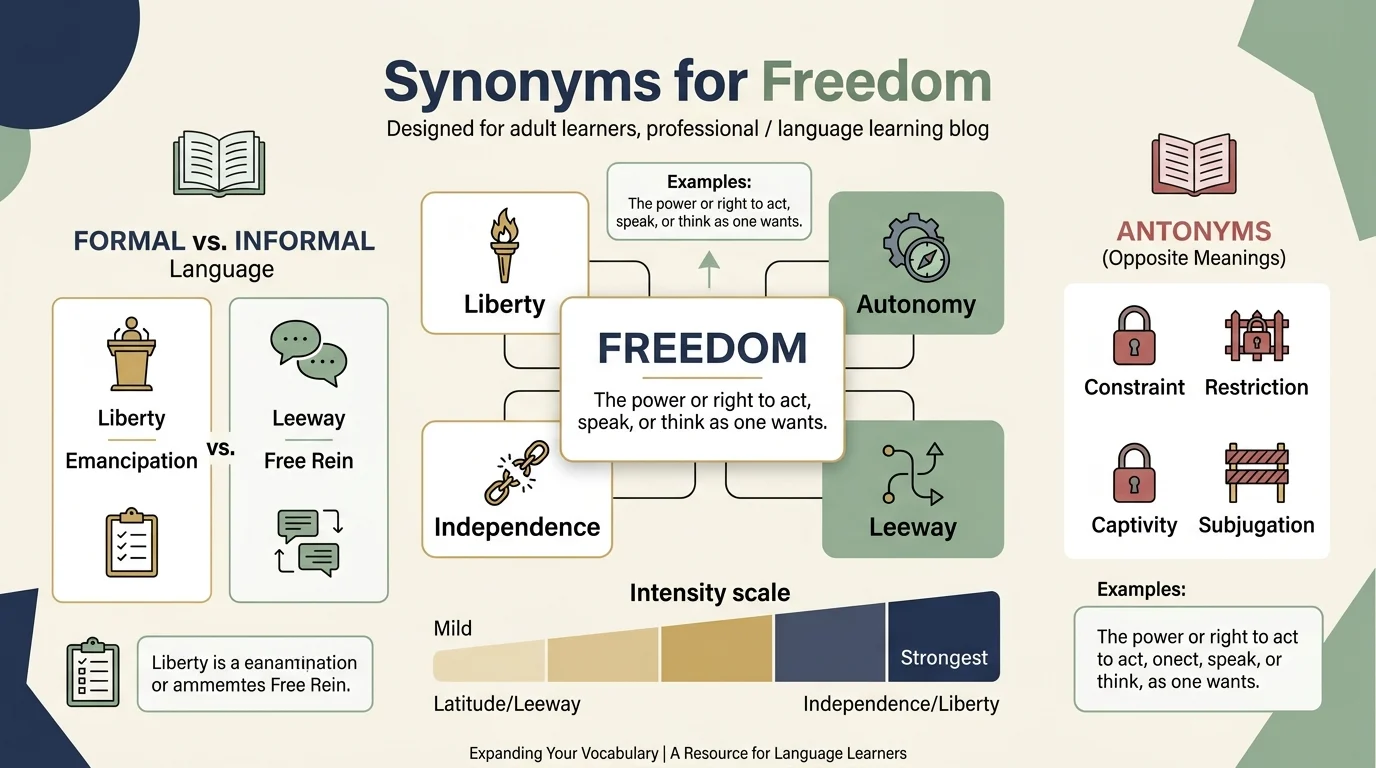
Freedom means the power or right to act, speak, or think without hindrance or restraint. The best synonym depends on context. Use liberty for formal and political contexts, independence for personal or national situations, autonomy for professional and academic settings, and leeway for casual conversations.
Meaning, Tone and Context
- Simple definition: Freedom is the state of being free from external control, constraint, or limitation. It can refer to physical movement, personal choice, political rights, or creative expression.
- Part of speech: Freedom is a noun. The adjective form is “free.” The adverb form is “freely.”
- Tone: Freedom has a positive tone in most contexts. It conveys empowerment, opportunity, and human dignity.
- Formality level: Freedom is versatile. It works in formal speeches, casual conversations, academic papers, and professional documents. The formality shifts based on the synonyms you choose.
- Common use cases: Political discussions about human rights. Personal growth and self expression. Professional autonomy and workplace policies. Creative projects and artistic choices. Social movements and advocacy.
- Important word forms: Freedom (noun), free (adjective), freely (adverb), freer (comparative adjective), freest (superlative adjective).
When and How to Use “Freedom”
Use freedom when you want to express the absence of constraints, restrictions, or obligations. It works best when describing general conditions rather than specific situations. Choose more precise synonyms when you need to specify what type of freedom you mean.
Professional Context
The new policy gives employees more freedom to design their work schedules. This flexibility has boosted team morale significantly.
Personal Context
Moving to a new city gave her the freedom to reinvent herself and explore new career paths without family expectations.
Academic Context
The study examines how economic freedom correlates with democratic governance in developing nations.
Emotional Context
After years of strict parenting, he finally felt the freedom to make his own decisions without fear of judgment.
Creative Context
The artist values the freedom to experiment with unconventional materials and techniques in her studio.
Social Media Caption
Freedom looks like this: sunsets, open roads, and no plans for tomorrow.
Resume Context
Seeking a role that offers creative freedom and the opportunity to lead independent projects from concept to completion.
Another Word for “Freedom”
The best single replacement depends entirely on your context and intended meaning. Here are the top choices for specific situations.
- Professional writing: Autonomy works best when describing self governance or independent decision making in workplace settings.
- Academic writing: Liberty is the preferred term for political philosophy, historical analysis, and legal discussions.
- Casual conversation: Leeway or room are natural choices when discussing flexibility in everyday situations.
- Emotional writing: Emancipation adds dramatic weight when describing personal or social liberation from oppression.
- Creative writing: Unfettered describes freedom as boundless and unrestricted, perfect for poetic or descriptive passages.
- Resume or workplace use: Independence signals self sufficiency and the ability to work without constant supervision.
- Social media captions: Unbound works well for aesthetic, inspirational, or travel related posts.
- Stronger meaning: Sovereignty implies ultimate authority and complete self determination.
- Softer meaning: Breathing room suggests a milder form of freedom that feels like relief from pressure.
When Not to Use “Freedom”
Freedom becomes problematic when you need to be specific about what kind of freedom you mean. The word is too general for many professional and academic contexts.
Mistake Example
“The company offers freedom to its employees.”
Improved Version
“The company offers autonomy to its employees in project selection and work methods.”
When Freedom Sounds Too Vague
Describing political systems requires more precise language. “Civil liberties” is better than “freedom” when discussing constitutional protections.
When Freedom Sounds Too Casual
In legal documents or formal policies, “discretion” or “authorization” are more appropriate than the general term freedom.
When Freedom Sounds Too Emotional
Scientific or technical writing benefits from neutral terms like “flexibility” or “latitude” instead of the emotionally charged freedom.
Words Commonly Confused With “Freedom”
Freedom vs. Liberty
Liberty often refers to specific legal or political rights granted by a government. Freedom is broader and can describe personal, creative, or emotional states. Use liberty in formal political writing. Use freedom in everyday contexts.
Freedom vs. Independence
Independence emphasizes self sufficiency and the absence of external control. Freedom emphasizes the ability to choose without constraints. Independence is more concrete. Freedom is more abstract.
Freedom vs. Autonomy
Autonomy focuses on self governance and independent decision making. Freedom is a broader concept. Autonomy is more precise in professional and academic contexts.
Freedom vs. License
License implies permission granted by an authority. Freedom suggests an inherent right. License carries a more limited and conditional meaning.
Freedom vs. Latitude
Latitude describes flexibility within boundaries or rules. Freedom describes the absence of boundaries. Latitude is more practical and specific.
Freedom vs. Emancipation
Emancipation specifically means liberation from legal, social, or political restrictions. Freedom is a general term. Emancipation carries historical weight and dramatic meaning.
Best Synonym by Context for “Freedom”
| Context | Best Synonym | Why It Works | Example |
|---|---|---|---|
| Formal writing | Liberty | Emphasizes legal and political rights | The constitution guarantees liberty to all citizens |
| Academic writing | Autonomy | Sounds precise and scholarly | The study examines student autonomy in online learning |
| Professional or business use | Discretion | Implies trusted decision making | Managers have discretion over team budgets |
| Resume use | Independence | Signals self sufficiency | Successfully managed projects with complete independence |
| Casual conversation | Leeway | Natural and conversational | Give me some leeway to figure this out |
| Creative writing | Unfettered | Adds poetic imagery | The unfettered imagination of children |
| Emotional tone | Emancipation | Adds dramatic weight | Her journey toward emotional emancipation |
| Strong intensity | Sovereignty | Suggests ultimate authority | Complete sovereignty over personal choices |
| Soft or moderate tone | Breathing room | Sounds gentle and relieved | Finally got some breathing room in my schedule |
| Social media captions | Unbound | Modern and aesthetic | Feel unbound and free to explore |
| US usage | Freedom | Widely used in American English | The American value of freedom |
| UK usage | Liberty | More common in British formal contexts | The British tradition of civil liberty |
Which Synonym Should You Choose?
Start by identifying the type of freedom you want to describe. Political or legal freedom calls for liberty. Personal growth and self reliance require independence.
Consider your audience. Academic readers expect autonomy or self determination. Professional colleagues respond well to discretion and latitude. Casual friends understand leeway and breathing room.
Think about the intensity. Strong situations need sovereignty or emancipation. Mild situations need flexibility or room.
Match the formality level. Formal documents need autonomy, liberty, or sovereignty. Informal writing works with leeway, elbow room, or free rein.
Always test your synonym in the sentence. Read it aloud. Does it sound natural? Does it convey the precise meaning you intend? If something feels off, try another option.
Real Life Examples of “Freedom” in Sentences
School Context
The school encourages intellectual freedom so students can explore controversial topics in their research papers. This approach builds critical thinking skills.
Workplace Context
Our team operates with creative freedom to develop innovative solutions without micromanagement. This trust increases our productivity and job satisfaction.
Writing Context
Writers need the freedom to revise extensively without worrying about deadlines. The best work emerges from this iterative process.
Conversation Context
Having the freedom to choose my own projects makes this job incredibly satisfying. I never feel trapped or limited by someone else’s vision.
Social Media Context
Travel gives me the freedom to disconnect from routine and reconnect with myself. Every destination offers a new perspective.
Resume Context
I excel in positions that offer professional freedom and require independent problem solving without constant oversight.
Email Context
Please give me some freedom to adjust the project timeline based on client feedback. I will keep you updated on major changes.
Storytelling Context
She finally tasted freedom on that open road with no destination in mind. The wind erased all her old worries.
25 Synonyms for “Freedom”
| Synonym | Simple Meaning | Best Used For | Example Sentence |
|---|---|---|---|
| Liberty | Legal and political rights | Formal writing and political discussion | Citizens cherish their liberty and constitutional protections |
| Independence | Self reliance and self governance | Personal growth and national context | The country celebrated its independence from colonial rule |
| Autonomy | Independent decision making | Professional and academic contexts | The department head has autonomy over research funding |
| Sovereignty | Ultimate authority and self rule | Political and philosophical writing | National sovereignty must be respected by international bodies |
| Emancipation | Liberation from oppression | Historical and social justice contexts | The emancipation of enslaved people marked a turning point |
| Latitude | Flexibility within limits | Professional and practical situations | The manager gave us latitude to meet the deadline as we saw fit |
| Leeway | Room to maneuver | Casual conversations | The new policy gives employees leeway in choosing their hours |
| Discretion | Authorized independent choice | Formal workplace decisions | Judges have discretion in sentencing |
| Unfettered | Completely unrestricted | Creative and poetic expression | The artist’s unfettered creativity produced groundbreaking work |
| Unbound | Free from ties or constraints | Modern and emotional contexts | She felt unbound and ready for new adventures |
| License | Permission to act freely | Professional and technical writing | The engineer had license to experiment with new materials |
| Scope | Range of action or thought | Academic and business contexts | The project scope allows considerable flexibility |
| Elbow room | Physical or metaphorical space | Informal and conversational settings | We need more elbow room to implement our ideas |
| Free rein | Full permission to act | Professional and creative situations | The director gave the designers free rein on the project |
| Self determination | Control over one’s life | Political and psychological contexts | The community demanded self determination in local affairs |
| Room | Space for action or thought | Casual everyday situations | Give the team room to make mistakes and learn |
| Flexibility | Ability to adapt or change | Professional and practical contexts | The schedule offers flexibility for remote work |
| Breathing room | Relief from pressure | Personal and emotional situations | The weekend gave me some breathing room from deadlines |
| Free hand | Authority to act as one wishes | Workplace and creative contexts | The editor gave the writer a free hand on the manuscript |
| Exemption | Freedom from an obligation | Legal and formal contexts | The organization received tax exemption for its charitable work |
| Immunity | Protection from a requirement | Legal and formal situations | Diplomatic immunity protects foreign officials from prosecution |
| Release | Freedom from confinement | Personal and emotional contexts | The release from anxiety felt like a new beginning |
| Deliverance | Rescue from difficulty | Religious and dramatic contexts | The survivors experienced deliverance from their situation |
| Franchise | Right to vote or participate | Political and legal contexts | Universal franchise expanded democracy worldwide |
| Impunity | Freedom from punishment | Legal and formal writing | Leaders cannot act with impunity in a democratic society |
Synonym Groups and Usage Differences
Professional vs. Personal Synonyms
Professional synonyms emphasize systems, rights, and structures. Autonomy, discretion, latitude, and scope belong to workplace vocabulary. They sound competent and precise.
Personal synonyms emphasize emotions and experiences. Independence, emancipation, and breathing room describe internal states. They connect with readers on a human level.
Formal vs. Conversational Synonyms
Formal synonyms work in reports, speeches, and essays. Liberty, sovereignty, autonomy, and franchise appear in serious writing. They maintain a respectful and authoritative tone.
Conversational synonyms work in texts, casual emails, and friendly conversations. Leeway, elbow room, and breathing room sound natural and approachable. They build rapport with listeners.
Academic Synonyms
Academic writing rewards precision. Autonomy appears frequently in education research. Sovereignty dominates international relations papers. Liberty features in political philosophy. Self determination drives psychology studies.
Professional and Business Synonyms
Workplace communication benefits from action oriented synonyms. Discretion suggests trustworthy decision making. Latitude implies practical flexibility. Scope defines boundaries clearly. Free hand communicates trust and authority.
Creative or Literary Synonyms
Writers add depth with descriptive alternatives. Unfettered, unbound, and deliverance bring imagery and emotion to prose. These synonyms paint vivid pictures in readers’ minds. They elevate ordinary sentences into memorable passages.
Slang or Modern Synonyms
Modern language offers expressive options. “Free rein” remains popular in workplace contexts. “Elbow room” adds humor to casual situations. “Breathing room” captures emotional relief perfectly. These terms work well in informal writing but stay away from formal documents.
Strongest vs. Weaker Synonyms
Mild: breathing room, elbow room, flexibility, room
Moderate: independence, latitude, leeway, self determination
Strong: emancipation, sovereignty, deliverance, unfettered
Strongest: absolute freedom, complete autonomy, total sovereignty
Emotional vs. Neutral Synonyms
Emotional synonyms carry personal weight. Emancipation evokes struggle and victory. Deliverance suggests rescue and gratitude. Breathing room conveys relief. These words connect with feelings.
Neutral synonyms stay factual. Flexibility, discretion, and latitude describe conditions without emotional charge. They work in objective writing where emotion might distract.
Antonyms of “Freedom”
| Antonym | Meaning | Example Sentence |
|---|---|---|
| Restriction | A limiting condition or rule | The strict restrictions prevented any creative solutions |
| Constraint | A limitation on action | Budget constraints forced the team to reduce the project scope |
| Confinement | The state of being trapped or enclosed | The confinement of the small office space affected employee morale |
| Dependence | Reliance on others for support | Economic dependence limited the country’s policy options |
| Subjugation | Domination by an external power | The subjugation of minority groups sparked international condemnation |
| Captivity | The state of being imprisoned | The animal’s captivity at the zoo drew criticism from activists |
| Obligation | A duty or commitment | Family obligations reduced her freedom to travel |
| Bondage | Servitude or forced labor | Historical accounts documented the horrors of bondage |
| Enslavement | The act of making someone a slave | Modern forms of enslavement continue to exist worldwide |
| Suppression | The act of crushing or putting down | The suppression of free speech violated human rights |
| Servitude | The state of being a servant | The workers lived in conditions of near servitude |
| Submission | The act of yielding to authority | Forced submission to authority stifled innovation |
| Domination | Control over others | Corporate domination of the media limited diverse perspectives |
| Tyranny | Cruel and oppressive government | The citizens revolted against the tyranny of the regime |
| Oppression | Prolonged cruel treatment | The oppression of workers led to widespread protests |
Comparison: Freedom vs. Similar Words
Freedom vs. Liberty
Main difference: Freedom is broader and more personal. Liberty is more political and legal. Liberty often refers to specific constitutional rights. Freedom describes general personal states.
Which one is stronger: Both are equally strong but in different domains. Liberty carries constitutional weight. Freedom carries personal weight.
Which one is more formal: Liberty is more formal and appears in legal and political documents. Freedom works in all contexts.
Example with freedom: She valued the freedom to express her opinions openly.
Example with liberty: The constitution protects the liberty of every citizen.
Freedom vs. Independence
Main difference: Independence emphasizes self sufficiency. Freedom emphasizes lack of constraints. Independence is measurable. Freedom is more abstract.
Which one is stronger: Independence often feels stronger because it implies capability and self reliance.
Which one is more formal: Both work in formal contexts. Independence sounds more concrete. Freedom sounds more aspirational.
Example with freedom: The artist explored freedom through abstract expressionism.
Example with independence: The nation declared independence after years of struggle.
Freedom vs. Autonomy
Main difference: Autonomy focuses on self governance. Freedom is more general. Autonomy is specific to decision making authority.
Which one is stronger: Autonomy sounds more professional and precise. Freedom sounds more emotional.
Which one is more formal: Autonomy is significantly more formal and academic.
Example with freedom: She finally found freedom from her family’s expectations.
Example with autonomy: The professor has autonomy over the course curriculum.
Freedom vs. Latitude
Main difference: Latitude means flexibility within boundaries. Freedom means absence of boundaries. Latitude is more realistic in professional settings.
Which one is stronger: Freedom is stronger because it suggests no limits. Latitude acknowledges existing constraints.
Which one is more formal: Latitude is slightly more formal in business writing.
Example with freedom: The promotion gave him freedom to run the department.
Example with latitude: The manager gave the team latitude to adjust their work hours.
Freedom vs. Discretion
Main difference: Discretion means authorized choice. Freedom means unrestricted choice. Discretion implies trust. Freedom implies inherent right.
Which one is stronger: Freedom is stronger. Discretion exists within boundaries.
Which one is more formal: Discretion is more formal and appears in policy documents.
Example with freedom: Employees have the freedom to decorate their workspaces.
Example with discretion: The supervisor used discretion in enforcing the attendance policy.
Freedom vs. Emancipation
Main difference: Emancipation means liberation from specific oppression. Freedom is general. Emancipation has historical and legal weight.
Which one is stronger: Emancipation is much stronger and more dramatic.
Which one is more formal: Emancipation is formal and carries historical significance.
Example with freedom: The retreat offered freedom from daily stress.
Example with emancipation: The abolition movement sought emancipation from slavery.
Common Phrases and Expressions with “Freedom”
1. Freedom of speech
Meaning: The right to express opinions without censorship or restraint. This is a fundamental democratic right.
Example sentence: Freedom of speech is protected by the First Amendment to the United States Constitution.
2. Freedom of choice
Meaning: The right to make decisions about one’s own life without external interference.
Example sentence: Consumers demand freedom of choice in selecting their healthcare providers.
3. Freedom from fear
Meaning: The state of living without anxiety about threats or danger.
Example sentence: The new safety measures provided freedom from fear for the community.
4. Freedom to roam
Meaning: The right to move about without restrictions or permission.
Example sentence: National parks offer freedom to roam through unspoiled wilderness.
5. Freedom of expression
Meaning: The right to share thoughts and feelings through creative works or public statements.
Example sentence: The festival celebrates freedom of expression through visual art and music.
6. Freedom of movement
Meaning: The right to travel and relocate without government restrictions.
Example sentence: The European Union guarantees freedom of movement for all citizens.
7. Freedom to choose
Meaning: The right to make personal decisions without coercion.
Example sentence: Parents want the freedom to choose their children’s education.
8. Freedom of thought
Meaning: The right to hold beliefs without government interference.
Example sentence: Freedom of thought is essential for intellectual development.
Common Mistakes to Avoid
1. Using freedom when a more precise synonym is better
Your writing improves when you specify the type of freedom. Instead of “freedom in the workplace,” use “autonomy,” “discretion,” or “flexibility.” Each word communicates a different aspect of professional freedom.
2. Confusing freedom with license
License implies permission granted by someone in authority. Freedom suggests an inherent right. Using license when you mean freedom creates a condescending tone. Use freedom to emphasize rights. Use license to discuss permissions.
3. Using casual synonyms in formal writing
Leeway, elbow room, and breathing room are excellent in conversations. They weaken formal documents. Choose autonomy, discretion, or liberty for professional and academic writing. Match the formality to your audience.
4. Using overly dramatic synonyms for simple situations
Emancipation and deliverance carry heavy historical weight. Using them for everyday decisions sounds exaggerated and insincere. Save these powerful words for genuine liberation narratives.
5. Repeating the same word too often
Paragraphs filled with freedom sound repetitive. Rotate between synonyms to maintain reader interest. Use liberty, autonomy, and independence to create variety while preserving meaning.
6. Choosing a synonym with the wrong emotional tone
Freedom feels warm and hopeful. Sovereignty feels strong and authoritative. Emancipation feels triumphant and dramatic. Pick the emotion that matches your message. Mismatched tone confuses readers.
7. Using slang in academic or professional writing
Slang synonyms like “breathing room” and “elbow room” destroy credibility in formal contexts. Academic readers expect autonomy and liberty. Professional readers respect discretion and latitude. Save casual terms for appropriate settings.
FAQs
1. What is the best synonym for freedom?
The best synonym depends on context. Liberty works for formal writing. Autonomy fits professional contexts. Independence suits personal growth. Leeway works for casual conversations.
2. What is a formal synonym for freedom?
Liberty is the most formal synonym. Autonomy and sovereignty also appear in academic and political writing. Discretion works in legal and professional contexts.
3. What is an informal synonym for freedom?
Leeway, elbow room, and breathing room are informal choices. Free rein also works in casual professional settings. These words sound natural in everyday conversations.
4. What is another word for freedom in professional writing?
Autonomy is the professional choice. Discretion and latitude also work well. These words emphasize trusted decision making and practical flexibility.
5. What is the difference between freedom and liberty?
Freedom is broader and more personal. Liberty is more political and legal. Use freedom for everyday situations. Use liberty for constitutional and governmental contexts.
6. What is the opposite of freedom?
Restriction is a direct opposite. Constraint, confinement, and dependence also contrast with freedom. Oppression and subjugation represent severe forms of unfreedom.
Conclusion
Freedom means the power to act without restraint. This simple definition expands into dozens of nuanced synonyms. Liberty suits formal writing. Independence fits personal growth. Autonomy belongs in professional contexts. Leeway works in casual conversations.
Your word choice changes how readers understand your message. Formal settings require precise terms like discretion and sovereignty. Informal situations welcome breathing room and elbow room. Matching the synonym to the situation shows language mastery.
Build your vocabulary by using different synonyms in your daily writing. Challenge yourself to avoid repeating freedom. Each alternative adds depth and precision to your communication. The right synonym transforms ordinary writing into memorable, effective content.
Remember to verify definitions in trusted dictionaries such as Cambridge, Oxford, Merriam Webster, Collins, or Britannica before publishing. Accurate word choice demonstrates professionalism and builds reader trust.