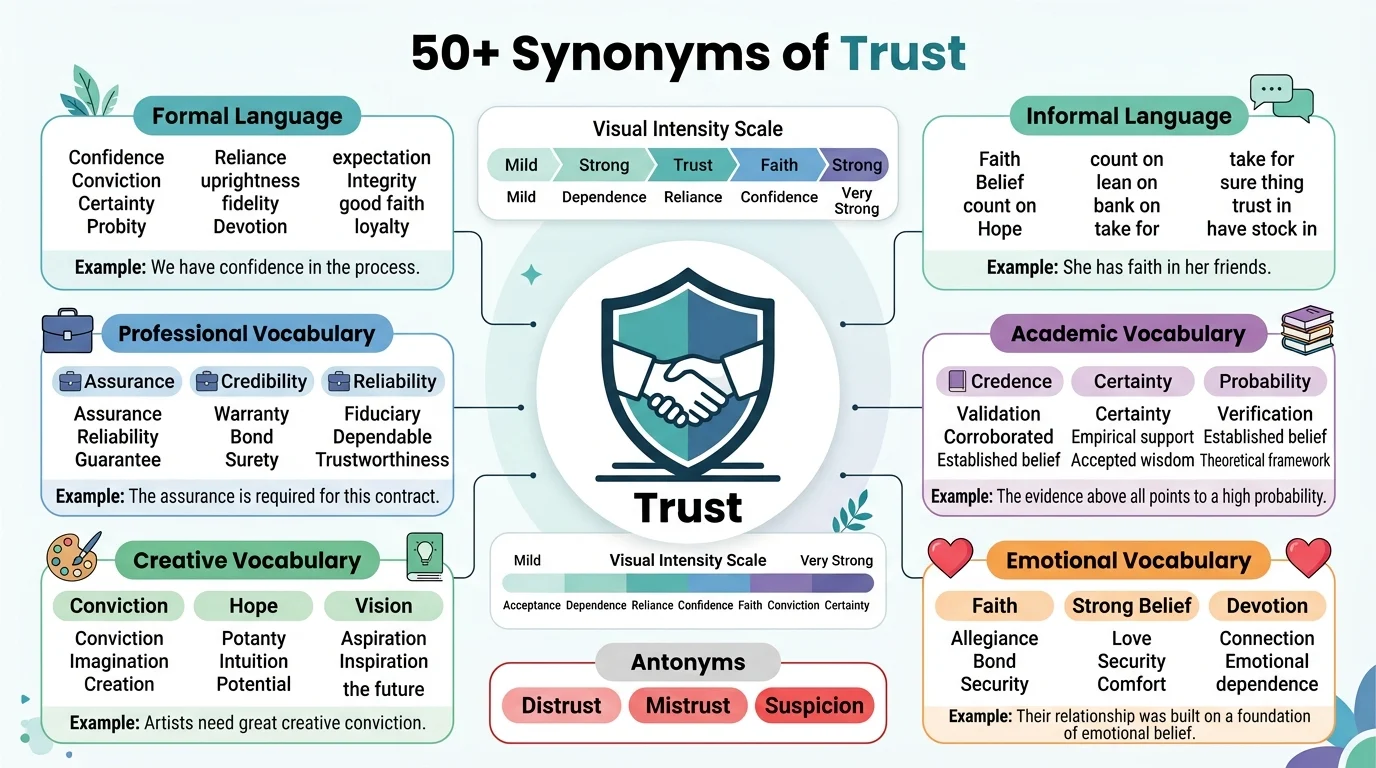
Have you ever found yourself writing an email, essay, or social media caption and using the word “trust” over and over again? It happens to everyone. You want to express confidence, belief, or reliance on someone, but the same word keeps appearing in every sentence. This repetition makes your writing sound dull and less professional.
The good news is that English offers many powerful synonyms of trust that can transform your communication. Choosing the right synonym helps you say exactly what you mean with clarity and impact. Whether you are writing a business proposal, a college essay, a personal message, or a blog post, the right word makes all the difference.
Understanding the subtle differences between synonyms of trust allows you to match your tone to your audience. A lawyer speaking in court chooses different language than a friend giving advice. A resume requires professional vocabulary while a creative story welcomes emotional depth. This guide will help you master the art of choosing the perfect word for every situation.
What Are the Best Synonyms of “Trust”?
Trust means having confidence in the reliability, truth, or strength of someone or something. It conveys a sense of security and belief. The best formal synonyms include confidence, reliance, and assurance. For casual conversation, try faith, belief, or credit. Professional writing often uses confidence and reliance. Emotional writing benefits from faith and conviction. Creative writing welcomes confidence and certainty.
Meaning, Tone, and Context
Simple Definition
Trust is the firm belief in the reliability, truth, ability, or strength of someone or something. It represents a confident expectation that a person or thing will act appropriately.
Part of Speech
Trust functions as both a noun and a verb. As a noun, it describes the feeling of confidence or belief. As a verb, it describes the action of believing in or relying on someone or something.
Overall Tone
Trust has a strongly positive tone. It implies safety, security, and dependability. The word carries warmth and creates a sense of connection between people.
Formality Level
Trust is neutral in formality. It works comfortably in both casual conversations and professional settings. This versatility makes it one of the most commonly used English words.
Common Uses
Native English speakers use trust in countless situations. Trust friends with secrets. They trust professionals like doctors and lawyers. They trust institutions like banks and governments. Trust products, processes, and even their own judgment. The word appears in daily conversation, business communication, academic writing, and creative expression.
Word Forms
- Noun: trust
- Verb: trust, trusts, trusted, trusting
- Adjective: trustworthy, trusting, trustful, trusty
- Adverb: trustingly
- Opposite form: distrust, mistrust
When and How to Use “Trust”
Choose trust when you want to express a general sense of confidence or belief in someone or something. It works well when no specific intensity or formality is required. Trust is your default word for everyday situations.
Here are seven realistic examples showing how to use trust naturally.
Professional
“The board placed their trust in the new CEO to turn the company around.”
Academic
“Researchers must trust that their methodology will produce reliable results.”
Workplace
“I trust my team to handle this project independently.”
Personal
“She learned to trust her instincts when making difficult decisions.”
“Thank you for your continued trust in our services.”
Resume
“Built trust with clients through consistent, transparent communication.”
Social Media
“Trust yourself. You know more than you think you do.”
Best Synonyms of “Trust”
No two synonyms are exactly identical. Each word carries its own shade of meaning, emotional weight, and level of formality. The best synonym depends entirely on your situation, audience, and purpose.
Professional Writing
Confidence works best in professional contexts. It suggests a strong belief based on evidence and experience. Colleagues and clients respond well to this word because it sounds capable and assured.
Academic Writing
Reliance fits academic work well. It implies a dependence on something that has proven itself reliable. Research papers and scholarly articles benefit from this precise term.
Business Communication
Confidence remains the top choice for business settings. It projects professionalism and certainty. Partners and stakeholders appreciate this word in proposals and presentations.
Casual Conversation
Faith sounds natural in everyday talk. It carries emotional warmth and personal connection. Friends and family understand this word easily.
Emotional Writing
Faith conveys deep emotional commitment. It suggests trust that goes beyond evidence. Personal letters and reflective writing benefit from this word.
Creative Writing
Certainty adds power to creative work. It creates strong imagery and decisive tone. Fiction writers use this word to show character conviction.
Resume Writing
Reliability showcases dependability effectively. Employers want to see this quality highlighted. Use it to describe your work ethic and professional relationships.
Workplace Communication
Reliance describes workplace interdependence well. It shows that colleagues count on each other. Team settings benefit from this collaborative word.
Stronger Meaning
Conviction delivers the strongest impact. It suggests unshakeable belief. Use this when you need to express absolute certainty.
Softer Meaning
Confidence offers a gentler approach. It suggests belief without pressure. This works well in sensitive situations.
When Not to Use “Trust”
Sometimes trust is not the best word choice. Recognizing these situations will improve your writing significantly.
When the Word Sounds Too General
Trust can feel vague when you need precision. In a courtroom, lawyers do not simply say they trust evidence. They use more specific language like rely upon or have confidence in.
Weak: “We trust the data from this study.”
Better: “We rely upon the data from this study because it has been peer-reviewed.”
The stronger version explains why the data deserves confidence, making the statement more persuasive.
When the Word Sounds Too Vague
Trust sometimes lacks the specificity required in technical or legal writing. You need words that describe exactly what kind of confidence you have.
Weak: “The engineer trusts the bridge design.”
Better: “The engineer has confidence in the bridge design based on structural analysis.”
The improved version adds the reasoning behind the confidence, creating a more complete statement.
When the Word Feels Too Formal
Trust is neutral, but sometimes you want a warmer, more personal word. In intimate conversations, faith or belief might feel more appropriate.
Weak: “I trust you completely.”
Better: “I have complete faith in you.”
The second version sounds more personal and emotionally connected.
When the Word Feels Too Informal
Trust works in most situations, but formal documents sometimes need more authoritative language. Legal contracts and official statements benefit from words like assurance or reliance.
Weak: “The company trusts its suppliers.”
Better: “The company has full assurance that its suppliers will meet delivery deadlines.”
The formal version sounds more professional and legally appropriate.
When the Word Sounds Too Weak
Sometimes you need to express absolute certainty, and trust does not provide enough emphasis.
Weak: “I trust this is the right decision.”
Better: “I have absolute conviction that this is the right decision.”
The stronger version shows unshakeable belief.
When the Word Sounds Outdated
Trust remains modern and relevant. No outdated usage issues exist with this word.
Words Commonly Confused With “Trust”
Trust vs Confidence
Confidence emphasizes certainty and self-assurance. Trust focuses on reliability and dependability of others. Use confidence when talking about your own abilities or general certainty. Use trust when talking about belief in others.
Example of trust: “She trusts her doctor completely.”
Example of confidence: “She has confidence in her recovery.”
Trust vs Faith
Faith carries stronger emotional and sometimes spiritual meaning. It suggests belief without needing proof. Trust can be based on evidence. Use faith for personal, emotional, or spiritual contexts. Use trust for practical, professional, or everyday situations.
Example of trust: “I trust this software will work correctly.”
Example of faith: “I have faith that everything will work out.”
Trust vs Reliance
Reliance emphasizes dependence and need. Trust emphasizes belief and confidence. Use reliance when someone depends on another person or thing. Use trust when you simply believe in someone or something.
Example of trust: “I trust my coworker to be honest.”
Example of reliance: “Our team relies on this equipment to do our jobs.”
Trust vs Conviction
Conviction suggests strong, firm belief that does not waver. Trust suggests a more general confidence. Use conviction for deeply held beliefs. Use trust for everyday confidence.
Example of trust: “I trust the system.”
Example of conviction: “She has a deep conviction that justice will prevail.”
Trust vs Certainty
Certainty leaves no room for doubt. Trust allows for some uncertainty but still involves belief. Use certainty when facts are clear. Use trust when belief exists despite unknowns.
Example of trust: “I trust you will make the right call.”
Example of certainty: “I am certain this equation is correct.”
Trust vs Assurance
Assurance suggests giving confidence to someone else. Trust describes the confidence itself. Use assurance when you want to emphasize giving confidence. Use trust when you want to emphasize having confidence.
Example of trust: “He trusts his team.”
Example of assurance: “The contract gave them assurance of payment.”
Best Synonyms of “Trust” by Context
| Context | Best Synonym | Why It Works | Example |
|---|---|---|---|
| Formal writing | Confidence | Sounds authoritative and professional | “The committee has confidence in the findings.” |
| Academic writing | Reliance | Suggests dependence on proven sources | “This conclusion relies upon peer-reviewed research.” |
| Professional communication | Confidence | Projects assurance and competence | “We have confidence in our strategic plan.” |
| Business emails | Confidence | Maintains professional tone | “I have confidence in your ability to lead this project.” |
| Resume writing | Reliability | Highlights dependability | “Known for reliability in meeting tight deadlines.” |
| Workplace communication | Reliance | Describes team interdependence | “Team members rely on each other for success.” |
| Casual conversation | Faith | Feels warm and personal | “I have faith in you.” |
| Everyday speaking | Trust | Neutral and universal | “I trust you.” |
| Creative writing | Certainty | Creates decisive imagery | “She knew with certainty that her choice was right.” |
| Storytelling | Conviction | Shows strong character belief | “His conviction never wavered.” |
| Emotional writing | Faith | Expresses deep feeling | “She held onto faith through difficult times.” |
| Strong emphasis | Conviction | Delivers maximum intensity | “I have complete conviction in this approach.” |
| Mild tone | Trust | Gentle and accessible | “I trust the process.” |
| Social media captions | Trust | Short and relatable | “Trust your journey.” |
| American English | Trust | Widely used across all contexts | “I trust my neighbor.” |
How to Choose the Best Synonym of “Trust”
Choosing the right synonym requires considering several factors. Your audience matters most. A formal business presentation requires different vocabulary than a text message to a friend.
Think about your purpose. Are you trying to sound professional, warm, authoritative, or creative? Each synonym carries its own tone. Confidence sounds professional. Faith sounds warm. Reliance sounds practical. Conviction sounds powerful.
Consider the emotional intensity you want to convey. Mild situations call for trust or confidence. Strong emotions call for conviction or certainty. Match your word to your feeling.
Pay attention to natural usage. Does the word sound right in context? Read your sentence aloud. If it sounds awkward, try a different synonym. Natural speech patterns guide you toward the best choice.
Ask yourself what you truly mean. Are you expressing belief in someone’s character? Use trust or faith. Are you expressing dependence on something? Use reliance. Are you expressing certainty about an outcome? Use confidence or conviction.
Real Life Examples of “Trust”
School
“The students trust their teacher to explain difficult concepts clearly.”
College
“The research team trusted their methodology to produce accurate results.”
Workplace
“Managers need to trust their employees to complete assignments independently.”
Business
“Customer trust is essential for long term business success.”
“I trust your judgment on this matter and look forward to your recommendations.”
Resume
“Developed trust with stakeholders through transparent reporting and consistent results.”
Conversation
“I trust you completely. You have never let me down.”
Storytelling
“She had trusted him with her deepest secret, and he had honored that trust.”
Blogging
“Building trust with your readers takes time and consistent authenticity.”
Social Media
“Trust the timing of your life. Everything happens when it should.”
Improved Examples
Original: “The organization trusts its volunteers to represent its values.”
Improved: “The organization has confidence in its volunteers to represent its values authentically.”
Original: “I trust this will be successful.”
Improved: “I have conviction that this will be successful.”
Original: “We trust the new system.”
Improved: “We have full reliance on the new system based on thorough testing.”
18 Best Synonyms of “Trust”
| Synonym | Simple Meaning | Best Used For | Example Sentence |
|---|---|---|---|
| Confidence | Strong belief in ability or outcome | Professional and business contexts | “The team has confidence in their new product launch.” |
| Faith | Deep belief without proof | Personal and emotional situations | “She has faith in her children’s future.” |
| Reliance | Dependence on someone or something | Practical and professional contexts | “The project relies on accurate data.” |
| Conviction | Strong unshakeable belief | Powerful emotional statements | “He spoke with conviction about his vision.” |
| Certainty | Complete absence of doubt | Decisive situations | “She knows with certainty that she made the right choice.” |
| Assurance | Promise or guarantee | Legal and formal documents | “The contract provides assurance of payment.” |
| Credence | Belief or acceptance as true | Intellectual or academic contexts | “The theory gained credence among researchers.” |
| Dependence | State of relying on someone | Describing reliance relationships | “Their dependence on technology is significant.” |
| Belief | Acceptance that something exists or is true | General use in all contexts | “His belief in honest business practices is well known.” |
| Expectation | Belief that something will happen | Future oriented contexts | “The company has expectations of continued growth.” |
| Hope | Desire combined with belief | Emotional and future contexts | “She holds hope for a better outcome.” |
| Credibility | Quality of being trusted | Professional reputation | “The journalist’s credibility is unquestionable.” |
| Reliability | Consistency and dependability | Professional evaluations | “His reliability makes him a valuable team member.” |
| Stability | Steady and dependable nature | Describing systems or situations | “The stable economy encourages investment.” |
| Sufficiency | Adequate or enough | Resource related contexts | “The plan has sufficiency of resources.” |
| Strong belief | Powerful conviction | Emphasis and intensity | “Her strong belief drives her advocacy work.” |
| Firm reliance | Solid dependable trust | Formal business contexts | “The board has firm reliance on the executive team.” |
| Absolute confidence | Complete trust without doubt | Maximum emphasis | “The pilot has absolute confidence in the aircraft.” |
Synonyms of “Trust” by Usage
Professional vs Personal Synonyms
Professional settings benefit from confidence, reliance, and assurance. These words sound businesslike and appropriate for workplace communication. They project competence and authority.
Personal contexts welcome faith, belief, and hope. These words sound warm and emotionally connected. They build relationships and show genuine feeling.
Professional recommendation: “I have confidence in your ability to deliver this presentation.”
Personal recommendation: “I have faith in you to succeed.”
Formal vs Conversational Synonyms
Formal writing demands precise vocabulary. Confidence, reliance, assurance, and credence fit academic papers, reports, and legal documents. These words show attention to language and professional polish.
Conversational speech allows simpler words. Trust, faith, belief, and hope flow naturally in everyday talk. They require no explanation and feel comfortable.
Formal example: “The committee places credence in the witness testimony.”
Conversational example: “I trust what he said.”
Academic Synonyms
Academic contexts require precise and authoritative vocabulary. Reliance describes methodological dependence. Credence describes acceptance of theories. Certainty describes confidence in conclusions.
These words sound scholarly and appropriate for research papers, dissertations, and peer-reviewed publications. They show familiarity with academic vocabulary.
Academic recommendation: “Researchers place reliance upon established methodologies.”
Professional and Business Synonyms
Business communication benefits from confidence and assurance. These words sound capable and reliable. Resumes should include reliability, dependability, and trustworthiness.
Resume recommendation: “Demonstrated reliability in managing complex projects.”
Creative and Literary Synonyms
Creative writing welcomes words like conviction and certainty. They add power and imagery. Storytellers use these words to show character strength and resolve.
Creative recommendation: “She faced her fears with unwavering conviction.”
Slang or Modern Synonyms
No widely used slang alternatives exist for trust. The word is too fundamental to require informal replacements. However, “buy” appears in casual contexts like “I don’t buy his story.”
Strongest to Mildest Synonyms
Mild
- Belief
- Expectation
- Hope
Moderate
- Trust
- Confidence
- Reliance
Strong
- Faith
- Assurance
- Credence
Very Strong
- Conviction
- Certainty
- Absolute confidence
Emotional vs Neutral Synonyms
Emotional synonyms express deep feeling. Faith carries warmth and personal connection. Conviction shows passionate belief. Hope suggests desire combined with trust.
Neutral synonyms simply communicate information. Confidence states belief without emotion. Reliance describes dependence objectively. Assurance provides factual guarantee.
Emotional use: “I have faith in your goodness.”
Neutral use: “The statistics give us confidence.”
Antonyms of “Trust”
| Antonym | Meaning | Example Sentence |
|---|---|---|
| Distrust | Lack of trust | “She felt distrust toward the salesperson.” |
| Mistrust | Suspicion or doubt | “His experiences created mistrust of authorities.” |
| Doubt | Uncertainty about truth | “I doubt his explanation.” |
| Suspicion | Belief without proof | “Suspicion fell on the new employee.” |
| Skepticism | Questioning attitude | “Scientists approach claims with skepticism.” |
| Disbelief | Refusal to accept truth | “Her story met with disbelief.” |
| Uncertainty | Lack of confidence | “Uncertainty clouded their decision.” |
| Insecurity | Lack of confidence in safety | “His insecurity prevented him from speaking up.” |
| Apprehension | Fear of something bad | “Apprehension filled the room.” |
| Wariness | Cautiousness about danger | “She approached the deal with wariness.” |
| Misgiving | Feeling of doubt | “He had misgivings about the proposal.” |
| Treachery | Betrayal of trust | “His treachery ended their friendship.” |
| Betrayal | Violation of trust | “The betrayal hurt her deeply.” |
| Disloyalty | Lack of loyalty | “His disloyalty cost him his job.” |
| Deception | Misleading or lying | “The deception damaged their relationship.” |
Comparison: “Trust” vs Similar Words
Trust vs Confidence
Main Difference: Trust focuses on belief in others. Confidence focuses on certainty in abilities or outcomes.
Which Is Stronger: Confidence often feels more decisive and assured.
Which Is More Formal: Both are neutral, but confidence appears more frequently in business writing.
When to Use Each: Use trust when believing in people. Use confidence when feeling certain about outcomes.
Examples:
Trust: “The board trusts the management team.”
Confidence: “The board has confidence in the management team’s strategy.”
Trust vs Faith
Main Difference: Faith suggests belief without evidence. Trust can be based on evidence and experience.
Which Is Stronger: Faith carries deeper emotional and sometimes spiritual meaning.
Which Is More Formal: Trust is more formal. Faith feels personal and informal.
When to Use Each: Use trust in professional contexts. Use faith in personal or emotional contexts.
Examples:
Trust: “I trust this product based on reviews.”
Faith: “I have faith that this product will work.”
Trust vs Reliance
Main Difference: Reliance emphasizes dependence. Trust emphasizes belief.
Which Is Stronger: Reliance suggests stronger practical need.
Which Is More Formal: Reliance sounds more formal and technical.
When to Use Each: Use reliance when describing dependence. Use trust when describing belief.
Examples:
Trust: “I trust my coworker’s advice.”
Reliance: “I rely on my coworker’s advice.”
Trust vs Conviction
Main Difference: Conviction suggests unshakeable belief. Trust allows for some uncertainty.
Which Is Stronger: Conviction is much stronger and more intense.
Which Is More Formal: Both work formally, but conviction feels more powerful.
When to Use Each: Use trust in everyday situations. Use conviction when expressing deep certainty.
Examples:
Trust: “I trust the system will work.”
Conviction: “I have a deep conviction that this system is right.”
Trust vs Certainty
Main Difference: Certainty means no doubt exists. Trust means you believe despite possible doubt.
Which Is Stronger: Certainty is absolute and stronger.
Which Is More Formal: Certainty appears more often in academic and legal writing.
When to Use Each: Use trust when belief exists alongside some uncertainty. Use certainty when facts leave no doubt.
Examples:
Trust: “I trust the weather forecast.”
Certainty: “I am certain it will rain tomorrow.”
Trust vs Assurance
Main Difference: Trust describes internal belief. Assurance describes external guarantee.
Which Is Stronger: Assurance feels more concrete and reliable.
Which Is More Formal: Assurance is more formal and businesslike.
When to Use Each: Use trust for personal belief. Use assurance for formal guarantees.
Examples:
Trust: “I trust my insurance provider.”
Assurance: “My insurance provider gave me assurance of coverage.”
Common Phrases and Expressions with “Trust”
Trust in
Meaning: Having confidence in someone or something.
Example Sentence: “She has trust in her financial advisor.”
Trust someone with
Meaning: Confiding in someone or giving them responsibility.
Example Sentence: “I trust my sister with my deepest secrets.”
Trust the process
Meaning: Believing that things will work out.
Example Sentence: “Even when results are slow, you need to trust the process.”
Earn someone’s trust
Meaning: Gaining confidence through behavior.
Example Sentence: “He worked hard to earn his manager’s trust.”
Break someone’s trust
Meaning: Damaging confidence through betrayal.
Example Sentence: “Lying to a friend breaks their trust.”
Trust your gut
Meaning: Relying on instinct or intuition.
Example Sentence: “When you are unsure, trust your gut.”
Blind trust
Meaning: Confidence without evidence or caution.
Example Sentence: “Blind trust can lead to disappointment.”
Trust fund
Meaning: Money managed for someone.
Example Sentence: “She uses her trust fund for education.”
Common Mistakes to Avoid
Mistake 1: Choosing a Vague Synonym Instead of a Precise One
Using “trust” when a more specific word exists weakens your writing. “Reliance” describes dependence better. “Confidence” describes certainty better. “Assurance” describes guarantees better. Choose the word that matches your exact meaning.
Incorrect: “We have trust in the software.”
Better: “We have confidence in the software’s capabilities.”
Mistake 2: Confusing “Trust” with “Belief”
Trust involves confidence in people or things. Belief involves accepting something as true. They overlap but are not identical.
Incorrect: “I trust in climate change.”
Better: “I believe in the reality of climate change.”
Mistake 3: Using an Informal Synonym in Formal Writing
“Faith” sounds too personal for a business report. “Confidence” works better in professional documents.
Incorrect: “The board has faith in the new policy.”
Better: “The board has confidence in the new policy.”
Mistake 4: Selecting an Overly Dramatic Synonym
“Conviction” carries strong emotion. Using it casually sounds melodramatic.
Incorrect: “I have conviction about this sandwich.”
Better: “I am confident this sandwich is good.”
Mistake 5: Repeating the Same Word Too Often
Variety improves writing. Instead of using “trust” four times in one paragraph, use “confidence,” “reliance,” and “assurance” as well.
Incorrect: “I trust the team. I trust the plan. I trust the results.”
Better: “I trust the team. I have confidence in the plan. I rely on the results.”
Mistake 6: Choosing a Synonym with the Wrong Emotional Tone
Emotional words like “faith” and “conviction” do not belong in technical writing. Use neutral words like “reliance” and “assurance” instead.
Incorrect: “The scientist has faith in her hypothesis.”
Better: “The scientist has reliance upon her hypothesis.”
Mistake 7: Using “Trust” When Action Is Needed
Sometimes you should replace “trust” with an active verb. “Trust” describes a feeling. “Count on” describes an action.
Incorrect: “We trust the supplier to deliver.”
Better: “We count on the supplier to deliver.”
Frequently Asked Questions
1. What are the best synonyms of trust?
The best synonyms of trust depend on your context. Professional writing, use confidence. For personal situations, use faith. For academic work, use reliance. Emotional emphasis, use conviction. Each synonym serves a specific purpose.
2. What are the best formal synonyms of trust?
The best formal synonyms of trust include confidence, reliance, assurance, and credence. These words sound professional and appropriate for business reports, academic papers, legal documents, and official correspondence.
3. What are common informal synonyms of trust?
Common informal synonyms of trust include faith, belief, and hope. These words feel warm and personal. They work well in conversations, personal messages, and emotional writing where a friendly tone is preferred.
4. What is another word for trust in professional writing?
In professional writing, confidence is the most effective alternative to trust. It projects assurance and competence. Reliance works well when describing dependence. Assurance fits when discussing guarantees or promises.
5. What is the difference between trust and confidence?
Trust focuses on belief in the reliability of someone or something. Confidence focuses on certainty in abilities or outcomes. Trust emphasizes the object of belief. Confidence emphasizes the feeling of certainty itself.
6. What is the opposite of trust?
The opposite of trust includes distrust, mistrust, doubt, suspicion, skepticism, and disbelief. These words all express a lack of confidence or belief in someone or something. Choose based on the specific shade of meaning you need.
Conclusion
Trust is a fundamental word that expresses confidence in the reliability, truth, or ability of someone or something. It serves as a versatile and neutral choice in countless situations. However, mastering the synonyms of trust will elevate your writing and communication skills significantly.
Confidence works best in professional settings. Faith shines in personal and emotional contexts. Reliance fits academic and practical situations. Conviction delivers powerful emphasis. Each synonym offers unique value for different audiences and purposes.
Remember that no synonym works perfectly in every situation. The best choice depends on your meaning, tone, audience, and emotional intensity. Think carefully about what you want to communicate. Choose the word that expresses your message most clearly.
A practical tip for improving your vocabulary: when you write the word “trust,” pause and ask yourself if a more precise word would communicate your meaning better. This habit will make your writing stronger and more effective over time.